
Information about Iraq in French
Iraqi Jewish Archive (NARA) — transcription judeoiraq.org · אַרײַנגעלייגט דעם 24טן אויגוסט 2026 · רעגיסטער איבערשנײַד · באַהיטער, נישט באַזיצער
פֿאַרבונדענע ענינים
❧ באַשרײַבונג
אָנקוקן אויף דער אינטערנעץ
דער דאָזיקער אָביעקט איז אײַנגעגעבן געוואָרן ווי אַ לינק: מען קוקט אים אָן אויף דער וועבזײַט וואָס האַלט אים.
- judeoiraq.org/documents/19c1ce94-4413-4272-8db0-af6b4af85bb4
- ijarchive.org/s/iraqi-jewish-archive/item/1502
די אַדרעס איז געגעבן געוואָרן פֿונעם אײַנגעבער. דער דאָזיקער אינהאַלט ווערט נישט געהאַלטן דאָ, און זײַן צוטריטלעכקייט הענגט נישט אָפּ פֿון אונדז.
אילוסטראַציעס
מקור-טעקסט
### csp_034178112f245eab8ab307585acea2f6
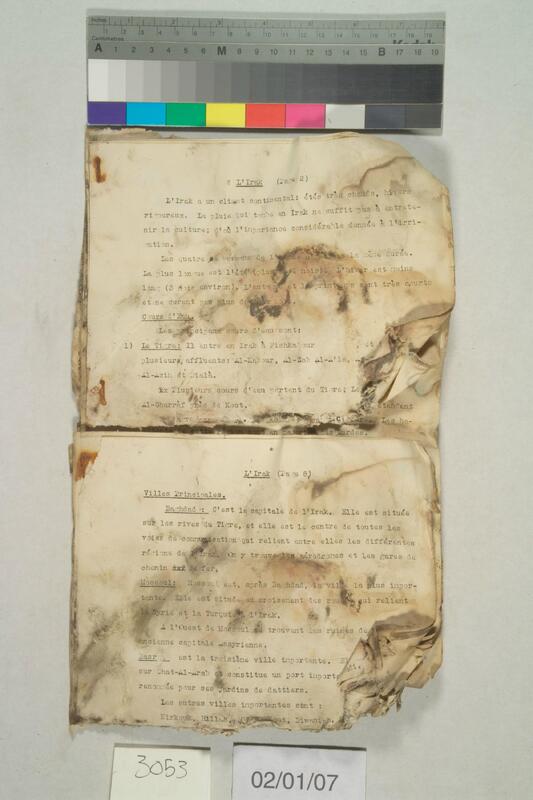
L'Irak (Page 2)
L'Irak a un climat continental: étés très chauds, hivers rigoureux. La pluie qui tombe en Irak ne suffit pas à entrete- nir la culture; d'où l'importance considérable donnée à l'irri- gation.
Les quatre ⟦de⟧ s⟦ai⟧sons de l'année n'ont pas la même durée. La plus longue est l'été (plus de 4 mois). L'hiver est moins long (3 mois environ). L'automne et le printemps sont très courts et ne durent pas plus de ⟦deux⟧ mois.
Cours d'Eau.
Les principaux cours d'eau sont:
1) Le Tigre: Il entre en Irak à Fishkabour , et il reçoit plusieurs affluents: Al-Kabour, Al-Zab Al-A'la, Az-Zab Al-Asfal, Al-Azim et Dialà. ⟦Ex⟧ Plusieurs cours d'eau partent du Tigre; Le principal est Al-Gharraf près de Kout. ⟦...⟧ Tigre ⟦...⟧ Kout, Al-Amara,
2) L'Euphrate. Il pénètre en Irak près de Al-Kaëm , il traverse des régions rocheuse, peu élevées jusqu'à Ramadi. Après Ramadi, l'Euphrate passe dans des plaines et se rapproche de plus en plus du Tigre. Après Al-Mouçaïeb, l'Euphrate se divise en deux branches: l'une arrose les deux villes de Hillah et de Diwanieh et l'autre arrose Hindieh et Koufa. Ces deux cours d'eau se ré- unissent de nouveau près de Samawah. De là, l'Euphrate se diri- ge vers Nasirieh, passe par Hour Al-hammar, et se joint au Tigre près de Cournah , où les deux fleuves n'en forment plus qu'un seul : Chat-Al-Arab.
3) Chat-Al-Arab. C'est le Tigre et l'Euphrate réunis. Il se termine dans le golfe de Basrah auprès de la ville de Fao . Le fleuve de Karoun est un affluent de Chat-Al-Arab. Il prend sa source en Iran.
**Traduction anglaise —**
Iraq (Page 2) Iraq has a continental climate: very hot summers, harsh winters. The rain that falls in Iraq is not enough to main- tain cultivation; hence the considerable importance given to irri- gation. The four ⟦of⟧ s⟦ea⟧sons of the year do not have the same duration. The longest is summer (more than 4 months). Winter is less long (about 3 months). Autumn and spring are very short and do not last more than ⟦two⟧ months. Watercourses. The main watercourses are: 1) The Tigris: It enters Iraq at Fishkhabur, and it receives several tributaries: Al-Khabur, Al-Zab Al-A'la, Az-Zab Al-Asfal, Al-Adhaim and Diyala. ⟦Ex⟧ Several watercourses branch off from the Tigris; The main one is Al-Gharraf near Kut. ⟦...⟧ Tigris ⟦...⟧ Kut, Al-Amara, 2) The Euphrates. It enters Iraq near Al-Qa'im, it traverses rocky, low-elevation regions until Ramadi. After Ramadi, the Euphrates passes through plains and gets closer and closer to the Tigris. After Al-Musayib, the Euphrates divides into two branches: one waters the two cities of Hillah and Diwaniyah and the other waters Hindiyah and Kufa. These two watercourses re- unite again near Samawah. From there, the Euphrates heads towards Nasiriyah, passes through Hor Al-Hammar, and joins the Tigris near Qurna, where the two rivers form only one: Shatt al-Arab. 3) Shatt al-Arab. It is the Tigris and the Euphrates joined. It ends in the Gulf of Basra near the city of Fao. The Karun River is a tributary of the Shatt al-Arab. It originates in Iran.
---
### csp_0c86b6b766bd5b8881f9767869be51c9
B01 · header / latin L'Irak (Page 6)
B02 · paragraph / latin Elevage. Les animaux domestiques élevés en Irak sont: les moutons, les vaches. les chevaux, les ânes et le buffles. Les chameaux sont surtout élevés par les tribus nomades. Les mulets sont nombreux dans les régions montagneuses. On peut citer des volailles comme les poules, les oies, les canards, les dindons. Les animaux sauvages vivent dans les forêts et les déserts, et abondent dans les montagnes. Les principales espèces sont: le sanglier, l'ours, le renard, l'hyène, le loup et le cerf.
B03 · paragraph / latin EXPORTATIONS. Les principales productions que L'Irak exporte à l'étran- ger sont:
B04 · table / latin 1) Les céréales (blé, orge, maïs, riz). 2) Les dattes. On distingue: a) Le dattes conservées dans des sacs et exportées aux Indes et en Arabie Séoudite. b) Les dattes préparées et conservées dans des boites en bois ou en carton et exportées en Europe et en Amérique. 3) Le bétail est vendu à la Syrie et à la Transjordanie. 4) Les produits du bétail (Lainages, peaux, graisses ). 5) Le coton, le sésame, la réglisse.
B05 · paragraph / latin IMPORTATIONS. L'Irak importe:
B06 · table / latin 1) Les lainages, les cotonnades et les soieries des Etats-Unis, d'Angleterre, de France et de l'Inde. 2) Les machines à vapeur et les automobiles des Etats-Unis et d'Angleterre. 3) Le sucre et le thé de l'Inde. 4) Les verreries et les produits chimiques (produits pharmaceu- tiques, couleurs, engrais chimiques). 5) Les bois et les papiers.
**Traduction anglaise —**
Iraq (Page 6) Livestock. The domestic animals raised in Iraq are: sheep, cows, horses, donkeys and buffaloes. Camels are mainly raised by nomadic tribes. Mules are numerous in mountainous regions. One can mention poultry such as chickens, geese, ducks, turkeys. Wild animals live in the forests and deserts, and abound in the mountains. The main species are: the wild boar, the bear, the fox, the hyena, the wolf and the deer. EXPORTS. The main products that Iraq exports abroad are: 1) Cereals (wheat, barley, corn, rice). 2) Dates. We distinguish: a) Dates preserved in bags and exported to India and Saudi Arabia. b) Dates prepared and preserved in wooden or cardboard boxes and exported to Europe and America. 3) Livestock is sold to Syria and Transjordan. 4) Livestock products (Woolens, skins, fats). 5) Cotton, sesame, licorice. IMPORTS. Iraq imports: 1) Woolens, cottons and silks from the United States, England, France and India. 2) Steam engines and automobiles from the United States and England. 3) Sugar and tea from India. 4) Glassware and chemical products (pharmaceutical products, colors, chemical fertilizers). 5) Wood and paper.
---
### csp_56441074d29456e0be218fe475f6dc84
B01 · header / latin L' Irak (Page 5)
B02 · paragraph / latin 3) La fabrication de quelques liqueurs. 4) Les savonneries. 5) Les verreries. 6) Les briqueteries : Les briques utilisées pour les constructions des maisons. 7) Les tanneries et la fabrication des souliers. 8) La préparation et la conservation des dattes. Des sucreries et des aciéries sont en voie d'accomplisse- ment. On pense aussi à installer des usines pour la fabrication du papier et du carton.
B03 · header / latin Richesses Minérales.
B04 · paragraph / latin Le sol de l'Irak renferme de nombreux minerais comme le fer, le soufre et la houille (au Nord), le cuivre, le zinc, l'asphalte, le sel gemme et le pétrole. L'Asphalte est employé dans les constructions des maisons et pour faire ⟦illegible⟧ les ⟦illegible⟧ et Hammâm Al-'Alil. Le Sel Gemme: L'Etat conserve le monopole du sel. Il l'ex- ploite et le vend aux habitants. Les principales mines de Sel sont dans les régions de Mossoul, Djebel Hamrin, Samawah, Sha- tata, A Fao, le sel est extrait des eaux de la mer. Le Pétrole : La principale ressource de L'Irak est le pétrole. L'Irak en possède de grands puits; et il est considéré, du point de vue richesse pétrolifère, le quatrième pays du monde. Le pétrole irakien est exploité par trois compagnies étran- gères:
B05 · paragraph / latin 1) Compagnie pétrolifère irakienne: Son monopole est limité aux régions situées à l'Est du Tigre entre Baghdad et Mossoul. 2) Compagnie pétrolifère Britannique: Son monopole est limité aux régions situées à l'Ouest du Tigre entre Baghdad et Mossoul. 3) Compagnie pétrolifère de Basrah: Il a le monopole sur le Sud de l'Irak.
**Traduction anglaise —**
Iraq (Page 5) 3) The manufacture of some liqueurs. 4) Soap factories. 5) Glassworks. 6) Brickworks: Bricks used for the construction of houses. 7) Tanneries and the manufacture of shoes. 8) The preparation and preservation of dates. Sugar refineries and steel mills are in the process of completion.
There are also plans to install factories for the manufacture of paper and cardboard. Mineral Wealth. The soil of Iraq contains many minerals such as iron, sulfur and coal (in the North), copper, zinc, asphalt, rock salt and oil. Asphalt is used in the construction of houses and to make ⟦illegible⟧ the ⟦illegible⟧ and Hammam Al-'Alil. Rock Salt: The State maintains a monopoly on salt. It exploits it and sells it to the inhabitants. The main salt mines are in the regions of Mosul, Jebel Hamrin, Samawah, Sha- tata, At Fao, salt is extracted from sea water. Oil: Iraq's main resource is oil. Iraq possesses large wells; and it is considered, from the point of view of oil wealth, the fourth country in the world. Iraqi oil is exploited by three foreign companies:
1) Iraqi Petroleum Company: Its monopoly is limited to the regions located East of the Tigris between Baghdad and Mosul. 2) British Petroleum Company: Its monopoly is limited to the regions located West of the Tigris between Baghdad and Mosul. 3) Basrah Petroleum Company: It has the monopoly over the South of Iraq.
---
### csp_6278f3eed20e5bbeb9efbaa906cdc362
B01 · header / latin L'Irak (Page 7)
B02 · paragraph / latin Voies de Communication. 1) Voies fluviales: Les grand navires traversent Chat-Al-Arab et arrivent jusqu'à Basrah. Les petits bateaux peuvent remonter le Tigre jusqu'à Baghdad. 2) Voies aériennes: Grâce à sa situation géographique, l'Irak est devenu un grand centre de communication entre l'Europe, l'Ex- trême et le Moyen Orient. De grands aérodromes se trouvent à Baghdad, Basrah, Mossoul et Kirkouk. 3) Voies ferrées et routes. a) Un chemin de fer relie Baghdad aux villes de Basrah, Kir- kouk et Mossoul. b) Des routes carrossables relient le plus grand nombre des villes irakiennes entre elles.
B03 · paragraph / latin POPULATION. Elle est peu dense par rapport à la superficie du pays. Les habitants de l'Irak appartien⟦...⟧t à plusieurs races ⟦...⟧ a⟦...⟧bes constituent la majorité. Viennent ensuite les Kurd⟦...⟧ ⟦...⟧ domi- nent surtout dans les régions septentrionales. Les autres sont des turcs, des persans et des arméniens. L'Islam est la religion de la majorité. Viennent ensuite le Christianisme, le Judaïsme, le Sabéisme et le Yazidisme. On divise les habitants de l'Irak du point de vue civilisa- tion et habitation en trois catégories:
B04 · paragraph / latin 1) <del>Les</del> Les Citadins: Ils habitent les villes et travaillent surtout dans le commerce et l'industrie. D'autres sont fonctionnaires; quelques uns agriculteurs. 2) Les paysans: Ils habitent les villages et les fermes. Ils cultivent les champs et font l'élevage du bétail. 3) Les nomades: Ils n'ont pas d'habitation fixe. Ils errent d'un lieu à un autre et vivent sous les tentes. Leur activité se borne à faire paître le bétail.
B05 · stamp / unknown ⟦circular stamp illegible⟧
**Traduction anglaise —**
Iraq (Page 7) Communication Routes. 1) Waterways: Large ships cross the Shatt-Al-Arab and reach as far as Basra. Small boats can go up the Tigris as far as Baghdad. 2) Air routes: Thanks to its geographical location, Iraq has become a major communication center between Europe, the Far and Middle East. Large airfields are located in Baghdad, Basra, Mosul and Kirkuk. 3) Railways and roads. a) A railway connects Baghdad to the cities of Basra, Kir- kuk and Mosul. b) Motorable roads connect the majority of Iraqi cities with each other. POPULATION. It is sparse in relation to the area of the country. The inhabitants of Iraq belon⟦...⟧ to several races ⟦...⟧ A⟦...⟧bs constitute the majority. Next come the Kurd⟦...⟧ ⟦...⟧ domi- nate especially in the northern regions. The others are Turks, Persians and Armenians. Islam is the religion of the majority. Next come Christianity, Judaism, Sabeanism and Yazidism. The inhabitants of Iraq are divided from the point of view of civiliza- tion and housing into three categories: 1) <del>The</del> The City Dwellers: They live in cities and work mainly in commerce and industry. Others are civil servants; some are farmers. 2) The peasants: They live in villages and farms. They cultivate the fields and raise livestock. 3) The nomads: They have no fixed dwelling. They wander from one place to another and live in tents. Their activity is limited to grazing livestock. ⟦circular stamp illegible⟧
---
### csp_6ccc4d55120156b6b1cb4cf832086ae2
B01 · marginalia / latin Sarah Denise Marguerite ⟦illegible⟧ deed Jacob Sam ⟦illegible⟧
B02 · header / latin ( ⟦illegible⟧ ) ⟦illegible⟧
B03 · paragraph / latin ⟦illegible⟧ ⟦illegible⟧ ⟦illegible⟧ ⟦illegible⟧ ⟦illegible⟧ ⟦illegible⟧ ⟦illegible⟧ ⟦illegible⟧ ⟦illegible⟧ ⟦illegible⟧ ⟦illegible⟧ ⟦illegible⟧ ⟦illegible⟧ ⟦illegible⟧ ⟦illegible⟧ ⟦illegible⟧ ⟦illegible⟧ ⟦illegible⟧ ⟦illegible⟧ ⟦illegible⟧ ⟦illegible⟧ ⟦illegible⟧ ⟦illegible⟧ ⟦illegible⟧ ⟦illegible⟧ ⟦illegible⟧ ⟦illegible⟧ ⟦illegible⟧ ⟦illegible⟧ ⟦illegible⟧ ⟦illegible⟧ ⟦illegible⟧ ⟦illegible⟧ ⟦illegible⟧ ⟦illegible⟧ ⟦illegible⟧ ⟦illegible⟧ ⟦illegible⟧ ⟦illegible⟧ ⟦illegible⟧ ⟦illegible⟧ ⟦illegible⟧ ⟦illegible⟧ ⟦illegible⟧ ⟦illegible⟧ ⟦illegible⟧ ⟦illegible⟧ ⟦illegible⟧ ⟦illegible⟧ ⟦illegible⟧ ⟦illegible⟧ ⟦illegible⟧ ⟦illegible⟧ ⟦illegible⟧ ⟦illegible⟧ ⟦illegible⟧ ⟦illegible⟧ ⟦illegible⟧ ⟦illegible⟧ ⟦illegible⟧ ⟦illegible⟧ ⟦illegible⟧ ⟦illegible⟧ ⟦illegible⟧ ⟦illegible⟧ ⟦illegible⟧ ⟦illegible⟧ ⟦illegible⟧ ⟦illegible⟧ ⟦illegible⟧ ⟦illegible⟧ ⟦illegible⟧ ⟦illegible⟧ ⟦illegible⟧ ⟦illegible⟧ ⟦illegible⟧ ⟦illegible⟧ ⟦line⟧ ⟦illegible⟧ ⟦illegible⟧ ⟦illegible⟧ ⟦illegible⟧ ⟦illegible⟧ ⟦illegible⟧ ⟦illegible⟧ ⟦illegible⟧ ⟦illegible⟧ ⟦illegible⟧ ⟦illegible⟧ ⟦illegible⟧ ⟦illegible⟧ ⟦illegible⟧ ⟦line⟧
**Traduction anglaise —**
Sarah Denise Marguerite ⟦illegible⟧ deed Jacob Sam ⟦illegible⟧ ( ⟦illegible⟧ ) ⟦illegible⟧ ⟦illegible⟧ ⟦illegible⟧ ⟦illegible⟧ ⟦illegible⟧ ⟦illegible⟧ ⟦illegible⟧ ⟦illegible⟧ ⟦illegible⟧ ⟦illegible⟧ ⟦illegible⟧ ⟦illegible⟧ ⟦illegible⟧ ⟦illegible⟧ ⟦illegible⟧ ⟦illegible⟧ ⟦illegible⟧ ⟦illegible⟧ ⟦illegible⟧ ⟦illegible⟧ ⟦illegible⟧ ⟦illegible⟧ ⟦illegible⟧ ⟦illegible⟧ ⟦illegible⟧ ⟦illegible⟧ ⟦illegible⟧ ⟦illegible⟧ ⟦illegible⟧ ⟦illegible⟧ ⟦illegible⟧ ⟦illegible⟧ ⟦illegible⟧ ⟦illegible⟧ ⟦illegible⟧ ⟦illegible⟧ ⟦illegible⟧ ⟦illegible⟧ ⟦illegible⟧ ⟦illegible⟧ ⟦illegible⟧ ⟦illegible⟧ ⟦illegible⟧ ⟦illegible⟧ ⟦illegible⟧ ⟦illegible⟧ ⟦illegible⟧ ⟦illegible⟧ ⟦illegible⟧ ⟦illegible⟧ ⟦illegible⟧ ⟦illegible⟧ ⟦illegible⟧ ⟦illegible⟧ ⟦illegible⟧ ⟦illegible⟧ ⟦illegible⟧ ⟦illegible⟧ ⟦illegible⟧ ⟦illegible⟧ ⟦illegible⟧ ⟦illegible⟧ ⟦illegible⟧ ⟦illegible⟧ ⟦illegible⟧ ⟦illegible⟧ ⟦illegible⟧ ⟦illegible⟧ ⟦illegible⟧ ⟦illegible⟧ ⟦illegible⟧ ⟦illegible⟧ ⟦illegible⟧ ⟦illegible⟧ ⟦illegible⟧ ⟦illegible⟧ ⟦illegible⟧ ⟦illegible⟧ ⟦line⟧ ⟦illegible⟧ ⟦illegible⟧ ⟦illegible⟧ ⟦illegible⟧ ⟦illegible⟧ ⟦illegible⟧ ⟦illegible⟧ ⟦illegible⟧ ⟦illegible⟧ ⟦illegible⟧ ⟦illegible⟧ ⟦illegible⟧ ⟦illegible⟧ ⟦illegible⟧ ⟦line⟧
---
### csp_7c5bfc8fcf0554a99474cc3905729594
L' Irak (Page 4)
3) Le Coton : Depuis quelques années, l'Irak déploie une grande ⟦ac-⟧ tivité pour la production du Coton. La culture du Coton va en progressant. Les principales régions productrices du coton sont celles de Baghdad, Mossoul, Diala et Hillah.
4) Le Tabac : La culture du tabac devient de plus en plus prospère. Les régions productrices de tabac sont celles de Soulaimanich, Arbil, Mossoul, Diala, Hillah et Karbala. Le gouvernement travaille à améliorer la semence du tabac, en important des graines d'Amérique.
5) Les dattes: L'Irak produit les meilleures espèces de dattes. On y cultive 180 espèces environ. Le climat sec du pays, la chaleur et l'abondance de l'eau, tout cela favorise énormément la croissance des <del>dattxx</del> dattiers. L'Irak exporte ses dattes dans le monde entier. Les principales régions riches en dattiers sont celles de Chat-Al-Arab, ⟦...⟧
6) Le Citron : Son principal centre est celui de Diala. ⟦Une⟧ partie des citrons est consommée dans le pays, une autre est exportée en Iran.
7) Le Sésame est planté au centre de l'Irak.
8) La luzerne et les trèfles sont plantées dans plusieurs régions et constituent une nourriture pour le bétail. Des forêts de sapins et de cyprès couvrent les montagnes du Nord de l'Irak.
INDUSTRIE.
L'industrie est peu développée en Irak. On y trouve de pe- tites usines qui n'emploient pas en tout plus de 2000 ouvriers. Seule, l'industrie pétrolifère occupe 12000 ouvriers environ. L'Irak importe de l'étranger le principal matériel industriel dont il a besoin. L'industrie irakienne consiste dans:
1) L'exploitation et le tissage du Coton. 2) La fabrication des cigarettes.
**Traduction anglaise —**
Iraq (Page 4) 3) Cotton: For several years, Iraq has been deploying a great deal of ac- tivity for the production of Cotton. Cotton cultivation is progressing. The main cotton-producing regions are those of Baghdad, Mosul, Diyala and Hillah. 4) Tobacco: Tobacco cultivation is becoming more and more prosperous. The tobacco-producing regions are those of Sulaymaniyah, Erbil, Mosul, Diyala, Hillah and Karbala. The government is working to improve tobacco seed, by importing seeds from America. 5) Dates: Iraq produces the best species of dates. About 180 species are cultivated there. The dry climate of the country, the heat and the abundance of water, all this greatly favors the growth of <del>datxx</del> date palms. Iraq exports its dates all over the world. The main regions rich in date palms are those of Shatt-Al-Arab, ⟦...⟧ 6) Lemon: Its main center is that of Diyala. ⟦A⟧ part of the lemons is consumed in the country, another is exported to Iran. 7) Sesame is planted in central Iraq. 8) Alfalfa and clover are planted in several regions and constitute food for livestock. Forests of firs and cypresses cover the mountains of Northern Iraq. INDUSTRY. Industry is little developed in Iraq. One finds there small tite factories that do not employ in all more than 2000 workers. Only the oil industry occupies about 12000 workers. Iraq imports from abroad the main industrial material which it needs. Iraqi industry consists of: 1) The exploitation and weaving of Cotton. 2) The manufacture of cigarettes.
---
### csp_8ab14a176eaf5d19be81bafc3f5330e0
B01 · header / latin L'Irak (Page 3)
B02 · paragraph / latin ETANGS. Les principaux étangs sont: 1) Hour Al-Hammar situé entre Basrah et Nasiriah. 2) Hour Abou-Najn et Hour Al-Chanafieh situés entre Hillah et Hindiah. 3) Hour Abou-Doubs situé à l'ouest de Karbala. 4) Le lac de Habbanieh situé entre Ramadi et Fallouja. 5) Hour Akarkouf situé au ⟦...⟧-Ouest de Baghdad. 6) Hour Al-Houeiza situé entre Kourna et Amara. Le principal marécage est celui de Choueija.
B03 · paragraph / latin La Crue. Elle commence vers la fin de Février. La crue atteint son maximum au mois d'avril; Elle est causée par les pluies printa- nières et la fonte des neiges. L'avantage de la crue réside dans le fait que le fleuve <del>xxx</del> charrie de grandes ⟦...⟧ ⟦...⟧ fer⟦...⟧ Par contre, la crue peut causer des dommages ⟦...⟧ tions qu'elle provoque sont très fortes car les villages et les champs sont alors submergés et les nombreux marécages que le fleuve laisse en se retirant multiplient les moustiques et répandent le paludisme.
B04 · paragraph / latin Végétation. Dans le centre et le Sud de l'Irak où <del>xxx</del> la pluie est rare, croissent les plantes épineuses. Dans le Nord où la pluie est fréquente, on trouve de vastes prairies et des arbres fruitiers comme les noyers, les amandiers...
B05 · paragraph / latin Les principales productions agricoles de l'Irak sont: 1) Les Céréales: (blé, maïs, orge, avoine) arrosées au Nord par les eaux de pluie, au Sud par les eaux d'irrigation. 2) Le Riz: Il est cultivé au Sud dans les terrains marécageux. On le cultive aussi au Nord sur les rives des fleuves (vallées de Chahr-Zour, de Baziane et de Akra).
**Traduction anglaise —**
Iraq (Page 3) PONDS. The main ponds are: 1) Hor Al-Hammar located between Basra and Nasiriyah. 2) Hor Abu-Najn and Hor Al-Shanafiyah located between Hillah and Hindiyah. 3) Hor Abu-Dibs located west of Karbala. 4) Lake Habbaniyah located between Ramadi and Fallujah. 5) Hor Aqarquf located to the ⟦...⟧-West of Baghdad. 6) Hor Al-Hawizeh located between Qurna and Amara. The main marsh is that of Shwayja. The Flood. It begins towards the end of February. The flood reaches its maximum in the month of April; It is caused by spring rains and the melting of snow. The advantage of the flood lies in the fact that the river <del>xxx</del> carries large ⟦...⟧ ⟦...⟧ fer⟦...⟧ On the other hand, the flood can cause damage ⟦...⟧ the floods it causes are very strong because the villages and fields are then submerged and the many marshes that the river leaves behind when receding multiply mosquitoes and spread malaria. Vegetation. In central and southern Iraq where <del>xxx</del> rain is rare, thorny plants grow. In the North where rain is frequent, one finds vast meadows and fruit trees such as walnut trees, almond trees... The main agricultural productions of Iraq are: 1) Cereals: (wheat, corn, barley, oats) watered in the North by rainwater, in the South by irrigation water. 2) Rice: It is cultivated in the South in marshy lands. It is also cultivated in the North on the banks of rivers (valleys of Shahrizor, Bazian and Akre).
---
### csp_b0721d15ac90596da0f882ea4d1635d1
L' I R A K
Limites et Superficie.
L' Irak est limité :
Au Nord par la Turquie, A l'est par l'Iran Au Sud par l'Arabie Séoudite, le Kweit et le Golfe Persique. A l'ouest par la Syrie et la Transjordanie.
La superficie ⟦...⟧ 453,500 Km² environ. Ses habitants sont au nombre ⟦...⟧ 5 millions environ.
Relief du Sol.
On peut diviser l'⟦...⟧ en 3 parties:
1) Kurdistan : c'est une région limitée par la Turquie d'une part et les plateaux de l'Iran de l'autre. Elle comprend des hauteurs qui sont presque désertes dans leurs parties supéri- eures. On y trouve de petites forêts dispersées ça et là. Dans les vallées et ⟦...⟧ montagnes. ⟦...⟧bitants de cette région sont en majorité des Kurdes.
2) Le Haut Irak : Il comprend le Nord de l'Irak. Il est en grande partie une plaine s'élevant en quelques endroits pour former des col- lines comme celles de Sinjar à l'Ouest de Mossoul. Il est sillonné d'un grand nombre de cours d'eau comme l'Al-Khabour, Al-Zab Al-Ala, Al-Zab Al-Asfal, et Di⟦...⟧ .
3) Le Bas Irak. Il comprend le Sud de l'Irak. Il est plus ⟦...⟧ au Nord qu'au Sud. Des sédiments charriés par le Tigre et l'Euphrate viennent s'ajouter sans cesse à son sol. On y trouve peu de cours d'eau; c'est pourquoi les villes et les villages se sont élevés sur les rives de deux grands fleuves: le Tigre et L'Eu- phrate.
CLIMAT.
Sans le Tigre et l'Euphrate, l'Irak serait une région aride; car il est, en grande partie, un pays où la pluie tombe en quantité insuffisante.
<del>⟦illegible⟧</del>
**Traduction anglaise —**
I R A Q Limits and Area. Iraq is bordered: To the North by Turkey, To the East by Iran To the South by Saudi Arabia, Kuwait and the Persian Gulf. To the West by Syria and Transjordan. The area ⟦...⟧ approximately 453,500 Km². Its inhabitants number ⟦...⟧ approximately 5 million. Relief of the Soil. One can divide ⟦...⟧ into 3 parts: 1) Kurdistan: it is a region bordered by Turkey on one hand and the plateaus of Iran on the other. It includes heights which are almost deserted in their upper parts. Small forests scattered here and there are found there. In the valleys and ⟦...⟧ mountains. ⟦...⟧habitants of this region are mostly Kurds. 2) Upper Iraq: It includes the North of Iraq. It is largely a plain rising in some places to form hills like those of Sinjar to the West of Mosul. It is crisscrossed by a large number of watercourses such as Al-Khabour, Al-Zab Al-Ala, Al-Zab Al-Asfal, and Di⟦...⟧ . 3) Lower Iraq. It includes the South of Iraq. It is more ⟦...⟧ in the North than in the South. Sediments carried by the Tigris and the Euphrates are constantly added to its soil. Few watercourses are found there; that is why the cities and villages have risen on the banks of two great rivers: the Tigris and the Euphrates. CLIMATE. Without the Tigris and the Euphrates, Iraq would be an arid region; for it is, in large part, a country where rain falls in insufficient quantity. <del>⟦illegible⟧</del>
---
### csp_fb306918fbad58bd8089f3d3cdcf3ab0
L' Irak (Page 8)
Villes Principales.
Baghdad : C'est la capitale de l'Irak. Elle est située sur les rives du Tigre, et elle est le centre de toutes les voies de communication qui relient entre elles les différentes régions de l'Irak. On y trouve les aérodromes et les gares de chemin <del>dax</del> de fer.
Mossoul: Mossoul est, après Baghdad, la ville la plus impor- tante. Elle est si⟦tuée⟧ au croisement des routes qui relient la Syrie et la Turquie à l'Irak.
A l'Ouest de Mossoul se trouvent les ruines de Ninive, ancienne capitale Assyrienne.
Basrah est la troisième ville importante. Elle est située sur Chat-Al-Arab et constitue un port important. Elle est renommée pour ses jardins de dattiers.
Les autres villes importantes sont : Kirkouk, Hillah, ⟦Amara⟧, Kout, Diwaniah, Slaïmani, ⟦Ramadi⟧, Arbil...
Quelques villes sont connues comme centres religieux . On cite : Najaf, Karbala et Samarrah.
____________________
**Traduction anglaise —**
Iraq (Page 8) Main Cities. Baghdad: It is the capital of Iraq. It is situated on the banks of the Tigris, and it is the center of all the communication routes that connect the different regions of Iraq. One finds there the airfields and the railway stations. Mosul: Mosul is, after Baghdad, the most important city. It is si⟦tuated⟧ at the crossing of the roads that connect Syria and Turkey to Iraq. To the West of Mosul lie the ruins of Nineveh, ancient Assyrian capital. Basra is the third important city. It is situated on the Shatt-Al-Arab and constitutes an important port. It is renowned for its date palm gardens. The other important cities are: Kirkuk, Hillah, ⟦Amara⟧, Kut, Diwaniyah, Sulaymaniyah, ⟦Ramadi⟧, Erbil... Some cities are known as religious centers. One mentions: Najaf, Karbala and Samarra. ⟦line⟧