
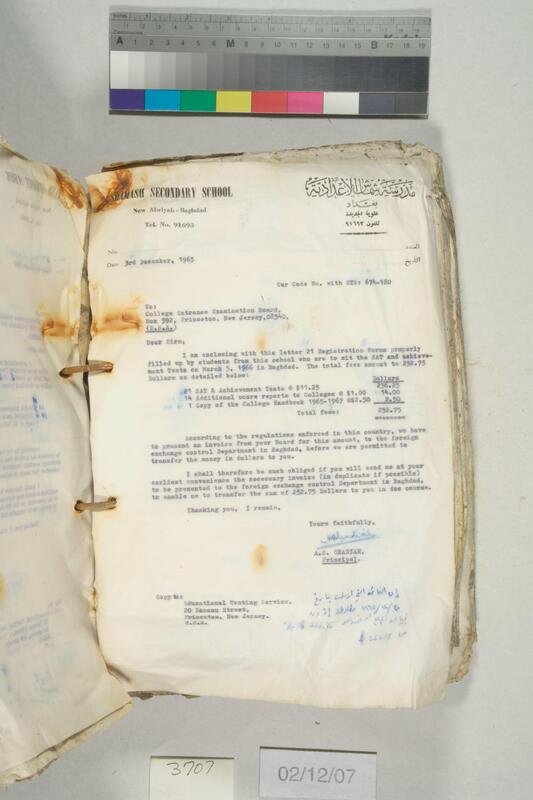
Correspondence Regarding Standardized Exams, Shamash Secondary School
Iraqi Jewish Archive (NARA) — transcription judeoiraq.org · הופקד ב־24 באוגוסט 2026 · רישום הצטלבות · נאמן, לא בעלים
❧ תיאור
לצפייה באינטרנט
פריט זה הופקד בצורת קישור: ניתן לצפות בו באתר המארח אותו.
- judeoiraq.org/documents/673d7e0e-77e1-48e1-bfed-58df74447171
- ijarchive.org/s/iraqi-jewish-archive/item/12283
הכתובת נמסרה על ידי המפקיד. תוכן זה אינו מאוחסן כאן, וזמינותו אינה תלויה בנו.
איורים
טקסט מקור
### csp_0069f905e8ff55958605045cda315e8a
October 3, he wrote the digits “10” and “03” in the empty boxes at the top of the birth-date columns. Note that, since the day of Alex- ander’s birth has only one digit, “3,” he wrote “03” in the boxes. Two digits must be placed in each set of this series of boxes. (For instance, if Alexander had been born in January, he would have written “01” in the first two of this series of boxes.) Then Alexander blackened the appropriate box below each number that corre- sponded to the number at the top of each column.
The third column has a double series of boxes running from 1 to 0 (standing for “10”). Alexander was born in Chicago and therefore he wrote “14,” the Illinois code number, in the empty boxes at the top of the state of birth columns. He then blackened the corresponding number below in each column. In the fourth set of columns he blackened the box for his mother’s month of birth, February. Then he blackened the box for May, his father’s month of birth.
You are now ready to fill in the blank sample answer sheet on page 7 for practice. Make up your own code numbers for the state in which you were born and for your secondary school.
A description of the PSAT
The two-hour PSAT uses the same kinds of multiple-choice questions and measures the same verbal and mathematical abilities as the three-hour SAT. In order that each student may have the best possible chance to demonstrate his ability, the test includes several different types of questions, some verbal and some mathematical. These types have been chosen because they are closely related to skills that are needed in college work. The Verbal section emphasizes materials that test your ability to understand word relationships and to com- prehend what you read; the Mathematical section emphasizes mate- rials that test your ability to understand and solve problems.
The sample questions that follow are examples of the kinds of questions you will find in the PSAT and of the general range of diffi- culty within parts of the test. Do not consider them as a complete sample test, either in the number of questions given or in the order in which they appear.
6
**Traduction anglaise —**
October 3, he wrote the digits “10” and “03” in the empty boxes at the top of the birth-date columns. Note that, since the day of Alex- ander’s birth has only one digit, “3,” he wrote “03” in the boxes. Two digits must be placed in each set of this series of boxes. (For instance, if Alexander had been born in January, he would have written “01” in the first two of this series of boxes.) Then Alexander blackened the appropriate box below each number that corre- sponded to the number at the top of each column. The third column has a double series of boxes running from 1 to 0 (standing for “10”). Alexander was born in Chicago and therefore he wrote “14,” the Illinois code number, in the empty boxes at the top of the state of birth columns. He then blackened the corresponding number below in each column. In the fourth set of columns he blackened the box for his mother’s month of birth, February. Then he blackened the box for May, his father’s month of birth. You are now ready to fill in the blank sample answer sheet on page 7 for practice. Make up your own code numbers for the state in which you were born and for your secondary school. A description of the PSAT The two-hour PSAT uses the same kinds of multiple-choice questions and measures the same verbal and mathematical abilities as the three-hour SAT. In order that each student may have the best possible chance to demonstrate his ability, the test includes several different types of questions, some verbal and some mathematical. These types have been chosen because they are closely related to skills that are needed in college work. The Verbal section emphasizes materials that test your ability to understand word relationships and to com- prehend what you read; the Mathematical section emphasizes mate- rials that test your ability to understand and solve problems. The sample questions that follow are examples of the kinds of questions you will find in the PSAT and of the general range of diffi- culty within parts of the test. Do not consider them as a complete sample test, either in the number of questions given or in the order in which they appear. 6
---
### csp_00b68533249e5e3fb9d53e00bc036468
Appleton, Wisconsin Telephone: Area Code 414 RE 3-5577 Director of Admissions: Edward J. Roberts Private college, established 1847. 70% of students from out of state.
62 ERC 63
Lawrence College 600 Men 500 Women
ADMISSIONS Requirements No specific unit requirements, but 16 units recom- mended, including the following:
| English | 4 | Science | 2 | | Mathematics | 2 | Social Science | 2 | | Foreign Language | 2 | Electives | 2 |
SAT required. Three Achievement Tests required: English and two others. Interview not required. Application fee $10, not refundable. Basis for Candidate Selection Academic: Secondary school record SAT and ACH scores School's recommendation Rank in upper half of class Other: Character and personality strongly emphasized. Extracurricular participation important.
Admission Procedure Normal sequence; Take SAT in December or January of 12th year. Take ACH by March of 12th year. No deadline for filing admission application, but advised by March 1. Notification of action of Admissions Committee beginning March 1 until class is filled. College does not subscribe to Candidates Reply Date Agreement. Candidate must accept offer of admission within two weeks of notification of acceptance and pay deposit of $100, not refundable if candidate subsequently withdraws.
College does not have Early Decision Program. College does not have Early Entrance Program. College participates in CEEB Advanced Placement Program; degree credit may be granted on basis of AP test. Transfer students admitted in September; oc- casionally in January and March.
Experience 530 men and 528 women applied for admission to class entering fall 1962. Of these applicants, 74% of men and 59% of women were offered admission. Of those offered admission, 48% of men and 52% of women matriculated. Size of freshman class (fall 1962): 191 men; 162 women. 19% of enrolled class came from independent schools; 81% from public schools.
Secondary school class rank: 25% of men entering fall 1962 ranked in top tenth of their secondary school class. Summary:
| Top tenth | Men 25% | Women 69% | | ⟦line⟧ | ⟦line⟧ | ⟦line⟧ | | Top quarter | 62 | 93 | | Second quarter | 18 | 7 | | *Third quarter | 15 | 0 | | **Bottom quarter | 3 | 0 | | No rank | 2 | 0 | | | 100% | 100% |
*Of these, 76% were from private schools. **Of these, 83% were from private schools. CEEB SAT scores: 23% of men entering fall 1962 scored between 500 and 549 on Verbal SAT. Summary:
| | Men Verbal | Men Math | Women Verbal | Women Math | | 750 and above | 1% | 1% | 1% | 1% | | 700-749 | 3 | 8 | 2 | 5 | | 650-699 | 10 | 21 | 11 | 10 | | 600-649 | 19 | 23 | 27 | 17 | | 550-599 | 21 | 23 | 27 | 25 | | 500-549 | 23 | 13 | 20 | 17 | | 450-499 | 13 | 6 | 9 | 14 | | 400-449 | 8 | 4 | 2 | 9 | | 350-399 | 0 | 0 | 1 | 2 | | 300-349 | 1 | 0 | 0 | 0 | | No score | 1 | 1 | 0 | 0 | | | 100% | 100% | 100% | 100% |
Admissions Staff Edward J. Roberts, Director Patricia O'Connor, Associate Director Rogelio S. Llerandi, Admissions Counselor Reed Taylor, Admissions Counselor Mrs. Lucille Biechler, Assistant to Director
FINANCIAL Expenses Inclusive fee (1962-63): $2,100 per year including instructional costs; room and board; approved extra-classroom activities; lab, social, and health fees This should be approximate total cost per year (not including travel, books, supplies, and personal expenses). Other: Books and supplies: $60 Fraternity: $75 per year plus $25 initiation fee Financial Aid College participates in College Scholarship Service. Scholarships: 112 freshmen had scholarship assistance (1962-63). Deadline for filing scholarship application is March 15; however, earlier in 12th year advisable. Financial aid applicants notified only after
**Traduction anglaise —**
Appleton, Wisconsin Telephone: Area Code 414 RE 3-5577 Director of Admissions: Edward J. Roberts Private college, established 1847. 70% of students from out of state. 62 ERC 63 Lawrence College 600 Men 500 Women ADMISSIONS Requirements No specific unit requirements, but 16 units recom- mended, including the following: English | 4 | Science | 2 Mathematics | 2 | Social Science | 2 Foreign Language | 2 | Electives | 2 SAT required. Three Achievement Tests required: English and two others. Interview not required. Application fee $10, not refundable. Basis for Candidate Selection Academic: Secondary school record SAT and ACH scores School's recommendation Rank in upper half of class Other: Character and personality strongly emphasized. Extracurricular participation important. Admission Procedure Normal sequence; Take SAT in December or January of 12th year. Take ACH by March of 12th year. No deadline for filing admission application, but advised by March 1. Notification of action of Admissions Committee beginning March 1 until class is filled. College does not subscribe to Candidates Reply Date Agreement. Candidate must accept offer of admission within two weeks of notification of acceptance and pay deposit of $100, not refundable if candidate subsequently withdraws. College does not have Early Decision Program. College does not have Early Entrance Program. College participates in CEEB Advanced Placement Program; degree credit may be granted on basis of AP test. Transfer students admitted in September; oc- casionally in January and March. Experience 530 men and 528 women applied for admission to class entering fall 1962. Of these applicants, 74% of men and 59% of women were offered admission. Of those offered admission, 48% of men and 52% of women matriculated. Size of freshman class (fall 1962): 191 men; 162 women. 19% of enrolled class came from independent schools; 81% from public schools. Secondary school class rank: 25% of men entering fall 1962 ranked in top tenth of their secondary school class. Summary: Top tenth | Men 25% | Women 69% ⟦line⟧ | ⟦line⟧ | ⟦line⟧ Top quarter | 62 | 93 Second quarter | 18 | 7 *Third quarter | 15 | 0 **Bottom quarter | 3 | 0 No rank | 2 | 0 | 100% | 100% *Of these, 76% were from private schools. **Of these, 83% were from private schools. CEEB SAT scores: 23% of men entering fall 1962 scored between 500 and 549 on Verbal SAT. Summary: | Men Verbal | Men Math | Women Verbal | Women Math 750 and above | 1% | 1% | 1% | 1% 700-749 | 3 | 8 | 2 | 5 650-699 | 10 | 21 | 11 | 10 600-649 | 19 | 23 | 27 | 17 550-599 | 21 | 23 | 27 | 25 500-549 | 23 | 13 | 20 | 17 450-499 | 13 | 6 | 9 | 14 400-449 | 8 | 4 | 2 | 9 350-399 | 0 | 0 | 1 | 2 300-349 | 1 | 0 | 0 | 0 No score | 1 | 1 | 0 | 0 | 100% | 100% | 100% | 100% Admissions Staff Edward J. Roberts, Director Patricia O'Connor, Associate Director Rogelio S. Llerandi, Admissions Counselor Reed Taylor, Admissions Counselor Mrs. Lucille Biechler, Assistant to Director FINANCIAL Expenses Inclusive fee (1962-63): $2,100 per year including instructional costs; room and board; approved extra-classroom activities; lab, social, and health fees This should be approximate total cost per year (not including travel, books, supplies, and personal expenses). Other: Books and supplies: $60 Fraternity: $75 per year plus $25 initiation fee Financial Aid College participates in College Scholarship Service. Scholarships: 112 freshmen had scholarship assistance (1962-63). Deadline for filing scholarship application is March 15; however, earlier in 12th year advisable. Financial aid applicants notified only after
---
### csp_03f11e7a1fb053a1b959bbe80bb52296
B01 · header / latin Verbal section
B02 · paragraph / latin Four kinds of que opposites, sentence sion. Each type is d
B03 · paragraph / latin Opposites. These d vocabulary. In eac select from the five site in meaning to words most high s reading, although speech.
B04 · paragraph / latin Directions: Each qu letters, followed b Choose the lettered meaning to the wo require you to dist choices before mak
B05 · paragraph / latin 1. AGILE: (A) humbl Since agile means answer is "clumsy" in movement. If yo (C), (D), and (E) question.
B06 · paragraph / latin 2. ALLEVIATE: (A) low (E) amuse This is a relatively lessen (usually ph nearly opposite is ally physical or m meaning of "allev "Control" (D) can troubles, but the a of "lightening or le ing or magnifying. ing as alleviate, a mental problems, It is certainly not t
B07 · footer / latin 8
**Traduction anglaise —**
Verbal section Four kinds of que opposites, sentence sion. Each type is d Opposites. These d vocabulary. In eac select from the five site in meaning to words most high s reading, although speech. Directions: Each qu letters, followed b Choose the lettered meaning to the wo require you to dist choices before mak 1. AGILE: (A) humbl Since agile means answer is "clumsy" in movement. If yo (C), (D), and (E) question. 2. ALLEVIATE: (A) low (E) amuse This is a relatively lessen (usually ph nearly opposite is ally physical or m meaning of "allev "Control" (D) can troubles, but the a of "lightening or le ing or magnifying. ing as alleviate, a mental problems, It is certainly not t 8
---
### csp_056f1cd6c9b9532ba083d3bfa53e4a49
ADVANCED PLACEMENT EXAMINATIONS, 1960-61 SCHOOL PARTICIPATION FORM
In May 1961, secondary schools will again conduct the Advanced Placement Examinations. Schools wishing to participate in the Advanced Placement Program by preparing candidates and by administering the ex- aminations to their students are requested to use this form to indicate their wish to participate and to name an Advanced Placement Examinations Coordinator. The Coordinator will be responsible for making all necessary arrangements for giving the examinations.
Upon return of this form, the Coordinator will auto- matically be sent two copies of Information for Co- ordinators. This booklet is intended to assist the Co- ordinator by providing him with the examination schedule and detailed information about ordering copies of Bulletin for Students, the registration of candidates, the collection of fees, and other arrangements for the examinations. No order need be placed by the school to receive Information for Coordinators.
The Coordinator for this school's Advanced Placement Examinations is: Name: Title: School: Address: Signature:
The address slip below will be used to mail the booklet Information for Coordinators. Please fill out this entire sheet and r⟦...⟧rn to⟦line⟧ D90R20—277800
College Board Advanced Placement Examinations, c/o Educational Testing Service, Box 592, Princeton, New Je⟦...⟧y, by not later than December 9, 1960.
⟦line⟧ College Board Advanced Placement Examinations c/o Educational Testing Service, Box 592, Princeton, New Jersey To::
**Traduction anglaise —**
ADVANCED PLACEMENT EXAMINATIONS, 1960-61 SCHOOL PARTICIPATION FORM In May 1961, secondary schools will again conduct the Advanced Placement Examinations. Schools wishing to participate in the Advanced Placement Program by preparing candidates and by administering the ex- aminations to their students are requested to use this form to indicate their wish to participate and to name an Advanced Placement Examinations Coordinator. The Coordinator will be responsible for making all necessary arrangements for giving the examinations. Upon return of this form, the Coordinator will auto- matically be sent two copies of Information for Co- ordinators. This booklet is intended to assist the Co- ordinator by providing him with the examination schedule and detailed information about ordering copies of Bulletin for Students, the registration of candidates, the collection of fees, and other arrangements for the examinations. No order need be placed by the school to receive Information for Coordinators. The Coordinator for this school's Advanced Placement Examinations is: Name: Title: School: Address: Signature: The address slip below will be used to mail the booklet Information for Coordinators. Please fill out this entire sheet and r⟦eturn⟧n to⟦line⟧ D90R20—277800 College Board Advanced Placement Examinations, c/o Educational Testing Service, Box 592, Princeton, New Je⟦rse⟧y, by not later than December 9, 1960. ⟦line⟧ College Board Advanced Placement Examinations c/o Educational Testing Service, Box 592, Princeton, New Jersey To::
---
### csp_06e42fbd3d7b53fa9bf429f1e2fe39e7
College Board ⟦logo: cceb⟧ Advanced Placement Examinations 1958-9
Please complete and return this form not later than November 15 to College Board Advanced Placement Examinations, Box 592, Princeton, New Jersey.
Please do not write in this box Send via ⟦line⟧ ⟦line⟧ ⟦line⟧ Date sent: ⟦line⟧
The total number of students from this school that will probably be taking the Advanced Placement Ex- aminations in May 1959 is approximately: ⟦line⟧ students. ⟦line⟧ none, but we have introduced Advanced Placement courses ⟦line⟧ none, but we are planning to introduce Advanced Placement courses
The estimated numbers of each of the May 1959 Advanced Placement Examinations that students from this school will take are approximately as follows:
| Examination | Number | Examination | Number | | American History ⟦line⟧ | ⟦line⟧ | Latin 4 ⟦line⟧ | ⟦line⟧ | | Biology ⟦line⟧ | ⟦line⟧ | Latin 5 ⟦line⟧ | ⟦line⟧ | | Chemistry ⟦line⟧ | ⟦line⟧ | Literature and English | | | European History ⟦line⟧ | ⟦line⟧ | Composition ⟦line⟧ | ⟦line⟧ | | French ⟦line⟧ | ⟦line⟧ | Mathematics ⟦line⟧ | ⟦line⟧ | | German 3 ⟦line⟧ | ⟦line⟧ | Physics ⟦line⟧ | ⟦line⟧ | | German 4 ⟦line⟧ | ⟦line⟧ | Spanish ⟦line⟧ | ⟦line⟧ |
The number of copies of the 1958-59 Bulletin of Information, Advanced Placement Examinations that this school wants sent for use by students taking the examination and by their counselors and teachers is: ⟦line⟧ copies
Note: One copy of the application form with which the student registers for the examination is bound into each copy of the Bulletin.
This school is interested in receiving (or in continuing to receive) Advanced Placement Program announce- ments regularly, and would like them addressed to: Name: Title: School: Address: Signature:
Note: Submission of this estimate and order form does not constitute registration of students for the examination. Students register by submitting individual applications.
The address slip at right will be used to mail the bulletins ordered. Please fill it out completely.
College Board Advanced Placement Examinations Box 592, Princeton, New Jersey To::
Postmaster: Educational Materials. Contents fourt' class mail. May be opened for postal inspection.
**Traduction anglaise —**
College Board ⟦logo: cceb⟧ Advanced Placement Examinations 1958-9 Please complete and return this form not later than November 15 to College Board Advanced Placement Examinations, Box 592, Princeton, New Jersey. Please do not write in this box Send via ⟦line⟧ ⟦line⟧ ⟦line⟧ Date sent: ⟦line⟧ The total number of students from this school that will probably be taking the Advanced Placement Ex- aminations in May 1959 is approximately: ⟦line⟧ students. ⟦line⟧ none, but we have introduced Advanced Placement courses ⟦line⟧ none, but we are planning to introduce Advanced Placement courses The estimated numbers of each of the May 1959 Advanced Placement Examinations that students from this school will take are approximately as follows: Examination | Number | Examination | Number American History ⟦line⟧ | ⟦line⟧ | Latin 4 ⟦line⟧ | ⟦line⟧ Biology ⟦line⟧ | ⟦line⟧ | Latin 5 ⟦line⟧ | ⟦line⟧ Chemistry ⟦line⟧ | ⟦line⟧ | Literature and English | European History ⟦line⟧ | ⟦line⟧ | Composition ⟦line⟧ | ⟦line⟧ French ⟦line⟧ | ⟦line⟧ | Mathematics ⟦line⟧ | ⟦line⟧ German 3 ⟦line⟧ | ⟦line⟧ | Physics ⟦line⟧ | ⟦line⟧ German 4 ⟦line⟧ | ⟦line⟧ | Spanish ⟦line⟧ | ⟦line⟧ The number of copies of the 1958-59 Bulletin of Information, Advanced Placement Examinations that this school wants sent for use by students taking the examination and by their counselors and teachers is: ⟦line⟧ copies Note: One copy of the application form with which the student registers for the examination is bound into each copy of the Bulletin. This school is interested in receiving (or in continuing to receive) Advanced Placement Program announce- ments regularly, and would like them addressed to: Name: Title: School: Address: Signature: Note: Submission of this estimate and order form does not constitute registration of students for the examination. Students register by submitting individual applications. The address slip at right will be used to mail the bulletins ordered. Please fill it out completely. College Board Advanced Placement Examinations Box 592, Princeton, New Jersey To:: Postmaster: Educational Materials. Contents fourth class mail. May be opened for postal inspection.
---
### csp_07fdb68a042956329a602ba762361acf
You will need to provide the following information in the center portion of your answer sheet: your last and first names, your moth- er’s maiden name, the month and day of your birth, your sex, your grade in school, the state where you were born, the month of your mother’s birth, and the month of your father’s birth. It will be very helpful if you will make sure beforehand that you can record all of the above information readily and correctly at the time you take the PSAT. With this in mind, a blank sample and a completed sample of this portion of the answer sheet have been included here. After you have studied the completed sample, fill in the blank sample with your own information for practice.
Looking first at the completed sample portion of the answer sheet, you will notice that the top two-thirds of the sheet has three main groups of boxes running down the alphabet from A to Z. If you look from left to right across the top of the columns and count, you will see that the first group of columns has 13 boxes for the letters of the student’s last name, the second set of columns has boxes for 7 letters of his first name, and the third set has boxes for the first 5 letters of his mother’s maiden name.
Our hypothetical student, Alexander Fielding, whose mother’s maiden name was Cromwell, first printed his last name in the empty boxes at the top of the left-hand set of columns. If his last name had contained more than thirteen letters, he would have filled in only the first thirteen. Moving to the right to the “First Name” column, he filled in seven letters of his first name: “Alexand.” Over the columns to the far right he printed the first five letters of his mother’s maiden name: “Cromw.”
Alexander was then asked to blacken the lettered box in each column that corresponded to the letter in his name at the top of that column. Note that he blackened only one box in each column.
The bottom third of the center portion of the answer sheet has five groups of columns of boxes to be filled in: (1) your sex, and your grade in school, (2) the month and day of your birth, (3) the code number of the state in which you were born, (4) the month in which your mother was born and your father’s month of birth, and (5) the code number of your secondary school. (A list of state code numbers and your secondary school code number will be provided at the time you take the PSAT.)
To return to our example, Alexander blackened the boxes labeled “male” and “junior” in the first lower column. Since he was born on
5
**Traduction anglaise —**
You will need to provide the following information in the center portion of your answer sheet: your last and first names, your moth- er’s maiden name, the month and day of your birth, your sex, your grade in school, the state where you were born, the month of your mother’s birth, and the month of your father’s birth. It will be very helpful if you will make sure beforehand that you can record all of the above information readily and correctly at the time you take the PSAT. With this in mind, a blank sample and a completed sample of this portion of the answer sheet have been included here. After you have studied the completed sample, fill in the blank sample with your own information for practice. Looking first at the completed sample portion of the answer sheet, you will notice that the top two-thirds of the sheet has three main groups of boxes running down the alphabet from A to Z. If you look from left to right across the top of the columns and count, you will see that the first group of columns has 13 boxes for the letters of the student’s last name, the second set of columns has boxes for 7 letters of his first name, and the third set has boxes for the first 5 letters of his mother’s maiden name. Our hypothetical student, Alexander Fielding, whose mother’s maiden name was Cromwell, first printed his last name in the empty boxes at the top of the left-hand set of columns. If his last name had contained more than thirteen letters, he would have filled in only the first thirteen. Moving to the right to the “First Name” column, he filled in seven letters of his first name: “Alexand.” Over the columns to the far right he printed the first five letters of his mother’s maiden name: “Cromw.” Alexander was then asked to blacken the lettered box in each column that corresponded to the letter in his name at the top of that column. Note that he blackened only one box in each column. The bottom third of the center portion of the answer sheet has five groups of columns of boxes to be filled in: (1) your sex, and your grade in school, (2) the month and day of your birth, (3) the code number of the state in which you were born, (4) the month in which your mother was born and your father’s month of birth, and (5) the code number of your secondary school. (A list of state code numbers and your secondary school code number will be provided at the time you take the PSAT.) To return to our example, Alexander blackened the boxes labeled “male” and “junior” in the first lower column. Since he was born on 5
---
### csp_08846d247db35e4db1deaa639b1e895e
Percentile Ranks for Candidates Tested March 1961
| | Hebrew | | | Russian | | | | Years of Study | | | Years of Study | | | Scores | 2 Years | 3 Years | 4 Years | 2 Years | 3 Years | | 800 | | 99 | 98 | | | | 750 | | 99 | 98 | | | | 700 | 97 | 94 | 91 | 99 | 96 | | 650 | 97 | 85 | 77 | 92 | 84 | | 600 | 90 | 77 | 55 | 77 | 57 | | 550 | 73 | 59 | 36 | 62 | 33 | | 500 | 60 | 41 | 18 | 45 | 17 | | 450 | 40 | 22 | 8 | 29 | 4 | | 400 | 27 | 10 | 2 | 16 | 3 | | 350 | 13 | 3 | 1 | 4 | 3 | | 300 | 3 | 2 | 0 | 2 | 1 | | 250 | 0 | 1. | | 1 | 0 | | 200 | | | | 0 | | | Average Score | 472 | 529 | 584 | 511 | 575 | | Number Tested | 30 | 115 | 137 | 174 | 69 |
Note: Scores for 130 candidates who took the Hebrew test and 89 candidates who took the Russian test are not included in these distributions. These candidates either did not give information on years of study, or had training in the languages outside the regular school curriculum.
**Traduction anglaise —**
Percentile Ranks for Candidates Tested March 1961 | Hebrew | | | Russian | | Years of Study | | | Years of Study | Scores | 2 Years | 3 Years | 4 Years | 2 Years | 3 Years 800 | | 99 | 98 | | 750 | | 99 | 98 | | 700 | 97 | 94 | 91 | 99 | 96 650 | 97 | 85 | 77 | 92 | 84 600 | 90 | 77 | 55 | 77 | 57 550 | 73 | 59 | 36 | 62 | 33 500 | 60 | 41 | 18 | 45 | 17 450 | 40 | 22 | 8 | 29 | 4 400 | 27 | 10 | 2 | 16 | 3 350 | 13 | 3 | 1 | 4 | 3 300 | 3 | 2 | 0 | 2 | 1 250 | 0 | 1. | | 1 | 0 200 | | | | 0 | Average Score | 472 | 529 | 584 | 511 | 575 Number Tested | 30 | 115 | 137 | 174 | 69 Note: Scores for 130 candidates who took the Hebrew test and 89 candidates who took the Russian test are not included in these distributions. These candidates either did not give information on years of study, or had training in the languages outside the regular school curriculum.
---
### csp_08f56b1aaa005175bafebd9d12acb72b
WHAT'S IN IT FOR ETS? ⟦line⟧
There is, in this project, a prospect of satisfy- ing the mandate in ETS's charter to seek a var- iety of ways in which to serve American edu- cation. Further, any system of communication that extends and enriches the recorded aca- demic picture of individual students will re- lieve unwholesome pressures that have been built up around the use of tests for selection, placement, scholarship award, and admissions. Anything that improves the usefulness of tests is very much ETS's business.
For Educational Testing Service, then, the CPGA project has been, and will continue to be one of professional service and leadership. If financial profit were a motive, the project doors would have been quietly closed four years ago.
HOW CAN I KEEP ABREAST OF THIS DEVELOPMENT? ⟦line⟧
A first step is to obtain more detailed informa- tion about the prototype program, what it looks like, what it does, how it works. Details are available on either the information process- ing part or the records-keeping part of CPGA or both.
A second step is to be included on the mail- ing list to receive the CPGA Newsletter which is issued four times a year.
Inquiries should be directed to: WESLEY W. WALTON, DIRECTOR DEVELOPMENTAL PROGRAMS EDUCATIONAL TESTING SERVICE PRINCETON, NEW JERSEY 08540
12
WHAT IS IT? ⟦line⟧
The Cooperative Plan for Guidance and Ad- mission actually is two ideas: a common lan- guage that high school and college educators can use to communicate information about students; and a method of summarizing, trans- mitting, and increasing the usefulness of this information.
These two ideas are being offered to edu⟦...⟧ cators as a way of making student recor⟦...⟧ more descriptive, comprehensive, and com- parable from school to school. They have been developed to make student records more mean- ingful and useful to students, counselors, em- ployers, college admissions and placement officers. Moreover, the CPGA has uncovered ways to reduce the paper work involved in keeping student records.
In the CPGA system, computers are used to analyze, summarize, and help educators in their interpretation of the evidence that each stu- dent's record contains.
In essence, the ideas embodied in the CPGA constitute a recipe for higher fidelity in the communication of information about students —a flexible plan to bridge the gap in guidance that exists during the student's transition from high school to college or job. Its purpose is toward clearer perceptions and insights abou⟦...⟧ students and their potential. It is an unpatent⟦...⟧ plan which its originators hope all schools will use and adapt to their own needs.
1
**Traduction anglaise —**
WHAT'S IN IT FOR ETS? ⟦line⟧ There is, in this project, a prospect of satisfy- ing the mandate in ETS's charter to seek a var- iety of ways in which to serve American edu- cation. Further, any system of communication that extends and enriches the recorded aca- demic picture of individual students will re- lieve unwholesome pressures that have been built up around the use of tests for selection, placement, scholarship award, and admissions. Anything that improves the usefulness of tests is very much ETS's business. For Educational Testing Service, then, the CPGA project has been, and will continue to be one of professional service and leadership. If financial profit were a motive, the project doors would have been quietly closed four years ago. HOW CAN I KEEP ABREAST OF THIS DEVELOPMENT? ⟦line⟧ A first step is to obtain more detailed informa- tion about the prototype program, what it looks like, what it does, how it works. Details are available on either the information process- ing part or the records-keeping part of CPGA or both. A second step is to be included on the mail- ing list to receive the CPGA Newsletter which is issued four times a year. Inquiries should be directed to: WESLEY W. WALTON, DIRECTOR DEVELOPMENTAL PROGRAMS EDUCATIONAL TESTING SERVICE PRINCETON, NEW JERSEY 08540 12 WHAT IS IT? ⟦line⟧ The Cooperative Plan for Guidance and Ad- mission actually is two ideas: a common lan- guage that high school and college educators can use to communicate information about students; and a method of summarizing, trans- mitting, and increasing the usefulness of this information. These two ideas are being offered to edu⟦cators⟧ cators as a way of making student recor⟦ds⟧ more descriptive, comprehensive, and com- parable from school to school. They have been developed to make student records more mean- ingful and useful to students, counselors, em- ployers, college admissions and placement officers. Moreover, the CPGA has uncovered ways to reduce the paper work involved in keeping student records. In the CPGA system, computers are used to analyze, summarize, and help educators in their interpretation of the evidence that each stu- dent's record contains. In essence, the ideas embodied in the CPGA constitute a recipe for higher fidelity in the communication of information about students —a flexible plan to bridge the gap in guidance that exists during the student's transition from high school to college or job. Its purpose is toward clearer perceptions and insights abou⟦t⟧ students and their potential. It is an unpatent⟦ed⟧ plan which its originators hope all schools will use and adapt to their own needs. 1
---
### csp_09acf45049b4587c8e01126445956145
SHAMASH SECONDARY SCHOOL New Alwiyah - Baghdad Telephone No. 91693 مدرسة شماش الاعدادية بغداد علوية الجديدة تلفون ٩١٦٩٣
[Marginalia] 4 Copies
No.: الرقم: Date: 20th December, 1963. <del>14th December, 1962,</del> التاريخ:
Our Code No. with ETS: 990210
To: College Entrance Examination Board, Box 592, Princeton, New Jersey, (U.S.A.)
Dear Sirs,
I am enclosing with this letter 13 <del>nine</del> application cards properly filled up by students from this school who are to sit the SAT and Achievement Tests on March 7 <del>2,</del> 1964 <del>1963,</del> in Baghdad. The total fees amount to 162.50 <del>125</del> Dollars as detailed below:
| | | Dollars | | 13 <del>9</del> | SAT & Achievement Tests at $ 12.50 <del>13.00</del> | 162.50 <del>117.00</del> | | 2 <del>8</del> | Additional score reports to Colleges at $ 1.00 | 2.00 <del>8.00</del> | | | Total fees: | 164.50 <del>125.00</del> |
According to the regulations enforced in this country, we have to present an invoice from your Board for this amount, to the foreign exchange control Department in Baghdad, before we are permitted to transfer the money in dollars to you.
I shall therefore be much obliged if you will send me at your earliest convenience the necessary invoice (in duplicate if possible) to be presented to the foreign exchange control department in Baghdad, to enable me to transfer the sum of 164.50 <del>125</del> dollars to you in due course.
Thanking you, I remain,
Yours faithfully,
[Signature] ⟦A.S. Obadiah⟧
A.S. OBADIAH, Principal.
copy to: Educational Testing Service, 20 Nassau Street, Princeton, New Jersey, (U.S.A.)
**Traduction anglaise —**
SHAMASH SECONDARY SCHOOL New Alwiyah - Baghdad Telephone No. 91693 Shamash Preparatory School Baghdad New Alwiyah Telephone 91693 4 Copies No.: Number: Date: 20th December, 1963. <del>14th December, 1962,</del> Date: Our Code No. with ETS: 990210 To: College Entrance Examination Board, Box 592, Princeton, New Jersey, (U.S.A.) Dear Sirs, I am enclosing with this letter 13 <del>nine</del> application cards properly filled up by students from this school who are to sit the SAT and Achievement Tests on March 7 <del>2,</del> 1964 <del>1963,</del> in Baghdad. The total fees amount to 162.50 <del>125</del> Dollars as detailed below: | | Dollars 13 <del>9</del> | SAT & Achievement Tests at $ 12.50 <del>13.00</del> | 162.50 <del>117.00</del> 2 <del>8</del> | Additional score reports to Colleges at $ 1.00 | 2.00 <del>8.00</del> | Total fees: | 164.50 <del>125.00</del> According to the regulations enforced in this country, we have to present an invoice from your Board for this amount, to the foreign exchange control Department in Baghdad, before we are permitted to transfer the money in dollars to you. I shall therefore be much obliged if you will send me at your earliest convenience the necessary invoice (in duplicate if possible) to be presented to the foreign exchange control department in Baghdad, to enable me to transfer the sum of 164.50 <del>125</del> dollars to you in due course. Thanking you, I remain, Yours faithfully, ⟦A.S. Obadiah⟧ A.S. OBADIAH, Principal. copy to: Educational Testing Service, 20 Nassau Street, Princeton, New Jersey, (U.S.A.)
---
### csp_0b049776081358738b97183fd667bb96
SHAMASH SECONDARY SCHOOL New Alwiyah - Baghdad Tel. No. 91693
مدرسة شماش الاعدادية بغداد علوية الجديدة تلفون ٩١٦٩٣
No.: العدد: Date: 19th February, 1965 التاريخ:
Our Code No. with ETS: 990210
To: College Entrance Examination Board, Box 592, Princeton, 08540, New Jersey. U.S.A.
Dear Sirs,
I have received the enclosed invoice in duplicate about a month ago. The sum of 187.50 dollars covering examina- tion fees, extra score reports and one College Handbook, has been remitted by the Credit Bank of Iraq through their New York correspondent, the First National City Bank of New York, New York, for payment to you through their Princeton correspondent. Kindly acknowledge receipt.
As I informed you previously, the only way we can arrange for payment in dollars is by Air Transfer, as all transactions in dollars have got to pass through the Foreign Exchange Control Department in Baghdad and are settled in this way.
Yours faithfully,
[Signature] ⟦A.S. Obadiah⟧ [Signature] A.S. Obadiah, [Signature] Principal.
[Marginalia] ⟦illegible blue ink mark⟧
**Traduction anglaise —**
SHAMASH SECONDARY SCHOOL New Alwiyah - Baghdad Tel. No. 91693 Shamash Secondary School Baghdad New Alwiyah Telephone 91693 No.: Number: Date: 19th February, 1965 Date: Our Code No. with ETS: 990210 To: College Entrance Examination Board, Box 592, Princeton, 08540, New Jersey. U.S.A. Dear Sirs, I have received the enclosed invoice in duplicate about a month ago. The sum of 187.50 dollars covering examina- tion fees, extra score reports and one College Handbook, has been remitted by the Credit Bank of Iraq through their New York correspondent, the First National City Bank of New York, New York, for payment to you through their Princeton correspondent. Kindly acknowledge receipt. As I informed you previously, the only way we can arrange for payment in dollars is by Air Transfer, as all transactions in dollars have got to pass through the Foreign Exchange Control Department in Baghdad and are settled in this way. Yours faithfully, ⟦A.S. Obadiah⟧ A.S. Obadiah, Principal. ⟦illegible blue ink mark⟧
---
### csp_0c75965096d95f32987f63d9b4c503ae
4. EDWARD GEORGY NAFTALY 6. Edward Georgy Naftaly
⟦4/5/1⟧ Kard Al-Pasha, Baghdad IRAQ
15. month Day year 10 11 1946
17. Mothers Maiden name: KHDIAR
18. Mother [7] . Father [9]
20. | 2562 | New York University | | 3514 | Massachusetts Institute of Technology | | 5812 | University of Florida (Gainesville, Fla.) |
**Traduction anglaise —**
4. EDWARD GEORGY NAFTALY 6. Edward Georgy Naftaly ⟦4/5/1⟧ Karrat Al-Pasha, Baghdad IRAQ 15. month Day year 10 11 1946 17. Mothers Maiden name: KHDIAR 18. Mother [7] . Father [9] 20. 2562 | New York University 3514 | Massachusetts Institute of Technology 5812 | University of Florida (Gainesville, Fla.)
---
### csp_0c9433271c32590a9cc2b956d43041a6
B01 · marginalia / latin PULL OUT FOR POSTAL INSPECTION
B02 · stamp / mixed ⟦illegible⟧ 5 NOV ⟦illegible⟧ ⟦illegible⟧
B03 · other / unknown ⟦illegible text visible through paper⟧
**Traduction anglaise —**
PULL OUT FOR POSTAL INSPECTION ⟦illegible⟧ 5 NOV ⟦illegible⟧ ⟦illegible⟧ ⟦illegible text visible through paper⟧
---
### csp_0d4323a6b5a2557b8f171c5df8aac626
SHAMASH SECONDARY SCHOOL New Alwiyah - Baghdad Tel. No. 91693 ⟦line⟧ مدرسة شماش الاعدادية بغداد علوية الجديدة تلفون ٩١٦٩٣ ⟦line⟧
No.: العدد: Date: 22nd December,1961. التاريخ:
Our Code No.with ETS: 990210
To the: College Entrance Examination Board, Box 592, Princeton, New Jersy, U. S. A.
Dear Sirs,
I am enclosing, herewith, five applications of students from this school who will be taking the SAT and Achievement Tests on March 3, 1962.
The amount of 57 Dollars, covering examination fees, was remitted by air mail on the 19th instant by the Ottoman Bank, Baghdad, through their New York Correspondent, the First National City Bank of New York, New York, for payment to you through their Princeton correspondent.
At present, the only way we can arrange for payment in Dollars is by Air Transfer, as all transactions in Dollars have got to pass through the Foreign Exchange Control Depart- ment in Baghdad and are settled in this way.
Yours faithfully,
[Signature] ⟦signature⟧ [Signature] A. S. OBADIAH, [Signature] PRINCIPAL.
**Traduction anglaise —**
SHAMASH SECONDARY SCHOOL New Alwiyah - Baghdad Tel. No. 91693 ⟦line⟧ Shamash Secondary School Baghdad New Alwiyah Telephone 91693 ⟦line⟧ No.: Number: Date: 22nd December, 1961. Date: Our Code No. with ETS: 990210 To the: College Entrance Examination Board, Box 592, Princeton, New Jersey, U. S. A. Dear Sirs, I am enclosing, herewith, five applications of students from this school who will be taking the SAT and Achievement Tests on March 3, 1962. The amount of 57 Dollars, covering examination fees, was remitted by air mail on the 19th instant by the Ottoman Bank, Baghdad, through their New York Correspondent, the First National City Bank of New York, New York, for payment to you through their Princeton correspondent. At present, the only way we can arrange for payment in Dollars is by Air Transfer, as all transactions in Dollars have got to pass through the Foreign Exchange Control Depart- ment in Baghdad and are settled in this way. Yours faithfully, ⟦signature⟧ A. S. OBADIAH, PRINCIPAL.
---
### csp_0defc164c9095cd38ab7f3745c9dfcaf
SHAMASH SECONDARY SCHOOL New Alwiyah - Baghdad Tel. No. 91693 مدرسة شماش الاعدادية بغداد علوية الجديدة تلفون ٩١٦٩٣
No.: العدد: Date: 17th May, 1968 التاريخ:
To: Educational Testing Service, Princeton, New Jersey, 08540, U. S. A.
Our Code No. with ETS is: 674-180
Dear Sirs, Your Invoice No. 3121-110.03 dated January 18, 1968 (Total due $319.00 ) ⟦line⟧
I have just received another copy of your invoice No. 3121-110.03 dated January 18, 1968, in which you are asking us to remit to you the sum of $319.00 for services rendered in connec- tion with the March 1968 administration of the College Board Exami- nations.
I wish to refer you again to my letter of 29th January, 1968, ( a copy of which is enclosed herewith), in which I explained that unless we receive your invoice, properly stamped with the signature of an authorized official of ETS on it, it will not be possible for us to remit to you the sum of $319.00 due to your Institution, because the exchange control department in Baghdad will not allow such a transfer without the supporting documents being properly signed and stamped.
I shall be much obliged therefore, if you will kindly send me the invoice by airmail immediately after it is stamped and signed in order to enable me to settle our debt with you.
Thanking you, I remain,
[Signature] Yours sincerely, [Signature] ⟦signature⟧ [Signature] A.S. Obadiah, [Signature] Principal.
**Traduction anglaise —**
SHAMASH SECONDARY SCHOOL New Alwiyah - Baghdad Tel. No. 91693 Shamash Secondary School Baghdad New Alwiyah Telephone 91693 No.: Number: Date: 17th May, 1968 Date: To: Educational Testing Service, Princeton, New Jersey, 08540, U. S. A. Our Code No. with ETS is: 674-180 Dear Sirs, Your Invoice No. 3121-110.03 dated January 18, 1968 (Total due $319.00 ) ⟦line⟧ I have just received another copy of your invoice No. 3121-110.03 dated January 18, 1968, in which you are asking us to remit to you the sum of $319.00 for services rendered in connec- tion with the March 1968 administration of the College Board Exami- nations. I wish to refer you again to my letter of 29th January, 1968, ( a copy of which is enclosed herewith), in which I explained that unless we receive your invoice, properly stamped with the signature of an authorized official of ETS on it, it will not be possible for us to remit to you the sum of $319.00 due to your Institution, because the exchange control department in Baghdad will not allow such a transfer without the supporting documents being properly signed and stamped. I shall be much obliged therefore, if you will kindly send me the invoice by airmail immediately after it is stamped and signed in order to enable me to settle our debt with you. Thanking you, I remain, Yours sincerely, ⟦signature⟧ A.S. Obadiah, Principal.
---
### csp_0eed21047c965fc899fa979aa9d6063f
B01 · paragraph / latin missions test, and the College Board is not aware of any college that requires the PSAT for admission or that will accept PSAT scores as a substitute for SAT scores. Thus, a student applying for admission to college should be sure to take any admissions tests required by the college or colleges to which he is applying, whether or not he has taken the PSAT.
B02 · header / latin Test dates
B03 · paragraph / latin The test dates for the 1965 PSAT are Tuesday, October 19 and Saturday, October 23. A school may choose either date, but all participating students in the school must be tested on the same day. A different form (edition) of the PSAT will be used for each test date and no school will be authorized to use more than one form. If both of the scheduled test dates conflict with school vacations, teachers' conferences, or religious observances, or if there are other compelling reasons for requesting a different test date, a school must request a special testing date by letter, using the appropriate address given on the inside front cover of this leaflet. The letter should contain a detailed account of the circum- stances and should specify the desired test date. The special test date should be as close to the dates given above as possible. The only circumstance under which a school may give the test on more than one date will arise when a school wishes to test on Saturday but has some students who cannot take the test on that day because of religious convictions. Such a school may test these students on the Friday immediately preceding the scheduled testing date. If for some reason the special administration for these students cannot be held on Friday, the test may be administered on the following Sunday. In either case, the principal of the school should notify the College Board,
B04 · paragraph / latin using the appropriate address on the inside front cover, stating that this is being done because of the religious convictions of the students being tested at the special ad- ministration.
B05 · header / latin How schools register for the test
B06 · paragraph / latin All schools wishing to administer the PSAT in 1965 must register with Educational Testing Service (ETS), which conducts the PSAT program for the College Board. The information below is intended to assist school principals in registering for the test. Registration for the PSAT is designed to insure that schools will receive PSAT materials in adequate time prior to the test date. For this reason, the following registration pro- cedures are used: • Schools located on the North American continent (except Mexico), Hawaii, and the Caribbean Islands, and U.S. Depend- ents Schools will receive a Spring and a Fall Registration Form. Schools in these areas should follow the procedures ex- plained under both "Spring and Fall Reg- istration" on page 10. The Spring Regis- tration Form may be used to submit an estimate of the number of students to be tested in 1965; it should be returned by July 15, since shipments of the PSAT Bulletin for Students are made in August. The Fall Registration Form may be used to give a final registration figure; this Form must be returned by October 1. • Schools located in areas other than those specified in the preceding paragraph will receive only the Spring Registration Form on which they are to specify the number of students they will test in 1965. Schools in these areas should follow the proce- dures discussed under "Spring Registra- tion" on page 10. These schools are urged to return the Spring Form by July 15,
B07 · footer / latin 8 9
**Traduction anglaise —**
missions test, and the College Board is not aware of any college that requires the PSAT for admission or that will accept PSAT scores as a substitute for SAT scores. Thus, a student applying for admission to college should be sure to take any admissions tests required by the college or colleges to which he is applying, whether or not he has taken the PSAT. Test dates The test dates for the 1965 PSAT are Tuesday, October 19 and Saturday, October 23. A school may choose either date, but all participating students in the school must be tested on the same day. A different form (edition) of the PSAT will be used for each test date and no school will be authorized to use more than one form. If both of the scheduled test dates conflict with school vacations, teachers' conferences, or religious observances, or if there are other compelling reasons for requesting a different test date, a school must request a special testing date by letter, using the appropriate address given on the inside front cover of this leaflet. The letter should contain a detailed account of the circum- stances and should specify the desired test date. The special test date should be as close to the dates given above as possible. The only circumstance under which a school may give the test on more than one date will arise when a school wishes to test on Saturday but has some students who cannot take the test on that day because of religious convictions. Such a school may test these students on the Friday immediately preceding the scheduled testing date. If for some reason the special administration for these students cannot be held on Friday, the test may be administered on the following Sunday. In either case, the principal of the school should notify the College Board, using the appropriate address on the inside front cover, stating that this is being done because of the religious convictions of the students being tested at the special ad- ministration. How schools register for the test All schools wishing to administer the PSAT in 1965 must register with Educational Testing Service (ETS), which conducts the PSAT program for the College Board. The information below is intended to assist school principals in registering for the test. Registration for the PSAT is designed to insure that schools will receive PSAT materials in adequate time prior to the test date. For this reason, the following registration pro- cedures are used: • Schools located on the North American continent (except Mexico), Hawaii, and the Caribbean Islands, and U.S. Depend- ents Schools will receive a Spring and a Fall Registration Form. Schools in these areas should follow the procedures ex- plained under both "Spring and Fall Reg- istration" on page 10. The Spring Regis- tration Form may be used to submit an estimate of the number of students to be tested in 1965; it should be returned by July 15, since shipments of the PSAT Bulletin for Students are made in August. The Fall Registration Form may be used to give a final registration figure; this Form must be returned by October 1. • Schools located in areas other than those specified in the preceding paragraph will receive only the Spring Registration Form on which they are to specify the number of students they will test in 1965. Schools in these areas should follow the proce- dures discussed under "Spring Registra- tion" on page 10. These schools are urged to return the Spring Form by July 15, 8 9
---
### csp_0ef4e458b7ab543eb87abd3e40f19f6c
SHAMASH SECONDARY SCHOOL مدرسة شماش الاعدادية بغداد New Alwiyah - Baghdad علوية الجديدة Tel. No. 91693 تلفون ٩١٦٩٣
No.: العدد: Date: 29th December, 1967 التاريخ:
Our Code No.with ETS: 674-180
To: College Entrance Examination Board, Box 592, Princeton, New Jersey, 08540 U.S.A.
Dear Sirs,
I have sent you under a separate cover, 25 Registration Forms properly filled up by students from this school who are to sit the SAT and Achievement Tests on March 2, 1968 in Baghdad. The total fees amount to 319.00 Dollars as detailed below:
| | Dollars | | 25 SAT & Achievement Test @ $12.50 | 312.50 | | 3 Additional score reports to Colleges @ $1.00 | 3.00 | | 1 Copy of the College Handbook (latest edition 1967-1969) @ $3.50 | 3.50 | | Total fees: | $ 319.00 |
[Signature] ⟦initials⟧
According to the regulations enforced in this country, we have to present a signed invoice from your Board for this amount, to the foreign exchange control Department in Baghdad, before we are prermitted to transfer the money in dollars to you.
I shall therefore be much obliged if you will send me at your earliest convenience the necessary invoice, signed by the official concerned, (in duplicate if possible) to be presented to the foreign exchange control Department in Baghdad, to enable me to transfer the sum of 319.00 dollars to you in due course.
Thanking you, I remain,
Yours faithfully,
[Signature] Principal.
copy to: Educational Testing Service, 20 Nassau Street, Princeton, New Jersey, U.S.A.
P.S. Kindly note that due to circumstances beyond our control, we could not possibly mail the Registration Forms earlier. We therefore request you kindly to exempt our school from the penalty fees usually paid, in case you receive the Forms after the penalty date of January 13, 1968. Thank you.
**Traduction anglaise —**
SHAMASH SECONDARY SCHOOL Baghdad New Alwiyah - Baghdad Tel. No. 91693 No.: Number: Date: 29th December, 1967 Date: Our Code No.with ETS: 674-180 To: College Entrance Examination Board, Box 592, Princeton, New Jersey, 08540 U.S.A. Dear Sirs, I have sent you under a separate cover, 25 Registration Forms properly filled up by students from this school who are to sit the SAT and Achievement Tests on March 2, 1968 in Baghdad. The total fees amount to 319.00 Dollars as detailed below: | Dollars 25 SAT & Achievement Test @ $12.50 | 312.50 3 Additional score reports to Colleges @ $1.00 | 3.00 1 Copy of the College Handbook (latest edition 1967-1969) @ $3.50 | 3.50 Total fees: | $ 319.00 ⟦initials⟧ According to the regulations enforced in this country, we have to present a signed invoice from your Board for this amount, to the foreign exchange control Department in Baghdad, before we are prermitted to transfer the money in dollars to you. I shall therefore be much obliged if you will send me at your earliest convenience the necessary invoice, signed by the official concerned, (in duplicate if possible) to be presented to the foreign exchange control Department in Baghdad, to enable me to transfer the sum of 319.00 dollars to you in due course. Thanking you, I remain, Yours faithfully, Principal. copy to: Educational Testing Service, 20 Nassau Street, Princeton, New Jersey, U.S.A. P.S. Kindly note that due to circumstances beyond our control, we could not possibly mail the Registration Forms earlier. We therefore request you kindly to exempt our school from the penalty fees usually paid, in case you receive the Forms after the penalty date of January 13, 1968. Thank you.
---
### csp_0f4c954d45de5deb9dd4780c35f901d7
COLLEGE ENTRANCE EXAMINATION BOARD Notice to Recipients of Scores on CEEB-PSSC PHYSICS TEST ITALIAN AND GREEK TESTS
Some colleges and schools may receive scores for candidates who took the CEEB-PSSC Physics test, the Italian test or one of the Greek tests offered by the College Entrance Examination Board in March 1960. Scores on the CEEB-PSSC Physics test are reported on the score report form used to report scores on the regular achievement tests. While scores on the Italian and Greek tests are reported on a separate form, they were mailed at the same time as the scores on the other achievement tests and should be received by schools and colleges at approximately the same time. If scores on any of these tests are received, the information on this sheet should be useful, since the interpretation of scores on these tests is not discussed in the publications of the College Board concerned with score interpretation.
CEEB-PSSC PHYSICS TEST
At the administration of the regular College Board achievement tests in March 1960, candidates who wished to take the Physics test had a choice between a test like those offered at other College Board administrations and a special Physics test designed to be an appropriate measure of achievement for students who had studied Physics under the Physical Science Study Committee program. The PSSC Physics course and the special test are discussed in the College Board Review, Fall, 1958, No. 36, "Test Year for New Physics Course."
Candidates who chose to take the CEEB-PSSC Physics test should not have taken the regular Physics test, so that no candidates should present scores on both tests, since they measure different kinds of achievement. While the CEEB-PSSC Physics test and the regular Physics test are different, scores on the CEEB-PSSC Physics test are CEEB standard ratings and are reported on the scale used for the regular Physics test to facilitate the use of scores by colleges and schools.
A frequency distribution of the scores obtained by all candidates who took the CEEB-PSSC Physics test in March 1960, is given below. Additional information pertaining to the interpretation of College Board Test scores is contained in: College Board Score Reports - A Guide for Counselors; 1957 Supplement to College Board Scores No. 2; and College Board Scores No. 2.
CEEB-PSSC PHYSICS TEST March 1960
| Standard Rating | Frequency | Per Cent Below | | 800 | 13 | 99 | | 750-799 | 28 | 98 | | 700-749 | 78 | 95 | | 650-699 | 141 | 88 | | 600-649 | 282 | 76 | | 550-599 | 446 | 56 | | 500-549 | 547 | 31 | | 450-499 | 509 | 8 | | 400-449 | 178 | 0 |
Number of Candidates Tested 2,222
See reverse side for information on Italian and Greek tests.
March 1960 Educational Testing Service
**Traduction anglaise —**
COLLEGE ENTRANCE EXAMINATION BOARD Notice to Recipients of Scores on CEEB-PSSC PHYSICS TEST ITALIAN AND GREEK TESTS Some colleges and schools may receive scores for candidates who took the CEEB-PSSC Physics test, the Italian test or one of the Greek tests offered by the College Entrance Examination Board in March 1960. Scores on the CEEB-PSSC Physics test are reported on the score report form used to report scores on the regular achievement tests. While scores on the Italian and Greek tests are reported on a separate form, they were mailed at the same time as the scores on the other achievement tests and should be received by schools and colleges at approximately the same time. If scores on any of these tests are received, the information on this sheet should be useful, since the interpretation of scores on these tests is not discussed in the publications of the College Board concerned with score interpretation. CEEB-PSSC PHYSICS TEST At the administration of the regular College Board achievement tests in March 1960, candidates who wished to take the Physics test had a choice between a test like those offered at other College Board administrations and a special Physics test designed to be an appropriate measure of achievement for students who had studied Physics under the Physical Science Study Committee program. The PSSC Physics course and the special test are discussed in the College Board Review, Fall, 1958, No. 36, "Test Year for New Physics Course." Candidates who chose to take the CEEB-PSSC Physics test should not have taken the regular Physics test, so that no candidates should present scores on both tests, since they measure different kinds of achievement. While the CEEB-PSSC Physics test and the regular Physics test are different, scores on the CEEB-PSSC Physics test are CEEB standard ratings and are reported on the scale used for the regular Physics test to facilitate the use of scores by colleges and schools. A frequency distribution of the scores obtained by all candidates who took the CEEB-PSSC Physics test in March 1960, is given below. Additional information pertaining to the interpretation of College Board Test scores is contained in: College Board Score Reports - A Guide for Counselors; 1957 Supplement to College Board Scores No. 2; and College Board Scores No. 2. CEEB-PSSC PHYSICS TEST March 1960 Standard Rating | Frequency | Per Cent Below 800 | 13 | 99 750-799 | 28 | 98 700-749 | 78 | 95 650-699 | 141 | 88 600-649 | 282 | 76 550-599 | 446 | 56 500-549 | 547 | 31 450-499 | 509 | 8 400-449 | 178 | 0 Number of Candidates Tested 2,222 See reverse side for information on Italian and Greek tests. March 1960 Educational Testing Service
---
### csp_0fdd2ca424195b2a91d0b2fac882ff11
B01 · header / latin 1965 PSAT Program Calendar
B02 · paragraph / latin July 15 Deadline for return of Spring Registration Form to insure early arrival of PSAT Bulletin for Students August 20 Bulletin for Students shipped to schools August 30 Fall Registration Form mailed to schools on the North American continent (except Mexico), Hawaii, and the Caribbean Islands, and U.S. Dependents Schools September 13 Deadline for return of Spring Registration Form from schools in areas other than those specified above October 1 Deadline for return of Fall Registration Form October 14 Notify ETS if tests for October 19 administration have not been received October 19 Notify ETS if tests for October 23 administration have not been received October 19 or 23 PSAT Administrations November 15—December 15 Approximate dates for release of PSAT scores December 21 Approximate date for release of score distributions
B03 · marginalia / latin D35P105 • 201610
B04 · other / latin ceeb Announcement of the 1965 Preliminary Scholastic Aptitude Test To be administered on Tuesday, October 19 Saturday, October 23
B05 · footer / latin College Entrance Examination Board
**Traduction anglaise —**
1965 PSAT Program Calendar July 15 Deadline for return of Spring Registration Form to insure early arrival of PSAT Bulletin for Students August 20 Bulletin for Students shipped to schools August 30 Fall Registration Form mailed to schools on the North American continent (except Mexico), Hawaii, and the Caribbean Islands, and U.S. Dependents Schools September 13 Deadline for return of Spring Registration Form from schools in areas other than those specified above October 1 Deadline for return of Fall Registration Form October 14 Notify ETS if tests for October 19 administration have not been received October 19 Notify ETS if tests for October 23 administration have not been received October 19 or 23 PSAT Administrations November 15—December 15 Approximate dates for release of PSAT scores December 21 Approximate date for release of score distributions D35P105 • 201610 ceeb Announcement of the 1965 Preliminary Scholastic Aptitude Test To be administered on Tuesday, October 19 Saturday, October 23 College Entrance Examination Board
---
### csp_107eadc1ebfa5414ae6bbe86a1968c33
- 4 -
<del>address of your school and check the box for sex and school class. (Pause</del> <del>while they do this.) Turn your answer sheet over. Read the section which</del> <del>lists the various scholarship programs and their elegibility requirements. If</del> <del>you are elegible for and interested in one or more of the programs listed,</del> <del>darken the appropriate box or boxes and then sign and date the certifying</del> <del>statement. Next, read the list of programs at the bottom of the sheet and</del> <del>darken the box if you have applied or plan to apply to any of these programs.</del> <del>When you have finished, look up at me. Are there any questions?</del> <del>Now turn your answer sheet back so that Section I and Section II appear at</del> <del>the top of the page.</del>
Remember that you are not expected to finish all test questions in the time allowed. Work steadily and don't waste time on a question that seems too difficult for you. If you have some knowledge of the question, take a guess at the answer, since no deduction will be made for wrong answers. You will receive credit of course only for right answers. You are to work for the next hour on Section I. As soon as you finish one page, go on to the next but don't go on to Section II until I tell you to do so. When I give the sig- nal, open your test book, read the directions for Section I, and start to work.
[Marginalia] PRELIMINARY [Marginalia] TEST [Marginalia] DIRECTIONS
Reset your watch at 8:59. When the watch reads exactly 9:00, say:
BEGIN WORK.
[Marginalia] AT 9:00
During the test you and/or the proctor should walk about the room frequently to make sure that all the students are working on the correct section of the test. Printed in the upper corner of each page in the test book, there is a large numeral "1" or "2" by which you will be able to tell at a glance the number of the section. You should also be ready to replace any de- fective test books, answer sheets or pencils.
STOP. Even if you have not finished Section I, you must stop work on it. During the next hour, you are to work on Section II and only on that Sec- tion. Don't turn back to Section I. When I give the signal, open your test book to Section II, read the directions, and start to work.
[Marginalia] AT 10:00
**Traduction anglaise —**
- 4 - <del>address of your school and check the box for sex and school class. (Pause</del> <del>while they do this.) Turn your answer sheet over. Read the section which</del> <del>lists the various scholarship programs and their elegibility requirements. If</del> <del>you are elegible for and interested in one or more of the programs listed,</del> <del>darken the appropriate box or boxes and then sign and date the certifying</del> <del>statement. Next, read the list of programs at the bottom of the sheet and</del> <del>darken the box if you have applied or plan to apply to any of these programs.</del> <del>When you have finished, look up at me. Are there any questions?</del> <del>Now turn your answer sheet back so that Section I and Section II appear at</del> <del>the top of the page.</del> Remember that you are not expected to finish all test questions in the time allowed. Work steadily and don't waste time on a question that seems too difficult for you. If you have some knowledge of the question, take a guess at the answer, since no deduction will be made for wrong answers. You will receive credit of course only for right answers. You are to work for the next hour on Section I. As soon as you finish one page, go on to the next but don't go on to Section II until I tell you to do so. When I give the sig- nal, open your test book, read the directions for Section I, and start to work. PRELIMINARY TEST DIRECTIONS Reset your watch at 8:59. When the watch reads exactly 9:00, say: BEGIN WORK. AT 9:00 During the test you and/or the proctor should walk about the room frequently to make sure that all the students are working on the correct section of the test. Printed in the upper corner of each page in the test book, there is a large numeral "1" or "2" by which you will be able to tell at a glance the number of the section. You should also be ready to replace any de- fective test books, answer sheets or pencils. STOP. Even if you have not finished Section I, you must stop work on it. During the next hour, you are to work on Section II and only on that Sec- tion. Don't turn back to Section I. When I give the signal, open your test book to Section II, read the directions, and start to work. AT 10:00
---
### csp_10b4819e5815561f9ab66862629c4b14
Origins
The Advanced Placement Program grew out of two experiments supported financially by the Fund for the Advancement of Education. It continues the School and College Study of Admission with Advanced Standing, and re- flects many of the basic ideas and much of the underlying philosophy of the School and College Study of General Education. Both of these studies date from the early 1950's—and were in essence formalizations of earlier traditions.
College Board
The Advanced Placement Program is in its sixth year as a project of the College Entrance Examination Board. The Program operates through a Director who works with a general supervisory body, the Committee on Advanced Placement. The College Board itself, which was founded in 1900, is a membership association composed of colleges and universities, schools, and educational associations.
Educational Testing Service
In its operation of the Advanced Placement Program, the College Board has the help of Educational Testing Service, an independent, nonprofit agency with headquarters in Prince- ton, New Jersey. Educational Testing Service provides and grades the examinations, as well as offers administrative services involved in the Program.
2
**Traduction anglaise —**
Origins The Advanced Placement Program grew out of two experiments supported financially by the Fund for the Advancement of Education. It continues the School and College Study of Admission with Advanced Standing, and re- flects many of the basic ideas and much of the underlying philosophy of the School and College Study of General Education. Both of these studies date from the early 1950's—and were in essence formalizations of earlier traditions. College Board The Advanced Placement Program is in its sixth year as a project of the College Entrance Examination Board. The Program operates through a Director who works with a general supervisory body, the Committee on Advanced Placement. The College Board itself, which was founded in 1900, is a membership association composed of colleges and universities, schools, and educational associations. Educational Testing Service In its operation of the Advanced Placement Program, the College Board has the help of Educational Testing Service, an independent, nonprofit agency with headquarters in Prince- ton, New Jersey. Educational Testing Service provides and grades the examinations, as well as offers administrative services involved in the Program. 2
---
### csp_119082af2437592183282ca0c8d4b00d
B01 · header / latin EDUCATIONAL TESTING SERVICE PRINCETON, N. J. 08540 AREA CODE 609 921-9000 CABLE: EDUCTESTSVC
B02 · paragraph / latin Shamash School Attn: A. S. Obadiah, Principal New Alwiyah, Baghdad, IRAQ
B03 · paragraph / latin October 14, 1968
B04 · paragraph / latin Gentlemen: - We wrote to you on several occasions requesting payment of past due invoices in the amount of $ 319.00-see attached correspondence. We request that you please forward a check for the above amount promptly. If there is any reason why the overdue balance cannot be paid at this time, we would appreciate an explanation of the circumstances. Thank you for your immediate attention to this matter.
B05 · signature / latin Yours truly EDUCATIONAL TESTING SERVICE Mildred B. Stephens (Mrs.) Mildred B. Stephens Head, Accounting
B06 · footer / latin MBS/lsb
B07 · stamp / latin OVERDUE PLEASE ⟦illegible⟧
B08 · marginalia / unknown ⟦illegible blue ink mark⟧
**Traduction anglaise —**
EDUCATIONAL TESTING SERVICE PRINCETON, N. J. 08540 AREA CODE 609 921-9000 CABLE: EDUCTESTSVC Shamash School Attn: A. S. Obadiah, Principal New Alwiyah, Baghdad, IRAQ October 14, 1968 Gentlemen: - We wrote to you on several occasions requesting payment of past due invoices in the amount of $ 319.00-see attached correspondence. We request that you please forward a check for the above amount promptly. If there is any reason why the overdue balance cannot be paid at this time, we would appreciate an explanation of the circumstances. Thank you for your immediate attention to this matter. Yours truly EDUCATIONAL TESTING SERVICE Mildred B. Stephens (Mrs.) Mildred B. Stephens Head, Accounting MBS/lsb OVERDUE PLEASE ⟦illegible⟧ ⟦illegible blue ink mark⟧
---
### csp_11a2be4587f45889b869bd9e24cee5c3
PSAT fees
The fee charged by the College Board for each student who takes the PSAT is $.75, which covers the cost of both test materials and scoring services. After the test administration, schools should forward the fees in the prepaid return envelope included in the test shipment. Some schools that give the PSAT on Saturday or incur other special expenses charge an additional fee to cover these expenses—generally $.50 to $1 per student. (The amount forwarded remains $.75 for each student.)
Reporting of PSAT scores
PSAT scores will be mailed to the principal no later than the middle of December if the school returns the answer sheets immediately after the scheduled administration dates. At his discretion, the school principal may release the scores to students and to colleges and scholarship programs that might request them.
The high school will receive three score labels for each student and a roster of scores for all students tested. These score labels are designed to take up a minimum amount of space on student record forms used by schools. They are pressure-sensitive and may easily be attached to school records and to the students' interpretive leaflet, Your College Board Scores: Preliminary Scholastic Aptitude Test, which is sent to schools with the test materials.
To facilitate sorting of score reports at the schools, ETS will print on one of the score labels a two-digit code number corresponding to the student's homeroom or some other grouping that the school specifies. Schools that want this service must designate their optional code numbers and instruct their students to fill in the code number on their answer sheets before they
12
Introduction
This leaflet describes the 1965 Preliminary Scholastic Aptitude Test (PSAT), which is offered for use in secondary school guidance programs. The PSAT, a shorter version of the Scholastic Aptitude Test (SAT), is one of several guidance services offered by the College Entrance Examination Board to aid students in the transition from high school to college. It will be administered on Tuesday, October 19 and Saturday, October 23 this year. Since the PSAT is designed for school use, the decision to administer it rests solely with the schools.
Schools wishing to administer the PSAT in 1965 should complete the Registration Form mailed to school principals with this Announcement. (A copy of this Announcement is also mailed directly to the school guidance director in the spring.) Instructions for filling out this year's registration forms are given under "How schools register for the test" on page 9. The fee of $.75 for each student tested is paid at the time the answer sheets are returned.
Information concerning the test, school registration procedures, test administration policies, and score reporting is included in this Announcement leaflet. A calendar of important dates in the 1965 PSAT program is on the back cover.
5
**Traduction anglaise —**
PSAT fees The fee charged by the College Board for each student who takes the PSAT is $.75, which covers the cost of both test materials and scoring services. After the test administration, schools should forward the fees in the prepaid return envelope included in the test shipment. Some schools that give the PSAT on Saturday or incur other special expenses charge an additional fee to cover these expenses—generally $.50 to $1 per student. (The amount forwarded remains $.75 for each student.) Reporting of PSAT scores PSAT scores will be mailed to the principal no later than the middle of December if the school returns the answer sheets immediately after the scheduled administration dates. At his discretion, the school principal may release the scores to students and to colleges and scholarship programs that might request them. The high school will receive three score labels for each student and a roster of scores for all students tested. These score labels are designed to take up a minimum amount of space on student record forms used by schools. They are pressure-sensitive and may easily be attached to school records and to the students' interpretive leaflet, Your College Board Scores: Preliminary Scholastic Aptitude Test, which is sent to schools with the test materials. To facilitate sorting of score reports at the schools, ETS will print on one of the score labels a two-digit code number corresponding to the student's homeroom or some other grouping that the school specifies. Schools that want this service must designate their optional code numbers and instruct their students to fill in the code number on their answer sheets before they 12 Introduction This leaflet describes the 1965 Preliminary Scholastic Aptitude Test (PSAT), which is offered for use in secondary school guidance programs. The PSAT, a shorter version of the Scholastic Aptitude Test (SAT), is one of several guidance services offered by the College Entrance Examination Board to aid students in the transition from high school to college. It will be administered on Tuesday, October 19 and Saturday, October 23 this year. Since the PSAT is designed for school use, the decision to administer it rests solely with the schools. Schools wishing to administer the PSAT in 1965 should complete the Registration Form mailed to school principals with this Announcement. (A copy of this Announcement is also mailed directly to the school guidance director in the spring.) Instructions for filling out this year's registration forms are given under "How schools register for the test" on page 9. The fee of $.75 for each student tested is paid at the time the answer sheets are returned. Information concerning the test, school registration procedures, test administration policies, and score reporting is included in this Announcement leaflet. A calendar of important dates in the 1965 PSAT program is on the back cover. 5
---
### csp_1203c1be510856cc8fce7a8feea8ac60
..... a lively forum of fact and opinion in guidance, advanced placement, college admissions, curriculum development, financial aid, testing, educational research, and education in general.
Some articles that have appeared in recent issues: Education and Social Change in Puerto Rico Angel G. Quintero Alfaro Training the Pre-college Counselor George H. Hanford Transcripts and the Law Bernard P. Ireland The Personality Testing Tangle S. A. Kendrick Is There Static in the Educational Channel? Gordon A. Sabine Let's Intensify the School Curriculum Thomas C. Mendenhall A Universal View of Secondary Education John H. Fischer The Social Role of the High School Edgar Z. Friedenberg Things Are Stirring in English Floyd Rinker Ethics in Student Aid Charles C. Cole Jr. College Admissions in the 21st Century Alvin C. Eurich The Social Consequences of Educational Testing Robert L. Ebel Some topics planned for future issues: Britain's New Centralized Admissions Plan Does a Father Have a Legal Obligation to Finance a Child's College Education? New Information for Guidance Counselors and Admissions Officers on Improved Methods of Predicting College Success The Role of the Two-Year College Faculty Perceptions of Students Is There a Right College for Every Student?
Annual subscription rate: $1 Three issues per year
Please detach and mail to enter your subscription Order Form College Entrance Examination Board Publications Order Office Box 592, Princeton, New Jersey Gentlemen: Please enter my subscription for 1 year (3 issues) to the College Board Review at the annual subscription rate of $1. ☐ Please bill me. ☐ My payment is enclosed. Name ________________________________________________________________ Mailing address ______________________________________________________________ Position ________________________________ Institution ________________
**Traduction anglaise —**
⟦line⟧ a lively forum of fact and opinion in guidance, advanced placement, college admissions, curriculum development, financial aid, testing, educational research, and education in general. Some articles that have appeared in recent issues: Education and Social Change in Puerto Rico Angel G. Quintero Alfaro Training the Pre-college Counselor George H. Hanford Transcripts and the Law Bernard P. Ireland The Personality Testing Tangle S. A. Kendrick Is There Static in the Educational Channel? Gordon A. Sabine Let's Intensify the School Curriculum Thomas C. Mendenhall A Universal View of Secondary Education John H. Fischer The Social Role of the High School Edgar Z. Friedenberg Things Are Stirring in English Floyd Rinker Ethics in Student Aid Charles C. Cole Jr. College Admissions in the 21st Century Alvin C. Eurich The Social Consequences of Educational Testing Robert L. Ebel Some topics planned for future issues: Britain's New Centralized Admissions Plan Does a Father Have a Legal Obligation to Finance a Child's College Education? New Information for Guidance Counselors and Admissions Officers on Improved Methods of Predicting College Success The Role of the Two-Year College Faculty Perceptions of Students Is There a Right College for Every Student? Annual subscription rate: $1 Three issues per year Please detach and mail to enter your subscription Order Form College Entrance Examination Board Publications Order Office Box 592, Princeton, New Jersey Gentlemen: Please enter my subscription for 1 year (3 issues) to the College Board Review at the annual subscription rate of $1. ☐ Please bill me. ☐ My payment is enclosed. Name ⟦line⟧ Mailing address ⟦line⟧ Position ⟦line⟧ Institution ⟦line⟧
---
### csp_131b68a0475755998abf4b59dceeaf07
"EXTREMELY HELPFUL" "The College Admissions Data Service has been extremely helpful in keeping abreast of current changes. Your monthly bulletins enable one to plan ahead in counseling college-bound students." - Wm. N. Sagin, Guidance Director Anaconda High School, Anaconda, Mont.
"NEVER HAD THE PRIVILEGE OF EXAMINING A BOOK THAT HAD SO MUCH INFORMATION AT MY FINGERTIPS" "Never have I had the privilege of examining a book that had so much informa- tion at my fingertips. I have referred to the book at several of my educa- tional meetings and was gratified to watch the kindled interest shown by other counselors who were there. "Needless to say, it definitely meets a great need for those of us who are called upon to answer questions pertaining to higher education. I especially appreciate the additional information concerning SAT scores that I have not been able to locate elsewhere. Some of my students were intrigued with the thumbnail sketches of the locations of the colleges." - Mrs. Clarice B. Roehm, Counselor Mapleton High School, Mapleton, Oregon
"VERY FUNCTIONAL . . . QUITE COMPLETE" "I have found your College Admissions Data Service very helpful in counseling high school students. It is very functional in content and make-up, and quite complete in coverage." - J. W. Hinds, College-Vocational Counselor Proviso East High School, Maywood, Illinois
"A FINE JOB" "May I compliment you on a fine job in publishing the College Admissions Data Service. It is handy, neat, and has pertinent information at the fingertip." - Ernest R. Hartz, Guidance Counselor Middlebrook School, Trumbull, Conn.
"MY VOLUME STOLEN!" "Excellent service! Proof of value to parents and students -- my revised volume stolen! So will you please send me another binder and bill me?" - Elsie C. Menzies, Director of Pupil Personnel Services Guilford High School, Guilford, Conn.
"Very Enthusiastic" "The Guidance Counselor's Desk Calendar has arrived and I must say I am very enthusiastic regarding its value to college placement counselors." - Warren V. Noble, Director Pupil Personnel Services West Hempstead Schools, West Hempstead, N. Y.
Educational Research Corporation is a non-profit research and development or- ganization founded in 1938 to further the cause of education by the conduct of experiments, studies, investigations, and research.
ERC EDUCATIONAL RESEARCH CORPORATION TEN CRAIGIE STREET . CAMBRIDGE 38 . MASSACHUSETTS
**Traduction anglaise —**
"EXTREMELY HELPFUL" "The College Admissions Data Service has been extremely helpful in keeping abreast of current changes. Your monthly bulletins enable one to plan ahead in counseling college-bound students." - Wm. N. Sagin, Guidance Director Anaconda High School, Anaconda, Mont. "NEVER HAD THE PRIVILEGE OF EXAMINING A BOOK THAT HAD SO MUCH INFORMATION AT MY FINGERTIPS" "Never have I had the privilege of examining a book that had so much informa- tion at my fingertips. I have referred to the book at several of my educa- tional meetings and was gratified to watch the kindled interest shown by other counselors who were there. "Needless to say, it definitely meets a great need for those of us who are called upon to answer questions pertaining to higher education. I especially appreciate the additional information concerning SAT scores that I have not been able to locate elsewhere. Some of my students were intrigued with the thumbnail sketches of the locations of the colleges." - Mrs. Clarice B. Roehm, Counselor Mapleton High School, Mapleton, Oregon "VERY FUNCTIONAL . . . QUITE COMPLETE" "I have found your College Admissions Data Service very helpful in counseling high school students. It is very functional in content and make-up, and quite complete in coverage." - J. W. Hinds, College-Vocational Counselor Proviso East High School, Maywood, Illinois "A FINE JOB" "May I compliment you on a fine job in publishing the College Admissions Data Service. It is handy, neat, and has pertinent information at the fingertip." - Ernest R. Hartz, Guidance Counselor Middlebrook School, Trumbull, Conn. "MY VOLUME STOLEN!" "Excellent service! Proof of value to parents and students -- my revised volume stolen! So will you please send me another binder and bill me?" - Elsie C. Menzies, Director of Pupil Personnel Services Guilford High School, Guilford, Conn. "Very Enthusiastic" "The Guidance Counselor's Desk Calendar has arrived and I must say I am very enthusiastic regarding its value to college placement counselors." - Warren V. Noble, Director Pupil Personnel Services West Hempstead Schools, West Hempstead, N. Y. Educational Research Corporation is a non-profit research and development or- ganization founded in 1938 to further the cause of education by the conduct of experiments, studies, investigations, and research. ERC EDUCATIONAL RESEARCH CORPORATION TEN CRAIGIE STREET . CAMBRIDGE 38 . MASSACHUSETTS
---
### csp_1342766f148c5ff09851c70f6ba415b2
1960-61 examinations summary
Administration: The Advanced Placement Examina- tions are administered to students by their schools. In November, schools are asked to indicate their intention to give the examinations and to name an Advanced Placement Examinations Coordinator on a School Participation Form. These forms should be returned by December 10, 1960. A School Estimate Form will then be sent to Examinations Coordinators for an estimate of the number of Advanced Placement candidates and the number of examinations needed. In February, the Examinations Coordinators will receive a Test Order Form which must be returned by April 19, 1961 in order to ensure the delivery of test supplies. Part of the examination fees, which the schools will collect, will be retained to help cover school expenses and as an honorarium. Stu- dents at schools where the examinations will not be available will be referred by the College Board to schools where they will be given.
Subjects: Examinations are offered in the following subjects: English Composition and Literature (one examination), American History, European History, French, Intermediate German, Advanced German, Latin 4, Latin 5, Spanish, Mathematics, Biology, Chemistry, and Physics.
Examination dates: May 15-19, 1961.
Candidate fees: $5 for registration plus $8 for each examination taken.
Inquiries: All correspondence concerning the examina- tions should be addressed to: College Board Advanced Placement Examinations Box 592, Princeton, New Jersey
Copyright 1960 by College Entrance Examination Board
**Traduction anglaise —**
1960-61 examinations summary Administration: The Advanced Placement Examina- tions are administered to students by their schools. In November, schools are asked to indicate their intention to give the examinations and to name an Advanced Placement Examinations Coordinator on a School Participation Form. These forms should be returned by December 10, 1960. A School Estimate Form will then be sent to Examinations Coordinators for an estimate of the number of Advanced Placement candidates and the number of examinations needed. In February, the Examinations Coordinators will receive a Test Order Form which must be returned by April 19, 1961 in order to ensure the delivery of test supplies. Part of the examination fees, which the schools will collect, will be retained to help cover school expenses and as an honorarium. Stu- dents at schools where the examinations will not be available will be referred by the College Board to schools where they will be given. Subjects: Examinations are offered in the following subjects: English Composition and Literature (one examination), American History, European History, French, Intermediate German, Advanced German, Latin 4, Latin 5, Spanish, Mathematics, Biology, Chemistry, and Physics. Examination dates: May 15-19, 1961. Candidate fees: $5 for registration plus $8 for each examination taken. Inquiries: All correspondence concerning the examina- tions should be addressed to: College Board Advanced Placement Examinations Box 592, Princeton, New Jersey Copyright 1960 by College Entrance Examination Board
---
### csp_13ad9b299d9357d4a9d72082f7b2a13f
Verbal section
Four kinds of questions are used in the verbal section of the PSAT: opposites, sentence completions, analogies, and reading comprehen- sion. Each type is described and illustrated in the following sections: Opposites. These questions are designed to test the extent of your vocabulary. In each question a word is given and you are asked to select from the five choices that follow it the one most nearly oppo- site in meaning to it. The vocabulary used in this section includes words most high school students should have met in their general reading, although they may not be the kind you use in everyday speech. Directions: Each question below consists of a word printed in capital letters, followed by five words or phrases lettered A through E. Choose the lettered word or phrase that is most nearly opposite in meaning to the word in capital letters. Since some of the questions require you to distinguish fine shades of meaning, consider all the choices before making your decision.
1. AGILE: (A) humble (B) clumsy (C) useless (D) timid (E) ugly Since agile means quick, dexterous, and easy in movement, the best answer is "clumsy" (B), which means slow, awkward, and ungainly in movement. If you know the meaning of this word, answers (A), (C), (D), and (E) are obviously incorrect. This is a relatively easy question.
2. ALLEVIATE: (A) lower (B) aggravate (C) finish (D) control (E) amuse This is a relatively difficult question. "Alleviate" means to lighten or lessen (usually physical or mental troubles). The meaning most nearly opposite is "aggravate" (B), which means to increase (usu- ally physical or mental troubles). To one who understands the meaning of "alleviate," (C) and (E) are obviously incorrect. "Control" (D) can be thought of in relation to physical or mental troubles, but the act of controlling would not provide the opposite of "lightening or lessening"; the correct answer must imply increas- ing or magnifying. "Lower" (A), in a sense, carries the same mean- ing as alleviate, although alleviate usually refers to physical or mental problems, while the word "lower" is much more general. It is certainly not the opposite of alleviate.
8
**Traduction anglaise —**
Verbal section Four kinds of questions are used in the verbal section of the PSAT: opposites, sentence completions, analogies, and reading comprehen- sion. Each type is described and illustrated in the following sections: Opposites. These questions are designed to test the extent of your vocabulary. In each question a word is given and you are asked to select from the five choices that follow it the one most nearly oppo- site in meaning to it. The vocabulary used in this section includes words most high school students should have met in their general reading, although they may not be the kind you use in everyday speech. Directions: Each question below consists of a word printed in capital letters, followed by five words or phrases lettered A through E. Choose the lettered word or phrase that is most nearly opposite in meaning to the word in capital letters. Since some of the questions require you to distinguish fine shades of meaning, consider all the choices before making your decision. 1. AGILE: (A) humble (B) clumsy (C) useless (D) timid (E) ugly Since agile means quick, dexterous, and easy in movement, the best answer is "clumsy" (B), which means slow, awkward, and ungainly in movement. If you know the meaning of this word, answers (A), (C), (D), and (E) are obviously incorrect. This is a relatively easy question. 2. ALLEVIATE: (A) lower (B) aggravate (C) finish (D) control (E) amuse This is a relatively difficult question. "Alleviate" means to lighten or lessen (usually physical or mental troubles). The meaning most nearly opposite is "aggravate" (B), which means to increase (usu- ally physical or mental troubles). To one who understands the meaning of "alleviate," (C) and (E) are obviously incorrect. "Control" (D) can be thought of in relation to physical or mental troubles, but the act of controlling would not provide the opposite of "lightening or lessening"; the correct answer must imply increas- ing or magnifying. "Lower" (A), in a sense, carries the same mean- ing as alleviate, although alleviate usually refers to physical or mental problems, while the word "lower" is much more general. It is certainly not the opposite of alleviate. 8
---
### csp_149d63f8cf4451ffa54675a07bbbed5e
B01 · header / mixed SHAMASH SECONDARY SCHOOL New Alwiyah - Baghdad Tel. No. 91693 مدرسة شماش الاعدادية بغداد علوية الجديدة تلفون ٩١٦٩٣
B02 · stamp / unknown ⟦illegible triangular stamp⟧
B03 · form / mixed No.: العدد: Date: 17th May, 1960. التاريخ:
B04 · paragraph / latin To: Educational Testing Service, Box 592, Princeton, New Jersey, U. S. A.
B05 · paragraph / latin Dear Sirs, 1. Kindly supply me with an official bill showing your fee charge to this School for the Advanced Placement Examination in Mathematics for May 17th, 1960. Only two students of this School have taken this Examination. I need at least one extra copy of the bill in order to be able to settle your account , officially through the Exchange Control Department in Baghdad. 2. It will be much appreciated if you will kindly send the Math. Examination grade of the above two student to this School as early as July next if possible.
B06 · signature / latin Yours faithfully. A. S. Obadiah, Principal.
B07 · marginalia / latin sent inside envelope no. 1
B08 · other / latin ⟦illegible faint blue carbon copy text showing through from another page⟧
**Traduction anglaise —**
SHAMASH SECONDARY SCHOOL New Alwiyah - Baghdad Tel. No. 91693 Shamash Secondary School Baghdad New Alwiyah Telephone 91693 ⟦illegible triangular stamp⟧ No.: Number: Date: 17th May, 1960. Date: To: Educational Testing Service, Box 592, Princeton, New Jersey, U. S. A. Dear Sirs, 1. Kindly supply me with an official bill showing your fee charge to this School for the Advanced Placement Examination in Mathematics for May 17th, 1960. Only two students of this School have taken this Examination. I need at least one extra copy of the bill in order to be able to settle your account , officially through the Exchange Control Department in Baghdad. 2. It will be much appreciated if you will kindly send the Math. Examination grade of the above two student to this School as early as July next if possible. Yours faithfully. A. S. Obadiah, Principal. sent inside envelope no. 1 ⟦illegible faint blue carbon copy text showing through from another page⟧
---
### csp_14a27d5099fa501199fc97883f96a2ec
COLLEGE ENTRANCE EXAMINATION BOARD
Memorandum for: Recipients of scores for students who took the College Board Achievement Test in American History and Social Studies in March 1963
Beginning with this academic year, the College Board is offering both an American History and Social Studies Test and a European History and World Cultures Test instead of the single Social Studies Test that was part of the College Board testing program for many years. The decision by the College Board to offer these new tests was prompted by changes over recent years that have taken place in secondary school curriculums and in the admissions testing schedules of many colleges. After reviewing these changes, the College Board judged that two tests would provide better measurement and more meaningful information than could be provided by the single Social Studies Test.
The American History and Social Studies Test, the only one of the two new tests offered in March 1963, is primarily a test of American history. However, it contains a small number of questions that deal especially with American political and economic institutions and which are based on the content of secondary school economics and government courses. These areas were also covered by the earlier Social Studies Test, but less intensively, since that test also included some questions devoted to world history.
Scores on the new test are on the College Board scale and may be interpreted in the same way as scores on other College Board Achievement Tests.* The following table presents a distribution of American History and Social Studies scores of students tested in December 1962 or in January 1963.
Percentile Ranks for the American History and Social Studies Test (Based on students tested in December 1962 or in January 1963)
| Score | Percentile Rank | | 800 | 99+ | | 750 | 98 | | 700 | 93 | | 650 | 84 | | 600 | 71 | | 550 | 55 | | 500 | 39 | | 450 | 24 | | 400 | 13 | | 350 | 5 | | 300 | 1 | | Average (Mean) Score | 533 | | Number Tested | 39,706 |
March 1963 College Entrance Examination Board Box 592, Princeton, New Jersey
* For a discussion of the College Board scale see College Board Score Reports: A Guide for Counselors or College Board Score Reports: A Guide for Admissions Officers.
**Traduction anglaise —**
COLLEGE ENTRANCE EXAMINATION BOARD Memorandum for: Recipients of scores for students who took the College Board Achievement Test in American History and Social Studies in March 1963 Beginning with this academic year, the College Board is offering both an American History and Social Studies Test and a European History and World Cultures Test instead of the single Social Studies Test that was part of the College Board testing program for many years. The decision by the College Board to offer these new tests was prompted by changes over recent years that have taken place in secondary school curriculums and in the admissions testing schedules of many colleges. After reviewing these changes, the College Board judged that two tests would provide better measurement and more meaningful information than could be provided by the single Social Studies Test. The American History and Social Studies Test, the only one of the two new tests offered in March 1963, is primarily a test of American history. However, it contains a small number of questions that deal especially with American political and economic institutions and which are based on the content of secondary school economics and government courses. These areas were also covered by the earlier Social Studies Test, but less intensively, since that test also included some questions devoted to world history. Scores on the new test are on the College Board scale and may be interpreted in the same way as scores on other College Board Achievement Tests.* The following table presents a distribution of American History and Social Studies scores of students tested in December 1962 or in January 1963. Percentile Ranks for the American History and Social Studies Test (Based on students tested in December 1962 or in January 1963) Score | Percentile Rank 800 | 99+ 750 | 98 700 | 93 650 | 84 600 | 71 550 | 55 500 | 39 450 | 24 400 | 13 350 | 5 300 | 1 Average (Mean) Score | 533 Number Tested | 39,706 March 1963 College Entrance Examination Board Box 592, Princeton, New Jersey * For a discussion of the College Board scale see College Board Score Reports: A Guide for Counselors or College Board Score Reports: A Guide for Admissions Officers.
---
### csp_1597633a80605d0cb1957076d6940810
B01 · header / latin COLLEGE BOARD NEWS College Entrance Examination Board, 425 West 117 Street, New York 27, N. Y.
B02 · header / latin FOR USE ON OR AFTER MARCH 4, 1959
B03 · paragraph / latin The Trustees of the College Entrance Examination Board today an- nounced that the Board has decided on two courses of action, one im- mediate and the other long range, in response to the concerns expressed by schools and colleges over the rapidly growing problems of college admission.
B04 · paragraph / latin The College Board, as it is known to educators and the hundreds of thousands of boys and girls who take college entrance examinations each year, is a nonprofit association of school and college members estab- lished in 1900 to facilitate the transition of students from school to col- lege. The membership now consists of 250 colleges which require the examinations for admission and 37 educational associations representa- tive of school interests throughout the nation.
B05 · header / latin PRELIMINARY SCHOLASTIC APTITUDE TEST ANNOUNCED
B06 · paragraph / latin The first move authorized by the Trustees will be the introduction of a new test, to be known as the Preliminary Scholastic Aptitude Test, de- signed especially to assist schools in advising their college preparatory students early in the junior year.
B07 · paragraph / latin The test will be given nation-wide in October at every school wishing to obtain for its college-bound juniors information which will provide (1) a forecast of their performance in the senior year on the Scholastic Aptitude Test when it is taken for college admission, and (2) an advance indication of their college capability which will be particularly helpful in arriving at a good and realistic choice of college.
B08 · paragraph / latin It is estimated, on the basis of current trends toward earlier guid- ance, that the Preliminary Scholastic Aptitude Test will be taken by ap- proximately 500,000 students in some 15,000 public and private schools. The combination of economies achieved through this large volume and
**Traduction anglaise —**
COLLEGE BOARD NEWS College Entrance Examination Board, 425 West 117 Street, New York 27, N. Y. FOR USE ON OR AFTER MARCH 4, 1959 The Trustees of the College Entrance Examination Board today an- nounced that the Board has decided on two courses of action, one im- mediate and the other long range, in response to the concerns expressed by schools and colleges over the rapidly growing problems of college admission. The College Board, as it is known to educators and the hundreds of thousands of boys and girls who take college entrance examinations each year, is a nonprofit association of school and college members estab- lished in 1900 to facilitate the transition of students from school to col- lege. The membership now consists of 250 colleges which require the examinations for admission and 37 educational associations representa- tive of school interests throughout the nation. PRELIMINARY SCHOLASTIC APTITUDE TEST ANNOUNCED The first move authorized by the Trustees will be the introduction of a new test, to be known as the Preliminary Scholastic Aptitude Test, de- signed especially to assist schools in advising their college preparatory students early in the junior year. The test will be given nation-wide in October at every school wishing to obtain for its college-bound juniors information which will provide (1) a forecast of their performance in the senior year on the Scholastic Aptitude Test when it is taken for college admission, and (2) an advance indication of their college capability which will be particularly helpful in arriving at a good and realistic choice of college. It is estimated, on the basis of current trends toward earlier guid- ance, that the Preliminary Scholastic Aptitude Test will be taken by ap- proximately 500,000 students in some 15,000 public and private schools. The combination of economies achieved through this large volume and
---
### csp_160325daf9445fabb604ab314aa61e80
[Stamp] ceeb
and sequence of subject matter. Also, such a test would clarify and simplify for the colleges the problem of interpre- tation and comparability of scores.
An extensive study was made to test this hypothesis, com- paring the results on a specially constructed single test of the kind the committee proposed with those on a special form of the Intermediate and on a special form of the Advanced Test administered in January 1962 to a large group of candidates who had taken either of the regular mathematics tests in the December or January administra- tions. Information was obtained from the candidates about their preparation in mathematics and questionnaires were sent to the participating schools to ascertain the nature of their curriculums in mathematics.
The results of this study showed that the single test was entirely feasible from the viewpoint of good measurement and that it would serve admirably for college entrance screening for the candidate group as a whole at a variety of examination dates. The new Level I (Standard) exami- nation will be a test of this type.
However, the Committee recognized that there is a small, but growing, group of students of high mathematical ability for whom neither the new Level I nor even the present Advanced Test would provide an adequate opportunity to demonstrate their training and achievement. At the same time, there are a few colleges which require for admission intensive preparation in mathematics and a very high level of ability. It is for these students and these colleges that the Level II test has been developed.
Scores and Score Interpretation
Scores on the new tests will be reported on the regular Col- lege Board scale, although it is probable that the present score ceiling of 800 will be lifted for the Level II test. As the change to the new tests occurs, continuity with previous mathematics scales and the comparability of scores between the two tests will be maintained.
On the Level I test, students with the same preparation can expect to receive scaled scores that are approximately
the same as they would receive on the appropriate one of the current tests. Since the two tests will be scaled to reflect the greater difficulty of the Level II test and the greater mathematical sophistication required for it, it will be pos- sible for colleges to accept and use scores on either test. A candidate making a certain score on the Level II test can be presumed to be able to make at least as high a score on the Level I test. However, a particular score on the Level I test cannot be presumed to imply an equivalent score on the Level II test since the candidate probably would not have had the necessary training.
Scores on both tests must, as always, be interpreted in terms of the student's secondary school record. While a stu- dent who has had training appropriate for the Level II test would not be able to demonstrate the full extent of his knowledge if he takes the Level I test, a student who takes the Level II test without adequate preparation for it would not have the opportunity, which would be provided by the Level I test, to demonstrate his grasp of the material he has studied.
Consideration is being given to providing separate norms on the Level I test for candidates with different numbers of years of training. The desirability of providing such distri- butions is complicated by the difficulty in getting reliable information about years of training and by the fact that differences in ability, in curriculum, and in teaching, as well as in the number of years of preparation, lead to differences in results on any test.
More specific information will be provided before you face the need to deal with scores on the new tests.
Implications for the Colleges
Those colleges which require a Mathematics Achievement Test for admission will need to make a change next year in their catalogues and other publications dealing with admis- sions requirements. Most colleges will find Level I (Stand- ard) as satisfactory a test for admissions purposes as either the present Intermediate or Advanced Test. They may wish either to state that they prefer Level I but will accept Level II
**Traduction anglaise —**
ceeb and sequence of subject matter. Also, such a test would clarify and simplify for the colleges the problem of interpre- tation and comparability of scores. An extensive study was made to test this hypothesis, com- paring the results on a specially constructed single test of the kind the committee proposed with those on a special form of the Intermediate and on a special form of the Advanced Test administered in January 1962 to a large group of candidates who had taken either of the regular mathematics tests in the December or January administra- tions. Information was obtained from the candidates about their preparation in mathematics and questionnaires were sent to the participating schools to ascertain the nature of their curriculums in mathematics. The results of this study showed that the single test was entirely feasible from the viewpoint of good measurement and that it would serve admirably for college entrance screening for the candidate group as a whole at a variety of examination dates. The new Level I (Standard) exami- nation will be a test of this type. However, the Committee recognized that there is a small, but growing, group of students of high mathematical ability for whom neither the new Level I nor even the present Advanced Test would provide an adequate opportunity to demonstrate their training and achievement. At the same time, there are a few colleges which require for admission intensive preparation in mathematics and a very high level of ability. It is for these students and these colleges that the Level II test has been developed. Scores and Score Interpretation Scores on the new tests will be reported on the regular Col- lege Board scale, although it is probable that the present score ceiling of 800 will be lifted for the Level II test. As the change to the new tests occurs, continuity with previous mathematics scales and the comparability of scores between the two tests will be maintained. On the Level I test, students with the same preparation can expect to receive scaled scores that are approximately the same as they would receive on the appropriate one of the current tests. Since the two tests will be scaled to reflect the greater difficulty of the Level II test and the greater mathematical sophistication required for it, it will be pos- sible for colleges to accept and use scores on either test. A candidate making a certain score on the Level II test can be presumed to be able to make at least as high a score on the Level I test. However, a particular score on the Level I test cannot be presumed to imply an equivalent score on the Level II test since the candidate probably would not have had the necessary training. Scores on both tests must, as always, be interpreted in terms of the student's secondary school record. While a stu- dent who has had training appropriate for the Level II test would not be able to demonstrate the full extent of his knowledge if he takes the Level I test, a student who takes the Level II test without adequate preparation for it would not have the opportunity, which would be provided by the Level I test, to demonstrate his grasp of the material he has studied. Consideration is being given to providing separate norms on the Level I test for candidates with different numbers of years of training. The desirability of providing such distri- butions is complicated by the difficulty in getting reliable information about years of training and by the fact that differences in ability, in curriculum, and in teaching, as well as in the number of years of preparation, lead to differences in results on any test. More specific information will be provided before you face the need to deal with scores on the new tests. Implications for the Colleges Those colleges which require a Mathematics Achievement Test for admission will need to make a change next year in their catalogues and other publications dealing with admis- sions requirements. Most colleges will find Level I (Stand- ard) as satisfactory a test for admissions purposes as either the present Intermediate or Advanced Test. They may wish either to state that they prefer Level I but will accept Level II
---
### csp_16a12fd62cf95ced9f32151a711ca291
College Board scale. Interpretive material for these tests will be supplied with the score reports, since it is not provided in the score interpretation publications.
Descriptive Materials
A description of the seven Supplementary Achievement Tests will be found in a new booklet, A Description of the College Board Supplementary Achievement Tests, a copy of which has already been sent to all schools whose students took College Board Admissions Tests last year. An additional supply may be ordered without cost if needed. The booklet is intended to give both students and teachers information about the nature of the tests, the types of questions used, and the abilities and skills they measure. It contains sample questions for each of the seven tests. A demonstration tape for use with the sample questions of listening comprehension is available to secondary schools participating in the Supplementary Achievement Tests Program. A copy of the tape will be sent to these schools upon request and without charge. (The tape is approximately one hour in length and is recorded at 3¾ inches-per-second rather than the 7½ inches-per-second speed of the tapes used in the February test administration.)
Test Security
It is essential that the same security measures applied to admissions tests at College Board test centers be en- forced by schools ordering these supplementary tests. Until the time of administration, the tests must be kept under lock in a place to which not more than a few authorized persons have access. No copy whatever is to be made of any portion of the taped or printed test materials. Test content, whether in a tape recording or test booklet, can be disclosed only to the students themselves in the course of taking the tests, and all test materials must be returned immediately after the test administra- tion in accordance with Educational Testing Service’s instructions. To avoid any possible breach of security, each test should be administered at only one time on Tuesday, February 4.
Test Supervision
The Board hopes to achieve in the administration of the Supplementary Achievement Tests the same conditions of uniformly fair, standardized testing that exist at regular College Board centers. One condition at regular centers is that only candidates may see the tests. To achieve this in the case of the Listening Comprehension Tests, it is necessary to stipulate that teachers not serve as supervisors or proctors of tests in the languages they teach, since this of necessity would give them a full knowledge of test content. The Board asks, therefore, that the tests be administered by the principal or guid- ance counselor, or by a teacher of some subject other than the one being tested. The tapes, and instructions for their checking and use, have been prepared so as not to require a knowledge of the languages involved.
Preliminary Estimate of Numbers of Tests Needed
To help us determine printing quantities for the various tests, schools are asked now to estimate as closely as possible the number of students expected to take each test. Although copies of this memorandum are being sent to the school principal, the guidance director and the chairman of the foreign language department, the College Board asks that either the principal or the guidance director handle preliminary arrangements and adminis- tration of the tests. The enclosed preliminary estimate form, however, should be signed only by the principal. In arriving at estimates of how many students are anticipated for each Supplementary Achievement Test, the principal or guidance director is asked to coordinate with the chairman of the foreign language department to avoid submission of duplicate estimates. Confirmation of these estimates will be requested through the official test order blank, which will be mailed to the schools in late November. Preliminary estimate forms should be received in the Princeton or Berkeley Office of ETS, whichever the school customarily deals with, by October 21 at the latest. Only schools that submit an estimate form will automatically receive a test order blank later this fall.
Inquiries and Correspondence
Any inquiries or correspondence about the Supplemen- tary Achievement Tests should be addressed to: College Board Supplementary Achievement Tests Box 592, Princeton, New Jersey 08540 or Box 1025, Berkeley, California 94701
COLLEGE ENTRANCE EXAMINATION BOARD
**Traduction anglaise —**
College Board scale. Interpretive material for these tests will be supplied with the score reports, since it is not provided in the score interpretation publications. Descriptive Materials A description of the seven Supplementary Achievement Tests will be found in a new booklet, A Description of the College Board Supplementary Achievement Tests, a copy of which has already been sent to all schools whose students took College Board Admissions Tests last year. An additional supply may be ordered without cost if needed. The booklet is intended to give both students and teachers information about the nature of the tests, the types of questions used, and the abilities and skills they measure. It contains sample questions for each of the seven tests. A demonstration tape for use with the sample questions of listening comprehension is available to secondary schools participating in the Supplementary Achievement Tests Program. A copy of the tape will be sent to these schools upon request and without charge. (The tape is approximately one hour in length and is recorded at 3¾ inches-per-second rather than the 7½ inches-per-second speed of the tapes used in the February test administration.) Test Security It is essential that the same security measures applied to admissions tests at College Board test centers be en- forced by schools ordering these supplementary tests. Until the time of administration, the tests must be kept under lock in a place to which not more than a few authorized persons have access. No copy whatever is to be made of any portion of the taped or printed test materials. Test content, whether in a tape recording or test booklet, can be disclosed only to the students themselves in the course of taking the tests, and all test materials must be returned immediately after the test administra- tion in accordance with Educational Testing Service’s instructions. To avoid any possible breach of security, each test should be administered at only one time on Tuesday, February 4. Test Supervision The Board hopes to achieve in the administration of the Supplementary Achievement Tests the same conditions of uniformly fair, standardized testing that exist at regular College Board centers. One condition at regular centers is that only candidates may see the tests. To achieve this in the case of the Listening Comprehension Tests, it is necessary to stipulate that teachers not serve as supervisors or proctors of tests in the languages they teach, since this of necessity would give them a full knowledge of test content. The Board asks, therefore, that the tests be administered by the principal or guid- ance counselor, or by a teacher of some subject other than the one being tested. The tapes, and instructions for their checking and use, have been prepared so as not to require a knowledge of the languages involved. Preliminary Estimate of Numbers of Tests Needed To help us determine printing quantities for the various tests, schools are asked now to estimate as closely as possible the number of students expected to take each test. Although copies of this memorandum are being sent to the school principal, the guidance director and the chairman of the foreign language department, the College Board asks that either the principal or the guidance director handle preliminary arrangements and adminis- tration of the tests. The enclosed preliminary estimate form, however, should be signed only by the principal. In arriving at estimates of how many students are anticipated for each Supplementary Achievement Test, the principal or guidance director is asked to coordinate with the chairman of the foreign language department to avoid submission of duplicate estimates. Confirmation of these estimates will be requested through the official test order blank, which will be mailed to the schools in late November. Preliminary estimate forms should be received in the Princeton or Berkeley Office of ETS, whichever the school customarily deals with, by October 21 at the latest. Only schools that submit an estimate form will automatically receive a test order blank later this fall. Inquiries and Correspondence Any inquiries or correspondence about the Supplemen- tary Achievement Tests should be addressed to: College Board Supplementary Achievement Tests Box 592, Princeton, New Jersey 08540 or Box 1025, Berkeley, California 94701 COLLEGE ENTRANCE EXAMINATION BOARD
---
### csp_1748acf93905581d8ce66539cbbd3638
B01 · stamp / latin ⟦illegible⟧ JUL 1 ⟦illegible⟧
B02 · header / latin BOSTON UNIVERSITY 755 COMMONWEALTH AVENUE BOSTON 15, MASSACHUSETTS
B03 · stamp / latin BOSTON JUN 6'60 MASS.
B04 · marginalia / latin 1961
B05 · paragraph / latin SHAMASH SECONDARY SC NEW ALWIYAH BAGHDAD IRAQ
**Traduction anglaise —**
⟦illegible⟧ JUL 1 ⟦illegible⟧ BOSTON UNIVERSITY 755 COMMONWEALTH AVENUE BOSTON 15, MASSACHUSETTS BOSTON JUN 6'60 MASS. 1961 SHAMASH SECONDARY SC NEW ALWIYAH BAGHDAD IRAQ
---
### csp_17941538610a59db8a43b59e92e3068d
- 9 -
The used and unused books should be arranged separately in whatever order is most convenient . Neither you nor a proctor may inspect a test book , except to determine whether a particular test book is defective .
b. Attendance The number of candidates taking the test must be entered on the Final Shipment Notice . The individual candidate's presence or absence must be indicated opposite his name on Form N . If you admit to the test any candidates not listed on Form N , their names must be added to the list . It is most important that the attendance record be correct . The rules governing closing of the examination room (Section 9) must be strictly enforced .
c. Information about guessing If the candidates ask whether or not they should guess , tell them the following : "Many candidates wonder whether or not to guess the answers to questions about which they are not certain . In these tests , a percentage of the wrong answers will be subtracted from the number of right answers as a correction for haphazard guessing . It is improbable , therefore , that mere guessing will improve your score significantly ; it may even lower your score , and it does take time . If , however , you are not sure of the correct answer but have some knowledge of the question and are able to eliminate one or more of the answer choices as wrong , your chances of getting the right answer are improved , and it will be to your advantage to answer such a question . "
d. Cheating If you are convinced beyond a reasonable doubt that a candidate is giving or receiving assistance during an examination you should require him to surrender his examination materials to you . He must leave the room and must not be permitted to return . His test book and answer sheet are to be returned to Educational Testing Service with a note of explanation written on the Irregularity Report . Educational Testing Service will make the facts known to his college and to the schools he has named to receive a report .
e. Routine absences The rest period during the Aptitude Test will be ten minutes long . During this time candidates may not leave the examination room except to go to a rest room . Two or more candidates may be allowed to go to a rest room at the same time unaccompanied by a proctor so long as you have accounted for all test materials . During the rest period candidates may talk quietly . These restrictions must be enforced during the Aptitude Test rest period , since candidates will still have on their desks the answer sheets on which they have just been working .
**Traduction anglaise —**
- 9 - The used and unused books should be arranged separately in whatever order is most convenient . Neither you nor a proctor may inspect a test book , except to determine whether a particular test book is defective . b. Attendance The number of candidates taking the test must be entered on the Final Shipment Notice . The individual candidate's presence or absence must be indicated opposite his name on Form N . If you admit to the test any candidates not listed on Form N , their names must be added to the list . It is most important that the attendance record be correct . The rules governing closing of the examination room (Section 9) must be strictly enforced . c. Information about guessing If the candidates ask whether or not they should guess , tell them the following : "Many candidates wonder whether or not to guess the answers to questions about which they are not certain . In these tests , a percentage of the wrong answers will be subtracted from the number of right answers as a correction for haphazard guessing . It is improbable , therefore , that mere guessing will improve your score significantly ; it may even lower your score , and it does take time . If , however , you are not sure of the correct answer but have some knowledge of the question and are able to eliminate one or more of the answer choices as wrong , your chances of getting the right answer are improved , and it will be to your advantage to answer such a question . " d. Cheating If you are convinced beyond a reasonable doubt that a candidate is giving or receiving assistance during an examination you should require him to surrender his examination materials to you . He must leave the room and must not be permitted to return . His test book and answer sheet are to be returned to Educational Testing Service with a note of explanation written on the Irregularity Report . Educational Testing Service will make the facts known to his college and to the schools he has named to receive a report . e. Routine absences The rest period during the Aptitude Test will be ten minutes long . During this time candidates may not leave the examination room except to go to a rest room . Two or more candidates may be allowed to go to a rest room at the same time unaccompanied by a proctor so long as you have accounted for all test materials . During the rest period candidates may talk quietly . These restrictions must be enforced during the Aptitude Test rest period , since candidates will still have on their desks the answer sheets on which they have just been working .
---
### csp_18834980ce3b5afaaa2a05457d25fbd9
ceeb COLLEGE ENTRANCE EXAMINATION BOARD 425 West 117th Street, New York 27, N. Y., UNiversity 5-9500
JACK N. ARBOLINO Director of the Advanced Placement Program
Dear Sir:
Enclosed you will find the Advanced Placement Program's school participation form and the "Guide." The first is self-explanatory; the "Guide" is a concise description of the College Board's plan to help high schools offer college-level courses to their best students.
The Advanced Placement Program has grown quickly. In 1956, 1,200 students from 104 schools took the examinations. In 1959 the comparable figures were 5,800 and 560. In every section of the country large and small, public and private school⟦s⟧ have successfully participated. The National Association of Secondary School Prin- cipals and the National Council of Independent Schools have supported the Progra⟦m⟧ and a number of distinguished educators have publicly recommended it.
If your school has already participated in the Program, I should like to call your attention to the inside front cover of the "Guide," which carries a summary of the new procedure for administering the examinations. Detailed information will be sent to schools giving the examinations. If yours is not a participating school and you would like to know more about the Program, or if you would like help in establishing it, I want to urge you to call on us. We will do everything we can to help.
Sincerely yours,
[Signature] ⟦Jack N. Arbolino⟧
**Traduction anglaise —**
ceeb COLLEGE ENTRANCE EXAMINATION BOARD 425 West 117th Street, New York 27, N. Y., UNiversity 5-9500 JACK N. ARBOLINO Director of the Advanced Placement Program Dear Sir: Enclosed you will find the Advanced Placement Program's school participation form and the "Guide." The first is self-explanatory; the "Guide" is a concise description of the College Board's plan to help high schools offer college-level courses to their best students. The Advanced Placement Program has grown quickly. In 1956, 1,200 students from 104 schools took the examinations. In 1959 the comparable figures were 5,800 and 560. In every section of the country large and small, public and private school⟦s⟧ have successfully participated. The National Association of Secondary School Prin- cipals and the National Council of Independent Schools have supported the Progra⟦m⟧ and a number of distinguished educators have publicly recommended it. If your school has already participated in the Program, I should like to call your attention to the inside front cover of the "Guide," which carries a summary of the new procedure for administering the examinations. Detailed information will be sent to schools giving the examinations. If yours is not a participating school and you would like to know more about the Program, or if you would like help in establishing it, I want to urge you to call on us. We will do everything we can to help. Sincerely yours, ⟦Jack N. Arbolino⟧
---
### csp_1884c81ddef1546f94a06dabf4693a7b
B01 · header / mixed SHAMASH SECONDARY SCHOOL New Alwiyah - Baghdad Tel. No. 91693 مدرسة شمش الاعدادية بغداد علوية الجديدة تلفون ٩١٦٩٣
B02 · form / mixed No.: العدد: Date: 3rd December, 1965 التاريخ:
B03 · paragraph / latin Our Code No. with ETS: 674-180 To: College Entrance Examination Board, Box 592, Princeton, New Jersey, 08540, (U.S.A.) Dear Sirs, I am enclosing with this letter 21 Registration Forms properly filled up by students from this school who are to sit the SAT and achievement Tests on March 5, 1966 in Baghdad. The total fees amount to 252.75 Dollars as detailed below:
B04 · table / latin Dollars 21 SAT & Achievement Tests @ $11.25 | 236.25 14 Additional score reports to Colleges @ $1.00 | 14.00 1 Copy of the College Handbook 1965-1967 @$2.50 | 2.50 Total fees: | 252.75
B05 · paragraph / latin According to the regulations enforced in this country, we have to present an invoice from your Board for this amount, to the foreign exchange control Department in Baghdad, before we are permitted to transfer the money in dollars to you. I shall therefore be much obliged if you will send me at your earliest convenience the necessary invoice (in duplicate if possible) to be presented to the foreign exchange control Department in Baghdad, to enable me to transfer the sum of 252.75 Dollars to you in due course. Thanking you, I remain,
B06 · signature / latin Yours faithfully, ⟦signature⟧ A.S. OBADIAH, Principal.
B07 · paragraph / latin Copy to: Educational Testing Service, 20 Nassau Street, Princeton, New Jersey. U.S.A.
B08 · marginalia / arabic إن القائمة التي ارسلت بتاريخ ١٤ / ١٢ / ١٩٦٥ مطابقة إذ ورد فيها ان المبلغ المستحق هو $ 252.75 من $ 252.75
**Traduction anglaise —**
SHAMASH SECONDARY SCHOOL New Alwiyah - Baghdad Tel. No. 91693 Shamash Secondary School Baghdad New Alwiyah Telephone 91693 No.: Number: Date: 3rd December, 1965 Date: Our Code No. with ETS: 674-180 To: College Entrance Examination Board, Box 592, Princeton, New Jersey, 08540, (U.S.A.) Dear Sirs, I am enclosing with this letter 21 Registration Forms properly filled up by students from this school who are to sit the SAT and achievement Tests on March 5, 1966 in Baghdad. The total fees amount to 252.75 Dollars as detailed below: | Dollars 21 SAT & Achievement Tests @ $11.25 | 236.25 14 Additional score reports to Colleges @ $1.00 | 14.00 1 Copy of the College Handbook 1965-1967 @$2.50 | 2.50 Total fees: | 252.75 According to the regulations enforced in this country, we have to present an invoice from your Board for this amount, to the foreign exchange control Department in Baghdad, before we are permitted to transfer the money in dollars to you. I shall therefore be much obliged if you will send me at your earliest convenience the necessary invoice (in duplicate if possible) to be presented to the foreign exchange control Department in Baghdad, to enable me to transfer the sum of 252.75 Dollars to you in due course. Thanking you, I remain, Yours faithfully, ⟦signature⟧ A.S. OBADIAH, Principal. Copy to: Educational Testing Service, 20 Nassau Street, Princeton, New Jersey. U.S.A. The list that was sent on 14 / 12 / 1965 is identical as it stated therein that the amount due is $ 252.75 from $ 252.75
---
### csp_190e3fa77aaa5741b143a1514f0dfe54
10. In which one of the following comparisons made by the author is the parallelism of the elements least satisfactory? (A) Topics and flowers (B) The youth and the butterfly (C) London and an isolated village (D) Knowledge and province (E) Life and the butterfly
Sometimes an author uses comparisons that are not very reasonable ones. In question 10 you are asked to look critically at what has been said. The same kind of thinking needed in the analogies is called for here. The comparisons in (A) and (B) are satisfactory. The au- thor's statement that "the youth would flit from topic to topic as a butterfly from flower to flower" is a clear and effective comparison. Choice (C) is also satisfactory; by today's standards, Johnson's London was very much like an isolated village. The word "province" (D) is often used to refer to a person's sphere of interest or activity and the philosopher who took all knowledge as his province is well known--whether or not his name comes to mind; so (D) is satisfac- tory. But in (E) the comparison is a little shaky. What the author really means is that human life would be like the life of a butterfly-- aimless and evanescent—not that human life would be like the butter- fly itself. The least satisfactory comparison, then, is (E).
Mathematical section
Some questions in the Mathematical section require you to apply graphical, spatial, numerical, symbolical, and logical techniques to situations already familiar to you; these may be similar to exercises in your textbooks. In other questions you are presented with novel situations and are called upon to do original thinking and problem- solving. You will not be expected to use mathematical knowledge beyond elementary algebra or the geometry implied by the formulas printed for your reference at the beginning of each Mathematical section of the test. Although no specific knowledge of subject matter beyond that just described is required, well-taught courses in mathe- matics preceding and following the ninth grade will probably im- prove your performance on the PSAT and will provide a stronger foundation for your college-level work.
13
**Traduction anglaise —**
10. In which one of the following comparisons made by the author is the parallelism of the elements least satisfactory? (A) Topics and flowers (B) The youth and the butterfly (C) London and an isolated village (D) Knowledge and province (E) Life and the butterfly Sometimes an author uses comparisons that are not very reasonable ones. In question 10 you are asked to look critically at what has been said. The same kind of thinking needed in the analogies is called for here. The comparisons in (A) and (B) are satisfactory. The au- thor's statement that "the youth would flit from topic to topic as a butterfly from flower to flower" is a clear and effective comparison. Choice (C) is also satisfactory; by today's standards, Johnson's London was very much like an isolated village. The word "province" (D) is often used to refer to a person's sphere of interest or activity and the philosopher who took all knowledge as his province is well known--whether or not his name comes to mind; so (D) is satisfac- tory. But in (E) the comparison is a little shaky. What the author really means is that human life would be like the life of a butterfly-- aimless and evanescent—not that human life would be like the butter- fly itself. The least satisfactory comparison, then, is (E). Mathematical section Some questions in the Mathematical section require you to apply graphical, spatial, numerical, symbolical, and logical techniques to situations already familiar to you; these may be similar to exercises in your textbooks. In other questions you are presented with novel situations and are called upon to do original thinking and problem- solving. You will not be expected to use mathematical knowledge beyond elementary algebra or the geometry implied by the formulas printed for your reference at the beginning of each Mathematical section of the test. Although no specific knowledge of subject matter beyond that just described is required, well-taught courses in mathe- matics preceding and following the ninth grade will probably im- prove your performance on the PSAT and will provide a stronger foundation for your college-level work. 13
---
### csp_192dd35f66a15133adfc515492a5f960
B01 · header / latin EDUCATIONAL TESTING SERVICE PRINCETON, N.J. 08540 ⟦illegible⟧ October 17, 1969
B02 · paragraph / latin Shamash School New Alwiyah Baghdad Iraq
B03 · paragraph / latin Gentlemen:
B04 · form / latin We wrote to you on October 14, 1968 requesting payment of past due invoices in the amount of $319.00.
B05 · paragraph / latin We request that you please forward a check for the above promptly. If there is any reason why the overdue balance cannot be paid at this time, we would appreciate an explanation of the circumstances. Thank you for your immediate attention to this matter.
B06 · signature / latin Yours truly, EDUCATIONAL TESTING SERVICE ⟦signature⟧ (Mrs.) Gloria S. Conover Head, Accounting
B07 · footer / latin GSC/lc
**Traduction anglaise —**
EDUCATIONAL TESTING SERVICE PRINCETON, N.J. 08540 ⟦illegible⟧ October 17, 1969 Shamash School New Alwiyah Baghdad Iraq Gentlemen: We wrote to you on October 14, 1968 requesting payment of past due invoices in the amount of $319.00. We request that you please forward a check for the above promptly. If there is any reason why the overdue balance cannot be paid at this time, we would appreciate an explanation of the circumstances. Thank you for your immediate attention to this matter. Yours truly, EDUCATIONAL TESTING SERVICE ⟦signature⟧ (Mrs.) Gloria S. Conover Head, Accounting GSC/lc
---
### csp_199b65c1e35f594e98bf0a940f1653e7
The Preliminary Scholastic Aptitude Test (PSAT) is under the supervision of two com- mittees of the College Entrance Examination Board. The Committee of Examiners in Ap- titude Testing is responsible for the technical content of the test. The Committee on Guid- ance is responsible for administrative arrange- ments and other aspects of the PSAT to assure its usefulness as a guidance instrument in secondary schools. Members of the two com- mittees are listed on the inside back cover.
Address correspondence concerning the PSAT to: College Entrance Examination Board Box 589, Princeton, New Jersey 08540 or Box 1025, Berkeley, California 94701
This publication was prepared and produced for the College Entrance Examination Board by Educational Testing Service. Copyright © 1965 by College Entrance Examination Board. All rights reserved.
Committee of Examiners in Aptitude Testing 1965 John B. Carroll, Professor of Educational Psychology, Harvard University, Chairman Carl Bereiter, Professor of Special Education, University of Illinois Eric F. Gardner, Chairman, Department of Psychology, Syracuse University John E. Milholland, Professor of Psychology, University of Michigan Julian C. Stanley, Professor of Educational Psychology, University of Wisconsin Committee on Guidance 1965 Calvert W. Bowman, Head of Guidance and Counseling, San Mateo High School, San Mateo, California, Chairman Margaret J. Gilkey, Director of Guidance Services, Dade County Public Schools, Miami, Florida, Vice Chairman Loren L. Benson, Chairman, Counseling Department, Hopkins Senior High School, Hopkins, Minnesota Justin W. Brierly, Coordinator, College and Scholarship Guidance, Denver Public Schools, Denver, Colorado Margaret C. Campbell, Academic Dean, St. Margaret's School, Tappahannock, Virginia Robert E. Gorman, Director of Guidance, The Wheatley School, Old Westbury, New York Franklyn A. Graff, Assistant Superintendent, Westport Public Schools, Westport, Con- necticut Francis O. Grubbs, Headmaster, The Loomis School, Windsor, Connecticut John W. Loughary, Associate Research Pro- fessor, University of Oregon Edward C. Roeber, Professor of Education, School of Education, University of Michigan Reverend Joseph F. Sweeney, S.J., Director of Admissions, Georgetown University
**Traduction anglaise —**
The Preliminary Scholastic Aptitude Test (PSAT) is under the supervision of two com- mittees of the College Entrance Examination Board. The Committee of Examiners in Ap- titude Testing is responsible for the technical content of the test. The Committee on Guid- ance is responsible for administrative arrange- ments and other aspects of the PSAT to assure its usefulness as a guidance instrument in secondary schools. Members of the two com- mittees are listed on the inside back cover. Address correspondence concerning the PSAT to: College Entrance Examination Board Box 589, Princeton, New Jersey 08540 or Box 1025, Berkeley, California 94701 This publication was prepared and produced for the College Entrance Examination Board by Educational Testing Service. Copyright © 1965 by College Entrance Examination Board. All rights reserved. Committee of Examiners in Aptitude Testing 1965 John B. Carroll, Professor of Educational Psychology, Harvard University, Chairman Carl Bereiter, Professor of Special Education, University of Illinois Eric F. Gardner, Chairman, Department of Psychology, Syracuse University John E. Milholland, Professor of Psychology, University of Michigan Julian C. Stanley, Professor of Educational Psychology, University of Wisconsin Committee on Guidance 1965 Calvert W. Bowman, Head of Guidance and Counseling, San Mateo High School, San Mateo, California, Chairman Margaret J. Gilkey, Director of Guidance Services, Dade County Public Schools, Miami, Florida, Vice Chairman Loren L. Benson, Chairman, Counseling Department, Hopkins Senior High School, Hopkins, Minnesota Justin W. Brierly, Coordinator, College and Scholarship Guidance, Denver Public Schools, Denver, Colorado Margaret C. Campbell, Academic Dean, St. Margaret's School, Tappahannock, Virginia Robert E. Gorman, Director of Guidance, The Wheatley School, Old Westbury, New York Franklyn A. Graff, Assistant Superintendent, Westport Public Schools, Westport, Con- necticut Francis O. Grubbs, Headmaster, The Loomis School, Windsor, Connecticut John W. Loughary, Associate Research Pro- fessor, University of Oregon Edward C. Roeber, Professor of Education, School of Education, University of Michigan Reverend Joseph F. Sweeney, S.J., Director of Admissions, Georgetown University
---
### csp_19ebf2d71896552691eac4c2b6ca8db8
College Board Advanced Placement Examinations c/o Educational Testing Service Box 592 Princeton, New Jersey
Since some confusion seems to exist regarding the fees to be collected and the portion of these fees which schools will be permitted to withhold, to cover the coordinator's retainer and to assist with administrative expenses, the following examples are provided by way of amplification and illustration of the fees and honoraria discussed on pages 5 and 6 of Information for Coordinators.
Situation No. 1: School "A" has one candidate ⟦line⟧ takes one examination
Candidate pays school "A" $ 5.00 registration fee ⟦line⟧ 8.00 examination fee $13.00 Total Candidate Fees School "A" is permitted to withhold: for coordinator's retainer $5.00* for administrative expenses 1.00 Total School Withholding $6.00 School "A" will be billed ⟦line⟧ $7.00
Situation No. 2: School "B" has three candidates who take a total of three tests. (one in English, one in Mathematics)
Candidates pay school "B" $5.00 each for registration $15.00 $8.00 each for examination 24.00 Total Candidate Fees $39.00 School "B" is permitted to withhold: for coordinator's retainer $5.00* plus $1.00 per examination administered for administrative expenses 3.00 Total School Withholding $8.00 School "B" will be billed ⟦line⟧ $31.00
*It is intended that coordinator receive at least $5.00. This may or may not be supplemented by use of administrative expense money at the discretion of the school.
[Signature] John R. Valley [Signature] CEEB Program Director
December 2, 1959
**Traduction anglaise —**
College Board Advanced Placement Examinations c/o Educational Testing Service Box 592 Princeton, New Jersey Since some confusion seems to exist regarding the fees to be collected and the portion of these fees which schools will be permitted to withhold, to cover the coordinator's retainer and to assist with administrative expenses, the following examples are provided by way of amplification and illustration of the fees and honoraria discussed on pages 5 and 6 of Information for Coordinators. Situation No. 1: School "A" has one candidate ⟦line⟧ takes one examination Candidate pays school "A" $ 5.00 registration fee ⟦line⟧ 8.00 examination fee $13.00 Total Candidate Fees School "A" is permitted to withhold: for coordinator's retainer $5.00* for administrative expenses 1.00 Total School Withholding $6.00 School "A" will be billed ⟦line⟧ $7.00 Situation No. 2: School "B" has three candidates who take a total of three tests. (one in English, one in Mathematics) Candidates pay school "B" $5.00 each for registration $15.00 $8.00 each for examination 24.00 Total Candidate Fees $39.00 School "B" is permitted to withhold: for coordinator's retainer $5.00* plus $1.00 per examination administered for administrative expenses 3.00 Total School Withholding $8.00 School "B" will be billed ⟦line⟧ $31.00 *It is intended that coordinator receive at least $5.00. This may or may not be supplemented by use of administrative expense money at the discretion of the school. John R. Valley CEEB Program Director December 2, 1959
---
### csp_1a8297c39e875f029962cf5a06fdc908
⟦W⟧riting Sample - 2
explore ways of improving the teaching of English in school and college, the Board has made a major effort to find good long-range solutions in this critical problem area.
"As an intermediate measure, and in response to a majority vote by the Board as a whole and the explicit wishes of at least a third of its member colleges, the Board will introduce the Writing Sample in its regular testing program for the academic year 1960-61. Students who register for this one-hour exercise will be asked to write essays on a prescribed topic. The essays will not be graded by the Board. Copies will be distributed to the colleges to which the students are applying for admission and to their schools. No copies of the essays will be retained by the Board. The Writing Sample will supplement other information (school grades, English Composition Test scores, etc.) about the ability of candidates to write clearly and correctly.
"The Board will undertake (a) to survey the various uses colleges make of ⟦the⟧ essays of candidates, (b) to evaluate the contribution of the Writing Sample to ⟦the⟧ whole admissions process, and (c) on the basis of experience and research to ⟦develop⟧ recommendations regarding its most effective use."
The ⟦Writing Sam⟧ple will be available to students ⟦on⟧ the December date in conjunction with the administration of the afternoon Achievement Tests. Candidates may take the Writing Sample as one of the three Achievement ⟦T⟧est options covered by ⟦the⟧ Achievement Test fee of $6, or may take only the Writing Sample at a fee of $2. ⟦On⟧ the January date, when the Achievement Tests will not be given, the Writing Sample will be offered in the afternoon at the $2 fee. A description of the Writing Sample and complete details of the registration procedure will be provided in publications to be sent to schools and colleges in September.
May 1960
**Traduction anglaise —**
⟦W⟧riting Sample - 2 explore ways of improving the teaching of English in school and college, the Board has made a major effort to find good long-range solutions in this critical problem area. "As an intermediate measure, and in response to a majority vote by the Board as a whole and the explicit wishes of at least a third of its member colleges, the Board will introduce the Writing Sample in its regular testing program for the academic year 1960-61. Students who register for this one-hour exercise will be asked to write essays on a prescribed topic. The essays will not be graded by the Board. Copies will be distributed to the colleges to which the students are applying for admission and to their schools. No copies of the essays will be retained by the Board. The Writing Sample will supplement other information (school grades, English Composition Test scores, etc.) about the ability of candidates to write clearly and correctly. "The Board will undertake (a) to survey the various uses colleges make of ⟦the⟧ essays of candidates, (b) to evaluate the contribution of the Writing Sample to ⟦the⟧ whole admissions process, and (c) on the basis of experience and research to ⟦develop⟧ recommendations regarding its most effective use." The ⟦Writing Sam⟧ple will be available to students ⟦on⟧ the December date in conjunction with the administration of the afternoon Achievement Tests. Candidates may take the Writing Sample as one of the three Achievement ⟦T⟧est options covered by ⟦the⟧ Achievement Test fee of $6, or may take only the Writing Sample at a fee of $2. ⟦On⟧ the January date, when the Achievement Tests will not be given, the Writing Sample will be offered in the afternoon at the $2 fee. A description of the Writing Sample and complete details of the registration procedure will be provided in publications to be sent to schools and colleges in September. May 1960
---
### csp_1aca1fe12c785748b9b9ac9bfe512fd4
-7-
7. Examination Number Labels Gummed labels on which the candidate's examination number has been printed are attached to the ticket of admission. The candidate should affix one label in the space provided on the answer sheet, as later instructions indicate. Under no circumstances should a candidate use the examination number labels issued to someone else. Use of incorrect labels will result not only in the delay of the candidate's own report but also in the possible issuance of an incorrect report for some other candidate. It is extremely important that the number on each label used be plainly visible when the answer sheets are processed.
8. Seating of Candidates If possible, the candidates should be seated in every other seat in every other row. If this cannot be done, it is suggested that you have the candidates use odd-numbered seats in every row at the front of the room and in every other row at the back of the room. Desks, tables, or chairs with arms on which the candidates can write, provide acceptable work places for taking the test. Left-handed candidates should be seated in a separate section of the room according to instructions given in the Handbook.
9. Closing the Examination Room The doors of the room are to be closed at 9:00 a.m. Any candidates who arrive a few minutes late may be admitted at the discretion of the supervisor, provided the actual test administration has not begun and admittance of these candidates will not disturb the others. Under ordinary circumstances no candidate should be admitted after the actual testing has begun. However, if you decide to admit a candidate who has been delayed by an unusual circumstance (flood, snowstorm, etc.) you must assume the responsibility of giving him the full testing time. Do not permit a candidate to come in late and finish with the on-time candidates. The circumstances should be fully ex- plained in your Irregularity Report to Educational Testing Service -- not on the candi- date's answer sheet. Visitors are not allowed to enter the room while the test is in progress.
10. Distribution of Test Materials The test books will be arranged in the order of their serial numbers, but they need not be distributed or collected in that order. Each candidate must be handed his book individ- ually; it is absolutely essential that each candidate receive only one book. After dis- tribution the proctors must return the remaining books to you immediately. No person except a candidate is allowed to break the seal on or to examine the contents of a test book except when a test book is found to be defective. In such a case, the proctor will break the seal of a new test book, remove the answer sheet, and direct the candidate to continue the test with the new book. (See Duties of Proctors).
The candidate should have nothing on his desk but his test book, answer sheet, and special pencil supplied by Educational Testing Service. The use of rulers, compasses, dictionaries, protractors, or slide rules is prohibited during the test. The use of scratch paper is prohibited. Any preliminary work can be done in the margins of the test book.
**Traduction anglaise —**
-7- 7. Examination Number Labels Gummed labels on which the candidate's examination number has been printed are attached to the ticket of admission. The candidate should affix one label in the space provided on the answer sheet, as later instructions indicate. Under no circumstances should a candidate use the examination number labels issued to someone else. Use of incorrect labels will result not only in the delay of the candidate's own report but also in the possible issuance of an incorrect report for some other candidate. It is extremely important that the number on each label used be plainly visible when the answer sheets are processed. 8. Seating of Candidates If possible, the candidates should be seated in every other seat in every other row. If this cannot be done, it is suggested that you have the candidates use odd-numbered seats in every row at the front of the room and in every other row at the back of the room. Desks, tables, or chairs with arms on which the candidates can write, provide acceptable work places for taking the test. Left-handed candidates should be seated in a separate section of the room according to instructions given in the Handbook. 9. Closing the Examination Room The doors of the room are to be closed at 9:00 a.m. Any candidates who arrive a few minutes late may be admitted at the discretion of the supervisor, provided the actual test administration has not begun and admittance of these candidates will not disturb the others. Under ordinary circumstances no candidate should be admitted after the actual testing has begun. However, if you decide to admit a candidate who has been delayed by an unusual circumstance (flood, snowstorm, etc.) you must assume the responsibility of giving him the full testing time. Do not permit a candidate to come in late and finish with the on-time candidates. The circumstances should be fully ex- plained in your Irregularity Report to Educational Testing Service -- not on the candi- date's answer sheet. Visitors are not allowed to enter the room while the test is in progress. 10. Distribution of Test Materials The test books will be arranged in the order of their serial numbers, but they need not be distributed or collected in that order. Each candidate must be handed his book individ- ually; it is absolutely essential that each candidate receive only one book. After dis- tribution the proctors must return the remaining books to you immediately. No person except a candidate is allowed to break the seal on or to examine the contents of a test book except when a test book is found to be defective. In such a case, the proctor will break the seal of a new test book, remove the answer sheet, and direct the candidate to continue the test with the new book. (See Duties of Proctors). The candidate should have nothing on his desk but his test book, answer sheet, and special pencil supplied by Educational Testing Service. The use of rulers, compasses, dictionaries, protractors, or slide rules is prohibited during the test. The use of scratch paper is prohibited. Any preliminary work can be done in the margins of the test book.
---
### csp_1c88523d5a8e5e038f049e086d608140
B01 · header / mixed ⟦illegible⟧ ⟦illegible⟧ ⟦illegible⟧ ⟦illegible⟧ ⟦illegible⟧ SECONDARY SCHOOL New Alwiyah - Baghdad Tel. No. 91932
B02 · form / arabic العدد: ⟦line⟧ التاريخ: ⟦line⟧
B03 · paragraph / latin 4th July, 1961 Our School Code No. is 520010
B04 · paragraph / latin Mr. Robert E. Smith, Program Director, Educational Testing Service, Box 592, Princeton, New Jersey, U.S.A.
B05 · paragraph / latin Dear Sir, With reference to your memorandum of 5th June 1961, regarding the PSAT remittance form of our school, I would like to refer you to my letter of 24th October 1960, addressed to: the Rector, Baghdad College, Centre for SAT and Achievement Tests, Baghdad, with a copy to Educational Testing Service. In this letter I have requested Baghdad College to remit to you $ 15.50 being fees for PSAT which was administered on Tuesday 18th October 1960 to 25 students of this school. The Rector of Baghdad College informs me that the sum of $ 15.50 has been paid to you as per their voucher number ⟦illegible⟧ immediately after the December 1960 administration of the SAT and Achievement Tests. I hope that you will be able to locate the settlement of this account in time for the closing of your 1960 records.
B06 · signature / latin Yours sincerely, ⟦signature⟧ A. S. OGAIDAT, Principal.
B07 · stamp / latin A. S. OGAIDAT Principal
**Traduction anglaise —**
⟦illegible⟧ ⟦illegible⟧ ⟦illegible⟧ ⟦illegible⟧ ⟦illegible⟧ SECONDARY SCHOOL New Alwiyah - Baghdad Tel. No. 91932 Number: ⟦line⟧ Date: ⟦line⟧ 4th July, 1961 Our School Code No. is 520010 Mr. Robert E. Smith, Program Director, Educational Testing Service, Box 592, Princeton, New Jersey, U.S.A. Dear Sir, With reference to your memorandum of 5th June 1961, regarding the PSAT remittance form of our school, I would like to refer you to my letter of 24th October 1960, addressed to: the Rector, Baghdad College, Centre for SAT and Achievement Tests, Baghdad, with a copy to Educational Testing Service. In this letter I have requested Baghdad College to remit to you $ 15.50 being fees for PSAT which was administered on Tuesday 18th October 1960 to 25 students of this school. The Rector of Baghdad College informs me that the sum of $ 15.50 has been paid to you as per their voucher number ⟦illegible⟧ immediately after the December 1960 administration of the SAT and Achievement Tests. I hope that you will be able to locate the settlement of this account in time for the closing of your 1960 records. Yours sincerely, ⟦signature⟧ A. S. OGAIDAT, Principal. A. S. OGAIDAT Principal
---
### csp_1c963b68478556df816efe36f698b89b
B01 · header / mixed SHAMASH SECONDARY SCHOOL New Alwiyah - Baghdad Tel. No. 91693 ⟦line⟧ مدرسة شمش الاعدادية بغداد علوية الجديدة تلفون ٩١٦٩٣ ⟦line⟧
B02 · form / mixed No.: العدد: Date: 6th October, 1959. التاريخ:
B03 · paragraph / latin Dear Sirs, I shall be much obliged if you will kindly supply me with one copy of each of the following publications: 1. College Board Score Reports, A Guide for Counselors. 2. The College Handbook-- latest edition. I will arrange to settle the cost of the above if any, through the Foreign Exchange Department in Baghdad on receiving your bill.
B04 · signature / latin Sincerely yours, ⟦illegible signature⟧ A. S. Obadiah, Principal.
B05 · footer / latin College Entrance Examination Board, Box 592, Princeton, New Jersey.
**Traduction anglaise —**
SHAMASH SECONDARY SCHOOL New Alwiyah - Baghdad Tel. No. 91693 ⟦line⟧ Shamash Secondary School Baghdad New Alwiyah Telephone 91693 ⟦line⟧ No.: Number: Date: 6th October, 1959. Date: Dear Sirs, I shall be much obliged if you will kindly supply me with one copy of each of the following publications: 1. College Board Score Reports, A Guide for Counselors. 2. The College Handbook-- latest edition. I will arrange to settle the cost of the above if any, through the Foreign Exchange Department in Baghdad on receiving your bill. Sincerely yours, ⟦illegible signature⟧ A. S. Obadiah, Principal. College Entrance Examination Board, Box 592, Princeton, New Jersey.
---
### csp_1dfbf802826755a6a43e515823b6f3b6
You will need to provide the following information in the center portion of your answer sheet: your last and first names, your moth- er's maiden name, the month and day of your birth, your sex, your grade in school, the state where you were born, the month of your mother's birth, and the month of your father's birth. It will be very helpful if you will make sure beforehand that you can record all of the above information readily and correctly at the time you take the PSAT. With this in mind, a blank sample and a completed sample of this portion of the answer sheet have been included here. After you have studied the completed sample, fill in the blank sample with your own information for practice.
Looking first at the completed sample portion of the answer sheet, you will notice that the top two-thirds of the sheet has three main groups of boxes running down the alphabet from A to Z. If you look from left to right across the top of the columns and count, you will see that the first group of columns has 13 boxes for the letters of the student's last name, the second set of columns has boxes for 7 letters of his first name, and the third set has boxes for the first 5 letters of his mother's maiden name.
Our hypothetical student, Alexander Fielding, whose mother's maiden name was Cromwell, first printed his last name in the empty boxes at the top of the left-hand set of columns. If his last name had contained more than thirteen letters, he would have filled in only the first thirteen. Moving to the right to the "First Name" column, he filled in seven letters of his first name: "Alexand." Over the columns to the far right he printed the first five letters of his mother's maiden name: "Cromw."
Alexander was then asked to blacken the lettered box in each column that corresponded to the letter in his name at the top of that column. Note that he blackened only one box in each column.
The bottom third of the center portion of the answer sheet has five groups of columns of boxes to be filled in: (1) your sex, and your grade in school, (2) the month and day of your birth, (3) the code number of the state in which you were born, (4) the month in which your mother was born and your father's month of birth, and (5) the code number of your secondary school. (A list of state code numbers and your secondary school code number will be provided at the time you take the PSAT.)
To return to our example, Alexander blackened the boxes labeled "male" and "junior" in the first lower column. Since he was born on
5
**Traduction anglaise —**
You will need to provide the following information in the center portion of your answer sheet: your last and first names, your moth- er's maiden name, the month and day of your birth, your sex, your grade in school, the state where you were born, the month of your mother's birth, and the month of your father's birth. It will be very helpful if you will make sure beforehand that you can record all of the above information readily and correctly at the time you take the PSAT. With this in mind, a blank sample and a completed sample of this portion of the answer sheet have been included here. After you have studied the completed sample, fill in the blank sample with your own information for practice. Looking first at the completed sample portion of the answer sheet, you will notice that the top two-thirds of the sheet has three main groups of boxes running down the alphabet from A to Z. If you look from left to right across the top of the columns and count, you will see that the first group of columns has 13 boxes for the letters of the student's last name, the second set of columns has boxes for 7 letters of his first name, and the third set has boxes for the first 5 letters of his mother's maiden name. Our hypothetical student, Alexander Fielding, whose mother's maiden name was Cromwell, first printed his last name in the empty boxes at the top of the left-hand set of columns. If his last name had contained more than thirteen letters, he would have filled in only the first thirteen. Moving to the right to the "First Name" column, he filled in seven letters of his first name: "Alexand." Over the columns to the far right he printed the first five letters of his mother's maiden name: "Cromw." Alexander was then asked to blacken the lettered box in each column that corresponded to the letter in his name at the top of that column. Note that he blackened only one box in each column. The bottom third of the center portion of the answer sheet has five groups of columns of boxes to be filled in: (1) your sex, and your grade in school, (2) the month and day of your birth, (3) the code number of the state in which you were born, (4) the month in which your mother was born and your father's month of birth, and (5) the code number of your secondary school. (A list of state code numbers and your secondary school code number will be provided at the time you take the PSAT.) To return to our example, Alexander blackened the boxes labeled "male" and "junior" in the first lower column. Since he was born on 5
---
### csp_1ee2f7319fe0516bba81f4f2a5a2f55a
20 QUESTIONS ABOUT CPGA
QQ103P40 . 295750
THE COOPERATIVE PLAN FOR GUIDANCE AND ADMISSION
**Traduction anglaise —**
20 QUESTIONS ABOUT CPGA QQ103P40 . 295750 THE COOPERATIVE PLAN FOR GUIDANCE AND ADMISSION
---
### csp_1f176c4d584b5bdeb808bc6f11a3f1ee
B01 · header / latin College Entrance Examination Board c/o Educational Testing Service P. O. Box 592 Princeton, New Jersey
B02 · stamp / latin AIR MAIL PRINCETON NOV 1 9-AM 1960 N.J.
B03 · stamp / latin PRINCETON OCT 31'60 N.J. U.S. POSTAGE 1.00 P.B. METER 377996
B04 · marginalia / arabic مدرسة فرنك عيني
B05 · form / latin Shamash Secondary School New Alwiyah, Baghdad 990210 Baghdad, Iraq
B06 · stamp / latin <del>ATTENTION:</del> <del>GUIDANCE</del> <del>COUNSELOR</del>
B07 · marginalia / latin Advanced Placement Program 1960-1961 to be neglected
B08 · footer / latin ATTENTION: THE PRINCIPAL
**Traduction anglaise —**
College Entrance Examination Board c/o Educational Testing Service P. O. Box 592 Princeton, New Jersey AIR MAIL PRINCETON NOV 1 9-AM 1960 N.J. PRINCETON OCT 31'60 N.J. U.S. POSTAGE 1.00 P.B. METER 377996 Frank Iny School Shamash Secondary School New Alwiyah, Baghdad 990210 Baghdad, Iraq <del>ATTENTION:</del> <del>GUIDANCE</del> <del>COUNSELOR</del> Advanced Placement Program 1960-1961 to be neglected ATTENTION: THE PRINCIPAL
---
### csp_1f5783855d9c529fa7d67df5f4893bd2
to consider the “whole” candidate and all those aspects of his environment which may help predict his development in college and subsequently. Deeply interested as we are in intellectual promise, we disavow a sole reliance on tran- scripts and test scores for selection. We beg your continued help and under- standing in handling this complicated problem.
6. We subscribe fully to the College Entrance Examination Board testing pro- gram and believe that College Board scores, when used in conjunction with school grades and interpreted by experienced admissions officers, are the best widely available objective tests for predicting academic achievement at our colleges.
7. Though College Entrance Examination Board tes⟦t⟧ing for admissions purposes is mainly done in the senior year, we recommend that in the spring of the junior year our candidates also take the College Board Scholastic Aptitude Test, and Achievement Tests in any subjects which will not be continued in the senior year.
8. We endorse wholeheartedly the College Entrance Examination Board Candi- dates Reply Date Agreement establishing a spring date before which candidates are not required to commit themselves to attend any one of the signatory institutions. It is strongly felt that if more colleges subscribed to this agree- ment, one of the most troublesome areas of college admission would be removed. Officials of schools regularly presenting candidates for College Board member institutions will, we hope, raise their voices whenever they can appropriately do so in support of the common reply date principle.
9. We believe that a personal interview when judiciously used can be a ⟦means⟧ of interpreting the institution to the candidate as well as an ⟦opportunity⟧ to learn something of the candidate’s academic objectives and personal qualities. That some candidates may not be able to arrange interviews is understandable and the lack of an interview will not hurt their chances of admission.
10. Because of the pressures of admission committee work each spring, we regret that interviews cannot be provided at our offices from the first of March to early May. Campus visits may be made at any time as our offices are prepared to distribute bulletins and to direct visitors to points of interest on our respec-
**Traduction anglaise —**
to consider the “whole” candidate and all those aspects of his environment which may help predict his development in college and subsequently. Deeply interested as we are in intellectual promise, we disavow a sole reliance on tran- scripts and test scores for selection. We beg your continued help and under- standing in handling this complicated problem. 6. We subscribe fully to the College Entrance Examination Board testing pro- gram and believe that College Board scores, when used in conjunction with school grades and interpreted by experienced admissions officers, are the best widely available objective tests for predicting academic achievement at our colleges. 7. Though College Entrance Examination Board tes⟦t⟧ing for admissions purposes is mainly done in the senior year, we recommend that in the spring of the junior year our candidates also take the College Board Scholastic Aptitude Test, and Achievement Tests in any subjects which will not be continued in the senior year. 8. We endorse wholeheartedly the College Entrance Examination Board Candi- dates Reply Date Agreement establishing a spring date before which candidates are not required to commit themselves to attend any one of the signatory institutions. It is strongly felt that if more colleges subscribed to this agree- ment, one of the most troublesome areas of college admission would be removed. Officials of schools regularly presenting candidates for College Board member institutions will, we hope, raise their voices whenever they can appropriately do so in support of the common reply date principle. 9. We believe that a personal interview when judiciously used can be a ⟦means⟧ of interpreting the institution to the candidate as well as an ⟦opportunity⟧ to learn something of the candidate’s academic objectives and personal qualities. That some candidates may not be able to arrange interviews is understandable and the lack of an interview will not hurt their chances of admission. 10. Because of the pressures of admission committee work each spring, we regret that interviews cannot be provided at our offices from the first of March to early May. Campus visits may be made at any time as our offices are prepared to distribute bulletins and to direct visitors to points of interest on our respec-
---
### csp_1f88b10613145d95bc2f3484677f0dca
SHAMASH SECONDARY SCHOOL New Alwiyah - Baghdad Tel. No. 91693
مدرسة شماش الاعدادية بغداد علوية الجديدة تلفون ٩١٦٩٣
( TRUE COPY )
No.: العدد: Date: 29th January, 1968 التاريخ:
Our Code No. with ETS is: 674-180
To: Educational Testing Service, Princeton, New Jersey, 08540, U. S. A.
Dear Sirs,
[Stamp] ⟦illegible⟧ SERVICE [Stamp] ⟦illegible⟧ [Stamp] ⟦illegible⟧
I am returning herewith your invoice No. 3121-110.03, dated 18th January, 1968, together with its duplicate which I received recently.
The Exchange Control Department in Baghdad refuses the transfer of the sum of $310.00 due to your Institution un- less the enclosed invoice with its duplicate are signed by the proper official of ETS. It would be even better if the invoice is stamped if this is usual routine with you.
I shall be much obliged if you will return the invoice with its duplicate by air mail immediately after they are signed, in order to enable me to secure the permission of the Exchange Control Department in Baghdad to transfer to you the sum of $319.00 at the earliest possible.
Thanking you, I am,
Very truly yours,
[Signature] ⟦signature⟧
A.S. Obadiah, Principal.
[Marginalia] ⟦illegible⟧
**Traduction anglaise —**
SHAMASH SECONDARY SCHOOL New Alwiyah - Baghdad Tel. No. 91693 Shamash Secondary School Baghdad New Alwiyah Telephone 91693 ( TRUE COPY ) No.: | Number: Date: 29th January, 1968 | Date: Our Code No. with ETS is: 674-180 To: Educational Testing Service, Princeton, New Jersey, 08540, U. S. A. Dear Sirs, ⟦illegible⟧ SERVICE ⟦illegible⟧ ⟦illegible⟧ I am returning herewith your invoice No. 3121-110.03, dated 18th January, 1968, together with its duplicate which I received recently. The Exchange Control Department in Baghdad refuses the transfer of the sum of $310.00 due to your Institution un- less the enclosed invoice with its duplicate are signed by the proper official of ETS. It would be even better if the invoice is stamped if this is usual routine with you. I shall be much obliged if you will return the invoice with its duplicate by air mail immediately after they are signed, in order to enable me to secure the permission of the Exchange Control Department in Baghdad to transfer to you the sum of $319.00 at the earliest possible. Thanking you, I am, Very truly yours, ⟦signature⟧ A.S. Obadiah, Principal. ⟦illegible⟧
---
### csp_212fa6388a5f5421b597b957974971ca
SHAMASH SECONDARY SCHOOL New Alwiyah - Baghdad Tel. No. 91693
مدرسة شماش الاعدادية بغداد علوية الجديدة تلفون ٩١٦٩٣
No.: Date: 7th July, 1961 العدد: التاريخ:
Our School Code No. with ETS. 990210
Mr. Robert E. Smith, Program Director, Educational Testing Service, Box 589, Princeton, New Jersey, U.S.A.
Dear Sir,
With reference to your memorandum of 9th June 1961, regarding the PSAT remittance form of our School, I would like to refer you to my letter of 24th October 1960, addressed to: the Rector, Baghdad College, Centre for SAT and Achievement Tests, Baghdad, with a copy to Educational Testing Service. In this letter I have requested Baghdad College to remit to you $ 12.50 being fees for PSAT which was administered on Tuesday 18th October 1960 to 25 students of this school.
The Rector of Baghdad College informs me that the sum of $ 12.50 has been paid to you as per their voucher sent to you immediately after the December 1960 administration of SAT and Achievement Tests. I hope that you will be able to locate the settlement of this account in time for the closing of your 1960 records.
Yours sincerely,
[Signature] ⟦signature⟧
A.S. OBADIAH, Principal.
**Traduction anglaise —**
SHAMASH SECONDARY SCHOOL New Alwiyah - Baghdad Tel. No. 91693 Shamash Preparatory School Baghdad New Alwiyah Telephone 91693 No.: Date: 7th July, 1961 Number: Date: Our School Code No. with ETS. 990210 Mr. Robert E. Smith, Program Director, Educational Testing Service, Box 589, Princeton, New Jersey, U.S.A. Dear Sir, With reference to your memorandum of 9th June 1961, regarding the PSAT remittance form of our School, I would like to refer you to my letter of 24th October 1960, addressed to: the Rector, Baghdad College, Centre for SAT and Achievement Tests, Baghdad, with a copy to Educational Testing Service. In this letter I have requested Baghdad College to remit to you $ 12.50 being fees for PSAT which was administered on Tuesday 18th October 1960 to 25 students of this school. The Rector of Baghdad College informs me that the sum of $ 12.50 has been paid to you as per their voucher sent to you immediately after the December 1960 administration of SAT and Achievement Tests. I hope that you will be able to locate the settlement of this account in time for the closing of your 1960 records. Yours sincerely, ⟦signature⟧ A.S. OBADIAH, Principal.
---
### csp_2190b280b27c5933bfe6ff9e44d53858
B01 · header / latin Shamash Secondary Scho⟦ol⟧ New Alwiyah, Baghdad 990210 Baghdad, Iraq
B02 · stamp / latin FIRST CLASS PERMIT NO. 8⟦0⟧ PRINCETON, NEW JERSEY
B03 · form / latin BUSINESS REPLY CARD NO POSTAGE STAMP NECESSARY IF MAILED IN THE U.S. POSTAGE WILL BE PAID BY: EDUCATIONAL TESTING SERVICE PRINCETON, NEW JERSEY 08540 ATT: MR. STAMM 805-52
B04 · other / latin ⟦line⟧ IBM F89584-0
**Traduction anglaise —**
Shamash Secondary Scho⟦ol⟧ New Alwiyah, Baghdad 990210 Baghdad, Iraq FIRST CLASS PERMIT NO. 8⟦0⟧ PRINCETON, NEW JERSEY BUSINESS REPLY CARD NO POSTAGE STAMP NECESSARY IF MAILED IN THE U.S. POSTAGE WILL BE PAID BY: EDUCATIONAL TESTING SERVICE PRINCETON, NEW JERSEY 08540 ATT: MR. STAMM 805-52 ⟦line⟧ IBM F89584-0
---
### csp_2225be7ea34550579fbcf4ece3ca94f4
B01 · header / latin EDUCATIONAL TESTING SERVICE PRINCETON, N. J. 08540 AREA CODE 609 921-9000 CABLE: EDUCTESTSVC
B02 · form / latin Invoice No:: 3121-110.13 Date:: December 19, 1966 P.O.#: Terms:: Net 30 days
B03 · paragraph / latin ⟦illegible⟧ Secondary School ⟦illegible⟧ Service, Attn: ⟦illegible⟧. Obeidiah, Principal-⟦illegible⟧, New Alwiyah Baghdad, Iraq
B04 · table / latin Services in connection with College Entrance Examination on 3/4/67. ⟦illegible⟧ Achievement Tests @ $12.50 $275.00 Additional score reports to colleges @ 1.00 2.00 1 College Handbook @ 2.50 2.50 Total $279.50
B05 · stamp / latin I certify that this bill is correct and just and payment therefor has not been received. Educational Testing Service
B06 · signature / latin Gloria J. Coroneo - Supervisor Bookkeeper Accts Rec
B07 · footer / latin Please return one copy with check made payable to EDUCATIONAL TESTING SERVICE
**Traduction anglaise —**
EDUCATIONAL TESTING SERVICE PRINCETON, N. J. 08540 AREA CODE 609 921-9000 CABLE: EDUCTESTSVC Invoice No:: 3121-110.13 Date:: December 19, 1966 P.O.#: Terms:: Net 30 days ⟦illegible⟧ Secondary School ⟦illegible⟧ Service, Attn: ⟦illegible⟧. Obeidiah, Principal-⟦illegible⟧, New Alwiyah Baghdad, Iraq Services in connection with College Entrance Examination on 3/4/67. ⟦illegible⟧ Achievement Tests @ $12.50 $275.00 Additional score reports to colleges @ 1.00 2.00 1 College Handbook @ 2.50 2.50 Total $279.50 I certify that this bill is correct and just and payment therefor has not been received. Educational Testing Service Gloria J. Coroneo - Supervisor Bookkeeper Accts Rec Please return one copy with check made payable to EDUCATIONAL TESTING SERVICE
---
### csp_2237e48ad0c35e4c8844220524368bc4
4. HENRY SALEM LOYA 6. Henry S. Loya 7. 9B Bataween, BAGHDAD IRAQ 15/1 15. Month Day Year 11 November 5 1946 17. TERZI 18. Mother Don't know Father Don't know 20. 2186 Dickinson College 2562 New York University 3514 Massachusetts Institute of Technology
**Traduction anglaise —**
4. HENRY SALEM LOYA 6. Henry S. Loya 7. 9B Bataween, BAGHDAD IRAQ 15/1 15. Month Day Year 11 November 5 1946 17. TERZI 18. Mother Don't know Father Don't know 20. 2186 Dickinson College 2562 New York University 3514 Massachusetts Institute of Technology
---
### csp_226f1e50b36e53a592cb616a171accdb
ETS EDUCATIONAL TESTING SERVICE 20 NASSAU STREET, PRINCETON, NEW JERSEY TELEPHONE: WALNUT 1-6550 • CABLE: EDUCTESTSVC
MEMORANDUM FOR: College Board Advanced Placement Examinations Coordinators SUBJECT: Test Order for May 1960 Examinations
Enclosed are two copies of the form to be used in ordering copies of Advanced Placement Examinations to be administered in May 1960. One copy of this form must be submitted to reach the indicated address no later than April 20; the other copy may be retained for your files as a record of the materials ordered. Schools which are able to place orders early are urged to do so; Educational Testing Service will be able to handle supplementary orders received up to April 20.
Near the top of the form, you are asked to indicate the number of individuals to be tested. In most schools the information requested here is not the same as the total number of examinations ordered since a student may take more than one test. Usually the number of individuals to be tested will be less, therefore, than the total number of examinations ordered. Please determine carefully the number of students you will test since many of the accessory materials are needed only on a one-per-student basis regardless of the number of tests to be taken.
In the "No. to be Tested" columns, indicate the exact number of candidates registered for each test. Please do not include any overages. ETS will routinely add an overage of test materials to cover the possibility of defective supplies.
Be sure to indicate the preferred speed for the tape recordings if you order French, German, or Spanish examinations. If your machine will play either speed, it is suggested that you order 7 1/2 inches per second speed.
While two tests in Latin (Latin 4 and Latin 5) are offered, these are printed in a single test booklet. Therefore, you need not specify which level of tests your students will take. However, candidates will take either Latin 4 or Latin 5, not both.
Orders will be filled and shipped to arrive not earlier than April 25 and no later than May 11. If you have not received your order by the latter date, please inquire by a collect telephone call.
College Entrance Examination Board Advanced Placement Examinations c/o Educational Testing Service Institutional Programs Section 20 Nassau Street Princeton, New Jersey
February 29, 1960
**Traduction anglaise —**
ETS EDUCATIONAL TESTING SERVICE 20 NASSAU STREET, PRINCETON, NEW JERSEY TELEPHONE: WALNUT 1-6550 • CABLE: EDUCTESTSVC MEMORANDUM FOR: College Board Advanced Placement Examinations Coordinators SUBJECT: Test Order for May 1960 Examinations Enclosed are two copies of the form to be used in ordering copies of Advanced Placement Examinations to be administered in May 1960. One copy of this form must be submitted to reach the indicated address no later than April 20; the other copy may be retained for your files as a record of the materials ordered. Schools which are able to place orders early are urged to do so; Educational Testing Service will be able to handle supplementary orders received up to April 20. Near the top of the form, you are asked to indicate the number of individuals to be tested. In most schools the information requested here is not the same as the total number of examinations ordered since a student may take more than one test. Usually the number of individuals to be tested will be less, therefore, than the total number of examinations ordered. Please determine carefully the number of students you will test since many of the accessory materials are needed only on a one-per-student basis regardless of the number of tests to be taken. In the "No. to be Tested" columns, indicate the exact number of candidates registered for each test. Please do not include any overages. ETS will routinely add an overage of test materials to cover the possibility of defective supplies. Be sure to indicate the preferred speed for the tape recordings if you order French, German, or Spanish examinations. If your machine will play either speed, it is suggested that you order 7 1/2 inches per second speed. While two tests in Latin (Latin 4 and Latin 5) are offered, these are printed in a single test booklet. Therefore, you need not specify which level of tests your students will take. However, candidates will take either Latin 4 or Latin 5, not both. Orders will be filled and shipped to arrive not earlier than April 25 and no later than May 11. If you have not received your order by the latter date, please inquire by a collect telephone call. College Entrance Examination Board Advanced Placement Examinations c/o Educational Testing Service Institutional Programs Section 20 Nassau Street Princeton, New Jersey February 29, 1960
---
### csp_2310e5340b065c85aca82e7622782eea
SHAMASH SECONDARY SCHOOL مدرسة شماش الاعدادية New Alwiyah - Baghdad بغداد علوية الجديدة Tel. No. 91693 تلفون ٩١٦٩٣
No.: ⟦3rd December, 1965⟧ Date: <del>14th November, 1964</del> العدد: التاريخ:
Our Code No. with ETS: 990210
To: College Entrance Examination Board, Box 592, Princeton, New Jersey, (U.S.A.)
Dear Sirs,
I am enclosing with this letter <del>16</del> 21 Registration cards properly filled up by students from this school who are to sit the SAT and achieve- ment Tests on March 5, 1966 in Baghdad. The total fees amount to <del>187.50</del> Dollars as detailed below:
| | Dollars | | <del>16</del> 21 SAT & Achievement Tests @ $ 11.25 | 180.00 ⟦236.25⟧ | | <del>5</del> 14 Additional score reports to Colleges @ $ 1.00 | 5.00 ⟦14.00⟧ | | 1 Copy of the College Handbook 1963-1965 @ $ 2.50 | 2.50 | | Total fees: | ======= <del>187.50</del> 252.75 |
According to the regulations enforced in this country, we have to present an invoice from your Board for this amount, to the foreign exchange control Department in Baghdad, before we are permitted to transfer the money in dollars to you.
I shall therefore be much obliged if you will send me at your earliest convenience the necessary invoice (in duplicate if possible) to be presented to the foreign exchange control Department in Baghdad, to enable me to transfer the sum of <del>187.50</del> Dollars to you in due course. ⟦252.75⟧
Thanking you, I remain,
[Signature] Yours faithfully, [Signature] ⟦signature⟧ [Signature] A.S. OBADIAH, [Signature] Principal.
Copy to: Educational Testing Service, 20 Nassau Street, Princeton, New Jersey, U.S.A.
[Marginalia] 6 copies [Marginalia] 674-150 [Marginalia] السيد ⟦...⟧ [Marginalia] ١- ⟦...⟧ [Marginalia] ⟦...⟧ [Marginalia] ⟦...⟧
[Marginalia] ⟦...⟧ [Marginalia] A.S. Obadiah, [Marginalia] Principal, Shamash etc..
**Traduction anglaise —**
SHAMASH SECONDARY SCHOOL Shamash Secondary School New Alwiyah - Baghdad Baghdad New Alwiyah Tel. No. 91693 Telephone 91693 No.: ⟦3rd December, 1965⟧ Date: <del>14th November, 1964</del> Number: Date: Our Code No. with ETS: 990210 To: College Entrance Examination Board, Box 592, Princeton, New Jersey, (U.S.A.) Dear Sirs, I am enclosing with this letter <del>16</del> 21 Registration cards properly filled up by students from this school who are to sit the SAT and achieve- ment Tests on March 5, 1966 in Baghdad. The total fees amount to <del>187.50</del> Dollars as detailed below: | Dollars <del>16</del> 21 SAT & Achievement Tests @ $ 11.25 | 180.00 ⟦236.25⟧ <del>5</del> 14 Additional score reports to Colleges @ $ 1.00 | 5.00 ⟦14.00⟧ 1 Copy of the College Handbook 1963-1965 @ $ 2.50 | 2.50 Total fees: | ⟦line⟧ <del>187.50</del> 252.75 According to the regulations enforced in this country, we have to present an invoice from your Board for this amount, to the foreign exchange control Department in Baghdad, before we are permitted to transfer the money in dollars to you. I shall therefore be much obliged if you will send me at your earliest convenience the necessary invoice (in duplicate if possible) to be presented to the foreign exchange control Department in Baghdad, to enable me to transfer the sum of <del>187.50</del> Dollars to you in due course. ⟦252.75⟧ Thanking you, I remain, Yours faithfully, ⟦signature⟧ A.S. OBADIAH, Principal. Copy to: Educational Testing Service, 20 Nassau Street, Princeton, New Jersey, U.S.A. 6 copies 674-150 Mr. ⟦...⟧ 1- ⟦...⟧ ⟦...⟧ ⟦...⟧ ⟦...⟧ A.S. Obadiah, Principal, Shamash etc..
---
### csp_24229625d6845bfc868a17a36a70f17b
B01 · header / latin Contents
B02 · table / latin Freshman class profiles: Agnes Scott College Albertus Magnus College Albion College Albright College Amherst College Annhurst College Antioch College Appalachian State Teachers College Arkansas College Asheville-Biltmore College Assumption College Austin College (Texas) Avila College Babson Institute Bard College Barnard College Barry College Bates College Beaver College Beloit College Bennett College (New York) Bennington College Birmingham-Southern College Boston College Boston University Bowdoin College Bradford Junior College Bradley University Brandeis University Brenau College Brown University Bryn Mawr College Bucknell University Butler University (Indiana) C. W. Post College Caldwell College California Institute of Technology California State College (Pennsylvania) Canisius College Capital University Carleton College Carnegie Institute of Technology Case Institute of Technology Catholic University of America Cedar Crest College Centre College of Kentucky Chapman College Chatham College The Citadel Claremont Men's College Clark University (Massachusetts) Clarke College (Iowa) Clarkson College of Technology Clemson College Coe College Coker College Colby College Colgate University College of Charleston College of Mount Saint Vincent College of New Rochelle College of Notre Dame of Maryland College of Saint Catherine College of Saint Elizabeth College of Saint Rose College of the Holy Cross College of the Holy Names College of the Sacred Heart (Santurce, Puerto Rico) Colorado College Colorado Woman's College Columbia College (South Carolina) Columbia University (New York) Connecticut College Cooper Union for the Advancement of Science and Art Cornell College Cornell University Dartmouth College Davidson College Denison University DePauw University Dickinson College Dominican College (California) Douglass College Drew University (College of Liberal Arts) Drexel Institute of Technology Duke University Dunbarton College of Holy Cross Duquesne University D'Youville College Earlham College East Carolina College Eastern Baptist College Edgewood College of the Sacred Heart Elmhurst College Elmira College Emerson College Emory University Fairleigh Dickinson University Fenn College Finch College Florida Southern College Fordham University Fort Wright College of the Holy Names Fresno State College Furman University Gannon College Geneva College (Pennsylvania) George Washington University Georgetown University Georgia Institute of Technology Georgia Southern College Georgia Southwestern College Gettysburg College Goddard College Gonzaga University Good Counsel College Gordon College Goucher College Greensboro College Grinnell College Grove City College Gustavus Adolphus College Gwynedd-Mercy College Hamilton College Hamline University Hanover College Hartwick College Harvard College Harvey Mudd College Haverford College Heidelberg College Hiram College Hobart College Hofstra University Hollins College Hood College Hope College
B03 · footer / latin ⟦line⟧ The Manual of Freshman Class Profiles, 1964 Edition is intended for professional use by school and college officers and must be ordered on official stationery or purchase order. Copies may be obtained from the College Entrance Examination Board, Box 592, Princeton, N. J. 08540; or Box 1025, Berkeley, Calif. 94701. The cost is $7 per copy. Copyright by College Entrance Examination Board 1964. All rights reserved.
**Traduction anglaise —**
Contents Freshman class profiles: Agnes Scott College Albertus Magnus College Albion College Albright College Amherst College Annhurst College Antioch College Appalachian State Teachers College Arkansas College Asheville-Biltmore College Assumption College Austin College (Texas) Avila College Babson Institute Bard College Barnard College Barry College Bates College Beaver College Beloit College Bennett College (New York) Bennington College Birmingham-Southern College Boston College Boston University Bowdoin College Bradford Junior College Bradley University Brandeis University Brenau College Brown University Bryn Mawr College Bucknell University Butler University (Indiana) C. W. Post College Caldwell College California Institute of Technology California State College (Pennsylvania) Canisius College Capital University Carleton College Carnegie Institute of Technology Case Institute of Technology Catholic University of America Cedar Crest College Centre College of Kentucky Chapman College Chatham College The Citadel Claremont Men's College Clark University (Massachusetts) Clarke College (Iowa) Clarkson College of Technology Clemson College Coe College Coker College Colby College Colgate University College of Charleston College of Mount Saint Vincent College of New Rochelle College of Notre Dame of Maryland College of Saint Catherine College of Saint Elizabeth College of Saint Rose College of the Holy Cross College of the Holy Names College of the Sacred Heart (Santurce, Puerto Rico) Colorado College Colorado Woman's College Columbia College (South Carolina) Columbia University (New York) Connecticut College Cooper Union for the Advancement of Science and Art Cornell College Cornell University Dartmouth College Davidson College Denison University DePauw University Dickinson College Dominican College (California) Douglass College Drew University (College of Liberal Arts) Drexel Institute of Technology Duke University Dunbarton College of Holy Cross Duquesne University D'Youville College Earlham College East Carolina College Eastern Baptist College Edgewood College of the Sacred Heart Elmhurst College Elmira College Emerson College Emory University Fairleigh Dickinson University Fenn College Finch College Florida Southern College Fordham University Fort Wright College of the Holy Names Fresno State College Furman University Gannon College Geneva College (Pennsylvania) George Washington University Georgetown University Georgia Institute of Technology Georgia Southern College Georgia Southwestern College Gettysburg College Goddard College Gonzaga University Good Counsel College Gordon College Goucher College Greensboro College Grinnell College Grove City College Gustavus Adolphus College Gwynedd-Mercy College Hamilton College Hamline University Hanover College Hartwick College Harvard College Harvey Mudd College Haverford College Heidelberg College Hiram College Hobart College Hofstra University Hollins College Hood College Hope College ⟦line⟧ The Manual of Freshman Class Profiles, 1964 Edition is intended for professional use by school and college officers and must be ordered on official stationery or purchase order. Copies may be obtained from the College Entrance Examination Board, Box 592, Princeton, N. J. 08540; or Box 1025, Berkeley, Calif. 94701. The cost is $7 per copy. Copyright by College Entrance Examination Board 1964. All rights reserved.
---
### csp_24261a7c11135f35a56d265ede85232a
Considerations in deciding to use the PSAT
The primary purpose of the PSAT is to provide schools with valid, reliable, and in- expensive data for use in helping high school juniors and seniors estimate their ability to do work at various kinds of colleges. Since this test can provide scores early in the school year, counselors may find the scores useful in helping students who intend to go to college decide which colleges to consider. In addition, counselors may find PSAT scores useful in encouraging able students who had not planned to go to college to do so.
The PSAT score interpretation materials supplied to counselors and students are based upon extensive studies of juniors and seniors. A few schools have administered the PSAT to students in their sophomore year, but no norms or validity data are available for such students.
The PSAT contains the same types of multiple-choice questions as the SAT and measures the same verbal and mathematical abilities. Scores are reported on a scale of 20 to 80 that is comparable to the SAT scale of 200 to 800. Studies show that PSAT scores from either the junior or senior year are good predictors of SAT scores. In fact, they are virtually as useful for the prediction of senior-year SAT scores as are SAT scores earned at the end of the junior year.* For this reason, PSAT scores may be adjusted to permit comparison with the published SAT score distributions of applicants, and of admitted and enrolled students of many colleges. By using PSAT scores in conjunction with these descriptions of the students at various colleges, counselors can help stu- dents make realistic college plans consistent with their abilities.
If a school indicates a different test date on the Fall Form, it will be assumed that the school found it necessary to change test dates. Care should therefore be taken to insure that any discrepancy in test dates chosen in the Spring and Fall is intentional. If no revisions are necessary, please check the appropriate box to confirm Spring reg- istration figures and return the Fall Form.
If the number of students to be tested, as indicated on the Fall Form, exceeds the number of Bulletins sent in August, enough extra copies will be included automatically in the test shipment to insure that each student taking the test will have one. Schools may request additional Bulletins by indicating the number of additional copies required in the appropriate space on the Fall Form.
Administering the test
All test and informational materials are sent directly to the secondary school principal, who may either administer the test himself or appoint a representative to do so. Testing time is two hours; an additional 20 minutes should be allowed for instructions and ad- ministrative details. General procedures for storing and handling the tests are listed on the stub of the Registration Form. Detailed procedures are given in a Supervisor's Man- ual which will be shipped with the tests.
After giving the test, the school destroys the test books; the answer sheets are re- turned for scoring in the envelope provided with the test shipment.*
*See College Board Score Reports: A Guide for Counse- lors and Admissions Officers
*Counselors and principals who wish to take the complete test under the standard administration conditions may do so without charge. The answer sheets for these test-takers should be returned in an envelope separate from that used for the students' answer sheets to avoid subsequent billing. The envelope should be marked to the attention of the PSAT Program Director to insure that the scores are reported only to the person who took the test.
6 11
**Traduction anglaise —**
Considerations in deciding to use the PSAT The primary purpose of the PSAT is to provide schools with valid, reliable, and in- expensive data for use in helping high school juniors and seniors estimate their ability to do work at various kinds of colleges. Since this test can provide scores early in the school year, counselors may find the scores useful in helping students who intend to go to college decide which colleges to consider. In addition, counselors may find PSAT scores useful in encouraging able students who had not planned to go to college to do so. The PSAT score interpretation materials supplied to counselors and students are based upon extensive studies of juniors and seniors. A few schools have administered the PSAT to students in their sophomore year, but no norms or validity data are available for such students. The PSAT contains the same types of multiple-choice questions as the SAT and measures the same verbal and mathematical abilities. Scores are reported on a scale of 20 to 80 that is comparable to the SAT scale of 200 to 800. Studies show that PSAT scores from either the junior or senior year are good predictors of SAT scores. In fact, they are virtually as useful for the prediction of senior-year SAT scores as are SAT scores earned at the end of the junior year.* For this reason, PSAT scores may be adjusted to permit comparison with the published SAT score distributions of applicants, and of admitted and enrolled students of many colleges. By using PSAT scores in conjunction with these descriptions of the students at various colleges, counselors can help stu- dents make realistic college plans consistent with their abilities. If a school indicates a different test date on the Fall Form, it will be assumed that the school found it necessary to change test dates. Care should therefore be taken to insure that any discrepancy in test dates chosen in the Spring and Fall is intentional. If no revisions are necessary, please check the appropriate box to confirm Spring reg- istration figures and return the Fall Form. If the number of students to be tested, as indicated on the Fall Form, exceeds the number of Bulletins sent in August, enough extra copies will be included automatically in the test shipment to insure that each student taking the test will have one. Schools may request additional Bulletins by indicating the number of additional copies required in the appropriate space on the Fall Form. Administering the test All test and informational materials are sent directly to the secondary school principal, who may either administer the test himself or appoint a representative to do so. Testing time is two hours; an additional 20 minutes should be allowed for instructions and ad- ministrative details. General procedures for storing and handling the tests are listed on the stub of the Registration Form. Detailed procedures are given in a Supervisor's Man- ual which will be shipped with the tests. After giving the test, the school destroys the test books; the answer sheets are re- turned for scoring in the envelope provided with the test shipment.* *See College Board Score Reports: A Guide for Counse- lors and Admissions Officers *Counselors and principals who wish to take the complete test under the standard administration conditions may do so without charge. The answer sheets for these test-takers should be returned in an envelope separate from that used for the students' answer sheets to avoid subsequent billing. The envelope should be marked to the attention of the PSAT Program Director to insure that the scores are reported only to the person who took the test. 6 11
---
### csp_24d509a5837e56b1a274a71592a6c10d
B01 · header / mixed SHAMASH SECONDARY SCHOOL New Alwiyah - Baghdad Tel. No. 91693 مدرسة شماش الثانوية بغداد - العلوية تلفون ٩١٦٩٣
B02 · form / mixed No.: ⟦illegible⟧ Date: 25th March, 1956 عدد: ⟦illegible⟧ التاريخ: ⟦illegible⟧
B03 · paragraph / latin Our Code No. ⟦illegible⟧ Educational Testing Service, 20 Nassau Street, Princeton, New Jersey, U. S. A. Dear Sirs, 1. I have received the original of the enclosed invoice No. 45224 dated a month ago. The sum of $25.75 covering examination fees, extra score reports and one College Handbook, has been remitted by the Credit Bank of Iraq through their New York correspondent, the First National City Bank of New York, New York, for payment to you through their Princeton correspondent. As per the enclosed copy of Debit Advice. Kindly acknowledge receipt. 2. In your invoice there appears an overcharge of 5 dollars in the column headed by "Amount Due". If you think this is really the case, kindly credit our account with 5 dollars to be settled later. 3. As I informed you previously, the only way we can arrange for payment in dollars is by Air Transfer, as all transactions in dollars have got to pass through the Foreign Exchange Control Depart- ment in Baghdad and are settled in this way.
B04 · signature / latin Yours faithfully, ⟦signature⟧ A. S. Obadia Principal
B05 · stamp / arabic ⟦illegible stamp⟧
**Traduction anglaise —**
SHAMASH SECONDARY SCHOOL New Alwiyah - Baghdad Tel. No. 91693 Shamash Secondary School Baghdad - Alwiyah Telephone 91693 No.: ⟦illegible⟧ Date: 25th March, 1956 Number: ⟦illegible⟧ Date: ⟦illegible⟧ Our Code No. ⟦illegible⟧ Educational Testing Service, 20 Nassau Street, Princeton, New Jersey, U. S. A. Dear Sirs, 1. I have received the original of the enclosed invoice No. 45224 dated a month ago. The sum of $25.75 covering examination fees, extra score reports and one College Handbook, has been remitted by the Credit Bank of Iraq through their New York correspondent, the First National City Bank of New York, New York, for payment to you through their Princeton correspondent. As per the enclosed copy of Debit Advice. Kindly acknowledge receipt. 2. In your invoice there appears an overcharge of 5 dollars in the column headed by "Amount Due". If you think this is really the case, kindly credit our account with 5 dollars to be settled later. 3. As I informed you previously, the only way we can arrange for payment in dollars is by Air Transfer, as all transactions in dollars have got to pass through the Foreign Exchange Control Depart- ment in Baghdad and are settled in this way. Yours faithfully, ⟦signature⟧ A. S. Obadia Principal ⟦illegible stamp⟧
---
### csp_24d7524f45365e89ad8fdf1850101f06
B01 · header / mixed ⟦illegible⟧ SECONDARY SCHOOL New Alwiyah - Baghdad Tel. No. 91693 ⟦line⟧ مدرسة ⟦illegible⟧ الاعدادية بغداد علوية الجديدة تلفون ٩١٦٩٣ ⟦line⟧
B02 · form / mixed No.: العدد: Date: 17th May, 1960. التاريخ:
B03 · paragraph / latin To: Educational Testing Service, Box 592, Princeton, New Jersey, U. S. A.
B04 · header / latin Advanced Placement Examinations Coordinator's Report Form ⟦line⟧
B05 · paragraph / latin Please note: In the shipment of the Advanced Place- ment Examination materials for May 17th, 1960, the Coordinator's Report Form was not included. Nor was there any mention of this Form in your shipping order No. 293, dated 28/4/60, sent to this School under a separate cover. As a substitute, I give on this sheet below an account for examination books and answer sheets returned to ETS from my Centre: 2 Used answer sheets (Mathematics sec I) 2 Used section II exam. book in Math. (pink)⟦illegible⟧
B06 · marginalia / latin sent inside envelope No. 1
B07 · signature / latin Faithfully yours ⟦signature⟧ A. S. Obadiah, Principal.
**Traduction anglaise —**
⟦illegible⟧ SECONDARY SCHOOL New Alwiyah - Baghdad Tel. No. 91693 ⟦line⟧ ⟦illegible⟧ Preparatory School Baghdad New Alwiyah Telephone 91693 ⟦line⟧ No.: Number: Date: 17th May, 1960. Date: To: Educational Testing Service, Box 592, Princeton, New Jersey, U. S. A. Advanced Placement Examinations Coordinator's Report Form ⟦line⟧ Please note: In the shipment of the Advanced Place- ment Examination materials for May 17th, 1960, the Coordinator's Report Form was not included. Nor was there any mention of this Form in your shipping order No. 293, dated 28/4/60, sent to this School under a separate cover. As a substitute, I give on this sheet below an account for examination books and answer sheets returned to ETS from my Centre: 2 Used answer sheets (Mathematics sec I) 2 Used section II exam. book in Math. (pink)⟦illegible⟧ sent inside envelope No. 1 Faithfully yours ⟦signature⟧ A. S. Obadiah, Principal.
---
### csp_24e1767ebddd5bc5be04563e09560c8e
B01 · header / latin 13
B02 · paragraph / latin of the class at College Y and, if his other credentials are equally favorable, his chances for admission and success are good. Turning now to College Z—representative of a much larger group of colleges than all those similar to X and Y put together—we see that Paul's ⟦scores⟧, 46 Verbal and 43 Mathematical, place ⟦him⟧ in about the top quarter of the class. With a good school record Paul should do very well academically at College Z. Perhaps College Z is a college that accepts all applicants and then gives failing marks to the sizable group of students who do unsatisfactory academic work according to its standards. But even if it is, Paul would stand high enough in his freshman class to indicate that he has the ability to do successful work at this college. A simple way to see where Paul would stand among the freshmen at all three colleges is to draw a line representing each of his scores right across all three charts. If this were done first for his Verbal score, the picture of his rela- ⟦tive⟧ standing would look in outline like Figure 4.
B03 · other / latin Figure 4 ⟦line⟧ Verbal Paul Verbal ⟦line⟧ 46 X Y Z
B04 · paragraph / latin From Figure 4 you can see that, in PSAT Verbal score, Paul would stand below most of the freshmen at College X, at about the middle of the freshmen at College Y, and above most of the freshmen at College Z. His actual standings in percentages can be read from the full charts as already explained.
**Traduction anglaise —**
13 of the class at College Y and, if his other credentials are equally favorable, his chances for admission and success are good. Turning now to College Z—representative of a much larger group of colleges than all those similar to X and Y put together—we see that Paul's ⟦scores⟧, 46 Verbal and 43 Mathematical, place ⟦him⟧ in about the top quarter of the class. With a good school record Paul should do very well academically at College Z. Perhaps College Z is a college that accepts all applicants and then gives failing marks to the sizable group of students who do unsatisfactory academic work according to its standards. But even if it is, Paul would stand high enough in his freshman class to indicate that he has the ability to do successful work at this college. A simple way to see where Paul would stand among the freshmen at all three colleges is to draw a line representing each of his scores right across all three charts. If this were done first for his Verbal score, the picture of his rela- ⟦tive⟧ standing would look in outline like Figure 4. Figure 4 ⟦line⟧ Verbal Paul Verbal ⟦line⟧ 46 X Y Z From Figure 4 you can see that, in PSAT Verbal score, Paul would stand below most of the freshmen at College X, at about the middle of the freshmen at College Y, and above most of the freshmen at College Z. His actual standings in percentages can be read from the full charts as already explained.
---
### csp_26b6dd56036b516899305dfe9aef2e84
B01 · header / arabic مدرسة فرنك عيني مدرسة شمش الاهلية بغداد علوية الجديدة تلفون ٩١٦٩٣
B02 · marginalia / arabic ⟦illegible⟧ ⟦illegible⟧
B03 · form / arabic الرقم: ش / ٦٤ / التاريخ: ٢٢ / ٤ / ١٩٦٤
B04 · paragraph / arabic الى بنك الاعتماد العراقي - بغداد م / طلب تحويل مبلغ ( <del>١٣٢,٥٠</del> ١٨٧,٥٠ ) دولارا
B05 · paragraph / mixed بعد التحية ، نظرا لاشتراك ثلاثة عشر طالبا من هذه المدرسة في السنة الدراسية الحالية بتقديم امتحانات خاصة ( Scholastic Aptitude Test & Achievement Tests ) تجربها لجنة امتحانات القبول للجامعات الاميركية في بغداد ونظرا لما يتطلبه ذلك من اجور الاشتراك في هذه الامتحانات التي يجب ان تدفع مقدما . لذا يرجى التوسط لدى مديرية التحويل الخارجي لاستحصال مبلغ ( <del>١٣٢,٥٠</del> ١٨٧,٥٠ ) دولارا ، وهو المبلغ المطلوب دفعه لهذا الغرض مع العلم ان الجهة التي يجب تحويل المبلغ اليها هي :- College Entrance Examination Board, Box 592, Princeton, New Jersey, 08540, U.S.A. وذلك اسوة بالسنة الماضية ، اذ سبق ان طلبنا بكتابنا المرقم ش / ⟦illegible⟧ / ٦٣ والمؤرخ في ٢٧ / ٢ / ١٩٦٣ تحويل مبلغ ( <del>١٣٢,٥٠</del> ١٦٢,٥٠ ) دولارا عن اجور امتحانية لعدد ⟦illegible⟧ طالبا كانوا قد اشتركوا في نفس الامتحانات في السنة الماضية ووافقت مديرية التحويل الخارجي على ذلك في حينه . هذا وبعد موافقة مديرية التحويل الخارجي على تحويل مبلغ ( <del>١٣٢,٥٠</del> ١٨٧,٥٠ ) دولارا يرجى قيد ما يعادله بالدينار العراقي على حساب مدرسة فرنك عيني معكم المرقم ٢٠٨٨ واعلامنا . هذا وتفضلوا بقبول فائق الاحترام ،،
B06 · signature / arabic عبد الله عويديا عن المدير
B07 · paragraph / arabic المرفقات مذكرة طلب دفع مبلغ ( <del>١٣٢,٥٠</del> ١٨٧,٥٠ ) دولارا صادرة من اللجنة المختصة بالامتحانات لتعزيز الطلب .
B08 · footer / arabic صورة منه الى / مديرية التحويل الخارجي - للتفضل بتسهيل معاملة التحويل المشروع اعلاه رجاء - مع العلم ان هذه الامتحانات تجرى في بغداد بتاريخ ٧ / ٣ / ١٩٦٤ . ٦ / ٣ / ١٩٦٥
B09 · stamp / arabic ⟦illegible stamp⟧
**Traduction anglaise —**
Frank Iny School Shamash Private School Baghdad Alwiyah Al-Jadidah Telephone 91693 ⟦illegible⟧ ⟦illegible⟧ Number: Sh / 64 / Date: 22 / 4 / 1964 To: Iraqi Credit Bank - Baghdad Subject: Request to transfer the amount of (<del>132.50</del> 187.50) dollars Greetings, Due to the participation of thirteen students from this school in the current academic year by taking special exams (Scholastic Aptitude Test & Achievement Tests) conducted by the College Entrance Examination Board for American Universities in Baghdad, and due to the required participation fees for these exams which must be paid in advance. Therefore, please mediate with the Directorate of Foreign Exchange to obtain the amount of (<del>132.50</del> 187.50) dollars, which is the amount required to be paid for this purpose, noting that the party to which the amount must be transferred is: College Entrance Examination Board, Box 592, Princeton, New Jersey, 08540, U.S.A. This is following the precedent of last year, as we previously requested in our letter No. Sh / ⟦illegible⟧ / 63 dated 27 / 2 / 1963 to transfer the amount of (<del>132.50</del> 162.50) dollars for exam fees for ⟦illegible⟧ students who participated in the same exams last year, and the Directorate of Foreign Exchange approved it at the time. Following the approval of the Directorate of Foreign Exchange to transfer the amount of (<del>132.50</del> 187.50) dollars, please debit its equivalent in Iraqi Dinars to the account of Frank Iny School with you, No. 2088, and inform us. Please accept our highest respect, Abdullah Oweidia For the Director Attachments A memorandum requesting payment of (<del>132.50</del> 187.50) dollars issued by the specialized committee for examinations to support the request. Copy to / Directorate of Foreign Exchange - for kindly facilitating the above-mentioned transfer transaction, please - Noting that these exams are held in Baghdad on 7 / 3 / 1964. 6 / 3 / 1965 ⟦illegible stamp⟧
---
### csp_2730d213d45257c484eec90052e44577
of all high school juniors, all high school seniors, juniors who go on to college, and seniors who go on to college. Copies of this leaflet will be sent to schools at the time the tests are shipped, for subsequent distri- bution to students with their scores. College Board Score Reports: A Guide for Counselors and Admissions Officers provides more detailed information about PSAT scores, including, in addition to the norms described above, reliability coefficients, standard errors of measurement, coefficients of correlation with SAT scores, and tables for estimating SAT scores from PSAT scores. Information about scores on the College Board's Scholas- tic Aptitude Test and Achievement Tests also appears in this booklet, which is dis- tributed to schools in late summer. A limited number of copies of College Board Score Reports: A Guide for Counselors and Admissions Officers will be sent to schools routinely. Please see the statement regarding additional copies printed on the inside front cover of that publication.
| | Contents | | 5 | Introduction | | 6 | Considerations in deciding to use the PSAT | | 8 | Test dates | | 9 | How schools register for the test | | 11 | Administering the test | | 12 | PSAT fees | | 12 | Reporting of PSAT scores | | 13 | Publications for the PSAT program |
14
**Traduction anglaise —**
of all high school juniors, all high school seniors, juniors who go on to college, and seniors who go on to college. Copies of this leaflet will be sent to schools at the time the tests are shipped, for subsequent distri- bution to students with their scores. College Board Score Reports: A Guide for Counselors and Admissions Officers provides more detailed information about PSAT scores, including, in addition to the norms described above, reliability coefficients, standard errors of measurement, coefficients of correlation with SAT scores, and tables for estimating SAT scores from PSAT scores. Information about scores on the College Board's Scholas- tic Aptitude Test and Achievement Tests also appears in this booklet, which is dis- tributed to schools in late summer. A limited number of copies of College Board Score Reports: A Guide for Counselors and Admissions Officers will be sent to schools routinely. Please see the statement regarding additional copies printed on the inside front cover of that publication. | Contents 5 | Introduction 6 | Considerations in deciding to use the PSAT 8 | Test dates 9 | How schools register for the test 11 | Administering the test 12 | PSAT fees 12 | Reporting of PSAT scores 13 | Publications for the PSAT program 14
---
### csp_27e5e06b8cba5a2faa1829d41abd0d24
B01 · form / latin 4. MOSHI SALMAN DALLAL 6. Moshi Salman Dallal 7. 10/3/4 ALWIYAH, BAGHDAD, IRAQ month Day year 15. <del>⟦illegible⟧</del> 4 25 1948 17. KAHTAN 18. Mother 12 Father 1 20. 3514 Massachusetts Institute of Technology 0935 McGill University (Canada) 2562 New York University
**Traduction anglaise —**
4. MOSHI SALMAN DALLAL 6. Moshi Salman Dallal 7. 10/3/4 ALWIYAH, BAGHDAD, IRAQ month Day year 15. <del>⟦illegible⟧</del> 4 25 1948 17. KAHTAN 18. Mother 12 Father 1 20. 3514 Massachusetts Institute of Technology 0935 McGill University (Canada) 2562 New York University
---
### csp_28400454f92451f5b2d982d0b8fc2bc3
B01 · header / latin 12077 1964 Check ONE Test Date February 17 ☐ November 2 ☐
B02 · form / latin Fill in line 2 in your own handwriting. Typewrite or print in ink all other information requested.: 1. NAME: LAST (family) NAME FIRST NAME MIDDLE NAME 2. SIGNATURE: Write name in usual manner as if signing a business letter. 3. HOME ADDRESS: Number and Street Town or City: District, Province or State: Country: 4. BIRTH DATE: month / day / year 5. SEX: Check one: Male ☐ Female ☐
B03 · table / latin 6. SCORE REPORTS (See Bulletin of Information page 8.) | Institution | Address | Level (If graduate, give school or department) | Do Not Write in Boxes Below 1 | ☐ Undergraduate → ☐ Graduate → | 1 2 | ☐ Undergraduate → ☐ Graduate → | 2 3 | ☐ Undergraduate → ☐ Graduate → | 3 (Enclose $1 for each score report after first three.) 4 | ☐ Undergraduate → ☐ Graduate → | 4 5 | ☐ Undergraduate → ☐ Graduate → | 5 6 | ☐ Undergraduate → ☐ Graduate → | 6
B04 · form / latin 7. TEST CENTER: Select center from list on pages 5-8 in Bulletin of Information. Print the city, country and center number below. City: Country: Center Number:
B05 · footer / latin 12077 DO NOT DETACH DO NOT DETACH This is your Registration Number
**Traduction anglaise —**
12077 1964 Check ONE Test Date February 17 ☐ November 2 ☐ Fill in line 2 in your own handwriting. Typewrite or print in ink all other information requested.: 1. NAME: LAST (family) NAME FIRST NAME MIDDLE NAME 2. SIGNATURE: Write name in usual manner as if signing a business letter. 3. HOME ADDRESS: Number and Street Town or City: District, Province or State: Country: 4. BIRTH DATE: month / day / year 5. SEX: Check one: Male ☐ Female ☐ 6. SCORE REPORTS (See Bulletin of Information page 8.) | Institution | Address | Level (If graduate, give school or department) | Do Not Write in Boxes Below 1 | | | ☐ Undergraduate → ☐ Graduate → | 1 2 | | | ☐ Undergraduate → ☐ Graduate → | 2 3 | | | ☐ Undergraduate → ☐ Graduate → | 3 (Enclose $1 for each score report after first three.) | | | | 4 | | | ☐ Undergraduate → ☐ Graduate → | 4 5 | | | ☐ Undergraduate → ☐ Graduate → | 5 6 | | | ☐ Undergraduate → ☐ Graduate → | 6 7. TEST CENTER: Select center from list on pages 5-8 in Bulletin of Information. Print the city, country and center number below. City: Country: Center Number: 12077 DO NOT DETACH DO NOT DETACH This is your Registration Number
---
### csp_2906945f348e5598a031a88675e9faab
الطائفة الموسوية في بغداد التلفون { ٨٣٠٢١ الرئيس { ⟦...⟧ السكرتير ⟦line⟧
الرقم ط / ⟦line⟧ التاريخ ⟦line⟧
الموضوع / ⟦line⟧
الى بنك الاعتماد العراقي - بغداد م/ طلب تحويل مبلغ (٣١٩/٠٠) دولارا
بعد التحية . سبق أن اشترك خمس وعشرون طالبا من طلبة مدرسة شماش الاعدادية العائدة الى الطائفة الموسوية في امتحانات خاصة معروفة باسم ( Scholastic Aptitude Test and Achievement Tests ) جرت في بغداد بتاريخ ٢/ ٣/ ١٩٦٨ من قبل المؤسسة التربوية المعروفة بالاسم والعنوان التاليين : Educational Testing Service , Princeton, New Jersey, 08540, U.S.A. هذا وان اجور الاشتراك في هذه الامتحانات بلغت بمقدار (٣١٩/٠٠) دولارا وذلك بموجب المستمسكات المرفقة طيا . لذا يرجى التوسط لدى مديرية التحويل الخارجي لتحويل مبلغ (٣١٩/٠٠) دولارا الى المؤسسة المذكورة اعلاه ، وذلك أسوة بالسنوات السابقة ، اذ سبق ان طلبت ادارة مدرسة شماش الاعدادية بكتابها المرقم ش/٤/ ٦٧ والمؤرخ في ١٣/ ٢/ ١٩٦٧ تحويل مبلغ (٢٧٩/٥٠) دولارا عن اجور امتحانية لاثنين وعشرين طالبا كانوا قد اشتركوا في امتحانات مماثلة في مارت سنة ١٩٦٧ ووافقت مديرية التحويل الخارجي على ذلك في حينه . هذا وتفضلوا بقبول فائق الاحترام .
[Signature] الحاخام ساسون خضوري [Signature] رئيس الطائفة الموسوية
[Stamp] رئاسة الطائفة الموسوية [Stamp] بغداد
المرفقات ⟦line⟧ صورة مذكرة طلب دفع مبلغ (٣١٩/٠٠) دولارا مرقمة ٣١٢١ - ١١٠ - ٠٣ ومؤرخة ١٨ / كانون الثاني / ١٩٦٨ صادرة من المؤسسة المختصة باجراء الامتحانات مع كتب تأكيد على تسديد الطلب . صورة منه الى / ١- مديرية التحويل الخارجي ⟦...⟧ بتسهيل معاملة التحويل المشروح اعلاه مع الشكر . ٢- ادارة مدرسة شماش الاعدادية - للعلم والتأشير . ٣- اللجنة الادارية لليهود العراقيين للعلم وتحويل المبلغ بعد ان تتم الموافقة على ذلك . ٤- مدرسة فرنك عيني واعدادية شماش .
**Traduction anglaise —**
The Mosaic Community in Baghdad Telephone { 83021 President { ⟦Secretary⟧ ⟦line⟧ No. T / ⟦line⟧ Date ⟦line⟧ Subject / ⟦line⟧ To the Credit Bank of Iraq - Baghdad Re: Request for transfer of ($319.00) Greetings. Previously, twenty-five students from the Shamash Secondary School belonging to the Mosaic Community participated in special exams known as ( Scholastic Aptitude Test and Achievement Tests ) which took place in Baghdad on 3/2/1968 by the educational institution known by the following name and address: Educational Testing Service , Princeton, New Jersey, 08540, U.S.A. The participation fees for these exams amounted to ($319.00) in accordance with the attached documents. Therefore, please mediate with the Directorate of Foreign Transfer to transfer the amount of ($319.00) to the aforementioned institution, following the example of previous years, as the administration of Shamash Secondary School previously requested in its letter No. Sh/4/67 dated 2/13/1967 to transfer the amount of ($279.50) for examination fees for twenty-two students who had participated in similar exams in March 1967, and the Directorate of Foreign Transfer approved that at the time. Please accept the utmost respect. Rabbi Sassoon Khadhuri President of the Mosaic Community Presidency of the Mosaic Community Baghdad Attachments ⟦line⟧ A copy of the payment request memorandum for ($319.00) numbered 3121 - 110 - 03 and dated January 18, 1968, issued by the institution specialized in conducting the exams with confirmation letters regarding the settlement of the request. Copy to / 1- Directorate of Foreign Transfer ⟦to please⟧ facilitate the transfer transaction described above, with thanks. 2- Shamash Secondary School Administration - for information and notation. 3- The Administrative Committee for Iraqi Jews for information and to transfer the amount after approval is granted. 4- Frank Iny School and Shamash Secondary School.
---
### csp_29ce7b4bae51533294e438560022bfe6
[Stamp] ETS
Test of English as a Foreign Language
Bulletin of Information for Candidates 1964
EDUCATIONAL TESTING SERVICE
**Traduction anglaise —**
ETS Test of English as a Foreign Language Bulletin of Information for Candidates 1964 EDUCATIONAL TESTING SERVICE
---
### csp_29d7e74a884b53a3882ba8711acb7eff
B01 · header / latin COLLEGE ENTRANCE EXAMINATION BOARD
B02 · paragraph / latin Memorandum for: Recipients of scores for students who took the College Board Achievement Tests in Biology and Chemistry
B03 · paragraph / latin In recent years a number of secondary schools have introduced new courses in the sciences which differ in varying degrees from the more traditional courses in these subjects. As part of its normal score reporting operation the College Board has analyzed the test results of the students trained in these new curricula in an attempt to determine whether they are at a dis- advantage in comparison with students taking the more traditional courses. These analyses at the time of score reporting represent an attempt to develop score interpretation information during a period when more extensive research is underway but has not been completed.
B04 · paragraph / latin Analysis of the Chemistry Test administered in May 1962, has led to the conclusion that when students in two new curricula, developed by the Chemical Bond Approach (CBA) and the Chemical Education Material Study (CHEMS), are tested at or near the completion of a course, they may be at a 20 to 25 point disadvantage when compared with students of equal competence taking traditional chemistry courses. On this basis we urge college admissions officers to give extra attention to the student's course of study in the few instances where a decision might hinge on a difference of this magnitude. Secondary schools that have adopted these new curricula are requested to indicate on their transcripts that they have done so.
B05 · paragraph / latin This statement represents a change from our prior statements that there seemed to be no disadvantage for these students on the Chemistry Test. The study in May 1962 followed the same procedures as those used in earlier studies. However, it provided more dependable evidence than the earlier studies because, for the May administration, there were about five times as many examinees from the new chemistry curricula as there had been in past administrations. It should be noted that other limitations associated with analyses of data from the normal score reporting process remain. These results, then, are not considered definitive.
B06 · paragraph / latin The problem of providing unbiased measurement for students from different curricula will remain under study during the coming year. We expect that additional information about chemistry will be available following the administration of the Chemistry Test in May 1963.
B07 · paragraph / latin Because the numbers of examinees from the Biological Sciences Curriculum Study (BSCS) have remained small, it has not been possible to do an intensive analysis of the Biology Test. What evidence there is seems to indicate that the Biology Test is appropriate for students from the new biology curricula. In this case too, however, we would suggest that it might be advisable for an admissions officer to give special attention to students from these curricula if a decision hinges on a small score difference.
B08 · footer / latin College Entrance Examination Board Box 592, Princeton, New Jersey December 1962
**Traduction anglaise —**
COLLEGE ENTRANCE EXAMINATION BOARD Memorandum for: Recipients of scores for students who took the College Board Achievement Tests in Biology and Chemistry In recent years a number of secondary schools have introduced new courses in the sciences which differ in varying degrees from the more traditional courses in these subjects. As part of its normal score reporting operation the College Board has analyzed the test results of the students trained in these new curricula in an attempt to determine whether they are at a dis- advantage in comparison with students taking the more traditional courses. These analyses at the time of score reporting represent an attempt to develop score interpretation information during a period when more extensive research is underway but has not been completed. Analysis of the Chemistry Test administered in May 1962, has led to the conclusion that when students in two new curricula, developed by the Chemical Bond Approach (CBA) and the Chemical Education Material Study (CHEMS), are tested at or near the completion of a course, they may be at a 20 to 25 point disadvantage when compared with students of equal competence taking traditional chemistry courses. On this basis we urge college admissions officers to give extra attention to the student's course of study in the few instances where a decision might hinge on a difference of this magnitude. Secondary schools that have adopted these new curricula are requested to indicate on their transcripts that they have done so. This statement represents a change from our prior statements that there seemed to be no disadvantage for these students on the Chemistry Test. The study in May 1962 followed the same procedures as those used in earlier studies. However, it provided more dependable evidence than the earlier studies because, for the May administration, there were about five times as many examinees from the new chemistry curricula as there had been in past administrations. It should be noted that other limitations associated with analyses of data from the normal score reporting process remain. These results, then, are not considered definitive. The problem of providing unbiased measurement for students from different curricula will remain under study during the coming year. We expect that additional information about chemistry will be available following the administration of the Chemistry Test in May 1963. Because the numbers of examinees from the Biological Sciences Curriculum Study (BSCS) have remained small, it has not been possible to do an intensive analysis of the Biology Test. What evidence there is seems to indicate that the Biology Test is appropriate for students from the new biology curricula. In this case too, however, we would suggest that it might be advisable for an admissions officer to give special attention to students from these curricula if a decision hinges on a small score difference. College Entrance Examination Board Box 592, Princeton, New Jersey December 1962
---
### csp_2ae9a5c68390546d86a8bf973f4f3529
colleges and schools. Research on their per- formance and other aspects of the Program is planned for the coming years, as the number of students and institutions interested in the Pro- gram continues to increase.
Given in the following table are the growing numbers of schools, students, and colleges partic- ipating in the Program over the last seven years.
| Year | Schools | Students taking examinations | Examinations taken | Colleges | | 1953-4a | 18 | 532 | 959 | 94 | | 1954-5a | 38 | 925 | 1,522 | 134 | | 1955-6b | 104 | 1,229 | 2,199 | 130 | | 1956-7 | 212 | 2,068 | 3,772 | 201 | | 1957-8 | 355 | 3,715 | 6,800 | 279 | | 1958-9 | 560 | 5,862 | 8,265 | 391 | | 1959-60 | 890 | 10,531 | 14,158 | 567 |
a Conducted as the School and College Study of Ad- mission with Advanced Standing. b Program responsibility assumed by the College Board.
Conferences
Nine conferences sponsored by the Advanced Placement Program were held late in June 1960. These conferences, similar to those of preced- ing years, were given in accordance with the Program’s aims of developing communication between school and college and improving the work done in school and college. The conference participants included school and college teachers and administrators who are interested in the Program, as well as members of the committees of examiners and readers for the examination.
The 1960 conferences were organized accord- ing to the following fields of interest and met at the following institutions: for administrators,
8
**Traduction anglaise —**
colleges and schools. Research on their per- formance and other aspects of the Program is planned for the coming years, as the number of students and institutions interested in the Pro- gram continues to increase. Given in the following table are the growing numbers of schools, students, and colleges partic- ipating in the Program over the last seven years. Year | Schools | Students taking examinations | Examinations taken | Colleges 1953-4a | 18 | 532 | 959 | 94 1954-5a | 38 | 925 | 1,522 | 134 1955-6b | 104 | 1,229 | 2,199 | 130 1956-7 | 212 | 2,068 | 3,772 | 201 1957-8 | 355 | 3,715 | 6,800 | 279 1958-9 | 560 | 5,862 | 8,265 | 391 1959-60 | 890 | 10,531 | 14,158 | 567 a Conducted as the School and College Study of Ad- mission with Advanced Standing. b Program responsibility assumed by the College Board. Conferences Nine conferences sponsored by the Advanced Placement Program were held late in June 1960. These conferences, similar to those of preced- ing years, were given in accordance with the Program’s aims of developing communication between school and college and improving the work done in school and college. The conference participants included school and college teachers and administrators who are interested in the Program, as well as members of the committees of examiners and readers for the examination. The 1960 conferences were organized accord- ing to the following fields of interest and met at the following institutions: for administrators, 8
---
### csp_2aedc4b2fe8a53f592cbb4888ffd8837
4. VILMA YOUSIF KAREEN 6. Vilma Yousif Kareen. 7. Arasa 81, <del>HINDIA</del> Hindia, Karrada BAGHDAD, IRAQ 15. month Day Year 6 10 1949 17. Mothers Maiden Name: DANGOOR. 18. Mother [ 4 ] Father [ 4 ] 20. 3514 Massachusetts Institute of Technology 0935 McGill University (Canada) 2562 New York University
**Traduction anglaise —**
4. VILMA YOUSIF KAREEN 6. Vilma Yousif Kareen. 7. Arasa 81, <del>HINDIA</del> Hindia, Karrada BAGHDAD, IRAQ 15. month Day Year 6 10 1949 17. Mothers Maiden Name: DANGOOR. 18. Mother [ 4 ] Father [ 4 ] 20. 3514 Massachusetts Institute of Technology 0935 McGill University (Canada) 2562 New York University
---
### csp_2b72116ca53854c1a3d821ea4fcf121b
B01 · header / latin CONFERENCE FOR ADMINISTRATORS
B02 · paragraph / latin The 1964 Advanced Placement Program conference for administra- tors will be held June 25-27 at the University of Colorado in Boulder. Its chairman will be Stephen A. Romine, dean of the university's School of Education; all requests for information on this conference should be addressed to him.
**Traduction anglaise —**
CONFERENCE FOR ADMINISTRATORS The 1964 Advanced Placement Program conference for administra- tors will be held June 25-27 at the University of Colorado in Boulder. Its chairman will be Stephen A. Romine, dean of the university's School of Education; all requests for information on this conference should be addressed to him.
---
### csp_2b96a41b6cad562382430b476d8b493d
INABILITY TO TAKE THE TEST
Educational Testing Service will refund part of your test fee if you have registered for the test and are unable to take it, provided you return your admission ticket within sixty (60) days after the date and request a refund. The amount refunded will be the total fee you paid less five dollars ($5) to cover the expense of registra- tion and cancellation.
HOW TO FILL OUT THE REGISTRATION FORM
The registration form enclosed in the envelope in this BULLETIN should be filled out with a pen or typewriter. If you use a pen, please print everything except your signature which should be written on line 2 just as you would sign a business letter.
The spaces on the registration form are numbered. You will find below short explanations of what you are to put in each space. The explanations have the same numbers as the spaces. Before you fill in each space, please read carefully the explanation about that space.
1. Print or type your last name (family name), then your first name, then your middle name. Please do not use initials. You must use the same form of your name that you give on this line on all documents (registration form, answer sheet, a request for score reports, or correspondence) used in this testing program. At the end of this line, place a check in the appropriate box to indicate the date on which you will take the test.
2. Sign your name in full, as if signing a business letter.
3. In this space you are to print your complete home address. This should be a permanent mailing address, not a university address or temporary box number.
4. & 5. Give the date of your birth and place a check in the appropriate box to indicate your sex.
6. List here the institutions or agencies to which you wish your scores reported. You should print the name and address of the college or university to which you are applying for entrance. Then check the appropriate box "undergraduate" or "graduate"
11
**Traduction anglaise —**
INABILITY TO TAKE THE TEST Educational Testing Service will refund part of your test fee if you have registered for the test and are unable to take it, provided you return your admission ticket within sixty (60) days after the date and request a refund. The amount refunded will be the total fee you paid less five dollars ($5) to cover the expense of registra- tion and cancellation. HOW TO FILL OUT THE REGISTRATION FORM The registration form enclosed in the envelope in this BULLETIN should be filled out with a pen or typewriter. If you use a pen, please print everything except your signature which should be written on line 2 just as you would sign a business letter. The spaces on the registration form are numbered. You will find below short explanations of what you are to put in each space. The explanations have the same numbers as the spaces. Before you fill in each space, please read carefully the explanation about that space. 1. Print or type your last name (family name), then your first name, then your middle name. Please do not use initials. You must use the same form of your name that you give on this line on all documents (registration form, answer sheet, a request for score reports, or correspondence) used in this testing program. At the end of this line, place a check in the appropriate box to indicate the date on which you will take the test. 2. Sign your name in full, as if signing a business letter. 3. In this space you are to print your complete home address. This should be a permanent mailing address, not a university address or temporary box number. 4. & 5. Give the date of your birth and place a check in the appropriate box to indicate your sex. 6. List here the institutions or agencies to which you wish your scores reported. You should print the name and address of the college or university to which you are applying for entrance. Then check the appropriate box "undergraduate" or "graduate" 11
---
### csp_2bac7bccb33b5f5aaac6b973fc2e51b8
- 12 -
DETAILED INSTRUCTIONS FOR THE ADMINISTRATION OF THE APTITUDE TEST - MORNING SESSION
Admission of Candidates The examination is to begin at 9:00 a.m. All candidates have been requested to report at 8:45 a.m. and have been informed that they will not be admitted after 9:00. You and your assistants should be at the examination room by 8:30. As each candidate is admitted to the room inspect, but do not collect, his ticket of admission. At 9:00 the doors to the examination room are to be closed, and as soon as possible thereafter, you should start reading the directions.
Any candidates who arrive a few minutes late may be admitted at the discretion of the supervisor, provided the admittance of these candidates will not disturb the others. If you admit a candidate after the test has begun, you must give him the full testing time, even though he must stay after the on-time candidates are dismissed. Such occurences should be noted on the Irregularity Report.
Timing of the Examination Use a watch with a second hand (not a stop watch). The watch should be set so that it will read exactly 9:00 when you give the instruction "BEGIN WORK." The hours and minutes in the schedule must be followed exactly.
Supervisor's Schedule A complete schedule for the supervisor follows. Read aloud all directions enclosed in boxes. Do not depart from these directions, nor answer any questions regarding the con- tent of the examination.
Obtain the center number from the Final Shipment Notice and post it in view of all the candidates so that they can copy it on their answer sheets where necessary.
If the candidates inquire about the advisability of guessing the answers to questions, refer them to the instructions on the cover of the test book.
Insure the proper seating of all candidates, paying special attention to those that are left- handed, by following the procedure given in Section 8. After all candidates have been seated and before any test materials are distributed, the following preliminary directions are to be read aloud:
[Marginalia] PRELIMINARY [Marginalia] DIRECTIONS
The entire Aptitude Test is 2 1/2 hours long and consists of three sections. You will have 25 minutes to work on Section I,
**Traduction anglaise —**
- 12 - DETAILED INSTRUCTIONS FOR THE ADMINISTRATION OF THE APTITUDE TEST - MORNING SESSION Admission of Candidates The examination is to begin at 9:00 a.m. All candidates have been requested to report at 8:45 a.m. and have been informed that they will not be admitted after 9:00. You and your assistants should be at the examination room by 8:30. As each candidate is admitted to the room inspect, but do not collect, his ticket of admission. At 9:00 the doors to the examination room are to be closed, and as soon as possible thereafter, you should start reading the directions. Any candidates who arrive a few minutes late may be admitted at the discretion of the supervisor, provided the admittance of these candidates will not disturb the others. If you admit a candidate after the test has begun, you must give him the full testing time, even though he must stay after the on-time candidates are dismissed. Such occurences should be noted on the Irregularity Report. Timing of the Examination Use a watch with a second hand (not a stop watch). The watch should be set so that it will read exactly 9:00 when you give the instruction "BEGIN WORK." The hours and minutes in the schedule must be followed exactly. Supervisor's Schedule A complete schedule for the supervisor follows. Read aloud all directions enclosed in boxes. Do not depart from these directions, nor answer any questions regarding the con- tent of the examination. Obtain the center number from the Final Shipment Notice and post it in view of all the candidates so that they can copy it on their answer sheets where necessary. If the candidates inquire about the advisability of guessing the answers to questions, refer them to the instructions on the cover of the test book. Insure the proper seating of all candidates, paying special attention to those that are left- handed, by following the procedure given in Section 8. After all candidates have been seated and before any test materials are distributed, the following preliminary directions are to be read aloud: PRELIMINARY DIRECTIONS The entire Aptitude Test is 2 1/2 hours long and consists of three sections. You will have 25 minutes to work on Section I,
---
### csp_2bfa176ff5eb530d8cb130f2b9840eff
EDUCATIONAL TESTING SERVICE PRINCETON, N. J. AREA CODE 609 921-9000 CABLE: EDUCTESTSVC
[Stamp] ⟦illegible⟧
Shamash Secondary School December 12, 1966 Att: A.S. Obadiah, Principal New Alwiyah Baghdad, Iraq P.O. # Att: Terms: Net 30 days
Services in connection with College Entrance Examination on 3/4/67.
| | SAT & Achievement Tests | ⟦illegible⟧ | | 2 | Additional score reports to colleges | ⟦illegible⟧ | | 1 | College Handbook | ⟦illegible⟧ | | | Total | ⟦illegible⟧ |
Please return one copy with check made payable to EDUCA⟦TIONAL⟧ TE⟦STING⟧ ⟦SERVICE⟧
**Traduction anglaise —**
EDUCATIONAL TESTING SERVICE PRINCETON, N. J. AREA CODE 609 921-9000 CABLE: EDUCTESTSVC ⟦illegible⟧ Shamash Secondary School December 12, 1966 Att: A.S. Obadiah, Principal New Alwiyah Baghdad, Iraq P.O. # Att: Terms: Net 30 days Services in connection with College Entrance Examination on 3/4/67. | SAT & Achievement Tests | ⟦illegible⟧ 2 | Additional score reports to colleges | ⟦illegible⟧ 1 | College Handbook | ⟦illegible⟧ | Total | ⟦illegible⟧ Please return one copy with check made payable to EDUCA⟦TIONAL⟧ TE⟦STING⟧ ⟦SERVICE⟧
---
### csp_2c0fdcfff62a53b7a49f28a00f2999ba
and purpose of the Board, and its current testing programs, services, research interests, and associational activities. This publication is free.
Test information revised: New editions of the informational ma- terials relating to the Scholastic Aptitude Test, Achievement Tests, and Preliminary Scholastic Aptitude Test are now in preparation for distribution in September. These include the two booklets which des- cribe the Scholastic Aptitude Test and Achievement Tests, the two leaflets for students which provide interpretive information on the test scores, and a single booklet for counselors which will consolidate interpretive materials now contained in separate booklets on the Scholastic Aptitude Test and Achievement Tests and on the Prelimi- nary Scholastic Aptitude Test. A sample set of these publications will be sent to schools and colleges in September. Schools will be asked to order copies for students who expect to take the test and for counselors. All of these publications will be free.
NOYES NAMED ACTING PRESIDENT
Edward S. Noyes, a former chairman of the College Board, has been appointed acting president of the Board for a two-year period begin- ning July 1. He will serve during the absence of President Frank H. Bowles, who has been granted a leave of absence to direct an interna- tional study of university admissions theory and practice.
College Entrance Examination Board Post Office Box 592, Princeton, N. J.
[Stamp] PRINCETON [Stamp] N. J. [Stamp] U.S. POSTAGE [Stamp] 04 : [Stamp] P.B. METER 366999
[Marginalia] مدير [Marginalia] مدرسة شماش [Marginalia] الثانوية
Shamash Secondary School New Alwiyah, Baghdad 990210 Baghdad, Iraq
ATTENTION: THE PRINCIPAL
Form 3547 requested
**Traduction anglaise —**
and purpose of the Board, and its current testing programs, services, research interests, and associational activities. This publication is free. Test information revised: New editions of the informational ma- terials relating to the Scholastic Aptitude Test, Achievement Tests, and Preliminary Scholastic Aptitude Test are now in preparation for distribution in September. These include the two booklets which des- cribe the Scholastic Aptitude Test and Achievement Tests, the two leaflets for students which provide interpretive information on the test scores, and a single booklet for counselors which will consolidate interpretive materials now contained in separate booklets on the Scholastic Aptitude Test and Achievement Tests and on the Prelimi- nary Scholastic Aptitude Test. A sample set of these publications will be sent to schools and colleges in September. Schools will be asked to order copies for students who expect to take the test and for counselors. All of these publications will be free. NOYES NAMED ACTING PRESIDENT Edward S. Noyes, a former chairman of the College Board, has been appointed acting president of the Board for a two-year period begin- ning July 1. He will serve during the absence of President Frank H. Bowles, who has been granted a leave of absence to direct an interna- tional study of university admissions theory and practice. College Entrance Examination Board Post Office Box 592, Princeton, N. J. PRINCETON N. J. U.S. POSTAGE 04 : P.B. METER 366999 Director Shamash School Secondary Shamash Secondary School New Alwiyah, Baghdad 990210 Baghdad, Iraq ATTENTION: THE PRINCIPAL Form 3547 requested
---
### csp_2cc65ea293025fc68c5009f7ae108515
B01 · header / arabic بِسْمِ اللهِ الرَّحْمَنِ الرَّحِيمِ
B02 · paragraph / arabic ⟦illegible⟧ تلفون ⟦illegible⟧ ص.ب ⟦illegible⟧ بغداد
B03 · other / unknown ⟦line⟧
**Traduction anglaise —**
In the name of God, the Most Gracious, the Most Merciful ⟦illegible⟧ Telephone ⟦illegible⟧ P.O. Box ⟦illegible⟧ Baghdad ⟦line⟧
---
### csp_2cd482087d07598e9ca833c75e3dfcd5
[Stamp] FIRST CLASS [Stamp] PERMIT NO. 89 [Stamp] PRINCETON, N. J.
BUSINESS REPLY ENVELOPE No postage stamp necessary if mailed in the United States
Postage will be paid by PSAT Preliminary Scholastic Aptitude Test Educational Testing Service P. O. Box 589 Princeton, New Jersey
||||||||||||||||||||
**Traduction anglaise —**
FIRST CLASS PERMIT NO. 89 PRINCETON, N. J. BUSINESS REPLY ENVELOPE No postage stamp necessary if mailed in the United States Postage will be paid by PSAT Preliminary Scholastic Aptitude Test Educational Testing Service P. O. Box 589 Princeton, New Jersey ||||||||||||
---
### csp_2ce4ddce7110572b83c2aa921481e5a3
Student notification and records
Joint school administration
Students should be notified that the Coordinator is responsible for making all necessary arrangements for the examinations. It may be helpful to the Co- ordinator to ask students to fill out a simple form prepared by the school on which students would indicate their intention to take the examinations. A Master Record Card for each student, which will be used to identify the candidate with the examinations he has taken and the college to which his grades are to be reported, will be sent to the Coordinator with the examination supplies. This card should be filled out by candidates at the time they take the examina- tions and then returned by the Coordinator along with the examination materials. Coordinators should confirm the accuracy of their Master Record Cards, since the cards will serve as the basis for billing the school. If at the time he takes the exam- inations the candidate does not know which college he will attend, he should be given a Choice of Col- lege Card (as explained on page 8).
Schools in the same area may wish to cooperate with each other by combining their testing of Ad- vanced Placement Examination candidates in a single school or in a limited number of schools. The College Board should be notified as soon as pos- sible, but not later than February 1960, that such an arrangement has been made. The names of the participating schools and the name of the person selected to receive further word about the adminis- tration of the examinations should be included. These schools should also submit a single combined final estimate of the expected number of Advanced Placement candidates by April 20, 1960. On the basis of this estimate, a single shipment of examina- tion supplies will be made to the school at which the examinations are to be held.
4
**Traduction anglaise —**
Student notification and records Joint school administration Students should be notified that the Coordinator is responsible for making all necessary arrangements for the examinations. It may be helpful to the Co- ordinator to ask students to fill out a simple form prepared by the school on which students would indicate their intention to take the examinations. A Master Record Card for each student, which will be used to identify the candidate with the examinations he has taken and the college to which his grades are to be reported, will be sent to the Coordinator with the examination supplies. This card should be filled out by candidates at the time they take the examina- tions and then returned by the Coordinator along with the examination materials. Coordinators should confirm the accuracy of their Master Record Cards, since the cards will serve as the basis for billing the school. If at the time he takes the exam- inations the candidate does not know which college he will attend, he should be given a Choice of Col- lege Card (as explained on page 8). Schools in the same area may wish to cooperate with each other by combining their testing of Ad- vanced Placement Examination candidates in a single school or in a limited number of schools. The College Board should be notified as soon as pos- sible, but not later than February 1960, that such an arrangement has been made. The names of the participating schools and the name of the person selected to receive further word about the adminis- tration of the examinations should be included. These schools should also submit a single combined final estimate of the expected number of Advanced Placement candidates by April 20, 1960. On the basis of this estimate, a single shipment of examina- tion supplies will be made to the school at which the examinations are to be held. 4
---
### csp_2d68bd3a7f185e9d93bca61b1538e8f4
مدرسة شماش الاعدادية SHAMASH SECONDARY SCHOOL بغداد New Alwiyah - Baghdad علوية الجديدة Telephone No. 91693 تلفون ٩١٦٩٣
No. / الرقم: Date / التاريخ: 14th March, 1963
Our Code No. with ETS: 990210
To: College Entrance Examination Board, Box 592, Princeton, New Jersey, U.S.A.
Dear Sirs,
I have received the enclosed invoice in duplicate about two weeks ago. The sum of 125 dollars covering examinations fees and extra score reports, has been remitted by air mail yesterday by the Credit Bank of Iraq through their New York correspondent, the First National City Bank of New York, New York, for payment to you through their Princeton correspondent. Kindly acknowledge receipt.
As I informed you previously, the only way we can arrange for payment in dollars is by Air Transfer, as all transactions in dollars have got to pass through the Foreign Exchange Control Department in Baghdad and are settled in this way.
Yours faithfully,
[Signature] ⟦A.S. Obadiah⟧
A.S. Obadiah, Principal.
**Traduction anglaise —**
Shamash Secondary School SHAMASH SECONDARY SCHOOL Baghdad New Alwiyah - Baghdad New Alwiyah Telephone No. 91693 Telephone 91693 No. / Number: Date / Date: 14th March, 1963 Our Code No. with ETS: 990210 To: College Entrance Examination Board, Box 592, Princeton, New Jersey, U.S.A. Dear Sirs, I have received the enclosed invoice in duplicate about two weeks ago. The sum of 125 dollars covering examinations fees and extra score reports, has been remitted by air mail yesterday by the Credit Bank of Iraq through their New York correspondent, the First National City Bank of New York, New York, for payment to you through their Princeton correspondent. Kindly acknowledge receipt. As I informed you previously, the only way we can arrange for payment in dollars is by Air Transfer, as all transactions in dollars have got to pass through the Foreign Exchange Control Department in Baghdad and are settled in this way. Yours faithfully, ⟦A.S. Obadiah⟧ A.S. Obadiah, Principal.
---
### csp_2dd7cd51ec7c560a82ee4841dcb405a2
B01 · header / latin Introduction
B02 · paragraph / latin The Manual of Freshman Class Profiles is intended for sec- ondary school counselors, teachers, and administrators who help students make their college plans. This fourth edition contains profiles supplied by 351 colleges; all are members of the College Entrance Examination Board. The profiles are designed to supplement information given by these colleges in The College Handbook and in their cata- logues. Each college prepared its own profile, following a format suggested by the College Board's committee on guidance. Standard forms were prescribed for all tables to enable counselors to interpret them more easily and accurately. But the college decided which tables to include and what other information to present in the accompanying text. The freshman class represented in the tables of most of these profiles was selected in the spring of 1963 and en- tered college in the fall of that year. The admissions and financial aid policies of colleges change slowly except in unusual circumstances. An interval of one or two years will therefore make little difference to a college applicant in most cases.
B03 · header / latin How a profile is organized
B04 · paragraph / latin A typical profile consists of a text statement and several tables. Both the statement and the tables first report on the characteristics of the college's applicants for admission and its enrolled students. Then both present information on fi- nancial aid applicants and recipients. The subheading "Fi- nancial aid" marks the beginning of that section in the statement. There is no corresponding subheading to set off the tables on financial aid, but the tables are presented in uniform sequence, and they can be identified by their titles. In order to accommodate the growing number of pro- files without proportionately increasing the cost of the Manual, the Board has discontinued the looseleaf binding of previous editions and slightly modified the profile format for economy of space. In each profile, the entire text state- ment is presented first, and the tables follow.
B05 · header / latin Questions a profile helps answer
B06 · paragraph / latin The profile deals principally with three topics—admissions policies and practices, some characteristics of enrolled stu- dents, and financial aid. Its purpose is to provide the coun- selor with information that is relevant to the college plan- ning of most students—information that because of its tech- nical nature is unsuitable for a more general publication. Given adequate interpretation, however, the profile may and scholastic aptitude with the recent applicants for ad- mission to this college? How do I compare with those who were offered admission to the college? With those who en- rolled? With those who applied for, and those who received, financial aid? How do my major curricular interests and goals compare with those of the students in the college? In brief, when used intelligently with information in the college's catalogue, The College Handbook, and other de- pendable sources, the profile may help the counselor and stu- dent to estimate the probability of admission, success, and satisfaction in the college. Needless to say, such estimates can be reliable only to a limited extent, inasmuch as human behavior is largely unpredictable. But such estimates should be more reliable than those based on hearsay or other un- reliable kinds of information.
B07 · header / latin How to read a profile
B08 · paragraph / latin Each profile attempts to convey a large amount of infor- mation in a small space. Because the tables and text are in- terconnected and each helps to explain the other, the reader is urged, whenever possible, to read the entire text and examine all the tables before interpreting a profile. The terms used in the tables are generally familiar, but some of them—such as "applicant for admission" and "family income"—can be misleading. The last section of this introduction defines such terms as they have been used by the colleges in preparing these profiles. Some tables contain columns of numbers and columns of percentages, side by side. The reader should note the column headings carefully and be sure in each case whether he is reading a percentage or a number. Percentages based upon very small numbers of appli- cants should be interpreted with caution. Suppose, for ex- ample, that only two of the applicants for admission to a college had College Board Scholastic Aptitude Test scores in the 300-349 category. If one of these two applicants was accepted—because of a very good school record, perhaps— an entry of 50% would appear in the "per cent accepted" column opposite 300-349. Or if the other applicant—per- haps a foreign student handicapped by language—was also accepted for admission, the entry would be 100%. Thus, an entry of 50% or 100% for applicants accepted in this score category could be attributed only to the specific qualifi- cations of these two applicants. Such entries could not be accurately interpreted to mean that the college customarily accepts half or all of those applicants whose SAT scores fall between 300 and 349. Percentages indicate college practices more accurately when they refer to relatively large numbers of applicants, therefore. They are unreliable when they are based on small numbers.
**Traduction anglaise —**
Introduction The Manual of Freshman Class Profiles is intended for sec- ondary school counselors, teachers, and administrators who help students make their college plans. This fourth edition contains profiles supplied by 351 colleges; all are members of the College Entrance Examination Board. The profiles are designed to supplement information given by these colleges in The College Handbook and in their cata- logues. Each college prepared its own profile, following a format suggested by the College Board's committee on guidance. Standard forms were prescribed for all tables to enable counselors to interpret them more easily and accurately. But the college decided which tables to include and what other information to present in the accompanying text. The freshman class represented in the tables of most of these profiles was selected in the spring of 1963 and en- tered college in the fall of that year. The admissions and financial aid policies of colleges change slowly except in unusual circumstances. An interval of one or two years will therefore make little difference to a college applicant in most cases. How a profile is organized A typical profile consists of a text statement and several tables. Both the statement and the tables first report on the characteristics of the college's applicants for admission and its enrolled students. Then both present information on fi- nancial aid applicants and recipients. The subheading "Fi- nancial aid" marks the beginning of that section in the statement. There is no corresponding subheading to set off the tables on financial aid, but the tables are presented in uniform sequence, and they can be identified by their titles. In order to accommodate the growing number of pro- files without proportionately increasing the cost of the Manual, the Board has discontinued the looseleaf binding of previous editions and slightly modified the profile format for economy of space. In each profile, the entire text state- ment is presented first, and the tables follow. Questions a profile helps answer The profile deals principally with three topics—admissions policies and practices, some characteristics of enrolled stu- dents, and financial aid. Its purpose is to provide the coun- selor with information that is relevant to the college plan- ning of most students—information that because of its tech- nical nature is unsuitable for a more general publication. Given adequate interpretation, however, the profile may and scholastic aptitude with the recent applicants for ad- mission to this college? How do I compare with those who were offered admission to the college? With those who en- rolled? With those who applied for, and those who received, financial aid? How do my major curricular interests and goals compare with those of the students in the college? In brief, when used intelligently with information in the college's catalogue, The College Handbook, and other de- pendable sources, the profile may help the counselor and stu- dent to estimate the probability of admission, success, and satisfaction in the college. Needless to say, such estimates can be reliable only to a limited extent, inasmuch as human behavior is largely unpredictable. But such estimates should be more reliable than those based on hearsay or other un- reliable kinds of information. How to read a profile Each profile attempts to convey a large amount of infor- mation in a small space. Because the tables and text are in- terconnected and each helps to explain the other, the reader is urged, whenever possible, to read the entire text and examine all the tables before interpreting a profile. The terms used in the tables are generally familiar, but some of them—such as "applicant for admission" and "family income"—can be misleading. The last section of this introduction defines such terms as they have been used by the colleges in preparing these profiles. Some tables contain columns of numbers and columns of percentages, side by side. The reader should note the column headings carefully and be sure in each case whether he is reading a percentage or a number. Percentages based upon very small numbers of appli- cants should be interpreted with caution. Suppose, for ex- ample, that only two of the applicants for admission to a college had College Board Scholastic Aptitude Test scores in the 300-349 category. If one of these two applicants was accepted—because of a very good school record, perhaps— an entry of 50% would appear in the "per cent accepted" column opposite 300-349. Or if the other applicant—per- haps a foreign student handicapped by language—was also accepted for admission, the entry would be 100%. Thus, an entry of 50% or 100% for applicants accepted in this score category could be attributed only to the specific qualifi- cations of these two applicants. Such entries could not be accurately interpreted to mean that the college customarily accepts half or all of those applicants whose SAT scores fall between 300 and 349. Percentages indicate college practices more accurately when they refer to relatively large numbers of applicants, therefore. They are unreliable when they are based on small numbers.
---
### csp_2e98de71205f546b8d9b91a9861cb47c
SOUTH AMERICA
ARGENTINA COLOMBIA 122 Buenos Aires 113 Barranquilla 130 Cordoba 118 Bogota BOLIVIA ECUADOR 160 La Paz 143 Guayaquil BRAZIL 185 Quito 188 Recife PARAGUAY 189 Rio de Janeiro 107 Asuncion 198 Sao Paulo PERU BRITISH GUIANA 106 Arequipa 141 Georgetown 162 Lima CHILE URUGUAY 128 Concepcion 172 Montevideo 197 Santiago VENEZUELA 125 Caracas
WHO RECEIVES SCORE REPORTS
This test is intended to give information concerning your English proficiency to institutions or agencies that you may plan to enter. Score reports will go only to such institutions. They will not be sent to the person taking the test. For the regular test fee of ten dollars ($10), Educational Test- ing Service will send a score report directly to each of the insti- tutions (maximum of three) that you list in item 6 of your registra- tion form. If you list more than three institutions, there is an additional charge of one dollar ($1) for each extra institution. Also, if you make a separate request after mailing in your registra- tion form (even though you have listed fewer than three institu- tions on the registration form), there is a charge of one dollar ($1) for each institution. You may make this request for additional score reports from Educational Testing Service up to the test date, but not thereafter. If you wish to have additional score reports sent to institutions after the test date, your request should be mailed to:
8
**Traduction anglaise —**
SOUTH AMERICA ARGENTINA COLOMBIA 122 Buenos Aires 113 Barranquilla 130 Cordoba 118 Bogota BOLIVIA ECUADOR 160 La Paz 143 Guayaquil BRAZIL 185 Quito 188 Recife PARAGUAY 189 Rio de Janeiro 107 Asuncion 198 Sao Paulo PERU BRITISH GUIANA 106 Arequipa 141 Georgetown 162 Lima CHILE URUGUAY 128 Concepcion 172 Montevideo 197 Santiago VENEZUELA 125 Caracas WHO RECEIVES SCORE REPORTS This test is intended to give information concerning your English proficiency to institutions or agencies that you may plan to enter. Score reports will go only to such institutions. They will not be sent to the person taking the test. For the regular test fee of ten dollars ($10), Educational Test- ing Service will send a score report directly to each of the insti- tutions (maximum of three) that you list in item 6 of your registra- tion form. If you list more than three institutions, there is an additional charge of one dollar ($1) for each extra institution. Also, if you make a separate request after mailing in your registra- tion form (even though you have listed fewer than three institu- tions on the registration form), there is a charge of one dollar ($1) for each institution. You may make this request for additional score reports from Educational Testing Service up to the test date, but not thereafter. If you wish to have additional score reports sent to institutions after the test date, your request should be mailed to: 8
---
### csp_2fba85d6df315fa8b43a1560f1f39b02
SHAMASH SECONDARY SCHOOL New Alwiyah - Baghdad Tel. No. 91693 مدرسة شمش الاعدادية بغداد علوية الجديدة تلفون ٩١٦٩٣
No.: ⟦line⟧ العدد: ⟦line⟧ Date: 22nd December, 1961. التاريخ: ⟦line⟧
Our Code No. with ETS: 990210
To the: College Entrance Examination Board, Box 592, Princeton, New Jersy, U. S. A.
Dear Sirs, I am enclosing, herewith, five applications of students from this school who will be taking the SAT and Achievement Tests on March 3, 1962. The amount of 57 Dollars, covering examination fees, was remitted by air mail on the 19th instant by the Ottoman Bank, Baghdad, through their New York Correspondent, the First National City Bank of New York, New York, for payment to you through their Princeton correspondent. At present, the only way we can arrange for payment in Dollars is by Air Transfer, as all transactions in Dollars have got to pass through the Foreign Exchange Control Department in Baghdad and are settled in this way.
[Signature] Yours faithfully, [Signature] ⟦signature⟧ [Signature] A. S. OBADIAH, [Signature] PRINCIPAL.
**Traduction anglaise —**
SHAMASH SECONDARY SCHOOL New Alwiyah - Baghdad Tel. No. 91693 Shamash Preparatory School Baghdad New Alwiyah Telephone 91693 No.: ⟦line⟧ Number: ⟦line⟧ Date: 22nd December, 1961. Date: ⟦line⟧ Our Code No. with ETS: 990210 To the: College Entrance Examination Board, Box 592, Princeton, New Jersy, U. S. A. Dear Sirs, I am enclosing, herewith, five applications of students from this school who will be taking the SAT and Achievement Tests on March 3, 1962. The amount of 57 Dollars, covering examination fees, was remitted by air mail on the 19th instant by the Ottoman Bank, Baghdad, through their New York Correspondent, the First National City Bank of New York, New York, for payment to you through their Princeton correspondent. At present, the only way we can arrange for payment in Dollars is by Air Transfer, as all transactions in Dollars have got to pass through the Foreign Exchange Control Department in Baghdad and are settled in this way. Yours faithfully, ⟦signature⟧ A. S. OBADIAH, PRINCIPAL.
---
### csp_3064e81e4c405bfdaaa9d948c10c3bf6
SHAMASH SECONDARY SCHOOL مدرسة شماش الاعدادية New Alwiyah - Baghdad بغداد Tel. No. 91693 علوية الجديدة تلفون ٩١٦٩٣
No.: العدد: Date: 6th April, 1962 التاريخ:
Our Code No. with ETS: 990210
To: College Entrance Examination Board, Box 592, Princeton, New Jersey, U. S. A.
Dear Sirs,
I have received the enclosed invoice about two weeks ago. The sum of 57 Dollars has been remitted to you by air mail on the 19th December 1961, through the First National City Bank of New York, New York.
Kindly acknowledge receipt.
Yours faithfully,
[Signature] ⟦A. Obadiah⟧ [Signature] A.S. OBADIAH [Signature] Principal.
**Traduction anglaise —**
SHAMASH SECONDARY SCHOOL SHAMASH SECONDARY SCHOOL New Alwiyah - Baghdad Baghdad Tel. No. 91693 New Alwiyah Telephone 91693 No.: Number: Date: 6th April, 1962 Date: Our Code No. with ETS: 990210 To: College Entrance Examination Board, Box 592, Princeton, New Jersey, U. S. A. Dear Sirs, I have received the enclosed invoice about two weeks ago. The sum of 57 Dollars has been remitted to you by air mail on the 19th December 1961, through the First National City Bank of New York, New York. Kindly acknowledge receipt. Yours faithfully, ⟦A. Obadiah⟧ A.S. OBADIAH Principal.
---
### csp_320d36ac81ca53dea56aa57fa036d7c3
رئاسة الطائفة الموسوية في بغداد رقم التلفون { ٨٣٥٣١ الرئيس ٨٠٤٥٢ السكرتير
[Marginalia] ٧٠/١٢٢٤ كتابنا بشأن الاعتماد الى التحويل الخارجي [Marginalia] ٩٧٠/٢/٢٩
الرقم ط /: التاريخ: الموضوع /:
السيد مدير الاعتماد العراقي - بغداد
م/ طلب تحويل مبلغ (٣١٦/٠٠) دولارا
بعد التحية . سبق أن اشترك خمس وعشرون طالبا من طلبة مدرسة شماش الاعدادية العائدة الى الطائفة الموسوية في امتحانات خاصة معروفة باسم ( Scholastic Aptitude Test and Achievement Tests ) جرت في بغداد بتاريخ ٢ / ٣ / ١٩٦٨ من قبل المؤسسة التربوية المعروفة بالاسم والعنوان التاليين : Educational Testing Service , Princeton, New Jersey, 08540, U.S.A.
هذا وان اجور الاشتراك في هذه الامتحانات بلغت بمقدار ( ٣١٦/٠٠ ) دولارا وذلك بموجب المستمسكات المرفقة طيا .
لذا يرجى التوسط لدى مديرية التحويل الخارجي لتحويل مبلغ ( ٣١٦/٠٠ ) دولارا الى المؤسسة المذكورة اعلاه ، وذلك أسوة بالسنوات السابقة ، اذ سبق ان طلبت ادارة مدرسة شماش الاعدادية بكتابها المرقم ٤/٤/٦٧ والمؤرخ في ١٣ / ٢ / ١٩٦٧ تحويل مبلغ ( ٢٧٩/٥٠ ) دولارا عن اجور اشتراك اثنين وعشرين طالبا كانوا قد اشتركوا في امتحانات مماثلة في مارت سنة ١٩٦٧ ووافقت مديرية التحويل الخارجي على ذلك في حينه .
هذا وتفضلوا بقبول فائق الاحترام .
[Signature] ⟦signature⟧ [Signature] الحاخام ساسون خضوري [Signature] رئيس الطائفة الموسوية
[Stamp] رئاسة الطائفة الموسوية في بغداد
المرفقات صورة مذكرة طلب دفع مبلغ ( ٣١٦/٠٠ ) دولارا مرقمة ٣١٢١ - ١١٠ - ٠٣ ومؤرخة ١٨ / كانون الثاني / ١٩٦٨ صادرة من المؤسسة المختصة باجراء الامتحانات مع كتب تأكيد على تسديد الطلب .
صورة منه الى / ١- مديرية التحويل الخارجي للتفضل بتسهيل معاملة التحويل المشروح اعلاه مع الشكر . ٢- ادارة مدرسة شماش الاعدادية - للعلم والتأشير . ٣- اللجنة الادارية لليهود العراقيين للعلم وتحويل المبلغ بعد ان تتم الموافقة على ذلك . ٤- مدرسة فرنك عيني واعدادية شماش .
**Traduction anglaise —**
Presidency of the Mosaic Community In Baghdad Telephone Number { 83531 President 80452 Secretary 70/1224 Our letter regarding credit for foreign transfer 2/29/1970 Number T/: Date: Subject/: Mr. Director of Iraqi Credit - Baghdad Subject/ Request to transfer an amount of (316/00) Dollars Greetings. Previously, twenty-five students from the Shamash Preparatory School belonging to the Mosaic Community participated in special examinations known as ( Scholastic Aptitude Test and Achievement Tests ) which took place in Baghdad on 3/2/1968 by the educational institution known by the following name and address: Educational Testing Service , Princeton, New Jersey, 08540, U.S.A. The participation fees for these exams amounted to (316/00) Dollars, according to the attached documents. Therefore, please mediate with the Foreign Transfer Directorate to transfer an amount of (316/00) Dollars to the institution mentioned above, following the example of previous years, as the administration of the Shamash Preparatory School previously requested in its letter numbered 4/4/67 dated 2/13/1967 the transfer of an amount of (279/50) Dollars for the participation fees of twenty-two students who had participated in similar exams in March 1967, and the Foreign Transfer Directorate approved it at the time. Please accept our highest respect. ⟦signature⟧ Rabbi Sassoon Khedhouri Head of the Mosaic Community Presidency of the Mosaic Community in Baghdad Enclosures A copy of the request memo to pay an amount of (316/00) Dollars numbered 3121 - 110 - 03 and dated January 18, 1968, issued by the institution specialized in conducting the exams, along with confirmation letters regarding the settlement of the request. Copy to / 1- Foreign Transfer Directorate - for kindly facilitating the transfer transaction explained above, with thanks. 2- Administration of Shamash Preparatory School - for information and notation. 3- Administrative Committee for Iraqi Jews - for information and to transfer the amount once approval is granted. 4- Frank Iny School and Shamash Preparatory School.
---
### csp_324d4b72267d57aeb8402f745419ba59
- 6 -
kinds of tests against those listed on the Final Shipment Notice. It is advisable, if possible, to have an associate supervisor or proctor assist you. If there is any dis- crepancy, notify Educational Testing Service at once by collect telegram. After completing this checking, place all tests under lock until the day of the administration.
6. Admission of Candidates
Each candidate who is properly registered with Educational Testing Service has been sent a ticket of admission stapled to the mailing address form which the candidate completed when he registered.
As the candidates enter the examination room, you will inspect, but not collect each ticket of admission to make sure it is for the correct administration, the correct center, signed properly, and that the names on the ticket of admission and the mailing form agree. Each candidate's ticket is stamped either " Good for One Half-Day of Testing" or "Good for Two Half-Days of Testing." Candidates registered for one session of the examination may not register with you for the other session.
A candidate with a ticket for a different administration or center who is without authoriza- tion for transfer from ETS may be admitted, provided you have sufficient test materials. Candidates presenting unsigned tickets should be instructed to sign them and the name signed should be compared with that appearing in the address oval of the mailing form. If the signatures do not agree, you should keep the ticket and all the attached examination number labels and return ticket and labels to Educational Testing Service, explaining your action on the Irregularity Report. The candidate in this instance is also permitted to take the test. A candidate who has lost his ticket may be admitted if his name appears on the Form N (the alphabetical list of candidates). If his name does not appear on the Form N, he may be admitted at your discretion, however, it should be made clear that ETS may cancel his test if a check of the records at this office shows that he was not en- titled to take the test.
Every candidate admitted with an incorrect ticket or without a ticket must be given a Substitute Admission Card. You should see that he fills out the card completely. Have him read the reverse side of the card, sign the Candidates Affirmation, and return it to you. Filling out of the card by an unregistered candidate does not constitute registration, but serves merely as an aid to ETS in processing the answer sheet of a candidate who is properly registered but who does not have examination number labels. Under no circum- stances should a candidate use the examination number labels from a ticket issued to someone else. A student who has an incorrect ticket of admission should use the examina- tion number labels he has, but should also fill out the Substitute Admission Card.
All Substitute Admission Cards should be fastened together and returned to ETS as directed in "Detailed Instructions for Return of Test Materials" at the end of this Manual. They will be checked against the registration files at ETS, and any tests taken by an unregistered candidate may be cancelled.
**Traduction anglaise —**
- 6 - kinds of tests against those listed on the Final Shipment Notice. It is advisable, if possible, to have an associate supervisor or proctor assist you. If there is any dis- crepancy, notify Educational Testing Service at once by collect telegram. After completing this checking, place all tests under lock until the day of the administration. 6. Admission of Candidates Each candidate who is properly registered with Educational Testing Service has been sent a ticket of admission stapled to the mailing address form which the candidate completed when he registered. As the candidates enter the examination room, you will inspect, but not collect each ticket of admission to make sure it is for the correct administration, the correct center, signed properly, and that the names on the ticket of admission and the mailing form agree. Each candidate's ticket is stamped either " Good for One Half-Day of Testing" or "Good for Two Half-Days of Testing." Candidates registered for one session of the examination may not register with you for the other session. A candidate with a ticket for a different administration or center who is without authoriza- tion for transfer from ETS may be admitted, provided you have sufficient test materials. Candidates presenting unsigned tickets should be instructed to sign them and the name signed should be compared with that appearing in the address oval of the mailing form. If the signatures do not agree, you should keep the ticket and all the attached examination number labels and return ticket and labels to Educational Testing Service, explaining your action on the Irregularity Report. The candidate in this instance is also permitted to take the test. A candidate who has lost his ticket may be admitted if his name appears on the Form N (the alphabetical list of candidates). If his name does not appear on the Form N, he may be admitted at your discretion, however, it should be made clear that ETS may cancel his test if a check of the records at this office shows that he was not en- titled to take the test. Every candidate admitted with an incorrect ticket or without a ticket must be given a Substitute Admission Card. You should see that he fills out the card completely. Have him read the reverse side of the card, sign the Candidates Affirmation, and return it to you. Filling out of the card by an unregistered candidate does not constitute registration, but serves merely as an aid to ETS in processing the answer sheet of a candidate who is properly registered but who does not have examination number labels. Under no circum- stances should a candidate use the examination number labels from a ticket issued to someone else. A student who has an incorrect ticket of admission should use the examina- tion number labels he has, but should also fill out the Substitute Admission Card. All Substitute Admission Cards should be fastened together and returned to ETS as directed in "Detailed Instructions for Return of Test Materials" at the end of this Manual. They will be checked against the registration files at ETS, and any tests taken by an unregistered candidate may be cancelled.
---
### csp_32c1d01c737c5419b635546daf026766
necessarily final; they may be revised in Septem- ber when registration materials are again sent to all schools. Delivery of materials in time for the test cannot be assured for registrations received later than the following dates: September 29 for schools in the United States, and September ⟦15⟧ for foreign schools.
When is the PSAT given?
The PSAT will be given on two dates in 1961: Tuesday, October 17 (Form 1), and Saturday, October 21 (Form 2). A school may choose either date, but all participating students in the school must be tested on the date selected. Form 1 can be given only on October 17; Form 2 only on October 21. Questions in Form 1 of the PSAT do not appear in Form 2. If both of the regular 1961 dates conflict with school vacations, teachers' conferences, or reli- gious observances, or if there are other com- pelling reasons, the school may select a special date to give the test. In such cases, Form 3 of the PSAT will be used. The special date selected by the school can- not be earlier than October 14 or later than October 29. Use of Form 3 will also require increased supervision by the school and one- half hour of additional testing time. Requests for the use of Form 3 of the 1961 PSAT should be received before September 20.
How is the PSAT administered?
Schools register for, and make arrangements to give the test, through ETS. The secondary school principal or his designated representa- tive administers the test in the school and is furnished test books, answer sheets, interpre-
3
**Traduction anglaise —**
necessarily final; they may be revised in Septem- ber when registration materials are again sent to all schools. Delivery of materials in time for the test cannot be assured for registrations received later than the following dates: September 29 for schools in the United States, and September ⟦15⟧ for foreign schools. When is the PSAT given? The PSAT will be given on two dates in 1961: Tuesday, October 17 (Form 1), and Saturday, October 21 (Form 2). A school may choose either date, but all participating students in the school must be tested on the date selected. Form 1 can be given only on October 17; Form 2 only on October 21. Questions in Form 1 of the PSAT do not appear in Form 2. If both of the regular 1961 dates conflict with school vacations, teachers' conferences, or reli- gious observances, or if there are other com- pelling reasons, the school may select a special date to give the test. In such cases, Form 3 of the PSAT will be used. The special date selected by the school can- not be earlier than October 14 or later than October 29. Use of Form 3 will also require increased supervision by the school and one- half hour of additional testing time. Requests for the use of Form 3 of the 1961 PSAT should be received before September 20. How is the PSAT administered? Schools register for, and make arrangements to give the test, through ETS. The secondary school principal or his designated representa- tive administers the test in the school and is furnished test books, answer sheets, interpre- 3
---
### csp_33d6cb8c56d45c42a186d428d375d642
B01 · paragraph / latin Dear Sirs It is the third time I receive a copy of this invoice which you are asking us to remit to you the sum $ 319.00 for services rendered to Shamash School connection with the March 1968 administration of the College Board Examinations. I wish to refer you to my letters to you on this subject dated 29th <del>29</del> January, and 17th May 1968, copies of which are enclosed herewith.
B02 · signature / latin sgd. A. S. ⟦illegible⟧ Principal Shamash School. 2nd June 1968
B03 · paragraph / mixed كتبت ملاحظة على (Invoice) ايضاً مماثلة لهذه الـ Invoice وارسلت مع النائب العام إلى ⟦illegible⟧ ١٩٦٨/٦/٢
**Traduction anglaise —**
Dear Sirs It is the third time I receive a copy of this invoice which you are asking us to remit to you the sum $ 319.00 for services rendered to Shamash School connection with the March 1968 administration of the College Board Examinations. I wish to refer you to my letters to you on this subject dated 29th <del>29</del> January, and 17th May 1968, copies of which are enclosed herewith. sgd. A. S. ⟦illegible⟧ Principal Shamash School. 2nd June 1968 I also wrote a note on the (Invoice) similar to this Invoice and sent it with the Attorney General to ⟦illegible⟧ 2/6/1968
---
### csp_3454375daef555f1a34ccf740c7ea804
B01 · header / latin COLLEGE ENTRANCE EXAMINATION BOARD Box 592, Princeton, N.J. 08540 · Box 1025, Berkeley, Calif. 94701
B02 · paragraph / latin March 1964
B03 · paragraph / latin Manual of Freshman Class Profiles, 1964 Edition The fourth edition of the Manual of Freshman Class Profiles is now available. The enclosed reprint lists the colleges represented in the book and reproduces its Introduction and a sample profile. The purpose of the Manual of Freshman Class Profiles is to make available in a single volume and in a uniform format the characteristics of the freshman classes at the Board's member colleges. The fourth edition contains profiles of 351 Board colleges, an increase of 101 over the third edition. Most of the profiles, as before, present information in both descriptive statements and tables. The new Manual has been produced as a bound book rather than in the loose-leaf format used for the first three editions. The change in format has been made in order to produce the book as economically as possible and to keep it from becoming too cumbersome. It has been priced at $7 to cover the cost of printing and mailing only. The book has 600 pages and is paper bound. Intended as a professional guidance aid, the Manual is available only to school and college officers and to recognized counseling agencies. It may be ordered on the coupon below or by letter or purchase order on official stationery to either of the addresses listed on the coupon.
B04 · other / latin ⟦line⟧
B05 · form / latin Publications Order Office College Entrance Examination Board Box 592, Princeton, N. J. 08540 or Box 1025, Berkeley, Calif. 94701 Please send: copies of the 1964 Manual of Freshman Class Profiles, at $7 per copy, to:: Name: Address: Payment enclosed: Please bill me:
**Traduction anglaise —**
COLLEGE ENTRANCE EXAMINATION BOARD Box 592, Princeton, N.J. 08540 · Box 1025, Berkeley, Calif. 94701 March 1964 Manual of Freshman Class Profiles, 1964 Edition The fourth edition of the Manual of Freshman Class Profiles is now available. The enclosed reprint lists the colleges represented in the book and reproduces its Introduction and a sample profile. The purpose of the Manual of Freshman Class Profiles is to make available in a single volume and in a uniform format the characteristics of the freshman classes at the Board's member colleges. The fourth edition contains profiles of 351 Board colleges, an increase of 101 over the third edition. Most of the profiles, as before, present information in both descriptive statements and tables. The new Manual has been produced as a bound book rather than in the loose-leaf format used for the first three editions. The change in format has been made in order to produce the book as economically as possible and to keep it from becoming too cumbersome. It has been priced at $7 to cover the cost of printing and mailing only. The book has 600 pages and is paper bound. Intended as a professional guidance aid, the Manual is available only to school and college officers and to recognized counseling agencies. It may be ordered on the coupon below or by letter or purchase order on official stationery to either of the addresses listed on the coupon. ⟦line⟧ Publications Order Office College Entrance Examination Board Box 592, Princeton, N. J. 08540 or Box 1025, Berkeley, Calif. 94701 Please send: copies of the 1964 Manual of Freshman Class Profiles, at $7 per copy, to:: Name: Address: Payment enclosed: Please bill me:
---
### csp_34a3bd488e775a8dba48a7f98a8fe475
SHAMASH SECONDARY SCHOOL مدرسة شماش الاعدادية New Alwiyah - Baghdad بغداد Tel. No. 91693 علوية الجديدة تلفون ٩١٦٩٣
No.: العدد: Date.: 9th December, 1960 التاريخ:
Assistant Head, Registration & Reports, Educational Testing Service, 20 Nassau Street, Princeton, New Jersey (U.S.A.)
Dear Madam,
Thank you for your letter of November 28 concerning payments of fees of the College Board Tests.
I appreciate the fact that the supervisors of examinations of your Centre in Baghdad cannot act as fee-collection agents, and I will try to arrange for payment of fees to be made directly to Educational Testing Service from now on.
However, I hope that some time in future it will be possible for your Department to arrange for Test fees to be collected locally in the same way as the University of London is doing. Every year, a large number of students from my school sit, (in Baghdad), the G.C.E. Examina- tions of the University of London; and the British Council in Baghdad collects the Exam fees for the University.
A local fee is charged by the British Council in addition to the University fee which the candidates pay willingly, for this saves them and the school the formalities which have got to be gone through to secure the foreign exchange necessary for the payment of such fees. I understand that "The American Friends of the Middle East" in Baghdad are undertaking to help Iraqi students to secure admissions to different American Universities. May be an approach to them by your Department on the question of fee-collection here, locally, would be favourably consi- dered by the above-Gentlemen, if you think that such an approach would not, in principal, be objectionable.
Sincerely yours,
[Signature] ⟦illegible⟧ [Signature] A.S. OBADIAH, [Signature] Principal.
copy to: Messrs. The American Friends of the Middle East, P.O.Box 329, Baghdad. IRAQ.
**Traduction anglaise —**
SHAMASH SECONDARY SCHOOL Shamash Secondary School New Alwiyah - Baghdad Baghdad Tel. No. 91693 New Alwiyah Telephone 91693 No.: Number: Date.: 9th December, 1960 Date: Assistant Head, Registration & Reports, Educational Testing Service, 20 Nassau Street, Princeton, New Jersey (U.S.A.) Dear Madam, Thank you for your letter of November 28 concerning payments of fees of the College Board Tests. I appreciate the fact that the supervisors of examinations of your Centre in Baghdad cannot act as fee-collection agents, and I will try to arrange for payment of fees to be made directly to Educational Testing Service from now on. However, I hope that some time in future it will be possible for your Department to arrange for Test fees to be collected locally in the same way as the University of London is doing. Every year, a large number of students from my school sit, (in Baghdad), the G.C.E. Examina- tions of the University of London; and the British Council in Baghdad collects the Exam fees for the University. A local fee is charged by the British Council in addition to the University fee which the candidates pay willingly, for this saves them and the school the formalities which have got to be gone through to secure the foreign exchange necessary for the payment of such fees. I understand that "The American Friends of the Middle East" in Baghdad are undertaking to help Iraqi students to secure admissions to different American Universities. May be an approach to them by your Department on the question of fee-collection here, locally, would be favourably consi- dered by the above-Gentlemen, if you think that such an approach would not, in principal, be objectionable. Sincerely yours, ⟦illegible⟧ A.S. OBADIAH, Principal. copy to: Messrs. The American Friends of the Middle East, P.O.Box 329, Baghdad. IRAQ.
---
### csp_34b7229c6a13526a86a9f3c77ebfc2a5
ERC The following quotations are from UNSOLICITED letters we have received from subscribers to the ERC College Admissions Data Ser- vice. Of course, we DID solicit permission to quote.
"Clear, Up-To-Date, Comprehensive" "We have been much pleased with the College Admissions Data Service. The material is clear, up-to-date, and comprehensive." - Frank E. Root, Guidance Director Beverly High School, Beverly, Mass.
"WE HAVE MADE GOOD USE OF THE SERVICE" "We have made good use of the College Admissions Data Service and the monthly bulletins. I personally want to thank you for the Guidance Counselor's Calendar. I find it most useful." - Marie F. Stebbins, Vice Principal Sacramento Senior High School Sacramento, California
"Helpful To The Students ... Readable And Easily Understood" "The College Admissions Data Service is comprehensive and I have found it very helpful to the students who come in with questions about a given college. They find a concise arrangement of information which is readable and easily understood." - Mrs. Bettie S. Coakley, Counselor King George High School, King George, Va.
"Most Effective Tool We Ever Bought" "This is the most effective tool we ever bought. Congratulations! Thanks for an excellent guidance tool." - Samuel L. Clauser, Guidance Director Conestoga Senior High School, Berwyn, Pa.
"We Have Found Entire Service Very Helpful" "We have found the entire service very helpful. We are very happy to know that the whole service will be continued and improved. We are particularly happy with the monthly Bulletins, which bring us up to date on college pro- grams and admissions policy changes." - Charles O. Holland, Director, Pupil Personnel Services, Massena Central Schools, Massena, N.Y.
"Data Are Relevant, Well Organized, Very Usable" "The data provided on each college are relevant, well organized, and very usable. If the publishers extend this service...it would appear to be the most valuable reference for the school counselor so far made available." - May 20, 1961 List of Selected Publications, U.S. Office of Education, U.S. Department of Health, Education, and Welfare.
"WE THINK HIGHLY OF YOUR SERVICE" "We think highly of your College Service. In fact, we feel that of all the college manuals we use in our guidance department, we get the best and most helpful information from yours." - Sonia Fisher, Counselor Ela-Vernon Consolidated High School, Lake Zurich, Ill.
**Traduction anglaise —**
ERC The following quotations are from UNSOLICITED letters we have received from subscribers to the ERC College Admissions Data Ser- vice. Of course, we DID solicit permission to quote. "Clear, Up-To-Date, Comprehensive" "We have been much pleased with the College Admissions Data Service. The material is clear, up-to-date, and comprehensive." - Frank E. Root, Guidance Director Beverly High School, Beverly, Mass. "WE HAVE MADE GOOD USE OF THE SERVICE" "We have made good use of the College Admissions Data Service and the monthly bulletins. I personally want to thank you for the Guidance Counselor's Calendar. I find it most useful." - Marie F. Stebbins, Vice Principal Sacramento Senior High School Sacramento, California "Helpful To The Students ... Readable And Easily Understood" "The College Admissions Data Service is comprehensive and I have found it very helpful to the students who come in with questions about a given college. They find a concise arrangement of information which is readable and easily understood." - Mrs. Bettie S. Coakley, Counselor King George High School, King George, Va. "Most Effective Tool We Ever Bought" "This is the most effective tool we ever bought. Congratulations! Thanks for an excellent guidance tool." - Samuel L. Clauser, Guidance Director Conestoga Senior High School, Berwyn, Pa. "We Have Found Entire Service Very Helpful" "We have found the entire service very helpful. We are very happy to know that the whole service will be continued and improved. We are particularly happy with the monthly Bulletins, which bring us up to date on college pro- grams and admissions policy changes." - Charles O. Holland, Director, Pupil Personnel Services, Massena Central Schools, Massena, N.Y. "Data Are Relevant, Well Organized, Very Usable" "The data provided on each college are relevant, well organized, and very usable. If the publishers extend this service...it would appear to be the most valuable reference for the school counselor so far made available." - May 20, 1961 List of Selected Publications, U.S. Office of Education, U.S. Department of Health, Education, and Welfare. "WE THINK HIGHLY OF YOUR SERVICE" "We think highly of your College Service. In fact, we feel that of all the college manuals we use in our guidance department, we get the best and most helpful information from yours." - Sonia Fisher, Counselor Ela-Vernon Consolidated High School, Lake Zurich, Ill.
---
### csp_35b26b8cd51f55bba5f95da2cc45734a
Advanced Placement Program Newsletter. This newsletter is issued from time to time as an information medium for school and college teachers interested in the latest developments in the Program.
Further information concerning the Advanced Placement Program may be obtained from Jack N. Arbolino, Director, Advanced Placement Program, College Entrance Examination Board, 475 River- side Drive, New York 27, New York.
11 D70R45 201100
**Traduction anglaise —**
Advanced Placement Program Newsletter. This newsletter is issued from time to time as an information medium for school and college teachers interested in the latest developments in the Program. Further information concerning the Advanced Placement Program may be obtained from Jack N. Arbolino, Director, Advanced Placement Program, College Entrance Examination Board, 475 River- side Drive, New York 27, New York. 11 D70R45 201100
---
### csp_35e75a4b3a4f53bba86457c94a4a5198
B01 · table / latin Residence of applicants for admission | Area | Number applied | Per cent accepted | Number enrolled New England | 81 | 40% | 17 Middle Atlantic | 263 | 42 | 58 North central | 104 | 49 | 32 South | 757 | 53 | 216 West, Northwest | 48 | 54 | 14 Possessions, foreign | 15 | 33 | 2
B02 · table / latin Principal postgraduate occupations of the class of 1962 | Occupation | Men Graduate study | 79 Employment | 30 Military service | 24 Other and unknown | 100 Total | 233
B03 · table / latin Scholastic Aptitude Test scores of applicants for admission | Score intervals | Verbal Number applied | Verbal Per cent accepted | Verbal Number enrolled | Mathematical Number applied | Mathematical Per cent accepted | Mathematical Number enrolled 750-800 | 6 | 100% | 4 | 20 | 100% | 8 700-749 | 49 | 87 | 21 | 87 | 93 | 39 650-699 | 134 | 77 | 49 | 186 | 77 | 76 600-649 | 198 | 75 | 75 | 243 | 63 | 85 550-599 | 258 | 64 | 97 | 264 | 51 | 78 500-549 | 253 | 51 | 77 | 205 | 38 | 40 450-499 | 181 | 14 | 15 | 136 | 8 | 12 400-449 | 87 | 2 | 1 | 53 | 4 | 1 350-399 | 63 | 0 | 0 | 35 | 0 | 0 Below 350 | 0 | 0 | 0 | 0 | 0 | 0 Not available | 39 | 0 | 0 | 39 | 0 | 0
B04 · table / latin Aid applicants accepted for admission | Men Aid applicants accepted for admission | 147 Aid applicants offered aid | 80 Aid applicants enrolled with aid | 50 Aid applicants enrolled without aid | 23 Aid applicants judged to have no need | 28
B05 · table / latin English Composition Test scores of applicants for admission | Score intervals | Number applied | Per cent accepted | Number enrolled 750-800 | 8 | 100% | 2 700-749 | 25 | 96 | 11 650-699 | 83 | 84 | 38 600-649 | 168 | 78 | 68 550-599 | 241 | 68 | 93 500-549 | 256 | 57 | 80 450-499 | 187 | 33 | 24 400-449 | 145 | 15 | 16 350-399 | 72 | 2 | 2 300-349 | 11 | 0 | 0 250-299 | 1 | 0 | 0 200-249 | 0 | 0 | 0 Not available | 71 | 15 | 5 Total | 339
B06 · table / latin Class rank in secondary schools of aid applicants accepted for admission | Class rank | Number accepted | Per cent offered aid Top fifth | 117 | 57% Second fifth | 21 | 48 Third fifth | 9 | 56 Fourth fifth | 0 | 0 Bottom fifth | 0 | 0 Not available | 0 | 0
B07 · table / latin Scholastic Aptitude Test scores of aid applicants accepted for admission | Score intervals | Verbal Number accepted | Verbal Per cent offered aid | Mathematical Number accepted | Mathematical Per cent offered aid 750-800 | 2 | 100% | 4 | 75% 700-749 | 14 | 93 | 23 | 87 650-699 | 33 | 85 | 42 | 60 600-649 | 34 | 56 | 28 | 50 550-599 | 40 | 28 | 29 | 34 500-549 | 22 | 27 | 19 | 42 450-499 | 2 | 100 | 1 | 100 400-449 | 0 | 0 | 1 | 0 Below 400 | 0 | 0 | 0 | 0 Not available | 0 | 0 | 0 | 0
B08 · table / latin Major fields of study of the class of 1963 | Field of study | Men History | 47 Business administration and commerce | 44 Economics, political science, psychology | 37 English | 26 Biology, chemistry, geology, physics | 20 Premedicine | 19 French, German, Spanish | 12 Philosophy, fine arts | 8 Journalism | 6 Mathematics | 3 Total | 222
B09 · table / latin Family incomes of aid applicants accepted for admission | Income level | Number accepted | Per cent offered aid | Range of offers Scholarship | Range of offers Job and loan Below $3,000 | 3 | 67% | $1,250-1,800 | $410 3,000-4,999 | 8 | 50 | 1,100-1,750 | 370-475 5,000-6,999 | 20 | 80 | 700-1,800 | 230-400 7,000-8,999 | 23 | 70 | 400-1,500 | 210-480 9,000-10,999 | 25 | 60 | 220-1,200 | 75-400 11,000-12,999 | 33 | 55 | 180-650 | 60-450 13,000 or over | 35 | 26 | 100-300 | 50-480
B10 · footer / latin 274600
**Traduction anglaise —**
Residence of applicants for admission | Area | Number applied | Per cent accepted | Number enrolled New England | 81 | 40% | 17 Middle Atlantic | 263 | 42 | 58 North central | 104 | 49 | 32 South | 757 | 53 | 216 West, Northwest | 48 | 54 | 14 Possessions, foreign | 15 | 33 | 2 Principal postgraduate occupations of the class of 1962 | Occupation | Men Graduate study | 79 Employment | 30 Military service | 24 Other and unknown | 100 Total | 233 Scholastic Aptitude Test scores of applicants for admission | Score intervals | Verbal Number applied | Verbal Per cent accepted | Verbal Number enrolled | Mathematical Number applied | Mathematical Per cent accepted | Mathematical Number enrolled 750-800 | 6 | 100% | 4 | 20 | 100% | 8 700-749 | 49 | 87 | 21 | 87 | 93 | 39 650-699 | 134 | 77 | 49 | 186 | 77 | 76 600-649 | 198 | 75 | 75 | 243 | 63 | 85 550-599 | 258 | 64 | 97 | 264 | 51 | 78 500-549 | 253 | 51 | 77 | 205 | 38 | 40 450-499 | 181 | 14 | 15 | 136 | 8 | 12 400-449 | 87 | 2 | 1 | 53 | 4 | 1 350-399 | 63 | 0 | 0 | 35 | 0 | 0 Below 350 | 0 | 0 | 0 | 0 | 0 | 0 Not available | 39 | 0 | 0 | 39 | 0 | 0 Aid applicants accepted for admission | Men Aid applicants accepted for admission | 147 Aid applicants offered aid | 80 Aid applicants enrolled with aid | 50 Aid applicants enrolled without aid | 23 Aid applicants judged to have no need | 28 English Composition Test scores of applicants for admission | Score intervals | Number applied | Per cent accepted | Number enrolled 750-800 | 8 | 100% | 2 700-749 | 25 | 96 | 11 650-699 | 83 | 84 | 38 600-649 | 168 | 78 | 68 550-599 | 241 | 68 | 93 500-549 | 256 | 57 | 80 450-499 | 187 | 33 | 24 400-449 | 145 | 15 | 16 350-399 | 72 | 2 | 2 300-349 | 11 | 0 | 0 250-299 | 1 | 0 | 0 200-249 | 0 | 0 | 0 Not available | 71 | 15 | 5 Total | | | 339 Class rank in secondary schools of aid applicants accepted for admission | Class rank | Number accepted | Per cent offered aid Top fifth | 117 | 57% Second fifth | 21 | 48 Third fifth | 9 | 56 Fourth fifth | 0 | 0 Bottom fifth | 0 | 0 Not available | 0 | 0 Scholastic Aptitude Test scores of aid applicants accepted for admission | Score intervals | Verbal Number accepted | Verbal Per cent offered aid | Mathematical Number accepted | Mathematical Per cent offered aid 750-800 | 2 | 100% | 4 | 75% 700-749 | 14 | 93 | 23 | 87 650-699 | 33 | 85 | 42 | 60 600-649 | 34 | 56 | 28 | 50 550-599 | 40 | 28 | 29 | 34 500-549 | 22 | 27 | 19 | 42 450-499 | 2 | 100 | 1 | 100 400-449 | 0 | 0 | 1 | 0 Below 400 | 0 | 0 | 0 | 0 Not available | 0 | 0 | 0 | 0 Major fields of study of the class of 1963 | Field of study | Men History | 47 Business administration and commerce | 44 Economics, political science, psychology | 37 English | 26 Biology, chemistry, geology, physics | 20 Premedicine | 19 French, German, Spanish | 12 Philosophy, fine arts | 8 Journalism | 6 Mathematics | 3 Total | 222 Family incomes of aid applicants accepted for admission | Income level | Number accepted | Per cent offered aid | Range of offers Scholarship | Range of offers Job and loan Below $3,000 | 3 | 67% | $1,250-1,800 | $410 3,000-4,999 | 8 | 50 | 1,100-1,750 | 370-475 5,000-6,999 | 20 | 80 | 700-1,800 | 230-400 7,000-8,999 | 23 | 70 | 400-1,500 | 210-480 9,000-10,999 | 25 | 60 | 220-1,200 | 75-400 11,000-12,999 | 33 | 55 | 180-650 | 60-450 13,000 or over | 35 | 26 | 100-300 | 50-480 274600
---
### csp_36071d9db28e5e91bbfe6ed6548ce012
B01 · table / latin University of Cincinnati (College of Engineering) University of Delaware University of Denver University of Georgia University of Houston University of Louisville (College of Arts and Sciences) University of Michigan University of New Hampshire University of North Carolina (Chapel Hill) University of North Carolina at Greensboro University of Notre Dame University of Oregon University of Pennsylvania University of Pittsburgh University of Portland University of Puget Sound University of Redlands University of Rhode Island University of Rochester University of San Francisco University of Scranton University of South Carolina University of Texas University of the Pacific University of the South University of Toledo University of Vermont University of Virginia Utica College of Syracuse University Valparaiso University Vanderbilt University Vassar College Villanova University Washington and Lee University Washington College Washington State University Washington University Waynesburg College Webster College Wellesley College Wells College Wesleyan College (Georgia) Wesleyan University Western College for Women Western Maryland College Western Reserve University Westminster College (Pennsylvania) Westmont College Wheaton College (Illinois)
B02 · table / latin Wheaton College (Massachusetts) Wheelock College Whitman College Whitworth College (Washington) Wiley College Willamette University William Smith College Williams College Wilson College Winthrop College Wittenberg University Wofford College Woman's College of Georgia Worcester Polytechnic Institute Yale University Yeshiva University Young Harris College
**Traduction anglaise —**
University of Cincinnati (College of Engineering) University of Delaware University of Denver University of Georgia University of Houston University of Louisville (College of Arts and Sciences) University of Michigan University of New Hampshire University of North Carolina (Chapel Hill) University of North Carolina at Greensboro University of Notre Dame University of Oregon University of Pennsylvania University of Pittsburgh University of Portland University of Puget Sound University of Redlands University of Rhode Island University of Rochester University of San Francisco University of Scranton University of South Carolina University of Texas University of the Pacific University of the South University of Toledo University of Vermont University of Virginia Utica College of Syracuse University Valparaiso University Vanderbilt University Vassar College Villanova University Washington and Lee University Washington College Washington State University Washington University Waynesburg College Webster College Wellesley College Wells College Wesleyan College (Georgia) Wesleyan University Western College for Women Western Maryland College Western Reserve University Westminster College (Pennsylvania) Westmont College Wheaton College (Illinois) Wheaton College (Massachusetts) Wheelock College Whitman College Whitworth College (Washington) Wiley College Willamette University William Smith College Williams College Wilson College Winthrop College Wittenberg University Wofford College Woman's College of Georgia Worcester Polytechnic Institute Yale University Yeshiva University Young Harris College
---
### csp_3668c9cbc42e5fca9f34f81722cb69b6
take the test. (Detailed information on this service is given in the Supervisor's Manual which is included in the test materials sent to each school.)
Score distributions will be sent to schools for any group of juniors or seniors of the same sex consisting of 25 or more students. For example, if the PSAT is administered to 20 junior boys and 35 junior girls, only a distribution of scores for the girls will be prepared. The score distributions are pro- vided to help schools develop local norms which can be used to make an over-all evaluation of the group's performance on the PSAT.
Publications for the PSAT program
The College Board provides, in addition to this Announcement, three other publications for use in the PSAT program. The Bulletin for Students explains the nature and purpose of the PSAT and contains sample questions similar to those the student will find in the test.* This publication is the only authori- tative source of information on the nature and content of the PSAT; it is revised as necessary to reflect developments in the test itself, and contains all information and practice materials that a student needs before taking the test. Copies of the Bulletin will be sent to schools according to the procedures described on pages 9-11.
Your College Board Scores: Preliminary Scholastic Aptitude Test is a leaflet designed to help the student understand his scores. It explains how to interpret PSAT scores in terms of percentile ranks in various popula- tions. Norms are given for national samples
*Schools requiring a more detailed description of the PSAT can obtain a sample copy of the test by writing to either of the addresses on the inside front cover. The sample test is intended for inspection only by school counselors and principals, and must be re- quested on official school letterhead. The test must not be shown to students.
13
**Traduction anglaise —**
take the test. (Detailed information on this service is given in the Supervisor's Manual which is included in the test materials sent to each school.) Score distributions will be sent to schools for any group of juniors or seniors of the same sex consisting of 25 or more students. For example, if the PSAT is administered to 20 junior boys and 35 junior girls, only a distribution of scores for the girls will be prepared. The score distributions are pro- vided to help schools develop local norms which can be used to make an over-all evaluation of the group's performance on the PSAT. Publications for the PSAT program The College Board provides, in addition to this Announcement, three other publications for use in the PSAT program. The Bulletin for Students explains the nature and purpose of the PSAT and contains sample questions similar to those the student will find in the test.* This publication is the only authori- tative source of information on the nature and content of the PSAT; it is revised as necessary to reflect developments in the test itself, and contains all information and practice materials that a student needs before taking the test. Copies of the Bulletin will be sent to schools according to the procedures described on pages 9-11. Your College Board Scores: Preliminary Scholastic Aptitude Test is a leaflet designed to help the student understand his scores. It explains how to interpret PSAT scores in terms of percentile ranks in various popula- tions. Norms are given for national samples *Schools requiring a more detailed description of the PSAT can obtain a sample copy of the test by writing to either of the addresses on the inside front cover. The sample test is intended for inspection only by school counselors and principals, and must be re- quested on official school letterhead. The test must not be shown to students. 13
---
### csp_36d8dd9376c454349be3650264df634e
- 5 -
Reset your watch at 9:59. When the watch reads exactly 10:00, say:
AT 10:00 BEGIN WORK.
AT 11:00 STOP. Even if you have not finished Section II you must stop work and close your test book. Keep your answer sheet and test book separate on your desk. Test books and answer sheets will now be collected. You may keep the special pencils. No one may leave the room until all materials have been collected and counted. Remain in your seat until I dismiss you. There must be no talking.
Collect the test books and the answer sheets, and count both. Before you dismiss the students, you should be certain that you have an answer sheet from every student who took the test and that you have every test booklet (used and unused) sent to your school by Educational Testing Service.
DESTRUCTION OF TEST BOOKS
Immediately after the test administration, all test books, both used and unused, are to be destroyed by burning or thoroughly shredding. The unused answer sheets are to be destroyed with the test books.
(5-59-30 - 1) 10 - 2)
**Traduction anglaise —**
- 5 - Reset your watch at 9:59. When the watch reads exactly 10:00, say: AT 10:00 BEGIN WORK. AT 11:00 STOP. Even if you have not finished Section II you must stop work and close your test book. Keep your answer sheet and test book separate on your desk. Test books and answer sheets will now be collected. You may keep the special pencils. No one may leave the room until all materials have been collected and counted. Remain in your seat until I dismiss you. There must be no talking. Collect the test books and the answer sheets, and count both. Before you dismiss the students, you should be certain that you have an answer sheet from every student who took the test and that you have every test booklet (used and unused) sent to your school by Educational Testing Service. DESTRUCTION OF TEST BOOKS Immediately after the test administration, all test books, both used and unused, are to be destroyed by burning or thoroughly shredding. The unused answer sheets are to be destroyed with the test books. (5-59-30 - 1) 10 - 2)
---
### csp_37a8f3be4eef5181a66ffea311d1755b
B01 · header / latin Scholastic Aptitude Test scores of aid applicants accepted for admission
B02 · table / latin Score intervals | Men Verbal Number accepted | Men Verbal Per cent offered aid | Men Mathematical Number accepted | Men Mathematical Per cent offered aid 750-800 | 2 | 100% | 4 | 75% 700-749 | 14 | 93 | 23 | 87 650-699 | 33 | 85 | 42 | 60 600-649 | 34 | 56 | 28 | 50 550-599 | 40 | 28 | 29 | 34 500-549 | 22 | 27 | 19 | 42 450-499 | 2 | 100 | 1 | 100 400-449 | 0 | 0 | 1 | 0 Below 400 | 0 | 0 | 0 | 0 Not available | 0 | 0 | 0 | 0
B03 · paragraph / latin Per cent accepted is the number of students in 100 who were accepted for admission, from among those students who applied for admission. Number enrolled refers to those applicants who were accepted for admission and entered the college as freshmen. Private school means any school not supported by taxes. Residence of applicants for admission was purposely left undefined to make it easier for colleges to report from whatever records they had. The geographic areas named in the residence table, therefore, do not necessarily have the same boundaries in every profile. Financial aid includes all scholarships, jobs, and loans that are administered by the college. Aid applicants refers only to those applicants for financial aid who were accepted for admission by the college. Students who applied for financial aid but were not accepted for admission are not included in the profile figures for aid applicants. Per cent offered aid is the number of students in 100 who were offered financial aid, from among those accepted students who applied for aid. Family income means the net family income before taxes. It is the same amount as that entered in Item 18 of the Parents' Confidential Statement, provided by the College Scholarship Service.
B04 · paragraph / latin Family incomes table. In 1963 the university offered financial aid to 60% of the 25 applicants whose net family incomes were between $9,000 and $10,999—the range that includes Carl's family's income. Scholarship grants to this group ranged in value from $220 to $1,200, while job and loan offers ranged from $75 to $400. These ranges show that many factors in the family's financial situation—such as the number of dependents, indebtedness, savings and other assets—were taken into account by the university in determining how much aid each applicant should receive.
B05 · header / latin Family incomes of aid applicants accepted for admission
B06 · table / latin Income level | Men Number accepted | Men Per cent offered aid | Range of offers Scholarship | Range of offers Job and loan Below $3,000 | 3 | 67% | $1,250-1,800 | $410 3,000-4,999 | 8 | 50 | 1,100-1,750 | 370-475 5,000-6,999 | 20 | 80 | 700-1,800 | 230-400 7,000-8,999 | 23 | 70 | 400-1,500 | 210-480 9,000-10,999 | 25 | 60 | 220-1,200 | 75-400 11,000-12,999 | 33 | 55 | 180-650 | 60-450 13,000 or over | 35 | 26 | 100-300 | 50-480
B07 · paragraph / latin What the financial aid tables show. If Carl were accepted for admission to Washington and Lee, and if the university judged that he needed financial aid, it appears probable that he would be offered an appropriate amount of aid in some form—scholarship, loan, job, or a combination of these—to enable him to attend.
B08 · header / latin Definition of profile terms
B09 · paragraph / latin The following definitions were supplied to colleges that prepared profile statements: Applicants for admission are students who submitted all necessary forms, information, and application fees. An admissions decision was made on each of them by the college.
**Traduction anglaise —**
Scholastic Aptitude Test scores of aid applicants accepted for admission Score intervals | Men Verbal Number accepted | Men Verbal Per cent offered aid | Men Mathematical Number accepted | Men Mathematical Per cent offered aid 750-800 | 2 | 100% | 4 | 75% 700-749 | 14 | 93 | 23 | 87 650-699 | 33 | 85 | 42 | 60 600-649 | 34 | 56 | 28 | 50 550-599 | 40 | 28 | 29 | 34 500-549 | 22 | 27 | 19 | 42 450-499 | 2 | 100 | 1 | 100 400-449 | 0 | 0 | 1 | 0 Below 400 | 0 | 0 | 0 | 0 Not available | 0 | 0 | 0 | 0 Per cent accepted is the number of students in 100 who were accepted for admission, from among those students who applied for admission. Number enrolled refers to those applicants who were accepted for admission and entered the college as freshmen. Private school means any school not supported by taxes. Residence of applicants for admission was purposely left undefined to make it easier for colleges to report from whatever records they had. The geographic areas named in the residence table, therefore, do not necessarily have the same boundaries in every profile. Financial aid includes all scholarships, jobs, and loans that are administered by the college. Aid applicants refers only to those applicants for financial aid who were accepted for admission by the college. Students who applied for financial aid but were not accepted for admission are not included in the profile figures for aid applicants. Per cent offered aid is the number of students in 100 who were offered financial aid, from among those accepted students who applied for aid. Family income means the net family income before taxes. It is the same amount as that entered in Item 18 of the Parents' Confidential Statement, provided by the College Scholarship Service. Family incomes table. In 1963 the university offered financial aid to 60% of the 25 applicants whose net family incomes were between $9,000 and $10,999—the range that includes Carl's family's income. Scholarship grants to this group ranged in value from $220 to $1,200, while job and loan offers ranged from $75 to $400. These ranges show that many factors in the family's financial situation—such as the number of dependents, indebtedness, savings and other assets—were taken into account by the university in determining how much aid each applicant should receive. Family incomes of aid applicants accepted for admission Income level | Men Number accepted | Men Per cent offered aid | Range of offers Scholarship | Range of offers Job and loan Below $3,000 | 3 | 67% | $1,250-1,800 | $410 3,000-4,999 | 8 | 50 | 1,100-1,750 | 370-475 5,000-6,999 | 20 | 80 | 700-1,800 | 230-400 7,000-8,999 | 23 | 70 | 400-1,500 | 210-480 9,000-10,999 | 25 | 60 | 220-1,200 | 75-400 11,000-12,999 | 33 | 55 | 180-650 | 60-450 13,000 or over | 35 | 26 | 100-300 | 50-480 What the financial aid tables show. If Carl were accepted for admission to Washington and Lee, and if the university judged that he needed financial aid, it appears probable that he would be offered an appropriate amount of aid in some form—scholarship, loan, job, or a combination of these—to enable him to attend. Definition of profile terms The following definitions were supplied to colleges that prepared profile statements: Applicants for admission are students who submitted all necessary forms, information, and application fees. An admissions decision was made on each of them by the college.
---
### csp_37e27ab6574e57dea3a9e0b9ec1c63bc
SHAMASH SECONDARY SCHOOL New Alwiyah - Baghdad Tel. No. 91693 ⟦line⟧ مدرسة شماش الاعدادية بغداد علوية الجديدة تلفون ٩١٦٩٣ ⟦line⟧
No.: العدد: Date: 22nd December,1961. التاريخ:
Our Code No.with ETS: 990210
To the: College Entrance Examination Board, Box 592, Princeton, New Jersy, U. S. A.
Dear Sirs, I am enclosing, herewith, five applications of students from this school who will be taking the SAT and Achievement Tests on March 3, 1962. The amount of 57 Dollars, covering examination fees, was remitted by air mail on the 19th instant by the Ottoman Bank, Baghdad, through their New York Correspondent, the First National City Bank of New York, New York, for payment to you through their Princeton correspondent. At present, the only way we can arrange for payment in Dollars is by Air Transfer, as all transactions in Dollars have got to pass through the Foreign Exchange Control Depart- ment in Baghdad and are settled in this way.
Yours faithfully,
[Signature] ⟦illegible⟧ [Signature] A. S. OBADIAH, [Signature] PRINCIPAL.
**Traduction anglaise —**
SHAMASH SECONDARY SCHOOL New Alwiyah - Baghdad Tel. No. 91693 ⟦line⟧ Shamash Secondary School Baghdad New Alwiyah Telephone 91693 ⟦line⟧ No.: Number: Date: 22nd December,1961. Date: Our Code No.with ETS: 990210 To the: College Entrance Examination Board, Box 592, Princeton, New Jersy, U. S. A. Dear Sirs, I am enclosing, herewith, five applications of students from this school who will be taking the SAT and Achievement Tests on March 3, 1962. The amount of 57 Dollars, covering examination fees, was remitted by air mail on the 19th instant by the Ottoman Bank, Baghdad, through their New York Correspondent, the First National City Bank of New York, New York, for payment to you through their Princeton correspondent. At present, the only way we can arrange for payment in Dollars is by Air Transfer, as all transactions in Dollars have got to pass through the Foreign Exchange Control Depart- ment in Baghdad and are settled in this way. Yours faithfully, ⟦illegible⟧ A. S. OBADIAH, PRINCIPAL.
---
### csp_385cbf002d145154a14debbfced293e0
3
Figure 1: Scores of all school juniors (if all juniors took the PSAT)
| PSAT Verbal | | ⟦60⟧ & above | 1% | | 55-59 | 2% | | ⟦50-54⟧ | 3% | | 45-49 | 5% | | 40-44 | 10% | | 35-39 | 24% | | 30-34 | 31% | | Below 30 | 24% |
| PSAT Mathematical | | 60 & above | 2% | | 55-59 | 7% | | 50-54 | 12% | | 45-49 | 17% | | 40-44 | 16% | | 35-39 | 19% | | 30-34 | 21% | | Below 30 | 6% |
Note: Students who have taken the Preliminary Scholastic Aptitude Test in competing for sponsored scholarships should await direct word from scholarship program sponsors, who will notify only those applicants who qualify for further consideration or awards. The College Board does not select potential scholarship winners, notify finalists, or award scholarships. Inquiries concerning particular scholarship programs that require the PSAT should be addressed to the individual programs.
**Traduction anglaise —**
3 Figure 1: Scores of all school juniors (if all juniors took the PSAT) PSAT Verbal ⟦60⟧ & above | 1% 55-59 | 2% ⟦50-54⟧ | 3% 45-49 | 5% 40-44 | 10% 35-39 | 24% 30-34 | 31% Below 30 | 24% PSAT Mathematical 60 & above | 2% 55-59 | 7% 50-54 | 12% 45-49 | 17% 40-44 | 16% 35-39 | 19% 30-34 | 21% Below 30 | 6% Note: Students who have taken the Preliminary Scholastic Aptitude Test in competing for sponsored scholarships should await direct word from scholarship program sponsors, who will notify only those applicants who qualify for further consideration or awards. The College Board does not select potential scholarship winners, notify finalists, or award scholarships. Inquiries concerning particular scholarship programs that require the PSAT should be addressed to the individual programs.
---
### csp_3860668807765faebac34785780ee4d2
B01 · header / latin College Entrance Examination Board
B02 · paragraph / latin A GUIDE TO THE ADVANCED PLACEMENT PROGRAM 1959-60
**Traduction anglaise —**
College Entrance Examination Board A GUIDE TO THE ADVANCED PLACEMENT PROGRAM 1959-60
---
### csp_38662ae48b5659449ccc523f29edc44c
contains descriptions of the recommended Pro- gram courses and of the examinations that are based upon them, and also includes illustrative examination questions. The book is available at a cost of $1.50. This revised edition of the former Advanced Placement Program Syllabus was pub- lished in June 1960. It may also be obtained from Box 27896, Los Angeles 27, California.
Essay Questions from the 1959-60 Advanced Placement Examinations. Essay questions used in the 13 examinations given in May 1960 may be purchased in sets for $1 per set. Two kinds of sets are available. One is a complete set (one each) of the examinations in all subjects; the other, eight copies of any one of the examina- tions. The sets do not include the questions of the multiple-choice or objective type used in any of the previous Advanced Placement Exam- inations.
Information for Coordinators, Advanced Place- ment Examinations, 1960-61. Intended for teachers or administrators who have been appointed Advanced Placement Examinations Coordinators in their schools, this leaflet pre- sents instructions on obtaining test materials, handling fees, and arranging for registration in those schools where examinations are to be administered. It is supplied without further request to schools that submit the School Par- ticipation Form.
Bulletin for Students, Advanced Placement Ex- aminations, 1960-61. Intended primarily for stu- dents, this booklet presents information on the nature of the examinations, the examination schedule, and the reporting of scores.
10
**Traduction anglaise —**
contains descriptions of the recommended Pro- gram courses and of the examinations that are based upon them, and also includes illustrative examination questions. The book is available at a cost of $1.50. This revised edition of the former Advanced Placement Program Syllabus was pub- lished in June 1960. It may also be obtained from Box 27896, Los Angeles 27, California. Essay Questions from the 1959-60 Advanced Placement Examinations. Essay questions used in the 13 examinations given in May 1960 may be purchased in sets for $1 per set. Two kinds of sets are available. One is a complete set (one each) of the examinations in all subjects; the other, eight copies of any one of the examina- tions. The sets do not include the questions of the multiple-choice or objective type used in any of the previous Advanced Placement Exam- inations. Information for Coordinators, Advanced Place- ment Examinations, 1960-61. Intended for teachers or administrators who have been appointed Advanced Placement Examinations Coordinators in their schools, this leaflet pre- sents instructions on obtaining test materials, handling fees, and arranging for registration in those schools where examinations are to be administered. It is supplied without further request to schools that submit the School Par- ticipation Form. Bulletin for Students, Advanced Placement Ex- aminations, 1960-61. Intended primarily for stu- dents, this booklet presents information on the nature of the examinations, the examination schedule, and the reporting of scores. 10
---
### csp_388402065ad45cc5bf9336c0308d9c04
SHAMASH SECONDARY SCHOOL مدرسة شماش الاعدادية New Alwiyah - Baghdad بغداد علوية الجديدة تلفون ٩١٦٩٣ Tel. No. 91693
No. العدد: Date التاريخ: 2nd December, 1966
Our Code No. with ETS: 674-180 To: College Entrance Examination Board, Box 592, Princeton, New Jersey, 08540, (U.S.A.) Dear Sirs, I am enclosing with this letter 22 Registration Forms properly filled up by students from this school who are to sit the SAT and Achievement Tests on March 4, 1967 in Baghdad. The total fees amount to 279.50 Dollars as detailed below:
| | Dollars | | 22 SAT & Achievement Tests @ $12.50 | 275.00 | | 2 Additional score reports to Colleges @ $1.00 | 2.00 | | 1 Copy of the College Handbook (latest edition) @ $2.50 | 2.50 | | Total fees: | 279.50 |
According to the regulations enforced in this country, we have to present an invoice from your Board for this amount, to the foreign exchange control Department in Baghdad, before we are permitted to transfer the money in dollars to you. I shall therefore be much obliged if you will send me at your earliest convenience the necessary invoice (in duplicate if possible) to be presented to the foreign exchange control Department in Baghdad, to enable me to transfer the sum of 279.50 Dollars to you in due course. Thanking you, I remain,
[Signature] Yours faithfully, [Signature] A.S. OBADIAH, [Signature] Principal.
Copy to: Educational Testing Service, 20 Nassau Street, Princeton, New Jersey. U.S.A.
**Traduction anglaise —**
SHAMASH SECONDARY SCHOOL Shamash Secondary School New Alwiyah - Baghdad Baghdad New Alwiyah Telephone 91693 Tel. No. 91693 No. Number: Date Date: 2nd December, 1966 Our Code No. with ETS: 674-180 To: College Entrance Examination Board, Box 592, Princeton, New Jersey, 08540, (U.S.A.) Dear Sirs, I am enclosing with this letter 22 Registration Forms properly filled up by students from this school who are to sit the SAT and Achievement Tests on March 4, 1967 in Baghdad. The total fees amount to 279.50 Dollars as detailed below: | Dollars 22 SAT & Achievement Tests @ $12.50 | 275.00 2 Additional score reports to Colleges @ $1.00 | 2.00 1 Copy of the College Handbook (latest edition) @ $2.50 | 2.50 Total fees: | 279.50 According to the regulations enforced in this country, we have to present an invoice from your Board for this amount, to the foreign exchange control Department in Baghdad, before we are permitted to transfer the money in dollars to you. I shall therefore be much obliged if you will send me at your earliest convenience the necessary invoice (in duplicate if possible) to be presented to the foreign exchange control Department in Baghdad, to enable me to transfer the sum of 279.50 Dollars to you in due course. Thanking you, I remain, Yours faithfully, A.S. OBADIAH, Principal. Copy to: Educational Testing Service, 20 Nassau Street, Princeton, New Jersey. U.S.A.
---
### csp_39061b06fce859529b0726db3d72443a
cpga
the cooperative plan for guidance and admission
PRINCETON, NEW JERSEY 08540 - AREA CODE 609, WALNUT 1-9000 November 1963
[Marginalia] ADVISORY COMMITTEE [Marginalia] Chairman [Marginalia] ARTHUR S. ADAMS [Marginalia] The Brookings Institution [Marginalia] JOHN G. AUGER [Marginalia] University of Colorado [Marginalia] THOMAS L. BROADBENT [Marginalia] University of Göttingen [Marginalia] Germany [Marginalia] ROGER DERTHICK [Marginalia] Henry Grady High School [Marginalia] Atlanta [Marginalia] DANIEL D. FEDER [Marginalia] San Francisco State College [Marginalia] RT. REV. MSGR. FREDERICK HOCHWALT [Marginalia] National Catholic [Marginalia] Educational Association [Marginalia] W. EARL HOLMAN [Marginalia] Jackson High School [Marginalia] Michigan [Marginalia] JOE JEFFERSON [Marginalia] Association of [Marginalia] College Admissions Counselors [Marginalia] VICTOR B. JOHNSON [Marginalia] Florida State Department [Marginalia] of Education [Marginalia] ROBERT J. KELLER [Marginalia] University of Minnesota [Marginalia] T. E. KELLOGG [Marginalia] University of Minnesota [Marginalia] GEORGE A. KRAMER [Marginalia] Rutgers University [Marginalia] JOSEPH C. MCLAIN [Marginalia] Mamaroneck Senior High School [Marginalia] New York [Marginalia] J. FRED MURPHY [Marginalia] Broadripple High School [Marginalia] Indianapolis [Marginalia] RICHARD PEARSON [Marginalia] College Entrance Examination Board [Marginalia] CARL O. PEETS [Marginalia] Scarsdale High School [Marginalia] New York [Marginalia] CHARLES W. SANFORD [Marginalia] University of Illinois [Marginalia] JOHN SEXTON [Marginalia] Northeast High School [Marginalia] St. Petersburg [Marginalia] FRANK L. SIEVERS [Marginalia] United States Office [Marginalia] of Education [Marginalia] ELLSWORTH TOMPKINS [Marginalia] National Association of [Marginalia] Secondary School Principals [Marginalia] CLYDE VROMAN [Marginalia] University of Michigan [Marginalia] ALVIN E. WESTGAARD [Marginalia] Milwaukee Public Schools [Marginalia] ERNEST WHITWORTH [Marginalia] University of Pennsylvania [Marginalia] HELEN WOOD [Marginalia] United States Department [Marginalia] of Labor
To High School Principals:
Five years ago a group of principals, superintendents, counselors, and admissions officers, together with staff members of Educational Testing Service, devised a plan for improving the communication of student information between schools and coll⟦ege⟧s. This plan called for a common language to be used by schools and colleges in ⟦e⟧xchanging student information, and the use of large-scale ⟦e⟧lectronic equipment to process this information.
Since that time, the plan, known as the Cooperative Plan for Guidance and Admission (CPGA) has had extensive trials in 150 schools in 14 states with substantial support from the Ford Foundation. Sufficient evidence is now available to assure that CPGA is ready for use by all schools in the nation interested in trying it.
Recently three hundred sixty leading educators representing 49 states attended regional conferences to review CPGA progress and potential. Many reacted that CPGA is likely to be one of the most significant developments in education in the decade of the sixties.
The enclosed booklet, "20 Questions About CPGA," describes the plan in concise form. It answers some of the most frequently asked questi⟦on⟧s such as the cost to the school, the ways in which the plan mak⟦es⟧ use of computers, how it can reduce time and money involved in ⟦sch⟧ool paperwork, and how schools can arrange for participation in CPGA during 1964. For your further information, I am also enclosing lists of state steering committee members and of schools whose records are being processed under CPGA.
I invite you to read the booklet and discuss it with your counselor and superintendent. Your completion and return of the enclosed card will assure that you receive further informa- tion about CPGA as it becomes available. We shall be pleased to discuss 1964 participation with you at your convenience.
[Signature] Sincerely yours, [Signature] ⟦Wesley W. Walton⟧ [Signature] Wesley W. Walton, Director [Signature] Developmental Programs
WWW:as Enclosures
EDUCATIONAL TESTING SERVICE • PRINCETON, NEW JERSEY • BERKELEY, CALIFORNIA
**Traduction anglaise —**
cpga the cooperative plan for guidance and admission PRINCETON, NEW JERSEY 08540 - AREA CODE 609, WALNUT 1-9000 November 1963 ADVISORY COMMITTEE Chairman ARTHUR S. ADAMS The Brookings Institution JOHN G. AUGER University of Colorado THOMAS L. BROADBENT University of Göttingen Germany ROGER DERTHICK Henry Grady High School Atlanta DANIEL D. FEDER San Francisco State College RT. REV. MSGR. FREDERICK HOCHWALT National Catholic Educational Association W. EARL HOLMAN Jackson High School Michigan JOE JEFFERSON Association of College Admissions Counselors VICTOR B. JOHNSON Florida State Department of Education ROBERT J. KELLER University of Minnesota T. E. KELLOGG University of Minnesota GEORGE A. KRAMER Rutgers University JOSEPH C. MCLAIN Mamaroneck Senior High School New York J. FRED MURPHY Broadripple High School Indianapolis RICHARD PEARSON College Entrance Examination Board CARL O. PEETS Scarsdale High School New York CHARLES W. SANFORD University of Illinois JOHN SEXTON Northeast High School St. Petersburg FRANK L. SIEVERS United States Office of Education ELLSWORTH TOMPKINS National Association of Secondary School Principals CLYDE VROMAN University of Michigan ALVIN E. WESTGAARD Milwaukee Public Schools ERNEST WHITWORTH University of Pennsylvania HELEN WOOD United States Department of Labor To High School Principals: Five years ago a group of principals, superintendents, counselors, and admissions officers, together with staff members of Educational Testing Service, devised a plan for improving the communication of student information between schools and coll⟦ege⟧s. This plan called for a common language to be used by schools and colleges in ⟦e⟧xchanging student information, and the use of large-scale ⟦e⟧lectronic equipment to process this information. Since that time, the plan, known as the Cooperative Plan for Guidance and Admission (CPGA) has had extensive trials in 150 schools in 14 states with substantial support from the Ford Foundation. Sufficient evidence is now available to assure that CPGA is ready for use by all schools in the nation interested in trying it. Recently three hundred sixty leading educators representing 49 states attended regional conferences to review CPGA progress and potential. Many reacted that CPGA is likely to be one of the most significant developments in education in the decade of the sixties. The enclosed booklet, "20 Questions About CPGA," describes the plan in concise form. It answers some of the most frequently asked questi⟦on⟧s such as the cost to the school, the ways in which the plan mak⟦es⟧ use of computers, how it can reduce time and money involved in ⟦sch⟧ool paperwork, and how schools can arrange for participation in CPGA during 1964. For your further information, I am also enclosing lists of state steering committee members and of schools whose records are being processed under CPGA. I invite you to read the booklet and discuss it with your counselor and superintendent. Your completion and return of the enclosed card will assure that you receive further informa- tion about CPGA as it becomes available. We shall be pleased to discuss 1964 participation with you at your convenience. Sincerely yours, ⟦Wesley W. Walton⟧ Wesley W. Walton, Director Developmental Programs WWW:as Enclosures EDUCATIONAL TESTING SERVICE • PRINCETON, NEW JERSEY • BERKELEY, CALIFORNIA
---
### csp_39709d49d19d5131a313883d34510a21
College Entrance Examination Board
⟦1⟧959-60
⟦A⟧DVANCED PLACEMENT EXAMINATIONS ⟦IN⟧FORMATION FOR COORDINATORS
**Traduction anglaise —**
College Entrance Examination Board ⟦1⟧959-60 ⟦A⟧DVANCED PLACEMENT EXAMINATIONS ⟦IN⟧FORMATION FOR COORDINATORS
---
### csp_3a1fc526d0785ab4a8adbc912bb501b1
College Board scale. Interpretive material for these tests will be supplied with the score reports, since it is not provided in the score interpretation publications.
Descriptive Materials
A description of the seven Supplementary Achievement Tests will be found in a new booklet, A Description of the College Board Supplementary Achievement Tests, a copy of which has already been sent to all schools whose students took College Board Admissions Tests last year. An additional supply may be ordered without cost if needed.
The booklet is intended to give both students and teachers information about the nature of the tests, the types of questions used, and the abilities and skills they measure. It contains sample questions for each of the seven tests. A demonstration tape for use with the sample questions of listening comprehension is available to secondary schools participating in the Supplementary Achievement Tests Program. A copy of the tape will be sent to these schools upon request and without charge. (The tape is approximately one hour in length and is recorded at 3¾ inches-per-second rather than the 7½ inches-per-second speed of the tapes used in the February test administration.)
Test Security
It is essential that the same security measures applied to admissions tests at College Board test centers be en- forced by schools ordering these supplementary tests. Until the time of administration, the tests must be kept under lock in a place to which not more than a few authorized persons have access. No copy whatever is to be made of any portion of the taped or printed test materials.
Test content, whether in a tape recording or test booklet, can be disclosed only to the students themselves in the course of taking the tests, and all test materials must be returned immediately after the test administra- tion in accordance with Educational Testing Service's instructions. To avoid any possible breach of security, each test should be administered at only one time on Tuesday, February 4.
Test Supervision
The Board hopes to achieve in the administration of the Supplementary Achievement Tests the same conditions of uniformly fair, standardized testing that exist at regular College Board centers. One condition at regular centers is that only candidates may see the tests. To achieve this in the case of the Listening Comprehension Tests, it is necessary to stipulate that teachers not serve as supervisors or proctors of tests in the languages they teach, since this of necessity would give them a full knowledge of test content. The Board asks, therefore, that the tests be administered by the principal or guid- ance counselor, or by a teacher of some subject other than the one being tested. The tapes, and instructions for their checking and use, have been prepared so as not to require a knowledge of the languages involved.
Preliminary Estimate of Numbers of Tests Needed
To help us determine printing quantities for the various tests, schools are asked now to estimate as closely as possible the number of students expected to take each test. Although copies of this memorandum are being sent to the school principal, the guidance director and the chairman of the foreign language department, the College Board asks that either the principal or the guidance director handle preliminary arrangements and adminis- tration of the tests. The enclosed preliminary estimate form, however, should be signed only by the principal. In arriving at estimates of how many students are anticipated for each Supplementary Achievement Test, the principal or guidance director is asked to coordinate with the chairman of the foreign language department to avoid submission of duplicate estimates. Confirmation of these estimates will be requested through the official test order blank, which will be mailed to the schools in late November. Preliminary estimate forms should be received in the Princeton or Berkeley Office of ETS, whichever the school customarily deals with, by October 21 at the latest. Only schools that submit an estimate form will automatically receive a test order blank later this fall.
Inquiries and Correspondence
Any inquiries or correspondence about the Supplemen- tary Achievement Tests should be addressed to:
College Board Supplementary Achievement Tests Box 592, Princeton, New Jersey 08540 or Box 1025, Berkeley, California 94701
COLLEGE ENTRANCE EXAMINATION BOARD
**Traduction anglaise —**
College Board scale. Interpretive material for these tests will be supplied with the score reports, since it is not provided in the score interpretation publications. Descriptive Materials A description of the seven Supplementary Achievement Tests will be found in a new booklet, A Description of the College Board Supplementary Achievement Tests, a copy of which has already been sent to all schools whose students took College Board Admissions Tests last year. An additional supply may be ordered without cost if needed. The booklet is intended to give both students and teachers information about the nature of the tests, the types of questions used, and the abilities and skills they measure. It contains sample questions for each of the seven tests. A demonstration tape for use with the sample questions of listening comprehension is available to secondary schools participating in the Supplementary Achievement Tests Program. A copy of the tape will be sent to these schools upon request and without charge. (The tape is approximately one hour in length and is recorded at 3¾ inches-per-second rather than the 7½ inches-per-second speed of the tapes used in the February test administration.) Test Security It is essential that the same security measures applied to admissions tests at College Board test centers be en- forced by schools ordering these supplementary tests. Until the time of administration, the tests must be kept under lock in a place to which not more than a few authorized persons have access. No copy whatever is to be made of any portion of the taped or printed test materials. Test content, whether in a tape recording or test booklet, can be disclosed only to the students themselves in the course of taking the tests, and all test materials must be returned immediately after the test administra- tion in accordance with Educational Testing Service's instructions. To avoid any possible breach of security, each test should be administered at only one time on Tuesday, February 4. Test Supervision The Board hopes to achieve in the administration of the Supplementary Achievement Tests the same conditions of uniformly fair, standardized testing that exist at regular College Board centers. One condition at regular centers is that only candidates may see the tests. To achieve this in the case of the Listening Comprehension Tests, it is necessary to stipulate that teachers not serve as supervisors or proctors of tests in the languages they teach, since this of necessity would give them a full knowledge of test content. The Board asks, therefore, that the tests be administered by the principal or guid- ance counselor, or by a teacher of some subject other than the one being tested. The tapes, and instructions for their checking and use, have been prepared so as not to require a knowledge of the languages involved. Preliminary Estimate of Numbers of Tests Needed To help us determine printing quantities for the various tests, schools are asked now to estimate as closely as possible the number of students expected to take each test. Although copies of this memorandum are being sent to the school principal, the guidance director and the chairman of the foreign language department, the College Board asks that either the principal or the guidance director handle preliminary arrangements and adminis- tration of the tests. The enclosed preliminary estimate form, however, should be signed only by the principal. In arriving at estimates of how many students are anticipated for each Supplementary Achievement Test, the principal or guidance director is asked to coordinate with the chairman of the foreign language department to avoid submission of duplicate estimates. Confirmation of these estimates will be requested through the official test order blank, which will be mailed to the schools in late November. Preliminary estimate forms should be received in the Princeton or Berkeley Office of ETS, whichever the school customarily deals with, by October 21 at the latest. Only schools that submit an estimate form will automatically receive a test order blank later this fall. Inquiries and Correspondence Any inquiries or correspondence about the Supplemen- tary Achievement Tests should be addressed to: College Board Supplementary Achievement Tests Box 592, Princeton, New Jersey 08540 or Box 1025, Berkeley, California 94701 COLLEGE ENTRANCE EXAMINATION BOARD
---
### csp_3a648e701b66580f9b5cc59e7a451798
BOSTON UNIVERSITY SIX-YEAR MEDICAL PROGRAM PRELIMINARY ANNOUNCEMENT
The College of Liberal Arts and the Medical School are initiating a combined program of study over a six-year period leading to the A.B. and M.D. degrees. The first class will start in September, 1961.
This intensive program is designed for highly competent graduates of High and Preparatory Schools who wish to complete their medical edu- cation in the shortest possible time without sacrificing either the quality of their education or the advantages of the college experience.
Applicants to the program must present the following high school or preparatory school course work:
Four years of English. Four years of Mathematics (algebra, plane and solid geometry, trigonometry, and preferably an intro- duction to analytic geometry). Minimum of two years of an ancient or modern language. One year each of history, chemistry and physics.
Selection of students will be based on the following criteria:
Academic record in secondary school. Recommendations from teachers. College Board or Advanced Placement Examinations in English, mathematics, chemistry and physics. Scholastic Aptitude Test and the C⟦ollege⟧ Entrance Examination Board.
Application for admission may be made after September 1, 1960.
For further information, write to: Office of Admissions Boston University 705 Commonwealth Avenue Boston 15, Massachusetts
**Traduction anglaise —**
BOSTON UNIVERSITY SIX-YEAR MEDICAL PROGRAM PRELIMINARY ANNOUNCEMENT The College of Liberal Arts and the Medical School are initiating a combined program of study over a six-year period leading to the A.B. and M.D. degrees. The first class will start in September, 1961. This intensive program is designed for highly competent graduates of High and Preparatory Schools who wish to complete their medical edu- cation in the shortest possible time without sacrificing either the quality of their education or the advantages of the college experience. Applicants to the program must present the following high school or preparatory school course work: Four years of English. Four years of Mathematics (algebra, plane and solid geometry, trigonometry, and preferably an intro- duction to analytic geometry). Minimum of two years of an ancient or modern language. One year each of history, chemistry and physics. Selection of students will be based on the following criteria: Academic record in secondary school. Recommendations from teachers. College Board or Advanced Placement Examinations in English, mathematics, chemistry and physics. Scholastic Aptitude Test and the C⟦ollege⟧ Entrance Examination Board. Application for admission may be made after September 1, 1960. For further information, write to: Office of Admissions Boston University 705 Commonwealth Avenue Boston 15, Massachusetts
---
### csp_3a6a587ad87f56809ff27c7c6bd82b75
B01 · header / latin BROWN ⟦illegible⟧MBIA CO⟦illegible⟧L D⟦illegible⟧UTH H⟦illegible⟧RD PENNSYLVANIA PRINCETON YALE
B02 · paragraph / latin Memo⟦illegible⟧nd⟦illegible⟧ ⟦illegible⟧ ab⟦illegible⟧ve ⟦illegible⟧ ⟦illegible⟧scious ⟦illegible⟧ t⟦illegible⟧ national dis⟦illegible⟧s created by ⟦illegible⟧ rent ⟦illegible⟧ ⟦illegible⟧ p ⟦illegible⟧ ⟦illegible⟧ne ⟦illegible⟧ f ⟦illegible⟧ many perplexing aspects for ents, can⟦illegible⟧ ⟦illegible⟧ool guidance offi⟦illegible⟧s the bewildering variety of procedures follo⟦illegible⟧ed by America's colleges and universities. Aware of the broad public interest in these matters, we wish to clarify our common prac- tices. Complete uniformity is neither possible nor necessarily desirable, but it is our hope that mutual recognition of the points that follow will facilitate effective communication between schools and our admissions offices, provide a more orderly admissions process, and offer an equitable basis for the con- sideration of candidates.
**Traduction anglaise —**
BROWN ⟦illegible⟧MBIA CO⟦illegible⟧L D⟦illegible⟧UTH H⟦illegible⟧RD PENNSYLVANIA PRINCETON YALE Memo⟦illegible⟧nd⟦illegible⟧ ⟦illegible⟧ ab⟦illegible⟧ve ⟦illegible⟧ ⟦illegible⟧scious ⟦illegible⟧ t⟦illegible⟧ national dis⟦illegible⟧s created by ⟦illegible⟧ rent ⟦illegible⟧ ⟦illegible⟧ p ⟦illegible⟧ ⟦illegible⟧ne ⟦illegible⟧ f ⟦illegible⟧ many perplexing aspects for ents, can⟦illegible⟧ ⟦illegible⟧ool guidance offi⟦illegible⟧s the bewildering variety of procedures follo⟦illegible⟧ed by America's colleges and universities. Aware of the broad public interest in these matters, we wish to clarify our common prac- tices. Complete uniformity is neither possible nor necessarily desirable, but it is our hope that mutual recognition of the points that follow will facilitate effective communication between schools and our admissions offices, provide a more orderly admissions process, and offer an equitable basis for the con- sideration of candidates.
---
### csp_3ab8937f5bfa51afaf6e86b1faa4292d
B01 · header / latin 1 9 6 5 Preliminary Scholastic Aptitude Test (PSAT) SPRING REGISTRATION FORM
B02 · stamp / latin FIRST CLASS PERMIT NO. 89 PRINCETON, N. J.
B03 · form / latin BUSINESS REPLY CARD No postage stamp necessary if mailed in the United States Postage will be paid by Preliminary Scholastic Aptitude Test (PSAT) Box 589 Princeton, New Jersey 08540
B04 · other / latin ⟦line⟧
B05 · paragraph / latin Correspondence about this test should be addressed to: Box 589 Princeton, New Jersey 08540
B06 · marginalia / latin ⟦170-01⟧
B07 · footer / latin Retain this stub portion for your files.
**Traduction anglaise —**
1 9 6 5 Preliminary Scholastic Aptitude Test (PSAT) SPRING REGISTRATION FORM FIRST CLASS PERMIT NO. 89 PRINCETON, N. J. BUSINESS REPLY CARD No postage stamp necessary if mailed in the United States Postage will be paid by Preliminary Scholastic Aptitude Test (PSAT) Box 589 Princeton, New Jersey 08540 ⟦line⟧ Correspondence about this test should be addressed to: Box 589 Princeton, New Jersey 08540 ⟦170-01⟧ Retain this stub portion for your files.
---
### csp_3ac184e70d2d595f8bcc19797ef63574
12. City R is 200 miles directly east of city T, and city H is 150 miles directly north of T. What is the shortest distance (in miles) between H and R? (A) 50√7 (B) 175 (C) 250 (D) 300 (E) 350 This question involves the Pythagorean Theorem and the recogni- tion of a right triangle. One must see that the ratio 150/200 is the same as 3/4, thus making this a 3-4-5 right triangle or a 150-200-250 right triangle.
13. A square and an equilateral triangle have equal perimeters. What is the length of a side of the triangle if the area of the square is 9? (A) 3 (B) 4 (C) 6 (D) 9 (E) 12 If the area of the square is 9, its side is 3 and its perimeter is 12. If the perimeter of an equilateral triangle is also 12, its side is 4.
▬▬▬▬▬▬▬▬▬ │ (◌)← 80 pounds (◌)← 20 pounds (◌)← 35 pounds (◌)← 45 pounds (◌)← 20 pounds │ ┌───┐ │ W │ └───┘
14. The chain in the figure above has 5 links. The maximum weight that each link can hold is shown. What is the maximum weight W, in pounds, that the chain can hold? (A) 20 (B) 35 (C) 45 (D) 80 (E) 200 Since "a chain is no stronger than its weakest link," this chain can hold no more than 20 pounds.
15. If the area of a certain triangle is equal to one-half the product of two of its sides, what kind of triangle is it? (A) Equilateral (B) Acute (C) Right (D) Obtuse (E) It cannot be determined from the information given.
15
**Traduction anglaise —**
12. City R is 200 miles directly east of city T, and city H is 150 miles directly north of T. What is the shortest distance (in miles) between H and R? (A) 50√7 (B) 175 (C) 250 (D) 300 (E) 350 This question involves the Pythagorean Theorem and the recogni- tion of a right triangle. One must see that the ratio 150/200 is the same as 3/4, thus making this a 3-4-5 right triangle or a 150-200-250 right triangle. 13. A square and an equilateral triangle have equal perimeters. What is the length of a side of the triangle if the area of the square is 9? (A) 3 (B) 4 (C) 6 (D) 9 (E) 12 If the area of the square is 9, its side is 3 and its perimeter is 12. If the perimeter of an equilateral triangle is also 12, its side is 4. ⟦line⟧ | (◌)← 80 pounds (◌)← 20 pounds (◌)← 35 pounds (◌)← 45 pounds (◌)← 20 pounds | ┌───┐ | W | └───┘ 14. The chain in the figure above has 5 links. The maximum weight that each link can hold is shown. What is the maximum weight W, in pounds, that the chain can hold? (A) 20 (B) 35 (C) 45 (D) 80 (E) 200 Since "a chain is no stronger than its weakest link," this chain can hold no more than 20 pounds. 15. If the area of a certain triangle is equal to one-half the product of two of its sides, what kind of triangle is it? (A) Equilateral (B) Acute (C) Right (D) Obtuse (E) It cannot be determined from the information given. 15
---
### csp_3bfb9b9186985fdfacb74c7e75cdbeb9
Page 2
One more thing: the complete ERC College Admissions Data Service includes eight monthly mailings, October through May, each of 24 sheets (48 pages) adding to and updating the information in the Handbook. So besides the 352 sheets (704 pages) in the Handbook, you get 192 new sheets (384 pages) giving data on additional colleges and updating the information in the Handbook. So besides being kept up to date, the Handbook grows throughout the year!
We said we will pay you to look at these materials. We will. Note the offer on the enclosed postcard. Send no money - just sign the card and put it in the mail. We will send you the Handbook, in a custom-built three-ring binder, and the Guidance Counselor's Calendar. Examine these materials. Use them for ten days. See how they help you with one of your most important and time-consuming responsibilities. If you do not think this Service is worth the nonprofit price of $50.00 for the school year, keep the Calendar, return the other materials to us, and we will cancel your bill. The Calendar is your pay for trying out the Service.
When you subscribe, we will send you the monthly mailings, beginning with the new sheets for this October. And if you want an extra Calendar in- cluded with your subscription, we will send one to you for an additional $5.50.
[Signature] Sincerely, [Signature] ⟦Phillip J. Rulon⟧ [Signature] Phillip J. Rulon [Signature] Director of Research
You know, of course, that these materials are eligible for purchase with Government funds under Title V of the National Defense Education Act of 1958.
PJR:RM 641027
**Traduction anglaise —**
Page 2 One more thing: the complete ERC College Admissions Data Service includes eight monthly mailings, October through May, each of 24 sheets (48 pages) adding to and updating the information in the Handbook. So besides the 352 sheets (704 pages) in the Handbook, you get 192 new sheets (384 pages) giving data on additional colleges and updating the information in the Handbook. So besides being kept up to date, the Handbook grows throughout the year! We said we will pay you to look at these materials. We will. Note the offer on the enclosed postcard. Send no money - just sign the card and put it in the mail. We will send you the Handbook, in a custom-built three-ring binder, and the Guidance Counselor's Calendar. Examine these materials. Use them for ten days. See how they help you with one of your most important and time-consuming responsibilities. If you do not think this Service is worth the nonprofit price of $50.00 for the school year, keep the Calendar, return the other materials to us, and we will cancel your bill. The Calendar is your pay for trying out the Service. When you subscribe, we will send you the monthly mailings, beginning with the new sheets for this October. And if you want an extra Calendar in- cluded with your subscription, we will send one to you for an additional $5.50. Sincerely, ⟦Phillip J. Rulon⟧ Phillip J. Rulon Director of Research You know, of course, that these materials are eligible for purchase with Government funds under Title V of the National Defense Education Act of 1958. PJR:RM 641027
---
### csp_3c21094dcbf3500cb8b71b0fde79dfc1
AMERICAN INSTITUTE OF LANGUAGES Alwiya Post Office Circle Baghdad, Iraq
Date: ____________________
________________________________________ has been given a three-hour examination to determine proficiency in the English language. The standard applied is the level of proficiency necessary to pursue undergraduate university training in the United States.
| Ability: ⟦Khedouri S. Shohet⟧ | Excellent | Good | Fair | Poor | | 1. To speak English | _______ | _______ | _______ | _______ | | 2. To understand spoken English | _______ | _______ | _______ | _______ | | 3. To understand written English | _______ | _______ | _______ | _______ | | 4. To express thoughts in written English | _______ | _______ | _______ | _______ | | 5. To understand English grammar | _______ | _______ | _______ | _______ |
Basis of evaluation for items 1-5 above: Items 1 and 2: oral interview; Item 3: adapted version of AULC "Vocabulary and Reading Test"; Item 4: original 1-hour composition on assigned topic; Item 5: AULC "English Usage Test for Non-Native Speakers of English" (Form A or B)
Rating of language Proficiency in Speaking and Understanding English (using evaluation criteria of AULC Oral Rating Form) ____________________ Assigned composition topic _____________________________________________ AULC English Usage Test (Form ) Score __________
GENERAL RATING ( ) Should have no difficulty. ( ) English adequate, but should have "special vocabulary enlarge- ment" of listening to advanced tapes and lectures of specializa- tion in the accepting university's language laboratory for about two or three weeks at about three hours per day. +( ) Should be able to manage if the school guarantees special English training for the candidate, along with his regular courses. ( ) Should have intensive English at any acceptable language institute for a period of approximately _______________ providing the university will accept the candidate upon success- ful completion of such an intensive course. ( ) Should pursue an English course in his own country until he reaches a higher proficiency, then plan to enroll in an intensive English course in the United States, prior to university enrollment.
+ If this category is not available, then the next lower category should be pursued.
REMARKS::
THIS TRANSCRIPT IS OFFICIAL AND ACCURATE ONLY IF IT BEARS THE SEAL OF THE AMERICAN INSTITUTE OF LANGUAGES AND IS RECEIVED DIRECTLY THEREFROM.
**Traduction anglaise —**
AMERICAN INSTITUTE OF LANGUAGES Alwiya Post Office Circle Baghdad, Iraq Date: ⟦line⟧ ⟦line⟧ has been given a three-hour examination to determine proficiency in the English language. The standard applied is the level of proficiency necessary to pursue undergraduate university training in the United States. Ability: ⟦Khedouri S. Shohet⟧ | Excellent | Good | Fair | Poor 1. To speak English | ⟦line⟧ | ⟦line⟧ | ⟦line⟧ | ⟦line⟧ 2. To understand spoken English | ⟦line⟧ | ⟦line⟧ | ⟦line⟧ | ⟦line⟧ 3. To understand written English | ⟦line⟧ | ⟦line⟧ | ⟦line⟧ | ⟦line⟧ 4. To express thoughts in written English | ⟦line⟧ | ⟦line⟧ | ⟦line⟧ | ⟦line⟧ 5. To understand English grammar | ⟦line⟧ | ⟦line⟧ | ⟦line⟧ | ⟦line⟧ Basis of evaluation for items 1-5 above: Items 1 and 2: oral interview; Item 3: adapted version of AULC "Vocabulary and Reading Test"; Item 4: original 1-hour composition on assigned topic; Item 5: AULC "English Usage Test for Non-Native Speakers of English" (Form A or B) Rating of language Proficiency in Speaking and Understanding English (using evaluation criteria of AULC Oral Rating Form) ⟦line⟧ Assigned composition topic ⟦line⟧ AULC English Usage Test (Form ) Score ⟦line⟧ GENERAL RATING ( ) Should have no difficulty. ( ) English adequate, but should have "special vocabulary enlarge- ment" of listening to advanced tapes and lectures of specializa- tion in the accepting university's language laboratory for about two or three weeks at about three hours per day. +( ) Should be able to manage if the school guarantees special English training for the candidate, along with his regular courses. ( ) Should have intensive English at any acceptable language institute for a period of approximately ⟦line⟧ providing the university will accept the candidate upon success- ful completion of such an intensive course. ( ) Should pursue an English course in his own country until he reaches a higher proficiency, then plan to enroll in an intensive English course in the United States, prior to university enrollment. + If this category is not available, then the next lower category should be pursued. REMARKS:: THIS TRANSCRIPT IS OFFICIAL AND ACCURATE ONLY IF IT BEARS THE SEAL OF THE AMERICAN INSTITUTE OF LANGUAGES AND IS RECEIVED DIRECTLY THEREFROM.
---
### csp_3c881128b23e56ecb832e9a599877327
registration number. This is the number that identifies all of your papers and records at Educational Testing Service. It is extremely important that you take this mailing label, as well as your admission ticket, to the test center so that you will have your registration number to copy onto your answer sheet before you take the test. If you do not have your registration number, or do not copy it correctly, there may well be a delay in identifying and reporting your test scores.
The mailing label also gives you information about the time to report for the test, the kind of pencils you should furnish, and other necessary details.
STUDENT HANDBOOK
After your registration form has been sent to and received at Educational Testing Service, you will be sent a Student Handbook which will tell you how to prepare for the test and will give you sample questions of the kinds you will be asked on the test. A sample of the answer sheet to be used is included in the Handbook. Record your registration number on the sample answer sheet and save it so that you will have your registration number to enter on all correspondence concerning this test. The Handbook also contains important information about the procedures you will follow at the center.
ON THE DAY OF THE TEST
This is the time schedule on each testing date:
| 8:45 a.m. | Candidates report to examination center | | 9:00 a.m. | Examination begins | | 12:30 p.m. | Examination ends (approximate) |
The test lasts approximately three and one-half hours, and is given in one morning session. The actual test is scheduled to start at 9:00 a.m. No candidate will be admitted to a testing room after the test has begun.
All directions, which will be printed in the test book and also will be read aloud by the test supervisor, will be in English. No dictionaries or other books or notes are allowed.
10
[Marginalia] ⟦writi⟧
**Traduction anglaise —**
registration number. This is the number that identifies all of your papers and records at Educational Testing Service. It is extremely important that you take this mailing label, as well as your admission ticket, to the test center so that you will have your registration number to copy onto your answer sheet before you take the test. If you do not have your registration number, or do not copy it correctly, there may well be a delay in identifying and reporting your test scores. The mailing label also gives you information about the time to report for the test, the kind of pencils you should furnish, and other necessary details. STUDENT HANDBOOK After your registration form has been sent to and received at Educational Testing Service, you will be sent a Student Handbook which will tell you how to prepare for the test and will give you sample questions of the kinds you will be asked on the test. A sample of the answer sheet to be used is included in the Handbook. Record your registration number on the sample answer sheet and save it so that you will have your registration number to enter on all correspondence concerning this test. The Handbook also contains important information about the procedures you will follow at the center. ON THE DAY OF THE TEST This is the time schedule on each testing date: 8:45 a.m. | Candidates report to examination center 9:00 a.m. | Examination begins 12:30 p.m. | Examination ends (approximate) The test lasts approximately three and one-half hours, and is given in one morning session. The actual test is scheduled to start at 9:00 a.m. No candidate will be admitted to a testing room after the test has begun. All directions, which will be printed in the test book and also will be read aloud by the test supervisor, will be in English. No dictionaries or other books or notes are allowed. 10 ⟦writi⟧
---
### csp_3cea6d3715f1512b89df3575de7f8dea
B01 · header / mixed ١٩٥٠ / ٨ / ٥ CREDIT BANK OF IRAQ بنك الاعتماد العراقي
B02 · form / mixed ira: ⟦illegible⟧ بغداد: Bag 14 Currency العملة: £ 10/9/- D/Credit: Margin L.D.: 114/205 Comm.: 7/28 Form: 350 Postage عمولة المراسلة: Corresp. Comm. اجرة بريدية: Cable الصافي د: 115 Net L.D.:
B03 · signature / mixed ⟦signature⟧ MANAGER المدير
**Traduction anglaise —**
5 / 8 / 1950 CREDIT BANK OF IRAQ Credit Bank of Iraq ira: ⟦illegible⟧ Baghdad: Bag 14 Currency Currency: £ 10/9/- D/Credit: Margin L.D.: 114/205 Comm.: 7/28 Form: 350 Postage Correspondence Commission: Corresp. Comm. Postage Fee: Cable Net D: 115 Net L.D.: ⟦signature⟧ MANAGER Manager
---
### csp_3d2a3d4e1c10573c8729833d2c387320
testing specialists on the Educational Testing Service staff. The members of these committees of examiners are appointed by the College Board.
Students are allowed three hours to complete each examination. Essay questions prevail, but they are supplemented in some of the examina- tions by questions of the multiple-choice, objec- tive type. Each modern language examination in- cludes a listening comprehension section that uses tape recordings to test the student's ability to understand the spoken language. Those parts of the May 1960 examinations that consisted of questions of the essay type may be purchased in sets (see page 10).
Since these examinations are based on college- level courses, students who have not had special preparation beyond regular secondary school work are advised not to take them unless advised to do so by their teachers. Students are urged to discuss their plans with their teachers.
In 1960-61, the examinations will be given during the week of May 15 to May 19 by schools throughout the country. Schools outside the United States that arrange to do so may also administer the examinations. Most students will take the examinations in their own schools; some, whose schools are not giving the examina- tions, will take them in local participating schools. Students who are unable to make these arrangements may write to the address given on the inside front cover. Candidate fees for exami- nations given in the schools are $5 for registra- tion and $8 for the examination in each subject and will be collected by the school. Of the total fees collected, the school retains $5 plus $1 for
4
**Traduction anglaise —**
testing specialists on the Educational Testing Service staff. The members of these committees of examiners are appointed by the College Board. Students are allowed three hours to complete each examination. Essay questions prevail, but they are supplemented in some of the examina- tions by questions of the multiple-choice, objec- tive type. Each modern language examination in- cludes a listening comprehension section that uses tape recordings to test the student's ability to understand the spoken language. Those parts of the May 1960 examinations that consisted of questions of the essay type may be purchased in sets (see page 10). Since these examinations are based on college- level courses, students who have not had special preparation beyond regular secondary school work are advised not to take them unless advised to do so by their teachers. Students are urged to discuss their plans with their teachers. In 1960-61, the examinations will be given during the week of May 15 to May 19 by schools throughout the country. Schools outside the United States that arrange to do so may also administer the examinations. Most students will take the examinations in their own schools; some, whose schools are not giving the examina- tions, will take them in local participating schools. Students who are unable to make these arrangements may write to the address given on the inside front cover. Candidate fees for exami- nations given in the schools are $5 for registra- tion and $8 for the examination in each subject and will be collected by the school. Of the total fees collected, the school retains $5 plus $1 for 4
---
### csp_3d68856e33f550c09273c6ca6fb30ba5
B01 · paragraph / latin tative materials, and information bulletins by ETS. Testing time is two hours, but an additional 20 minutes should be allowed for administra- tive details. After giving the test, schools destroy the test books, and return the answer sheets to ETS for scoring.
B02 · header / latin What is the test fee?
B03 · paragraph / latin The fee charged for each student who takes the PSAT is $1. This covers the cost of providing the test materials and services. Schools are respon- sible for collection of the test fee and forward to ETS, after the test administration, $1 for each student who has taken the PSAT. A school giving the test on Saturday or otherwise incurring special expenses may, if it wishes, charge an additional fee. The amount of any additional fee should be determined by the school in relation to its extra expenses; most commonly, an additional fee of 50 cents or one dollar is charged. In any event, the amount forwarded to ETS remains $1 for each student tested.
B04 · header / latin How are the scores reported?
B05 · paragraph / latin Each student's scores are reported to his school principal on four duplicate score report labels. Two of these carry the student's scores and appropriate national percentile rank. The other two labels carry only the scores and are in- tended for use by schools that prefer not to give the student his percentile rank. All labels are the pressure-sensitive type for easy place- ment on the student's interpretive booklet and his school record form. Score reports are mailed to the schools in December from the Princeton office of ETS.
B06 · footer / latin 4
B07 · paragraph / latin PSAT scores may be released by the principal at his discretion to colleges and other appro- priate agencies.
B08 · header / latin A new service for the schools
B09 · paragraph / latin To ease the clerical work involved in sorting PSAT score labels into homeroom groups or ⟦...⟧r classifications, a new service will be offered this year. Each PSAT answer sheet will carry, for school use, a two digit numerical grid on which students may enter any of 100 numbers (from 00 to 99). The number entered by each student will be printed by ETS on the student's score labels. For example, the school may assign each homeroom a code number, each student will then enter his homeroom number on his answer sheet, and the homeroom numbers will be printed by ETS on the score labels. When the school receives the score labels, a clerk can group the labels by home- room, using the numbers printed on them. Detailed information concerning this service will be given in the test supervisor's Manual of Instructions, which is included in the test materials shipped to each school.
B10 · header / latin ⟦...⟧re interpretation materials
B11 · paragraph / latin The College Board publishes two booklets on the interpretation of PSAT scores and their relation to college planning, one for school counselors and the other for students. Shortly before the score reports are mailed, ETS will send one copy of the student booklet, Your College Board Scores: Preliminary Scholastic Ap- titude Test, for each student tested. Copies of College Board Score Reports: A Guide for Coun- selors, which covers both the Board's regular test program and the PSAT, are sent to schools
B12 · footer / latin 5
**Traduction anglaise —**
tative materials, and information bulletins by ETS. Testing time is two hours, but an additional 20 minutes should be allowed for administra- tive details. After giving the test, schools destroy the test books, and return the answer sheets to ETS for scoring. What is the test fee? The fee charged for each student who takes the PSAT is $1. This covers the cost of providing the test materials and services. Schools are respon- sible for collection of the test fee and forward to ETS, after the test administration, $1 for each student who has taken the PSAT. A school giving the test on Saturday or otherwise incurring special expenses may, if it wishes, charge an additional fee. The amount of any additional fee should be determined by the school in relation to its extra expenses; most commonly, an additional fee of 50 cents or one dollar is charged. In any event, the amount forwarded to ETS remains $1 for each student tested. How are the scores reported? Each student's scores are reported to his school principal on four duplicate score report labels. Two of these carry the student's scores and appropriate national percentile rank. The other two labels carry only the scores and are in- tended for use by schools that prefer not to give the student his percentile rank. All labels are the pressure-sensitive type for easy place- ment on the student's interpretive booklet and his school record form. Score reports are mailed to the schools in December from the Princeton office of ETS. 4 PSAT scores may be released by the principal at his discretion to colleges and other appro- priate agencies. A new service for the schools To ease the clerical work involved in sorting PSAT score labels into homeroom groups or ⟦other⟧ classifications, a new service will be offered this year. Each PSAT answer sheet will carry, for school use, a two digit numerical grid on which students may enter any of 100 numbers (from 00 to 99). The number entered by each student will be printed by ETS on the student's score labels. For example, the school may assign each homeroom a code number, each student will then enter his homeroom number on his answer sheet, and the homeroom numbers will be printed by ETS on the score labels. When the school receives the score labels, a clerk can group the labels by home- room, using the numbers printed on them. Detailed information concerning this service will be given in the test supervisor's Manual of Instructions, which is included in the test materials shipped to each school. ⟦Score⟧ interpretation materials The College Board publishes two booklets on the interpretation of PSAT scores and their relation to college planning, one for school counselors and the other for students. Shortly before the score reports are mailed, ETS will send one copy of the student booklet, Your College Board Scores: Preliminary Scholastic Ap- titude Test, for each student tested. Copies of College Board Score Reports: A Guide for Coun- selors, which covers both the Board's regular test program and the PSAT, are sent to schools 5
---
### csp_3d76c9353156589b8aeb5feb5375c834
- 16 -
DETAILED INSTRUCTIONS FOR THE ADMINISTRATION OF THE ADVANCED TESTS - AFTERNOON SESSION
Admission of Candidates
The examination is to begin at 2:00 p.m. All candidates have been requested to report at 1:45 p.m. and have been informed that they will not be admitted after 2:00. Your assistants should be at the examination room by 1:30. As each candidate is admitted to the room, inspect, but do not collect, his ticket of admission. At 2:00 the doors to the examination room are to be closed, and as soon as possible thereafter, you should start reading the directions. Any candidates who arrive a few minutes late may be admitted at the discretion of the supervisor, provided the admittance of these candidates will not dis- turb the others. If you admit a candidate after the test has begun, you must give him the full testing time, even though he must stay after the on-time candidates are dismissed. Such occurrences should be noted on the Irregularity Report.
Timing of the Examination
The time allowed for the Advanced Tests is three hours.
| Biology | History | | Chemistry | Literature | | Economics | Mathematics | | Education | Philosophy | | Engineering | Physics | | French | Psychology | | Geology | Sociology | | Government | Spanish |
Use an ordinary watch with a second hand (not a stop watch). The watch should be set so that it will read exactly 2:00 when you say "All candidates, BEGIN WORK." The hours and minutes in your schedule must be followed exactly.
Supervisor's Schedule
A complete schedule for the supervisor follows. Read aloud all directions enclosed in boxes. Do not depart from these directions, nor answer any questions regarding the con- tent of the examination.
Obtain the center number from the Final Shipment Notice and post it in view of all candidates so that they can copy it on their answer sheets where necessary.
If the candidates inquire about the advisability of guessing the answers to questions, refer them to the instructions on the cover of the test book.
Insure the proper seating of all candidates, paying special attention to those that are
**Traduction anglaise —**
- 16 - DETAILED INSTRUCTIONS FOR THE ADMINISTRATION OF THE ADVANCED TESTS - AFTERNOON SESSION Admission of Candidates The examination is to begin at 2:00 p.m. All candidates have been requested to report at 1:45 p.m. and have been informed that they will not be admitted after 2:00. Your assistants should be at the examination room by 1:30. As each candidate is admitted to the room, inspect, but do not collect, his ticket of admission. At 2:00 the doors to the examination room are to be closed, and as soon as possible thereafter, you should start reading the directions. Any candidates who arrive a few minutes late may be admitted at the discretion of the supervisor, provided the admittance of these candidates will not dis- turb the others. If you admit a candidate after the test has begun, you must give him the full testing time, even though he must stay after the on-time candidates are dismissed. Such occurrences should be noted on the Irregularity Report. Timing of the Examination The time allowed for the Advanced Tests is three hours. Biology | History Chemistry | Literature Economics | Mathematics Education | Philosophy Engineering | Physics French | Psychology Geology | Sociology Government | Spanish Use an ordinary watch with a second hand (not a stop watch). The watch should be set so that it will read exactly 2:00 when you say "All candidates, BEGIN WORK." The hours and minutes in your schedule must be followed exactly. Supervisor's Schedule A complete schedule for the supervisor follows. Read aloud all directions enclosed in boxes. Do not depart from these directions, nor answer any questions regarding the con- tent of the examination. Obtain the center number from the Final Shipment Notice and post it in view of all candidates so that they can copy it on their answer sheets where necessary. If the candidates inquire about the advisability of guessing the answers to questions, refer them to the instructions on the cover of the test book. Insure the proper seating of all candidates, paying special attention to those that are
---
### csp_3dab33ca80e8505989885b8dcc79aecb
COLLEGE BOARD ⟦ceeb logo⟧ NEWS Published by the College Entrance Examination Board, 475 Riverside Drive, New York, N. Y. 10027 Regional Offices: MIDWEST, 625 Colfax Street, Evanston, Ill. 60201; NORTHEAST, 475 Riverside Drive, New York, N. Y. 10027; SOUTH, Sewanee, Tenn. 37375; WEST, 703 Welch Road, Palo Alto, Calif. 94304
June 1964 - Number 18
THREE TEST FEES ARE REDUCED
Fees for the Scholastic Aptitude Test, the Achievement Tests, and the Preliminary Scholastic ⟦Aptitude⟧ Test were reduced by the Trustees of the College Board at their March meeting. The SAT fee reduction, from $5.00 to $4.50, will take effect beginning with the December 1964 administration. The Achievement Tests reduction, from $7.50 to $6.75, will also take effect next December. And the PSAT fee reduction, from $1.00 to $.75, will become effective with the October 1964 administration of that test.
Fees were reduced for these three tests because they generate the largest margins of income over expenses and projections indi- cated that unless they were reduced, the College Board, a nonprofit organization, would accumulate greater reserves than are necessary.
CSS OFFERS A NEW SERVICE
Participants in the College Scholarship Service were notified in April of a new central processing service for college students who wish to have their financial aid awards renewed. Colleges that wish to use the new service, which will go into effect this fall, will dis- tribute a special version of ⟦the⟧ now-familiar Parents' Confidential Statement to renewal applicants. The parents of these applicants will complete the renewal PCS and send it to the College Scholarship Service, which will process the Statement and return it to the college with a financial need analysis.
For the student who has filed a PCS (regular or renewal) in con- secutive previous years, the analysis will be a cumulative report showing comparative figures for up to four years.
**Traduction anglaise —**
COLLEGE BOARD ⟦ceeb logo⟧ NEWS Published by the College Entrance Examination Board, 475 Riverside Drive, New York, N. Y. 10027 Regional Offices: MIDWEST, 625 Colfax Street, Evanston, Ill. 60201; NORTHEAST, 475 Riverside Drive, New York, N. Y. 10027; SOUTH, Sewanee, Tenn. 37375; WEST, 703 Welch Road, Palo Alto, Calif. 94304 June 1964 - Number 18 THREE TEST FEES ARE REDUCED Fees for the Scholastic Aptitude Test, the Achievement Tests, and the Preliminary Scholastic ⟦Aptitude⟧ Test were reduced by the Trustees of the College Board at their March meeting. The SAT fee reduction, from $5.00 to $4.50, will take effect beginning with the December 1964 administration. The Achievement Tests reduction, from $7.50 to $6.75, will also take effect next December. And the PSAT fee reduction, from $1.00 to $.75, will become effective with the October 1964 administration of that test. Fees were reduced for these three tests because they generate the largest margins of income over expenses and projections indi- cated that unless they were reduced, the College Board, a nonprofit organization, would accumulate greater reserves than are necessary. CSS OFFERS A NEW SERVICE Participants in the College Scholarship Service were notified in April of a new central processing service for college students who wish to have their financial aid awards renewed. Colleges that wish to use the new service, which will go into effect this fall, will dis- tribute a special version of ⟦the⟧ now-familiar Parents' Confidential Statement to renewal applicants. The parents of these applicants will complete the renewal PCS and send it to the College Scholarship Service, which will process the Statement and return it to the college with a financial need analysis. For the student who has filed a PCS (regular or renewal) in con- secutive previous years, the analysis will be a cumulative report showing comparative figures for up to four years.
---
### csp_3e28a6b1b1a25158b97027d69953c886
SHAMASH SECONDARY SCHOOL مدرسة شماش الاعدادية New Alwiyah - Baghdad بغداد Tel. No. 91693 علوية الجديدة تلفون ٩١٦٩٣
No.: العدد: Date: 3rd December, 1965 التاريخ:
Our Code No. with ETS: 674-180
To: College Entrance Examination Board, Box 592, Princeton, New Jersey, 08540, (U.S.A.)
Dear Sirs,
I am enclosing with this letter 21 Registration Forms properly filled up by students from this school who are to sit the SAT and achieve- ment Tests on March 5, 1966 in Baghdad. The total fees amount to 252.75 Dollars as detailed below:
| | Dollars | | 21 SAT & Achievement Tests @ $11.25 | 236.25 | | 14 Additional score reports to Colleges @ $1.00 | 14.00 | | 1 Copy of the College Handbook 1965-1967 @ $2.50 | 2.50 | | Total fees: | 252.75 |
According to the regulations enforced in this country, we have to present an invoice from your Board for this amount, to the foreign exchange control Department in Baghdad, before we are permitted to transfer the money in dollars to you.
I shall therefore be much obliged if you will send me at your earliest convenience the necessary invoice (in duplicate if possible) to be presented to the foreign exchange control Department in Baghdad, to enable me to transfer the sum of 252.75 Dollars to you in due course.
Thanking you, I remain,
[Signature] Yours faithfully, [Signature] ⟦signature⟧ [Signature] A.S. OBADIAH, [Signature] Principal.
Copy to: Educational Testing Service, 20 Nassau Street, Princeton, New Jersey. U.S.A.
[Marginalia] 5 copies
[Marginalia] 271.50 [Marginalia] 2.00 [Marginalia] 2.50 [Marginalia] 271.00
[Marginalia] ⟦illegible⟧
**Traduction anglaise —**
SHAMASH SECONDARY SCHOOL Shamash Secondary School New Alwiyah - Baghdad Baghdad Tel. No. 91693 New Alwiyah Telephone 91693 No.: Number: Date: 3rd December, 1965 Date: Our Code No. with ETS: 674-180 To: College Entrance Examination Board, Box 592, Princeton, New Jersey, 08540, (U.S.A.) Dear Sirs, I am enclosing with this letter 21 Registration Forms properly filled up by students from this school who are to sit the SAT and achieve- ment Tests on March 5, 1966 in Baghdad. The total fees amount to 252.75 Dollars as detailed below: | Dollars 21 SAT & Achievement Tests @ $11.25 | 236.25 14 Additional score reports to Colleges @ $1.00 | 14.00 1 Copy of the College Handbook 1965-1967 @ $2.50 | 2.50 Total fees: | 252.75 According to the regulations enforced in this country, we have to present an invoice from your Board for this amount, to the foreign exchange control Department in Baghdad, before we are permitted to transfer the money in dollars to you. I shall therefore be much obliged if you will send me at your earliest convenience the necessary invoice (in duplicate if possible) to be presented to the foreign exchange control Department in Baghdad, to enable me to transfer the sum of 252.75 Dollars to you in due course. Thanking you, I remain, Yours faithfully, ⟦signature⟧ A.S. OBADIAH, Principal. Copy to: Educational Testing Service, 20 Nassau Street, Princeton, New Jersey. U.S.A. 5 copies 271.50 2.00 2.50 271.00 ⟦illegible⟧
---
### csp_3e7cdc969c33564eae6ea0fae5b2dae3
⟦illegible⟧ student may give assistance to any other student during the test. Test booklets and answer sheets must be handed back to the super- visor; they may not be removed from the test room. • For use in taking the PSAT, you must bring with you several sharp- ened No. 2 pencils or a mechanical pencil with soft lead and an eraser. You should make solid black marks that completely fill the boxes on your answer sheet, so that the electronic scoring machines can record your responses.
Completing the answer sheet
When you take the PSAT, you will be given an answer sheet on which you will record your answers by blackening-in one of the five boxes that follow the number of each question. As you will see in the sec- tion that describes the test, each question has five possible answers, lettered (A), (B), (C), (D), or (E). When you have selected your answer, fill in the appropriate box completely. If you make an era- sure, be sure to do a thorough job. The following example illustrates how the answer to a question should be indicated on your answer sheet:
30. Chicago is a (A) state (B) city (C) country (D) town (E) village
Sample Answer Spaces: A B C D E 30 ▯ ▮ ▯ ▯ ▯
There will also be a section of the answer sheet on which, if you are eligible, you will be asked to blacken the appropriate box for any scholarship program for which you would like to be considered.
In the center of the answer sheet you will find a series of boxes that have been set off by a dark rule from the rest of the answer sheet. The information that you will provide here is important, because it will be used by electronic machines to "read" automatically the in- formation you have given and to compute a code number for you.
3
**Traduction anglaise —**
⟦illegible⟧ student may give assistance to any other student during the test. Test booklets and answer sheets must be handed back to the super- visor; they may not be removed from the test room. • For use in taking the PSAT, you must bring with you several sharp- ened No. 2 pencils or a mechanical pencil with soft lead and an eraser. You should make solid black marks that completely fill the boxes on your answer sheet, so that the electronic scoring machines can record your responses. Completing the answer sheet When you take the PSAT, you will be given an answer sheet on which you will record your answers by blackening-in one of the five boxes that follow the number of each question. As you will see in the sec- tion that describes the test, each question has five possible answers, lettered (A), (B), (C), (D), or (E). When you have selected your answer, fill in the appropriate box completely. If you make an era- sure, be sure to do a thorough job. The following example illustrates how the answer to a question should be indicated on your answer sheet: 30. Chicago is a (A) state (B) city (C) country (D) town (E) village Sample Answer Spaces: A B C D E 30 ▯ ▮ ▯ ▯ ▯ There will also be a section of the answer sheet on which, if you are eligible, you will be asked to blacken the appropriate box for any scholarship program for which you would like to be considered. In the center of the answer sheet you will find a series of boxes that have been set off by a dark rule from the rest of the answer sheet. The information that you will provide here is important, because it will be used by electronic machines to "read" automatically the in- formation you have given and to compute a code number for you. 3
---
### csp_3f2f0f0448845446b5501dc7029498d1
B01 · header / mixed SHAMASH SECONDARY SCHOOL New Alwiyah - Baghdad Tel. No. 91693 مدرسة شمش الاعدادية بغداد علوية الجديدة تلفون ٩١٦٩٣
B02 · form / mixed No.: العدد: Date: 25th March, 1966 التاريخ:
B03 · paragraph / latin Our Code No. with ETS; 674-180
B04 · paragraph / latin To: Educational Testing Service, Princeton, 08540, New Jersey. U. S. A. Dear Sirs,
B05 · paragraph / latin 1. I have received the original of the enclosed invoice, CB 45371 about a month ago. The sum of 257.75 dollars covering examination fees, extra score reports and one College Handbook, has been remitted by the Credit Bank of Iraq through their New York correspondent, the First National City Bank of New York, New York, for payment to you through their Princeton correspondent, as per the enclosed copy of Debit advice. Kindly acknowledge receipt.
B06 · paragraph / latin 2. In your invoice there appears an overcharge of 5 dollars in the column headed by " Amount Due". If you think this is really the case, kindly credit our account with 5 dollars to be settled later.
B07 · paragraph / latin 3. As I informed you previously, the only way we can arrange for payment in dollars is by Air Transfer, as all transactions in dollars have got to pass through the Foreign Exchange Control Depart- ment in Baghdad and are settled in this way.
B08 · signature / latin Yours faithfully, ⟦signature⟧ A.S. Obadiah, Principal.
**Traduction anglaise —**
SHAMASH SECONDARY SCHOOL New Alwiyah - Baghdad Tel. No. 91693 Shamash Secondary School Baghdad New Alwiyah Telephone 91693 No.: Number: Date: 25th March, 1966 Date: Our Code No. with ETS; 674-180 To: Educational Testing Service, Princeton, 08540, New Jersey. U. S. A. Dear Sirs, 1. I have received the original of the enclosed invoice, CB 45371 about a month ago. The sum of 257.75 dollars covering examination fees, extra score reports and one College Handbook, has been remitted by the Credit Bank of Iraq through their New York correspondent, the First National City Bank of New York, New York, for payment to you through their Princeton correspondent, as per the enclosed copy of Debit advice. Kindly acknowledge receipt. 2. In your invoice there appears an overcharge of 5 dollars in the column headed by " Amount Due". If you think this is really the case, kindly credit our account with 5 dollars to be settled later. 3. As I informed you previously, the only way we can arrange for payment in dollars is by Air Transfer, as all transactions in dollars have got to pass through the Foreign Exchange Control Depart- ment in Baghdad and are settled in this way. Yours faithfully, ⟦signature⟧ A.S. Obadiah, Principal.
---
### csp_407bd32a64a15313bf1cfa03e16f5ab9
SHAMASH SECONDARY SCHOOL مدرسة شماش الاعدادية New Alwiyah - Baghdad بغداد Tel. No. 91693 علوية الجديدة تلفون ٩١٦٩٣
[Marginalia] 3 copies
Our Code No. with ETS : 990210 No. .................... العدد .................... Date 24th November 1961 التاريخ ....................
[Marginalia] ⟦السيد السكرتير⟧ [Marginalia] يرجى طبع مغلف لدول الخارج [Marginalia] باسم المدرسة مع نسخة ترسل
The College Entrance Examination Board, Box 592, Princeton, New Jersey, U.S.A.
Dear Sirs, Thank you for your consignment to this school of the 1961-1962 set of the Bulletin of Information Booklet together with the description Booklets of the College Board SAT and Achievement Test. However, we urgently need at least three C.E.E.B. transmittal forms to be used for the purpose of transferring to you the student's test fees and their applications in a group. The Exchange Control Department in Baghdad requires these transmittal forms as testimonials before payment of fees to you in Dollars can be effected. Hoping to hear from you soon,
[Signature] Yours faithfully, [Signature] A. S. OBADIAH, [Signature] Principal
**Traduction anglaise —**
SHAMASH SECONDARY SCHOOL New Alwiyah - Baghdad Tel. No. 91693 Alwiyah Al-Jadida Telephone 91693 3 copies Our Code No. with ETS : 990210 No. ⟦line⟧ Number ⟦line⟧ Date 24th November 1961 Date ⟦line⟧ ⟦Mr. Secretary⟧ Please print an envelope for foreign countries In the name of the school with a copy to be sent to The College Entrance Examination Board, Box 592, Princeton, New Jersey, U.S.A. Dear Sirs, Thank you for your consignment to this school of the 1961-1962 set of the Bulletin of Information Booklet together with the description Booklets of the College Board SAT and Achievement Test. However, we urgently need at least three C.E.E.B. transmittal forms to be used for the purpose of transferring to you the student's test fees and their applications in a group. The Exchange Control Department in Baghdad requires these transmittal forms as testimonials before payment of fees to you in Dollars can be effected. Hoping to hear from you soon, Yours faithfully, A. S. OBADIAH, Principal
---
### csp_4090eadda65d58b4b5e7e5d39237019d
4. ZUHAIR MENASHI DALLAL 6. Zuhair Menashi Dallal 7. 419 Arassah, Baghdad, Iraq. 15. Month Day Year 5 23 1945 17. SHASHA 18. Mother [7] Father [7] 20. 5246 George Washington University <del>⟦illegible⟧</del> Washington State University 4705 Stanford University 4704 San Francisco State College 4684
**Traduction anglaise —**
4. ZUHAIR MENASHI DALLAL 6. Zuhair Menashi Dallal 7. 419 Arassah, Baghdad, Iraq. 15. Month Day Year 5 23 1945 17. SHASHA 18. Mother [7] Father [7] 20. 5246 George Washington University <del>⟦illegible⟧</del> Washington State University 4705 Stanford University 4704 San Francisco State College 4684
---
### csp_426ccfd84209586bb2d40654bff0db03
مدرسة فرنك عيني مدرسة شماش الاعدادية بغداد علوية الجديدة تلفون ٩١٦٩٣
الرقم ش/: ⟦٤⟧ / ٦٧ التاريخ: ⟦٤⟧ / ٢ / ١٩٦٧
الى بنك الاعتماد العراقي - بغداد م/ طلب تحويل مبلغ ( ٢٧٩,٥٠ ) دولارا
بعد التحية . نظرا لاشتراك اثنين وعشرين طالبا من هذه المدرسة في السنة الدراسية الحالية بتقديم امتحانات خاصة ( Scholastic Aptitude Test & Achievement Tests ) تجريها لجنة امتحانات القبول للجامعات الاميركية في بغداد ونظرا لما يتطلبه ذلك من اجور الاشتراك في هذه الامتحانات التي يجب ان تدفع مقدما . لذا يرجى التوسط لدى مديرية التحويل الخارجي لاستحصال مبلغ ( ٢٧٩,٥٠ ) دولارا ، وهو المبلغ المطلوب دفعه لهذا الغرض مع العلم ان الجهة التي يجب تحويل المبلغ اليها هي :-
Educational Testing Service, Princeton, New Jersey, 08540, U. S. A.
وذلك اسوة بالسنة الماضية اذ سبق ان طلبنا بكتابنا المرقم ش/٦٦/١٨ والمؤرخ في ٢٤/٢/١٩٦٦ تحويل مبلغ ( ٢٥٧,٧٥ ) دولارا عن اجور امتحانية لواحد وعشرين طالبا كانوا قد اشتركوا في نفس الامتحانات في السنة الماضية ووافقت مديرية التحويل الخارجي على ذلك في حينه . هذا وبعد موافقة مديرية التحويل الخارجي على تحويل مبلغ ( ٢٧٩,٥٠ ) دولارا ، يرجى قيد ما يعادله بالدينار العراقي على حساب مدرسة فرنك عيني معكم المرقم ٦٠١١٤ واعلامنا .
هذا وتفضلوا بقبول فائق الاحترام .
[Signature] عبد الله عوبديا [Signature] عن المدير
المرفقات صورة من مذكرة طلب دفع مبلغ ( ٢٧٩,٥٠ ) دولارا مرقمة ١٣ - ١١٠ - ٣١٢١ ومؤرخة ١٢ / كانون الاول / ١٩٦٦ صادرة من اللجنة المختصة بالامتحانات لتعزيز الطلب . نسخة الى : مديرية التحويل الخارجي - للتفضل بتسهيل معاملة التحويل المشروح اعلاه علما ان الامتحانات تجرى في بغداد بتاريخ ٤/٣/١٩٦٧ .
**Traduction anglaise —**
Frank Iny School Shamash Secondary School Baghdad Alwiyah Al-Jadida Telephone 91693 Number Sh/: ⟦4⟧ / 67 Date: ⟦4⟧ / 2 / 1967 To the Credit Bank of Iraq - Baghdad Subject/ Request to transfer an amount of (279.50) dollars Greetings. Given the participation of twenty-two students from this school in the current academic year in taking special examinations (Scholastic Aptitude Test & Achievement Tests) conducted by the College Entrance Examination Board in Baghdad, and given what this requires in participation fees for these exams which must be paid in advance. Therefore, please mediate with the Directorate of Foreign Exchange to obtain the amount of (279.50) dollars, which is the amount required to be paid for this purpose, noting that the entity to which the amount must be transferred is:- Educational Testing Service, Princeton, New Jersey, 08540, U. S. A. This is following the example of last year, as we previously requested in our letter No. Sh/66/18 dated 2/24/1966 the transfer of an amount of (257.75) dollars for exam fees for twenty-one students who had participated in the same exams last year, and the Directorate of Foreign Exchange approved that at the time. Now, upon the approval of the Directorate of Foreign Exchange to transfer the amount of (279.50) dollars, please debit the equivalent in Iraqi Dinars from the account of Frank Iny School with you, No. 60114, and inform us. Please accept our highest respect. Abdullah Obadia For the Director Attachments A copy of the request memo for payment of (279.50) dollars numbered 13 - 110 - 3121 and dated December 12, 1966, issued by the committee specialized in examinations to support the request. Copy to: Directorate of Foreign Exchange - please facilitate the transfer transaction described above noting that the examinations will be held in Baghdad on 3/4/1967.
---
### csp_42b6e1008f1351e4bfe849f8e0177a8b
B01 · header / latin Handbook Order Card
B02 · paragraph / latin The College Handbook presents in comparable form descriptions of member colleges of the College Board, together with information about location, size, terms of admission, programs of study, freshman year, costs, financial assistance, and where to write for further information. These statements were prepared by the colleges themselves. General sections contain scholarship and rotc information.
B03 · paragraph / latin The price of the Handbook is $2. If you wish to order a copy, fill out the address lines on the back of this card, enclose the card in an envelope with a check or money order for $2, and mail to: College Entrance Examination Board Box 592, Princeton, New Jersey or Box 27896, Los Angeles 27, California
B04 · marginalia / latin Be sure to fill in the other side!
B05 · footer / latin Allow three weeks for delivery.
B06 · other / latin Tear off this tab to release card from book.
B07 · header / latin Handbook Order Card
**Traduction anglaise —**
Handbook Order Card The College Handbook presents in comparable form descriptions of member colleges of the College Board, together with information about location, size, terms of admission, programs of study, freshman year, costs, financial assistance, and where to write for further information. These statements were prepared by the colleges themselves. General sections contain scholarship and rotc information. The price of the Handbook is $2. If you wish to order a copy, fill out the address lines on the back of this card, enclose the card in an envelope with a check or money order for $2, and mail to: College Entrance Examination Board Box 592, Princeton, New Jersey or Box 27896, Los Angeles 27, California Be sure to fill in the other side! Allow three weeks for delivery. Tear off this tab to release card from book. Handbook Order Card
---
### csp_4389229e14f3522e801644eb430575a3
B01 · paragraph / latin If the area of a triangle is one-half the product of two sides, one side must serve as the base and the other side as the altitude. This occurs only in the case of the two legs of a right triangle.
B02 · paragraph / latin 16. If an arrow (→) between two expressions indicates that the expres- sion on the right exceeds the expression on the left by 1, then which of the following is (are) true? I. x²→(x + 1)² II. — → —— x x + 1 y y + 1 III. x(x + 2)→(x + 1)² (A) None (B) I only (C) II only (D) III only (E) I and II
B03 · paragraph / latin In this question, you must work with a new symbol that has been defined. In cases I and III the right expressions must be expanded before comparison. In I, the right member exceeds the left by 2x + 1. y — x In II, the right member exceeds the left by ————. In III, the right y(y + 1) member exceeds the left by 1, making (D) the correct answer.
B04 · paragraph / latin 17. If rain is falling at the rate of 2 inches per hour, how many inches of rain will fall in x minutes? 1 x 30 60 (A) — (B) — (C) — (D) — (E) 30x 30x 30 x x
B05 · paragraph / latin This question requires relational thinking with rates. Since inches x x per hour times hours equals inches, 2 × — = — inches of rain. 60 30
B06 · paragraph / latin 18. If the radius of circle X is 40% of the radius of circle Y, the area of circle X is what per cent of the area of circle Y? (A) 16 (B) 20 (C) 40 (D) 80 (E) 160
B07 · paragraph / latin If the radius of circle X is R, that of circle Y is .4R. Therefore, the area of circle X is πR² and of circle Y is .16πR². The per cent is .16πR² ——— × 100 = 16. πR²
B08 · footer / latin 16
**Traduction anglaise —**
If the area of a triangle is one-half the product of two sides, one side must serve as the base and the other side as the altitude. This occurs only in the case of the two legs of a right triangle. 16. If an arrow (→) between two expressions indicates that the expres- sion on the right exceeds the expression on the left by 1, then which of the following is (are) true? I. x²→(x + 1)² II. — → —— x x + 1 y y + 1 III. x(x + 2)→(x + 1)² (A) None (B) I only (C) II only (D) III only (E) I and II In this question, you must work with a new symbol that has been defined. In cases I and III the right expressions must be expanded before comparison. In I, the right member exceeds the left by 2x + 1. y — x In II, the right member exceeds the left by ————. In III, the right y(y + 1) member exceeds the left by 1, making (D) the correct answer. 17. If rain is falling at the rate of 2 inches per hour, how many inches of rain will fall in x minutes? 1 x 30 60 (A) — (B) — (C) — (D) — (E) 30x 30x 30 x x This question requires relational thinking with rates. Since inches x x per hour times hours equals inches, 2 × — = — inches of rain. 60 30 18. If the radius of circle X is 40% of the radius of circle Y, the area of circle X is what per cent of the area of circle Y? (A) 16 (B) 20 (C) 40 (D) 80 (E) 160 If the radius of circle X is R, that of circle Y is .4R. Therefore, the area of circle X is πR² and of circle Y is .16πR². The per cent is .16πR² ——— × 100 = 16. πR² 16
---
### csp_447367b0e43751d09b5c1e5cce54dd7a
⟦...⟧AMASH SECONDARY SCHOOL مدرسة شماش الاعدادية بغداد New Alwiyah - Baghdad علوية الجديدة Tel. No. 91693 تلفون ٩١٦٩٣ ⟦line⟧
No.: العدد: Date: 17th February, 1967 التاريخ:
Our Code No.with ETS is: 674-180
To: Educational Testing Service, Princeton, New Jersey, 08540, U.S.A.
Dear Sirs,
I am returning herewith your invoice No.3121-110.13, dated 12th December,1966, together with its duplicate which I received only a week ago.
The Exchange Control Department in Baghdad refuses the transfer of the sum of $279.50 due to your Institution unless the enclosed invoice with its duplicate are signed by the proper official of ETS. It would be even better if the invoice is stamped if this is usual routine with you.
I shall be much obliged if you will return the in- voice with its duplicate by air mail immediately after they are signed, in order to enable me to secure the permission of the Exchange Control Department in Baghdad to transfer to you the sum of $279.50 at the earliest possible.
Thanking you, I am,
Very truly yours,
[Signature] ⟦signature⟧ [Signature] A.S. Obadiah [Signature] Principal.
**Traduction anglaise —**
⟦...⟧AMASH SECONDARY SCHOOL Shamash Secondary School Baghdad New Alwiyah - Baghdad New Alwiyah Tel. No. 91693 Telephone 91693 ⟦line⟧ No.: Number: Date: 17th February, 1967 Date: Our Code No.with ETS is: 674-180 To: Educational Testing Service, Princeton, New Jersey, 08540, U.S.A. Dear Sirs, I am returning herewith your invoice No.3121-110.13, dated 12th December,1966, together with its duplicate which I received only a week ago. The Exchange Control Department in Baghdad refuses the transfer of the sum of $279.50 due to your Institution unless the enclosed invoice with its duplicate are signed by the proper official of ETS. It would be even better if the invoice is stamped if this is usual routine with you. I shall be much obliged if you will return the in- voice with its duplicate by air mail immediately after they are signed, in order to enable me to secure the permission of the Exchange Control Department in Baghdad to transfer to you the sum of $279.50 at the earliest possible. Thanking you, I am, Very truly yours, ⟦signature⟧ A.S. Obadiah Principal.
---
### csp_44a39e863492550fa2a632a8ff5af0c0
EDUCATIONAL TESTING SERVICE ETS PRINCETON, N. J. College Board Guidance Services
May 1965
MEMORANDUM FOR: SECONDARY SCHOOL PRINCIPALS SUBJECT: 1965 PRELIMINARY SCHOLASTIC APTITUDE TEST PROGRAM
The 1965 Preliminary Scholastic Aptitude Test to be given on Tuesday, October 19 or Saturday, October 23 this year, is described in the accompanying Announcement. Also enclosed is a Registration Form to be used if your school plans to administer the test. A copy of the Announcement, without a Registration Form, has been sent to the Guidance Director of your school for his information.
The procedures for registering to administer the test have been changed to simplify the task for you. The de- tails are given on pages 9-11 of the Announcement. It may be helpful if you refer to these pages when you are com- pleting the Registration Form.
[Signature] Richard W. Watkins [Signature] Program Director
RWW:mbc enclosure
TELEPHONE: WALNUT 1-9000, CABLE: EDUCTESTSVC
**Traduction anglaise —**
EDUCATIONAL TESTING SERVICE ETS PRINCETON, N. J. College Board Guidance Services May 1965 MEMORANDUM FOR: SECONDARY SCHOOL PRINCIPALS SUBJECT: 1965 PRELIMINARY SCHOLASTIC APTITUDE TEST PROGRAM The 1965 Preliminary Scholastic Aptitude Test to be given on Tuesday, October 19 or Saturday, October 23 this year, is described in the accompanying Announcement. Also enclosed is a Registration Form to be used if your school plans to administer the test. A copy of the Announcement, without a Registration Form, has been sent to the Guidance Director of your school for his information. The procedures for registering to administer the test have been changed to simplify the task for you. The de- tails are given on pages 9-11 of the Announcement. It may be helpful if you refer to these pages when you are com- pleting the Registration Form. Richard W. Watkins Program Director RWW:mbc enclosure TELEPHONE: WALNUT 1-9000, CABLE: EDUCTESTSVC
---
### csp_4523e6aa817559fabb5f56889f838a02
SUMMER INSTITUTES FOR ENGLISH TEACHERS
Training institutes to upgrade the skills of high school English teachers are being held by 25 colleges and universities this sum⟦mer⟧. They are an outgrowth of the 20 Summer Institutes pioneered by th⟦e⟧ College Board's Commission on English in 1962. Floyd Rinker, ex- ecutive director of the Commission, summarizes the results of these earlier institutes in College Board Review No. 53, Spring 1964.
The 868 English teachers who participated were exposed to the latest thinking in linguistics, literature, and composition. Mr. Rinker writes that, "the most severe challe⟦nge⟧ was presented by composi- tion. Almost none of the participant⟦s h⟧ad done any writing since col- lege and not much then. Our course forced them to write, usually an essay a week. The prevailing reaction of the teacher-students was shock." According to one instructor, Mr. Rinker reports, the shock came from discovering that the rules of grammar, punctuation, and rhetoric which they had taught their students did not help much in actual writing. Their writing was often bad, the instructor concluded, not because it was incorrect but because they did not know how to say what they wanted to say.
College Entrance Examination Board Post Office Box 592, Princeton, New Jersey 0⟦854⟧0 Return requested
**Traduction anglaise —**
SUMMER INSTITUTES FOR ENGLISH TEACHERS Training institutes to upgrade the skills of high school English teachers are being held by 25 colleges and universities this sum⟦mer⟧. They are an outgrowth of the 20 Summer Institutes pioneered by th⟦e⟧ College Board's Commission on English in 1962. Floyd Rinker, ex- ecutive director of the Commission, summarizes the results of these earlier institutes in College Board Review No. 53, Spring 1964. The 868 English teachers who participated were exposed to the latest thinking in linguistics, literature, and composition. Mr. Rinker writes that, "the most severe challe⟦nge⟧ was presented by composi- tion. Almost none of the participant⟦s h⟧ad done any writing since col- lege and not much then. Our course forced them to write, usually an essay a week. The prevailing reaction of the teacher-students was shock." According to one instructor, Mr. Rinker reports, the shock came from discovering that the rules of grammar, punctuation, and rhetoric which they had taught their students did not help much in actual writing. Their writing was often bad, the instructor concluded, not because it was incorrect but because they did not know how to say what they wanted to say. College Entrance Examination Board Post Office Box 592, Princeton, New Jersey 0⟦854⟧0 Return requested
---
### csp_4532515bd18c576a9d2ead4cc2a8394c
[Marginalia] Test scores [Marginalia] supplement your [Marginalia] school record
The test scores are added to the school record, partly because they make it possible to compare students from different schools, and partly becaus⟦illegible⟧ they tend either to confirm the individual's record or to call attention to differences between his record and his ability. The SAT measures certain kinds of abilities—your reading ability, your ability to understand and use words, and your ability to reason with words and numbers. Since these abilities are closely related to both school and college success, if you have done well in school, you have probably done well on the test and will probably do well in college. If you have not been a good student, you probably scored low on the test and will probably do poorly in college.
[Marginalia] High or low scores
High test scores coupled with a poor school record often mean that you have not done your best in school. A high score, however, is neither an automatic ticket of admission nor a guarantee of success in college. It cannot compensate for mediocre preparation for college work any more than a strong body can compensate for lack of exercise and training in athletics. On the other hand, low scores can often be counterbalanced by an academic record which is good enough to demonstrate that your purpose is steadfast and that you are ready to undertake college courses.
[Marginalia] Colleges weigh [Marginalia] many factors
Clearly, then, a great many intangibles, both personal and intellectua⟦illegible⟧ are involved in the college's evaluation of the individual applicant. It is also true that the college's decision may be influenced by other consider-⟦illegible⟧
4
**Traduction anglaise —**
Test scores supplement your school record The test scores are added to the school record, partly because they make it possible to compare students from different schools, and partly becaus⟦illegible⟧ they tend either to confirm the individual's record or to call attention to differences between his record and his ability. The SAT measures certain kinds of abilities—your reading ability, your ability to understand and use words, and your ability to reason with words and numbers. Since these abilities are closely related to both school and college success, if you have done well in school, you have probably done well on the test and will probably do well in college. If you have not been a good student, you probably scored low on the test and will probably do poorly in college. High or low scores High test scores coupled with a poor school record often mean that you have not done your best in school. A high score, however, is neither an automatic ticket of admission nor a guarantee of success in college. It cannot compensate for mediocre preparation for college work any more than a strong body can compensate for lack of exercise and training in athletics. On the other hand, low scores can often be counterbalanced by an academic record which is good enough to demonstrate that your purpose is steadfast and that you are ready to undertake college courses. Colleges weigh many factors Clearly, then, a great many intangibles, both personal and intellectua⟦illegible⟧ are involved in the college's evaluation of the individual applicant. It is also true that the college's decision may be influenced by other consider-⟦illegible⟧ 4
---
### csp_462a0af48aa854a1a67362e2be49bf87
October 3, he wrote the digits “10” and “03” in the empty boxes at the top of the birth-date columns. Note that, since the day of Alex- ander’s birth has only one digit, “3,” he wrote “03” in the boxes. Two digits must be placed in each set of this series of boxes. (For instance, if Alexander had been born in January, he would have written “01” in the first two of this series of boxes.) Then Alexander blackened the appropriate box below each number that corre- sponded to the number at the top of each column.
The third column has a double series of boxes running from 1 to 0 (standing for “10”). Alexander was born in Chicago and therefore he wrote “14,” the Illinois code number, in the empty boxes at the top of the state of birth columns. He then blackened the corresponding number below in each column. In the fourth set of columns he blackened the box for his mother’s month of birth, February. Then he blackened the box for May, his father’s month of birth.
You are now ready to fill in the blank sample answer sheet on page 7 for practice. Make up your own code numbers for the state in which you were born and for your secondary school.
A description of the PSAT
The two-hour PSAT uses the same kinds of multiple-choice questions and measures the same verbal and mathematical abilities as the three-hour SAT. In order that each student may have the best possible chance to demonstrate his ability, the test includes several different types of questions, some verbal and some mathematical. These types have been chosen because they are closely related to skills that are needed in college work. The Verbal section emphasizes materials that test your ability to understand word relationships and to com- prehend what you read; the Mathematical section emphasizes mate- rials that test your ability to understand and solve problems.
The sample questions that follow are examples of the kinds of questions you will find in the PSAT and of the general range of diffi- culty within parts of the test. Do not consider them as a complete sample test, either in the number of questions given or in the order in which they appear.
6
**Traduction anglaise —**
October 3, he wrote the digits “10” and “03” in the empty boxes at the top of the birth-date columns. Note that, since the day of Alex- ander’s birth has only one digit, “3,” he wrote “03” in the boxes. Two digits must be placed in each set of this series of boxes. (For instance, if Alexander had been born in January, he would have written “01” in the first two of this series of boxes.) Then Alexander blackened the appropriate box below each number that corre- sponded to the number at the top of each column. The third column has a double series of boxes running from 1 to 0 (standing for “10”). Alexander was born in Chicago and therefore he wrote “14,” the Illinois code number, in the empty boxes at the top of the state of birth columns. He then blackened the corresponding number below in each column. In the fourth set of columns he blackened the box for his mother’s month of birth, February. Then he blackened the box for May, his father’s month of birth. You are now ready to fill in the blank sample answer sheet on page 7 for practice. Make up your own code numbers for the state in which you were born and for your secondary school. A description of the PSAT The two-hour PSAT uses the same kinds of multiple-choice questions and measures the same verbal and mathematical abilities as the three-hour SAT. In order that each student may have the best possible chance to demonstrate his ability, the test includes several different types of questions, some verbal and some mathematical. These types have been chosen because they are closely related to skills that are needed in college work. The Verbal section emphasizes materials that test your ability to understand word relationships and to com- prehend what you read; the Mathematical section emphasizes mate- rials that test your ability to understand and solve problems. The sample questions that follow are examples of the kinds of questions you will find in the PSAT and of the general range of diffi- culty within parts of the test. Do not consider them as a complete sample test, either in the number of questions given or in the order in which they appear. 6
---
### csp_46e9a20289425207bb61655c1f939584
For students not at participating schools
Students attending schools that do not plan to ad- minister the Advanced Placement Examinations in 1960 have been asked to report their difficulty to the address given on the inside front cover. The names of nearby schools planning to administer the exam- inations will be sent to them. These candidates will also be advised to ask the Coordinators of these schools if they can be accommodated at one of them.
Students who are not affiliated with any school or who are unable to make arrangements to be tested at a nearby school can arrange to take the examinations at special centers operated by Edu- cational Testing Service for the College Board. (See page 6 for further details about fees for special centers.) Requests for special centers in the United States, Canada, Mexico, the Canal Zone, and the West Indies must be received at Educational Testing Service by April 11, 1960, and for candidates wish- ing to be tested in Europe, Asia, Africa, Australia, Central America, and South America by March 18.
5
Fees, refunds, and honoraria
Regular fee policy
The regular fees for the Advanced Placement Ex- aminations are $5 for registration and an additional $8 for each examination taken. Fees are to be col- lected by the schools in advance of giving the exam- inations. In doing so, the schools may make what- ever arrangements are most convenient locally; unless the financial practice of the school prohibits such an arrangement, the Coordinator may be se- lected to collect the fees from Advanced Placement candidates. Since the school is to retain a portion of the fees, candidates who pay by check should be instructed to make their checks payable to the school, not the College Board.
A candidate cannot obtain a refund of either the $5 registration fee or the $8 examination fee if he attempts any part of an Advanced Placement Ex- amination. In the event that a student does not attempt an examination for which he has paid the fee, he will be entitled to a refund of the $8 examina-
**Traduction anglaise —**
For students not at participating schools Students attending schools that do not plan to ad- minister the Advanced Placement Examinations in 1960 have been asked to report their difficulty to the address given on the inside front cover. The names of nearby schools planning to administer the exam- inations will be sent to them. These candidates will also be advised to ask the Coordinators of these schools if they can be accommodated at one of them. Students who are not affiliated with any school or who are unable to make arrangements to be tested at a nearby school can arrange to take the examinations at special centers operated by Edu- cational Testing Service for the College Board. (See page 6 for further details about fees for special centers.) Requests for special centers in the United States, Canada, Mexico, the Canal Zone, and the West Indies must be received at Educational Testing Service by April 11, 1960, and for candidates wish- ing to be tested in Europe, Asia, Africa, Australia, Central America, and South America by March 18. 5 Fees, refunds, and honoraria Regular fee policy The regular fees for the Advanced Placement Ex- aminations are $5 for registration and an additional $8 for each examination taken. Fees are to be col- lected by the schools in advance of giving the exam- inations. In doing so, the schools may make what- ever arrangements are most convenient locally; unless the financial practice of the school prohibits such an arrangement, the Coordinator may be se- lected to collect the fees from Advanced Placement candidates. Since the school is to retain a portion of the fees, candidates who pay by check should be instructed to make their checks payable to the school, not the College Board. A candidate cannot obtain a refund of either the $5 registration fee or the $8 examination fee if he attempts any part of an Advanced Placement Ex- amination. In the event that a student does not attempt an examination for which he has paid the fee, he will be entitled to a refund of the $8 examina-
---
### csp_47ca065c8d8f581d8dede343abe8376c
What is the PSAT?
The PSAT is a two-hour version of the three- hour Scholastic Aptitude Test, using the ⟦same⟧ kinds of multiple-choice questions and meas- uring the same verbal and mathematical ⟦abili-⟧ ties. It ⟦yields⟧ separate verbal and mathemati- cal scores on a scale ranging from 20 to 80, a gradation parallel to that of the College Board's standard ⟦admissions⟧ test scale of 200 to 800. This scale allows guidance officers to relate the preliminary test scores directly to information about college admission stand- ards. Materials ⟦designed⟧ to aid both coun- selors and students to understand the mean- ing of their scores are sent to the schools.
Who may take the PSAT?
For college guidance purposes, schools may allow ⟦students⟧ in any ⟦grade⟧ to take the PSAT, when ⟦enrolled⟧ for it by the school ⟦principal⟧. In general, however, the PSAT has proved to be most useful for ⟦juniors⟧ and seniors who wish to clarify their college plans.
Although juniors may continue to ⟦take⟧ regular SAT for guidance purposes ⟦at a⟧ scheduled test date, the College Board ⟦recom-⟧ mends the PSAT for this purpose instead, be- cause it provides scores earlier in the junior year and costs less than the SAT.
Colleges that use test scores for pre-⟦admis-⟧ sions counseling are urged by the College Board to base such counseling on PSAT scores.
Juniors seeking to enter college at the end of their junior year or seeking admission through an "early decision" program will
**Traduction anglaise —**
What is the PSAT? The PSAT is a two-hour version of the three- hour Scholastic Aptitude Test, using the ⟦same⟧ kinds of multiple-choice questions and meas- uring the same verbal and mathematical ⟦abili-⟧ ties. It ⟦yields⟧ separate verbal and mathemati- cal scores on a scale ranging from 20 to 80, a gradation parallel to that of the College Board's standard ⟦admissions⟧ test scale of 200 to 800. This scale allows guidance officers to relate the preliminary test scores directly to information about college admission stand- ards. Materials ⟦designed⟧ to aid both coun- selors and students to understand the mean- ing of their scores are sent to the schools. Who may take the PSAT? For college guidance purposes, schools may allow ⟦students⟧ in any ⟦grade⟧ to take the PSAT, when ⟦enrolled⟧ for it by the school ⟦principal⟧. In general, however, the PSAT has proved to be most useful for ⟦juniors⟧ and seniors who wish to clarify their college plans. Although juniors may continue to ⟦take⟧ regular SAT for guidance purposes ⟦at a⟧ scheduled test date, the College Board ⟦recom-⟧ mends the PSAT for this purpose instead, be- cause it provides scores earlier in the junior year and costs less than the SAT. Colleges that use test scores for pre-⟦admis-⟧ sions counseling are urged by the College Board to base such counseling on PSAT scores. Juniors seeking to enter college at the end of their junior year or seeking admission through an "early decision" program will
---
### csp_48bde47dfd585d63adec6c6c6bad914c
B01 · paragraph / latin Announcement of the
B02 · paragraph / latin 1964 Preliminary Scholastic Aptitude Test
B03 · paragraph / latin To be administered on Tuesday, October 20 Saturday, October 24
B04 · other / latin ⟦line⟧
B05 · footer / latin D34P105—201609 College Entrance Examination Board
**Traduction anglaise —**
Announcement of the 1964 Preliminary Scholastic Aptitude Test To be administered on Tuesday, October 20 Saturday, October 24 ⟦line⟧ D34P105—201609 College Entrance Examination Board
---
### csp_490d7b212aaa5efa812ebf98971345b5
1. We expect candidates to file their formal applications in the fall of their senior year of secondary school and preferably before January first. No preferential treatment is given for earlier application.
2. We are vitally concerned with the content and quality of secondary school work, and give recognit⟦ion⟧ to individual programs including "honors" or "advanced" courses. Such courses must, however, be clearly identified on transcripts.
3. We ask that a transcript be furnished as early as possible covering the three year record through the eleventh grade, and expect a supplementary report on the work of the first half of the senior year. The transcript blank adopted by the National Association of Secondary School Principals is recommended whenever our own forms are not used. After our entering classes have been determined, each of us will ask for end of senior year grades and certification that prospective matriculants have honorably completed their final semester of secondary school work. Though not desiring to increase admission pressures on students, we do wish to support secondary schools in their attempts to avoid a letdown of reasonable effort in the spring of senior year.
4. We consider a report of rank in class to be an essential part of each school transcript, and recognize in using this information that school grading systems and programs vary widely. Admissions officers cannot intelligently judge grades without some knowledge of these variations and the distribution of the award of different grades within a given school. To interpret rank in class properly, it is necessary to know how the rank is computed, which courses are included, what period is covered, who is included, and what weight is given to honors or advanced courses. This information should be supplied with each tr⟦ansc⟧ript. A school refusing to report rank in class restricts our ability to judge its candidates fairly.
5. We desire a detailed confidential report on each applicant's personal qualities from a school official familiar with him. Recognizing that our academically well qualified candidates are considerably in excess of the number of places available at our institutions, we affirm that qualities other than academic also play a significant part in our selection process. We recognize the pressures on schools and the responsibility on ourselves which result from our determination
**Traduction anglaise —**
1. We expect candidates to file their formal applications in the fall of their senior year of secondary school and preferably before January first. No preferential treatment is given for earlier application. 2. We are vitally concerned with the content and quality of secondary school work, and give recognit⟦ion⟧ to individual programs including "honors" or "advanced" courses. Such courses must, however, be clearly identified on transcripts. 3. We ask that a transcript be furnished as early as possible covering the three year record through the eleventh grade, and expect a supplementary report on the work of the first half of the senior year. The transcript blank adopted by the National Association of Secondary School Principals is recommended whenever our own forms are not used. After our entering classes have been determined, each of us will ask for end of senior year grades and certification that prospective matriculants have honorably completed their final semester of secondary school work. Though not desiring to increase admission pressures on students, we do wish to support secondary schools in their attempts to avoid a letdown of reasonable effort in the spring of senior year. 4. We consider a report of rank in class to be an essential part of each school transcript, and recognize in using this information that school grading systems and programs vary widely. Admissions officers cannot intelligently judge grades without some knowledge of these variations and the distribution of the award of different grades within a given school. To interpret rank in class properly, it is necessary to know how the rank is computed, which courses are included, what period is covered, who is included, and what weight is given to honors or advanced courses. This information should be supplied with each tr⟦ansc⟧ript. A school refusing to report rank in class restricts our ability to judge its candidates fairly. 5. We desire a detailed confidential report on each applicant's personal qualities from a school official familiar with him. Recognizing that our academically well qualified candidates are considerably in excess of the number of places available at our institutions, we affirm that qualities other than academic also play a significant part in our selection process. We recognize the pressures on schools and the responsibility on ourselves which result from our determination
---
### csp_492c68c87f2159c9b8709c7bbdb612b8
[Marginalia] Mathematical score [Marginalia] example
yours, that is, somewhere between 450 and 499. If you add up the per cents above the 499 mark, you will find that 44 per cent of last year's group did better than you. If you add up the per cents below 450, you will find that 39 per cent did worse than you.
Still looking at Figure 1, suppose your Mathematical score is 527. This puts you among those who had scores between 500 and 549. Eighteen per cent of the candidates had scores in this vicinity. About 34 per cent have Mathematical scores higher than yours. About 48 per cent have Mathe- matical scores lower than yours.*
[Marginalia] How all seniors [Marginalia] might have scored
Figure 2 gives a different picture. It shows how all high school seniors might have done if they had taken the SAT. Against this background, your supposed Verbal score of 482 looks somewhat different. Only about 10 per cent of all high school seniors would have scored higher and about 83 per cent would have scored lower than you. Your supposed Mathematical score of 527 also looks different against this background of all high school seniors. In this case you are up among the top 23 per cent.
[Marginalia] Chart your position
Now look at your own actual scores in Verbal and Mathematical, and see where they put you on these two charts.
*In general girls do less well than boys on the Mathematical parts of the test and should not be surprised if their Mathematical scores are noticeably lower than their Verbal. 8
**Traduction anglaise —**
Mathematical score example yours, that is, somewhere between 450 and 499. If you add up the per cents above the 499 mark, you will find that 44 per cent of last year's group did better than you. If you add up the per cents below 450, you will find that 39 per cent did worse than you. Still looking at Figure 1, suppose your Mathematical score is 527. This puts you among those who had scores between 500 and 549. Eighteen per cent of the candidates had scores in this vicinity. About 34 per cent have Mathematical scores higher than yours. About 48 per cent have Mathe- matical scores lower than yours.* How all seniors might have scored Figure 2 gives a different picture. It shows how all high school seniors might have done if they had taken the SAT. Against this background, your supposed Verbal score of 482 looks somewhat different. Only about 10 per cent of all high school seniors would have scored higher and about 83 per cent would have scored lower than you. Your supposed Mathematical score of 527 also looks different against this background of all high school seniors. In this case you are up among the top 23 per cent. Chart your position Now look at your own actual scores in Verbal and Mathematical, and see where they put you on these two charts. *In general girls do less well than boys on the Mathematical parts of the test and should not be surprised if their Mathematical scores are noticeably lower than their Verbal. 8
---
### csp_495cb4d03b2a58d0960f0a20f282ad47
EDUCATIONAL TESTING SERVICE ETS PRINCETON, N. J. 08540
April 1965
College Board Admissions Tests
Memorandum for: GUIDANCE DIRECTORS
Subject: Distribution Plans for the 1965-66 College Board Admissions Tests Publications
To insure early and adequate delivery of the 1965-66 publications for the College Board Admissions Tests, we plan to ship to you, by September 1, the following publications and materials:
[Marginalia] 1 [Marginalia] 2 [Marginalia] 3 [Marginalia] 4 [Marginalia] 5 [Marginalia] 6 [Marginalia] 7 [Marginalia] 8
1965-66 Bulletin of Information for College Board Admissions Tests A Description of the College Board Scholastic Aptitude Test A Description of the College Board Achievement Tests College Board Score Reports: A Guide for Counselors and Admissions Officers Your College Board Scores: Scholastic Aptitude Test, Achievement Tests Registration Forms in envelopes School Code Posters Pad of Request Forms for Additional Score Reports
The quantity of materials you will receive in this shipment is based on the number of students from your school who took the tests during 1964-65. A substantial percentage is added, based on the expected increase in total test-takers from all schools. Since it is impossible to calculate an individual percentage increase for each school, a school that has an unusually large increase in the number of test-takers will need to order additional materials in the fall. The combination Shipment Notice/Order Form, enclosed in the shipment, will show the quantity of each publication sent to your school, and should be used to order additional materials as specified in the last paragraph of this memorandum.
[Marginalia] ⟦circle⟧
Schools that did not have any students take the tests in 1964-65 will receive one copy of each publication, three School Code Posters, and a pad of Request Forms for Additional Score Reports.
The following notes about the publications and materials to be shipped to you by September 1 may be helpful:
1. Each school will receive envelopes containing Registration Forms in a quantity equal to the number of Bulletins shipped, plus an appropriate additional supply. You will note that the Registration Form has been re-designed and should be considerably easier for students to complete than the 1964-65 version.
AREA CODE 609 TELEPHONE 921-9000, CABLE: EDUCTESTSVC
**Traduction anglaise —**
EDUCATIONAL TESTING SERVICE ETS PRINCETON, N. J. 08540 April 1965 College Board Admissions Tests Memorandum for: GUIDANCE DIRECTORS Subject: Distribution Plans for the 1965-66 College Board Admissions Tests Publications To insure early and adequate delivery of the 1965-66 publications for the College Board Admissions Tests, we plan to ship to you, by September 1, the following publications and materials: 1 2 3 4 5 6 7 8 1965-66 Bulletin of Information for College Board Admissions Tests A Description of the College Board Scholastic Aptitude Test A Description of the College Board Achievement Tests College Board Score Reports: A Guide for Counselors and Admissions Officers Your College Board Scores: Scholastic Aptitude Test, Achievement Tests Registration Forms in envelopes School Code Posters Pad of Request Forms for Additional Score Reports The quantity of materials you will receive in this shipment is based on the number of students from your school who took the tests during 1964-65. A substantial percentage is added, based on the expected increase in total test-takers from all schools. Since it is impossible to calculate an individual percentage increase for each school, a school that has an unusually large increase in the number of test-takers will need to order additional materials in the fall. The combination Shipment Notice/Order Form, enclosed in the shipment, will show the quantity of each publication sent to your school, and should be used to order additional materials as specified in the last paragraph of this memorandum. ⟦circle⟧ Schools that did not have any students take the tests in 1964-65 will receive one copy of each publication, three School Code Posters, and a pad of Request Forms for Additional Score Reports. The following notes about the publications and materials to be shipped to you by September 1 may be helpful: 1. Each school will receive envelopes containing Registration Forms in a quantity equal to the number of Bulletins shipped, plus an appropriate additional supply. You will note that the Registration Form has been re-designed and should be considerably easier for students to complete than the 1964-65 version. AREA CODE 609 TELEPHONE 921-9000, CABLE: EDUCTESTSVC
---
### csp_496be399169556d39ada6ccc494a8800
Considerations in deciding to use the PSAT
The primary purpose of the PSAT is to ⟦pr⟧ovide schools with valid, reliable, and in- ⟦e⟧xpensive data for use in helping high school ⟦ju⟧niors and seniors estimate their ability to ⟦...⟧do work at various kinds of colleges. Since ⟦...⟧this test can provide scores early in the school year, counselors may find the scores useful in helping students who intend to go to college decide which colleges to consider. In addition, counselors may find PSAT scores useful in encouraging able students who had not planned to go to college to do so.
The PSAT score interpretation materials supplied to counselors and students are based upon extensive studies of juniors and seniors. A few schools have administered the PSAT to students in their sophomore year, but no norms or validity data are available for such students.
The PSAT contains the same types of multiple-choice questions as the SAT and measures the same verbal and mathematical abilities. Scores are reported on a scale of 20 to 80 that is comparable to the SAT scale of 200 to 800. Studies show that PSAT scores from either the junior or senior year are good predictors of SAT scores. In fact, they are virtually as useful for the prediction of senior-year SAT scores as are SAT scores earned at the end of the junior year.* For this reason, PSAT scores may be adjusted to permit comparison with the published SAT score distributions of applicants, and of admitted and enrolled students of many colleges. By using PSAT scores in conjunction with these descriptions of the students at various colleges, counselors can help stu- dents make realistic college plans consistent with their abilities.
*See College Board Score Reports: A Guide for Counse- lors and Admissions Officers
6
If a school indicates a different test date on the Fall Form, it will be assumed that the school found it necessary to change test dates. Care should therefore be taken to insure that any discrepancy in test dates chosen in the Spring and Fall is intentional. If no revisions are necessary, please check the appropriate box to confirm Spring reg- istration figures and return the Fall Form.
If the number of students to be tested, as indicated on the Fall Form, exceeds the number of Bulletins sent in August, enough extra copies will be included automatically in the test shipment to insure that each student taking the test will have one. Schools may request additional Bulletins by indicating the number of additional copies required in the appropriate space on the Fall Form.
Administering the test
All test and informational materials are sent directly to the secondary school principal, who may either administer the test himself or appoint a representative to do so. Testing time is two hours; an additional 20 minutes should be allowed for instructions and ad- ministrative details. General procedures for storing and handling the tests are listed on the stub of the Registration Form. Detailed procedures are given in a Supervisor's Man- ual which will be shipped with the tests.
After giving the test, the school destroys the test books; the answer sheets are re- turned for scoring in the envelope provided with the test shipment.*
*Counselors and principals who wish to take the complete test under the standard administration conditions may do so without charge. The answer sheets for these test-takers should be returned in an envelope separate from that used for the students' answer sheets to avoid subsequent billing. The envelope should be marked to the attention of the PSAT Program Director to insure that the scores are reported only to the person who took the test.
11
**Traduction anglaise —**
Considerations in deciding to use the PSAT The primary purpose of the PSAT is to ⟦pr⟧ovide schools with valid, reliable, and in- ⟦e⟧xpensive data for use in helping high school ⟦ju⟧niors and seniors estimate their ability to ⟦...⟧do work at various kinds of colleges. Since ⟦...⟧this test can provide scores early in the school year, counselors may find the scores useful in helping students who intend to go to college decide which colleges to consider. In addition, counselors may find PSAT scores useful in encouraging able students who had not planned to go to college to do so. The PSAT score interpretation materials supplied to counselors and students are based upon extensive studies of juniors and seniors. A few schools have administered the PSAT to students in their sophomore year, but no norms or validity data are available for such students. The PSAT contains the same types of multiple-choice questions as the SAT and measures the same verbal and mathematical abilities. Scores are reported on a scale of 20 to 80 that is comparable to the SAT scale of 200 to 800. Studies show that PSAT scores from either the junior or senior year are good predictors of SAT scores. In fact, they are virtually as useful for the prediction of senior-year SAT scores as are SAT scores earned at the end of the junior year.* For this reason, PSAT scores may be adjusted to permit comparison with the published SAT score distributions of applicants, and of admitted and enrolled students of many colleges. By using PSAT scores in conjunction with these descriptions of the students at various colleges, counselors can help stu- dents make realistic college plans consistent with their abilities. *See College Board Score Reports: A Guide for Counse- lors and Admissions Officers 6 If a school indicates a different test date on the Fall Form, it will be assumed that the school found it necessary to change test dates. Care should therefore be taken to insure that any discrepancy in test dates chosen in the Spring and Fall is intentional. If no revisions are necessary, please check the appropriate box to confirm Spring reg- istration figures and return the Fall Form. If the number of students to be tested, as indicated on the Fall Form, exceeds the number of Bulletins sent in August, enough extra copies will be included automatically in the test shipment to insure that each student taking the test will have one. Schools may request additional Bulletins by indicating the number of additional copies required in the appropriate space on the Fall Form. Administering the test All test and informational materials are sent directly to the secondary school principal, who may either administer the test himself or appoint a representative to do so. Testing time is two hours; an additional 20 minutes should be allowed for instructions and ad- ministrative details. General procedures for storing and handling the tests are listed on the stub of the Registration Form. Detailed procedures are given in a Supervisor's Man- ual which will be shipped with the tests. After giving the test, the school destroys the test books; the answer sheets are re- turned for scoring in the envelope provided with the test shipment.* *Counselors and principals who wish to take the complete test under the standard administration conditions may do so without charge. The answer sheets for these test-takers should be returned in an envelope separate from that used for the students' answer sheets to avoid subsequent billing. The envelope should be marked to the attention of the PSAT Program Director to insure that the scores are reported only to the person who took the test. 11
---
### csp_49a86a7501585c71a83afabe0e30b978
these committees are appointed by Educational Testing Service. At least one person holds joint membership on the examining committee and the reading committee in each subject to insure easy communication between the groups writing and grading the examination.
Examination papers are graded on the follow- ing five-point scale: 5—high honors, 4—honors, 3—creditable, 2—pass, 1—fail.
Colleges make their decisions
The materials supporting a candidate's request for credit and placement are sent only to the college that he is entering. These materials, which are received in July by the college, include a school report which gives a description of the advanced course or courses taken, the course grades, and the school recommendation regard- ing college credit or placement. The college also receives an Advanced Placement Examination report which includes examination questions, the student's paper, the grade given him by the reading committee, and interpretive information on examination grades.
Since colleges have reported a substantial number of cases of students who did not receive advanced placement or credit because they failed to apply for this consideration, the College Board hopes that schools will urge students who have done well on the examinations to seek credit and proper course placement. Advanced Placement grades will be sent to schools on September 1. Any school that would like to receive the examination grades before Septem-
6
**Traduction anglaise —**
these committees are appointed by Educational Testing Service. At least one person holds joint membership on the examining committee and the reading committee in each subject to insure easy communication between the groups writing and grading the examination. Examination papers are graded on the follow- ing five-point scale: 5—high honors, 4—honors, 3—creditable, 2—pass, 1—fail. Colleges make their decisions The materials supporting a candidate's request for credit and placement are sent only to the college that he is entering. These materials, which are received in July by the college, include a school report which gives a description of the advanced course or courses taken, the course grades, and the school recommendation regard- ing college credit or placement. The college also receives an Advanced Placement Examination report which includes examination questions, the student's paper, the grade given him by the reading committee, and interpretive information on examination grades. Since colleges have reported a substantial number of cases of students who did not receive advanced placement or credit because they failed to apply for this consideration, the College Board hopes that schools will urge students who have done well on the examinations to seek credit and proper course placement. Advanced Placement grades will be sent to schools on September 1. Any school that would like to receive the examination grades before Septem- 6
---
### csp_4a93efcfdfb35ecb86522fd3f67126eb
COLLEGE ENTRANCE EXAMINATION BOARD Notice to Recipients of Scores on THE HEBREW TEST THE RUSSIAN TEST
Some schools and colleges may receive reports of scores on the Hebrew or Russian tests. If scores on these tests are received, the in- formation on this sheet should be useful since the interpretation of scores on these tests is not discussed in the publications of the College Board concerned with score interpretation.
Achievement tests in Hebrew and Russian were offered in the College Board program for the first time in March 1961. The tests offered in these languages were similar to the tests offered in other modern lan- guages in the College Board program. All of the tests were composed of multiple choice questions and tested knowledge of conversational forms, grammar, vocabulary and reading comprehension. These tests, like all other College Board tests, were developed by committees of examiners which included members from both colleges and secondary schools.
Scores on these tests are reported on the College Board scale. They were put on this scale in the same way as the scores on the other language tests that are offered in the regular College Board program. Thus, the level of ability and the number of years of study of the groups taking each test were taken into account in the scaling of these tests, and the scores may be con- sidered comparable to scores on other College Board tests obtained at March administrations.
The percentile ranks of the scores obtained by candidates who took these tests in March 1961 are presented on the reverse side of this sheet. Candidates are grouped on the basis of their report of the number of years they studied the language. Scores for a given candidate should be interpreted in the light of the amount of training he has had.
Information on the interpretation of College Board scores is available in the following publications: College Board Score Reports - A guide for coun- selors; College Board Scores No. 2; and 1957 Supplement to College Board Scores No. 2.
March 1961 Educational Testing Service
**Traduction anglaise —**
COLLEGE ENTRANCE EXAMINATION BOARD Notice to Recipients of Scores on THE HEBREW TEST THE RUSSIAN TEST Some schools and colleges may receive reports of scores on the Hebrew or Russian tests. If scores on these tests are received, the in- formation on this sheet should be useful since the interpretation of scores on these tests is not discussed in the publications of the College Board concerned with score interpretation. Achievement tests in Hebrew and Russian were offered in the College Board program for the first time in March 1961. The tests offered in these languages were similar to the tests offered in other modern lan- guages in the College Board program. All of the tests were composed of multiple choice questions and tested knowledge of conversational forms, grammar, vocabulary and reading comprehension. These tests, like all other College Board tests, were developed by committees of examiners which included members from both colleges and secondary schools. Scores on these tests are reported on the College Board scale. They were put on this scale in the same way as the scores on the other language tests that are offered in the regular College Board program. Thus, the level of ability and the number of years of study of the groups taking each test were taken into account in the scaling of these tests, and the scores may be con- sidered comparable to scores on other College Board tests obtained at March administrations. The percentile ranks of the scores obtained by candidates who took these tests in March 1961 are presented on the reverse side of this sheet. Candidates are grouped on the basis of their report of the number of years they studied the language. Scores for a given candidate should be interpreted in the light of the amount of training he has had. Information on the interpretation of College Board scores is available in the following publications: College Board Score Reports - A guide for coun- selors; College Board Scores No. 2; and 1957 Supplement to College Board Scores No. 2. March 1961 Educational Testing Service
---
### csp_4acc51bd9d235674a018f799f9ba0d96
COLLEGE BOARD ceeb NEWS College Entrance Examination Board, 475 Riverside Drive, New York 27, N. Y.
May 1960 — Number 7
1960-61 TEST FEES REDUCED
Fees for the Scholastic Aptitude Test, the Achievement Tests, and the Preliminary Scholastic Aptitude Test will be substantially reduced in 1960-61. Beginning with the tests administered in De- cember, the Scholastic Aptitude Test fee will be changed from the current $6 to $4, and the Achievement Test fee from $9 to $6. The fee for the Preliminary Scholastic Aptitude Test, given in October, will be reduced from $1 to $.50.
The changes in fees were made in accordance with the College Board's status as a nonprofit service agency of schools and colleges. They were made possible by two factors, operational economies achieved through the use of new facilities, methods, and equipment by Educational Testing Service, which conducts the testing programs for the Board, and the increasing numbers of students to whom the economies apply. The number of tests taken by students has grown by about 250,000 annually in the last three years with a total of approximately 1,300,000 expected in the 1959-60 academic year.
It is estimated that the effect of all Board fee reductions in 1960-61 will total a savings of about $2,650,000 for students and their parents.
WRITING SAMPLE SCHEDULED
Administrations of an English essay exercise to be known as the Writing Sample have been scheduled for the College Board's Decem- ber 3 and January 14 testing dates in 1960-61. The Writing Sample may be taken in December either separately from the Achievement Tests, at a fee of $2, or in place of one of the three Achievement Tests to which candidates are entitled for the $6 fee. On the
**Traduction anglaise —**
COLLEGE BOARD ceeb NEWS College Entrance Examination Board, 475 Riverside Drive, New York 27, N. Y. May 1960 — Number 7 1960-61 TEST FEES REDUCED Fees for the Scholastic Aptitude Test, the Achievement Tests, and the Preliminary Scholastic Aptitude Test will be substantially reduced in 1960-61. Beginning with the tests administered in De- cember, the Scholastic Aptitude Test fee will be changed from the current $6 to $4, and the Achievement Test fee from $9 to $6. The fee for the Preliminary Scholastic Aptitude Test, given in October, will be reduced from $1 to $.50. The changes in fees were made in accordance with the College Board's status as a nonprofit service agency of schools and colleges. They were made possible by two factors, operational economies achieved through the use of new facilities, methods, and equipment by Educational Testing Service, which conducts the testing programs for the Board, and the increasing numbers of students to whom the economies apply. The number of tests taken by students has grown by about 250,000 annually in the last three years with a total of approximately 1,300,000 expected in the 1959-60 academic year. It is estimated that the effect of all Board fee reductions in 1960-61 will total a savings of about $2,650,000 for students and their parents. WRITING SAMPLE SCHEDULED Administrations of an English essay exercise to be known as the Writing Sample have been scheduled for the College Board's Decem- ber 3 and January 14 testing dates in 1960-61. The Writing Sample may be taken in December either separately from the Achievement Tests, at a fee of $2, or in place of one of the three Achievement Tests to which candidates are entitled for the $6 fee. On the
---
### csp_4aef0baab051585db4064012450ea0da
مدرسة شماش الاعدادية بغداد علوية الجديدة تلفون ٩١٦٩٣
Tel. No. 91693
No.: العدد: Date: 24th October 1960 التاريخ:
Our School Code No. with ETS: 990210
The Rector, Baghdad College, Centre for SAT and Achievement Tests, B a g h d a d.
Dear Sir,
I am enclosing herewith an ETS Remittance Report together with the equivalent of $ 12.50 in Iraqi currency (ID. ⟦5.625⟧) being fees for the Preliminary Scholastic Aptitute Test (PSAT) which was administered on Tuesday 18th October 1960, to 25 studetns of this school.
I shall be much obliged if you will kindly arrange to remit same to Educational Testing Service, Box 589, Princeton, New Jersey on behalf of my School in order to avoid probable delay caused by the usual routine necessary for the transfer of fees, in a private capacity, through the Exchange Control Department.
Thanking you, I remain,
Yours faithfully,
[Signature] ⟦A.S. Obadiah⟧ [Signature] A.S.OBADIAH, [Signature] Principal.
Copy to: Educational Testing Service, Box 589, Princeton, New Jersey, U.S.A. Kindly arrange with your Baghdad centre to collect all fees of PSAT and SAT and Achievement Tests which are liable to be due to you in future from Shamash Secondary School in Baghdad, in order to cut routine to a minimum and to save unnecessary delay in the settlement of payment for such fees, by our School, through the Exchange Control Department in Baghdad. Thank you.
[Signature] ⟦A.S.⟧ [Signature] A.S. OBADIAH,
**Traduction anglaise —**
Shamash Secondary School Baghdad Alwiyah Al-Jadida Telephone 91693 Tel. No. 91693 No.: Number: Date: 24th October 1960 History: Our School Code No. with ETS: 990210 The Rector, Baghdad College, Centre for SAT and Achievement Tests, B a g h d a d. Dear Sir, I am enclosing herewith an ETS Remittance Report together with the equivalent of $ 12.50 in Iraqi currency (ID. ⟦5.625⟧) being fees for the Preliminary Scholastic Aptitute Test (PSAT) which was administered on Tuesday 18th October 1960, to 25 studetns of this school. I shall be much obliged if you will kindly arrange to remit same to Educational Testing Service, Box 589, Princeton, New Jersey on behalf of my School in order to avoid probable delay caused by the usual routine necessary for the transfer of fees, in a private capacity, through the Exchange Control Department. Thanking you, I remain, Yours faithfully, ⟦A.S. Obadiah⟧ A.S.OBADIAH, Principal. Copy to: Educational Testing Service, Box 589, Princeton, New Jersey, U.S.A. Kindly arrange with your Baghdad centre to collect all fees of PSAT and SAT and Achievement Tests which are liable to be due to you in future from Shamash Secondary School in Baghdad, in order to cut routine to a minimum and to save unnecessary delay in the settlement of payment for such fees, by our School, through the Exchange Control Department in Baghdad. Thank you. ⟦A.S.⟧ A.S. OBADIAH,
---
### csp_4af7c5f22ed95b629133cd88cacbffac
SHAMASH SECONDARY SCHOOL مدرسة شماش الاعدادية New Alwiyah - Baghdad بغداد Tel. No. 91693 علوية الجديدة تلفون ٩١٦٩٣
No. ......................... العدد Date 17th April,1964 التاريخ
Our Code No.with ETS: 990210
To: College Entrance Examination Board, Box 592, Princeton, New Jersey, U.S.A.
Dear Sirs,
I have received the enclosed invoice in duplicate about two weeks ago. The sum of 164.50 dollars covering examination fees and extra score reports, has been remitted by air mail one month ago by the Credit Bank of Iraq through their New York correspondent, the First National City Bank of New York, New York, for payment to you through their Princeton correspondent. Kindly acknowledge receipt.
As I informed you previously, the only way we can arrange for payment in dollars is by Air Transfer, as all transactions in dollars have got to pass through the Foreign Exchange Control Department in Baghdad and are settled in this way.
Yours faithfully,
[Signature] ⟦A.S. Obadiah⟧
A.S. Obadiah, Principal.
**Traduction anglaise —**
SHAMASH SECONDARY SCHOOL Shamash Preparatory School New Alwiyah - Baghdad Baghdad Tel. No. 91693 Alwiyah Al-Jadeeda Telephone 91693 No. ⟦line⟧ Number Date 17th April, 1964 Date Our Code No. with ETS: 990210 To: College Entrance Examination Board, Box 592, Princeton, New Jersey, U.S.A. Dear Sirs, I have received the enclosed invoice in duplicate about two weeks ago. The sum of 164.50 dollars covering examination fees and extra score reports, has been remitted by air mail one month ago by the Credit Bank of Iraq through their New York correspondent, the First National City Bank of New York, New York, for payment to you through their Princeton correspondent. Kindly acknowledge receipt. As I informed you previously, the only way we can arrange for payment in dollars is by Air Transfer, as all transactions in dollars have got to pass through the Foreign Exchange Control Department in Baghdad and are settled in this way. Yours faithfully, ⟦A.S. Obadiah⟧ A.S. Obadiah, Principal.
---
### csp_4b127e3b107851c48443cdeb882f4d87
CONTENTS
TEST SCHEDULE GENERAL INSTRUCTIONS 1. General Duties of the Supervisor ⟦line⟧ 4 2. Equipment of the Supervisor ⟦line⟧ 4 3. Center Code Number ⟦line⟧ 5 4. Duties of Proctors ⟦line⟧ 5 5. Counting of Test Materials ⟦line⟧ 5 6. Admission of Candidates ⟦line⟧ 6 7. Examination Number Labels ⟦line⟧ 7 8. Seating of Candidates ⟦line⟧ 7 9. Closing the Examination Room ⟦line⟧ 7 10. Distribution of Test Materials ⟦line⟧ 7 11. Supervisor's Irregularity Report ⟦line⟧ 8 12. Supervision During the Test ⟦line⟧ 8 13. Supervisor's Comments ⟦line⟧ 10 14. Collection of Test Materials ⟦line⟧ 10 15. The Supervisor's Report Form and Return of Test Materials ⟦line⟧ 11 16. Supervisor's Summary Voucher and Address Labels ⟦line⟧ 11 DETAILED INSTRUCTIONS FOR THE ADMINISTRATION OF THE APTITUDE TEST - MORNING SESSION ⟦line⟧ 12 DETAILED INSTRUCTIONS FOR THE ADMINISTRATION OF THE ADVANCED TESTS - AFTERNOON SESSION ⟦line⟧ 16 DETAILED INSTRUCTIONS FOR RETURN OF MATERIALS ⟦line⟧ 19
TEST SCHEDULE
| Morning Session | | 8:30 a.m. | Supervisors and proctors arrive at examination center | | 8:45 a.m. | Candidates report at examination center | | 9:00 a.m. | Aptitude test | | 11:50 a.m. | Approximate time for close of morning session |
| Afternoon Session | | 1:30 p.m. | Supervisors and proctors arrive at examination center | | 1:45 p.m. | Candidates report at examination center | | 2:00 p.m. | Advanced Tests | | 5:15 p.m. | Approximate time for close of afternoon session three-hour Advanced Tests |
**Traduction anglaise —**
CONTENTS TEST SCHEDULE GENERAL INSTRUCTIONS 1. General Duties of the Supervisor ⟦line⟧ 4 2. Equipment of the Supervisor ⟦line⟧ 4 3. Center Code Number ⟦line⟧ 5 4. Duties of Proctors ⟦line⟧ 5 5. Counting of Test Materials ⟦line⟧ 5 6. Admission of Candidates ⟦line⟧ 6 7. Examination Number Labels ⟦line⟧ 7 8. Seating of Candidates ⟦line⟧ 7 9. Closing the Examination Room ⟦line⟧ 7 10. Distribution of Test Materials ⟦line⟧ 7 11. Supervisor's Irregularity Report ⟦line⟧ 8 12. Supervision During the Test ⟦line⟧ 8 13. Supervisor's Comments ⟦line⟧ 10 14. Collection of Test Materials ⟦line⟧ 10 15. The Supervisor's Report Form and Return of Test Materials ⟦line⟧ 11 16. Supervisor's Summary Voucher and Address Labels ⟦line⟧ 11 DETAILED INSTRUCTIONS FOR THE ADMINISTRATION OF THE APTITUDE TEST - MORNING SESSION ⟦line⟧ 12 DETAILED INSTRUCTIONS FOR THE ADMINISTRATION OF THE ADVANCED TESTS - AFTERNOON SESSION ⟦line⟧ 16 DETAILED INSTRUCTIONS FOR RETURN OF MATERIALS ⟦line⟧ 19 TEST SCHEDULE Morning Session 8:30 a.m. | Supervisors and proctors arrive at examination center 8:45 a.m. | Candidates report at examination center 9:00 a.m. | Aptitude test 11:50 a.m. | Approximate time for close of morning session Afternoon Session 1:30 p.m. | Supervisors and proctors arrive at examination center 1:45 p.m. | Candidates report at examination center 2:00 p.m. | Advanced Tests 5:15 p.m. | Approximate time for close of afternoon session three-hour Advanced Tests
---
### csp_4bf14dc6c1045c248d7d5a8c4e7f8dec
Two copies of this booklet have been sent to each Coordi- nator, one for his own use and the other as information for the principal or headmaster of the school and for teachers of Advanced Placement courses. Additional copies may be obtained on request.
Address all correspondence to: ⟦C⟧ollege Board Advanced Placement Examinations c/o Educationa⟦l⟧ Testing Service Box 592 Princeton, New Jersey
Copyright 1959 by College Entrance Examination Board
**Traduction anglaise —**
Two copies of this booklet have been sent to each Coordi- nator, one for his own use and the other as information for the principal or headmaster of the school and for teachers of Advanced Placement courses. Additional copies may be obtained on request. Address all correspondence to: ⟦C⟧ollege Board Advanced Placement Examinations c/o Educationa⟦l⟧ Testing Service Box 592 Princeton, New Jersey Copyright 1959 by College Entrance Examination Board
---
### csp_4c3cbb22d92a5828b243796517e27a68
B01 · header / mixed ⟦illegible⟧ ⟦illegible⟧ ⟦illegible⟧ ⟦illegible⟧
B02 · header / latin ⟦illegible⟧ SECONDARY SCHOOL New Alwiyah - Baghdad Tel. No. 91939
B03 · form / mixed Ref. No. ⟦illegible⟧ Date: ⟦illegible⟧
B04 · marginalia / arabic ⟦illegible⟧ ⟦illegible⟧ ⟦illegible⟧
B05 · paragraph / latin The ⟦illegible⟧ ⟦illegible⟧ Bank, ⟦illegible⟧ ⟦illegible⟧ ⟦illegible⟧, ⟦illegible⟧ ⟦illegible⟧.
B06 · paragraph / latin Dear Sirs, Thank you for your ⟦illegible⟧ to the school ⟦illegible⟧ 1951-1952 ⟦illegible⟧ ⟦illegible⟧ ⟦illegible⟧ ⟦illegible⟧ ⟦illegible⟧ ⟦illegible⟧ ⟦illegible⟧ ⟦illegible⟧ ⟦illegible⟧ ⟦illegible⟧ ⟦illegible⟧ ⟦illegible⟧ ⟦illegible⟧ ⟦illegible⟧ ⟦illegible⟧ ⟦illegible⟧ ⟦illegible⟧ ⟦illegible⟧ ⟦illegible⟧ ⟦illegible⟧ ⟦illegible⟧ ⟦illegible⟧ ⟦illegible⟧ ⟦illegible⟧ ⟦illegible⟧ ⟦illegible⟧ ⟦illegible⟧ ⟦illegible⟧ ⟦illegible⟧ ⟦illegible⟧ ⟦illegible⟧ ⟦illegible⟧ ⟦illegible⟧ ⟦illegible⟧ ⟦illegible⟧ ⟦illegible⟧ ⟦illegible⟧ ⟦illegible⟧ ⟦illegible⟧ ⟦illegible⟧ ⟦illegible⟧ ⟦illegible⟧ ⟦illegible⟧ ⟦illegible⟧ ⟦illegible⟧ ⟦illegible⟧ ⟦illegible⟧ ⟦illegible⟧
B07 · signature / latin Yours faithfully, R. S. GABAY Principal
**Traduction anglaise —**
⟦illegible⟧ ⟦illegible⟧ ⟦illegible⟧ ⟦illegible⟧ ⟦illegible⟧ SECONDARY SCHOOL New Alwiyah - Baghdad Tel. No. 91939 Ref. No. ⟦illegible⟧ Date: ⟦illegible⟧ ⟦illegible⟧ ⟦illegible⟧ ⟦illegible⟧ The ⟦illegible⟧ ⟦illegible⟧ Bank, ⟦illegible⟧ ⟦illegible⟧ ⟦illegible⟧, ⟦illegible⟧ ⟦illegible⟧. Dear Sirs, Thank you for your ⟦illegible⟧ to the school ⟦illegible⟧ 1951-1952 ⟦illegible⟧ ⟦illegible⟧ ⟦illegible⟧ ⟦illegible⟧ ⟦illegible⟧ ⟦illegible⟧ ⟦illegible⟧ ⟦illegible⟧ ⟦illegible⟧ ⟦illegible⟧ ⟦illegible⟧ ⟦illegible⟧ ⟦illegible⟧ ⟦illegible⟧ ⟦illegible⟧ ⟦illegible⟧ ⟦illegible⟧ ⟦illegible⟧ ⟦illegible⟧ ⟦illegible⟧ ⟦illegible⟧ ⟦illegible⟧ ⟦illegible⟧ ⟦illegible⟧ ⟦illegible⟧ ⟦illegible⟧ ⟦illegible⟧ ⟦illegible⟧ ⟦illegible⟧ ⟦illegible⟧ ⟦illegible⟧ ⟦illegible⟧ ⟦illegible⟧ ⟦illegible⟧ ⟦illegible⟧ ⟦illegible⟧ ⟦illegible⟧ ⟦illegible⟧ ⟦illegible⟧ ⟦illegible⟧ ⟦illegible⟧ ⟦illegible⟧ ⟦illegible⟧ ⟦illegible⟧ ⟦illegible⟧ ⟦illegible⟧ ⟦illegible⟧ ⟦illegible⟧ Yours faithfully, R. S. GABAY Principal
---
### csp_4c899da181c759e4b4fff69191a160ee
1959-60 examinations summary
Administration: The Advanced Placement Examina- tions will be administered to students by their schools for the first time in May 1960. In previous years the examinations were given at centers estab- lished by the College Board. Each school will be asked to designate an Advanced Placement Exam- inations Coordinator who will make all arrange- ments and conduct the administration of the examinations. Participating schools will receive all examination materials and administration instruc- tions from the College Board. Part of the examina- tion fees, which the schools will collect, will be retained to help cover school expenses and as an honorarium. Students at schools where the exam- inations will not be available will be referred by the College Board to schools where they will be given.
Subjects: Examinations are offered in the following subjects: Literature and English Composition (one examination), American History, European History, French, Intermediate German, Advanced German, Latin 4, Latin 5, Spanish, Mathematics, Biology, Chemistry, and Physics.
Examination dates: May 16-20, 1960.
Fees: $5 registration plus $8 for each examination taken.
Inquiries: All correspondence concerning the exam- inations should be addressed to: College Board Advanced Placement Examinations Box 592, Princeton, New Jersey
Copyright 1959 by College Entrance Examination Board
**Traduction anglaise —**
1959-60 examinations summary Administration: The Advanced Placement Examina- tions will be administered to students by their schools for the first time in May 1960. In previous years the examinations were given at centers estab- lished by the College Board. Each school will be asked to designate an Advanced Placement Exam- inations Coordinator who will make all arrange- ments and conduct the administration of the examinations. Participating schools will receive all examination materials and administration instruc- tions from the College Board. Part of the examina- tion fees, which the schools will collect, will be retained to help cover school expenses and as an honorarium. Students at schools where the exam- inations will not be available will be referred by the College Board to schools where they will be given. Subjects: Examinations are offered in the following subjects: Literature and English Composition (one examination), American History, European History, French, Intermediate German, Advanced German, Latin 4, Latin 5, Spanish, Mathematics, Biology, Chemistry, and Physics. Examination dates: May 16-20, 1960. Fees: $5 registration plus $8 for each examination taken. Inquiries: All correspondence concerning the exam- inations should be addressed to: College Board Advanced Placement Examinations Box 592, Princeton, New Jersey Copyright 1959 by College Entrance Examination Board
---
### csp_4c921736775652c1a2f9108a0fc9a153
[Marginalia] Copyright 1958 by College Entrance Examination Board.
[Marginalia] To help you [Marginalia] confer
the way in which colleges consider scores, and we can tell you something about the scores made by other candidates who have also taken the SAT
Our purpose is to give you a basis for conferring about college admis- sion with your school counselor and with the admission officers of the various colleges in which you are interested. These men and women have a good deal of knowledge about you (including your test scores) and can give you helpful advice in your educational planning. This leaflet should help you formulate questions about your college prospects. When you have these questions well in mind ask your school counselor and college admis- sion officers to help you work out the answers.
[Marginalia] Scores range from [Marginalia] 200 to 800
The simplest fact about SAT scores is what they are: indicators of ability to do college work. They are not perfect indicators but considering that the test takes only three hours, they do a surprisingly good job in telling how a student will make out in college.
The scores are expressed as numbers on a scale that ranges from a low of 200 to a high of 800. This scale is the same for all forms (editions) of the test. That is, a score of 570 on one form of the SAT means the same thing in terms of academic promise as a score of 570 on any other form of the test. It also means the same thing whether a student takes the test in December or whether he takes it in March or at any other time.
The use of these scores makes it possible for college admission officers
2
**Traduction anglaise —**
Copyright 1958 by College Entrance Examination Board. To help you confer the way in which colleges consider scores, and we can tell you something about the scores made by other candidates who have also taken the SAT Our purpose is to give you a basis for conferring about college admis- sion with your school counselor and with the admission officers of the various colleges in which you are interested. These men and women have a good deal of knowledge about you (including your test scores) and can give you helpful advice in your educational planning. This leaflet should help you formulate questions about your college prospects. When you have these questions well in mind ask your school counselor and college admis- sion officers to help you work out the answers. Scores range from 200 to 800 The simplest fact about SAT scores is what they are: indicators of ability to do college work. They are not perfect indicators but considering that the test takes only three hours, they do a surprisingly good job in telling how a student will make out in college. The scores are expressed as numbers on a scale that ranges from a low of 200 to a high of 800. This scale is the same for all forms (editions) of the test. That is, a score of 570 on one form of the SAT means the same thing in terms of academic promise as a score of 570 on any other form of the test. It also means the same thing whether a student takes the test in December or whether he takes it in March or at any other time. The use of these scores makes it possible for college admission officers 2
---
### csp_4cd20246d7a65e32a2e1a81c10333a3b
SHAMASH SECONDARY SCHOOL مدرسة شماش الاعدادية New Alwiyah - Baghdad بغداد Tel. No. 91693 علوية الجديدة تلفون ٩١٦٩٣
No.: العدد: Date: 17th August, 1969. التاريخ:
To :- Mrs. Mildred B. Stephens, Head, Accounting, Educational Testing Service, Princeton, New Jersey, 08540, ( U. S. A. ).
Our code No. with ETS is: 674-180
Dear Madam,
I wish to refer to my letter of 13th December 1968, a copy of which is enclosed herewith.
In connection with the fees of $319.00 due to your Institution for Examination Services rendered to students from our School in March 1968, I am very sorry to inform you that the Exchange Control Department in Baghdad has not yet approved of our request to remit to you the indi- cated sum. I am still holding the fees pending settlement.
In March 1969, students from our school did not apply for taking the SAT & Achievement Tests because of the difficulty of settling the fees. There will be some 30 to 40 students from our School who would like to take the SAT & Achievement Tests in March 1970, if arrangement can be made for their fees to be paid locally in Baghdad.
I would appreciate it very much if your Institution will try to arrange a workable solution for this matter in order to enable our stu- dents to take the Tests in March 1970. Meanwhile, I shall be waiting for your reply which I hope to reveive early enough to enable me to order the Registration Forms and other material within the time-limit set for the March Administration of the Examinations.
Thanking you, & hoping to hear from you soon, I remain,
[Signature] Sincerely Yours, [Signature] A. S. Obadiah [Signature] Principal.
Copy to :- Educational Testing Service, Princeton, New Jersey, 08540, ( U. S. A. ).
**Traduction anglaise —**
SHAMASH SECONDARY SCHOOL | SHAMASH SECONDARY SCHOOL New Alwiyah - Baghdad | Baghdad Tel. No. 91693 | New Alwiyah Telephone 91693 No.: Number: Date: 17th August, 1969. Date: To :- Mrs. Mildred B. Stephens, Head, Accounting, Educational Testing Service, Princeton, New Jersey, 08540, ( U. S. A. ). Our code No. with ETS is: 674-180 Dear Madam, I wish to refer to my letter of 13th December 1968, a copy of which is enclosed herewith. In connection with the fees of $319.00 due to your Institution for Examination Services rendered to students from our School in March 1968, I am very sorry to inform you that the Exchange Control Department in Baghdad has not yet approved of our request to remit to you the indi- cated sum. I am still holding the fees pending settlement. In March 1969, students from our school did not apply for taking the SAT & Achievement Tests because of the difficulty of settling the fees. There will be some 30 to 40 students from our School who would like to take the SAT & Achievement Tests in March 1970, if arrangement can be made for their fees to be paid locally in Baghdad. I would appreciate it very much if your Institution will try to arrange a workable solution for this matter in order to enable our stu- dents to take the Tests in March 1970. Meanwhile, I shall be waiting for your reply which I hope to reveive early enough to enable me to order the Registration Forms and other material within the time-limit set for the March Administration of the Examinations. Thanking you, & hoping to hear from you soon, I remain, Sincerely Yours, A. S. Obadiah Principal. Copy to :- Educational Testing Service, Princeton, New Jersey, 08540, ( U. S. A. ).
---
### csp_4d540c4ec69557d2be4823b92c75934a
B01 · marginalia / latin 540
B02 · header / latin SUPERVISOR'S MANUAL
B03 · header / latin GRADUATE RECORD EXAMINATIONS NATIONAL PROGRAM FOR GRADUATE SCHOOL SELECTION January 17, 1959 April 25, 1959 July 11, 1959
B04 · table / latin APTITUDE TEST | Section I | 25 minutes Section II | 50 minutes Section III | 75 minutes Total | 150 minutes
B05 · table / latin ADVANCED TESTS | Time | 3 hours
B06 · paragraph / latin Compare the timing of the examinations on the front cover of the Supervisor's Manual with the timing on the back covers of the Aptitude and the Advanced Test books (If there is a discrepancy please notify Educational Testing Service immediately by collect wire.)
B07 · footer / latin EDUCATIONAL TESTING SERVICE 20 Nassau Street Box 27896 Princeton, New Jersey Los Angeles 27, California
**Traduction anglaise —**
540 SUPERVISOR'S MANUAL GRADUATE RECORD EXAMINATIONS NATIONAL PROGRAM FOR GRADUATE SCHOOL SELECTION January 17, 1959 April 25, 1959 July 11, 1959 APTITUDE TEST | Section I | 25 minutes | Section II | 50 minutes | Section III | 75 minutes | Total | 150 minutes ADVANCED TESTS | Time | 3 hours Compare the timing of the examinations on the front cover of the Supervisor's Manual with the timing on the back covers of the Aptitude and the Advanced Test books (If there is a discrepancy please notify Educational Testing Service immediately by collect wire.) EDUCATIONAL TESTING SERVICE 20 Nassau Street Box 27896 Princeton, New Jersey Los Angeles 27, California
---
### csp_4d8262a562fa5192bdee21945bb58d2b
B01 · stamp / latin ⟦illegible⟧
B02 · header / latin PSAT PRELIMINARY SCHOLASTIC APTITUDE TEST EDUCATIONAL TESTING SERVICE P. O. BOX 589 PRINCETON, NEW JERSEY
B03 · stamp / latin PRINCETON MAY 10 '60 N. J. P.B. METER 327392 U.S. POSTAGE 07
B04 · stamp / latin VIA AIR MAIL
B05 · other / unknown ⟦window for address⟧
**Traduction anglaise —**
⟦illegible⟧ PSAT PRELIMINARY SCHOLASTIC APTITUDE TEST EDUCATIONAL TESTING SERVICE P. O. BOX 589 PRINCETON, NEW JERSEY PRINCETON MAY 10 '60 N. J. P.B. METER 327392 U.S. POSTAGE 07 VIA AIR MAIL ⟦window for address⟧
---
### csp_4f17cdc486085de8a62eed51ed5d6177
College Board Review the magazine of the College Entrance Examination Board
220-2 Business Reply Mail No postage stamp necessary if mailed in the United States Postage will be paid by College Entrance Examination Board Publications Order Office Box 592 Princeton, New Jersey 08540 First Class Permit No. 89 Princeton, N. J.
Dear Educator: If you are working in the field of guidance, advanced placement, educational administration, curriculum planning, college admissions, or financial aid for students, you may be interested in what a subscriber smilingly calls, "one of the last great bargains of the Western World" ... a subscription to the College Board Review. Broad in scope, distinctive in appearance, responsible in content, the Review, in addition to being the chronicle of the College Board's activities and interests, offers........................
217753
**Traduction anglaise —**
College Board Review the magazine of the College Entrance Examination Board 220-2 Business Reply Mail No postage stamp necessary if mailed in the United States Postage will be paid by College Entrance Examination Board Publications Order Office Box 592 Princeton, New Jersey 08540 First Class Permit No. 89 Princeton, N. J. Dear Educator: If you are working in the field of guidance, advanced placement, educational administration, curriculum planning, college admissions, or financial aid for students, you may be interested in what a subscriber smilingly calls, "one of the last great bargains of the Western World" ... a subscription to the College Board Review. Broad in scope, distinctive in appearance, responsible in content, the Review, in addition to being the chronicle of the College Board's activities and interests, offers............ 217753
---
### csp_4f84233f00c45f46bb5a3b8ce7c4296a
SHAMASH SECONDARY SCHOOL New Alwiyah - Baghdad Tel. No. 91693 مدرسة شماش الاعدادية بغداد علوية الجديدة تلفون ٩١٦٩٣
No.: العدد: Date: 22nd December, 1961. التاريخ:
Our Code No. with ETS: 990210 To the: College Entrance Examination Board, Box 592, Princeton, New Jersey, U.S.A.
Dear Sirs, I have posted to you under a separate cover by air mail five applications of students from this School who will be taking the SAT and Achievement Tests on March 3, 1962. The amount of 57 Dollars, covering examination fees, was remitted by air mail on the 19th instant by the Ottoman Bank, Baghdad, through their New York correspondent, the First National City Bank of New York, New York, for payment to you through their Princeton correspondent. At present, the only way we can arrange for payment in Dollars is by Air Transfer, as all transactions in Dollars have got to pass through the Foreign Exchange Control Department in Baghdad and are settled in this way.
[Signature] Yours faithfully, [Signature] ⟦signature⟧ [Signature] A. S. OBADIAH, [Signature] PRINCIPAL.
⟦illegible blue ink bleed-through from reverse side⟧
**Traduction anglaise —**
SHAMASH SECONDARY SCHOOL New Alwiyah - Baghdad Tel. No. 91693 Shamash Preparatory School Baghdad New Alwiyah Telephone 91693 No.: Number: Date: 22nd December, 1961. Date: Our Code No. with ETS: 990210 To the: College Entrance Examination Board, Box 592, Princeton, New Jersey, U.S.A. Dear Sirs, I have posted to you under a separate cover by air mail five applications of students from this School who will be taking the SAT and Achievement Tests on March 3, 1962. The amount of 57 Dollars, covering examination fees, was remitted by air mail on the 19th instant by the Ottoman Bank, Baghdad, through their New York correspondent, the First National City Bank of New York, New York, for payment to you through their Princeton correspondent. At present, the only way we can arrange for payment in Dollars is by Air Transfer, as all transactions in Dollars have got to pass through the Foreign Exchange Control Department in Baghdad and are settled in this way. Yours faithfully, ⟦signature⟧ A. S. OBADIAH, PRINCIPAL. ⟦illegible blue ink bleed-through from reverse side⟧
---
### csp_4fa52688ba9e57399be239f635ebcf54
ETS EDUCATIONAL TESTING SERVICE PRINCETON • NEW JERSEY TELEPHONE: WALNUT 1-9000 • CABLE: EDUCTESTSVC College Board Guidance Services May 10, 1961
To Principals of Schools Outside the United States:
Your school is invited to participate in the College Entrance Examination Board's Preliminary Scholastic Aptitude Test. The third annual administration of the test will take place on Tuesday, October 17, or Saturday, October 21, 1961. We encourage you to examine the enclosed announcement leaflet which provides both general information about the uses of the PSAT program and specific details concerning your participation. Registration materials are also enclosed.
The PSAT is offered to you primarily as an aid in the guidance of juniors toward college. Its comparability to the Scholastic Aptitude Test which is required by many colleges for admissions purposes, its ready availability to schools and students and its low cost (1961 fee is $1 per candidate) particularly recommend it for guidance use.
We hope that you will complete the registration form and return it as soon as possible. In view of the shipping difficulties involved in making shipments outside the United States, your registration should reach us before September 19. Please note, that this is the only registration form for the PSAT that will be sent to your school.
A copy of this letter and an additional announcement folder are enclosed for your guidance director.
[Signature] Sincerely yours, [Signature] ⟦Robert E. Smith⟧ [Signature] Robert E. Smith [Signature] Program Director
RES:cm Enclosures
**Traduction anglaise —**
ETS EDUCATIONAL TESTING SERVICE PRINCETON • NEW JERSEY TELEPHONE: WALNUT 1-9000 • CABLE: EDUCTESTSVC College Board Guidance Services May 10, 1961 To Principals of Schools Outside the United States: Your school is invited to participate in the College Entrance Examination Board's Preliminary Scholastic Aptitude Test. The third annual administration of the test will take place on Tuesday, October 17, or Saturday, October 21, 1961. We encourage you to examine the enclosed announcement leaflet which provides both general information about the uses of the PSAT program and specific details concerning your participation. Registration materials are also enclosed. The PSAT is offered to you primarily as an aid in the guidance of juniors toward college. Its comparability to the Scholastic Aptitude Test which is required by many colleges for admissions purposes, its ready availability to schools and students and its low cost (1961 fee is $1 per candidate) particularly recommend it for guidance use. We hope that you will complete the registration form and return it as soon as possible. In view of the shipping difficulties involved in making shipments outside the United States, your registration should reach us before September 19. Please note, that this is the only registration form for the PSAT that will be sent to your school. A copy of this letter and an additional announcement folder are enclosed for your guidance director. Sincerely yours, ⟦Robert E. Smith⟧ Robert E. Smith Program Director RES:cm Enclosures
---
### csp_4fe269aaa15b518899e92a3445474134
COLLEGE ENTRANCE EXAMINATION BOARD 475 Riverside Drive, New York 27, N. Y., University 5-9500
ceeb ⟦JACK N. ARBOLINO⟧ Director of the Advanced Placement Program
October 1964
Dear Sir:
Enclosed you will find a School Participation Form and a copy of the 1964-65 Guide to the Advanced Placement Program. The form is self-explanatory; the Guide contains a concise description of the College Board's program for helping high schools offer college-level courses to their best students. You will note that for the first time this year the Guide includes a listing of the 1965 Advanced Placement Conference sites and Chairmen.
I should like to call your attention to page 24 of the Guide, which carries a summary of the procedure for administering the examinations. If your school is planning to prepare any students for the examinations next May, we would appre- ciate your filling out the form now and sending it to the Princeton address.
I should also like to call your attention to the fact that a newly revised edi- tion of the Advanced Placement Program: Course Descriptions is out this year. Page 21 of the Guide explains how to obtain copies of it.
If the Advanced Placement Program has not yet been made available to your students and you would like to know more about it, please feel free to call on us for further information.
Sincerely yours,
[Signature] ⟦Jack N. Arbolino⟧ [Signature] Jack N. Arbolino
**Traduction anglaise —**
COLLEGE ENTRANCE EXAMINATION BOARD 475 Riverside Drive, New York 27, N. Y., University 5-9500 ceeb ⟦JACK N. ARBOLINO⟧ Director of the Advanced Placement Program October 1964 Dear Sir: Enclosed you will find a School Participation Form and a copy of the 1964-65 Guide to the Advanced Placement Program. The form is self-explanatory; the Guide contains a concise description of the College Board's program for helping high schools offer college-level courses to their best students. You will note that for the first time this year the Guide includes a listing of the 1965 Advanced Placement Conference sites and Chairmen. I should like to call your attention to page 24 of the Guide, which carries a summary of the procedure for administering the examinations. If your school is planning to prepare any students for the examinations next May, we would appre- ciate your filling out the form now and sending it to the Princeton address. I should also like to call your attention to the fact that a newly revised edi- tion of the Advanced Placement Program: Course Descriptions is out this year. Page 21 of the Guide explains how to obtain copies of it. If the Advanced Placement Program has not yet been made available to your students and you would like to know more about it, please feel free to call on us for further information. Sincerely yours, ⟦Jack N. Arbolino⟧ Jack N. Arbolino
---
### csp_5074fed892135d668ccae27e773143c4
SHAMASH SECONDARY SCHOOL New Alwiyah - Baghdad Telephone No. 91693 مدرسة شماش الاعدادية بغداد علوية الجديدة تلفون ٩١٦٩٣
No.: الرقم: Date: 14th December, 1962. التاريخ:
Our Code No. with ETS: 990210 To: College Entrance Examination Board, Box 592, Princeton, New Jersey, (U.S.A.) Dear Sirs, I am enclosing with this letter nine application cards properly filled up by students from this school who are to sit the SAT and achievement Tests on March 2, 1963, in Baghdad. The total fees amount to 125 Dollars as detailed below:
| | Dollars | | 9 SAT & Achievement Tests at $ 13.00 | 117.00 | | 8 Additional score reports to Colleges at $ 1.00 | 8.00 | | Total fees: | 125.00 |
According to the regulations enforced in this country, we have to present an invoice from your Board for this amount, to the foreign exchange control Department in Baghdad, before we are permitted to transfer the money in dollars to you. I shall therefore be much obliged if you will send me at your earliest convenience the necessary invoice (in duplicate if possible) to be presented to the foreign exchange control department in Baghdad, to enable me to transfer the sum of 125 dollars to you in due course. Thanking you, I remain,
[Signature] Yours faithfully, [Signature] ⟦signature⟧ [Signature] A.S. OBADIAH, [Signature] Principal.
copy to: Educational Testing Service, 20 Nassau Street, Princeton, New Jersey, (U.S.A.)
**Traduction anglaise —**
SHAMASH SECONDARY SCHOOL New Alwiyah - Baghdad Telephone No. 91693 Shamash Secondary School Baghdad New Alwiyah Telephone 91693 No.: Number: Date: 14th December, 1962. Date: Our Code No. with ETS: 990210 To: College Entrance Examination Board, Box 592, Princeton, New Jersey, (U.S.A.) Dear Sirs, I am enclosing with this letter nine application cards properly filled up by students from this school who are to sit the SAT and achievement Tests on March 2, 1963, in Baghdad. The total fees amount to 125 Dollars as detailed below: | Dollars 9 SAT & Achievement Tests at $ 13.00 | 117.00 8 Additional score reports to Colleges at $ 1.00 | 8.00 Total fees: | 125.00 According to the regulations enforced in this country, we have to present an invoice from your Board for this amount, to the foreign exchange control Department in Baghdad, before we are permitted to transfer the money in dollars to you. I shall therefore be much obliged if you will send me at your earliest convenience the necessary invoice (in duplicate if possible) to be presented to the foreign exchange control department in Baghdad, to enable me to transfer the sum of 125 dollars to you in due course. Thanking you, I remain, Yours faithfully, ⟦signature⟧ A.S. OBADIAH, Principal. copy to: Educational Testing Service, 20 Nassau Street, Princeton, New Jersey, (U.S.A.)
---
### csp_524ae8ff6b0a5d1ea23dfe339be9ba9f
SHAMASH SECONDARY SCHOOL مدرسة شماش الاعدادية New Alwiyah - Baghdad بغداد Tel. No. 91693 علوية الجديدة ⟦line⟧ تلفون ٩١٦٩٣ ⟦line⟧
No. .................... العدد .................... Date 24th October 1960 التاريخ ....................
Our School Code No.with ETS: 990210
The Rector, Baghdad College, Centre for SAT and Achievement Tests, B a g h d a d. ⟦line⟧
Dear Sir,
I am enclosing herewith an ETS Remittance Report together with the equivalent of $ 12.50 in Iraqi currency (ID. 4.470) being fees for the Preliminary Schlastic Aptitude Test (PSAT) which was administered on Tuesday 18th October 1960, to 25 studetns of this school.
I shall be much obliged if you will kindly arrange to remit same to Educational Testing Service, Box 589, Princeton, New Jersey on behalf of my School in order to avoid probable delay caused by the usual routine necessary for the transfer of fees, in a private capacity, through the Exchange Control Department.
Thanking you, I remain,
[Signature] Yours faithfully, [Signature] ⟦signature⟧ [Signature] A.S.OBADIAH, [Signature] Principal.
[Stamp] ⟦Circular purple stamp, partially legible⟧
Copy to: Educational Testing Service, Box 589, Princeton, New Jersey, U.S.A. Kindly arrange with your Baghdad centre to collect all fees of PSAT and SAT and Achievement Tests which are liable to be due to you in future from Shamash Secondary School in Baghdad, in order to cut routine to a minimum and to save unnecessary delay in the settlement of payment for such fees, by our School, through the Exchange Control Department in Bahgdad. Thank you.
A.S. OBADIAH,
**Traduction anglaise —**
SHAMASH SECONDARY SCHOOL | Shamash Intermediate School New Alwiyah - Baghdad | Baghdad Tel. No. 91693 | Al-Jadida Al-Alwiyah ⟦line⟧ | Telephone 91693 ⟦line⟧ No. ⟦line⟧ | No. ⟦line⟧ Date 24th October 1960 | Date ⟦line⟧ Our School Code No.with ETS: 990210 The Rector, Baghdad College, Centre for SAT and Achievement Tests, B a g h d a d. ⟦line⟧ Dear Sir, I am enclosing herewith an ETS Remittance Report together with the equivalent of $ 12.50 in Iraqi currency (ID. 4.470) being fees for the Preliminary Schlastic Aptitude Test (PSAT) which was administered on Tuesday 18th October 1960, to 25 studetns of this school. I shall be much obliged if you will kindly arrange to remit same to Educational Testing Service, Box 589, Princeton, New Jersey on behalf of my School in order to avoid probable delay caused by the usual routine necessary for the transfer of fees, in a private capacity, through the Exchange Control Department. Thanking you, I remain, Yours faithfully, ⟦signature⟧ A.S.OBADIAH, Principal. ⟦Circular purple stamp, partially legible⟧ Copy to: Educational Testing Service, Box 589, Princeton, New Jersey, U.S.A. Kindly arrange with your Baghdad centre to collect all fees of PSAT and SAT and Achievement Tests which are liable to be due to you in future from Shamash Secondary School in Baghdad, in order to cut routine to a minimum and to save unnecessary delay in the settlement of payment for such fees, by our School, through the Exchange Control Department in Bahgdad. Thank you. A.S. OBADIAH,
---
### csp_527cbf20e4c652e2a5a4d6f3fdfbf6d6
⟦S⟧HAMASH SECONDARY SCHOOL New Alwiyah - Baghdad Tel. No. 91693 مدرسة شماش الاعدادية بغداد علوية الجديدة تلفون ٩١٦٩٣
العدد: No.: التاريخ: Date: 9th December, 1960
Assistant Head, Registration & Reports, Educational Testing Service, 20 Nassau Street, Princeton, New Jersey (U.S.A.)
Dear Madam,
Thank you for your letter of November 28 concerning payments of fees of the College Board Tests.
I appreciate the fact that the supervisors of examinations of your Centre in Baghdad cannot act as fee-collection agents, and I will try to arrange for payment of fees to be made directly to Educational Testing Service from now on.
However, I hope that some time in future it will be possible for your Department to arrange for Test fees to be collected locally in the same way as the University of London is doing. Every year, a large number of students from my school sit,(in Baghdad), the G.C.E. Examina- tions of the University of London; and the British Council in Baghdad collects the Exam fees for the University.
A local fee is charged by the British Council in addition to the University fee which the candidates pay willingly, for this saves them and the school the formalities which have got to be gone through to secure the foreign exchange necessary for the payment of such fees. I understand that "The American Friends of the Middle East" in Baghdad are undertaking to help Iraqi students to secure admissions to different American Universities. May be an approach to them by your Department on the question of fee-collection here, locally, would be favourably consi- dered by the above-Gentlemen, if you think that such an approach would not, in principal, be objectionable.
[Signature] Sincerely yours, [Signature] ⟦signature⟧ [Signature] A.S. OBADIAH, [Signature] Principal.
copy to: Messrs. The American Friends of the Middle East, P.O.Box 329, Baghdad. IRAQ.
**Traduction anglaise —**
⟦S⟧HAMASH SECONDARY SCHOOL New Alwiyah - Baghdad Tel. No. 91693 Shamash Preparatory School Baghdad New Alwiyah Telephone 91693 Number: No.: Date: Date: 9th December, 1960 Assistant Head, Registration & Reports, Educational Testing Service, 20 Nassau Street, Princeton, New Jersey (U.S.A.) Dear Madam, Thank you for your letter of November 28 concerning payments of fees of the College Board Tests. I appreciate the fact that the supervisors of examinations of your Centre in Baghdad cannot act as fee-collection agents, and I will try to arrange for payment of fees to be made directly to Educational Testing Service from now on. However, I hope that some time in future it will be possible for your Department to arrange for Test fees to be collected locally in the same way as the University of London is doing. Every year, a large number of students from my school sit,(in Baghdad), the G.C.E. Examina- tions of the University of London; and the British Council in Baghdad collects the Exam fees for the University. A local fee is charged by the British Council in addition to the University fee which the candidates pay willingly, for this saves them and the school the formalities which have got to be gone through to secure the foreign exchange necessary for the payment of such fees. I understand that "The American Friends of the Middle East" in Baghdad are undertaking to help Iraqi students to secure admissions to different American Universities. May be an approach to them by your Department on the question of fee-collection here, locally, would be favourably consi- dered by the above-Gentlemen, if you think that such an approach would not, in principal, be objectionable. Sincerely yours, ⟦signature⟧ A.S. OBADIAH, Principal. copy to: Messrs. The American Friends of the Middle East, P.O.Box 329, Baghdad. IRAQ.
---
### csp_527f6b3858695eb598dab98b9d8d455d
COLLEGE ENTRANCE EXAMINATION BOARD 475 Riverside Drive, New York 27, N. Y., University 5-9500
WRITING SAMPLE TO BE ADDED TO BOARD PROGRAM IN DECEMBER AND JANUARY
The College Entrance Examination Board announces that an English essay exercise to be known as the Writing Sample will be offered on two of its scheduled testing dates in the academic year 1960-61. Students applying for admission to colleges that ask applicants to submit the Writing Sample will register for either the December 3, 1960 or January 14, 1961 date on which the new offering will be provided at Board testing centers.
The introduction of the Writing Sample was approved by vote of the Board's members last fall, following a request by a number of the member colleges for a writing exercise conducted under conditions which would guarantee the authenticity of the student's work. A subsequent survey by a special committee disclosed that ⟦at⟧ least 100 of the member colleges were interested in using the Writing Sample as an indica⟦tor of the wr⟧iting ability of their candidates. Secondary school members of the Board, at the same time, expressed a preference for in⟦cluding⟧ the Writing ⟦Sample⟧ in the admission testing schedule rather than offering ⟦it⟧ under any separate and different adminis⟦trati⟧ve plan.
After considering the place of the Writing Sample in the Board's total pro- gram, the Committee on Examinations summarized its views in the following statement:
"Members of the College Board are unanimous in their belief that learning to write clearly and accurately is of first importance to intellectual growth. It is of concern to them that many school and college students fall short of reasonable standards of writing ability. In appointing a Commission on English, charged to
**Traduction anglaise —**
COLLEGE ENTRANCE EXAMINATION BOARD 475 Riverside Drive, New York 27, N. Y., University 5-9500 WRITING SAMPLE TO BE ADDED TO BOARD PROGRAM IN DECEMBER AND JANUARY The College Entrance Examination Board announces that an English essay exercise to be known as the Writing Sample will be offered on two of its scheduled testing dates in the academic year 1960-61. Students applying for admission to colleges that ask applicants to submit the Writing Sample will register for either the December 3, 1960 or January 14, 1961 date on which the new offering will be provided at Board testing centers. The introduction of the Writing Sample was approved by vote of the Board's members last fall, following a request by a number of the member colleges for a writing exercise conducted under conditions which would guarantee the authenticity of the student's work. A subsequent survey by a special committee disclosed that ⟦at⟧ least 100 of the member colleges were interested in using the Writing Sample as an indica⟦tor of the wr⟧iting ability of their candidates. Secondary school members of the Board, at the same time, expressed a preference for in⟦cluding⟧ the Writing ⟦Sample⟧ in the admission testing schedule rather than offering ⟦it⟧ under any separate and different adminis⟦trati⟧ve plan. After considering the place of the Writing Sample in the Board's total pro- gram, the Committee on Examinations summarized its views in the following statement: "Members of the College Board are unanimous in their belief that learning to write clearly and accurately is of first importance to intellectual growth. It is of concern to them that many school and college students fall short of reasonable standards of writing ability. In appointing a Commission on English, charged to
---
### csp_52f335c9db1c5baead35403200f88235
Board's services at the undergraduate level and to present recom- mendations for possible actions. Widespread interest has been expressed in developing admissions tests for transfer students and equivalency examinations to validate courses taken off the campus. Attention also has been drawn to the problems of financial aid for transfer students.
BOWLES ADMISSIONS STUDY PUBLISHED
Access to Higher Education, by Frank Bowles, the final report of the International Study of University Admissions, has been published by the United Nations Educational, Scientific, and Cultural Organization and the International Association of Universities. Mr. Bowles, who was President of the College Board before joining the Ford Founda- tion staff last November, directed the study during 1960-62 while on a leave of absence from the Board. The 212-page book represents the first comparative study ever made of the factors in different educational systems which deter- mine national and world-wide yields of educated persons. Although global in context and coverage, the study was based in part upon in- dividual studies of the educational processes in 12 countries. As a convenience to College Board News readers, the Board has obtained a supply of the book. Copies may be ordered at the publisher's price of $3 from: College Entrance Examination Board, Box 592, Princeton, New Jersey 08540, or Box 1025, Berkeley, California 94701.
PCS-USE SURVEY REPORTED
Certain financial aid practices, as established by a questionnaire survey of College Scholarship Service participants last October, will be considered by the CSS subcommittee on membership as the basis for possible new criteria for formal participation in the service. Institutions participating in CSS currently are committed to re-
**Traduction anglaise —**
Board's services at the undergraduate level and to present recom- mendations for possible actions. Widespread interest has been expressed in developing admissions tests for transfer students and equivalency examinations to validate courses taken off the campus. Attention also has been drawn to the problems of financial aid for transfer students. BOWLES ADMISSIONS STUDY PUBLISHED Access to Higher Education, by Frank Bowles, the final report of the International Study of University Admissions, has been published by the United Nations Educational, Scientific, and Cultural Organization and the International Association of Universities. Mr. Bowles, who was President of the College Board before joining the Ford Founda- tion staff last November, directed the study during 1960-62 while on a leave of absence from the Board. The 212-page book represents the first comparative study ever made of the factors in different educational systems which deter- mine national and world-wide yields of educated persons. Although global in context and coverage, the study was based in part upon in- dividual studies of the educational processes in 12 countries. As a convenience to College Board News readers, the Board has obtained a supply of the book. Copies may be ordered at the publisher's price of $3 from: College Entrance Examination Board, Box 592, Princeton, New Jersey 08540, or Box 1025, Berkeley, California 94701. PCS-USE SURVEY REPORTED Certain financial aid practices, as established by a questionnaire survey of College Scholarship Service participants last October, will be considered by the CSS subcommittee on membership as the basis for possible new criteria for formal participation in the service. Institutions participating in CSS currently are committed to re-
---
### csp_52f73e17e3cb564c8399c15070bcf4d1
EDUCATIONAL TESTING SERVICE ETS PRINCETON, N. J. College Board Guidance Services
May 7, 1964
To Guidance Directors:
All secondary school are being invited to use the College Entrance Examination Board's Preliminary Scholastic Aptitude Test, which will be administered on Tuesday, October 20 and Saturday, October 24 of this year. The PSAT is offered primarily as an aid in the guidance of high school juniors toward college. Its comparability to the Scholastic Aptitude Test, which is re- quired for admissions purposes by many colleges, and its ready availability to schools and students particularly recommend it for guidance use. The fee is $.75 per student tested.
A registration form and an announcement leaflet have been sent to all secondary school principals. A copy of the announce- ment leaflet is enclosed for your information.
Sincerely yours,
[Signature] ⟦Richard W. Watkins⟧ [Signature] Richard W. Watkins [Signature] Program Director
RWW:mbc Enclosure
**Traduction anglaise —**
EDUCATIONAL TESTING SERVICE ETS PRINCETON, N. J. College Board Guidance Services May 7, 1964 To Guidance Directors: All secondary school are being invited to use the College Entrance Examination Board's Preliminary Scholastic Aptitude Test, which will be administered on Tuesday, October 20 and Saturday, October 24 of this year. The PSAT is offered primarily as an aid in the guidance of high school juniors toward college. Its comparability to the Scholastic Aptitude Test, which is re- quired for admissions purposes by many colleges, and its ready availability to schools and students particularly recommend it for guidance use. The fee is $.75 per student tested. A registration form and an announcement leaflet have been sent to all secondary school principals. A copy of the announce- ment leaflet is enclosed for your information. Sincerely yours, ⟦Richard W. Watkins⟧ Richard W. Watkins Program Director RWW:mbc Enclosure
---
### csp_5314eb4c705659f89ed83c1b4ecd1f91
SHAMASH SECONDARY SCHOOL New Alwiyah - Baghdad Tel. No. 91693 مدرسة شماش الاعدادية بغداد علوية الجديدة تلفون ٩١٦٩٣
No.: العدد: Date: 29th January, 1968 التاريخ:
Our Code No. with ETS is: 674-180
To: Educational Testing Service, Princeton, New Jersey, 08540, U. S. A.
Dear Sirs, I am returning herewith your invoice No. 3121-110.03, dated 18th January, 1968, together with its duplicate which I received recently. The Exchange Control Department in Baghdad refuses the transfer of the sum of $319.00 due to your Institution un- less the enclosed invoice with its duplicate are signed by the proper official of ETS. It would be even better if the invoice is stamped if this is usual routine with you. I shall be much obliged if you will return the invoice with its duplicate by air mail immediately after they are signed, in order to enable me to secure the permission of the Exchange Control Department in Baghdad to transfer to you the sum of $319.00 at the earliest possible. Thanking you, I am,
[Signature] Very truly yours, [Signature] ⟦signature⟧ [Signature] A. S. Obadiah, [Signature] Principal.
**Traduction anglaise —**
SHAMASH SECONDARY SCHOOL New Alwiyah - Baghdad Tel. No. 91693 Shamash Secondary School Baghdad New Alwiyah Telephone 91693 No.: Number: Date: 29th January, 1968 Date: Our Code No. with ETS is: 674-180 To: Educational Testing Service, Princeton, New Jersey, 08540, U. S. A. Dear Sirs, I am returning herewith your invoice No. 3121-110.03, dated 18th January, 1968, together with its duplicate which I received recently. The Exchange Control Department in Baghdad refuses the transfer of the sum of $319.00 due to your Institution un- less the enclosed invoice with its duplicate are signed by the proper official of ETS. It would be even better if the invoice is stamped if this is usual routine with you. I shall be much obliged if you will return the invoice with its duplicate by air mail immediately after they are signed, in order to enable me to secure the permission of the Exchange Control Department in Baghdad to transfer to you the sum of $319.00 at the earliest possible. Thanking you, I am, Very truly yours, ⟦signature⟧ A. S. Obadiah, Principal.
---
### csp_5332506d3f125982a8224e651ca9eded
⟦SHAMASH⟧ SECONDARY SCHOOL New Alwiyah - Baghdad Tel. No. 91693
مدرسة شماش الاعدادية بغداد علوية الجديدة تلفون ٩١٦٩٣
No.: العدد: Date: 22nd December, 1961. التاريخ:
Our Code No. with ETS: 990210
To the: College Entrance Examination Board, Box 592, Princeton, New Jersey, U.S.A.
Dear Sirs,
I have posted to you under a separate cover by air mail five applications of students from this School who will be taking the SAT and Achievement Tests on March 3, 1962.
The amount of 57 Dollars, covering examination fees, was remitted by air mail on the 19th instant by the Otto- man Bank, Baghdad, through their New York correspondent, the First National City Bank of New York, New York, for payment to you through their Princeton correspondent.
At present, the only way we can arrange for payment in Dollars is by Air Transfer, as all transactions in Dollars have got to pass through the Foreign Exchange Control Department in Baghdad and are settled in this way.
Yours faithfully,
[Signature] ⟦A. S. Obadiah⟧
A. S. OBADIAH, PRINCIPAL.
**Traduction anglaise —**
⟦SHAMASH⟧ SECONDARY SCHOOL New Alwiyah - Baghdad Tel. No. 91693 Shamash Preparatory School Baghdad New Alwiyah Telephone 91693 No.: Number: Date: 22nd December, 1961. Date: Our Code No. with ETS: 990210 To the: College Entrance Examination Board, Box 592, Princeton, New Jersey, U.S.A. Dear Sirs, I have posted to you under a separate cover by air mail five applications of students from this School who will be taking the SAT and Achievement Tests on March 3, 1962. The amount of 57 Dollars, covering examination fees, was remitted by air mail on the 19th instant by the Otto- man Bank, Baghdad, through their New York correspondent, the First National City Bank of New York, New York, for payment to you through their Princeton correspondent. At present, the only way we can arrange for payment in Dollars is by Air Transfer, as all transactions in Dollars have got to pass through the Foreign Exchange Control Department in Baghdad and are settled in this way. Yours faithfully, ⟦A. S. Obadiah⟧ A. S. OBADIAH, PRINCIPAL.
---
### csp_54feed65009253bfb280c7d6d43584cf
(D) must be well versed in the arts (E) must be successful, whatever the cost This is a "plain-sense" question. The author gives Dr. Johnson's view, which he says was good in Dr. Johnson's day, and then gives his own view of what is true today. He says that success in a particu- lar field—science, as well as any other—today demands concentration within that field. The answer, then, is (B). Some students answer (C); but (C) is true of Dr. Johnson's view and is directly contrary to the author's. Question 8 is harder, but still requires only an understanding of the plain sense of the selection.
8. According to the passage, if we tried now to follow Doctor Johnson's advice, we would (A) lead a more worthwhile life (B) have a slower-paced, more peaceful, and more productive life (C) fail in our attempts (D) hasten the progress of civilization (E) perceive a deeper reality
The author has tried to show that it is impossible today to follow Dr. Johnson's advice; in one minute per topic, no one could learn much of anything. So the answer to question 8 is (C). Some students answer (B) and some answer (D); however, the author nowhere implies that we could or should turn the clock back. These may be the students' own views, but the question is not asking for them.
9. Why does the author compare the youth to a butterfly (next-to-last sentence)? (A) Butterflies symbolize a life of luxury and ease. (B) The butterfly, like the youth, exhausts a present source of energy. (C) The butterfly, like the youth, has no clear single objective. (D) The butterfly, like the youth, is unaware of the future. (E) The butterfly lives but a short time and thus retains the inno- cence of youth.
To answer this question, you should understand why it suits the author's purpose to compare the youth to a butterfly. All five of the choices state comparisons that could reasonably be made. But only one of the comparisons, (C), deals with "concentration," or the "single objective," which the author is driving at.
12
**Traduction anglaise —**
(D) must be well versed in the arts (E) must be successful, whatever the cost This is a "plain-sense" question. The author gives Dr. Johnson's view, which he says was good in Dr. Johnson's day, and then gives his own view of what is true today. He says that success in a particu- lar field—science, as well as any other—today demands concentration within that field. The answer, then, is (B). Some students answer (C); but (C) is true of Dr. Johnson's view and is directly contrary to the author's. Question 8 is harder, but still requires only an understanding of the plain sense of the selection. 8. According to the passage, if we tried now to follow Doctor Johnson's advice, we would (A) lead a more worthwhile life (B) have a slower-paced, more peaceful, and more productive life (C) fail in our attempts (D) hasten the progress of civilization (E) perceive a deeper reality The author has tried to show that it is impossible today to follow Dr. Johnson's advice; in one minute per topic, no one could learn much of anything. So the answer to question 8 is (C). Some students answer (B) and some answer (D); however, the author nowhere implies that we could or should turn the clock back. These may be the students' own views, but the question is not asking for them. 9. Why does the author compare the youth to a butterfly (next-to-last sentence)? (A) Butterflies symbolize a life of luxury and ease. (B) The butterfly, like the youth, exhausts a present source of energy. (C) The butterfly, like the youth, has no clear single objective. (D) The butterfly, like the youth, is unaware of the future. (E) The butterfly lives but a short time and thus retains the inno- cence of youth. To answer this question, you should understand why it suits the author's purpose to compare the youth to a butterfly. All five of the choices state comparisons that could reasonably be made. But only one of the comparisons, (C), deals with "concentration," or the "single objective," which the author is driving at. 12
---
### csp_560c2d647efc5bb094a712bfb5d9896a
ceeb COLLEGE ENTRANCE EXAMINATION BOARD 475 Riverside Drive, New York 27, N. Y., University 5-9500
JOHN A. VALENTINE Director of Examinations
May 23, 1960
MEMORANDUM TO SCHOOLS
We hope that the enclosed announcement of a new College Board offering will be helpful to you in preparing to advise students who will apply for college admission during the 1960-61 academic year.
It is apparent that many Board member colleges will require or recommend that their candidates submit a Writing Sample, as explained in the enclosed announce- ment, and will inform schools and students accordingly through their catalogue statements and other communi- cations. At the present time, however, the individual colleges are in the process of determining whether they will use the Writing Sample, and if they do, what its relation will be to their other entrance requirements.
Because this is a period of decision for the colleges, we will be unable to provide you with a summary report of ⟦th⟧eir requirements until later in the year. We are requ⟦es⟧ting this information from the col⟦leg⟧es with the hope that it can be sent to you in conve⟦ni⟧ent form in August or September at latest.
Sincerely yours,
[Signature] John A. Valentine
John A. Valentine
**Traduction anglaise —**
ceeb COLLEGE ENTRANCE EXAMINATION BOARD 475 Riverside Drive, New York 27, N. Y., University 5-9500 JOHN A. VALENTINE Director of Examinations May 23, 1960 MEMORANDUM TO SCHOOLS We hope that the enclosed announcement of a new College Board offering will be helpful to you in preparing to advise students who will apply for college admission during the 1960-61 academic year. It is apparent that many Board member colleges will require or recommend that their candidates submit a Writing Sample, as explained in the enclosed announce- ment, and will inform schools and students accordingly through their catalogue statements and other communi- cations. At the present time, however, the individual colleges are in the process of determining whether they will use the Writing Sample, and if they do, what its relation will be to their other entrance requirements. Because this is a period of decision for the colleges, we will be unable to provide you with a summary report of ⟦th⟧eir requirements until later in the year. We are requ⟦es⟧ting this information from the col⟦leg⟧es with the hope that it can be sent to you in conve⟦ni⟧ent form in August or September at latest. Sincerely yours, John A. Valentine John A. Valentine
---
### csp_562172d89e1256e28420be79c87b9467
B01 · form / latin 4- DHAFER GOURJI BALBOUL 6- Dhafer Gourji Balboul 7- Khan Dallah El-Kabir Room No 14 BAGHDAD, IRAQ 15) 11-30 - <del>1964</del> 1946 17) FARAJ 18) Mother (3) Father (12) 20) 3514 Massachusetts Institute of Technology 3087 Boston University 4034 California Institute of Technology 2562 New York University 2750 Queens College (N.Y)
**Traduction anglaise —**
4- DHAFER GOURJI BALBOUL 6- Dhafer Gourji Balboul 7- Khan Dallah El-Kabir Room No 14 BAGHDAD, IRAQ 15) 11-30 - <del>1964</del> 1946 17) FARAJ 18) Mother (3) Father (12) 20) 3514 Massachusetts Institute of Technology 3087 Boston University 4034 California Institute of Technology 2562 New York University 2750 Queens College (N.Y)
---
### csp_56c5b8c96dbc5f3a8c16a9c1cb17cb02
B01 · stamp / latin ceeb
B02 · paragraph / latin studied. It is not expected that all candidates will be familiar with ⟦...⟧he topics included. At least half of the test will be algebra and plane geom- etry and the rest will consist of questions from other areas ⟦...⟧ as coordinate geometry, elementary trigonometry, func- tional notation, space perception and simple solids, and mathematical reasoning and proof. In algebra, the content domain will include such topics as ⟦...⟧ions through quadratics and simple cubics, logarithms, factoring, properties of numbers and number systems, ra- tional exponents, simple irrational equations, systems of equations, linear inequalities and their graphs, operations with complex numbers, and the notion of absolute value. Included in coordinate geometry will be topics such as rectangular coordinates, properties of straight lines, dis- tance between points, the elementary conics centered at the origin, and symmetry. The trigonometry in the test will be mostly numerical, including the trigonometry of angles, simple identities, interpolation, the law of sines and of co- sines, and the graphs of simple trigonometric functions.
B03 · header / latin Level II (Intensive)
B04 · paragraph / latin This examination will be narrower in scope than Level I and will, in general, test material more advanced than Level I. The test will be composed of approximately equal amounts of algebra, geometry (including both coordinate and syn- thetic geometry of two and three dimensions), trigonometry,
B05 · paragraph / latin functions, and a miscellaneous category consisting of such topics as sequences and limits, logic and proof, probability and ⟦...⟧nting procedures, and approximations. This test to a lar⟦...⟧ extent implements, after a ten-year wait, the recom- mend⟦...⟧ons of the Commission on Mathematics on three and one-h⟦...⟧ to four years of college preparatory mathematics. In general, greater technical facility and sophistication will be expected than in Level I. In trigonometry, the empha- sis will be on analytic trigonometry and the content to be sampled will be extended to include the trigonometry of real numbers, radian measure, polar coordinates, DeMoivre's Theorem, multiple angle formulas, trigonometric equations, inverse trigonometric functions, periodicity, amplitude and phase, and graphs of more complex trigonometric functions. In coordinate geometry, conics not centered at the origin, translations and simple rotations, distance from a point to a line and loci will be among the topics, in addition to those in Level I, from which questions may be drawn. In algebra and functions, questions will sample such topics as poly- nomials of degree greater than two, including theorems on roots and their relation to coefficients, exponential and loga- rith⟦...⟧ functions, natural logarithms, absolute value func- tion⟦...⟧ d their graphs, systems of equations and existence of ⟦...⟧ions, irrational equations, inverses and composi- tion ⟦...⟧ functions, quadratic inequalities, and complex num- bers and their graphs. Both tests will continue to test for understanding of con- cepts and for the application of ideas in new situations rather than for rote recall.
B06 · footer / latin T123P56 201600
**Traduction anglaise —**
ceeb studied. It is not expected that all candidates will be familiar with ⟦t⟧he topics included. At least half of the test will be algebra and plane geom- etry and the rest will consist of questions from other areas ⟦such⟧ as coordinate geometry, elementary trigonometry, func- tional notation, space perception and simple solids, and mathematical reasoning and proof. In algebra, the content domain will include such topics as ⟦equat⟧ions through quadratics and simple cubics, logarithms, factoring, properties of numbers and number systems, ra- tional exponents, simple irrational equations, systems of equations, linear inequalities and their graphs, operations with complex numbers, and the notion of absolute value. Included in coordinate geometry will be topics such as rectangular coordinates, properties of straight lines, dis- tance between points, the elementary conics centered at the origin, and symmetry. The trigonometry in the test will be mostly numerical, including the trigonometry of angles, simple identities, interpolation, the law of sines and of co- sines, and the graphs of simple trigonometric functions. Level II (Intensive) This examination will be narrower in scope than Level I and will, in general, test material more advanced than Level I. The test will be composed of approximately equal amounts of algebra, geometry (including both coordinate and syn- thetic geometry of two and three dimensions), trigonometry, functions, and a miscellaneous category consisting of such topics as sequences and limits, logic and proof, probability and ⟦cou⟧nting procedures, and approximations. This test to a lar⟦ge⟧ extent implements, after a ten-year wait, the recom- mend⟦ati⟧ons of the Commission on Mathematics on three and one-h⟦alf⟧ to four years of college preparatory mathematics. In general, greater technical facility and sophistication will be expected than in Level I. In trigonometry, the empha- sis will be on analytic trigonometry and the content to be sampled will be extended to include the trigonometry of real numbers, radian measure, polar coordinates, DeMoivre's Theorem, multiple angle formulas, trigonometric equations, inverse trigonometric functions, periodicity, amplitude and phase, and graphs of more complex trigonometric functions. In coordinate geometry, conics not centered at the origin, translations and simple rotations, distance from a point to a line and loci will be among the topics, in addition to those in Level I, from which questions may be drawn. In algebra and functions, questions will sample such topics as poly- nomials of degree greater than two, including theorems on roots and their relation to coefficients, exponential and loga- rith⟦mic⟧ functions, natural logarithms, absolute value func- tion⟦s an⟧d their graphs, systems of equations and existence of ⟦solut⟧ions, irrational equations, inverses and composi- tion ⟦of⟧ functions, quadratic inequalities, and complex num- bers and their graphs. Both tests will continue to test for understanding of con- cepts and for the application of ideas in new situations rather than for rote recall. T123P56 201600
---
### csp_56de275b35b35d149b897a88b3fa122c
B01 · paragraph / latin college entrance procedures, to initiate and oversee the collection and dissemination of information relating to these problems, and to develop for consideration possible solutions to these problems." It is expected that the 17-member Committee, working under the chairmanship of Sidney B. Bennett, Secretary of Admissions of Hamilton College, will investigate all educational and administrative aspects of an increasingly complex situation. Involved are such factors as the growing number of young people who wish to go to college, the confusions and costs resulting from their uncertainties about admission, the multipli- cation of these difficulties through the practice of applying to more colleges than necessary, and the growing diversity of admissions meth- ods and schedules. The Committee is broadly representative of schools and colleges. Its members, in addition to Mr. Bennett include: G. Grenville Benedict, Phillips Academy, Andover, Mass.; Mary E. Chase, Wellesley College; H. Westcott Cunningham, College of William and Mary; Virginia Deane, North Shore Country Day School, Winnetka, Ill.; Burton W. Dunfield, Denison University; C. William Edwards, Princeton University; Robert L. Foose, Westfield (N.J.) High School; O. W. Hascall, University of Colorado; and Joe Jefferson, Columbia University. Also, Brother Brendan Joseph, Manhattan College; Richard W. Mechem, Walnut Hills High School, Cincinnati, Ohio; Kenneth L. Peters, Beverly Hills (Calif.) High School; Rixford K. Snyder, Stanford Univer- sity; Ann Splitstone, Hollins College; and Harold Zuckerman, Board of Education of the City of New York.
B02 · other / latin College Entrance Examination Board Post Office Box 592, Princeton, N. J.
B03 · footer / latin Form 3547 requested
**Traduction anglaise —**
college entrance procedures, to initiate and oversee the collection and dissemination of information relating to these problems, and to develop for consideration possible solutions to these problems." It is expected that the 17-member Committee, working under the chairmanship of Sidney B. Bennett, Secretary of Admissions of Hamilton College, will investigate all educational and administrative aspects of an increasingly complex situation. Involved are such factors as the growing number of young people who wish to go to college, the confusions and costs resulting from their uncertainties about admission, the multipli- cation of these difficulties through the practice of applying to more colleges than necessary, and the growing diversity of admissions meth- ods and schedules. The Committee is broadly representative of schools and colleges. Its members, in addition to Mr. Bennett include: G. Grenville Benedict, Phillips Academy, Andover, Mass.; Mary E. Chase, Wellesley College; H. Westcott Cunningham, College of William and Mary; Virginia Deane, North Shore Country Day School, Winnetka, Ill.; Burton W. Dunfield, Denison University; C. William Edwards, Princeton University; Robert L. Foose, Westfield (N.J.) High School; O. W. Hascall, University of Colorado; and Joe Jefferson, Columbia University. Also, Brother Brendan Joseph, Manhattan College; Richard W. Mechem, Walnut Hills High School, Cincinnati, Ohio; Kenneth L. Peters, Beverly Hills (Calif.) High School; Rixford K. Snyder, Stanford Univer- sity; Ann Splitstone, Hollins College; and Harold Zuckerman, Board of Education of the City of New York. College Entrance Examination Board Post Office Box 592, Princeton, N. J. Form 3547 requested
---
### csp_56f542ba805a5fb4bc1a56f9e38a5178
SHAMASH SECONDARY SCHOOL New Alwiyah - Baghdad Tel. No. 91693
مدرسة شماش الاعدادية بغداد علوية الجديدة تلفون ٩١٦٩٣
No.: العدد: Date: Baghdad, 14th August, 1967. التاريخ:
Our code No. with ETS. 674-180
To: Educational Testing Service, Princeton, 08540, New Jersey, U. S. A.
Dear Sirs,
1. I have received the enclosed invoice No: 3121-110.13, dated Decem- ber 12, 1966, a long time ago. The sum of 279.50 dollars covering examination fees, additional score reports and one copy of College Handbook, has been remitted by the Credit Bank of Iraq through their New York correspondent, Irving Trust Co., New York, for payment to you through their Princeton Correspondent as per the enclosed photo-copy of Debit advice, bearing refe- rence No. 59645-66 and dated 1st June, 1967. Kindly acknowledge receipt.
2. As I informed you previously, the only way we can arrange for pay- ment in dollars is by air transfer, after securing the permission of the Foreign Exchange Control Department in Baghdad and after presenting the supporting documents justifying such a transfer.
[Signature] Yours faithfully, [Signature] ⟦signature⟧ [Signature] A.S. Obadiah, [Signature] for Principal.
Copy to: Mr. Robert M. Kraty, Internal Auditor - with reference to his letter of 15th June, 1967.
**Traduction anglaise —**
SHAMASH SECONDARY SCHOOL New Alwiyah - Baghdad Tel. No. 91693 Shamash Preparatory School Baghdad New Alwiyah Telephone 91693 No.: Number: Date: Baghdad, 14th August, 1967. The Date: Our code No. with ETS. 674-180 To: Educational Testing Service, Princeton, 08540, New Jersey, U. S. A. Dear Sirs, 1. I have received the enclosed invoice No: 3121-110.13, dated Decem- ber 12, 1966, a long time ago. The sum of 279.50 dollars covering examination fees, additional score reports and one copy of College Handbook, has been remitted by the Credit Bank of Iraq through their New York correspondent, Irving Trust Co., New York, for payment to you through their Princeton Correspondent as per the enclosed photo-copy of Debit advice, bearing refe- rence No. 59645-66 and dated 1st June, 1967. Kindly acknowledge receipt. 2. As I informed you previously, the only way we can arrange for pay- ment in dollars is by air transfer, after securing the permission of the Foreign Exchange Control Department in Baghdad and after presenting the supporting documents justifying such a transfer. Yours faithfully, ⟦signature⟧ A.S. Obadiah, for Principal. Copy to: Mr. Robert M. Kraty, Internal Auditor - with reference to his letter of 15th June, 1967.
---
### csp_57321c773ba251b6ad17433d147620f8
B01 · form / latin 4. ADEL SALEH DARWISH 6. R Adel Saleh Darwish 7. 19 L Battaween, Baghdad, IRAQ. 1 15 month Day Year 1 1 <del>1949</del> 1947 17 Mother's Maiden Name: ABD-AL-NABI 19 Mother [4] Father [4] 20 2562 New York University <del>3087 Boston "</del> 3514 Massachusetts Institute of Technology 3087 Boston University.
**Traduction anglaise —**
4. ADEL SALEH DARWISH 6. R Adel Saleh Darwish 7. 19 L Battaween, Baghdad, IRAQ. 1 15 month Day Year 1 1 <del>1949</del> 1947 17 Mother's Maiden Name: ABD-AL-NABI 19 Mother [4] Father [4] 20 2562 New York University <del>3087 Boston "</del> 3514 Massachusetts Institute of Technology 3087 Boston University.
---
### csp_583440669e0953269fd00f557b103ffc
Test of English as a Foreign Language—1964 Do NOT write in this space
| 8. | FEES (See page 4) | Description of Services | Fees | Amount Remitted | | | | Regular test fee⟦line⟧ | $10.00 | $ | | | | Late registration fee⟦line⟧ (for registration forms received after January 17 or October 2, as appropriate.) | $ 3.00 | $ | | | | Score reports in addition to 3 normally sent (see item 5)⟦line⟧ | $ 1.00 each | $ | | | | Form of remittance: See Bulletin of Information, page 4. International Money Order □ Check □ Make checks payable to: Educational Testing Service | Total Amount Enclosed ⟶ | $ |
9. | Your Address for Admission Ticket | Enter here and in the address oval below, the address at which you wish to receive your admission ticket. ⟦line⟧ Number and Street ⟦line⟧ Town or City | District, Province, or State | Country
[Marginalia] TOEFL [Marginalia] TOEFL [Marginalia] TOEFL [Marginalia] TOEFL
DO NOT DETACH DO NOT DETACH
DIRECTIONS FOR FILLING OUT OVAL SPACE This address slip will be used to airmail you your admission ticket and Handbook. In the oval space enter your name and the address given on line 9 above. The exact address of the place to which you should report for assignment to an examination room will be printed on your admission ticket.
Name Number and Street ⟦line⟧ ⟦line⟧ City | District, Province or State | Country
BE CERTAIN THAT THE ADDRESS GIVEN IN THIS OVAL IS EXACTLY THE SAME AS THAT GIVEN ON LINE 9 ABOVE.
**Traduction anglaise —**
Test of English as a Foreign Language—1964 Do NOT write in this space 8. | FEES (See page 4) | Description of Services | Fees | Amount Remitted | | Regular test fee⟦line⟧ | $10.00 | $ | | Late registration fee⟦line⟧ (for registration forms received after January 17 or October 2, as appropriate.) | $ 3.00 | $ | | Score reports in addition to 3 normally sent (see item 5)⟦line⟧ | $ 1.00 each | $ | | Form of remittance: See Bulletin of Information, page 4. International Money Order □ Check □ Make checks payable to: Educational Testing Service | Total Amount Enclosed ⟶ | $ 9. | Your Address for Admission Ticket | Enter here and in the address oval below, the address at which you wish to receive your admission ticket. ⟦line⟧ Number and Street ⟦line⟧ Town or City | District, Province, or State | Country TOEFL TOEFL TOEFL TOEFL DO NOT DETACH DO NOT DETACH DIRECTIONS FOR FILLING OUT OVAL SPACE This address slip will be used to airmail you your admission ticket and Handbook. In the oval space enter your name and the address given on line 9 above. The exact address of the place to which you should report for assignment to an examination room will be printed on your admission ticket. Name Number and Street ⟦line⟧ ⟦line⟧ City | District, Province or State | Country BE CERTAIN THAT THE ADDRESS GIVEN IN THIS OVAL IS EXACTLY THE SAME AS THAT GIVEN ON LINE 9 ABOVE.
---
### csp_58645607aa0750199868add15304a4cd
Preparing to take the PSAT
Since the PSAT tests your ability to reason and not your ability to recall facts, short-term specific preparation for it is unprofitable. The greater part of your preparation for the test has already taken place. If you have observed the world about you thoughtfully, if you have read widely and well, and if you have studied conscientiously, you have completed the most effective preparation for the PSAT. It will be to your advantage, however, to read attentively the section in this leaflet that describes the test and explains the various types of questions you may be asked. You should also become familiar with the description of the answer sheet which you will be required to fill out when you take the PSAT.
When you take the PSAT, remember...
• Read the directions carefully. • Work attentively and rapidly. • Keep in mind that the test is two hours long and that you will be allowed to work one hour on the Verbal section and one hour on the Mathematical section. • Take the questions in order; skip the difficult ones and try them again later if you have time. • Do not be disturbed if you cannot answer all of the questions in a section of the test or if you do not have time to finish it. Many of the students who take the test do not attempt all of the questions, and no one is expected to know the answers to all of them. • When the test is scored, a percentage of the wrong answers is sub- tracted from the number of right answers as a correction for hap- hazard guessing. It is improbable, therefore, that mere guessing will improve your scores significantly; it may even lower your score. If, however, you are not sure of the correct answer but have some knowledge of the question and are able to eliminate one or more of the answer choices as wrong, your chance of getting the right answer is improved, and it is to your advantage to answer such a question. • No books, slide rules, or papers of any kind may be used during the test.
2
Copyright 1960 by College Entrance Examination Board
**Traduction anglaise —**
Preparing to take the PSAT Since the PSAT tests your ability to reason and not your ability to recall facts, short-term specific preparation for it is unprofitable. The greater part of your preparation for the test has already taken place. If you have observed the world about you thoughtfully, if you have read widely and well, and if you have studied conscientiously, you have completed the most effective preparation for the PSAT. It will be to your advantage, however, to read attentively the section in this leaflet that describes the test and explains the various types of questions you may be asked. You should also become familiar with the description of the answer sheet which you will be required to fill out when you take the PSAT. When you take the PSAT, remember... • Read the directions carefully. • Work attentively and rapidly. • Keep in mind that the test is two hours long and that you will be allowed to work one hour on the Verbal section and one hour on the Mathematical section. • Take the questions in order; skip the difficult ones and try them again later if you have time. • Do not be disturbed if you cannot answer all of the questions in a section of the test or if you do not have time to finish it. Many of the students who take the test do not attempt all of the questions, and no one is expected to know the answers to all of them. • When the test is scored, a percentage of the wrong answers is sub- tracted from the number of right answers as a correction for hap- hazard guessing. It is improbable, therefore, that mere guessing will improve your scores significantly; it may even lower your score. If, however, you are not sure of the correct answer but have some knowledge of the question and are able to eliminate one or more of the answer choices as wrong, your chance of getting the right answer is improved, and it is to your advantage to answer such a question. • No books, slide rules, or papers of any kind may be used during the test. 2 Copyright 1960 by College Entrance Examination Board
---
### csp_58bfd56d43ae5cae8cea5f7f91a0bdf6
SHAMASH SECONDARY SCHOOL New Alwiyah - Baghdad Tel. No. 91693
مدرسة شماش الاعدادية بغداد علوية الجديدة تلفون ٩١٦٩٣
No.: ⟦illegible⟧ Date: 17th April, 1964
العدد: التاريخ:
Our Code No. with ETS: 990210
To: College Entrance Examination Board, Box 592, Princeton, New Jersey, U.S.A.
Dear Sirs,
I have received the enclosed invoice in duplicate about two weeks ago. The sum of 164.50 dollars covering examination fees and extra score reports, has been remitted by air mail one month ago by the Credit Bank of Iraq through their New York correspondent, the First National City Bank of New York, New York, for payment to you through their Princeton correspondent. Kindly acknowledge receipt.
As I informed you previously, the only way we can arrange for payment in dollars is by Air Transfer, as all transactions in dollars have got to pass through the Foreign Exchange Control Department in Baghdad and are settled in this way.
Yours faithfully,
[Signature] ⟦A.S. Obadiah⟧
A.S. Obadiah, Principal.
**Traduction anglaise —**
SHAMASH SECONDARY SCHOOL New Alwiyah - Baghdad Tel. No. 91693 Shamash Preparatory School Baghdad New Alwiyah Telephone 91693 No.: ⟦illegible⟧ Date: 17th April, 1964 Number: Date: Our Code No. with ETS: 990210 To: College Entrance Examination Board, Box 592, Princeton, New Jersey, U.S.A. Dear Sirs, I have received the enclosed invoice in duplicate about two weeks ago. The sum of 164.50 dollars covering examination fees and extra score reports, has been remitted by air mail one month ago by the Credit Bank of Iraq through their New York correspondent, the First National City Bank of New York, New York, for payment to you through their Princeton correspondent. Kindly acknowledge receipt. As I informed you previously, the only way we can arrange for payment in dollars is by Air Transfer, as all transactions in dollars have got to pass through the Foreign Exchange Control Department in Baghdad and are settled in this way. Yours faithfully, ⟦A.S. Obadiah⟧ A.S. Obadiah, Principal.
---
### csp_58ce61c48cd559e38ae9da0320b659ff
B01 · paragraph / arabic ⟦illegible⟧ ⟦illegible⟧
**Traduction anglaise —**
⟦illegible⟧ ⟦illegible⟧
---
### csp_594c6e61f93c5e9996b5d500f20c4e32
B01 · header / mixed ⟦illegible⟧ASH SECONDARY SCHOOL New Alwiyah - Baghdad Tel. No. 91693
B02 · header / arabic مدرسة شمش الاعدادية بغداد علوية الجديدة تلفون ٩١٦٩٣
B03 · form / mixed No.: العدد: Date: 17th February, 1967 التاريخ:
B04 · paragraph / latin Our Code No. with ETS is: 674-180
B05 · paragraph / latin To: Educational Testing Service, Princeton, New Jersey, 08540, U.S.A.
B06 · paragraph / latin Dear Sirs, I am returning herewith your invoice No. 3121-110.13, dated 12th December, 1966, together with its duplicate which I received only a week ago. The Exchange Control Department in Baghdad refuses the transfer of the sum of $279.50 due to your Institution unless the enclosed invoice with its duplicate are signed by the proper official of ETS. It would be even better if the invoice is stamped if this is usual routine with you. I shall be much obliged if you will return the in- voice with its duplicate by air mail immediately after they are signed, in order to enable me to secure the permission of the Exchange Control Department in Baghdad to transfer to you the sum of $279.50 at the earliest possible. Thanking you, I am,
B07 · paragraph / latin Very truly yours,
B08 · signature / latin ⟦signature⟧ A.S. Obadiah Principal.
**Traduction anglaise —**
⟦illegible⟧ASH SECONDARY SCHOOL New Alwiyah - Baghdad Tel. No. 91693 Shamash Secondary School Baghdad New Alwiyah Telephone 91693 No.: Number: Date: 17th February, 1967 Date: Our Code No. with ETS is: 674-180 To: Educational Testing Service, Princeton, New Jersey, 08540, U.S.A. Dear Sirs, I am returning herewith your invoice No. 3121-110.13, dated 12th December, 1966, together with its duplicate which I received only a week ago. The Exchange Control Department in Baghdad refuses the transfer of the sum of $279.50 due to your Institution unless the enclosed invoice with its duplicate are signed by the proper official of ETS. It would be even better if the invoice is stamped if this is usual routine with you. I shall be much obliged if you will return the in- voice with its duplicate by air mail immediately after they are signed, in order to enable me to secure the permission of the Exchange Control Department in Baghdad to transfer to you the sum of $279.50 at the earliest possible. Thanking you, I am, Very truly yours, ⟦signature⟧ A.S. Obadiah Principal.
---
### csp_599645c8703f5a77a416f318cbb65811
CPGA STATE STEERING COMMITTEE MEMBERS
ARIZONA Mr. L. C. Bernardoni Dept. of Pub. Inst., Phoenix Mr. Van D. Clark Camelback High School, Phoenix Mr. John Curtain Ariz. State Employ. Ser., Phoenix Mr. Paul Danielson Univ. of Arizona, Tucson Mr. Ray J. Davis Scottsdale Pub. Schools, Phoenix Dr. Sandford S. Davis Dept. of Ed. Psy., State U., Tempe Mr. W. W. "Skipper" Dick Dept. of Pub. Inst., Phoenix Dr. G. Gordon Ellis Phoenix Union High School, Phoenix Mr. James E. Gibson Univ. of Arizona, Tucson Dr. Muriel N. Gurr State Dept. of Pub. Inst., Phoenix Mr. A. M. Gustafson Alice Vail Jr. High School, Tucson Dr. ⟦illegible⟧ Kelly Sperry Phoenix Company, Phoenix Mr. T. C. McCulluh Window Rock High School, Ft. Defiance Dr. G. B. Merritt Univ. of Arizona, Tucson Mr. Ross A. Owens Arizona State University, Tempe Dr. Keith Perkins Child Study Service, Phoenix Dr. John Prince St. Bd. of Dir. for Jr. Colls., Phoenix Mr. Merrills Smith Mesa High School, Mesa Mr. Alfred Thomas, Jr. Arizona State University, Tempe FLORIDA Miss Dixie J. Allen University of Florida, Gainesville Mrs. Marianna Bailey Boca Ciega High School, St. Petersburg Dr. William A. Bost County Bd. of Pub. Inst., Sarasota Mr. Paul Fitzgerald Pinellas Co. Coord. Guid., Clearwater Dr. Joe Fordyce Central Florida Jr. College, Ocala Miss Margaret Gilkey Dade Co. Pub. Schools, Miami Dr. Blanche Hardy N. Florida Jr. College, Madison Dr. Richard Johnson University of Florida, Gainesville Dr. Victor B. Johnson State Dept. of Ed., Tallahassee Mr. Elton Jones Ocala High School, Ocala Dr. Culbraith Melton University of Florida, Gainesville Miss Dicksie P. Mitchell Guid. & Test. Coor. Hillsborough Co., Tampa Mr. Paul Parker Stetson University, DeLand Mr. Gordon Parlette Dade Jr. College, Miami Mr. John Sexton Northeast High School, St. Petersburg Mr. Robert W. Sims St. Dept. of Ed., Tallahassee Mrs. Adelaide Snyder Florida Atlantic U., Boca Raton Dr. Frank H. Spain, Jr. Univ. of S. Florida, Tampa Mrs. Naomi Stevens Gainesville High School, Gainsville
Dr. Howard Stoker Florida State U., Tallahassee Dr. Beverly Swan State Dept. of Ed., Tallahassee Mr. Richard H. Whitehead University of Florida, Gainesville Dr. Russell Wiley Supt. of Pub. Inst., Sarasota INDIANA Mr. Max Beigh Anderson High School, Anderson Mr. Frank Blanning Hanover College, Hanover Mr. Paul Bowman Manchester College, N. Manchester Mr. Deane Dorwin Decatur High School, Decatur Dean Alice Eagle N. Central High School, Indianapolis Mrs. Josephine Ferguson Valparaiso University, Valparaiso Mr. Donald Fleener Indiana Central College, Indianapolis Mr. Melvin Harrison Columbus High School, Columbus Dr. Jean Harvey Purdue University, Lafayette Mr. John Klem Ball State College, Muncie Mr. Alexander Moore Crispus Attucks High School Indianapolis Mr. E. Sterl Phinney Taylor University, Upland Mr. Harland White Purdue University, Lafayette Mrs. Victoria Young North Side High School Fort Wayne Mr. Glenn Updike Elkhart High School, Elkhart MICHIGAN Sister Mary Acquin Marian High School, Birmingham Mr. James Alexander Oscoda High School, Oscoda Mr. Horace J. Allen Vicksburg High School, Vicksburg Sister Mary Ambrose Marian High School, Birmingham Dr. Russell Baker E. Grand Rapids High Sch., E. Grand Rapids Mr. Austin J. Buchanan Central Michigan Univ., Mt. Pleasant Miss Mary Cowles Big Rapids High School, Big Rapids Mr. William Finni Mich. State University, E. Lansing Mr. Arthur Fiorazo Kingsford High School, Kingsford Mr. Wellington Grimes Grosse Pointe High School, Grosse Pointe Mr. Roland J. Lehker University of Michigan, Ann Arbor Mr. John McDonald Vicksburg High School, Vicksburg Mr. Keith McTaggart E. Grand Rapids High School, E. Grand Rapids Mr. Clayton J. Maus Western Michigan University, Kalamazoo Mr. Dominick Pellegreno Saline High School, Saline Miss Margaret Postmus E. Grand Rapids High School, E. Grand Rapids Mr. Edward Rose Marshall High School, Marshall
Mr. Michael Rotunno Saline High School, Saline Dr. Wm. Snelling Detroit Country Day School Birmingham Mr. Albert Treado Kingsford High School, Kingsford Sister Ann Virginia St. Mary High School, Monroe Dr. Clyde Vroman University of Michigan, Ann Arbor MINNESOTA Mr. Loren Benson Hopkins Senior High School, Hopkins Miss Marie Corrigan College of St. Catherine, St. Paul Mr. Raynold Erickson State Department of Ed., St. Paul Mr. Meredith Freeman Mankato State College, Mankato Dr. Robert J. Keller University of Minnesota Minneapolis Dr. Theodore Kellogg University of Minnesota Minneapolis Prof. John Merwin University of Minnesota Minneapolis Mr. Russell J. R. McElhinney Albert Lea Senior High School Albert Lea Dr. Martin Snoke University of Minnesota Minneapolis VERMONT Rev. Raymond Adams Rice Memorial High School Burlington Dr. Max Barrows St. Dept. of Ed., Montpelier Mr. James F. Cawley St. Dept. of Ed., Montpelier Mr. Harold Collins University of Vermont, Burlington Mr. James Gilbert Castleton State College, Castleton Mr. L. Russell Heath Springfield High School Springfield Mr. W. Neal Hoadley Bristol High School, Bristol Mr. Edward Miller Rutland High School, Rutland Mr. Jonothan Osborn Peoples Academy, Morrisville Mr. Robert Pierce Northfield High School, Northfield Mr. Harold Rising Hartford High School White River Junction Miss Barbara Wells Middlebury College, Middlebury
**Traduction anglaise —**
CPGA STATE STEERING COMMITTEE MEMBERS ARIZONA Mr. L. C. Bernardoni Dept. of Pub. Inst., Phoenix Mr. Van D. Clark Camelback High School, Phoenix Mr. John Curtain Ariz. State Employ. Ser., Phoenix Mr. Paul Danielson Univ. of Arizona, Tucson Mr. Ray J. Davis Scottsdale Pub. Schools, Phoenix Dr. Sandford S. Davis Dept. of Ed. Psy., State U., Tempe Mr. W. W. "Skipper" Dick Dept. of Pub. Inst., Phoenix Dr. G. Gordon Ellis Phoenix Union High School, Phoenix Mr. James E. Gibson Univ. of Arizona, Tucson Dr. Muriel N. Gurr State Dept. of Pub. Inst., Phoenix Mr. A. M. Gustafson Alice Vail Jr. High School, Tucson Dr. ⟦illegible⟧ Kelly Sperry Phoenix Company, Phoenix Mr. T. C. McCulluh Window Rock High School, Ft. Defiance Dr. G. B. Merritt Univ. of Arizona, Tucson Mr. Ross A. Owens Arizona State University, Tempe Dr. Keith Perkins Child Study Service, Phoenix Dr. John Prince St. Bd. of Dir. for Jr. Colls., Phoenix Mr. Merrills Smith Mesa High School, Mesa Mr. Alfred Thomas, Jr. Arizona State University, Tempe FLORIDA Miss Dixie J. Allen University of Florida, Gainesville Mrs. Marianna Bailey Boca Ciega High School, St. Petersburg Dr. William A. Bost County Bd. of Pub. Inst., Sarasota Mr. Paul Fitzgerald Pinellas Co. Coord. Guid., Clearwater Dr. Joe Fordyce Central Florida Jr. College, Ocala Miss Margaret Gilkey Dade Co. Pub. Schools, Miami Dr. Blanche Hardy N. Florida Jr. College, Madison Dr. Richard Johnson University of Florida, Gainesville Dr. Victor B. Johnson State Dept. of Ed., Tallahassee Mr. Elton Jones Ocala High School, Ocala Dr. Culbraith Melton University of Florida, Gainesville Miss Dicksie P. Mitchell Guid. & Test. Coor. Hillsborough Co., Tampa Mr. Paul Parker Stetson University, DeLand Mr. Gordon Parlette Dade Jr. College, Miami Mr. John Sexton Northeast High School, St. Petersburg Mr. Robert W. Sims St. Dept. of Ed., Tallahassee Mrs. Adelaide Snyder Florida Atlantic U., Boca Raton Dr. Frank H. Spain, Jr. Univ. of S. Florida, Tampa Mrs. Naomi Stevens Gainesville High School, Gainsville Dr. Howard Stoker Florida State U., Tallahassee Dr. Beverly Swan State Dept. of Ed., Tallahassee Mr. Richard H. Whitehead University of Florida, Gainesville Dr. Russell Wiley Supt. of Pub. Inst., Sarasota INDIANA Mr. Max Beigh Anderson High School, Anderson Mr. Frank Blanning Hanover College, Hanover Mr. Paul Bowman Manchester College, N. Manchester Mr. Deane Dorwin Decatur High School, Decatur Dean Alice Eagle N. Central High School, Indianapolis Mrs. Josephine Ferguson Valparaiso University, Valparaiso Mr. Donald Fleener Indiana Central College, Indianapolis Mr. Melvin Harrison Columbus High School, Columbus Dr. Jean Harvey Purdue University, Lafayette Mr. John Klem Ball State College, Muncie Mr. Alexander Moore Crispus Attucks High School Indianapolis Mr. E. Sterl Phinney Taylor University, Upland Mr. Harland White Purdue University, Lafayette Mrs. Victoria Young North Side High School Fort Wayne Mr. Glenn Updike Elkhart High School, Elkhart MICHIGAN Sister Mary Acquin Marian High School, Birmingham Mr. James Alexander Oscoda High School, Oscoda Mr. Horace J. Allen Vicksburg High School, Vicksburg Sister Mary Ambrose Marian High School, Birmingham Dr. Russell Baker E. Grand Rapids High Sch., E. Grand Rapids Mr. Austin J. Buchanan Central Michigan Univ., Mt. Pleasant Miss Mary Cowles Big Rapids High School, Big Rapids Mr. William Finni Mich. State University, E. Lansing Mr. Arthur Fiorazo Kingsford High School, Kingsford Mr. Wellington Grimes Grosse Pointe High School, Grosse Pointe Mr. Roland J. Lehker University of Michigan, Ann Arbor Mr. John McDonald Vicksburg High School, Vicksburg Mr. Keith McTaggart E. Grand Rapids High School, E. Grand Rapids Mr. Clayton J. Maus Western Michigan University, Kalamazoo Mr. Dominick Pellegreno Saline High School, Saline Miss Margaret Postmus E. Grand Rapids High School, E. Grand Rapids Mr. Edward Rose Marshall High School, Marshall Mr. Michael Rotunno Saline High School, Saline Dr. Wm. Snelling Detroit Country Day School Birmingham Mr. Albert Treado Kingsford High School, Kingsford Sister Ann Virginia St. Mary High School, Monroe Dr. Clyde Vroman University of Michigan, Ann Arbor MINNESOTA Mr. Loren Benson Hopkins Senior High School, Hopkins Miss Marie Corrigan College of St. Catherine, St. Paul Mr. Raynold Erickson State Department of Ed., St. Paul Mr. Meredith Freeman Mankato State College, Mankato Dr. Robert J. Keller University of Minnesota Minneapolis Dr. Theodore Kellogg University of Minnesota Minneapolis Prof. John Merwin University of Minnesota Minneapolis Mr. Russell J. R. McElhinney Albert Lea Senior High School Albert Lea Dr. Martin Snoke University of Minnesota Minneapolis VERMONT Rev. Raymond Adams Rice Memorial High School Burlington Dr. Max Barrows St. Dept. of Ed., Montpelier Mr. James F. Cawley St. Dept. of Ed., Montpelier Mr. Harold Collins University of Vermont, Burlington Mr. James Gilbert Castleton State College, Castleton Mr. L. Russell Heath Springfield High School Springfield Mr. W. Neal Hoadley Bristol High School, Bristol Mr. Edward Miller Rutland High School, Rutland Mr. Jonothan Osborn Peoples Academy, Morrisville Mr. Robert Pierce Northfield High School, Northfield Mr. Harold Rising Hartford High School White River Junction Miss Barbara Wells Middlebury College, Middlebury
---
### csp_59ba74860bc753f2bb7cae2253ac45fa
B01 · marginalia / latin Posted on 2/8/1960.
B02 · header / latin Preliminary Scholastic Aptitude Test (PSAT) PRINCIPAL'S COPY OF SCHOOL REGISTRATION FORM Do NOT return to ETS
B03 · form / latin This school will administer PSAT on (check one) [ ] Form 1, Tuesday, October 18, 1960 } to an estimated [ ] students. [ ] Form 2, Saturday, October 22, 1960 }
B04 · paragraph / latin The registration form must be received at ETS by September 30 or shipment cannot be guaranteed. ETS must be notified immediately if adequate test supplies do not arrive by October 10.
B05 · paragraph / latin CONDITIONS WHICH ⟦...⟧ BE MET BY SCHOOLS USING PSAT: 1. All test booklets kept un⟦...⟧il administration date. 2. Test administered only ⟦...⟧ecified date—that is, PSAT Form 1 admin- istered only ⟦...⟧uesday ⟦...⟧er 18; PSAT Form 2 administered only on Saturday, Oct⟦...⟧er 22.
B06 · paragraph / latin 3. Test administered in ⟦...⟧ct compliance with directions given in Supervisor's Manual to ensure standard test conditions at all secondary schools. 4. E⟦...⟧ry test booklet collected at the end of the testing period. 5. Answer sheets returned as soon as possible after the administration. 6. Every test booklet, used or unused, destroyed October 18 or October 22, as appropriate.
**Traduction anglaise —**
Posted on 2/8/1960. Preliminary Scholastic Aptitude Test (PSAT) PRINCIPAL'S COPY OF SCHOOL REGISTRATION FORM Do NOT return to ETS This school will administer PSAT on (check one) [ ] Form 1, Tuesday, October 18, 1960 } to an estimated [ ] students. [ ] Form 2, Saturday, October 22, 1960 } The registration form must be received at ETS by September 30 or shipment cannot be guaranteed. ETS must be notified immediately if adequate test supplies do not arrive by October 10. CONDITIONS WHICH ⟦must⟧ BE MET BY SCHOOLS USING PSAT: 1. All test booklets kept un⟦til⟧ administration date. 2. Test administered only ⟦on the sp⟧ecified date—that is, PSAT Form 1 admin- istered only ⟦on T⟧uesday ⟦Octob⟧er 18; PSAT Form 2 administered only on Saturday, Oct⟦ob⟧er 22. 3. Test administered in ⟦stri⟧ct compliance with directions given in Supervisor's Manual to ensure standard test conditions at all secondary schools. 4. E⟦ve⟧ry test booklet collected at the end of the testing period. 5. Answer sheets returned as soon as possible after the administration. 6. Every test booklet, used or unused, destroyed October 18 or October 22, as appropriate.
---
### csp_59ef568807c859d18d236296296f25bc
each examination it has given. The amount retained is intended to help cover its costs in giving the examinations and as an honorarium.
For those students who cannot take the exam- inations at a nearby school, the examinations will be given at special centers for an additional special administration fee of $10 for each ex- amination.
Schools are asked to complete a School Par- ticipation Form and to return it by December 10, 1960, if they expect to have students who will wish to take Advanced Placement Examinations the following spring. Those schools that submit completed School Participation Forms will routinely be sent copies of two booklets: In- formation for Coordinators and Bulletin for Stu- dents (see page 10). A School Estimate Form will also be sent to Examinations Coordinators for an estimate of the number of Advanced Placement candidates in schools and the num- ber of examinations that will probably be needed the following spring. In February, participating schools will receive a Test Order Form which must be returned by April 19, 1961.
Any school that does not now regularly receive Advanced Placement Program announce- ments may do so by requesting the addition of its name to the Program's mailing list.
Reading the examinations
A committee of readers for each examination grades the essay portions of the examination papers in June. Composed of teachers from schools and colleges throughout the country,
5
**Traduction anglaise —**
each examination it has given. The amount retained is intended to help cover its costs in giving the examinations and as an honorarium. For those students who cannot take the exam- inations at a nearby school, the examinations will be given at special centers for an additional special administration fee of $10 for each ex- amination. Schools are asked to complete a School Par- ticipation Form and to return it by December 10, 1960, if they expect to have students who will wish to take Advanced Placement Examinations the following spring. Those schools that submit completed School Participation Forms will routinely be sent copies of two booklets: In- formation for Coordinators and Bulletin for Stu- dents (see page 10). A School Estimate Form will also be sent to Examinations Coordinators for an estimate of the number of Advanced Placement candidates in schools and the num- ber of examinations that will probably be needed the following spring. In February, participating schools will receive a Test Order Form which must be returned by April 19, 1961. Any school that does not now regularly receive Advanced Placement Program announce- ments may do so by requesting the addition of its name to the Program's mailing list. Reading the examinations A committee of readers for each examination grades the essay portions of the examination papers in June. Composed of teachers from schools and colleges throughout the country, 5
---
### csp_5a1dfd23032358aa9b50f596ebe14f43
B01 · stamp / arabic الرقابة العسكرية بغداد
B02 · stamp / latin 4 NOV 1960
B03 · stamp / mixed ⟦illegible⟧ DELY 4 NOV 1960 ⟦illegible⟧
B04 · marginalia / latin PULL OUT FOR POSTAL INSPECTION
B05 · other / latin ⟦illegible⟧ Secondary School ⟦illegible⟧ Baghdad Baghdad, Iraq
B06 · marginalia / latin ⟦illegible⟧ 1960 - 1961
**Traduction anglaise —**
Censorship Military Baghdad 4 NOV 1960 ⟦illegible⟧ DELY 4 NOV 1960 ⟦illegible⟧ PULL OUT FOR POSTAL INSPECTION ⟦illegible⟧ Secondary School ⟦illegible⟧ Baghdad Baghdad, Iraq ⟦illegible⟧ 1960 - 1961
---
### csp_5a2a7eeb2a855ceea13cbb2c0cc35dd9
B01 · header / latin COLLEGE ENTRANCE EXAMINATION BOARD Box 592, Princeton, New Jersey 08540 Box 1025, Berkeley, California 94701 September 1963
B02 · header / latin Memorandum for Schools and Colleges Subject: The 1964 College Board Supplementary Achievement Tests
B03 · paragraph / latin During the 1963-64 academic year, the College Board again will offer its Supplementary Achievement Tests Program to schools for administration to interested students. Thirty-minute Listening Comprehension Tests in French, German, Italian, Russian, and Spanish, and ninety-minute Achievement Tests in Greek and Italian will be offered. Schools that prepare students in these subject-matter areas may arrange with Educational Testing Service (ETS), which conducts the program for the College Board, to administer any or all of these tests to their students on Tuesday, February 4, 1964. The tests are administered by the school, at the school. Answer sheets and books will be returned to ETS for scoring. Score reports will be issued in March. The College Board pays all costs for shipment of test materials but cannot provide supervisory honoraria for the Supplementary Achievement Tests.
B04 · paragraph / latin Eligibility Any student registered or planning to register for an administration of the College Board's Achievement Tests, given this academic year on December 7, January 11, March 7, May 2, and July 8, is eligible to take one or more of the Supplementary Achievement Tests. There is no additional fee. Students themselves should not apply to the College Board or ETS to take a Supplementary Achievement Test. A test order blank will be sent in late November to schools that fill out and submit the enclosed preliminary estimate form. On the test order blank, schools will be asked to certify that all students for whom Supplementary Achievement Tests are being ordered have given assurance that they have registered, or expect to register, for an administration of College Board Achievement Tests on one of the above dates.
B05 · paragraph / latin Listening Comprehension Tests: French, German, Italian, Russian, and Spanish The aim of these five tests is to give certain candidates an additional opportunity to demonstrate their proficiency in a foreign language. Colleges may request candidates to take one of these tests provided their schools can make the necessary arrangements. It is not expected, however, that colleges will make any of the supplementary tests prerequisites for admission inasmuch as they are not available at College Board test centers.
B06 · paragraph / latin Students are advised to take one of the Listening Comprehension Tests only if they have taken or plan to take the Achievement Test in that language on one of the five test administration dates specified above. The Russian Achievement Test will be offered at College Board test centers in January only. Since the Italian Achievement Test and the Italian Listening Comprehension Test are available only in the Supplementary Achievement Tests Program, a student who wishes to take both tests will have to take them on the same day. He may, of course, elect to take only the Achievement Test. The five Listening Comprehension Tests require tape-playing facilities. No script will be provided. Only tapes recorded at 7 1/2 inches-per-second will be supplied. If a school without tape-playing facilities wishes to administer the tests, the necessary equipment can often be rented locally at nominal cost. Rental arrangements and costs are the responsibility of the individual school. All the Listening Comprehension Tests except Italian are reported on the customary 200-800 College Board score scale. A percentile rank table will be supplied with score reports for the Listening Comprehension Test in Italian since it is not included in the 1963-64 editions of College Board Score Reports: A Guide for Counselors or College Board Score Reports: A Guide for Admissions Officers. Scores for the Italian Listening Comprehension Test will be reported on a one-digit score scale.
B07 · paragraph / latin Achievement Tests: Greek and Italian The Greek and Italian Achievement Tests are each prepared and scored by a single well-qualified examiner. They are offered only in the Supplementary Achievement Test Program. Since each test requires 90 minutes of uninterrupted working time, schools may wish to give them outside the usual class period. The College Board recommends that schools should further arrange to administer the Italian Achievement Test before the Italian Listening Comprehension Test for students who plan to take both tests. Otherwise, there are no special administrative requirements for the Greek and Italian tests. Booklets for recording answers will be provided as part of the test materials. Because of the relatively small number of candidates anticipated for the two tests and the inclusion of free-response materials in each, the test scores will be reported on a different and simpler score scale than the 200-800
**Traduction anglaise —**
COLLEGE ENTRANCE EXAMINATION BOARD Box 592, Princeton, New Jersey 08540 Box 1025, Berkeley, California 94701 September 1963 Memorandum for Schools and Colleges Subject: The 1964 College Board Supplementary Achievement Tests During the 1963-64 academic year, the College Board again will offer its Supplementary Achievement Tests Program to schools for administration to interested students. Thirty-minute Listening Comprehension Tests in French, German, Italian, Russian, and Spanish, and ninety-minute Achievement Tests in Greek and Italian will be offered. Schools that prepare students in these subject-matter areas may arrange with Educational Testing Service (ETS), which conducts the program for the College Board, to administer any or all of these tests to their students on Tuesday, February 4, 1964. The tests are administered by the school, at the school. Answer sheets and books will be returned to ETS for scoring. Score reports will be issued in March. The College Board pays all costs for shipment of test materials but cannot provide supervisory honoraria for the Supplementary Achievement Tests. Eligibility Any student registered or planning to register for an administration of the College Board's Achievement Tests, given this academic year on December 7, January 11, March 7, May 2, and July 8, is eligible to take one or more of the Supplementary Achievement Tests. There is no additional fee. Students themselves should not apply to the College Board or ETS to take a Supplementary Achievement Test. A test order blank will be sent in late November to schools that fill out and submit the enclosed preliminary estimate form. On the test order blank, schools will be asked to certify that all students for whom Supplementary Achievement Tests are being ordered have given assurance that they have registered, or expect to register, for an administration of College Board Achievement Tests on one of the above dates. Listening Comprehension Tests: French, German, Italian, Russian, and Spanish The aim of these five tests is to give certain candidates an additional opportunity to demonstrate their proficiency in a foreign language. Colleges may request candidates to take one of these tests provided their schools can make the necessary arrangements. It is not expected, however, that colleges will make any of the supplementary tests prerequisites for admission inasmuch as they are not available at College Board test centers. Students are advised to take one of the Listening Comprehension Tests only if they have taken or plan to take the Achievement Test in that language on one of the five test administration dates specified above. The Russian Achievement Test will be offered at College Board test centers in January only. Since the Italian Achievement Test and the Italian Listening Comprehension Test are available only in the Supplementary Achievement Tests Program, a student who wishes to take both tests will have to take them on the same day. He may, of course, elect to take only the Achievement Test. The five Listening Comprehension Tests require tape-playing facilities. No script will be provided. Only tapes recorded at 7 1/2 inches-per-second will be supplied. If a school without tape-playing facilities wishes to administer the tests, the necessary equipment can often be rented locally at nominal cost. Rental arrangements and costs are the responsibility of the individual school. All the Listening Comprehension Tests except Italian are reported on the customary 200-800 College Board score scale. A percentile rank table will be supplied with score reports for the Listening Comprehension Test in Italian since it is not included in the 1963-64 editions of College Board Score Reports: A Guide for Counselors or College Board Score Reports: A Guide for Admissions Officers. Scores for the Italian Listening Comprehension Test will be reported on a one-digit score scale. Achievement Tests: Greek and Italian The Greek and Italian Achievement Tests are each prepared and scored by a single well-qualified examiner. They are offered only in the Supplementary Achievement Test Program. Since each test requires 90 minutes of uninterrupted working time, schools may wish to give them outside the usual class period. The College Board recommends that schools should further arrange to administer the Italian Achievement Test before the Italian Listening Comprehension Test for students who plan to take both tests. Otherwise, there are no special administrative requirements for the Greek and Italian tests. Booklets for recording answers will be provided as part of the test materials. Because of the relatively small number of candidates anticipated for the two tests and the inclusion of free-response materials in each, the test scores will be reported on a different and simpler score scale than the 200-800
---
### csp_5b03af6b35ff54c7bfe4428932a203c7
B01 · header / mixed ⟦illegible⟧AMASH SECONDARY SCHOOL New Alwiyah - Baghdad Tel. No. 91693 مدرسة شمش الاعدادية بغداد علوية الجديدة تلفون ٩١٦٩٣
B02 · form / mixed No.: العدد: Date: 23rd December, 1960. التاريخ:
B03 · paragraph / latin To The: College Entrance Examination Board, Box 592, Princeton, New Jersey, U. S. A.
B04 · paragraph / latin Dear Sirs, I am enclosing, herewith, eleven applications of students from this School who will be taking the SAT and Achievement Tests on March 18, 1961. The amount of 129 Dollars, covering exam- ination fees and reports to extra Colleges, was remitted by air mail on the 21st instant by the Ottoman Bank, Baghdad, through their Chicago corres- pondents, the First National Bank of Chicago, Chicago, for payment to you through their Princeton Correspondent. At present the only way we can arrange for payment in Dollars is by Air Transfer, as all trans- actions in Dollars have got to pass through the Foreign Exchange Control Department in Baghdad and are settled in this way.
B05 · signature / latin Yours faithfully, ⟦signature⟧ A. S. Obadiah, Principal.
**Traduction anglaise —**
⟦illegible⟧AMASH SECONDARY SCHOOL New Alwiyah - Baghdad Tel. No. 91693 Shamash Secondary School Baghdad New Alwiyah Telephone 91693 No.: Number: Date: 23rd December, 1960. Date: To The: College Entrance Examination Board, Box 592, Princeton, New Jersey, U. S. A. Dear Sirs, I am enclosing, herewith, eleven applications of students from this School who will be taking the SAT and Achievement Tests on March 18, 1961. The amount of 129 Dollars, covering exam- ination fees and reports to extra Colleges, was remitted by air mail on the 21st instant by the Ottoman Bank, Baghdad, through their Chicago corres- pondents, the First National Bank of Chicago, Chicago, for payment to you through their Princeton Correspondent. At present the only way we can arrange for payment in Dollars is by Air Transfer, as all trans- actions in Dollars have got to pass through the Foreign Exchange Control Department in Baghdad and are settled in this way. Yours faithfully, ⟦signature⟧ A. S. Obadiah, Principal.
---
### csp_5b81cfb4c9545f7094acaf196a376df1
B01 · marginalia / latin From: A.S. Obeid, Principal Daoudi Sunday School New Alwiyah, Baghdad,
**Traduction anglaise —**
From: A.S. Obeid, Principal Daoudi Sunday School New Alwiyah, Baghdad,
---
### csp_5bcfaa35b4a550c78b21eeb4eb0ca146
B01 · paragraph / latin Sentence completions. These questions require you to complete a sentence in which one or two words are missing. They provide a measure of one aspect of reading comprehension: your ability to select those choices that are consistent in logic and style with other elements in the sentence. If you understand the implications of the sentence, you will be able to select the one answer that best fulfils its meaning. The sentences deal with a wide variety of topics familiar to the secondary school student who has read widely and studied seriously. Understanding the sentences does not depend on special- ized knowledge in science, literature, music, philosophy, social studies, or other such fields. On the other hand, a broad general knowledge covering a wide range of topics is likely to be helpful.
B02 · paragraph / latin Directions: Each of the sentences below has one or more spaces, each blank indicating that a word has been omitted. Beneath the sentence are five lettered words or sets of words. You are to choose the one word or set of words that, when inserted in the sentence, best fits in with the meaning of the sentence as a whole.
B03 · paragraph / latin 3. Where the world is going is of no particular concern to him; that it ........... is sufficient.
B04 · paragraph / latin (A) flourishes (B) acts (C) moves (D) grows (E) triumphs
B05 · paragraph / latin The problem here is to comprehend not only the individual words in the sentence but also the logic of the sentence—to decide what idea provides a proper balance for the "where the world is going" of the first part. A careful analysis will reveal that only "moves" (C) pro- vides this balance. To a person with no concern for where the world is going, knowledge that it "flourishes" or "acts" or "grows" or "triumphs" would also be of no concern since they all imply some- thing about direction or destination. That it moves is sufficient.
B06 · paragraph / latin ⟦line⟧ makes it possible for us to profit by the experience of past generations as if this experience were our own.
B07 · paragraph / latin (A) Language (B) Democracy (C) Progress (D) Truth (E) Economy
B08 · paragraph / latin This relatively difficult sentence completion requires some under- standing of one important function of language, that it enables us to profit by the experience of past generations. Notice that if (B), (C), (D), or (E) were to be fitted into the blank space, they would fit no better than their opposites. We can profit from the experience
B09 · footer / latin 9
**Traduction anglaise —**
Sentence completions. These questions require you to complete a sentence in which one or two words are missing. They provide a measure of one aspect of reading comprehension: your ability to select those choices that are consistent in logic and style with other elements in the sentence. If you understand the implications of the sentence, you will be able to select the one answer that best fulfils its meaning. The sentences deal with a wide variety of topics familiar to the secondary school student who has read widely and studied seriously. Understanding the sentences does not depend on special- ized knowledge in science, literature, music, philosophy, social studies, or other such fields. On the other hand, a broad general knowledge covering a wide range of topics is likely to be helpful. Directions: Each of the sentences below has one or more spaces, each blank indicating that a word has been omitted. Beneath the sentence are five lettered words or sets of words. You are to choose the one word or set of words that, when inserted in the sentence, best fits in with the meaning of the sentence as a whole. 3. Where the world is going is of no particular concern to him; that it ........... is sufficient. (A) flourishes (B) acts (C) moves (D) grows (E) triumphs The problem here is to comprehend not only the individual words in the sentence but also the logic of the sentence—to decide what idea provides a proper balance for the "where the world is going" of the first part. A careful analysis will reveal that only "moves" (C) pro- vides this balance. To a person with no concern for where the world is going, knowledge that it "flourishes" or "acts" or "grows" or "triumphs" would also be of no concern since they all imply some- thing about direction or destination. That it moves is sufficient. ⟦line⟧ makes it possible for us to profit by the experience of past generations as if this experience were our own. (A) Language (B) Democracy (C) Progress (D) Truth (E) Economy This relatively difficult sentence completion requires some under- standing of one important function of language, that it enables us to profit by the experience of past generations. Notice that if (B), (C), (D), or (E) were to be fitted into the blank space, they would fit no better than their opposites. We can profit from the experience 9
---
### csp_5be606e72140532799a0f6e174350f4d
SHAMASH SECONDARY SCHOOL New Alwiyah - Baghdad Tel. No. 91693
مدرسة شماش الاعدادية بغداد علوية الجديدة تلفون ٩١٦٩٣
[Marginalia] 4 Copies [Marginalia] نسخة الى وزارة التربية [Marginalia] بشأن الامتحان من قبل ⟦illegible⟧ [Marginalia] في ⟦illegible⟧
No. ⟦24 March, 1965⟧ العدد Date 19th February, 1965 التاريخ 674-180 Our Code No. with ETS: <del>990210</del>
To: Educational Testing Service, College Entrance Examination Board, Box 592, Princeton, 08540, New Jersey. U.S.A.
Dear Sirs,
I have received the enclosed invoice, in duplicate about a month ago. The sum of 187.50 dollars covering examina- tion fees, extra score reports and one College Handbook, has been remitted by the Credit Bank of Iraq through their New York correspondent, the First National City Bank of New York, New York, for payment to you through their Princeton correspondent. Kindly acknowledge receipt.
As I informed you previously, the only way we can arrange for payment in dollars is by Air Transfer, as all transactions in dollars have got to pass through the Foreign Exchange Control Department in Baghdad and are settled in this way.
[Signature] Yours faithfully, [Signature] ⟦Obadiah⟧ [Signature] A.S. Obadiah, [Signature] Principal.
[Marginalia] ② In your invoice there appears an overcharge of 5 dollars in the column [Marginalia] headed by "Amount Due". If you think this is really the case, kindly credit [Marginalia] our account with the 5 dollars to be settled later.
251.75
**Traduction anglaise —**
SHAMASH SECONDARY SCHOOL New Alwiyah - Baghdad Tel. No. 91693 Shamash Preparatory School Baghdad New Alwiyah Telephone 91693 4 Copies Copy to the Ministry of Education Regarding the examination by ⟦illegible⟧ In ⟦illegible⟧ No. ⟦24 March, 1965⟧ Number Date 19th February, 1965 Date 674-180 Our Code No. with ETS: <del>990210</del> To: Educational Testing Service, College Entrance Examination Board, Box 592, Princeton, 08540, New Jersey. U.S.A. Dear Sirs, I have received the enclosed invoice, in duplicate about a month ago. The sum of 187.50 dollars covering examina- tion fees, extra score reports and one College Handbook, has been remitted by the Credit Bank of Iraq through their New York correspondent, the First National City Bank of New York, New York, for payment to you through their Princeton correspondent. Kindly acknowledge receipt. As I informed you previously, the only way we can arrange for payment in dollars is by Air Transfer, as all transactions in dollars have got to pass through the Foreign Exchange Control Department in Baghdad and are settled in this way. Yours faithfully, ⟦Obadiah⟧ A.S. Obadiah, Principal. ② In your invoice there appears an overcharge of 5 dollars in the column headed by "Amount Due". If you think this is really the case, kindly credit our account with the 5 dollars to be settled later. 251.75
---
### csp_5c4cb1be7a9751f7810d2ea69570f7cb
SHAMASH SECONDARY SCHOOL New Alwiyah - Baghdad Tel. No. 91693 مدرسة شماش الاعدادية بغداد علوية الجديدة تلفون ٩١٦٩٣
No. / العدد: Date / التاريخ: 17th May, 1968
[Stamp] ( FIRST COPY )
To: Educational Testing Service, Princeton, New Jersey, 08540, U. S. A.
Our Code No. with ETS is: 674-180
Dear Sirs,
Your Invoice No. 3121-110.03 dated January 18, 1968 (Total due $319.00 )
I have just received another copy of your invoice No. 3121-110.03 dated January 18, 1968, in which you are asking us to remit to you the sum of $319.00 for services rendered in connec- tion with the March 1968 administration of the College Board Exami- nations.
I wish to refer you again to my letter of 29th January, 1968, ( a copy of which is enclosed herewith), in which I explained that unless we receive your invoice, properly stamped with the signature of an authorized official of ETS on it, it will not be possible for us to remit to you the sum of $319.00 due to your Institution, because the exchange control department in Baghdad will not allow such a transfer without the supporting documents being properly signed and stamped.
I shall be much obliged therefore, if you will kindly send me the invoice by airmail immediately after it is stamped and signed in order to enable me to settle our debt with you.
Thanking you, I remain,
[Signature] Yours sincerely, [Signature] ⟦signature⟧ [Signature] A.S. Obadiah, [Signature] Principal.
**Traduction anglaise —**
SHAMASH SECONDARY SCHOOL New Alwiyah - Baghdad Tel. No. 91693 Shamash Preparatory School Baghdad New Alwiyah Telephone 91693 No. / Number: Date / Date: 17th May, 1968 ( FIRST COPY ) To: Educational Testing Service, Princeton, New Jersey, 08540, U. S. A. Our Code No. with ETS is: 674-180 Dear Sirs, Your Invoice No. 3121-110.03 dated January 18, 1968 (Total due $319.00 ) I have just received another copy of your invoice No. 3121-110.03 dated January 18, 1968, in which you are asking us to remit to you the sum of $319.00 for services rendered in connec- tion with the March 1968 administration of the College Board Exami- nations. I wish to refer you again to my letter of 29th January, 1968, ( a copy of which is enclosed herewith), in which I explained that unless we receive your invoice, properly stamped with the signature of an authorized official of ETS on it, it will not be possible for us to remit to you the sum of $319.00 due to your Institution, because the exchange control department in Baghdad will not allow such a transfer without the supporting documents being properly signed and stamped. I shall be much obliged therefore, if you will kindly send me the invoice by airmail immediately after it is stamped and signed in order to enable me to settle our debt with you. Thanking you, I remain, Yours sincerely, ⟦signature⟧ A.S. Obadiah, Principal.
---
### csp_5cb148fada45598fa49152c21d70c4c5
of past dictatorships as well as from past democracies. Falsehood has its lessons as well as Truth. Thus there is nothing particularly fitting about any of the choices except "Language" (A). Lacking a language, it would be almost impossible for one generation to com- municate with another. Given a language, the experiences of Democ- racy, Progress, Truth, or Economy—or their opposites—of one generation can be used by a succeeding one.
Analogies. These questions test your understanding of relationships between words and ideas. You are asked to analyze relationships and to recognize those that are similar to each other. Some of the ques- tions will involve cause and effect relationships; in others you will be asked to carry an analogy from a concrete, tangible relationship to a more abstract and less tangible one. Explore each relationship thoroughly and select as your answer the choice that comes closest to satisfying all of the demands.
Directions: In each of the following questions, a related pair of words or phrases is followed by five lettered pairs of words or phrases. Select the lettered pair which best expresses a relationship similar to that expressed in the original pair.
5. FOOTBALL: SPORT:: (A) frame:picture (B) clock:time (C) gourmet:food (D) cherry:fruit (E) intelligence:personality
This is a relatively easy analogy. Since football is one of a number of sports, the correct answer must involve some object that is in- cluded in a larger group described by the second part of the answer. The choice that best fits this description is (D), "cherry:fruit."
6. AXIOM:HYPOTHESIS:: (A) self-evident:tentative (B) concrete:abstract (C) fact:fancy (D) assume:conclude (E) adage:maxim
This relatively difficult analogy requires that you analyze the rela- tionship between "axiom" and "hypothesis" in order to arrive at the correct answer. Since an axiom is a self-evident truth, while a hy- pothesis is a tentative statement assumed as a basis for reasoning, the best answer is (A).
Reading comprehension. Approximately half of the time on the Ver- bal section of the PSAT is devoted to measures of reading comprehen- sion, because it is important that college students be able to read with
10
**Traduction anglaise —**
of past dictatorships as well as from past democracies. Falsehood has its lessons as well as Truth. Thus there is nothing particularly fitting about any of the choices except "Language" (A). Lacking a language, it would be almost impossible for one generation to com- municate with another. Given a language, the experiences of Democ- racy, Progress, Truth, or Economy—or their opposites—of one generation can be used by a succeeding one. Analogies. These questions test your understanding of relationships between words and ideas. You are asked to analyze relationships and to recognize those that are similar to each other. Some of the ques- tions will involve cause and effect relationships; in others you will be asked to carry an analogy from a concrete, tangible relationship to a more abstract and less tangible one. Explore each relationship thoroughly and select as your answer the choice that comes closest to satisfying all of the demands. Directions: In each of the following questions, a related pair of words or phrases is followed by five lettered pairs of words or phrases. Select the lettered pair which best expresses a relationship similar to that expressed in the original pair. 5. FOOTBALL: SPORT:: (A) frame:picture (B) clock:time (C) gourmet:food (D) cherry:fruit (E) intelligence:personality This is a relatively easy analogy. Since football is one of a number of sports, the correct answer must involve some object that is in- cluded in a larger group described by the second part of the answer. The choice that best fits this description is (D), "cherry:fruit." 6. AXIOM:HYPOTHESIS:: (A) self-evident:tentative (B) concrete:abstract (C) fact:fancy (D) assume:conclude (E) adage:maxim This relatively difficult analogy requires that you analyze the rela- tionship between "axiom" and "hypothesis" in order to arrive at the correct answer. Since an axiom is a self-evident truth, while a hy- pothesis is a tentative statement assumed as a basis for reasoning, the best answer is (A). Reading comprehension. Approximately half of the time on the Ver- bal section of the PSAT is devoted to measures of reading comprehen- sion, because it is important that college students be able to read with 10
---
### csp_5db80da8d077521fbef77f4e6b43bfe3
B01 · paragraph / latin arrangements to do so by writing to: College Board Supplementary Achievement Tests, Box 592, Princeton, New Jersey, or Box 27896, Los Angeles 27, California.
B02 · header / latin COLLEGE SCHOLARSHIP SERVICE USE INCREASES
B03 · paragraph / latin Through April 15 almost 60,000 parents had filed the Parents' Con- fidential Statement form with the College Scholarship Service for transmission to colleges to which their children were applying for admission with financial aid. A substantial portion of the increase of 38 per cent in the number of statements submitted this year, as compared with the same period last year, was credited to the system introduced last fall of distributing the form to students through their schools. This procedure will be continued in 1960-61. Another con- tributing factor was the rise in number of colleges requiring the form, from 196 to 254.
B04 · paragraph / latin Transcript fee reduced: Starting next fall, students will be charged $2 for each transcript of the Parents' Confidential Statement that they request the College Scholarship Service to send to colleges. This year's fee schedule is $3 for the first copy and $2 for each additional copy.
B05 · header / latin NEW COLLEGE BOARD PUBLICATIONS
B06 · paragraph / latin An unusual edition of the Report of the President of the College Board was published in May and widely distributed to school and college officers. Entitled Admission to College: A Perspective for the 1960's, the report is an analysis by Frank H. Bowles of the major educational and social factors which have determined the direction and scope of the Board's development in recent years, and of the trends that can be perceived in the foreseeable future. Topics covered are: Student Identification and Guidance, the Nature of College Preparation, Student Finance, Admissions Operations, Organization and Membership, Research, and Staff Functions and Finance. The report is available at $.50 per copy. Included in the mailing of Mr. Bowles' report was a new booklet, The College Board Today, which briefly describes the organization
**Traduction anglaise —**
arrangements to do so by writing to: College Board Supplementary Achievement Tests, Box 592, Princeton, New Jersey, or Box 27896, Los Angeles 27, California. COLLEGE SCHOLARSHIP SERVICE USE INCREASES Through April 15 almost 60,000 parents had filed the Parents' Con- fidential Statement form with the College Scholarship Service for transmission to colleges to which their children were applying for admission with financial aid. A substantial portion of the increase of 38 per cent in the number of statements submitted this year, as compared with the same period last year, was credited to the system introduced last fall of distributing the form to students through their schools. This procedure will be continued in 1960-61. Another con- tributing factor was the rise in number of colleges requiring the form, from 196 to 254. Transcript fee reduced: Starting next fall, students will be charged $2 for each transcript of the Parents' Confidential Statement that they request the College Scholarship Service to send to colleges. This year's fee schedule is $3 for the first copy and $2 for each additional copy. NEW COLLEGE BOARD PUBLICATIONS An unusual edition of the Report of the President of the College Board was published in May and widely distributed to school and college officers. Entitled Admission to College: A Perspective for the 1960's, the report is an analysis by Frank H. Bowles of the major educational and social factors which have determined the direction and scope of the Board's development in recent years, and of the trends that can be perceived in the foreseeable future. Topics covered are: Student Identification and Guidance, the Nature of College Preparation, Student Finance, Admissions Operations, Organization and Membership, Research, and Staff Functions and Finance. The report is available at $.50 per copy. Included in the mailing of Mr. Bowles' report was a new booklet, The College Board Today, which briefly describes the organization
---
### csp_5e0d5e7e5b235b7291f90a8b86db82aa
- 2 -
3. To facilitate prompt issuance of score reports requested after a student has submitted his Registration Card, each school will receive a pad ⟦...⟧equest Forms for Additional Score Reports. (One such form will also be ⟦...⟧ Bulletin.) Any time a student asks the College Board to send score reports to colleges and scholarship programs not listed on his Registration Card, the request should be made on this form.
Schools that had students who took the College Board Admissions Tests in 1963-64 will receive publications in quantities that have been estimated to be sufficient for their needs in 1964-65. Schools that had no students taking the tests in 1963-64 will receive one copy of each publication as well as the other materials described above.
Each shipment to schools will be addressed to the Guidance Director. A com- ⟦...⟧ination Shipment Notice/Order Form, enclosed in the shipment, will show the quantity of each publication sent to your school. The College Board wishes to provide enough copies of the booklets describing the Scholastic Aptitude Test and the Achievement Tests for the students who will need them and for distribution to teachers who may be interested in reading them. If you require additional quantities of any of the publications, or of the other materials, please indicate the quantities required in the spaces provided on the Shipment Notice/Order Form. Return the first copy of this form after September 1 to the College Entrance Examination Board, Box 592, Princeton, New Jersey, 08540, retaining the second copy for your file.
Since these late summer shipments may arrive before your school opens for the fall term, we suggest that you ask the school custodian to be on the lookout for the arrival of these packages. Upon your return to school in the fall, please inquire immediately to determine whether any packages addressed to you were delivered before school opened. You should not, in other words, place an order for the 1964-65 publications until you have received and inspected your shipment of publications next September. We hope that most Guidance Directors, as a result of this systematic distribution method, will be ⟦...⟧red the necessity of ordering.
[Signature] Margaret A. Thorne [Signature] Program Director
**Traduction anglaise —**
- 2 - 3. To facilitate prompt issuance of score reports requested after a student has submitted his Registration Card, each school will receive a pad ⟦of R⟧equest Forms for Additional Score Reports. (One such form will also be ⟦in the⟧ Bulletin.) Any time a student asks the College Board to send score reports to colleges and scholarship programs not listed on his Registration Card, the request should be made on this form. Schools that had students who took the College Board Admissions Tests in 1963-64 will receive publications in quantities that have been estimated to be sufficient for their needs in 1964-65. Schools that had no students taking the tests in 1963-64 will receive one copy of each publication as well as the other materials described above. Each shipment to schools will be addressed to the Guidance Director. A com- ⟦b⟧ination Shipment Notice/Order Form, enclosed in the shipment, will show the quantity of each publication sent to your school. The College Board wishes to provide enough copies of the booklets describing the Scholastic Aptitude Test and the Achievement Tests for the students who will need them and for distribution to teachers who may be interested in reading them. If you require additional quantities of any of the publications, or of the other materials, please indicate the quantities required in the spaces provided on the Shipment Notice/Order Form. Return the first copy of this form after September 1 to the College Entrance Examination Board, Box 592, Princeton, New Jersey, 08540, retaining the second copy for your file. Since these late summer shipments may arrive before your school opens for the fall term, we suggest that you ask the school custodian to be on the lookout for the arrival of these packages. Upon your return to school in the fall, please inquire immediately to determine whether any packages addressed to you were delivered before school opened. You should not, in other words, place an order for the 1964-65 publications until you have received and inspected your shipment of publications next September. We hope that most Guidance Directors, as a result of this systematic distribution method, will be ⟦spa⟧red the necessity of ordering. Margaret A. Thorne Program Director
---
### csp_5e1919c489a45f2ab4cfabaa6a42a380
understanding, insight, and discrimination. The selections come from a variety of fields, such as history, social science, physical sci- ence, biological science, music, art, literature, and philosophy.
Reading comprehension is tested at several levels. Some of the questions depend simply on an understanding of the plain sense of what has been directly stated. To answer other questions, you must be able to interpret and analyze what you have read. Still other ques- tions are designed to test your ability to recognize reasonable appli- cations of the principles or opinions expressed by the author. And some of the questions require you to judge what you have read—to observe good and bad points in the presentation, to recognize how far the author has supported his statements by evidence, and to rec- ognize and evaluate the means used by the author to get his points across.
Directions: Each passage in this group is followed by questions based on its content. After reading a passage, choose the best answer to each question. Answer all questions following a passage on the basis of what is stated or implied in that passage.
(The passages for this test have been adapted from published mate- rials to provide the candidate with significant problems for analysis and evaluation. The ideas contained in the passages are those of the original author and do not necessarily represent the opinions of the College Entrance Examination Board or Educational Testing Service.)
Talking with a young man about success and a career, Doctor Sam- uel Johnson advised the youth “to know something about everything and everything about something.” The advice was good—in Doctor Johnson’s day, when London was like an isolated village and it took a week to get the news from Paris, Rome, or Berlin. Today, if a man were to take all knowledge for his province and try to know something about everything, the allotment of time would give one minute to each subject, and soon the youth would flit from topic to topic as a butterfly from flower to flower; life would be as evanescent as the butterfly that lives for the present honey and moment. Today commercial, literary, or inventive success means concentration.
7. The author implies that a modern scientist
(A) makes discoveries by accident (B) must bend his mind in a specific direction (C) is able to contribute only if he has a background of general knowledge
11
**Traduction anglaise —**
understanding, insight, and discrimination. The selections come from a variety of fields, such as history, social science, physical sci- ence, biological science, music, art, literature, and philosophy. Reading comprehension is tested at several levels. Some of the questions depend simply on an understanding of the plain sense of what has been directly stated. To answer other questions, you must be able to interpret and analyze what you have read. Still other ques- tions are designed to test your ability to recognize reasonable appli- cations of the principles or opinions expressed by the author. And some of the questions require you to judge what you have read—to observe good and bad points in the presentation, to recognize how far the author has supported his statements by evidence, and to rec- ognize and evaluate the means used by the author to get his points across. Directions: Each passage in this group is followed by questions based on its content. After reading a passage, choose the best answer to each question. Answer all questions following a passage on the basis of what is stated or implied in that passage. (The passages for this test have been adapted from published mate- rials to provide the candidate with significant problems for analysis and evaluation. The ideas contained in the passages are those of the original author and do not necessarily represent the opinions of the College Entrance Examination Board or Educational Testing Service.) Talking with a young man about success and a career, Doctor Sam- uel Johnson advised the youth “to know something about everything and everything about something.” The advice was good—in Doctor Johnson’s day, when London was like an isolated village and it took a week to get the news from Paris, Rome, or Berlin. Today, if a man were to take all knowledge for his province and try to know something about everything, the allotment of time would give one minute to each subject, and soon the youth would flit from topic to topic as a butterfly from flower to flower; life would be as evanescent as the butterfly that lives for the present honey and moment. Today commercial, literary, or inventive success means concentration. 7. The author implies that a modern scientist (A) makes discoveries by accident (B) must bend his mind in a specific direction (C) is able to contribute only if he has a background of general knowledge 11
---
### csp_5e37c0579de850409c56c0a742a2fd8d
EDUCATIONAL TESTING SERVICE PRINCETON, N. J. 08540 AREA CODE 609 921-9000 CABLE: EDUCTESTSVC
Invoice No: 3121-110.13 ١٩/ / ١٩٦٦/١٢/٢٤
الى بنك الاعتماد العراقي - بغداد
To:: Shamash Secondary School Attn:: Principal Address:: Baghdad, Iraq Date:: December 12, 1966 P.O.#: Terms:: Net 30 days
الموضوع: ⟦illegible⟧ ⟦illegible⟧ طالبا من هذه المدرسة في السنة الدراسية ⟦illegible⟧ تجريها لجنة امتحانات القبول للجامعات الامريكية في بغداد ونظرا لما يتطلب ذلك اجور ⟦illegible⟧ بمبلغ (١٨٧,٥٠) دولاراً ، وهو المبلغ المطلوب ⟦illegible⟧ ⟦illegible⟧ العلم ان المبلغ المذكور قد جرى تحويله ⟦illegible⟧ Educational Testing Service, Princeton, New Jersey, 08540, U. S. A. وذلك اسوة بالسنة الماضية ، اذ سبق ان ابلغنا بكتابنا المرقم ⟦illegible⟧ والمؤرخ في ⟦illegible⟧ بتحويل مبلغ (١٨٧,٥٠) دولاراً عن اجور امتحانية لستة عشر طالبا كانوا قد ⟦illegible⟧ امتحانات في السنة الماضية وبالذات مديرية التحويل الخارجي على ذلك في حينه . لذا نرجو موافقة مديرية التحويل الخارجي على تحويل مبلغ (١٨٧,٥٠) دولاراً ، بموجب قيد ما يعادله بالدينار العراقي على حساب مدرسة فرنك عيني برقم الحساب ٦٠١١٤ راجين اهتمامكم . هذا وتفضلوا بقبول فائق الاحترام ..
[Signature] عبد الله عوبديا [Signature] عن المدير
المرفقات صورة من مذكرة تحويل بمبلغ (١٨٧,٥٠) دولاراً مرقمه ٤٥٣٢١ صادرة من اللجنة المختصة بالامتحانات لتعزيز الطلب . نسخة منه الى :- مديرية التحويل الخارجي - للتفضل بتسهيل معاملة التحويل المذكور اعلاه رجاء مع العلم ان هذه الامتحانات تجري في بغداد بتاريخ ⟦illegible⟧
Please return one copy with check made payable to EDUCATIONAL TESTING SERVICE
[Marginalia] S-5-967
**Traduction anglaise —**
EDUCATIONAL TESTING SERVICE PRINCETON, N. J. 08540 AREA CODE 609 921-9000 CABLE: EDUCTESTSVC Invoice No: 3121-110.13 19/ / 12/24/1966 To Credit Bank of Iraq - Baghdad To:: Shamash Secondary School Attn:: Principal Address:: Baghdad, Iraq Date:: December 12, 1966 P.O.#: Terms:: Net 30 days Subject: ⟦illegible⟧ ⟦illegible⟧ a student from this school in the academic year ⟦illegible⟧ conducted by the College Entrance Examination Board for American Universities in Baghdad, and given what that requires Fees of ⟦illegible⟧ in the amount of ($187.50), which is the amount required ⟦illegible⟧ ⟦illegible⟧ note that the aforementioned amount has been transferred ⟦illegible⟧ Educational Testing Service, Princeton, New Jersey, 08540, U. S. A. This is following the example of last year, as we previously informed you in our letter numbered ⟦illegible⟧ and dated ⟦illegible⟧ to transfer the amount of ($187.50) as examination fees for sixteen students who had ⟦illegible⟧ examinations last year, specifically the Foreign Exchange Directorate [agreed] to that at the time. Therefore, we request the approval of the Foreign Exchange Directorate to transfer the amount of ($187.50), by charging its equivalent in Iraqi Dinars to the account of Frank Iny School, account number 60114, hoping for your attention. Please accept our highest respect.. Abdullah Ovadia On behalf of the Director Attachments A copy of a transfer memo in the amount of ($187.50) numbered 45321 issued by the committee specialized in examinations to support the request. A copy to:- Foreign Exchange Directorate - kindly facilitate the aforementioned transfer process, please Note that these examinations take place in Baghdad on ⟦illegible⟧ Please return one copy with check made payable to EDUCATIONAL TESTING SERVICE S-5-967
---
### csp_5e6e9fdf5a64562ab3ea3c052ce5bd5e
B01 · paragraph / latin 1. ⟦illegible⟧ ⟦illegible⟧ ⟦illegible⟧
**Traduction anglaise —**
1. ⟦illegible⟧ ⟦illegible⟧ ⟦illegible⟧
---
### csp_5ec709fcb05d559ab803f1eef928a01c
B01 · stamp / latin ceeb
B02 · header / latin 3rd Annual Preliminary Scholastic Aptitude Test
B03 · paragraph / latin Tuesday, October 17 Saturday, October 21 1961
B04 · paragraph / latin A two-hour version of the Scholastic Aptitude Test offered to the secondary schools for use in college guidance
B05 · footer / latin College Entrance Examination Board
**Traduction anglaise —**
ceeb 3rd Annual Preliminary Scholastic Aptitude Test Tuesday, October 17 Saturday, October 21 1961 A two-hour version of the Scholastic Aptitude Test offered to the secondary schools for use in college guidance College Entrance Examination Board
---
### csp_5f1eae3f27b15b158e1e64ffc4788f43
B01 · header / latin College Entrance Examination Board
B02 · paragraph / latin 425 West 117 Street, New York 27, N. Y.
B03 · stamp / latin ceeb
**Traduction anglaise —**
College Entrance Examination Board 425 West 117 Street, New York 27, N. Y. ceeb
---
### csp_61c9e4866b6f53988faa266359e5d4cf
The Program
The College Entrance Examination Board offers the Advanced Placement Program in the interest of able students; in the interest of secondary schools which enable these students, while still in secondary school, to undertake work on the college level commensurate with their abilities; and in the interest of colleges that welcome incoming students who are thereby prepared for courses more advanced than those usually studied in the college freshman year.
Descriptions of the college-level courses in 11 subjects are provided by the Program in its book, the Advanced Placement Program: Course Descriptions. Through the Director of the Pro- gram, the College Board encourages and advises secondary schools in the introduction of these courses. It also offers, for students who have taken these courses, Advanced Placement Ex- aminations that are based on courses explained in the Course Descriptions. Both the course descriptions and the examination in each sub- ject are written by a committee of school and college teachers of that subject. In turn, colleges consider for credit and advanced placement those students who have taken the courses and the Advanced Placement Examinations. The Program is thus an effective instrument of cooperation between schools and colleges that seek to enhance the educational opportunities open to able and ambitious students.
1
**Traduction anglaise —**
The Program The College Entrance Examination Board offers the Advanced Placement Program in the interest of able students; in the interest of secondary schools which enable these students, while still in secondary school, to undertake work on the college level commensurate with their abilities; and in the interest of colleges that welcome incoming students who are thereby prepared for courses more advanced than those usually studied in the college freshman year. Descriptions of the college-level courses in 11 subjects are provided by the Program in its book, the Advanced Placement Program: Course Descriptions. Through the Director of the Pro- gram, the College Board encourages and advises secondary schools in the introduction of these courses. It also offers, for students who have taken these courses, Advanced Placement Ex- aminations that are based on courses explained in the Course Descriptions. Both the course descriptions and the examination in each sub- ject are written by a committee of school and college teachers of that subject. In turn, colleges consider for credit and advanced placement those students who have taken the courses and the Advanced Placement Examinations. The Program is thus an effective instrument of cooperation between schools and colleges that seek to enhance the educational opportunities open to able and ambitious students. 1
---
### csp_621195b1e56d5c8fb5060e94657f4baf
B01 · paragraph / latin offering courses which go deeper and extend further than has been customary in the traditional program. Neither the Level I test nor the previous Advanced Test would provide an opportunity for high ability students who have taken such courses to demonstrate their knowledge and ability. It is for these students that the Level II test is designed. Many students who would have been prepared for the Advanced Test will not have the preparation necessary for the Level II test. While it is not expected that everyone who takes either mathematics test will be familiar with every topic tested, a student can be expected to do well on the Level II test only if his courses have included most of the following:
B02 · paragraph / latin a) substantial exposure to functions and the relations between functions and their graphs, including poly- nomial, exponential, and logarithmic functions (about 20% of the test) b) enough trigonometry to be ⟦hole⟧ to deal with radian measure, graphs, inverse ⟦hole⟧igonometric func- tions, trigonometric equations, polar coordinates (trig- onometry about 20% of the test) c) coordinate geometry through the conics d) the complex number system e) some familiarity with such topics as sequences, limits, probability.
B03 · paragraph / latin This is not in any way a complete list of topics—rather it is an indication of the material included that may be beyond what has been taught customarily in a 3½-4 year traditional course sequence. The test will not include any calculus questions. Both tests will continue to assume an understanding of such things as inequalities, absolute value, the structure of the number system. Set notation may be introduced in one or two questions. Both tests will also continue to test for understanding of concepts and for the applica- tion of knowledge, rather than for rote recall. While there will be some overlap in the topics covered in the tests, the Level II test will concentrate on more advanced topics and will demand greater depth of understanding. At the end of this memorandum are the sets of sample questions which will appear in the 1964 edition of A Description of the College Board Achievement Tests. A study of these questions by your mathematics department may clarify further the nature of the two tests and verify that the tests will not constitute a revolutionary change.
B04 · header / latin Who should take the Level II test?
B05 · paragraph / latin If a college to which a student is applying requires a specific one of the tests, there is, of course, no question. If there is no specific requirement, a candidate should take Level II if he is a very able student in mathematics and if he has completed 3½-4 years of a college prepara- tory mathematics program which includes most of the material listed in the section above. (Typical of such
B06 · paragraph / latin programs would be any sequence of courses which ap- proximate the recommendations of the College Board Commission on Mathematics for 3½ years of high school mathematics. The series of texts published by the School Mathematics Study Group and by the University of Illinois Committee on School Mathematics, as well as many commercial texts published in recent years, include the depth and breadth of material expected.) A student certainly need not be in an advanced place- ment course in calculus to be prepared for the test since no calculus is included, but any student in such a course at the time he takes the College Board Achievement Tests should probably be advised to take the Level II test. The Level II test is being offered in January and in May. It is expected that it will be taken in May principally by high school juniors who, either by taking algebra in eighth grade or by taking accelerated courses in high school, have complete⟦hole⟧e equivalent of four years of the kind of program des⟦hole⟧bed. The minimum expected score of 690 on the old Ad- vanced Test mentioned in the December memorandum should not be taken too literally. It was intended only as an indication of the caliber and preparation of the candidates for whom the Level II test is designed, to assist guidance counselors who had had experience with Advanced Test scores.
B07 · header / latin What advice can be given to colleges with respect to mathematics test requirements?
B08 · paragraph / latin Colleges, in their admissions decisions, are faced with the same problems that faced the Committee of Mathematics Examiners—applicants have a wider diversity of prepara- tion in mathematics than ever before and the same test may not be appropriate for all. Since the two tests will be scaled so that scores can be compared, the wisest course for most colleges which require a mathematics test would be to accept either Level I or Level II—at least until they have built up some experience with the new tests. To require Level I would prevent the capable student who has the preparation for Level II from demonstrating his full ability; to require Level II might eliminate some able students who had not had the opportunity for the more intensive preparation necessary, but who might still be able to perform well in college and could demonstrate this by a satisfactory score on the Level I test. Only a college which requires very high mathematical ability of all the applicants it accepts and in which the first mathematics course re- quired for all freshmen is an intensive course in calculus for which full preparation for the Level II test would be necessary, should consider requiring the Level II test. In 1964-65, the ceiling of 800 on scaled scores reported will be retained for the new tests, but consideration is being given to reporting raw scores for candidates who score 800 or above on the Level II test.
**Traduction anglaise —**
offering courses which go deeper and extend further than has been customary in the traditional program. Neither the Level I test nor the previous Advanced Test would provide an opportunity for high ability students who have taken such courses to demonstrate their knowledge and ability. It is for these students that the Level II test is designed. Many students who would have been prepared for the Advanced Test will not have the preparation necessary for the Level II test. While it is not expected that everyone who takes either mathematics test will be familiar with every topic tested, a student can be expected to do well on the Level II test only if his courses have included most of the following: a) substantial exposure to functions and the relations between functions and their graphs, including poly- nomial, exponential, and logarithmic functions (about 20% of the test) b) enough trigonometry to be ⟦hole⟧ to deal with radian measure, graphs, inverse ⟦hole⟧igonometric func- tions, trigonometric equations, polar coordinates (trig- onometry about 20% of the test) c) coordinate geometry through the conics d) the complex number system e) some familiarity with such topics as sequences, limits, probability. This is not in any way a complete list of topics—rather it is an indication of the material included that may be beyond what has been taught customarily in a 3½-4 year traditional course sequence. The test will not include any calculus questions. Both tests will continue to assume an understanding of such things as inequalities, absolute value, the structure of the number system. Set notation may be introduced in one or two questions. Both tests will also continue to test for understanding of concepts and for the applica- tion of knowledge, rather than for rote recall. While there will be some overlap in the topics covered in the tests, the Level II test will concentrate on more advanced topics and will demand greater depth of understanding. At the end of this memorandum are the sets of sample questions which will appear in the 1964 edition of A Description of the College Board Achievement Tests. A study of these questions by your mathematics department may clarify further the nature of the two tests and verify that the tests will not constitute a revolutionary change. Who should take the Level II test? If a college to which a student is applying requires a specific one of the tests, there is, of course, no question. If there is no specific requirement, a candidate should take Level II if he is a very able student in mathematics and if he has completed 3½-4 years of a college prepara- tory mathematics program which includes most of the material listed in the section above. (Typical of such programs would be any sequence of courses which ap- proximate the recommendations of the College Board Commission on Mathematics for 3½ years of high school mathematics. The series of texts published by the School Mathematics Study Group and by the University of Illinois Committee on School Mathematics, as well as many commercial texts published in recent years, include the depth and breadth of material expected.) A student certainly need not be in an advanced place- ment course in calculus to be prepared for the test since no calculus is included, but any student in such a course at the time he takes the College Board Achievement Tests should probably be advised to take the Level II test. The Level II test is being offered in January and in May. It is expected that it will be taken in May principally by high school juniors who, either by taking algebra in eighth grade or by taking accelerated courses in high school, have complete⟦hole⟧e equivalent of four years of the kind of program des⟦hole⟧bed. The minimum expected score of 690 on the old Ad- vanced Test mentioned in the December memorandum should not be taken too literally. It was intended only as an indication of the caliber and preparation of the candidates for whom the Level II test is designed, to assist guidance counselors who had had experience with Advanced Test scores. What advice can be given to colleges with respect to mathematics test requirements? Colleges, in their admissions decisions, are faced with the same problems that faced the Committee of Mathematics Examiners—applicants have a wider diversity of prepara- tion in mathematics than ever before and the same test may not be appropriate for all. Since the two tests will be scaled so that scores can be compared, the wisest course for most colleges which require a mathematics test would be to accept either Level I or Level II—at least until they have built up some experience with the new tests. To require Level I would prevent the capable student who has the preparation for Level II from demonstrating his full ability; to require Level II might eliminate some able students who had not had the opportunity for the more intensive preparation necessary, but who might still be able to perform well in college and could demonstrate this by a satisfactory score on the Level I test. Only a college which requires very high mathematical ability of all the applicants it accepts and in which the first mathematics course re- quired for all freshmen is an intensive course in calculus for which full preparation for the Level II test would be necessary, should consider requiring the Level II test. In 1964-65, the ceiling of 800 on scaled scores reported will be retained for the new tests, but consideration is being given to reporting raw scores for candidates who score 800 or above on the Level II test.
---
### csp_625762182ecb5378a399ef537ae07733
College-level courses in schools
The Advanced Placement Program begins with courses on the college level given in secondary schools to able and ambitious students. A school that wishes to undertake such advanced work does not need to secure permission to do so, but it should be sure that it understands the Program. Teachers who are setting up college- level courses should read the course descrip- tions in the book, Advanced Placement Program Syllabus. They are also advised to get in touch with teachers in schools offering advanced work and with the appropriate departments in the colleges which many of their students enter. In addition, teachers are encouraged to write to the Director at the address given on p. 11 for any assistance he may be able to give. Small schools have made successful arrange- ments for college-level work through individual instruction of a tutorial nature.
Advanced Placement Examinations
Thirteen Advanced Placement Examinations, based upon the courses described in the Ad- vanced Placement Program Syllabus, are offered: Literature and English Composition (one exam- ination), American History, European History, French, Intermediate German, Advanced Ger- man, Latin 4, Latin 5, Spanish, Mathematics, Biology, Chemistry, and Physics. Each examination is prepared by a committee of five teachers, three from colleges and two from secondary schools, with the assistance of
**Traduction anglaise —**
College-level courses in schools The Advanced Placement Program begins with courses on the college level given in secondary schools to able and ambitious students. A school that wishes to undertake such advanced work does not need to secure permission to do so, but it should be sure that it understands the Program. Teachers who are setting up college- level courses should read the course descrip- tions in the book, Advanced Placement Program Syllabus. They are also advised to get in touch with teachers in schools offering advanced work and with the appropriate departments in the colleges which many of their students enter. In addition, teachers are encouraged to write to the Director at the address given on p. 11 for any assistance he may be able to give. Small schools have made successful arrange- ments for college-level work through individual instruction of a tutorial nature. Advanced Placement Examinations Thirteen Advanced Placement Examinations, based upon the courses described in the Ad- vanced Placement Program Syllabus, are offered: Literature and English Composition (one exam- ination), American History, European History, French, Intermediate German, Advanced Ger- man, Latin 4, Latin 5, Spanish, Mathematics, Biology, Chemistry, and Physics. Each examination is prepared by a committee of five teachers, three from colleges and two from secondary schools, with the assistance of
---
### csp_6285bbb6c1065b8da8ace721cd724bcd
The Program
The College Entrance Examination Board offers the Advanced Placement Program in the interest of able students; in the interest of secondary schools which enable these students, while still in secondary school, to undertake work on the college level commensurate with their abilities; and in the interest of colleges that welcome incoming students who are thereby prepared for courses more advanced than those usually studied in the college freshman year.
Descriptions of the college-level courses in 11 subjects are provided by the Program in its book, the Advanced Placement Program: Course Descriptions. Through the Director of the Pro- gram, the College Board encourages and advises secondary schools in the introduction of these courses. It also offers, for students who have taken these courses, Advanced Placement Ex- aminations that are based on courses explained in the Course Descriptions. Both the course descriptions and the examination in each sub- ject are written by a committee of school and college teachers of that subject. In turn, colleges consider for credit and advanced placement those students who have taken the courses and the Advanced Placement Examinations. The Program is thus an effective instrument of cooperation between schools and colleges that seek to enhance the educational opportunities open to able and ambitious students.
1
**Traduction anglaise —**
The Program The College Entrance Examination Board offers the Advanced Placement Program in the interest of able students; in the interest of secondary schools which enable these students, while still in secondary school, to undertake work on the college level commensurate with their abilities; and in the interest of colleges that welcome incoming students who are thereby prepared for courses more advanced than those usually studied in the college freshman year. Descriptions of the college-level courses in 11 subjects are provided by the Program in its book, the Advanced Placement Program: Course Descriptions. Through the Director of the Pro- gram, the College Board encourages and advises secondary schools in the introduction of these courses. It also offers, for students who have taken these courses, Advanced Placement Ex- aminations that are based on courses explained in the Course Descriptions. Both the course descriptions and the examination in each sub- ject are written by a committee of school and college teachers of that subject. In turn, colleges consider for credit and advanced placement those students who have taken the courses and the Advanced Placement Examinations. The Program is thus an effective instrument of cooperation between schools and colleges that seek to enhance the educational opportunities open to able and ambitious students. 1
---
### csp_62a2b1dd6bd35f6c8b0c7a72bec87e4c
- 8 -
11. Supervisor's Irregularity Report
Attached to the back of this Manual is an Irregularity Report form which you should detach and complete in accordance with the following instructions. If additional Report forms are needed, they may be obtained from other Supervisor's Manuals. The supervisor, associate supervisors, and proctors should note on the Report all irregularities which affect one or possibly two or three candidates. Irregularities which affect a large group or all of the candidates present should be described in detail on a separate sheet of paper and attached to the Report.
On the heading of the Report form write "GRE - National Program," the examination center and number, and the date. If no irregularities occur, the heading should be filled in, and the word "None" written under "Brief Description".
All Irregularity Report forms used at the examination center should be collected and clipped together before being returned to Educational Testing Service. All irregular answer sheets should be returned with the other used answer sheets, sorted as directed at the end of this Manual.
The following section of this Manual (Supervision During the Test) contains instructions for noting certain types of irregularities on the Report forms.
12. Supervision During the Test
a. Account of materials
You should determine within the first half hour of the test session the number of candidates taking the test. The number of unused, sealed test books should be counted. This number, added to the number of candidates taking the test, must equal the number of books received from Educational Testing Service. If any defective test books are found, the number of defective books must be in- cluded in the total of used test books. Before the candidates leave the room, you must be certain that you have every one of the books which were sent to you. You will be held responsible for returning the full number to Educational Testing Service.
In the event that the number of books counted does not equal the number of test books received from ETS, you should permit the candidates to finish the section on which they are working when the discrepancy is noted; at its conclusion, STOP the examination. The candidates should be informed that one of them has been accidentally given an extra book. You should request that the book be returned to you. When the book is handed in, resume the test. The circum - stances should be detailed in your Irregularity Report. If the book is not handed in, resume testing, place the room in a proctor's charge, and then telephone ETS, giving a report of the circumstances. You will be advised what to do next. In no case should candidates be dismissed before telephoning ETS. (Phone: Princeton, New Jersey, Walnut 1-9000 or Los Angeles, California, NOrmandy 3-1181.)
**Traduction anglaise —**
- 8 - 11. Supervisor's Irregularity Report Attached to the back of this Manual is an Irregularity Report form which you should detach and complete in accordance with the following instructions. If additional Report forms are needed, they may be obtained from other Supervisor's Manuals. The supervisor, associate supervisors, and proctors should note on the Report all irregularities which affect one or possibly two or three candidates. Irregularities which affect a large group or all of the candidates present should be described in detail on a separate sheet of paper and attached to the Report. On the heading of the Report form write "GRE - National Program," the examination center and number, and the date. If no irregularities occur, the heading should be filled in, and the word "None" written under "Brief Description". All Irregularity Report forms used at the examination center should be collected and clipped together before being returned to Educational Testing Service. All irregular answer sheets should be returned with the other used answer sheets, sorted as directed at the end of this Manual. The following section of this Manual (Supervision During the Test) contains instructions for noting certain types of irregularities on the Report forms. 12. Supervision During the Test a. Account of materials You should determine within the first half hour of the test session the number of candidates taking the test. The number of unused, sealed test books should be counted. This number, added to the number of candidates taking the test, must equal the number of books received from Educational Testing Service. If any defective test books are found, the number of defective books must be in- cluded in the total of used test books. Before the candidates leave the room, you must be certain that you have every one of the books which were sent to you. You will be held responsible for returning the full number to Educational Testing Service. In the event that the number of books counted does not equal the number of test books received from ETS, you should permit the candidates to finish the section on which they are working when the discrepancy is noted; at its conclusion, STOP the examination. The candidates should be informed that one of them has been accidentally given an extra book. You should request that the book be returned to you. When the book is handed in, resume the test. The circum - stances should be detailed in your Irregularity Report. If the book is not handed in, resume testing, place the room in a proctor's charge, and then telephone ETS, giving a report of the circumstances. You will be advised what to do next. In no case should candidates be dismissed before telephoning ETS. (Phone: Princeton, New Jersey, Walnut 1-9000 or Los Angeles, California, NOrmandy 3-1181.)
---
### csp_62c0e76294cd5a5599aca269913122f4
B01 · header / arabic مدرسة فرنك عيني مدرسة شمش الاعدادية بغداد علوية الجديدة تلفون ٩١٦٩٣
B02 · form / mixed الرقم: ش / ٦٦ التاريخ: ٢٤ / ٢ / ١٩٦٦
B03 · paragraph / arabic الى بنك الاعتماد العراقي - بغداد
B04 · paragraph / arabic الموضوع : طلب تحويل مبلغ ( ٢٧٩,٥٠ ) دولارا .
B05 · paragraph / mixed بعد التحية ، نظرا لاشتراك واحد وعشرين طالبا من هذه المدرسة في السنة الدراسية الحالية بتقديم امتحانات خاصة ( Scholastic Aptitude Test & Achievement Tests ) تجريها لجنة امتحانات القبول للجامعات الاميركية في بغداد ونظرا لما يتطلبه ذلك من اجور الاشتراك في هذه الامتحانات التي يجب ان تدفع مقدما . لذا يرجى التوسط لدى مديرية التحويل الخارجي لاستحصال مبلغ ( ٢٧٩,٥٠ ) دولارا ، وهو المبلغ المطلوب دفعه لهذا الغرض مع العلم ان الجهة التي يجب تحويل المبلغ اليها هي : Educational Testing Service, Princeton, New Jersey, 08540, U. S. A. وذلك اسوة بالسنة الماضية ، اذ سبق ان طلبنا بكتابنا المرقم ش / ٦٧ / ٦٥ والمؤرخ في ٣٠ / ١ / ١٩٦٥ تحويل مبلغ ( ٢٥٧,٧٥ ) دولارا عن اجور امتحانية لستة عشر طالبا قد اشتركوا في نفس الامتحانات في السنة الماضية ووافقت مديرية التحويل الخارجي على ذلك في حينه . هذا وبعد موافقة مديرية التحويل الخارجي على تحويل مبلغ ( ٢٧٩,٥٠ ) دولارا ، يرجى قيد ما يعادله بالدينار العراقي على حساب مدرسة فرنك عيني معكم المرقم ٦٠١١٤ واعلامنا . هذا وتفضلوا بقبول فائق الاحترام ،،
B06 · signature / arabic عبد الله عبيديا عن المدير
B07 · paragraph / arabic المرفقات : صورة من مذكرة طلب دفع مبلغ ( ٢٧٩,٥٠ ) دولارا مرقمه ٤٥٣٧١ - ١٢ - ١١٠ - ٢١٢١ صادرة من اللجنة المختصة بالامتحانات لتعزيز الطلب .
B08 · marginalia / arabic صورة منه الى : مديرية التحويل الخارجي - للتفضل بتسهيل معاملة التحويل المشروح اعلاه رجاء مع العلم ان هذه الامتحانات تجرى في بغداد بتاريخ ٥ / ٣ / ١٩٦٦ . ٤ / ٢ / ١٩٦٧
**Traduction anglaise —**
Frank Iny School Shamash Secondary School Baghdad Alwiyah Al-Jadida Telephone 91693 Number: Sh / 66 Date: 24 / 2 / 1966 To: Credit Bank of Iraq - Baghdad Subject: Request to transfer the amount of (279.50) dollars. Greetings, In view of the participation of twenty-one students from this school in the current academic year by taking special examinations (Scholastic Aptitude Test & Achievement Tests) conducted by the College Entrance Examination Board in Baghdad, and in view of the participation fees required for these examinations which must be paid in advance. Therefore, please mediate with the Directorate of Foreign Exchange to obtain the amount of (279.50) dollars, which is the amount required to be paid for this purpose, noting that the party to which the amount must be transferred is: Educational Testing Service, Princeton, New Jersey, 08540, U. S. A. This is following the precedent of last year, as we previously requested in our letter No. Sh / 67 / 65 dated 30 / 1 / 1965 to transfer the amount of (257.75) dollars for examination fees for sixteen students who participated in the same examinations last year, and the Directorate of Foreign Exchange approved it at the time. Accordingly, after the approval of the Directorate of Foreign Exchange to transfer the amount of (279.50) dollars, please debit the equivalent in Iraqi Dinars to the account of Frank Iny School with you, No. 60114, and inform us. Please accept our highest respect, Abdullah Obeidia For the Director Attachments: A copy of the payment request memo for the amount of (279.50) dollars, numbered 45371 - 12 - 110 - 2121, issued by the committee specialized in examinations to support the request. A copy to: Directorate of Foreign Exchange - to kindly facilitate the transfer transaction explained above, please, noting that these examinations will be held in Baghdad on 5 / 3 / 1966. 4 / 2 / 1967
---
### csp_64860e51ac9f501db921e1f5ce60186e
⟦S⟧HAMASH SECONDARY SCHOOL New Alwiyah - Baghdad Tel. No. 91693
مدرسة شماش الاعدادية بغداد علوية الجديدة تلفون ٩١٦٩٣
No.: العدد: Date: 7th July, 1961 التاريخ:
Our School Code No. with ETS. 990210
Mr. Robert E. Smith, Program Director, Educational Testing Service, Box 589, Princeton, New Jersey, U.S.A.
Dear Sir,
With reference to your memorandum of 9th June 1961, regarding the PSAT remittance form of our School, I would like to refer you to my letter of 24th October 1960, addressed to: the Rector, Baghdad College, Centre for SAT and Achievement Tests, Baghdad with a copy to Educational Testing Service. In this letter I have requested Baghdad College to remit to you $ 12.50 being fees for PSAT which was administered on Tuesday 18th October 1960 to 25 students of this school.
The Rector of Baghdad College informs me that the sum of $ 12.50 has been paid to you as per their voucher sent to you immediately after the December 1960 administration of SAT and Achievement Tests. I hope that you will be able to locate the settlement of this account in time for the closing of your 1960 records.
Yours sincerely,
[Signature] ⟦illegible⟧ [Signature] A.S. OBADIAH, [Signature] Principal.
**Traduction anglaise —**
⟦S⟧HAMASH SECONDARY SCHOOL New Alwiyah - Baghdad Tel. No. 91693 Shamash Secondary School Baghdad New Alwiyah Telephone 91693 No.: Number: Date: 7th July, 1961 Date: Our School Code No. with ETS. 990210 Mr. Robert E. Smith, Program Director, Educational Testing Service, Box 589, Princeton, New Jersey, U.S.A. Dear Sir, With reference to your memorandum of 9th June 1961, regarding the PSAT remittance form of our School, I would like to refer you to my letter of 24th October 1960, addressed to: the Rector, Baghdad College, Centre for SAT and Achievement Tests, Baghdad with a copy to Educational Testing Service. In this letter I have requested Baghdad College to remit to you $ 12.50 being fees for PSAT which was administered on Tuesday 18th October 1960 to 25 students of this school. The Rector of Baghdad College informs me that the sum of $ 12.50 has been paid to you as per their voucher sent to you immediately after the December 1960 administration of SAT and Achievement Tests. I hope that you will be able to locate the settlement of this account in time for the closing of your 1960 records. Yours sincerely, ⟦illegible⟧ A.S. OBADIAH, Principal.
---
### csp_6567c3333f04538c90e1abfab1a098f0
B01 · header / latin Tuesday JANUARY 29
B02 · marginalia / latin S M T W T F S ⟦illegible⟧ ⟦illegible⟧ 1 2 3 4 5 6 7 8 9 10 11 12 13 14 15 16 17 18 19 20 21 22 23 24 25 26 27 28 29 30 31
B03 · other / unknown ⟦line⟧
B04 · footer / latin One week hence, February 5, CEEB Supplementary Achievement Tests admin- istered by participating schools.
**Traduction anglaise —**
Tuesday JANUARY 29 S M T W T F S ⟦illegible⟧ ⟦illegible⟧ 1 2 3 4 5 6 7 8 9 10 11 12 13 14 15 16 17 18 19 20 21 22 23 24 25 26 27 28 29 30 31 ⟦line⟧ One week hence, February 5, CEEB Supplementary Achievement Tests admin- istered by participating schools.
---
### csp_660f3ddb1aa7555aa25b5a7c641c4139
B01 · marginalia / latin Bill sent in duplicate
**Traduction anglaise —**
Bill sent in duplicate
---
### csp_6831047119065c5ba5607911ce3b2580
B01 · header / latin College Entrance Examination Board c/o Educational Testing Service P. O. Box 592 Princeton, New Jersey
B02 · marginalia / latin about Writing Sample
B03 · stamp / latin PRINCETON MAY 27'60 N.J. P.B. 377⟦illegible⟧ U.S. POSTAGE 08
B04 · marginalia / latin 23 May 1960
B05 · form / latin Recipient: Shamash Secondary School Address Line 1: New Alwiyah, Baghdad Address Line 2: Baghdad, Iraq Code: 990210 ATTENTION:: GUIDANCE DIRECTOR
**Traduction anglaise —**
College Entrance Examination Board c/o Educational Testing Service P. O. Box 592 Princeton, New Jersey about Writing Sample PRINCETON MAY 27'60 N.J. P.B. 377⟦illegible⟧ U.S. POSTAGE 08 23 May 1960 Recipient: Shamash Secondary School Address Line 1: New Alwiyah, Baghdad Address Line 2: Baghdad, Iraq Code: 990210 ATTENTION:: GUIDANCE DIRECTOR
---
### csp_68485b767bcf565f862397d61cb263e1
WHEN MAY SCHOOLS USE THE CPGA?
Schools wishing to try the CPGA system may do so starting in the spring of 1964. Code ma- terials will be supplied in April. Posting from existing records to code sheets may be done on students just ending their junior year as soon as their eleventh grade records are com- plete.
Processing will then be done at ETS with computed reports delivered back to the school by September 1. During the academic year 1964-65, the school will then be able to use CPGA reports instead of conventional tran- scripts for its 1965 graduates.
If the trial by the school meets with success, the school may arrange to use CPGA on an operational basis for its 1966 graduates. Or, the school can revert to its conventional method of transcript preparation.
Arrangements for 1964 participation may be made at any time between now and May 1964. Schools wishing to participate should com- municate with ETS as soon as possible.
Timetable for Participating Schools April 1964 receive materials June 1964 complete code sheets July-August ETS processing September 1964 receive computed reports Academic year use and evaluate 1964-65 computed reports May 1965 retain one report as permanent record June 1965 phase into CPGA if desired
10
WHAT ARE THE INGREDIENTS?
Putting the ideas of the CPGA into a workable plan involves four basic ingredients: courage, cooperation, leadership, and computers.
A special kind of courage is required to bring about change in the habits of people. The inertia built into any present way of doing things, like keeping student records, opposes any change with considerable force. Desirat as a new technique may be, replacing older methods with it calls for conviction and pro- fessional "push."
A common language is realized by schools working cooperatively to achieve it, each giv- ing up a little of its own individuality in ter- minology, forms and procedures to gain the advantage of a language everyone will under- stand. Cooperation has been essential also in the design of a system that will make good use of the computer facilities presently avail- able to education.
Leadership is almost as important as cour- age and cooperation. Among the school and college people of an area there must be a few leaders who will devote time and energy to cooperative effort in the fostering of change.
Large computers that are available for high volume school use during the summer—avail- able through some central agency rather t⟦h⟧an within each school district itself—are impor- ant. Computers are available now at Educa- tional Testing Service (ETS) for this purpose. Large computers in state and regional educa- tional data processing centers soon will have similar capabilities.
Any school district or state that can bring these four ingredients together in a program of action can achieve a communications system such as the CPGA.
3
**Traduction anglaise —**
WHEN MAY SCHOOLS USE THE CPGA? Schools wishing to try the CPGA system may do so starting in the spring of 1964. Code ma- terials will be supplied in April. Posting from existing records to code sheets may be done on students just ending their junior year as soon as their eleventh grade records are com- plete. Processing will then be done at ETS with computed reports delivered back to the school by September 1. During the academic year 1964-65, the school will then be able to use CPGA reports instead of conventional tran- scripts for its 1965 graduates. If the trial by the school meets with success, the school may arrange to use CPGA on an operational basis for its 1966 graduates. Or, the school can revert to its conventional method of transcript preparation. Arrangements for 1964 participation may be made at any time between now and May 1964. Schools wishing to participate should com- municate with ETS as soon as possible. Timetable for Participating Schools April 1964 receive materials June 1964 complete code sheets July-August ETS processing September 1964 receive computed reports Academic year use and evaluate 1964-65 computed reports May 1965 retain one report as permanent record June 1965 phase into CPGA if desired 10 WHAT ARE THE INGREDIENTS? Putting the ideas of the CPGA into a workable plan involves four basic ingredients: courage, cooperation, leadership, and computers. A special kind of courage is required to bring about change in the habits of people. The inertia built into any present way of doing things, like keeping student records, opposes any change with considerable force. Desirat as a new technique may be, replacing older methods with it calls for conviction and pro- fessional "push." A common language is realized by schools working cooperatively to achieve it, each giv- ing up a little of its own individuality in ter- minology, forms and procedures to gain the advantage of a language everyone will under- stand. Cooperation has been essential also in the design of a system that will make good use of the computer facilities presently avail- able to education. Leadership is almost as important as cour- age and cooperation. Among the school and college people of an area there must be a few leaders who will devote time and energy to cooperative effort in the fostering of change. Large computers that are available for high volume school use during the summer—avail- able through some central agency rather t⟦h⟧an within each school district itself—are impor- ant. Computers are available now at Educa- tional Testing Service (ETS) for this purpose. Large computers in state and regional educa- tional data processing centers soon will have similar capabilities. Any school district or state that can bring these four ingredients together in a program of action can achieve a communications system such as the CPGA. 3
---
### csp_68e38568cf7155a584a16350f19aba59
EDUCATIONAL TESTING SERVICE ETS PRINCETON, N. J.
College Board Guidance Services
May 1965
MEMORANDUM FOR: GUIDANCE DIRECTORS SUBJECT: 1965 PRELIMINARY SCHOLASTIC APTITUDE TEST PROGRAM
The Preliminary Scholastic Aptitude Test of the College Entrance Examination Board will be administered on Tuesday, October 19 and Saturday, October 23 of this year. The PSAT is offered as an aid in the guidance of high school juniors toward college. Its comparability to the Scholastic Aptitude Test, which is required for admissions purposes by many colleges, and its ready availability to schools particularly recommend it for guidance use. The fee is $.75 for each student tested.
A Registration Form and the 1965 PSAT Announcement leaflet have been sent to all secondary school principals. A copy of the Announcement is enclosed for your information.
[Signature] Richard W. Watkins [Signature] Program Director
RWW:mbc enclosure
TELEPHONE: WALNUT 1-9000, CABLE: EDUCTESTSVC
**Traduction anglaise —**
EDUCATIONAL TESTING SERVICE ETS PRINCETON, N. J. College Board Guidance Services May 1965 MEMORANDUM FOR: GUIDANCE DIRECTORS SUBJECT: 1965 PRELIMINARY SCHOLASTIC APTITUDE TEST PROGRAM The Preliminary Scholastic Aptitude Test of the College Entrance Examination Board will be administered on Tuesday, October 19 and Saturday, October 23 of this year. The PSAT is offered as an aid in the guidance of high school juniors toward college. Its comparability to the Scholastic Aptitude Test, which is required for admissions purposes by many colleges, and its ready availability to schools particularly recommend it for guidance use. The fee is $.75 for each student tested. A Registration Form and the 1965 PSAT Announcement leaflet have been sent to all secondary school principals. A copy of the Announcement is enclosed for your information. Richard W. Watkins Program Director RWW:mbc enclosure TELEPHONE: WALNUT 1-9000, CABLE: EDUCTESTSVC
---
### csp_697f916364365ea6a1df0789a0cb10ff
Blank sample
⟦Two grids of bubbles for letters A through Z; left grid has 20 columns, right grid has 5 columns⟧
YOUR BIRTH YOUR MONTH PARENTS SECONDARY SCHOOL DATE STATE WERE BORN SEX Month Day OF Mother Father Code Number 1 □ MALE BIRTH 2 □ FEMALE GRADE SOPHOMORE □ JUNIOR □ SENIOR □ OTHER □
7
**Traduction anglaise —**
Blank sample ⟦Two grids of bubbles for letters A through Z; left grid has 20 columns, right grid has 5 columns⟧ YOUR BIRTH YOUR MONTH PARENTS SECONDARY SCHOOL DATE STATE WERE BORN SEX Month Day OF Mother Father Code Number 1 □ MALE BIRTH 2 □ FEMALE GRADE SOPHOMORE □ JUNIOR □ SENIOR □ OTHER □ 7
---
### csp_69f3ab4a31cd51129006cf6198ed18cb
- 4 -
GENERAL INSTRUCTIONS
We feel sure you will recognize the importance of systematic procedures in a test being administered at many schools all over the country. Only if all supervisors adhere to the same schedule and give exactly the same instructions will the scores of all students tested at the many centers be comparable. You should, therefore, be thoroughly familiar with these instructions before the day of the test and then follow them exactly.
1. General Duties of the Supervisor
As supervisor your chief concerns are to safeguard the security of the test, to conduct the examination efficiently and quietly, to protect the candidates from disturbance, and to return the test materials promptly. To aid you in administering the test you should be familiar with the Supervisor's Handbook, a comprehensive guide to tests administered by Educational Testing Service. You should also be familiar with the current Bulletin of In- formation for this program.
2. Equipment of Supervisor
You should read thoroughly the instructions in this Manual and in the Handbook before the day of the examinations. The necessary equipment for the examinations, aside from test books and special pencils, which Educational Testing Service will supply consist of:
a. Final Shipment Notice, listing the expected number of candidates and the quantities of tests sent. The supervisor will record on this form the actual number of candidates who took the test b. Form N, an alphabetical list of candidates, on which each one's presence or absence must be indicated c. Substitute Admission cards, to be filled in by each candidate admitted to the examination without a ticket of admission, or with an incorrect ticket d. This Manual and a copy of the Supervisor's Handbook e. A Supervisor's Report form f. An Irregularity Report form, which is the last page (yellow) of this Manual g. Supervisor's Comment sheet, on inside front cover of this Manual h. Summary Vouchers for all honoraria and necessary administrative expenses i. Address Labels, one for each supervisor, associate supervisor, and proctor
You must provide the following equipment:
**Traduction anglaise —**
- 4 - GENERAL INSTRUCTIONS We feel sure you will recognize the importance of systematic procedures in a test being administered at many schools all over the country. Only if all supervisors adhere to the same schedule and give exactly the same instructions will the scores of all students tested at the many centers be comparable. You should, therefore, be thoroughly familiar with these instructions before the day of the test and then follow them exactly. 1. General Duties of the Supervisor As supervisor your chief concerns are to safeguard the security of the test, to conduct the examination efficiently and quietly, to protect the candidates from disturbance, and to return the test materials promptly. To aid you in administering the test you should be familiar with the Supervisor's Handbook, a comprehensive guide to tests administered by Educational Testing Service. You should also be familiar with the current Bulletin of In- formation for this program. 2. Equipment of Supervisor You should read thoroughly the instructions in this Manual and in the Handbook before the day of the examinations. The necessary equipment for the examinations, aside from test books and special pencils, which Educational Testing Service will supply consist of: a. Final Shipment Notice, listing the expected number of candidates and the quantities of tests sent. The supervisor will record on this form the actual number of candidates who took the test b. Form N, an alphabetical list of candidates, on which each one's presence or absence must be indicated c. Substitute Admission cards, to be filled in by each candidate admitted to the examination without a ticket of admission, or with an incorrect ticket d. This Manual and a copy of the Supervisor's Handbook e. A Supervisor's Report form f. An Irregularity Report form, which is the last page (yellow) of this Manual g. Supervisor's Comment sheet, on inside front cover of this Manual h. Summary Vouchers for all honoraria and necessary administrative expenses i. Address Labels, one for each supervisor, associate supervisor, and proctor You must provide the following equipment:
---
### csp_69fcd518117c5678bc48ab45385b8d28
مدرسة فرنك عيني مدرسة شماش الاعدادية بغداد علوية الجديدة تلفون ٩١٦٩٣
الرقم: ش / ٧ / ٦٥ التاريخ: ٢٠ / ١ / ١٩٦٥
الى بنك الاعتماد العراقي - بغداد
الموضوع : طلب تحويل مبلغ ( ⟦٢٥٧,٧٥⟧ ) دولارا .
بعد التحية ،
نظرا لاشتراك ستة عشر طالبا من هذه المدرسة في السنة الدراسية الحالية بتقديم امتحانات خاصة (Scholastic Aptitude Test & Achievement Tests) تجريها لجنة امتحانات القبول للجامعات الاميركية في بغداد ونظرا لما يتطلبه ذلك من اجور الاشتراك في هذه الامتحانات التي يجب ان تدفع مقدما . لذا يرجى التوسط لدى مديرية التحويل الخارجي لاستحصال مبلغ ( ⟦٢٥٧,٧٥⟧ ) دولارا ، وهو المبلغ المطلوب دفعه لهذا الغرض مع العلم ان الجهة التي يجب تحويل المبلغ اليها هي :- ⟦Educational Testing Service⟧ <del>College Entrance Examination Board, Box 592, Princeton, New Jersey, 08540,</del> U.S.A.
وذلك اسوة بالسنة الماضية ، اذ سبق ان طلبنا بكتابنا المرقم ش/١٠/٦٥ والمؤرخ في ٢٧ / ٢ / ١٩٦٤ تحويل مبلغ ( ١٨٧,٥٠ ) دولارا عن اجور امتحانية لثلاثة عشر طالبا كانوا قد اشتركوا في نفس الامتحانات في السنة الماضية ووافقت مديرية التحويل الخارجي على ذلك في حينه . هذا وبعد موافقة مديرية التحويل الخارجي على تحويل مبلغ ( ⟦٢٥٧,٧٥⟧ ) دولارا يرجى قيد ما يعادله بالدينار العراقي على حساب مدرسة فرنك عيني معكم المرقم ⟦٦٠١١٤⟧ واعلامنا .
هذا وتفضلوا بقبول فائق الاحترام .
[Signature] عبد الله عبيديا [Signature] عن المدير
المرفقات : صورة من : مذكرة طلب دفع مبلغ ( ⟦٢٥٧,٧٥⟧ ) دولارا صادرة من اللجنة المختصة بالامتحانات لتعزيز الطلب .
صورة منه الى : مديرية التحويل الخارجي - للتفضل بتسهيل معاملة التحويل المشروع اعلاه رجاء مع العلم ان هذه الامتحانات تجرى في بغداد بتاريخ ٦ / ٣ / ١٩٦٥ . ٥ / ٢ / ١٩٦٦
[Stamp] برقم ٤٥٢٧١
[Marginalia] 257,75
**Traduction anglaise —**
Frank Iny School Shamash Secondary School Baghdad Alwiyah Al-Jadida Telephone 91693 Number: Sh / 7 / 65 Date: 20 / 1 / 1965 To the Credit Bank of Iraq - Baghdad Subject: Request to transfer an amount of ( ⟦257.75⟧ ) dollars. After greetings, In view of the participation of sixteen students from this school in the current academic year in taking special exams (Scholastic Aptitude Test & Achievement Tests) conducted by the College Entrance Examination Board for American universities in Baghdad and in view of what this requires of participation fees in these exams which must be paid in advance. Therefore, please mediate with the Directorate of Foreign Exchange to obtain the amount of ( ⟦257.75⟧ ) dollars, which is the required amount to be paid for this purpose, noting that the party to which the amount must be transferred is:- ⟦Educational Testing Service⟧ <del>College Entrance Examination Board, Box 592, Princeton, New Jersey, 08540,</del> U.S.A. This is following the example of last year, as we previously requested in our letter numbered Sh/10/65 dated 27 / 2 / 1964 the transfer of an amount of ( 187.50 ) dollars for examination fees for thirteen students who had participated in the same exams last year, and the Directorate of Foreign Exchange approved that at the time. Furthermore, after the approval of the Directorate of Foreign Exchange to transfer the amount of ( ⟦257.75⟧ ) dollars, please debit the equivalent in Iraqi Dinars to the account of the Frank Iny School with you numbered ⟦60114⟧ and inform us. Please accept the highest respect. Abdullah Obeidia For the Director Attachments: A copy of: A memorandum requesting payment of ( ⟦257.75⟧ ) dollars issued by the committee concerned with the exams to support the request. Copy to: Directorate of Foreign Exchange - please facilitate the aforementioned transfer transaction noting that these exams will be held in Baghdad on 6 / 3 / 1965. 5 / 2 / 1966 Number 45271 257.75
---
### csp_6a3b31877c8a51acba7382b6cb70e139
مدرسة فرنك عيني و مدرسة شماش الاعدادية بغداد علوية الجديدة تلفون ٩١٦٩٣
الرقم ش/ ١٤٢ / ٦١ التاريخ ١٢ / ١٢ / ١٩٦١
الى البنك العثماني - بغداد
م/ طلب تحويل مبلغ ( ٥٧ ) دولارا
بعد التحية . نظرا لاشتراك خمسة طلاب من هذه المدرسة في السنة الدراسية الحالية بتقديم امتحانات خاصة (Scholastic Aptitude Test & Achievement Tests) تجريها لجنة امتحانات القبول للجامعات الاميركية في بغداد ونظرا لما يتطلبه ذلك من اجور الاشتراك في هذه الامتحانات التي يجب ان تدفع مقدما . لذا يرجى التوسط لدى مديرية التحويل الخارجي لاستحصال مبلغ ( ٥٧ ) دولارا ، وهو المبلغ المطلوب دفعه لهذا الغرض مع العلم ان الجهة التي يجب تحويل المبلغ اليها هي : -
College Entrance Examination Board, Box 592, Princeton, New Jersey, U. S. A.
وذلك اسوة بالسنة الماضية ، اذ سبق ان طلبنا بكتابنا المرقم ش/ ٣٥٨ / ٦٠ والمؤرخ في ١١ / ١٢ / ١٩٦٠ تحويل مبلغ ( ١٢٩ ) دولارا عن اجور امتحانية لاحد عشر طالبا كانوا قد اشتركوا في نفس الامتحانات في السنة الماضية ووافقت مديرية التحويل الخارجي على ذلك في حينه . هذا وبعد موافقة مديرية التحويل الخارجي على تحويل مبلغ ( ٥٧ ) دولارا ، يرجى قيد ما يعادله بالدينار العراقي على حساب مدرسة فرنك عيني معكم المرقم ٢٠٨٨ واعلامنا . هذا وتفضلوا بقبول فائق الاحترام .
[Signature] ⟦signature⟧ [Signature] اسحق كوهين [Signature] المدير بالوكالة
صورة منه الى / مديرية التحويل الخارجي للتفضل بتسهيل معاملة التحويل المشروح اعلاه مع الشكر ، حيث ان مدة طلب الاشتراك في الامتحانات المذكورة اعلاه تنتهي في اواخر الشهر الحالي كانون الاول ١٩٦١ .
**Traduction anglaise —**
Frank Iny School and Shamash Secondary School Baghdad Alwiyah Al-Jadida Telephone 91693 No. Sh/142/61 Date: 12/12/1961 To the Ottoman Bank - Baghdad Subject: Request to transfer an amount of (57) Dollars Greetings. Since five students from this school are participating in the current academic year by taking special exams (Scholastic Aptitude Test & Achievement Tests) conducted by the College Entrance Examination Board in Baghdad, and due to the required fees for participating in these exams which must be paid in advance. Therefore, please mediate with the Directorate of Foreign Exchange to obtain the amount of (57) Dollars, which is the amount required to be paid for this purpose noting that the entity to which the amount must be transferred is: College Entrance Examination Board, Box 592, Princeton, New Jersey, U. S. A. And this is similar to last year, as we previously requested in our letter No. Sh/358/60 dated 12/11/1960 to transfer an amount of (129) Dollars for exam fees for eleven students who participated in the same exams last year, and the Directorate of Foreign Exchange approved it at the time. Following the approval of the Directorate of Foreign Exchange to transfer the amount of (57) Dollars, please charge the equivalent in Iraqi Dinars to the account of the Frank Iny School with you, No. 2088, and inform us. Please accept our highest respect. ⟦signature⟧ Isaac Cohen Acting Director A copy to/ Directorate of Foreign Exchange, kindly facilitating the transfer transaction described above with thanks, as the application period for the aforementioned exams ends at the end of the current month, December 1961.
---
### csp_6c4a168fa2565ad08414ba89cef69207
Origins
The Advanced Placement Program grew out of two experiments supported financially by the Fund for the Advancement of Education. It continues the School and College Study of Admission with Advanced Standing, and re- flects many of the basic ideas and much of the underlying philosophy of the School and College Study of General Education. Both of these studies date from the early 1950's—and were in essence formalizations of earlier traditions.
College Board
The Advanced Placement Program is in its sixth year as a project of the College Entrance Examination Board. The Program operates through a Director who works with a general supervisory body, the Committee on Advanced Placement. The College Board itself, which was founded in 1900, is a membership association composed of colleges and universities, schools, and educational associations.
Educational Testing Service
In its operation of the Advanced Placement Program, the College Board has the help of Educational Testing Service, an independent, nonprofit agency with headquarters in Prince- ton, New Jersey. Educational Testing Service provides and grades the examinations, as well as offers administrative services involved in the Program.
2
**Traduction anglaise —**
Origins The Advanced Placement Program grew out of two experiments supported financially by the Fund for the Advancement of Education. It continues the School and College Study of Admission with Advanced Standing, and re- flects many of the basic ideas and much of the underlying philosophy of the School and College Study of General Education. Both of these studies date from the early 1950's—and were in essence formalizations of earlier traditions. College Board The Advanced Placement Program is in its sixth year as a project of the College Entrance Examination Board. The Program operates through a Director who works with a general supervisory body, the Committee on Advanced Placement. The College Board itself, which was founded in 1900, is a membership association composed of colleges and universities, schools, and educational associations. Educational Testing Service In its operation of the Advanced Placement Program, the College Board has the help of Educational Testing Service, an independent, nonprofit agency with headquarters in Prince- ton, New Jersey. Educational Testing Service provides and grades the examinations, as well as offers administrative services involved in the Program. 2
---
### csp_6d1ef16883e453b79f6883262167d62c
SHAMASH SECONDARY SCHOOL مدرسة شمش الاعدادية New Alwiyah - Baghdad بغداد علوية الجديدة Tel. No. 91693 تلفون ٩١٦٩٣
No.: العدد: Date: 29th January, 1968 التاريخ:
Our Code No.with ETS is: 674-180
To: Educational Testing Service, Princeton, New Jersey, 08540, U. S. A.
Dear Sirs,
I am returning herewith your invoice No.3121-110.03, dated 18th January, 1968, together with its duplicate which I received recently.
The Exchange Control Department in Baghdad refuses the transfer of the sum of $319.00 due to your Institution un- less the enclosed invoice with its duplicate are signed by the proper official of ETS. It would be even better if the invoice is stamped if this is usual routine with you.
I shall be much obliged if you will return the invoice with its duplicate by air mail immediately after they are signed, in order to enable me to secure the permission of the Exchange Control Department in Baghdad to transfer to you the sum of $319.00 at the earliest possible.
Thanking you, I am,
Very truly yours,
[Signature] A Obadiah
A. S. Obadiah, Principal.
**Traduction anglaise —**
SHAMASH SECONDARY SCHOOL Shamash Preparatory School New Alwiyah - Baghdad Baghdad New Alwiyah Tel. No. 91693 Telephone 91693 No.: Number: Date: 29th January, 1968 Date: Our Code No.with ETS is: 674-180 To: Educational Testing Service, Princeton, New Jersey, 08540, U. S. A. Dear Sirs, I am returning herewith your invoice No.3121-110.03, dated 18th January, 1968, together with its duplicate which I received recently. The Exchange Control Department in Baghdad refuses the transfer of the sum of $319.00 due to your Institution un- less the enclosed invoice with its duplicate are signed by the proper official of ETS. It would be even better if the invoice is stamped if this is usual routine with you. I shall be much obliged if you will return the invoice with its duplicate by air mail immediately after they are signed, in order to enable me to secure the permission of the Exchange Control Department in Baghdad to transfer to you the sum of $319.00 at the earliest possible. Thanking you, I am, Very truly yours, A Obadiah A. S. Obadiah, Principal.
---
### csp_6d86a5c042485c379157c4acc965637e
SHAMASH SECONDARY SCHOOL New Alwiyah - Baghdad Tel. No. 91693
مدرسة شماش الاعدادية بغداد علوية الجديدة تلفون ٩١٦٩٣
No.: العدد: Date: 25th November, 1961. التاريخ:
Our Code No. with ETS : 990210
The College Entrance Examination Board, Box 592, Princeton, New Jersey, U. S. A.
Dear Sirs,
Thank you for your consignment to this school of the 1961-1962 set of the Bulletin of Information Booklet together with the description Booklets of the College Board SAT and Achievement Tests. However, we urgently need at least three C.E.E.B. transmittal forms to be used for the purpose of transferring to you the students' test fees and their applications in a group. The Exchange Control Department in Baghdad requires these transmittal forms as testimonials before payment of fees to you in dollars can be effected.
Hoping to hear from you soon,
Yours faithfully,
[Signature] ⟦A.S. Obadiah⟧
A.S. Obadiah, Principal.
**Traduction anglaise —**
SHAMASH SECONDARY SCHOOL New Alwiyah - Baghdad Tel. No. 91693 Shamash Preparatory School Baghdad New Alwiyah Telephone 91693 No.: Number: Date: 25th November, 1961. Date: Our Code No. with ETS : 990210 The College Entrance Examination Board, Box 592, Princeton, New Jersey, U. S. A. Dear Sirs, Thank you for your consignment to this school of the 1961-1962 set of the Bulletin of Information Booklet together with the description Booklets of the College Board SAT and Achievement Tests. However, we urgently need at least three C.E.E.B. transmittal forms to be used for the purpose of transferring to you the students' test fees and their applications in a group. The Exchange Control Department in Baghdad requires these transmittal forms as testimonials before payment of fees to you in dollars can be effected. Hoping to hear from you soon, Yours faithfully, ⟦A.S. Obadiah⟧ A.S. Obadiah, Principal.
---
### csp_6e1e5445a802567e911f99156b447162
-11-
Before the candidates are dismissed, a complete count of all test books and answer sheets must be made and CHECKED. In the directions to candidates, candidates are asked to print their full names on their test books at the top of the front cover. This has been requested so that if you find a test book or answer sheet missing when verify- ing count, you can match up test books with answer sheets, thereby locating the name of the candidate who used the missing material.
When all test materials, used and unused, which were sent from Educational Testing Service are in your possession, dismiss the candidates. No one is allowed to examine the test books or the answer sheets after they have been returned to the proctor or to you. This rule must be enforced.
15. The Supervisor's Report Form and Return of Test Materials
The Supervisor's Report Form will be found in your shipment of test supplies. At the end of each session you should list on this form the quantities of used and unused test booklets and answer sheets which you are returning.
The completed Supervisor's Report for each test should be clipped to the used answer sheets for that test. At the end of the last examination session all materials must be sent to the Princeton or the Los Angeles office of Educational Testing Service, as appropriate. Further detailed shipping instructions will be found at the end of this Manual.
Both used and unused test books must be kept under lock at all times until they are shipped.
16. Supervisor's Summary Voucher and Address Labels
The Supervisor's Summary Voucher form is to be filled out at the end of the administration and returned to ETS with the used answer sheets. Details for filling out the Summary Voucher are to be found on pages 29 and 35 of the Supervisor's Handbook.
Each associate supervisor and proctor, as well as the supervisor, is to write his address on a separate Address Label. These labels are used to mail the honorarium checks and must therefore be accurate and legible to assure prompt payment.
**Traduction anglaise —**
-11- Before the candidates are dismissed, a complete count of all test books and answer sheets must be made and CHECKED. In the directions to candidates, candidates are asked to print their full names on their test books at the top of the front cover. This has been requested so that if you find a test book or answer sheet missing when verify- ing count, you can match up test books with answer sheets, thereby locating the name of the candidate who used the missing material. When all test materials, used and unused, which were sent from Educational Testing Service are in your possession, dismiss the candidates. No one is allowed to examine the test books or the answer sheets after they have been returned to the proctor or to you. This rule must be enforced. 15. The Supervisor's Report Form and Return of Test Materials The Supervisor's Report Form will be found in your shipment of test supplies. At the end of each session you should list on this form the quantities of used and unused test booklets and answer sheets which you are returning. The completed Supervisor's Report for each test should be clipped to the used answer sheets for that test. At the end of the last examination session all materials must be sent to the Princeton or the Los Angeles office of Educational Testing Service, as appropriate. Further detailed shipping instructions will be found at the end of this Manual. Both used and unused test books must be kept under lock at all times until they are shipped. 16. Supervisor's Summary Voucher and Address Labels The Supervisor's Summary Voucher form is to be filled out at the end of the administration and returned to ETS with the used answer sheets. Details for filling out the Summary Voucher are to be found on pages 29 and 35 of the Supervisor's Handbook. Each associate supervisor and proctor, as well as the supervisor, is to write his address on a separate Address Label. These labels are used to mail the honorarium checks and must therefore be accurate and legible to assure prompt payment.
---
### csp_6ef426f73ddf5089ad8247eee0915cde
B01 · header / latin COLLEGE ENTRANCE EXAMINATION BOARD 475 Riverside Drive, New York 27, N. Y., University 5-9500
B02 · header / latin DOUGLAS D. DILLENBECK Director of Guidance Services
B03 · paragraph / latin To Guidance Directors:
B04 · header / latin Manual of Freshman Class Profiles Complimentary Distribution Experiment
B05 · paragraph / latin In order to test the usefulness of the Manual of Freshman Class Profiles, one com- plimentary copy of the 1965-67 edition is being offered to the guidance director of each secondary school using College Board tests. These copies will be supplied with the under- standing that reactions to the book and comments on its usefulness will be sought at a later date, in an effort to learn more about the effectiveness of the Manual as a counseling aid. If you are willing to help with this study and wish to receive a copy of the Manual, please return the enclosed labels by June 15. These will be the basis for the print order for the 1965-67 edition of the Manual, which will be distributed in September. Requests for complimentary copies received after June 15 cannot be honored. Beginning with this edition, the Manual will be published biennially, and its schedule will thus coincide with that of The College Handbook. Copies of the Manual will of course also be available for sale and, as in the past, will be for professional use only. The 1965-67 edition contains profiles of 420 colleges and universities. Your willingness to participate in this study of how the Manual is used will be ap- preciated, and prompt return of the enclosed card is requested.
B06 · paragraph / latin Sincerely yours,
B07 · signature / latin Douglas D Dillenbeck
B08 · footer / latin May 21, 1965
**Traduction anglaise —**
COLLEGE ENTRANCE EXAMINATION BOARD 475 Riverside Drive, New York 27, N. Y., University 5-9500 DOUGLAS D. DILLENBECK Director of Guidance Services To Guidance Directors: Manual of Freshman Class Profiles Complimentary Distribution Experiment In order to test the usefulness of the Manual of Freshman Class Profiles, one com- plimentary copy of the 1965-67 edition is being offered to the guidance director of each secondary school using College Board tests. These copies will be supplied with the under- standing that reactions to the book and comments on its usefulness will be sought at a later date, in an effort to learn more about the effectiveness of the Manual as a counseling aid. If you are willing to help with this study and wish to receive a copy of the Manual, please return the enclosed labels by June 15. These will be the basis for the print order for the 1965-67 edition of the Manual, which will be distributed in September. Requests for complimentary copies received after June 15 cannot be honored. Beginning with this edition, the Manual will be published biennially, and its schedule will thus coincide with that of The College Handbook. Copies of the Manual will of course also be available for sale and, as in the past, will be for professional use only. The 1965-67 edition contains profiles of 420 colleges and universities. Your willingness to participate in this study of how the Manual is used will be ap- preciated, and prompt return of the enclosed card is requested. Sincerely yours, Douglas D Dillenbeck May 21, 1965
---
### csp_700aa81092065b18b0794f3e15af1665
- 19 -
DETAILED INSTRUCTIONS FOR RETURN OF TEST MATERIALS
The following materials are to be returned immediately after the testing by FIRST CLASS MAIL, in the special prepaid business reply envelopes provided, to Educational Testing Service, 20 Nassau Street, Princeton, New Jersey, OR Box 27896, Los Angeles 27, California, as appropriate. It is not necessary to register the envelopes, they can just be deposited in any mail box. If extra envelopes are needed be sure to fill in all information on all the envelopes. (Supervisors at centers outside the United States and Canada return the materials by AIR MAIL, preferably registered. Overseas supervisors are requested NOT to return any materials by diplomatic pouch. Centers receiving special instructions with a shipment are to follow them and not the general instructions in this Manual.)
1. Used Aptitude Test answer sheets, including irregular ones, with completed Supervisor's Report attached 2. Used Advanced Test answer sheets, sorted by subject, including irregular answer sheets, with completed Supervisor's Report attached. 3. Completed Form N (list of candidates) 4. Completed Final Shipment Notice 5. Used Substitute Admission Cards 6. Summary vouchers for all honoraria and miscellaneous expenses 7. Address labels, one for each supervisor, associate supervisor and proctor 8. Completed Irregularity Report 9. Supervisor's Comment Sheet, if comments have been made
The following materials are to be sent immediately after administration of the test by RAILWAY EXPRESS COLLECT with a declared value of $50.00 on the entire shipment to Educational Testing Service, 20 Nassau Street, Princeton, New Jersey, OR 3607 Sunset Boulevard, Los Angeles 26, California, as appropriate: (Supervisors at overseas centers should return this material by registered FIRST CLASS MAIL, unless otherwise instructed in the shipment of materials. Please do not send by diplomatic pouch. When export regulations make it difficult to return the examination pencils, it is not necessary for the supervisor at an overseas center to do so.)
1. Used Aptitude Test books 2. Unused Aptitude Test books 3. Used Advanced Test books 4. Unused Advanced Test books 5. Unused Substitute Admission Cards 6. Special pencils
Paste the return labels over the printed labels on the mailing carton. Be sure to enter the school name, city, state, and center number in the appropriate spaces. Please make the center number, which appears on the Final Shipment Notice, as large as possible to facilitate checking returned material.
(12-58-2500)
**Traduction anglaise —**
- 19 - DETAILED INSTRUCTIONS FOR RETURN OF TEST MATERIALS The following materials are to be returned immediately after the testing by FIRST CLASS MAIL, in the special prepaid business reply envelopes provided, to Educational Testing Service, 20 Nassau Street, Princeton, New Jersey, OR Box 27896, Los Angeles 27, California, as appropriate. It is not necessary to register the envelopes, they can just be deposited in any mail box. If extra envelopes are needed be sure to fill in all information on all the envelopes. (Supervisors at centers outside the United States and Canada return the materials by AIR MAIL, preferably registered. Overseas supervisors are requested NOT to return any materials by diplomatic pouch. Centers receiving special instructions with a shipment are to follow them and not the general instructions in this Manual.) 1. Used Aptitude Test answer sheets, including irregular ones, with completed Supervisor's Report attached 2. Used Advanced Test answer sheets, sorted by subject, including irregular answer sheets, with completed Supervisor's Report attached. 3. Completed Form N (list of candidates) 4. Completed Final Shipment Notice 5. Used Substitute Admission Cards 6. Summary vouchers for all honoraria and miscellaneous expenses 7. Address labels, one for each supervisor, associate supervisor and proctor 8. Completed Irregularity Report 9. Supervisor's Comment Sheet, if comments have been made The following materials are to be sent immediately after administration of the test by RAILWAY EXPRESS COLLECT with a declared value of $50.00 on the entire shipment to Educational Testing Service, 20 Nassau Street, Princeton, New Jersey, OR 3607 Sunset Boulevard, Los Angeles 26, California, as appropriate: (Supervisors at overseas centers should return this material by registered FIRST CLASS MAIL, unless otherwise instructed in the shipment of materials. Please do not send by diplomatic pouch. When export regulations make it difficult to return the examination pencils, it is not necessary for the supervisor at an overseas center to do so.) 1. Used Aptitude Test books 2. Unused Aptitude Test books 3. Used Advanced Test books 4. Unused Advanced Test books 5. Unused Substitute Admission Cards 6. Special pencils Paste the return labels over the printed labels on the mailing carton. Be sure to enter the school name, city, state, and center number in the appropriate spaces. Please make the center number, which appears on the Final Shipment Notice, as large as possible to facilitate checking returned material. (12-58-2500)
---
### csp_70522ef3ab635aa2a7f9ca2619914c7e
HOW DOES IT HELP THE STUDENT? ⟦line⟧
The student benefits most of all by having a complete high school record. If he has held a part-time job, earned an award, or taken a special course, these facts are right there on the record along with his courses and grades. His record is in focus, with grade averages by subject field, area, and year to remind him of strengths and weaknesses, progress or slippage. His test scores are interpreted on a compara- tive basis with local and national groups. His class rankings clearly describe his school achievement in the light of competition with his classmates. Moreover, his record is avail- able for transmittal without delay to the col- leges in which he is interested.
WHO ELSE BENEFITS? ⟦line⟧
The school benefits, too, for it has a compre- hensive and accurate student record system that requires less time to maintain and costs less. The principal benefits by letting the com- puter accomplish things which before de- manded time or remained undone. Teachers and counselors benefit by having at all times a comprehensive record for every student and, for seniors, a computed report. The school system benefits since through the CPGA it will become directly involved in a major application of electronic computers early in the history of their use in education. The college admissions people benefit by receiving transcripts that are clear, complete, and comparable from school to school. This takes the emphasis off test scores in reaching admissions decisions.
8
HOW MUCH DOES IT COST⟦...⟧ ⟦line⟧
Costs of the CPGA need to be looked at in two ways: while ETS alone is doing the process- ing and after the processing begins to be shared by other educational data processing centers. At present, the data processing service of CPGA, under which ETS provides coding ma- terials, computer service, and five copies of the report for each student, costs $1.55 p⟦er⟧ student (or 31 cents for each computed transcript). Materials for the record-keeping part of CPGA, replacing all current cumulative records, intermediate record files and report cards, cost about 20 cents per student per year. As the system matures, and others share in the computer programs ETS has developed, costs may vary somewhat.
WHO PAYS FOR IT? ⟦line⟧
Through four years of design, development, and tryout, the considerable costs have been borne about equally by Educational Testing Service and the Ford Foundation, with large contributions of man-hours and small cont⟦ri⟧ butions in materials costs by the states a⟦nd⟧ schools involved. From this point onward, however, the schools that use the CPGA will pay for it. This is as it should be, for by March 1964 the CPGA will be a fully operational stu- dent information processing system tailored to a widely recognized educational need. Another way of putting this question is: who gets the money that CPGA saves the school?
5
**Traduction anglaise —**
HOW DOES IT HELP THE STUDENT? ⟦line⟧ The student benefits most of all by having a complete high school record. If he has held a part-time job, earned an award, or taken a special course, these facts are right there on the record along with his courses and grades. His record is in focus, with grade averages by subject field, area, and year to remind him of strengths and weaknesses, progress or slippage. His test scores are interpreted on a compara- tive basis with local and national groups. His class rankings clearly describe his school achievement in the light of competition with his classmates. Moreover, his record is avail- able for transmittal without delay to the col- leges in which he is interested. WHO ELSE BENEFITS? ⟦line⟧ The school benefits, too, for it has a compre- hensive and accurate student record system that requires less time to maintain and costs less. The principal benefits by letting the com- puter accomplish things which before de- manded time or remained undone. Teachers and counselors benefit by having at all times a comprehensive record for every student and, for seniors, a computed report. The school system benefits since through the CPGA it will become directly involved in a major application of electronic computers early in the history of their use in education. The college admissions people benefit by receiving transcripts that are clear, complete, and comparable from school to school. This takes the emphasis off test scores in reaching admissions decisions. 8 HOW MUCH DOES IT COST⟦...⟧ ⟦line⟧ Costs of the CPGA need to be looked at in two ways: while ETS alone is doing the process- ing and after the processing begins to be shared by other educational data processing centers. At present, the data processing service of CPGA, under which ETS provides coding ma- terials, computer service, and five copies of the report for each student, costs $1.55 p⟦er⟧ student (or 31 cents for each computed transcript). Materials for the record-keeping part of CPGA, replacing all current cumulative records, intermediate record files and report cards, cost about 20 cents per student per year. As the system matures, and others share in the computer programs ETS has developed, costs may vary somewhat. WHO PAYS FOR IT? ⟦line⟧ Through four years of design, development, and tryout, the considerable costs have been borne about equally by Educational Testing Service and the Ford Foundation, with large contributions of man-hours and small cont⟦ri⟧ butions in materials costs by the states a⟦nd⟧ schools involved. From this point onward, however, the schools that use the CPGA will pay for it. This is as it should be, for by March 1964 the CPGA will be a fully operational stu- dent information processing system tailored to a widely recognized educational need. Another way of putting this question is: who gets the money that CPGA saves the school? 5
---
### csp_70eec8536b0458f79b3c1c5ebae97c74
- 6 -
RETURN OF ANSWER SHEETS AND REPORTS
Large prepaid reply envelopes have been provided for the immediate return of used answer sheets and completed Supervisor's Report Form. The pink Supervisor's Report Form is inserted at the top of your shipment of test supplies. It is to be completed as soon as the test is over. Note that you are required to specify in this report the number of used answer sheets you are returning and to certify that all test books, used and unused, have been destroyed.
NOTE: It is important that you enclose the completed Supervisor's Report Form with your answer sheets.
For foreign schools, supervisors must pay the postage for the return of answer sheets via AIR MAIL. No envelopes will be provided for these schools.
Be sure that in your reply envelope you have included:
1. ALL USED ANSWER SHEETS 2. COMPLETED SUPERVISOR'S REPORT FORM 3. SUPERVISOR'S REPORT OF UNUSUAL EVENTS OR CIRCUMSTANCES- (if you have any to report)
To be mailed to Preliminary Scholastic Aptitude Test (PSAT), Box 589, Princeton, New Jersey.
Please be sure to seal the envelopes carefully. Bind down the clasp and tie the strings securely. If more than one envelope is needed to return answer sheets and report forms, please be sure to fill in all the information on each envelope.
RETURN OF REMITTANCE AND REMITTANCE REPORT FORM
Special blue envelopes have been provided for the return of the completed Remittance Report Form and your check or money order.
The blue Remittance Report Form, attached to the pink Supervisor's Report Form and inserted at the top of your shipment of test supplies, must be filled out completely and returned to Educa- tional Testing Service.
Make your check or money order for the indicated amount payable to Preliminary Scholastic Aptitude Test.
Be sure that in your special blue envelope you have included:
1. COMPLETED REMITTANCE REPORT FORM 2. CHECK OR MONEY ORDER
It is important that the remittances and the Remittance Report be mailed separately from the answer sheets and Supervisor's Report.
**Traduction anglaise —**
- 6 - RETURN OF ANSWER SHEETS AND REPORTS Large prepaid reply envelopes have been provided for the immediate return of used answer sheets and completed Supervisor's Report Form. The pink Supervisor's Report Form is inserted at the top of your shipment of test supplies. It is to be completed as soon as the test is over. Note that you are required to specify in this report the number of used answer sheets you are returning and to certify that all test books, used and unused, have been destroyed. NOTE: It is important that you enclose the completed Supervisor's Report Form with your answer sheets. For foreign schools, supervisors must pay the postage for the return of answer sheets via AIR MAIL. No envelopes will be provided for these schools. Be sure that in your reply envelope you have included: 1. ALL USED ANSWER SHEETS 2. COMPLETED SUPERVISOR'S REPORT FORM 3. SUPERVISOR'S REPORT OF UNUSUAL EVENTS OR CIRCUMSTANCES- (if you have any to report) To be mailed to Preliminary Scholastic Aptitude Test (PSAT), Box 589, Princeton, New Jersey. Please be sure to seal the envelopes carefully. Bind down the clasp and tie the strings securely. If more than one envelope is needed to return answer sheets and report forms, please be sure to fill in all the information on each envelope. RETURN OF REMITTANCE AND REMITTANCE REPORT FORM Special blue envelopes have been provided for the return of the completed Remittance Report Form and your check or money order. The blue Remittance Report Form, attached to the pink Supervisor's Report Form and inserted at the top of your shipment of test supplies, must be filled out completely and returned to Educa- tional Testing Service. Make your check or money order for the indicated amount payable to Preliminary Scholastic Aptitude Test. Be sure that in your special blue envelope you have included: 1. COMPLETED REMITTANCE REPORT FORM 2. CHECK OR MONEY ORDER It is important that the remittances and the Remittance Report be mailed separately from the answer sheets and Supervisor's Report.
---
### csp_7128b072c07c58f5b453143bf8be4329
B01 · paragraph / latin cants whose SAT-verbal scores were in the range 700-749 and only 14% of those whose scores were in the range 450-499 does not necessarily signify that SAT-verbal scores were im- portant factors in the decisions. In fact, if the university had not considered the applicants' SAT scores at all but had based its decisions entirely on school grades and other reports, the SAT table would probably be very similar to the one shown, in view of the correlation between SAT scores and school grades. On the other hand, if Washington and Lee had based its decisions primarily on SAT scores without considering class rank, the class rank table would probably be similar to the one shown. As the profile's statement implies, Washing- ton and Lee considers both school achievement and test scores as well as other information, and test scores alone are seldom, if ever, the primary basis for an admissions decision.
B02 · paragraph / latin English Composition Test (admissions and enrollment) table. Inasmuch as Washington and Lee requires the Achievement Test in English composition of all applicants, the distributions of these scores for applicants and enrolled students are significant to the prospective applicant. (Be- cause applicants choose their other two Achievement Tests from 15 other subjects, the English Composition Test is the only Achievement Test for which scores for the whole group are available.) The table shows that scores on this test are positively correlated with admission, although a wide range of scores is reported for both admitted and enrolled students.
B03 · header / latin English Composition Test scores of applicants for admission
B04 · table / latin Score intervals | Number applied | Per cent accepted | Number enrolled 750-800 | 8 | 100% | 2 700-749 | 25 | 96 | 11 650-699 | 83 | 84 | 38 600-649 | 168 | 78 | 68 550-599 | 241 | 68 | 93 500-549 | 256 | 57 | 80 450-499 | 187 | 33 | 24 400-449 | 145 | 15 | 16 350-399 | 72 | 2 | 2 300-349 | 11 | 0 | 0 250-299 | 1 | 0 | 0 200-249 | 0 | 0 | 0 Not available | 71 | 15 | 5
B05 · footer / latin Total 339
B06 · paragraph / latin counselor in anticipating the outcome of his application. If he is admitted, the table can give him one indication of his comparative strength in English or can indicate the possible need for additional work before he enrolls at the university. In a few profiles, colleges have combined the data for two or more Achievement Tests to reflect their actual use in the admissions process. For example, a college may report the averages of applicants' scores on two or three tests, even though different applicants take different tests, if it is the average which the college uses in making admissions de- cisions. Similarly, a college may combine the distributions of applicants' scores on the several foreign language tests, if it uses these scores interchangeably in admissions. The table title specifies which test or combination of tests is reported.
B07 · paragraph / latin What the admissions tables show. Carl's counselor, in an actual school situation, would have much more information about Carl than is presented here. Besides the detailed record of his scholastic achievement and extracurricular activities, the counselor would have further evidence of Carl's motivation, goals, and other personal characteristics. However, assuming that all these factors are favorable, the admissions information in the profile indicates that Carl might apply for admission to Washington and Lee with some hope of being accepted. In some of the qualifications portrayed by the profile, Carl is below the average of the applicant group. But he is well above the minimum of the accepted and enrolled group in every category. The uni- versity's decision regarding his admission would, therefore, rest upon its judgment of Carl's particular combination of scholastic and personal qualifications compared with those of its other applicants. His acceptance is possible but by no means certain. If Carl should decide that he wants to attend Washington and Lee, he should certainly apply for admission, but he should not assume that he will be ac- cepted, and he should have alternative plans to provide for the possibility of his rejection by Washington and Lee.
B08 · paragraph / latin If he were accepted for admission and enrolled, his standing among Washington and Lee freshmen in scholastic ability would be relatively low but not marginal. In view of the low percentage of academic failures in the freshman year, as reported in the profile statement, it seems clear that Carl could, with normal effort, achieve a satisfactory record at Washington and Lee.
B09 · paragraph / latin Major fields of study table. Carl's vocational interests are still tentative, and this table serves primarily to confirm for him that major programs have recently been completed by students in the fields he is considering. The distribution of numbers among the various major fields may offer a general clue regarding the academic interests of the students at Wash- ington and Lee, although this table refers to the class that entered the university in 1959 and cannot be assumed to describe the succeeding classes as well. Nor is such a table
B10 · paragraph / latin Carl plans to take the English Composition Test in Decem- ber or January of his senior year, and his score will be re- ported to his high school within six weeks after the test date. He will, therefore, probably decide whether or not to apply for admission to Washington and Lee before he can compare his score on this test with those shown in the profile. If he applies, however, this table may be of interest to him and his
**Traduction anglaise —**
cants whose SAT-verbal scores were in the range 700-749 and only 14% of those whose scores were in the range 450-499 does not necessarily signify that SAT-verbal scores were im- portant factors in the decisions. In fact, if the university had not considered the applicants' SAT scores at all but had based its decisions entirely on school grades and other reports, the SAT table would probably be very similar to the one shown, in view of the correlation between SAT scores and school grades. On the other hand, if Washington and Lee had based its decisions primarily on SAT scores without considering class rank, the class rank table would probably be similar to the one shown. As the profile's statement implies, Washing- ton and Lee considers both school achievement and test scores as well as other information, and test scores alone are seldom, if ever, the primary basis for an admissions decision. English Composition Test (admissions and enrollment) table. Inasmuch as Washington and Lee requires the Achievement Test in English composition of all applicants, the distributions of these scores for applicants and enrolled students are significant to the prospective applicant. (Be- cause applicants choose their other two Achievement Tests from 15 other subjects, the English Composition Test is the only Achievement Test for which scores for the whole group are available.) The table shows that scores on this test are positively correlated with admission, although a wide range of scores is reported for both admitted and enrolled students. English Composition Test scores of applicants for admission Score intervals | Number applied | Per cent accepted | Number enrolled 750-800 | 8 | 100% | 2 700-749 | 25 | 96 | 11 650-699 | 83 | 84 | 38 600-649 | 168 | 78 | 68 550-599 | 241 | 68 | 93 500-549 | 256 | 57 | 80 450-499 | 187 | 33 | 24 400-449 | 145 | 15 | 16 350-399 | 72 | 2 | 2 300-349 | 11 | 0 | 0 250-299 | 1 | 0 | 0 200-249 | 0 | 0 | 0 Not available | 71 | 15 | 5 Total 339 counselor in anticipating the outcome of his application. If he is admitted, the table can give him one indication of his comparative strength in English or can indicate the possible need for additional work before he enrolls at the university. In a few profiles, colleges have combined the data for two or more Achievement Tests to reflect their actual use in the admissions process. For example, a college may report the averages of applicants' scores on two or three tests, even though different applicants take different tests, if it is the average which the college uses in making admissions de- cisions. Similarly, a college may combine the distributions of applicants' scores on the several foreign language tests, if it uses these scores interchangeably in admissions. The table title specifies which test or combination of tests is reported. What the admissions tables show. Carl's counselor, in an actual school situation, would have much more information about Carl than is presented here. Besides the detailed record of his scholastic achievement and extracurricular activities, the counselor would have further evidence of Carl's motivation, goals, and other personal characteristics. However, assuming that all these factors are favorable, the admissions information in the profile indicates that Carl might apply for admission to Washington and Lee with some hope of being accepted. In some of the qualifications portrayed by the profile, Carl is below the average of the applicant group. But he is well above the minimum of the accepted and enrolled group in every category. The uni- versity's decision regarding his admission would, therefore, rest upon its judgment of Carl's particular combination of scholastic and personal qualifications compared with those of its other applicants. His acceptance is possible but by no means certain. If Carl should decide that he wants to attend Washington and Lee, he should certainly apply for admission, but he should not assume that he will be ac- cepted, and he should have alternative plans to provide for the possibility of his rejection by Washington and Lee. If he were accepted for admission and enrolled, his standing among Washington and Lee freshmen in scholastic ability would be relatively low but not marginal. In view of the low percentage of academic failures in the freshman year, as reported in the profile statement, it seems clear that Carl could, with normal effort, achieve a satisfactory record at Washington and Lee. Major fields of study table. Carl's vocational interests are still tentative, and this table serves primarily to confirm for him that major programs have recently been completed by students in the fields he is considering. The distribution of numbers among the various major fields may offer a general clue regarding the academic interests of the students at Wash- ington and Lee, although this table refers to the class that entered the university in 1959 and cannot be assumed to describe the succeeding classes as well. Nor is such a table Carl plans to take the English Composition Test in Decem- ber or January of his senior year, and his score will be re- ported to his high school within six weeks after the test date. He will, therefore, probably decide whether or not to apply for admission to Washington and Lee before he can compare his score on this test with those shown in the profile. If he applies, however, this table may be of interest to him and his
---
### csp_714dee6a9fbf5bb7b5c8658fd6b08541
B01 · header / latin EDUCATIONAL TESTING SERVICE PRINCETON, NEW JERSEY
B02 · form / mixed Date: March 4 1965 Received from: Shamash Secondary School Amount in words: One hundred eight seven dollars and 50/100 Dollars For: College Board fees $: 187. 50/100
B03 · signature / latin Mrs. Elizabeth C. Benson Accts. Rec. Dept.
B04 · footer / latin Made in U. S. A.
**Traduction anglaise —**
EDUCATIONAL TESTING SERVICE PRINCETON, NEW JERSEY Date: March 4 1965 Received from: Shamash Secondary School Amount in words: One hundred eight seven dollars and 50/100 Dollars For: College Board fees $: 187. 50/100 Mrs. Elizabeth C. Benson Accts. Rec. Dept. Made in U. S. A.
---
### csp_7180b05bc7155749a535b4b4f7d0a0b3
colleges and schools. Research on their per- formance and other aspects of the Program is planned for the coming years, as the number of students and institutions interested in the Pro- gram continues to increase.
Given in the following table are the growing numbers of schools, students, and colleges partic- ipating in the Program over the last seven years.
| Year | Schools | Students taking examinations | Examinations taken | Colleges | | 1953-4a | 18 | 532 | 959 | 94 | | 1954-5a | 38 | 925 | 1,522 | 134 | | 1955-6b | 104 | 1,229 | 2,199 | 130 | | 1956-7 | 212 | 2,068 | 3,772 | 201 | | 1957-8 | 355 | 3,715 | 6,800 | 279 | | 1958-9 | 560 | 5,862 | 8,265 | 391 | | 1959-60 | 890 | 10,531 | 14,158 | 567 |
a Conducted as the School and College Study of Ad- mission with Advanced Standing. b Program responsibility assumed by the College Board.
Conferences
Nine conferences sponsored by the Advanced Placement Program were held late in June 1960. These conferences, similar to those of preced- ing years, were given in accordance with the Program's aims of developing communication between school and college and improving the work done in school and college. The conference participants included school and college teachers and administrators who are interested in the Program, as well as members of the committees of examiners and readers for the examination.
The 1960 conferences were organized accord- ing to the following fields of interest and met at the following institutions: for administrators,
8
**Traduction anglaise —**
colleges and schools. Research on their per- formance and other aspects of the Program is planned for the coming years, as the number of students and institutions interested in the Pro- gram continues to increase. Given in the following table are the growing numbers of schools, students, and colleges partic- ipating in the Program over the last seven years. Year | Schools | Students taking examinations | Examinations taken | Colleges 1953-4a | 18 | 532 | 959 | 94 1954-5a | 38 | 925 | 1,522 | 134 1955-6b | 104 | 1,229 | 2,199 | 130 1956-7 | 212 | 2,068 | 3,772 | 201 1957-8 | 355 | 3,715 | 6,800 | 279 1958-9 | 560 | 5,862 | 8,265 | 391 1959-60 | 890 | 10,531 | 14,158 | 567 a Conducted as the School and College Study of Ad- mission with Advanced Standing. b Program responsibility assumed by the College Board. Conferences Nine conferences sponsored by the Advanced Placement Program were held late in June 1960. These conferences, similar to those of preced- ing years, were given in accordance with the Program's aims of developing communication between school and college and improving the work done in school and college. The conference participants included school and college teachers and administrators who are interested in the Program, as well as members of the committees of examiners and readers for the examination. The 1960 conferences were organized accord- ing to the following fields of interest and met at the following institutions: for administrators, 8
---
### csp_7248d50c6310585f8541ec4f56762059
ASIA ⟦line⟧
AFGHANISTAN LAOS 151 Kabul 220 Vientiene BRITISH CROWN COLONY LEBANON 145 Hong Kong 114 Beirut BURMA INDONESIA 187 Rangoon 136 Djakarta, Java 150 Jogjakarta, Java CAMBODIA 179 Palembang, Sumatra 182 Phnom Penh MALAYSIA CEYLON 156 Kuala Lumpur, Malaya 127 Colombo 157 Kuching, Sarawak 181 Penang, Penang Island INDIA 203 Singapore 111 Bangalore 119 Bombay PAKISTAN 124 Calcutta 131 Dacca 134 Delhi 153 Karachi 159 Lahore IRAN 204 Shiraz SAUDI ARABIA 211 Tehran 135 Dhahran IRAQ SYRIA 109 Baghdad 132 Damascus ISRAEL TAIWAN 212 Tel Aviv 208 Taipei JAPAN THAILAND 155 Kobe 112 Bangkok 199 Sapporo, Hokkaido 126 Chiang Mai 200 Sasebo 215 Tokyo TURKEY 105 Ankara JORDAN 147 Istanbul 104 Amman 148 Izmir KOREA VIETNAM 201 Seoul 193 Saigon
AUSTRALIA AND NEW ZEALAND ⟦line⟧
AUSTRALIA NEW ZEALAND 167 Melbourne, Victoria 221 Wellington 207 Sydney, New South Wales
6
**Traduction anglaise —**
ASIA ⟦line⟧ AFGHANISTAN LAOS 151 Kabul 220 Vientiane BRITISH CROWN COLONY LEBANON 145 Hong Kong 114 Beirut BURMA INDONESIA 187 Rangoon 136 Jakarta, Java 150 Yogyakarta, Java CAMBODIA 179 Palembang, Sumatra 182 Phnom Penh MALAYSIA CEYLON 156 Kuala Lumpur, Malaya 127 Colombo 157 Kuching, Sarawak 181 Penang, Penang Island INDIA 203 Singapore 111 Bangalore 119 Bombay PAKISTAN 124 Calcutta 131 Dacca 134 Delhi 153 Karachi 159 Lahore IRAN 204 Shiraz SAUDI ARABIA 211 Tehran 135 Dhahran IRAQ SYRIA 109 Baghdad 132 Damascus ISRAEL TAIWAN 212 Tel Aviv 208 Taipei JAPAN THAILAND 155 Kobe 112 Bangkok 199 Sapporo, Hokkaido 126 Chiang Mai 200 Sasebo 215 Tokyo TURKEY 105 Ankara JORDAN 147 Istanbul 104 Amman 148 Izmir KOREA VIETNAM 201 Seoul 193 Saigon AUSTRALIA AND NEW ZEALAND ⟦line⟧ AUSTRALIA NEW ZEALAND 167 Melbourne, Victoria 221 Wellington 207 Sydney, New South Wales 6
---
### csp_72865c4bc7dd5aa1a8d72de97253d7e2
each examination it has given. The amount retained is intended to help cover its costs in giving the examinations and as an honorarium.
For those students who cannot take the exam- inations at a nearby school, the examinations will be given at special centers for an additional special administration fee of $10 for each ex- amination.
Schools are asked to complete a School Par- ticipation Form and to return it by December 10, 1960, if they expect to have students who will wish to take Advanced Placement Examinations the following spring. Those schools that submit completed School Participation Forms will routinely be sent copies of two booklets: In- formation for Coordinators and Bulletin for Stu- dents (see page 10). A School Estimate Form will also be sent to Examinations Coordinators for an estimate of the number of Advanced Placement candidates in schools and the num- ber of examinations that will probably be needed the following spring. In February, participating schools will receive a Test Order Form which must be returned by April 19, 1961.
Any school that does not now regularly receive Advanced Placement Program announce- ments may do so by requesting the addition of its name to the Program’s mailing list.
Reading the examinations
A committee of readers for each examination grades the essay portions of the examination papers in June. Composed of teachers from schools and colleges throughout the country,
5
**Traduction anglaise —**
each examination it has given. The amount retained is intended to help cover its costs in giving the examinations and as an honorarium. For those students who cannot take the exam- inations at a nearby school, the examinations will be given at special centers for an additional special administration fee of $10 for each ex- amination. Schools are asked to complete a School Par- ticipation Form and to return it by December 10, 1960, if they expect to have students who will wish to take Advanced Placement Examinations the following spring. Those schools that submit completed School Participation Forms will routinely be sent copies of two booklets: In- formation for Coordinators and Bulletin for Stu- dents (see page 10). A School Estimate Form will also be sent to Examinations Coordinators for an estimate of the number of Advanced Placement candidates in schools and the num- ber of examinations that will probably be needed the following spring. In February, participating schools will receive a Test Order Form which must be returned by April 19, 1961. Any school that does not now regularly receive Advanced Placement Program announce- ments may do so by requesting the addition of its name to the Program’s mailing list. Reading the examinations A committee of readers for each examination grades the essay portions of the examination papers in June. Composed of teachers from schools and colleges throughout the country, 5
---
### csp_72b472dcd2b25ad58eae30213eae266b
SHAMASH SECONDARY SCHOOL New Alwiyah - Baghdad Tel. No. 91693
مدرسة شماش الاعدادية بغداد علوية الجديدة تلفون ٩١٦٩٣
No. العدد: Date التاريخ: 25th March, 1966
Our Code No. with ETS: 674-180
To: Educational Testing Service, Princeton, 08540, New Jersey. U. S. A.
Dear Sirs,
1. I have received the original of the enclosed invoice, CB 45371 about a month ago. The sum of 257.75 dollars covering examination fees, extra score reports and one College Handbook, has been remitted by the Credit Bank of Iraq through their New York correspondent, the First National City Bank of New York, New York, for payment to you through their Princeton correspondent, as per the enclosed copy of Debit advice. Kindly acknowledge receipt.
2. In your invoice there appears an overcharge of 5 dollars in the column headed by " Amount Due". If you think this is really the case, kindly credit our account with 5 dollars to be settled later.
3. As I informed you previously, the only way we can arrange for payment in dollars is by Air Transfer, as all transactions in dollars have got to pass through the Foreign Exchange Control Depart- ment in Baghdad and are settled in this way.
Yours faithfully,
[Signature] ⟦A.S. Obadiah⟧ [Signature] A.S. Obadiah, [Signature] Principal.
**Traduction anglaise —**
SHAMASH SECONDARY SCHOOL New Alwiyah - Baghdad Tel. No. 91693 Shamash Secondary School Baghdad New Alwiyah Telephone 91693 No.: Date: 25th March, 1966 Our Code No. with ETS: 674-180 To: Educational Testing Service, Princeton, 08540, New Jersey. U. S. A. Dear Sirs, 1. I have received the original of the enclosed invoice, CB 45371 about a month ago. The sum of 257.75 dollars covering examination fees, extra score reports and one College Handbook, has been remitted by the Credit Bank of Iraq through their New York correspondent, the First National City Bank of New York, New York, for payment to you through their Princeton correspondent, as per the enclosed copy of Debit advice. Kindly acknowledge receipt. 2. In your invoice there appears an overcharge of 5 dollars in the column headed by " Amount Due". If you think this is really the case, kindly credit our account with 5 dollars to be settled later. 3. As I informed you previously, the only way we can arrange for payment in dollars is by Air Transfer, as all transactions in dollars have got to pass through the Foreign Exchange Control Depart- ment in Baghdad and are settled in this way. Yours faithfully, ⟦A.S. Obadiah⟧ A.S. Obadiah, Principal.
---
### csp_72d26f2871995877bf6daa27a18f07fb
Results
Most Advanced Placement students to date have taken college-level courses in school in only one or two subjects. Very few, therefore, plan to finish college in fewer than four years. They have enriched rather than accelerated their edu- cational programs in both school and college.
It is possible, however, for some students actually to shorten their college careers. The number of such students is likely to be small, for they will have begun their acceleration as very able performers in three or more college-level courses in school. Most of them will go on to do graduate work.
Reports from individual colleges indicate that Advanced Placement students have done very well academically. It is worth noting that these students have also maintained an above-average level of extracurricular activities in school and college.
The College Board has received much favor- able testimony about these students from both colleges and schools. Research on their per- ⟦f⟧ormance and other aspects of the Program is ⟦p⟧lanned for the coming years, as the number of ⟦s⟧tudents and institutions interested in the Pro- ⟦g⟧ram continues to increase.
Given in the following table are the growing numbers of schools, students, and colleges par- ticipating in the Program over the last six years.
**Traduction anglaise —**
Results Most Advanced Placement students to date have taken college-level courses in school in only one or two subjects. Very few, therefore, plan to finish college in fewer than four years. They have enriched rather than accelerated their edu- cational programs in both school and college. It is possible, however, for some students actually to shorten their college careers. The number of such students is likely to be small, for they will have begun their acceleration as very able performers in three or more college-level courses in school. Most of them will go on to do graduate work. Reports from individual colleges indicate that Advanced Placement students have done very well academically. It is worth noting that these students have also maintained an above-average level of extracurricular activities in school and college. The College Board has received much favor- able testimony about these students from both colleges and schools. Research on their per- ⟦f⟧ormance and other aspects of the Program is ⟦p⟧lanned for the coming years, as the number of ⟦s⟧tudents and institutions interested in the Pro- ⟦g⟧ram continues to increase. Given in the following table are the growing numbers of schools, students, and colleges par- ticipating in the Program over the last six years.
---
### csp_72f165a14b3657a8b42ff08833f9f92a
B01 · form / latin 4- AMEERA NAJI MUSHAFFI 6- Ameera N. Musaffi 7- 1/187 RASHID STREET, BAGHDAD, IRAQ 15- month Day Year 1 31 1948 17- ALWA'YA 18- mother 11 father 10 20- <del>⟦illegible⟧</del> 3514 Massachu 3514 MASSACHUSETTS INSTITUTE of Technology 2562, New York University 3763 Springfield College.
**Traduction anglaise —**
4- AMEERA NAJI MUSHAFFI 6- Ameera N. Musaffi 7- 1/187 RASHID STREET, BAGHDAD, IRAQ 15- month Day Year 1 31 1948 17- ALWA'YA 18- mother 11 father 10 20- <del>⟦illegible⟧</del> 3514 Massachu 3514 MASSACHUSETTS INSTITUTE of Technology 2562, New York University 3763 Springfield College.
---
### csp_733ca743a23057b09fbca24f89f2397b
B01 · header / latin COLLEGE ENTRANCE EXAMINATION BOARD Box 592, Princeton, New Jersey 08540 December 1963
B02 · header / latin MEMORANDUM FOR: College Admissions Officers / Secondary School Guidance Directors SUBJECT: Basic Changes in College Board Mathematics Achievement Tests
B03 · paragraph / latin The purpose of this memorandum is to alert you, a year in advance, to basic changes that will take place in the Mathe- matics Achievement Tests offered in the Admissions Testing Program of the College Entrance Examination Board. After three years of careful study, these changes were recom- mended by the College Board's Committee of Examiners in Mathematics* and approved by the Board's Committee on Examinations to take effect beginning with the December 1964 administration. Two copies of the memorandum are enclosed, one for you and one to forward to the chairman of your mathematics department.
B04 · paragraph / latin The present battery of Intermediate and Advanced Achievement Tests in Mathematics will be discontinued after the July 1964 administration. Starting with the 1964-65 academic year, two different tests will be offered. The Com- mittee of Examiners believes these new tests will provide a better and fairer measure of candidate ability and training in today's educational picture, characterized as it is by varying degrees of ferment and change in mathematics curriculums.
B05 · marginalia / latin ⟦illegible⟧ ⟦illegible⟧ ⟦illegible⟧
B06 · paragraph / latin The new tests will be: Level I (Standard)—This test is designed to be an adequate and reliable test in mathematics for admissions purposes at all but a few colleges. It is expected that at least 80 per cent of all candidates who elect to take a mathematics test will take this test, regardless of years of preparation. It will be a broad-range, cumulative test, combining much of the con- tent coverage of the present two tests. This test will be offered at all administrations. Level II (Intensive)—This is a test designed especially for candidates with high ability in mathematics who have had
B07 · paragraph / latin the opportunity to take enriched or accelerated courses in mathematics. It will be narrower in scope than the present Advanced Test and will include more advanced material, stressing those aspects of pre-calculus mathematics which are important to full preparation for a good course in cal- culus and analytic geometry. It can be taken by high ability students either in the fourth year, or after completion of four years, of such a secondary school mathematics pro- gram. In the first year, this test will be offered only in January 1965 and May 1965.
B08 · paragraph / latin More detailed information about the content of the two tests is given below in the section entitled Description of the New Tests.
B09 · header / latin Reasons for the Change
B10 · paragraph / latin Over a long period of time, the Committee of Examiners in Mathematics has found it increasingly difficult to set fair examinations based on years of training. Among the prob- lems with which the Committee has been concerned are: • the blurring of course content distinctions by grade level and the concomitant gradual blurring of the lines of de- marcation between content specifications for the two present tests; • the difficulty that candidates encounter in selecting the test that is appropriate for them; • the overlapping, with respect to years of preparation, of the candidate groups taking the present two levels of tests, with many fourth year students taking the Intermediate Test; • rapidly changing curriculum in many schools, including shifts in grade placement of subject matter and the upgrad- ing of some courses; • the trend toward earlier testing dates for many candidates.
B11 · paragraph / latin The Committee concluded that a single test for most candidates would solve many of these problems and be a fairer measure in the complex situation arising from the growth of integrated courses and shifts in grade placement
B12 · footer / latin *Cletus O. Oakley, chairman of the department of mathematics at Haverford College, chairman; W. Eugene Ferguson, head of the department of mathematics at Newton High School, Newtonville, Mass.; George E. Forsythe, director of the computation center at Stanford University; Ransom VanB. Lynch, instructor in mathe- matics at Phillips Exeter Academy, Exeter, N.H.; and Henry Van Engen, professor of education and mathematics at the University of Wisconsin.
**Traduction anglaise —**
COLLEGE ENTRANCE EXAMINATION BOARD Box 592, Princeton, New Jersey 08540 December 1963 MEMORANDUM FOR: College Admissions Officers / Secondary School Guidance Directors SUBJECT: Basic Changes in College Board Mathematics Achievement Tests The purpose of this memorandum is to alert you, a year in advance, to basic changes that will take place in the Mathe- matics Achievement Tests offered in the Admissions Testing Program of the College Entrance Examination Board. After three years of careful study, these changes were recom- mended by the College Board's Committee of Examiners in Mathematics* and approved by the Board's Committee on Examinations to take effect beginning with the December 1964 administration. Two copies of the memorandum are enclosed, one for you and one to forward to the chairman of your mathematics department. The present battery of Intermediate and Advanced Achievement Tests in Mathematics will be discontinued after the July 1964 administration. Starting with the 1964-65 academic year, two different tests will be offered. The Com- mittee of Examiners believes these new tests will provide a better and fairer measure of candidate ability and training in today's educational picture, characterized as it is by varying degrees of ferment and change in mathematics curriculums. ⟦illegible⟧ ⟦illegible⟧ ⟦illegible⟧ The new tests will be: Level I (Standard)—This test is designed to be an adequate and reliable test in mathematics for admissions purposes at all but a few colleges. It is expected that at least 80 per cent of all candidates who elect to take a mathematics test will take this test, regardless of years of preparation. It will be a broad-range, cumulative test, combining much of the con- tent coverage of the present two tests. This test will be offered at all administrations. Level II (Intensive)—This is a test designed especially for candidates with high ability in mathematics who have had the opportunity to take enriched or accelerated courses in mathematics. It will be narrower in scope than the present Advanced Test and will include more advanced material, stressing those aspects of pre-calculus mathematics which are important to full preparation for a good course in cal- culus and analytic geometry. It can be taken by high ability students either in the fourth year, or after completion of four years, of such a secondary school mathematics pro- gram. In the first year, this test will be offered only in January 1965 and May 1965. More detailed information about the content of the two tests is given below in the section entitled Description of the New Tests. Reasons for the Change Over a long period of time, the Committee of Examiners in Mathematics has found it increasingly difficult to set fair examinations based on years of training. Among the prob- lems with which the Committee has been concerned are: • the blurring of course content distinctions by grade level and the concomitant gradual blurring of the lines of de- marcation between content specifications for the two present tests; • the difficulty that candidates encounter in selecting the test that is appropriate for them; • the overlapping, with respect to years of preparation, of the candidate groups taking the present two levels of tests, with many fourth year students taking the Intermediate Test; • rapidly changing curriculum in many schools, including shifts in grade placement of subject matter and the upgrad- ing of some courses; • the trend toward earlier testing dates for many candidates. The Committee concluded that a single test for most candidates would solve many of these problems and be a fairer measure in the complex situation arising from the growth of integrated courses and shifts in grade placement *Cletus O. Oakley, chairman of the department of mathematics at Haverford College, chairman; W. Eugene Ferguson, head of the department of mathematics at Newton High School, Newtonville, Mass.; George E. Forsythe, director of the computation center at Stanford University; Ransom VanB. Lynch, instructor in mathe- matics at Phillips Exeter Academy, Exeter, N.H.; and Henry Van Engen, professor of education and mathematics at the University of Wisconsin.
---
### csp_734c5965c247571981f79569d6044314
Enclosed in the attached envelope is your registration form. To separate the envelope from the Bulletin, tear this tab along the perforation and the envelope will fall free. Use this envelope to return your registration form and fee.
for CH 128
CLOSING DATES FOR SUBMITTING COMPLETED REGISTRATION FORM AND FEE The deadlines for the receipt by Educational Testing Service in Princeton, New Jersey of your completed test registration form and fee are:
| Closing Date | Examination Date | | January 17, 1964 | February 17, 1964 | | October 2, 1964 | November 2, 1964 |
No guarantee is made that you will be tested if you register after the closing date. However, Educational Test- ing Service will accept registration forms received after the closing date for an additional fee of $3.00, if space is available at the test center. YOU WILL RECEIVE AN ADMISSION TICKET VALID ONLY FOR ONE DATE AND CENTER
**Traduction anglaise —**
Enclosed in the attached envelope is your registration form. To separate the envelope from the Bulletin, tear this tab along the perforation and the envelope will fall free. Use this envelope to return your registration form and fee. for CH 128 CLOSING DATES FOR SUBMITTING COMPLETED REGISTRATION FORM AND FEE The deadlines for the receipt by Educational Testing Service in Princeton, New Jersey of your completed test registration form and fee are: Closing Date | Examination Date January 17, 1964 | February 17, 1964 October 2, 1964 | November 2, 1964 No guarantee is made that you will be tested if you register after the closing date. However, Educational Test- ing Service will accept registration forms received after the closing date for an additional fee of $3.00, if space is available at the test center. YOU WILL RECEIVE AN ADMISSION TICKET VALID ONLY FOR ONE DATE AND CENTER
---
### csp_739ecab9fed256e9843d559cf9de27c8
By-products
1. Students and teachers are stimulated to higher levels of achievement in the school's regular courses. 2. The Program conferences serve as forums for the valuable interchange of ideas between school and college teachers. 3. The Program provides challenging experiences for able secondary school teachers as well as for able students. 4. The Program tends to focus on subject matter and the teaching of subject matter. 5. College teachers who know what the schools are doing become "duplication conscious" and review all their courses. 6. Schools and colleges work together in an effective way, with the colleges showing an in- creasing interest in what the schools are doing.
Publications
The following informational publications are issued by the Advanced Placement Program and are available on request to College Board Ad- vanced Placement Examinations, Box 592, Princeton, New Jersey.
Advanced Placement Program Syllabus. In- tended primarily for teachers, the Syllabus con- tains descriptions of the recommended Program courses and of the examinations that are based upon them, and also includes illustrative exam- ination questions. The book is available at a cost of $1.50. A revised edition was published in June 1958.
**Traduction anglaise —**
By-products 1. Students and teachers are stimulated to higher levels of achievement in the school's regular courses. 2. The Program conferences serve as forums for the valuable interchange of ideas between school and college teachers. 3. The Program provides challenging experiences for able secondary school teachers as well as for able students. 4. The Program tends to focus on subject matter and the teaching of subject matter. 5. College teachers who know what the schools are doing become "duplication conscious" and review all their courses. 6. Schools and colleges work together in an effective way, with the colleges showing an in- creasing interest in what the schools are doing. Publications The following informational publications are issued by the Advanced Placement Program and are available on request to College Board Ad- vanced Placement Examinations, Box 592, Princeton, New Jersey. Advanced Placement Program Syllabus. In- tended primarily for teachers, the Syllabus con- tains descriptions of the recommended Program courses and of the examinations that are based upon them, and also includes illustrative exam- ination questions. The book is available at a cost of $1.50. A revised edition was published in June 1958.
---
### csp_747e27aab69757b59ee58e4c8378e15c
B01 · header / latin College Entrance Examination Board c/o Educational Testing Service P. O. Box 592 Princeton, New Jersey
B02 · marginalia / latin Advanced Placement Program 1960-1961 ⟦to be registered⟧
B03 · stamp / latin PRINCETON OCT 31 '60 N.J. U.S. POSTAGE = 75 : P.B. METER 377996
B04 · paragraph / latin Mr. Abdullah S. Obadiah, Principal Shamash Secondary School, New Alwiyah Baghdad, Iraq A 990210
B05 · signature / unknown ⟦line⟧
**Traduction anglaise —**
College Entrance Examination Board c/o Educational Testing Service P. O. Box 592 Princeton, New Jersey Advanced Placement Program 1960-1961 ⟦to be registered⟧ PRINCETON OCT 31 '60 N.J. U.S. POSTAGE = 75 : P.B. METER 377996 Mr. Abdullah S. Obadiah, Principal Shamash Secondary School, New Alwiyah Baghdad, Iraq A 990210 ⟦line⟧
---
### csp_74d0d7c76719559ea184960be8214dd9
ceeb COLLEGE ENTRANCE EXAMINATION BOARD 475 Riverside Drive, New York 27, N. Y., UNiversity 5-9500
JACK N. ARBOLINO Director of the Advanced Placement Program
October 31, 1960
Dear Sir:
Enclosed you will find a school participation form and the "Guide to the Advanced Placement Program." The first is self-explanatory; the "Guide" is a concise description of the College Board's plan to help high schools offer college-level courses to their best students.
The Advanced Placement Program continues to grow. In 1959, 5,862 candidates from 560 schools took 8,265 examinations. In 1960 the comparable figures were 10,531 candidates, 890 schools, and 14,158 examinations. School and college teachers and administrators in all sections of the country recognize the Program as a workable way to strengthen American education.
I should like to call your attention to the inside front cover of the "Guide," which carries a summary of the procedure for administering the examinations. Detailed information will be sent to schools giving the examinations. If yours is not a participating school and you would like to know more about the Program, or if you would ⟦...⟧ help in establishing it, please do not hesitate to call on us. We will be glad to help in any way we can.
Sincerely yours,
[Signature] Jack N. Arbolino [Signature] Jack N. Arbolino
**Traduction anglaise —**
ceeb COLLEGE ENTRANCE EXAMINATION BOARD 475 Riverside Drive, New York 27, N. Y., UNiversity 5-9500 JACK N. ARBOLINO Director of the Advanced Placement Program October 31, 1960 Dear Sir: Enclosed you will find a school participation form and the "Guide to the Advanced Placement Program." The first is self-explanatory; the "Guide" is a concise description of the College Board's plan to help high schools offer college-level courses to their best students. The Advanced Placement Program continues to grow. In 1959, 5,862 candidates from 560 schools took 8,265 examinations. In 1960 the comparable figures were 10,531 candidates, 890 schools, and 14,158 examinations. School and college teachers and administrators in all sections of the country recognize the Program as a workable way to strengthen American education. I should like to call your attention to the inside front cover of the "Guide," which carries a summary of the procedure for administering the examinations. Detailed information will be sent to schools giving the examinations. If yours is not a participating school and you would like to know more about the Program, or if you would ⟦like⟧ help in establishing it, please do not hesitate to call on us. We will be glad to help in any way we can. Sincerely yours, Jack N. Arbolino Jack N. Arbolino
---
### csp_7505cef9e9b55270a4156c45caeebb9b
استمارة س ٢ (منقحة ١٩٣٥) الكمارك العراقية النسخة ⟦illegible⟧
تصريحة: البري (بما فيه الجوي) الادخال / الاخراج: الادخال عن طريق: مطار بغداد رقم: ⟦illegible⟧ مركز كمرك: مطار الكاتب: ⟦illegible⟧ تاريخ: ⟦illegible⟧ مجموع القطع: واحد فقط اسم المستورد أو المصدر الاصلي: مدرسة شماش الاهلية اسم الشخص الذي تعود له ملكية الاموال عند ترسيمها: اسم الشخص الذي خرج الاموال: اسم المحل المرسلة منه: امريكا منشأ البضائع: امريكا المحل المسلمة اليه نهائيا: بغداد
| القطع | الكمية والوزن وأوصاف القطع | القيمة | من جانب الكمرك | | ١ طرد | ⟦illegible⟧ | ١ | كيلو ⟦illegible⟧ | مطبوعات مدرسية | مجاناً | | | |
[Stamp] ⟦circular stamp⟧
اعترف / نعترف أن التفصيلات المشروحة أعلاه هي صحيحة.: امضاء المستورد أو وكيله المفوض: ⟦signature⟧ التاريخ: ٧ / ٨ / ١٩٦٨ المحل: بغداد مجموع القيمة المقدرة كتابة: مجموع الرسم كتابة: المثمن: رقم الايصال: التاريخ: أمين الصندوق: مدير الكمرك والمكوس: ⟦signature/stamp⟧
[Stamp] ⟦blue stamp at bottom right⟧
[Marginalia] ⟦illegible blue handwriting at top left⟧
**Traduction anglaise —**
Form S 2 (Revised 1935) Iraqi Customs Copy ⟦illegible⟧ Declaration: Land (including Air) Import / Export: Import Via: Baghdad Airport Number: ⟦illegible⟧ Customs Post: Airport Clerk: ⟦illegible⟧ Date: ⟦illegible⟧ Total Pieces: One only Name of original Importer or Exporter: Shamash Private School Name of the person to whom ownership of funds belongs at assessment: Name of the person who exported the funds: Name of the place sent from: USA Origin of goods: USA Place of final delivery: Baghdad Pieces | Quantity, weight and description of pieces | Value | From the Customs side 1 Parcel | ⟦illegible⟧ | 1 | kg ⟦illegible⟧ | School publications | Free | | | ⟦circular stamp⟧ I / We acknowledge that the details described above are correct.: Signature of the Importer or his authorized agent: ⟦signature⟧ Date: 7 / 8 / 1968 Place: Baghdad Total estimated value in writing: Total duty in writing: Appraiser: Receipt number: Date: Treasurer: Director of Customs and Excise: ⟦signature/stamp⟧ ⟦blue stamp at bottom right⟧ ⟦illegible blue handwriting at top left⟧
---
### csp_751fe8b0538b534296638458743b89ab
SHAMASH SECONDARY SCHOOL مدرسة شماش الاعدادية New Alwiyah - Baghdad بغداد علوية الجديدة Tel. No. 91693 تلفون ٩١٦٩٣
No.: العدد: Date: 2nd December, 1966 التاريخ:
Our Code No. with ETS: 674-180
To: College Entrance Examination Board, Box 592, Princeton, New Jersey, 08540, (U.S.A.)
Dear Sirs,
I am enclosing with this letter 22 Registration Forms properly filled up by students from this school who are to sit the SAT and Achievement Tests on March 4, 1967 in Baghdad. The total fees amount to 279.50 Dollars as detailed below:
| | Dollars | | 22 SAT & Achievement Tests @ $12.50 | 275.00 | | 2 Additional score reports to Colleges @ $1.00 | 2.00 | | 1 Copy of the College Handbook (latest edition) @ $2.50 | 2.50 | | Total fees: | 279.50 |
According to the regulations enforced in this country, we have to present an invoice from your Board for this amount, to the foreign exchange control Department in Baghdad, before we are permitted to transfer the money in dollars to you.
I shall therefore be much obliged if you will send me at your earliest convenience the necessary invoice (in duplicate if possible) to be presented to the foreign exchange control Depart- ment in Baghdad, to enable me to transfer the sum of 279.50 Dollars to you in due course.
Thanking you, I remain,
[Signature] Yours faithfully, [Signature] ⟦signature⟧ [Signature] A.S. OBADIAH, [Signature] Principal.
Copy to: Educational Testing Service, 20 Nassau Street, Princeton, New Jersey. U.S.A.
**Traduction anglaise —**
SHAMASH SECONDARY SCHOOL Shamash Secondary School New Alwiyah - Baghdad Baghdad New Alwiyah Tel. No. 91693 Telephone 91693 No.: Number: Date: 2nd December, 1966 Date: Our Code No. with ETS: 674-180 To: College Entrance Examination Board, Box 592, Princeton, New Jersey, 08540, (U.S.A.) Dear Sirs, I am enclosing with this letter 22 Registration Forms properly filled up by students from this school who are to sit the SAT and Achievement Tests on March 4, 1967 in Baghdad. The total fees amount to 279.50 Dollars as detailed below: | Dollars 22 SAT & Achievement Tests @ $12.50 | 275.00 2 Additional score reports to Colleges @ $1.00 | 2.00 1 Copy of the College Handbook (latest edition) @ $2.50 | 2.50 Total fees: | 279.50 According to the regulations enforced in this country, we have to present an invoice from your Board for this amount, to the foreign exchange control Department in Baghdad, before we are permitted to transfer the money in dollars to you. I shall therefore be much obliged if you will send me at your earliest convenience the necessary invoice (in duplicate if possible) to be presented to the foreign exchange control Depart- ment in Baghdad, to enable me to transfer the sum of 279.50 Dollars to you in due course. Thanking you, I remain, Yours faithfully, ⟦signature⟧ A.S. OBADIAH, Principal. Copy to: Educational Testing Service, 20 Nassau Street, Princeton, New Jersey. U.S.A.
---
### csp_75a2fe7a56f75223880c26f73449d5ca
B01 · header / latin 5
B02 · paragraph / latin Figure 2: Scores of all school seniors (if all seniors took the PSAT)
B03 · table / latin PSAT Verbal 60 & above | 3% 55-59 | 2% 50-54 | 5% 45-49 | 8% 40-44 | 13% 35-39 | 23% 30-34 | 27% Below 30 | 19%
B04 · table / latin PSAT Mathematical 60 & above | 6% 55-59 | 7% 50-54 | 11% 45-49 | 16% 40-44 | 17% 35-39 | 18% 30-34 | 19% Below 30 | 6%
B05 · paragraph / latin ever test scores they have for you and your school record to evaluate your application. If you have high scores and a mediocre school record, you may not be working hard in school. Low scores can often be outweighed by a school record that shows that you are serious about your school work. In general, though, your test scores should agree with your day-by-day per- formance. If both are good, the chances are that you will do well in college. If both are low, you may have difficulty with college work.
**Traduction anglaise —**
5 Figure 2: Scores of all school seniors (if all seniors took the PSAT) PSAT Verbal 60 & above | 3% 55-59 | 2% 50-54 | 5% 45-49 | 8% 40-44 | 13% 35-39 | 23% 30-34 | 27% Below 30 | 19% PSAT Mathematical 60 & above | 6% 55-59 | 7% 50-54 | 11% 45-49 | 16% 40-44 | 17% 35-39 | 18% 30-34 | 19% Below 30 | 6% ever test scores they have for you and your school record to evaluate your application. If you have high scores and a mediocre school record, you may not be working hard in school. Low scores can often be outweighed by a school record that shows that you are serious about your school work. In general, though, your test scores should agree with your day-by-day per- formance. If both are good, the chances are that you will do well in college. If both are low, you may have difficulty with college work.
---
### csp_75ed3bc7ce8158fbb9ac54521938072c
- 10 -
Routine absences to go to the rest room during the actual testing time need not be reported in the Irregularity Report. The candidate's test book and answer sheet should be collected, and upon his return, he is to be given the same test materials.
f. Absence due to illness All cases of a candidate's leaving the room because of illness are to be recorded on the Irregularity Report attached to the back of this Manual. The candidate's test book and answer sheet are to be collected. On the Irregularity Report you should note the candidate's examination number and name, the name of the test, the time (shown by your reset watch) when the candidate left the room, and, under "Brief Description," the following information: LEFT ROOM FOR . . . . . . . . . MINUTES BECAUSE OF (type of illness). . . . . . . . . . The candidate is to be given the same test materials upon his return.
If a candidate must withdraw permanently from the test, you should collect his test materials and note in the Irregularity Report the candidate's examination number and name, the name of the test, the time (shown by your reset watch) when the candidate withdrew, and the following informa- tion: FORCED TO LEAVE BECAUSE OF . . . . . . . . .
g. Smoking Smoking may be permitted at the discretion of the supervisor, provided the local building regulations permit it.
13. Supervisor's Comments On the inside front cover of this Manual is a form entitled Supervisor's Comments. If you have comments or suggestions which you feel might improve the administration of these tests, write them here and return the form to ETS.
All irregularities, however, should be noted on the Irregularity Report as previously described.
14. Collection of Test Materials At the end of the test session, after the candidates have been told to close their books you and/or the proctors are to collect quickly and quietly the special pencils, the test books, and the answer sheets - separately and in that order.
To insure cooperation of the candidate until ALL testing materials have been collected, it is essential that the answer sheet, most important item to the candidate, be collected last. You are to place the test materials so that the candidates will not have access to them as they leave the room.
**Traduction anglaise —**
- 10 - Routine absences to go to the rest room during the actual testing time need not be reported in the Irregularity Report. The candidate's test book and answer sheet should be collected, and upon his return, he is to be given the same test materials. f. Absence due to illness All cases of a candidate's leaving the room because of illness are to be recorded on the Irregularity Report attached to the back of this Manual. The candidate's test book and answer sheet are to be collected. On the Irregularity Report you should note the candidate's examination number and name, the name of the test, the time (shown by your reset watch) when the candidate left the room, and, under "Brief Description," the following information: LEFT ROOM FOR . . . . . . . . . MINUTES BECAUSE OF (type of illness). . . . . . . . . . The candidate is to be given the same test materials upon his return. If a candidate must withdraw permanently from the test, you should collect his test materials and note in the Irregularity Report the candidate's examination number and name, the name of the test, the time (shown by your reset watch) when the candidate withdrew, and the following informa- tion: FORCED TO LEAVE BECAUSE OF . . . . . . . . . g. Smoking Smoking may be permitted at the discretion of the supervisor, provided the local building regulations permit it. 13. Supervisor's Comments On the inside front cover of this Manual is a form entitled Supervisor's Comments. If you have comments or suggestions which you feel might improve the administration of these tests, write them here and return the form to ETS. All irregularities, however, should be noted on the Irregularity Report as previously described. 14. Collection of Test Materials At the end of the test session, after the candidates have been told to close their books you and/or the proctors are to collect quickly and quietly the special pencils, the test books, and the answer sheets - separately and in that order. To insure cooperation of the candidate until ALL testing materials have been collected, it is essential that the answer sheet, most important item to the candidate, be collected last. You are to place the test materials so that the candidates will not have access to them as they leave the room.
---
### csp_7622faf1d28759f19d5a626d5d32c5fa
1959 Tuesday, October 20 Saturday, October 24
Preliminary Scholastic Aptitude Test
for junior guidance
for senior scholarship awards
A two-hour version of the Scholastic Aptitude Test replaces the Scholarship Qualifying Test
College Entrance Examination Board
To whom will the scores be reported?
Test scores will be reported to the secondary schools from which the candidates register, and to the scholarship programs for which candidates wish to qualify. In addition to the school score roster, a pressure-sensitive adhe- sive individual score report for attachment to each student's cumulative record folder and a similar report for each student's interpretive leaflet will be sent to the secondary school. This interpretive leaflet will be designed to help each student understand the meaning of his scores. Supplementary interpretive mate- rials concerning PSAT scores will also be sent to the schools, to assist them in counseling students.
Address correspondence concerning PSAT to:
Preliminary Scholastic Aptitude Test Educational Testing Service Box 589 Princeton, New Jersey
Where will the PSAT be given?
The PSAT will be given at all secondary schools in the United States and its territories and possessions where the schools want to test stu- dents for guidance purposes or where students are taking the test for scholarship purposes.
Who will administer the PSAT?
The test will be administered in the second- ary schools by the school principal or his des- ignated representatives. Registration and ad- ministration arrangements will be made through the PSAT Program Director at Educa- tional Testing Service, Princeton, New Jersey, which is operating the program for the Col- lege Board. Testing time is two hours.
What is the test fee?
Schools will be responsible for the collection of student fees to cover test administration costs. Principals will forward to Educational Testing Service one dollar ($1) for each stu- dent taking the PSAT.
How do students register?
All students register through their school principal.
How does a school register students?
All secondary schools will be sent registration materials in May and again in September. Ship- ment of test materials cannot be guaranteed for registrations received after October 1, 1959.
**Traduction anglaise —**
1959 Tuesday, October 20 Saturday, October 24 Preliminary Scholastic Aptitude Test for junior guidance for senior scholarship awards A two-hour version of the Scholastic Aptitude Test replaces the Scholarship Qualifying Test College Entrance Examination Board To whom will the scores be reported? Test scores will be reported to the secondary schools from which the candidates register, and to the scholarship programs for which candidates wish to qualify. In addition to the school score roster, a pressure-sensitive adhe- sive individual score report for attachment to each student's cumulative record folder and a similar report for each student's interpretive leaflet will be sent to the secondary school. This interpretive leaflet will be designed to help each student understand the meaning of his scores. Supplementary interpretive mate- rials concerning PSAT scores will also be sent to the schools, to assist them in counseling students. Address correspondence concerning PSAT to: Preliminary Scholastic Aptitude Test Educational Testing Service Box 589 Princeton, New Jersey Where will the PSAT be given? The PSAT will be given at all secondary schools in the United States and its territories and possessions where the schools want to test stu- dents for guidance purposes or where students are taking the test for scholarship purposes. Who will administer the PSAT? The test will be administered in the second- ary schools by the school principal or his des- ignated representatives. Registration and ad- ministration arrangements will be made through the PSAT Program Director at Educa- tional Testing Service, Princeton, New Jersey, which is operating the program for the Col- lege Board. Testing time is two hours. What is the test fee? Schools will be responsible for the collection of student fees to cover test administration costs. Principals will forward to Educational Testing Service one dollar ($1) for each stu- dent taking the PSAT. How do students register? All students register through their school principal. How does a school register students? All secondary schools will be sent registration materials in May and again in September. Ship- ment of test materials cannot be guaranteed for registrations received after October 1, 1959.
---
### csp_78b5aeb5a93d5dc8b5a0e8bc4a95481e
[Stamp] ETS
and sequence of subject matter. Also, such a test would ⟦clarify⟧ and simplify for the colleges the problem of interpre- tation and comparability of scores. An extensive study was made to test this hypothesis, com- paring the results on a specially constructed single test of the kind the committee proposed with those on a special form of the Intermediate and on a special form of the Advanced Test administered in January 1962 to a large group of candidates who had taken either of the regular mathematics tests in the December or January administra- tions. Information was obtained from the candidates about their preparation in mathematics and questionnaires were sent to the participating schools to ascertain the nature of their curriculums in mathematics. The results of this study showed that the single test was entirely feasible from the viewpoint of good measurement and that it would serve admirably for college entrance screening for the candidate group as a whole at a variety of examination dates. The new Level I (Standard) exami- nation will be a test of this type. However, the Committee recognized that there is a small, but growing, group of students of high mathematical ability for whom neither the new Level I nor even the present Advanced Test would provide an adequate opportunity to demonstrate their training and achievement. At the same time, there are a few colleges which require for admission intensive preparation in mathematics and a very high level of ability. It is for these students and these colleges that the Level II test has been developed.
the same as they would receive on the appropriate one of the current tests. Since the two tests will be scaled to reflect the ⟦greater⟧ difficulty of the Level II test and the greater mat⟦hematical⟧ sophistication required for it, it will be pos- sib⟦le for⟧ colleges to accept and use scores on either test. A candidate making a certain score on the Level II test can be presumed to be able to make at least as high a score on the Level I test. However, a particular score on the Level I test cannot be presumed to imply an equivalent score on the Level II test since the candidate probably would not have had the necessary training. Scores on both tests must, as always, be interpreted in terms of the student's secondary school record. While a stu- dent who has had training appropriate for the Level II test would not be able to demonstrate the full extent of his knowledge if he takes the Level I test, a student who takes the Level II test without adequate preparation for it would not have the opportunity, which would be provided by the Level I test, to demonstrate his grasp of the material he has studied. ⟦Consideration⟧ is being given to providing separate norms on ⟦the⟧ Level I test for candidates with different numbers of ye⟦ars⟧ of training. The desirability of providing such disti⟦nc-⟧ ti⟦ons⟧ is complicated by the difficulty in getting reliable information about years of training and by the fact that differences in ability, in curriculum, and in teaching, as well as in the number of years of preparation, lead to differences in results on any test. More specific information will be provided before you face the need to deal with scores on the new tests.
Scores and Score Interpretation
Implications for the Colleges
Scores on the new tests will be reported on the regular Col- lege Board scale, although it is probable that the present score ceiling of 800 will be lifted for the Level II test. As the change to the new tests occurs, continuity with previous mathematics scales and the comparability of scores between the two tests will be maintained. On the Level I test, students with the same preparation can expect to receive scaled scores that are approximately
Those colleges which require a Mathematics Achievement Test for admission will need to make a change next year in their catalogues and other publications dealing with admis- sions requirements. Most colleges will find Level I (Stand- ard) as satisfactory a test for admissions purposes as either the present Intermediate or Advanced Test. They may wish either to state that they prefer Level I but will accept Level II
**Traduction anglaise —**
ETS and sequence of subject matter. Also, such a test would ⟦clarify⟧ and simplify for the colleges the problem of interpre- tation and comparability of scores. An extensive study was made to test this hypothesis, com- paring the results on a specially constructed single test of the kind the committee proposed with those on a special form of the Intermediate and on a special form of the Advanced Test administered in January 1962 to a large group of candidates who had taken either of the regular mathematics tests in the December or January administra- tions. Information was obtained from the candidates about their preparation in mathematics and questionnaires were sent to the participating schools to ascertain the nature of their curriculums in mathematics. The results of this study showed that the single test was entirely feasible from the viewpoint of good measurement and that it would serve admirably for college entrance screening for the candidate group as a whole at a variety of examination dates. The new Level I (Standard) exami- nation will be a test of this type. However, the Committee recognized that there is a small, but growing, group of students of high mathematical ability for whom neither the new Level I nor even the present Advanced Test would provide an adequate opportunity to demonstrate their training and achievement. At the same time, there are a few colleges which require for admission intensive preparation in mathematics and a very high level of ability. It is for these students and these colleges that the Level II test has been developed. the same as they would receive on the appropriate one of the current tests. Since the two tests will be scaled to reflect the ⟦greater⟧ difficulty of the Level II test and the greater mat⟦hematical⟧ sophistication required for it, it will be pos- sib⟦le for⟧ colleges to accept and use scores on either test. A candidate making a certain score on the Level II test can be presumed to be able to make at least as high a score on the Level I test. However, a particular score on the Level I test cannot be presumed to imply an equivalent score on the Level II test since the candidate probably would not have had the necessary training. Scores on both tests must, as always, be interpreted in terms of the student's secondary school record. While a stu- dent who has had training appropriate for the Level II test would not be able to demonstrate the full extent of his knowledge if he takes the Level I test, a student who takes the Level II test without adequate preparation for it would not have the opportunity, which would be provided by the Level I test, to demonstrate his grasp of the material he has studied. ⟦Consideration⟧ is being given to providing separate norms on ⟦the⟧ Level I test for candidates with different numbers of ye⟦ars⟧ of training. The desirability of providing such disti⟦nc-⟧ ti⟦ons⟧ is complicated by the difficulty in getting reliable information about years of training and by the fact that differences in ability, in curriculum, and in teaching, as well as in the number of years of preparation, lead to differences in results on any test. More specific information will be provided before you face the need to deal with scores on the new tests. Scores and Score Interpretation Implications for the Colleges Scores on the new tests will be reported on the regular Col- lege Board scale, although it is probable that the present score ceiling of 800 will be lifted for the Level II test. As the change to the new tests occurs, continuity with previous mathematics scales and the comparability of scores between the two tests will be maintained. On the Level I test, students with the same preparation can expect to receive scaled scores that are approximately Those colleges which require a Mathematics Achievement Test for admission will need to make a change next year in their catalogues and other publications dealing with admis- sions requirements. Most colleges will find Level I (Stand- ard) as satisfactory a test for admissions purposes as either the present Intermediate or Advanced Test. They may wish either to state that they prefer Level I but will accept Level II
---
### csp_7950bd4753415922bb9450891fdf9f6e
4. FOUAD EZRA MUSSAFFI 6. Fouad E. Mussaffi 48w 17/2 <del>Awirdy</del> Sadoon Baghdad Iraq. <del>⟦illegible⟧</del> Awirdy street 15) Month Day Year 9 12 1948 17) Mother maiden ⟦&⟧ name: Mussaffi 18) Mother [4] Father [1] 20) 2562 New York University 2750 Queens College 2093 Columbia College (New York, N.Y.
**Traduction anglaise —**
4. FOUAD EZRA MUSSAFFI 6. Fouad E. Mussaffi 48w 17/2 <del>Awirdy</del> Sadoon Baghdad Iraq. <del>⟦illegible⟧</del> Awirdy street 15) Month Day Year 9 12 1948 17) Mother maiden ⟦&⟧ name: Mussaffi 18) Mother [4] Father [1] 20) 2562 New York University 2750 Queens College 2093 Columbia College (New York, N.Y.
---
### csp_79e422addb4f5b1babd0c7d45e9bca7b
B01 · header / latin Examination Card No. 320
B02 · paragraph / latin PLEASE SEND ME, for 10 days' free examination, the new 1964-65 ERC College Admissions Data Handbook. Also send the Guidance Counselor's Desk Calendar. If I am not fully satisfied, I may return these materials within 10 days and you will can- cel your bill. Otherwise, I will subscribe at the regular $50 rate for new subscribers. If I do not subscribe, I will return everything but the Guidance Counselor's Calendar, which is mine, in any case. If I do subscribe, I have the privilege of purchasing another Calendar for $5.50.
B03 · form / latin Signature: ⟦line⟧ (To be valid, this card must be signed above):
B04 · form / latin Is Your Address Correct?: Shamash Secondary School New Alwiyah, Baghdad Baghdad, Iraq
Attention: Guidance Counselor
B05 · marginalia / latin Remove stub before mailing card
B06 · footer / latin SEND NO MONEY • JUST MAIL THIS CARD • NO POSTAGE NEEDED
B07 · other / latin SAVE THIS STUB FOR YOUR RECORDS This Card Brings You . . . • New, completely up-dated 1964-65 ERC Handbook. • Exclusive 1964-1965 Guidance Counselor's Desk Calendar. • 10-day Free Trial Privilege. If not satisfied, you may return the materials within 10 days and owe nothing. • Remember: If you subscribe, you will receive monthly supplements for the whole school year, adding to and up-dating the Handbook.
**Traduction anglaise —**
Examination Card No. 320 PLEASE SEND ME, for 10 days' free examination, the new 1964-65 ERC College Admissions Data Handbook. Also send the Guidance Counselor's Desk Calendar. If I am not fully satisfied, I may return these materials within 10 days and you will can- cel your bill. Otherwise, I will subscribe at the regular $50 rate for new subscribers. If I do not subscribe, I will return everything but the Guidance Counselor's Calendar, which is mine, in any case. If I do subscribe, I have the privilege of purchasing another Calendar for $5.50. Signature: ⟦line⟧ (To be valid, this card must be signed above): Is Your Address Correct?: Shamash Secondary School New Alwiyah, Baghdad Baghdad, Iraq
Attention: Guidance Counselor Remove stub before mailing card SEND NO MONEY • JUST MAIL THIS CARD • NO POSTAGE NEEDED SAVE THIS STUB FOR YOUR RECORDS This Card Brings You . . . • New, completely up-dated 1964-65 ERC Handbook. • Exclusive 1964-1965 Guidance Counselor's Desk Calendar. • 10-day Free Trial Privilege. If not satisfied, you may return the materials within 10 days and owe nothing. • Remember: If you subscribe, you will receive monthly supplements for the whole school year, adding to and up-dating the Handbook.
---
### csp_79e8a52bf69f569f90cddd105d3a89d0
- 15 -
BEGIN WORK. AT 10:25
STOP. Close your test book and keep it closed on your desk. AT 11:40 Do not insert your answer sheet in your test book. Check to make sure that on your answer sheet you have given all the information requested and have pasted an examination num- ber label in the space provided. (Pause.) Then check the cover of your test book to see that you have printed your full name in the upper left hand corner. (Pause.) We will now collect the special pencils, the test books, and the answer sheets. No one may leave the room until all mat- erials have been collected and counted. Remain in your seats until you are dismissed. There should be no talking.
The special pencils, the copies of the Aptitude Test and the answer sheets -- in that order -- must be collected and counted as directed in the GENERAL INSTRUCTIONS, Section 14. It is imperative that no one leave the room until you make sure that you have an Aptitude Test book and answer sheet from each candidate. After everything has been checked, say:
Candidates for an Advanced Test are to report ____________________ (Designate the _________________________________ at 1:45 this afternoon with tickets of place) admission. The doors to the examination room will be closed at 2:00. (For candidates remaining for the afternoon session who are not familiar with the center location, you might suggest some convenient eating places. Then dismiss the candidates.)
Fill out the Supervisor's Report for the Aptitude Test and attach it to the used Aptitude Test answer sheets. Any irregularities at the Aptitude Test session should be noted in the Irregularity Report.
The used Aptitude Test answer sheets and all other examination materials should be kept in a locked room to which only you or a designated assistant has access until after the after- noon session.
**Traduction anglaise —**
- 15 - BEGIN WORK. AT 10:25 STOP. Close your test book and keep it closed on your desk. AT 11:40 Do not insert your answer sheet in your test book. Check to make sure that on your answer sheet you have given all the information requested and have pasted an examination num- ber label in the space provided. (Pause.) Then check the cover of your test book to see that you have printed your full name in the upper left hand corner. (Pause.) We will now collect the special pencils, the test books, and the answer sheets. No one may leave the room until all mat- erials have been collected and counted. Remain in your seats until you are dismissed. There should be no talking. The special pencils, the copies of the Aptitude Test and the answer sheets -- in that order -- must be collected and counted as directed in the GENERAL INSTRUCTIONS, Section 14. It is imperative that no one leave the room until you make sure that you have an Aptitude Test book and answer sheet from each candidate. After everything has been checked, say: Candidates for an Advanced Test are to report ⟦line⟧ (Designate the ⟦line⟧ at 1:45 this afternoon with tickets of place) admission. The doors to the examination room will be closed at 2:00. (For candidates remaining for the afternoon session who are not familiar with the center location, you might suggest some convenient eating places. Then dismiss the candidates.) Fill out the Supervisor's Report for the Aptitude Test and attach it to the used Aptitude Test answer sheets. Any irregularities at the Aptitude Test session should be noted in the Irregularity Report. The used Aptitude Test answer sheets and all other examination materials should be kept in a locked room to which only you or a designated assistant has access until after the after- noon session.
---
### csp_7a55519cf0735b9b823154f8dfc71e67
B01 · header / latin Figure 1 Scores of the school seniors who took the SAT Figure 2 Scores of all school seniors (if all seniors took the SAT)
B02 · table / latin SAT Verbal | Figure 1 Percentages 650 & above | 8% 600-649 | 8% 550-599 | 12% 500-549 | 16% 450-499 | 17% 400-449 | 16% 350-399 | 13% 300-349 | 7% Below 300 | 3%
B03 · table / latin SAT Verbal | Figure 2 Percentages 650 & above | 1% 600-649 | 2% 550-599 | 2% 500-549 | 5% 450-499 | 7% 400-449 | 12% 350-399 | 22% 300-349 | 28% Below 300 | 21%
B04 · table / latin SAT Mathematical | Figure 1 Percentages 650 & above | 10% 600-649 | 10% 550-599 | 14% 500-549 | 18% 450-499 | 17% 400-449 | 15% 350-399 | 9% 300-349 | 5% Below 300 | 2%
B05 · table / latin SAT Mathematical | Figure 2 Percentages 650 & above | 2% 600-649 | 4% 550-599 | 7% 500-549 | 10% 450-499 | 16% 400-449 | 15% 350-399 | 18% 300-349 | 20% Below 300 | 8%
**Traduction anglaise —**
Figure 1 Scores of the school seniors who took the SAT Figure 2 Scores of all school seniors (if all seniors took the SAT) SAT Verbal | Figure 1 Percentages 650 & above | 8% 600-649 | 8% 550-599 | 12% 500-549 | 16% 450-499 | 17% 400-449 | 16% 350-399 | 13% 300-349 | 7% Below 300 | 3% SAT Verbal | Figure 2 Percentages 650 & above | 1% 600-649 | 2% 550-599 | 2% 500-549 | 5% 450-499 | 7% 400-449 | 12% 350-399 | 22% 300-349 | 28% Below 300 | 21% SAT Mathematical | Figure 1 Percentages 650 & above | 10% 600-649 | 10% 550-599 | 14% 500-549 | 18% 450-499 | 17% 400-449 | 15% 350-399 | 9% 300-349 | 5% Below 300 | 2% SAT Mathematical | Figure 2 Percentages 650 & above | 2% 600-649 | 4% 550-599 | 7% 500-549 | 10% 450-499 | 16% 400-449 | 15% 350-399 | 18% 300-349 | 20% Below 300 | 8%
---
### csp_7ad9f8f67c8d51cb9be86818ce4e9314
COLLEGE ENTRANCE EXAMINATION BOARD Box 592, Princeton, New Jersey 08540 Box 1025, Berkeley, California 94701
To: School Principals Subject: The 1963-64 Supplementary Achievement Tests Program (February 4, 1964)
This program, described fully in the enclosed announcement, enables the College Board in cooperation with schools to administer Listening Comprehension Tests in French, German, Italian, Russian, and Spanish to students who wish to take these tests in conjunction with the Achievement Tests series of the Board's Admis- sions Testing Program. It also provides the only opportunity for students to take College Board Achievement Tests in Greek and Italian.
Two extra copies of the program announcement are enclosed for circulation among your foreign language teachers and guidance staff. If, after consultation with these members of your staff, you decide to administer one or more of these tests, please complete and sign the Preliminary Estimate Form on the reverse side and mail it to the appropriate address. This will insure your receipt of an order blank in time for you to order, receive, and administer the tests.
Should you wish to receive a copy of the sample tape prepared for use with the booklet, A Description of the College Board Supplementary Achievement Tests, please check the appropriate box on the reverse side.
Thank you for your cooperation.
[Signature] COLLEGE ENTRANCE EXAMINATION BOARD
**Traduction anglaise —**
COLLEGE ENTRANCE EXAMINATION BOARD Box 592, Princeton, New Jersey 08540 Box 1025, Berkeley, California 94701 To: School Principals Subject: The 1963-64 Supplementary Achievement Tests Program (February 4, 1964) This program, described fully in the enclosed announcement, enables the College Board in cooperation with schools to administer Listening Comprehension Tests in French, German, Italian, Russian, and Spanish to students who wish to take these tests in conjunction with the Achievement Tests series of the Board's Admis- sions Testing Program. It also provides the only opportunity for students to take College Board Achievement Tests in Greek and Italian. Two extra copies of the program announcement are enclosed for circulation among your foreign language teachers and guidance staff. If, after consultation with these members of your staff, you decide to administer one or more of these tests, please complete and sign the Preliminary Estimate Form on the reverse side and mail it to the appropriate address. This will insure your receipt of an order blank in time for you to order, receive, and administer the tests. Should you wish to receive a copy of the sample tape prepared for use with the booklet, A Description of the College Board Supplementary Achievement Tests, please check the appropriate box on the reverse side. Thank you for your cooperation. COLLEGE ENTRANCE EXAMINATION BOARD
---
### csp_7afec0b42640509c9bea7a86399a371c
B01 · table / latin Illinois Institute of Technology Immaculata College Immaculate Heart College Indiana State College (Pennsylvania) Jackson College for Women Johns Hopkins University Juniata College Kalamazoo College Kenyon College Keuka College Kutztown State College Ladycliff College Lafayette College LaGrange College Lake Erie College Lake Forest College La Salle College La Verne College Lawrence College Lebanon Valley College Lehigh University Lewis and Clark College Lindenwood College Loretto Heights College Lycoming College Macalester College MacMurray College Manhattanville College of the Sacred Heart Marietta College (Ohio) Mary Baldwin College Marygrove College (Michigan) Marylhurst College Marymount College (New York) Marywood College Massachusetts Institute of Technology Mercer University Meredith College Merrimack College Miami University (Ohio) Middlebury College Millersville State College Millikin University Mills College Morris Harvey College Mount Holyoke College Mount Mercy College (Pennsylvania) Mount Saint Agnes College Mount St. Mary's College (California)
B02 · table / latin Mundelein College Muskingum College Nasson College Nazareth College of Rochester New Bedford Institute of Technology New York University Newark College of Engineering Newton College of the Sacred Heart North Carolina State College Norwich University Notre Dame College of Staten Island Oberlin College Occidental College Ohio Wesleyan University Ottawa University Parsons College Pembroke College in Brown University Pennsylvania State University Pine Manor Junior College Polytechnic Institute of Brooklyn Pomona College Pratt Institute Presbyterian College Princeton University Principia College Purdue University Queens College (North Carolina) Radcliffe College Randolph-Macon Woman's College Reed College Regis College (Massachusetts) Reinhardt College Rensselaer Polytechnic Institute Rhode Island College Rice University Ripon College Rockford College Rollins College Rosary College Rosary Hill College Rose Polytechnic Institute Russell Sage College Rutgers—The State University St. Andrews Presbyterian College St. Bernard College St. John's College (Maryland) St. John's University (Minnesota) Saint Joseph College (Maryland) Saint Joseph's College (Pennsylvania) St. Joseph's College for Women
B03 · table / latin St. Lawrence University Saint Mary-of-the-Woods College Saint Mary's College (Indiana) St. Mary's Dominican College St. Mary's Junior College (North Carolina) Saint Michael's College (Vermont) Saint Norbert College St. Olaf College Saint Vincent College Saint Xavier College (Illinois) Salem State College Salve Regina College San Francisco College for Women Sarah Lawrence College Scripps College Seattle Pacific College Seton Hill College Shimer College Siena College (New York) Simmons College Skidmore College Slippery Rock State College Smith College Southern Methodist University Southwestern at Memphis Southwestern University Springfield College Stanford University Stetson University Stevens Institute of Technology Stonehill College Suffolk University Swarthmore College Sweet Briar College Syracuse University Texas A & M University Texas Technological College Transylvania College Trinity College (Connecticut) Trinity College (Washington, D. C.) Trinity University Tufts College of Tufts University Tulane University and Newcomb College Union College (New York) United States Air Force Academy United States Merchant Marine Academy United States Military Academy United States Naval Academy University of Bridgeport University of Chicago (The College)
**Traduction anglaise —**
Illinois Institute of Technology Immaculata College Immaculate Heart College Indiana State College (Pennsylvania) Jackson College for Women Johns Hopkins University Juniata College Kalamazoo College Kenyon College Keuka College Kutztown State College Ladycliff College Lafayette College LaGrange College Lake Erie College Lake Forest College La Salle College La Verne College Lawrence College Lebanon Valley College Lehigh University Lewis and Clark College Lindenwood College Loretto Heights College Lycoming College Macalester College MacMurray College Manhattanville College of the Sacred Heart Marietta College (Ohio) Mary Baldwin College Marygrove College (Michigan) Marylhurst College Marymount College (New York) Marywood College Massachusetts Institute of Technology Mercer University Meredith College Merrimack College Miami University (Ohio) Middlebury College Millersville State College Millikin University Mills College Morris Harvey College Mount Holyoke College Mount Mercy College (Pennsylvania) Mount Saint Agnes College Mount St. Mary's College (California) Mundelein College Muskingum College Nasson College Nazareth College of Rochester New Bedford Institute of Technology New York University Newark College of Engineering Newton College of the Sacred Heart North Carolina State College Norwich University Notre Dame College of Staten Island Oberlin College Occidental College Ohio Wesleyan University Ottawa University Parsons College Pembroke College in Brown University Pennsylvania State University Pine Manor Junior College Polytechnic Institute of Brooklyn Pomona College Pratt Institute Presbyterian College Princeton University Principia College Purdue University Queens College (North Carolina) Radcliffe College Randolph-Macon Woman's College Reed College Regis College (Massachusetts) Reinhardt College Rensselaer Polytechnic Institute Rhode Island College Rice University Ripon College Rockford College Rollins College Rosary College Rosary Hill College Rose Polytechnic Institute Russell Sage College Rutgers—The State University St. Andrews Presbyterian College St. Bernard College St. John's College (Maryland) St. John's University (Minnesota) Saint Joseph College (Maryland) Saint Joseph's College (Pennsylvania) St. Joseph's College for Women St. Lawrence University Saint Mary-of-the-Woods College Saint Mary's College (Indiana) St. Mary's Dominican College St. Mary's Junior College (North Carolina) Saint Michael's College (Vermont) Saint Norbert College St. Olaf College Saint Vincent College Saint Xavier College (Illinois) Salem State College Salve Regina College San Francisco College for Women Sarah Lawrence College Scripps College Seattle Pacific College Seton Hill College Shimer College Siena College (New York) Simmons College Skidmore College Slippery Rock State College Smith College Southern Methodist University Southwestern at Memphis Southwestern University Springfield College Stanford University Stetson University Stevens Institute of Technology Stonehill College Suffolk University Swarthmore College Sweet Briar College Syracuse University Texas A & M University Texas Technological College Transylvania College Trinity College (Connecticut) Trinity College (Washington, D. C.) Trinity University Tufts College of Tufts University Tulane University and Newcomb College Union College (New York) United States Air Force Academy United States Merchant Marine Academy United States Military Academy United States Naval Academy University of Bridgeport University of Chicago (The College)
---
### csp_7b2391895fde5cf6a8ba3c3fc13fdf96
B01 · header / latin Affix label with student’s name and scores here
B02 · header / latin Your scores on the Preliminary Scholastic Aptitude Test
B03 · paragraph / latin The numbers above are the scores you made several weeks ago on the Preliminary Scholastic Aptitude Test of the College Entrance Exam- ination Board. The purpose of this leaflet is to tell you what these scores mean and to suggest how to use this information in planning for college. The questions you answered on the Verbal and Mathematical parts of the PSAT measured your ability to reason with verbal and quantitative
**Traduction anglaise —**
Affix label with student’s name and scores here Your scores on the Preliminary Scholastic Aptitude Test The numbers above are the scores you made several weeks ago on the Preliminary Scholastic Aptitude Test of the College Entrance Exam- ination Board. The purpose of this leaflet is to tell you what these scores mean and to suggest how to use this information in planning for college. The questions you answered on the Verbal and Mathematical parts of the PSAT measured your ability to reason with verbal and quantitative
---
### csp_7b40a098e98d59db9313c7b99b05b38a
4. BERTINE ISAAC DABBY 6. Bertine Isaac Dabby 7. <del>⟦illegible⟧</del> 74 Bustan AL-Khass 17 — 1
15. month Day year 12 23 1945
17. KHDIAR
18. Mother [6] Father [8]
20 4850 University of San Francisco 3514 Massachusetts Institute of Technology 2562 New York University
**Traduction anglaise —**
4. BERTINE ISAAC DABBY 6. Bertine Isaac Dabby 7. <del>⟦illegible⟧</del> 74 Bustan AL-Khass 17 — 1 15. month Day year 12 23 1945 17. KHDIAR 18. Mother [6] Father [8] 20 4850 University of San Francisco 3514 Massachusetts Institute of Technology 2562 New York University
---
### csp_7b928b20e3cf55ec87f1954224ebce7d
B01 · header / latin College Entrance Examination Board Box 592, Princeton, New Jersey or Box 27896, Los Angeles 27, California
B02 · form / latin NAME: NUMBER AND STREET: CITY: ZONE: STATE:
B03 · paragraph / latin • To receive The College Handbook, you must give your name and address above.
**Traduction anglaise —**
College Entrance Examination Board Box 592, Princeton, New Jersey or Box 27896, Los Angeles 27, California NAME: NUMBER AND STREET: CITY: ZONE: STATE: • To receive The College Handbook, you must give your name and address above.
---
### csp_7bd248f5214650a6b4b7d86f5a27ab16
SHAMASH SECONDARY SCHOOL BAGHDAD Tel. No. 91693
مدرسة شماش الاعدادية بغداد تلفون ٩١٦٩٣
No: ......................... العدد: ......................... Date: ......................... التاريخ: .........................
Names of Candidates from Shamash School taking the (PSAT) exam on the 20th October ⟦1962⟧
1. Nessim ⟦Ezekiel⟧ Sasson Muallim 2. Jacob ⟦Shaoul⟧ Adas 3. Fouad ⟦Abdullah⟧ Layal 4. Mounir ⟦David⟧ Salman Chitayat 5. Jaim ⟦Isaac⟧ Masriyyah 6. Yousef ⟦Edward⟧ Salim Shashoua 7. Jack ⟦John Shamash⟧ 8. Younis ⟦Baruch Younis⟧
**Traduction anglaise —**
SHAMASH SECONDARY SCHOOL BAGHDAD Tel. No. 91693 Shamash Secondary School Baghdad Telephone 91693 No: ⟦line⟧ Number: ⟦line⟧ Date: ⟦line⟧ Date: ⟦line⟧ Names of Candidates from Shamash School taking the (PSAT) exam on the 20th October ⟦1962⟧ 1. Nessim ⟦Ezekiel⟧ Sasson Muallim 2. Jacob ⟦Shaoul⟧ Adas 3. Fouad ⟦Abdullah⟧ Layal 4. Mounir ⟦David⟧ Salman Chitayat 5. Jaim ⟦Isaac⟧ Masriyyah 6. Yousef ⟦Edward⟧ Salim Shashoua 7. Jack ⟦John Shamash⟧ 8. Younis ⟦Baruch Younis⟧
---
### csp_7c9b91679fbe546ebe22d2d84258a24a
- 14 -
all your answer marks are black and heavy and that they completely fill the space between the dotted lines; do not make stray marks on your answer sheet; if you erase, do so completely. Keep your answer sheet flat on your desk and directly in front of you during the test. Are there any questions?
After answering any questions set your watch at 8:59. When the watch reads 9:00, say:
| AT 9:00 | BEGIN WORK. | | AT 9:25 | STOP. When I give the signal, turn to Section II, read the directions, and start to work. You will have 50 minutes to work on Section II. BEGIN WORK. | | AT 10:15 | STOP. Put your answer sheet inside your test book, close your test book, and leave it closed on the desk. (Pause.) You will have a ten minute rest period. During this time you may stand by your seat and talk quietly. |
Walk about the room during the intermission to make sure that all test books are closed, with answer sheets inside. A short time before the end of the rest period, say:
ATTENTION PLEASE. Take your seat and get ready to resume work. (Pause.) When I give the signal, take out your answer sheet, open your test book to Section III, read the directions, and start to work. You will have 75 minutes to work on Section III.
Now set your watch at 10:24. When the watch reads 10:25, say:
**Traduction anglaise —**
- 14 - all your answer marks are black and heavy and that they completely fill the space between the dotted lines; do not make stray marks on your answer sheet; if you erase, do so completely. Keep your answer sheet flat on your desk and directly in front of you during the test. Are there any questions? After answering any questions set your watch at 8:59. When the watch reads 9:00, say: AT 9:00 | BEGIN WORK. AT 9:25 | STOP. When I give the signal, turn to Section II, read the directions, and start to work. You will have 50 minutes to work on Section II. BEGIN WORK. AT 10:15 | STOP. Put your answer sheet inside your test book, close your test book, and leave it closed on the desk. (Pause.) You will have a ten minute rest period. During this time you may stand by your seat and talk quietly. Walk about the room during the intermission to make sure that all test books are closed, with answer sheets inside. A short time before the end of the rest period, say: ATTENTION PLEASE. Take your seat and get ready to resume work. (Pause.) When I give the signal, take out your answer sheet, open your test book to Section III, read the directions, and start to work. You will have 75 minutes to work on Section III. Now set your watch at 10:24. When the watch reads 10:25, say:
---
### csp_7cbb40e336705049842a96a44cc2f390
Monday JANUARY 28
| ⟦...⟧ | ⟦...⟧ | ⟦...⟧ | ⟦...⟧ | ⟦...⟧ | 1 | 2 | | 3 | 4 | 5 | 6 | 7 | 8 | 9 | | 10 | 11 | 12 | 13 | 14 | 15 | 16 | | 17 | 18 | 19 | 20 | 21 | 22 | 23 | | 24 | 25 | 26 | 27 | 28 | | |
⟦line⟧
Opening date of Winter scoring period (through February 28) for National Guidance Testing Program (SCAT-STEP series).
**Traduction anglaise —**
Monday JANUARY 28 ⟦...⟧ | ⟦...⟧ | ⟦...⟧ | ⟦...⟧ | ⟦...⟧ | 1 | 2 3 | 4 | 5 | 6 | 7 | 8 | 9 10 | 11 | 12 | 13 | 14 | 15 | 16 17 | 18 | 19 | 20 | 21 | 22 | 23 24 | 25 | 26 | 27 | 28 | | ⟦line⟧ Opening date of Winter scoring period (through February 28) for National Guidance Testing Program (SCAT-STEP series).
---
### csp_7d1219e2a2ef5c238b55f4567117afa0
Preparing to take the PSAT
Since the PSAT tests your ability to reason and not your ability to recall facts, short-term specific preparation for it is unprofitable. The greater part of your preparation for the test has already taken place. If you have observed the world about you thoughtfully, if you have read widely and well, and if you have studied conscientiously, you have completed the most effective preparation for the PSAT. It will be to your advantage, however, to read attentively the section in this leaflet that describes the test and explains the various types of questions you may be asked. You should also become familiar with the description of the answer sheet which you will be required to fill out when you take the PSAT.
When you take the PSAT, remember...
• Read the directions carefully. • Work attentively and rapidly. • Keep in mind that the test is two hours long and that you will be allowed one hour on the Verbal section and one hour on the Mathematical section. • Take the questions in order; skip the difficult ones and try them again later if you have time. • Do not be disturbed if you cannot answer all of the questions in a section of the test or if you do not have time to finish it. Many of the students who take the test do not attempt all of the questions, and no one is expected to know the answers to all of them. • When the test is scored, a percentage of the wrong answers is sub- tracted from the number of right answers as a correction for hap- hazard guessing. It is improbable, therefore, that mere guessing will improve your scores significantly; it may even lower your score. If, however, you are not sure of the correct answer but have some knowledge of the question and are able to eliminate one or more of the answer choices as wrong, your chance of getting the right answer is improved, and it is to your advantage to answer such a question. • No books, slide rules, or papers of any kind may be used during the test.
2
Copyright 1960 by College Entrance Examination Board
**Traduction anglaise —**
Preparing to take the PSAT Since the PSAT tests your ability to reason and not your ability to recall facts, short-term specific preparation for it is unprofitable. The greater part of your preparation for the test has already taken place. If you have observed the world about you thoughtfully, if you have read widely and well, and if you have studied conscientiously, you have completed the most effective preparation for the PSAT. It will be to your advantage, however, to read attentively the section in this leaflet that describes the test and explains the various types of questions you may be asked. You should also become familiar with the description of the answer sheet which you will be required to fill out when you take the PSAT. When you take the PSAT, remember... • Read the directions carefully. • Work attentively and rapidly. • Keep in mind that the test is two hours long and that you will be allowed one hour on the Verbal section and one hour on the Mathematical section. • Take the questions in order; skip the difficult ones and try them again later if you have time. • Do not be disturbed if you cannot answer all of the questions in a section of the test or if you do not have time to finish it. Many of the students who take the test do not attempt all of the questions, and no one is expected to know the answers to all of them. • When the test is scored, a percentage of the wrong answers is sub- tracted from the number of right answers as a correction for hap- hazard guessing. It is improbable, therefore, that mere guessing will improve your scores significantly; it may even lower your score. If, however, you are not sure of the correct answer but have some knowledge of the question and are able to eliminate one or more of the answer choices as wrong, your chance of getting the right answer is improved, and it is to your advantage to answer such a question. • No books, slide rules, or papers of any kind may be used during the test. 2 Copyright 1960 by College Entrance Examination Board
---
### csp_7d216656a9f755ea8be779768fb61cb6
B01 · header / latin I'm with IBM
B02 · paragraph / latin and I enjoy it. It's my job to interest senior executives in modern methods of financial and management control. I work with them in a study of their requirements and I'm responsible for planning and installing data processing systems to suit their needs. I left a good, well-paid job four years ago to join IBM, and since then I've more than doubled my income. In a company that's growing as fast as IBM there are many such opportunities and the chance of rapid promotion. The standards are high but so are the rewards.
B03 · paragraph / latin IBM want to engage and train men (under 35) with experience of commerce or industry to do the same sort of job that I am doing. If you have a degree or professional qualification, so much the better. There are vacancies throughout the country, so get in touch with W.M.R. Jeffreys at 101 Wigmore Street, London W.1. WELbeck 6600. Please quote reference D8.
B04 · header / latin WIMPEY invite applications from REINFORCED CONCRETE DESIGNERS REINFORCED CONCRETE DETAILERS
B05 · paragraph / latin Continuing expansion of our Head Office organisation offers first- class opportunities for keen and experienced men in the field of Chemical and Refinery structures. These appointments carry attractive salaries; personnel benefits include opportunity to join pension scheme, five-day week, and restaurant facilities. Apply, giving full particulars, to:— The Manager, Planning Department, GEORGE WIMPEY & CO. LIMITED
**Traduction anglaise —**
I'm with IBM and I enjoy it. It's my job to interest senior executives in modern methods of financial and management control. I work with them in a study of their requirements and I'm responsible for planning and installing data processing systems to suit their needs. I left a good, well-paid job four years ago to join IBM, and since then I've more than doubled my income. In a company that's growing as fast as IBM there are many such opportunities and the chance of rapid promotion. The standards are high but so are the rewards. IBM want to engage and train men (under 35) with experience of commerce or industry to do the same sort of job that I am doing. If you have a degree or professional qualification, so much the better. There are vacancies throughout the country, so get in touch with W.M.R. Jeffreys at 101 Wigmore Street, London W.1. WELbeck 6600. Please quote reference D8. WIMPEY invite applications from REINFORCED CONCRETE DESIGNERS REINFORCED CONCRETE DETAILERS Continuing expansion of our Head Office organisation offers first- class opportunities for keen and experienced men in the field of Chemical and Refinery structures. These appointments carry attractive salaries; personnel benefits include opportunity to join pension scheme, five-day week, and restaurant facilities. Apply, giving full particulars, to:— The Manager, Planning Department, GEORGE WIMPEY & CO. LIMITED
---
### csp_7e60a38530cd5ede98df023cb2ce4175
COLLEGE ENTRANCE EXAMINATION BOARD 475 Riverside Drive, New York 27, N. Y., UNiversity 5-9500
JACK N. ARBOLINO Director of the Advanced Placement Program
October 1963
Dear Sir:
Enclosed you will find a School Participation Form and a copy of the 1963-64 Guide to the Advanced Placement Program. The form is self-explanatory; the Guide contains a concise description of the College Board's program for helping high schools offer college-level courses to their best students.
I should like to call your attention to page 24 of the Guide, which carries a summary of the procedure for administering the examinations. If your school is planning to prepare any students for the examinations next May, we would appreciate your filling out the form now and sending it to the Princeton address.
If the Advanced Placement Program has not yet been made available to your students and you would like to know more about it, please feel free to call on us for further information.
Sincerely yours,
[Signature] ⟦Jack N. Arbolino⟧ [Signature] Jack N. Arbolino
⟦illegible⟧
**Traduction anglaise —**
COLLEGE ENTRANCE EXAMINATION BOARD 475 Riverside Drive, New York 27, N. Y., UNiversity 5-9500 JACK N. ARBOLINO Director of the Advanced Placement Program October 1963 Dear Sir: Enclosed you will find a School Participation Form and a copy of the 1963-64 Guide to the Advanced Placement Program. The form is self-explanatory; the Guide contains a concise description of the College Board's program for helping high schools offer college-level courses to their best students. I should like to call your attention to page 24 of the Guide, which carries a summary of the procedure for administering the examinations. If your school is planning to prepare any students for the examinations next May, we would appreciate your filling out the form now and sending it to the Princeton address. If the Advanced Placement Program has not yet been made available to your students and you would like to know more about it, please feel free to call on us for further information. Sincerely yours, ⟦Jack N. Arbolino⟧ Jack N. Arbolino ⟦illegible⟧
---
### csp_7ea3e2bad65a56bd8ad049c949f1050f
examination it has given. The amount retained is intended to help cover its costs in giving the examinations and as an honorarium.
For those students who cannot take the exam- inations at a nearby school, the examinations will be given at special centers for an additional special administration fee of $10 for each ex- amination.
In the fall of each year, schools are asked if they expect to have students who will wish to take Advanced Placement Examinations the following spring, and how many examinations in each subject they estimate their students will need. Estimates of the number of students who will take the May 1960 examinations should be received by the College Board no later than December 10, 1959. Any school which does not now regularly receive Advanced Placement Pro- gram announcements may do so by requesting the addition of its name to the Program's mailing list.
Reading the examinations
A committee of readers for each examination grades the essay portions of the examination papers in June. Composed of teachers from schools and colleges throughout the country, these committees are appointed by Educational Testing Service. At least one person holds joint membership on the examining committee and the reading committee in each subject to insure easy communication between the groups writing and grading the examination.
**Traduction anglaise —**
examination it has given. The amount retained is intended to help cover its costs in giving the examinations and as an honorarium. For those students who cannot take the exam- inations at a nearby school, the examinations will be given at special centers for an additional special administration fee of $10 for each ex- amination. In the fall of each year, schools are asked if they expect to have students who will wish to take Advanced Placement Examinations the following spring, and how many examinations in each subject they estimate their students will need. Estimates of the number of students who will take the May 1960 examinations should be received by the College Board no later than December 10, 1959. Any school which does not now regularly receive Advanced Placement Pro- gram announcements may do so by requesting the addition of its name to the Program's mailing list. Reading the examinations A committee of readers for each examination grades the essay portions of the examination papers in June. Composed of teachers from schools and colleges throughout the country, these committees are appointed by Educational Testing Service. At least one person holds joint membership on the examining committee and the reading committee in each subject to insure easy communication between the groups writing and grading the examination.
---
### csp_7ecd04d05a6b5041a89a5e32a69bf2b3
⟦WHAT IS⟧ ITS BACKGROUND?
The CPGA grew out of a discussion five years ago of transcript problems among some Georgia educators and staff members of Edu- cational Testing Service. To try out the ideas generated there, the "Georgia Plan" was cre- ated and used experimentally by eleven schools in that state. Sixty schools in Georgia, includ- ing ten of the original eleven, now use the "Georgia Plan" on a permanent basis.
The results of this tryout attracted such interest nationally that the Ford Foundation provided funds for further tryouts and im- provements in 75 schools across seven states.
In its 1963 version, CPGA is being used, either experimentally or operationally, by about 150 schools in fourteen states. The 1964 version will be generally available.
WHAT HAS TO BE BOUGHT?
There are two things that have to be bought to take advantage of the CPGA: (1) code sheets to record student information, and (2) data processing service resulting in computed CPGA reports. The code sheets are purchased near ⟦the⟧ end of the school year. Computed reports are invoiced early in the following school year.
Some other things may be bought. A com- plete record-keeping system has been developed as an accessory to the CPGA. This includes student records folders, permanent records, and report cards, all of which are coordinated with the processing system.
4
WHAT DO SECONDARY SCHOOL EDUCATORS THINK OF IT?
During the experimental phase of the CPGA development, four times as many schools were offered by their principals for demonstration centers as were called for in the pilot project. Only one school has been dropped from the study at its own request.
Hundreds of school principals and coun- selors have worked to develop the CPGA ideas. Many of them have said that the project ex- cites their imagination. Schools whose prin- cipals have learned of CPGA have quickly laid plans to use it at the earliest practicable date.
There are scores of prominent school prin- cipals and counselors interested in sharing their enthusiasm for CPGA with colleagues.
WHAT DO COLLEGES THINK OF IT?
Georgia colleges are unanimous in their sup- port of the "Georgia Plan," and encourage wide availability of computed student reports. Ninety-seven of ninety-eight New England col- leges surveyed reacted favorably to CPGA. Only one institution entered a demurrer.
Fifty responses from college people in con- nection with CPGA reports received from Mich- igan high schools were favorable by better than three to one. Most critical comments were on matters of detail. A preponderance of favor- able reaction also resulted from the Indiana demonstration project.
Scores of college people on school-college relations committees have worked along with school people to bring about changes such as those that characterize CPGA.
9
**Traduction anglaise —**
⟦WHAT IS⟧ ITS BACKGROUND? The CPGA grew out of a discussion five years ago of transcript problems among some Georgia educators and staff members of Edu- cational Testing Service. To try out the ideas generated there, the "Georgia Plan" was cre- ated and used experimentally by eleven schools in that state. Sixty schools in Georgia, includ- ing ten of the original eleven, now use the "Georgia Plan" on a permanent basis. The results of this tryout attracted such interest nationally that the Ford Foundation provided funds for further tryouts and im- provements in 75 schools across seven states. In its 1963 version, CPGA is being used, either experimentally or operationally, by about 150 schools in fourteen states. The 1964 version will be generally available. WHAT HAS TO BE BOUGHT? There are two things that have to be bought to take advantage of the CPGA: (1) code sheets to record student information, and (2) data processing service resulting in computed CPGA reports. The code sheets are purchased near ⟦the⟧ end of the school year. Computed reports are invoiced early in the following school year. Some other things may be bought. A com- plete record-keeping system has been developed as an accessory to the CPGA. This includes student records folders, permanent records, and report cards, all of which are coordinated with the processing system. 4 WHAT DO SECONDARY SCHOOL EDUCATORS THINK OF IT? During the experimental phase of the CPGA development, four times as many schools were offered by their principals for demonstration centers as were called for in the pilot project. Only one school has been dropped from the study at its own request. Hundreds of school principals and coun- selors have worked to develop the CPGA ideas. Many of them have said that the project ex- cites their imagination. Schools whose prin- cipals have learned of CPGA have quickly laid plans to use it at the earliest practicable date. There are scores of prominent school prin- cipals and counselors interested in sharing their enthusiasm for CPGA with colleagues. WHAT DO COLLEGES THINK OF IT? Georgia colleges are unanimous in their sup- port of the "Georgia Plan," and encourage wide availability of computed student reports. Ninety-seven of ninety-eight New England col- leges surveyed reacted favorably to CPGA. Only one institution entered a demurrer. Fifty responses from college people in con- nection with CPGA reports received from Mich- igan high schools were favorable by better than three to one. Most critical comments were on matters of detail. A preponderance of favor- able reaction also resulted from the Indiana demonstration project. Scores of college people on school-college relations committees have worked along with school people to bring about changes such as those that characterize CPGA. 9
---
### csp_7ee2fa7be9f753708a029ed092a6f08b
After giving the test, the school destroys the test books and returns the answer sheets to ETS for scoring.
Schools collect the test fee
The fee charged by the College Board for each student who takes the PSAT is $.75, which covers the cost of both test materials and services. Schools are responsible for collect- ing the test fees and forwarding them to ETS after administering the test. Schools that give the PSAT on Saturday or incur other special expenses may want to charge an additional fee to cover these expenses— generally $.50 to $1 per student. (The amount forwarded to ETS remains $.75 for each student who takes the test.)
How PSAT scores are reported
A student's PSAT scores are reported to his high school principal by the end of the sec- ond week in December. The principal may, at his discretion, release scores to colleges and to scholarship programs that have not made arrangements to receive them directly from the College Board. The high school will receive three score labels for each student and a continuous roster of scores for all students tested. These score labels are designed to take up a minimum amount of space on student record forms used by schools. They are pressure- sensitive and may easily be attached to school records and to the students' inter- pretive leaflet, Your College Board Scores: Preliminary Scholastic Aptitude Test, which is sent to schools with the test materials. To facilitate sorting of score reports at the
scores of admitted students issued each year by many colleges. By using PSAT scores in conjunction with these descriptions of the freshman class at various colleges, coun- selors can help students make realistic col- lege plans consistent with their abilities. Some students, on the recommendation of their schools or the colleges to which they are applying for admission, take the SAT in their junior year for admission under "early decision plans" or for other purposes. Such students may have no reason to take the PSAT if their plans are quite definite, unless they wish to obtain an early estimate of their probable performance on the SAT in the junior year. Students who have had little experience with timed multiple-choice tests, or who feel uncertain about taking such tests for college admissions, may benefit from taking the PSAT. This experience with an SAT-type of test may give them a better understanding of what to expect in taking the SAT. It should be noted, however, that a student who takes the PSAT will not necessarily obtain a higher score on the SAT than a student of equal ability who did not take the PSAT.
Use of PSAT by scholarship sponsor⟦s⟧
Although some scholarship programs have made use of the PSAT in initial screening of applicants for scholarship awards, the Col- lege Board has been making every effort to help such sponsors find other screening procedures. For various reasons a few spon- sors may continue to use the PSAT in their selection programs this year. Such sponsors have been informed that some schools may decide not to administer the PSAT. Use of
6 3
**Traduction anglaise —**
After giving the test, the school destroys the test books and returns the answer sheets to ETS for scoring. Schools collect the test fee The fee charged by the College Board for each student who takes the PSAT is $.75, which covers the cost of both test materials and services. Schools are responsible for collect- ing the test fees and forwarding them to ETS after administering the test. Schools that give the PSAT on Saturday or incur other special expenses may want to charge an additional fee to cover these expenses— generally $.50 to $1 per student. (The amount forwarded to ETS remains $.75 for each student who takes the test.) How PSAT scores are reported A student's PSAT scores are reported to his high school principal by the end of the sec- ond week in December. The principal may, at his discretion, release scores to colleges and to scholarship programs that have not made arrangements to receive them directly from the College Board. The high school will receive three score labels for each student and a continuous roster of scores for all students tested. These score labels are designed to take up a minimum amount of space on student record forms used by schools. They are pressure- sensitive and may easily be attached to school records and to the students' inter- pretive leaflet, Your College Board Scores: Preliminary Scholastic Aptitude Test, which is sent to schools with the test materials. To facilitate sorting of score reports at the scores of admitted students issued each year by many colleges. By using PSAT scores in conjunction with these descriptions of the freshman class at various colleges, coun- selors can help students make realistic col- lege plans consistent with their abilities. Some students, on the recommendation of their schools or the colleges to which they are applying for admission, take the SAT in their junior year for admission under "early decision plans" or for other purposes. Such students may have no reason to take the PSAT if their plans are quite definite, unless they wish to obtain an early estimate of their probable performance on the SAT in the junior year. Students who have had little experience with timed multiple-choice tests, or who feel uncertain about taking such tests for college admissions, may benefit from taking the PSAT. This experience with an SAT-type of test may give them a better understanding of what to expect in taking the SAT. It should be noted, however, that a student who takes the PSAT will not necessarily obtain a higher score on the SAT than a student of equal ability who did not take the PSAT. Use of PSAT by scholarship sponsor⟦s⟧ Although some scholarship programs have made use of the PSAT in initial screening of applicants for scholarship awards, the Col- lege Board has been making every effort to help such sponsors find other screening procedures. For various reasons a few spon- sors may continue to use the PSAT in their selection programs this year. Such sponsors have been informed that some schools may decide not to administer the PSAT. Use of 6 3
---
### csp_7fb9d909b1b25217b97ffcb482c89520
PRINT NAME: LAST: FIRST: MIDDLE: WRITE SIGNATURE: CHECK SEX AND CLASS: MALE: ☐ FEMALE: ☐ 1. SOPHOMORE: ☐ 2. JUNIOR: ☐ 3. SENIOR: ☐ 4. OTHER: ☐ PRINT HOME ADDRESS: NUMBER AND STREET: CITY OR TOWN: STATE: PRINT NAME OF SCHOOL: PRINT SCHOOL ADDRESS: ⟦handwritten: P.O. Box 44 Baghdad Iraq 990200⟧ CITY OR TOWN: STATE: DO NOT WRITE IN THESE BOXES.: V | M
I
SECTION I 1 A :::: B :::: C :::: D :::: E 16 A :::: B :::: C :::: D :::: E 2 A :::: B :::: C :::: D :::: E 17 A :::: B :::: C :::: D :::: E 3 A :::: B :::: C :::: D :::: E 18 A :::: B :::: C :::: D :::: E 4 A :::: B :::: C :::: D :::: E 19 A :::: B :::: C :::: D :::: E 5 A :::: B :::: C :::: D :::: E 20 A :::: B :::: C :::: D :::: E 6 A :::: B :::: C :::: D :::: E 21 A :::: B :::: C :::: D :::: E 7 A :::: B :::: C :::: D :::: E 22 A :::: B :::: C :::: D :::: E 8 A :::: B :::: C :::: D :::: E 23 A :::: B :::: C :::: D :::: E 9 A :::: B :::: C :::: D :::: E 24 A :::: B :::: C :::: D :::: E 10 A :::: B :::: C :::: D :::: E 25 A :::: B :::: C :::: D :::: E 11 A :::: B :::: C :::: D :::: E 26 A :::: B :::: C :::: D :::: E 12 A :::: B :::: C :::: D :::: E 27 A :::: B :::: C :::: D :::: E 13 A :::: B :::: C :::: D :::: E 28 A :::: B :::: C :::: D :::: E 14 A :::: B :::: C :::: D :::: E 29 A :::: B :::: C :::: D :::: E 15 A :::: B :::: C :::: D :::: E 30 A :::: B :::: C :::: D :::: E
Be sure your marks are HEAVY and BLACK
31 A :::: B :::: C :::: D :::: E 46 A :::: B :::: C :::: D :::: E 32 A :::: B :::: C :::: D :::: E 47 A :::: B :::: C :::: D :::: E 33 A :::: B :::: C :::: D :::: E 48 A :::: B :::: C :::: D :::: E 34 A :::: B :::: C :::: D :::: E 49 A :::: B :::: C :::: D :::: E 35 A :::: B :::: C :::: D :::: E 50 A :::: B :::: C :::: D :::: E 36 A :::: B :::: C :::: D :::: E 51 A :::: B :::: C :::: D :::: E 37 A :::: B :::: C :::: D :::: E 52 A :::: B :::: C :::: D :::: E 38 A :::: B :::: C :::: D :::: E 53 A :::: B :::: C :::: D :::: E 39 A :::: B :::: C :::: D :::: E 54 A :::: B :::: C :::: D :::: E 40 A :::: B :::: C :::: D :::: E 55 A :::: B :::: C :::: D :::: E 41 A :::: B :::: C :::: D :::: E 56 A :::: B :::: C :::: D :::: E 42 A :::: B :::: C :::: D :::: E 57 A :::: B :::: C :::: D :::: E 43 A :::: B :::: C :::: D :::: E 58 A :::: B :::: C :::: D :::: E 44 A :::: B :::: C :::: D :::: E 59 A :::: B :::: C :::: D :::: E 45 A :::: B :::: C :::: D :::: E 60 A :::: B :::: C :::: D :::: E
1959 PRELIMINARY SCHOLASTIC APTITUDE TEST, HPT1
SECTION II 61 A :::: B :::: C :::: D :::: E 62 A :::: B :::: C :::: D :::: E 63 A :::: B :::: C :::: D :::: E 64 A :::: B :::: C :::: D :::: E 65 A :::: B :::: C :::: D :::: E
66 A :::: B :::: C :::: D :::: E 81 A :::: B :::: C :::: D :::: E 67 A :::: B :::: C :::: D :::: E 82 A :::: B :::: C :::: D :::: E 68 A :::: B :::: C :::: D :::: E 83 A :::: B :::: C :::: D :::: E 69 A :::: B :::: C :::: D :::: E 84 A :::: B :::: C :::: D :::: E 70 A :::: B :::: C :::: D :::: E 85 A :::: B :::: C :::: D :::: E 71 A :::: B :::: C :::: D :::: E 86 A :::: B :::: C :::: D :::: E 72 A :::: B :::: C :::: D :::: E 87 A :::: B :::: C :::: D :::: E 73 A :::: B :::: C :::: D :::: E 88 A :::: B :::: C :::: D :::: E 74 A :::: B :::: C :::: D :::: E 89 A :::: B :::: C :::: D :::: E 75 A :::: B :::: C :::: D :::: E 90 A :::: B :::: C :::: D :::: E 76 A :::: B :::: C :::: D :::: E 91 A :::: B :::: C :::: D :::: E 77 A :::: B :::: C :::: D :::: E 92 A :::: B :::: C :::: D :::: E 78 A :::: B :::: C :::: D :::: E 93 A :::: B :::: C :::: D :::: E 79 A :::: B :::: C :::: D :::: E 94 A :::: B :::: C :::: D :::: E 80 A :::: B :::: C :::: D :::: E 95 A :::: B :::: C :::: D :::: E
96 A :::: B :::: C :::: D :::: E 111 A :::: B :::: C :::: D :::: E 97 A :::: B :::: C :::: D :::: E 112 A :::: B :::: C :::: D :::: E 98 A :::: B :::: C :::: D :::: E 113 A :::: B :::: C :::: D :::: E 99 A :::: B :::: C :::: D :::: E 114 A :::: B :::: C :::: D :::: E 100 A :::: B :::: C :::: D :::: E 115 A :::: B :::: C :::: D :::: E 101 A :::: B :::: C :::: D :::: E 102 A :::: B :::: C :::: D :::: E 103 A :::: B :::: C :::: D :::: E 104 A :::: B :::: C :::: D :::: E 105 A :::: B :::: C :::: D :::: E 106 A :::: B :::: C :::: D :::: E 107 A :::: B :::: C :::: D :::: E 108 A :::: B :::: C :::: D :::: E 109 A :::: B :::: C :::: D :::: E 110 A :::: B :::: C :::: D :::: E
**Traduction anglaise —**
PRINT NAME: LAST: FIRST: MIDDLE: WRITE SIGNATURE: CHECK SEX AND CLASS: MALE: ☐ FEMALE: ☐ 1. SOPHOMORE: ☐ 2. JUNIOR: ☐ 3. SENIOR: ☐ 4. OTHER: ☐ PRINT HOME ADDRESS: NUMBER AND STREET: CITY OR TOWN: STATE: PRINT NAME OF SCHOOL: PRINT SCHOOL ADDRESS: ⟦handwritten: P.O. Box 44 Baghdad Iraq 990200⟧ CITY OR TOWN: STATE: DO NOT WRITE IN THESE BOXES.: V | M I SECTION I 1 A :::: B :::: C :::: D :::: E 16 A :::: B :::: C :::: D :::: E 2 A :::: B :::: C :::: D :::: E 17 A :::: B :::: C :::: D :::: E 3 A :::: B :::: C :::: D :::: E 18 A :::: B :::: C :::: D :::: E 4 A :::: B :::: C :::: D :::: E 19 A :::: B :::: C :::: D :::: E 5 A :::: B :::: C :::: D :::: E 20 A :::: B :::: C :::: D :::: E 6 A :::: B :::: C :::: D :::: E 21 A :::: B :::: C :::: D :::: E 7 A :::: B :::: C :::: D :::: E 22 A :::: B :::: C :::: D :::: E 8 A :::: B :::: C :::: D :::: E 23 A :::: B :::: C :::: D :::: E 9 A :::: B :::: C :::: D :::: E 24 A :::: B :::: C :::: D :::: E 10 A :::: B :::: C :::: D :::: E 25 A :::: B :::: C :::: D :::: E 11 A :::: B :::: C :::: D :::: E 26 A :::: B :::: C :::: D :::: E 12 A :::: B :::: C :::: D :::: E 27 A :::: B :::: C :::: D :::: E 13 A :::: B :::: C :::: D :::: E 28 A :::: B :::: C :::: D :::: E 14 A :::: B :::: C :::: D :::: E 29 A :::: B :::: C :::: D :::: E 15 A :::: B :::: C :::: D :::: E 30 A :::: B :::: C :::: D :::: E Be sure your marks are HEAVY and BLACK 31 A :::: B :::: C :::: D :::: E 46 A :::: B :::: C :::: D :::: E 32 A :::: B :::: C :::: D :::: E 47 A :::: B :::: C :::: D :::: E 33 A :::: B :::: C :::: D :::: E 48 A :::: B :::: C :::: D :::: E 34 A :::: B :::: C :::: D :::: E 49 A :::: B :::: C :::: D :::: E 35 A :::: B :::: C :::: D :::: E 50 A :::: B :::: C :::: D :::: E 36 A :::: B :::: C :::: D :::: E 51 A :::: B :::: C :::: D :::: E 37 A :::: B :::: C :::: D :::: E 52 A :::: B :::: C :::: D :::: E 38 A :::: B :::: C :::: D :::: E 53 A :::: B :::: C :::: D :::: E 39 A :::: B :::: C :::: D :::: E 54 A :::: B :::: C :::: D :::: E 40 A :::: B :::: C :::: D :::: E 55 A :::: B :::: C :::: D :::: E 41 A :::: B :::: C :::: D :::: E 56 A :::: B :::: C :::: D :::: E 42 A :::: B :::: C :::: D :::: E 57 A :::: B :::: C :::: D :::: E 43 A :::: B :::: C :::: D :::: E 58 A :::: B :::: C :::: D :::: E 44 A :::: B :::: C :::: D :::: E 59 A :::: B :::: C :::: D :::: E 45 A :::: B :::: C :::: D :::: E 60 A :::: B :::: C :::: D :::: E 1959 PRELIMINARY SCHOLASTIC APTITUDE TEST, HPT1 SECTION II 61 A :::: B :::: C :::: D :::: E 62 A :::: B :::: C :::: D :::: E 63 A :::: B :::: C :::: D :::: E 64 A :::: B :::: C :::: D :::: E 65 A :::: B :::: C :::: D :::: E 66 A :::: B :::: C :::: D :::: E 81 A :::: B :::: C :::: D :::: E 67 A :::: B :::: C :::: D :::: E 82 A :::: B :::: C :::: D :::: E 68 A :::: B :::: C :::: D :::: E 83 A :::: B :::: C :::: D :::: E 69 A :::: B :::: C :::: D :::: E 84 A :::: B :::: C :::: D :::: E 70 A :::: B :::: C :::: D :::: E 85 A :::: B :::: C :::: D :::: E 71 A :::: B :::: C :::: D :::: E 86 A :::: B :::: C :::: D :::: E 72 A :::: B :::: C :::: D :::: E 87 A :::: B :::: C :::: D :::: E 73 A :::: B :::: C :::: D :::: E 88 A :::: B :::: C :::: D :::: E 74 A :::: B :::: C :::: D :::: E 89 A :::: B :::: C :::: D :::: E 75 A :::: B :::: C :::: D :::: E 90 A :::: B :::: C :::: D :::: E 76 A :::: B :::: C :::: D :::: E 91 A :::: B :::: C :::: D :::: E 77 A :::: B :::: C :::: D :::: E 92 A :::: B :::: C :::: D :::: E 78 A :::: B :::: C :::: D :::: E 93 A :::: B :::: C :::: D :::: E 79 A :::: B :::: C :::: D :::: E 94 A :::: B :::: C :::: D :::: E 80 A :::: B :::: C :::: D :::: E 95 A :::: B :::: C :::: D :::: E 96 A :::: B :::: C :::: D :::: E 111 A :::: B :::: C :::: D :::: E 97 A :::: B :::: C :::: D :::: E 112 A :::: B :::: C :::: D :::: E 98 A :::: B :::: C :::: D :::: E 113 A :::: B :::: C :::: D :::: E 99 A :::: B :::: C :::: D :::: E 114 A :::: B :::: C :::: D :::: E 100 A :::: B :::: C :::: D :::: E 115 A :::: B :::: C :::: D :::: E 101 A :::: B :::: C :::: D :::: E 102 A :::: B :::: C :::: D :::: E 103 A :::: B :::: C :::: D :::: E 104 A :::: B :::: C :::: D :::: E 105 A :::: B :::: C :::: D :::: E 106 A :::: B :::: C :::: D :::: E 107 A :::: B :::: C :::: D :::: E 108 A :::: B :::: C :::: D :::: E 109 A :::: B :::: C :::: D :::: E 110 A :::: B :::: C :::: D :::: E
---
### csp_804ab8174b605a788a3b52a2f9e3ef30
B01 · header / latin College Entrance ⟦illegible⟧ination Board
B02 · paragraph / latin A GUIDE TO T ADVANCED PLA MENT PROGRAM AND THE ADVANCED PLACEMENT EXAMINATIONS 1958-59
**Traduction anglaise —**
College Entrance ⟦illegible⟧ination Board A GUIDE TO T ADVANCED PLA MENT PROGRAM AND THE ADVANCED PLACEMENT EXAMINATIONS 1958-59
---
### csp_80f43cbe38ee571a922f13e8a7902949
This preliminary estimate form must be received no later than October 21, 1963
Supplementary Achievement Tests Preliminary Estimate Form College Board Supplementary Achievement Tests Program Box 592, Princeton, New Jersey 08540 or Box 1025, Berkeley, California 94701
DATE: SCHOOL: STREET: CITY: STATE:
We expect to administer the following tests to the indicated numbers of our students on Tuesday, February 4, 1964, and would like to receive a test order blank in late November.
| NAME OF TEST | ESTIMATED NUMBER OF CANDIDATES | | French Listening Comprehension Test . . . . . . | | | German Listening Comprehension Test . . . . . . | | | Italian Listening Comprehension Test . . . . . . | | | Russian Listening Comprehension Test . . . . . . | | | Spanish Listening Comprehension Test . . . . . | | | Greek Achievement Test . . . . . . | | | Italian Achievement Test . . . . . . | |
As a participating school, we do ☐, do not ☐ desire to receive a copy of the sample Listening Comprehension Tests tape.
(Note: This Preliminary Estimate Form is not an order form for Supplementary Achievement Tests. It is only an estimate of the number of students you think you will test in February. The actual test order blank will be sent to you late in November only if you have filled out and returned this form.)
[Signature] SIGNATURE OF PRINCIPAL
NAME & TITLE (PLEASE PRINT OR TYPE): SCHOOL: STREET: CITY & STATE: ZIP CODE:
The address slip at the left will be used to mail your test order blank. Please fill it out completely. The Principal may designate the Guid- ance Director to receive the test order blank, if desired.
**Traduction anglaise —**
This preliminary estimate form must be received no later than October 21, 1963 Supplementary Achievement Tests Preliminary Estimate Form College Board Supplementary Achievement Tests Program Box 592, Princeton, New Jersey 08540 or Box 1025, Berkeley, California 94701 DATE: SCHOOL: STREET: CITY: STATE: We expect to administer the following tests to the indicated numbers of our students on Tuesday, February 4, 1964, and would like to receive a test order blank in late November. NAME OF TEST | ESTIMATED NUMBER OF CANDIDATES French Listening Comprehension Test ⟦line⟧ | German Listening Comprehension Test ⟦line⟧ | Italian Listening Comprehension Test ⟦line⟧ | Russian Listening Comprehension Test ⟦line⟧ | Spanish Listening Comprehension Test ⟦line⟧ | Greek Achievement Test ⟦line⟧ | Italian Achievement Test ⟦line⟧ | As a participating school, we do ☐, do not ☐ desire to receive a copy of the sample Listening Comprehension Tests tape. (Note: This Preliminary Estimate Form is not an order form for Supplementary Achievement Tests. It is only an estimate of the number of students you think you will test in February. The actual test order blank will be sent to you late in November only if you have filled out and returned this form.) SIGNATURE OF PRINCIPAL NAME & TITLE (PLEASE PRINT OR TYPE): SCHOOL: STREET: CITY & STATE: ZIP CODE: The address slip at the left will be used to mail your test order blank. Please fill it out completely. The Principal may designate the Guid- ance Director to receive the test order blank, if desired.
---
### csp_816e41f01fdf5f56ae918b74f56e0ca0
B01 · paragraph / latin January date, when Achievement Tests are not given, the Writing Sample will be administered in the afternoon at the $2 fee. Students will be given one hour to write an essay on an assigned topic. Copies of their essays, ungraded, will be sent to their schools and to the colleges they name. Further information about the Writing Sample, including a state- ment by the Board's committee on examinations, is contained in an announcement scheduled for distribution to schools and colleges in May.
B02 · header / latin HEBREW, RUSSIAN TESTS ADDED
B03 · paragraph / latin Tests in Hebrew and Russian will be offered by the College Board for the first time in 1961. The tests, which will be administered at Board testing centers on the March 18 date only, will be among the Achieve- ment Tests available to students. The other one-hour objective tests in foreign languages which are part of the Achievement Test program are in French, German, Latin, and Spanish. They will continue to be administered at Board centers on the December, March, May, and August testing dates. Tests in Greek and Italian, which are taken by relatively small numbers of students, will not be given at Board centers but will be available to schools for their administration to interested students. Students taking the March or May Achievement Tests will be entitled to take the Greek or Italian test at no additional fee when it is given by their school. Italian listening test: A test in Italian will be added in 1961 to the listening comprehension test offerings, which this year included only French, German, and Spanish. It is anticipated that a Russian listen- ing comprehension test will become part of this program in 1962. These tests are administered by schools to their students on a single date approximately two weeks before the Board's March Achievement Test date. They are available at no additional charge to students who register for the March or May Achievement Tests. Schools interested in administering the test in Greek or Italian or any of the listening comprehension tests next year may make
**Traduction anglaise —**
January date, when Achievement Tests are not given, the Writing Sample will be administered in the afternoon at the $2 fee. Students will be given one hour to write an essay on an assigned topic. Copies of their essays, ungraded, will be sent to their schools and to the colleges they name. Further information about the Writing Sample, including a state- ment by the Board's committee on examinations, is contained in an announcement scheduled for distribution to schools and colleges in May. HEBREW, RUSSIAN TESTS ADDED Tests in Hebrew and Russian will be offered by the College Board for the first time in 1961. The tests, which will be administered at Board testing centers on the March 18 date only, will be among the Achieve- ment Tests available to students. The other one-hour objective tests in foreign languages which are part of the Achievement Test program are in French, German, Latin, and Spanish. They will continue to be administered at Board centers on the December, March, May, and August testing dates. Tests in Greek and Italian, which are taken by relatively small numbers of students, will not be given at Board centers but will be available to schools for their administration to interested students. Students taking the March or May Achievement Tests will be entitled to take the Greek or Italian test at no additional fee when it is given by their school. Italian listening test: A test in Italian will be added in 1961 to the listening comprehension test offerings, which this year included only French, German, and Spanish. It is anticipated that a Russian listen- ing comprehension test will become part of this program in 1962. These tests are administered by schools to their students on a single date approximately two weeks before the Board's March Achievement Test date. They are available at no additional charge to students who register for the March or May Achievement Tests. Schools interested in administering the test in Greek or Italian or any of the listening comprehension tests next year may make
---
### csp_82688a25d25b50c092652cbea8eb45cc
B01 · header / mixed SHAMASH SECONDARY SCHOOL New Alwiyah - Baghdad Tel. No. 91693
B02 · header / arabic مدرسة شماش الاعدادية بغداد علوية الجديدة تلفون ٩١٦٩٣
B03 · marginalia / latin Cancelled
B04 · form / mixed No.: Date: 29th December, 1967 العدد: التاريخ:
B05 · paragraph / latin Our Code No. with ETS: 674-180 To: College Entrance Examination Board, Box 592, Princeton, New Jersey, 08540 U. S. A. Dear Sirs, I am enclosing with this letter 24 Registration Forms properly filled up by students from this school who are to sit the SAT and Achievement Tests on March 2, 1968 in Baghdad. The total fees amount to 306.50 Dollars as detailed below:
B06 · table / latin Dollars 24 SAT & Achievement Test @ $12.50 | 300.00 3 Additional score reports to Colleges @ $1.00 | 3.00 1 Copy of the College Handbook (latest edition, 1967-1969) @ $3.50 | 3.50 Total fees: | $ 306.50
B07 · paragraph / latin According to the regulations enforced in this country we have to present a signed invoice from your Board for this amount to the foreign exchange control Department in Baghdad, before we are permitted to transfer the money in dollars to you. I shall therefore be much obliged if you will send me at your earliest convenience the necessary invoice, signed by the official concerned, (in duplicate, if possible) to be presented to the foreign exchange control Department in Baghdad, to enable me to transfer the sum of 306.50 Dollars to you in due course. Thanking you, I remain,
B08 · signature / latin Yours faithfully, ⟦signature⟧ Principal.
B09 · footer / latin Copy to: Educational Testing Service, 20 Nassau Street, Princeton, New Jersey, U.S.A.
**Traduction anglaise —**
SHAMASH SECONDARY SCHOOL New Alwiyah - Baghdad Tel. No. 91693 Shamash Preparatory School Baghdad New Alwiyah Telephone 91693 Cancelled No.: Date: 29th December, 1967 Number: Date: Our Code No. with ETS: 674-180 To: College Entrance Examination Board, Box 592, Princeton, New Jersey, 08540 U. S. A. Dear Sirs, I am enclosing with this letter 24 Registration Forms properly filled up by students from this school who are to sit the SAT and Achievement Tests on March 2, 1968 in Baghdad. The total fees amount to 306.50 Dollars as detailed below: | Dollars 24 SAT & Achievement Test @ $12.50 | 300.00 3 Additional score reports to Colleges @ $1.00 | 3.00 1 Copy of the College Handbook (latest edition, 1967-1969) @ $3.50 | 3.50 Total fees: | $ 306.50 According to the regulations enforced in this country we have to present a signed invoice from your Board for this amount to the foreign exchange control Department in Baghdad, before we are permitted to transfer the money in dollars to you. I shall therefore be much obliged if you will send me at your earliest convenience the necessary invoice, signed by the official concerned, (in duplicate, if possible) to be presented to the foreign exchange control Department in Baghdad, to enable me to transfer the sum of 306.50 Dollars to you in due course. Thanking you, I remain, Yours faithfully, ⟦signature⟧ Principal. Copy to: Educational Testing Service, 20 Nassau Street, Princeton, New Jersey, U.S.A.
---
### csp_827bb0b8969b56e69853d052983f8407
B01 · table / mixed 1. ⟦أبرة ناجي حلة⟧ Springfield College 2. ⟦بيرتين دية⟧ University of San Francisco 3. ⟦إيزابيل شمعون⟧ University of Chicago 4. ⟦هدى اليا⟧ Dickinson College 5. ⟦خير دلال⟧ George Washington University Washington State University (Pullman Washington) Stanford University San Francisco State College (Cal.) 6. ⟦كازيل⟧ California Institute of Technology 7. ⟦أديب شاؤول⟧ University of Florida (Gainesville Fla) 8. ⟦فؤاد⟧ Bucknell University
B02 · marginalia / latin ⟦Next Rank Achievement⟧
**Traduction anglaise —**
1. ⟦Abra Naji Hilla⟧ Springfield College 2. ⟦Bertin Diya⟧ University of San Francisco 3. ⟦Isabelle Shamoun⟧ University of Chicago 4. ⟦Huda Ilya⟧ Dickinson College 5. ⟦Khair Dalal⟧ George Washington University Washington State University (Pullman Washington) Stanford University San Francisco State College (Cal.) 6. ⟦Kazil⟧ California Institute of Technology 7. ⟦Adib Shaoul⟧ University of Florida (Gainesville Fla) 8. ⟦Fouad⟧ Bucknell University ⟦Next Rank Achievement⟧
---
### csp_82f40b1bc2275e4a962ca9a995719145
since the PSAT Bulletin for Students is shipped in August. The latest date for return of the Spring Form is September 13 to guarantee delivery of test materials for the administration. The Registration Forms have a perforated stub on which schools may copy their registration information; this stub should be removed before mailing the Registration Form.
SPRING REGISTRATION: Schools should indi- cate, in the box designating the date on which they will administer the PSAT, the number of students to be tested in 1965. (Please note that a school may administer the test on only one of the two test dates; the edition of the test appropriate for the date indicated will be shipped.) If the school administered the PSAT in 1964, the number of students tested is printed on the Form to help in making an estimate for 1965.
Each school that submits a Spring Regis- tration Form automatically receives a quantity of the PSAT Bulletin for Students equal to the number of students to be tested plus five per cent extra. Space is provided on the Form for schools to request additional copies of the Bulletin if they will be needed. Bulletin shipments are made August 20. If schools that gave the PSAT in 1964 have not registered by the July 15 deadline, a quantity of Bulletins based on anticipated volume will be shipped.
FALL REGISTRATION: The Fall Registration Form, which will be mailed to schools Au- gust 30, will show the number of students tested in 1964, the estimated number of stu- dents to be tested in 1965, the test date chosen on the Spring Form, and the number of Bulletins that were shipped. Schools wish- ing to revise the Spring estimate should indicate the revised total number of students to be tested in the appropriate box by date.
10
Students who have had little experience with timed multiple-choice tests, ⟦or who⟧ feel uncertain about taking such tests ⟦for⟧ college admissions, may benefit from taking the PSAT. This experience with a test similar to the SAT may give them a better under- standing of what to expect in the SAT. It should be noted, however, that a student who takes the PSAT will not necessarily obtain a higher score on the SAT than a student of equal ability who did not take the PSAT.
Some students, on the recommendation of their schools and the colleges to which they are applying, take the SAT in their junior year for admission under an "early decision plan" or for other purposes. Such students may have no reason to take the PSAT since their plans are quite definite, unless they wish to obtain an early estimate of their probable performance on the SAT later in their junior year.
Although some scholarship programs have made use of the PSAT in initial screening of scholarship applicants, the College Board has been making every effort to help such sponsors find other screening procedures. For various reasons a few sponsors may continue to use the PSAT in their selection programs this year. Such sponsors have been informed that some schools may decide not to administer the PSAT. Use of the PSAT by scholarship sponsors, therefore, should not be a major factor in any school's decision to offer the test if, in the school's judgment, it serves no other educational purpose.
It cannot be emphasized too strongly that PSAT scores, like the scores from any test, offer only one piece of information for use in assessing a student's abilities. These scores should be used in conjunction with school records and other information about the student for the most valid judgment of his abilities. The PSAT is not intended as an ad-
7
**Traduction anglaise —**
since the PSAT Bulletin for Students is shipped in August. The latest date for return of the Spring Form is September 13 to guarantee delivery of test materials for the administration. The Registration Forms have a perforated stub on which schools may copy their registration information; this stub should be removed before mailing the Registration Form. SPRING REGISTRATION: Schools should indi- cate, in the box designating the date on which they will administer the PSAT, the number of students to be tested in 1965. (Please note that a school may administer the test on only one of the two test dates; the edition of the test appropriate for the date indicated will be shipped.) If the school administered the PSAT in 1964, the number of students tested is printed on the Form to help in making an estimate for 1965. Each school that submits a Spring Regis- tration Form automatically receives a quantity of the PSAT Bulletin for Students equal to the number of students to be tested plus five per cent extra. Space is provided on the Form for schools to request additional copies of the Bulletin if they will be needed. Bulletin shipments are made August 20. If schools that gave the PSAT in 1964 have not registered by the July 15 deadline, a quantity of Bulletins based on anticipated volume will be shipped. FALL REGISTRATION: The Fall Registration Form, which will be mailed to schools Au- gust 30, will show the number of students tested in 1964, the estimated number of stu- dents to be tested in 1965, the test date chosen on the Spring Form, and the number of Bulletins that were shipped. Schools wish- ing to revise the Spring estimate should indicate the revised total number of students to be tested in the appropriate box by date. 10 Students who have had little experience with timed multiple-choice tests, ⟦or who⟧ feel uncertain about taking such tests ⟦for⟧ college admissions, may benefit from taking the PSAT. This experience with a test similar to the SAT may give them a better under- standing of what to expect in the SAT. It should be noted, however, that a student who takes the PSAT will not necessarily obtain a higher score on the SAT than a student of equal ability who did not take the PSAT. Some students, on the recommendation of their schools and the colleges to which they are applying, take the SAT in their junior year for admission under an "early decision plan" or for other purposes. Such students may have no reason to take the PSAT since their plans are quite definite, unless they wish to obtain an early estimate of their probable performance on the SAT later in their junior year. Although some scholarship programs have made use of the PSAT in initial screening of scholarship applicants, the College Board has been making every effort to help such sponsors find other screening procedures. For various reasons a few sponsors may continue to use the PSAT in their selection programs this year. Such sponsors have been informed that some schools may decide not to administer the PSAT. Use of the PSAT by scholarship sponsors, therefore, should not be a major factor in any school's decision to offer the test if, in the school's judgment, it serves no other educational purpose. It cannot be emphasized too strongly that PSAT scores, like the scores from any test, offer only one piece of information for use in assessing a student's abilities. These scores should be used in conjunction with school records and other information about the student for the most valid judgment of his abilities. The PSAT is not intended as an ad- 7
---
### csp_833fbc2ce9a45da099bd329274b79549
COLLEGE ENTRANCE EXAMINATION BOARD
Memorandum for: Recipients of scores on the College Board Achievement Test in PSSC Physics
In recent years a number of secondary schools have introduced the course in Physics developed by the Physical Science Study Committee. It was felt that the existing College Board Physics Test was not appropriate for PSSC Physics students, and since many candidates were affected, the College Board in 1959 began offering a special PSSC Physics Test for them. Beginning in the 1962-63 academic year a new single test, considered appropriate both for PSSC Physics students and for candidates who have followed traditional curricula, is being offered at some College Board administrations, whereas at other administrations both the traditional Physics Test and the special PSSC Physics Test are being offered.
Scores on the PSSC Physics Test are reported on the College Board scale and may be interpreted in the same way as scores on other College Board Achievement Tests.* Because data on candidate performance are not included in the College Board publications concerned with score interpretation, percentile ranks for candidates who took this test at the March 1963 administration are presented in the table below:
Percentile Ranks on the PSSC Physics Test for Candidates Tested in March 1963
| Score | Percentile Rank | | 800 | 99+ | | 750 | 99 | | 700 | 97 | | 650 | 92 | | 600 | 81 | | 550 | 59 | | 500 | 31 | | 450 | 8 | | 400 | 1- |
Average (Mean) Score 541 Number Tested 1,283
March 1963 College Entrance Examination Board Box 592, Princeton, New Jersey
________________ * For a discussion of the College Board scale see College Board Score Reports: A Guide for Counselors or College Board Score Reports: A Guide for Admissions Officers.
**Traduction anglaise —**
COLLEGE ENTRANCE EXAMINATION BOARD Memorandum for: Recipients of scores on the College Board Achievement Test in PSSC Physics In recent years a number of secondary schools have introduced the course in Physics developed by the Physical Science Study Committee. It was felt that the existing College Board Physics Test was not appropriate for PSSC Physics students, and since many candidates were affected, the College Board in 1959 began offering a special PSSC Physics Test for them. Beginning in the 1962-63 academic year a new single test, considered appropriate both for PSSC Physics students and for candidates who have followed traditional curricula, is being offered at some College Board administrations, whereas at other administrations both the traditional Physics Test and the special PSSC Physics Test are being offered. Scores on the PSSC Physics Test are reported on the College Board scale and may be interpreted in the same way as scores on other College Board Achievement Tests.* Because data on candidate performance are not included in the College Board publications concerned with score interpretation, percentile ranks for candidates who took this test at the March 1963 administration are presented in the table below: Percentile Ranks on the PSSC Physics Test for Candidates Tested in March 1963 Score | Percentile Rank 800 | 99+ 750 | 99 700 | 97 650 | 92 600 | 81 550 | 59 500 | 31 450 | 8 400 | 1- Average (Mean) Score 541 Number Tested 1,283 March 1963 College Entrance Examination Board Box 592, Princeton, New Jersey ⟦line⟧ * For a discussion of the College Board scale see College Board Score Reports: A Guide for Counselors or College Board Score Reports: A Guide for Admissions Officers.
---
### csp_83960d4f1df75474b508ec043eabc077
B01 · header / latin ORAL RATING FORM for Rating Language Proficiency in Speaking and Understanding English
B02 · form / latin Name of applicant: Date: Name of interviewer: Place:
B03 · paragraph / latin I. COMPREHENSION ⟦line⟧ 5. Understands everything; no adjustments in speed or vocabulary are needed. ⟦line⟧ 4. Understands nearly everything at normal speed, though occasional repetition may be necessary. ⟦line⟧ 3. Understands fairly well at slower-than-normal speed with some repetition. ⟦line⟧ 2. Obviously has trouble understanding; frequent adjustments in speed and vocabulary are necessary. ⟦line⟧ 1. Understands only very general conversational subjects at slow speed with frequent repetitions. ⟦line⟧ 0. Cannot be said to understand even simple conversational English.
B04 · paragraph / latin II. PRONUNCIATION (including word accent and sentence pitch) ⟦line⟧ 5. Speaks with few (if any) traces of "foreign accent." ⟦line⟧ 4. Pronunciation understandable, but one is always conscious of a definite "accent." ⟦line⟧ 3. "Foreign accent" necessitates concentrated listening and leads to occasional misunderstanding. Words and sentences must sometimes be repeated. ⟦line⟧ 2. Many serious errors in pronunciation (e.g., still sounds like steel, laws sounds like loss), word accent (words are frequently accented on the wrong syllable), and sentence pitch (statements have the "melody" of questions, etc.). Frequent repetitions are required. ⟦line⟧ 1. Very hard to understand because of sound, accent, pitch difficulties. ⟦line⟧ 0. Pronunciation would be virtually unintelligible to "the man in the street."
B05 · paragraph / latin III. GRAMMAR AND WORD-ORDER ⟦line⟧ 5. Uses English with few (if any) noticeable errors of grammar or word-order. ⟦line⟧ 4. In general uses "good English," but with occasional grammatical or word-order errors which do not, however, obscure meaning (e.g., "I am needing more English," "He gave to me the letter"). ⟦line⟧ 3. Meaning occasionally obscured by grammatical and/or word-order errors. ⟦line⟧ 2. Grammatical usage and word-order definitely unsatisfactory; frequently needs to rephrase constructions and/or restricts himself to basic structural patterns (e.g., uses the simple present tense where he should use past or future). ⟦line⟧ 1. Errors of grammar and word-order make comprehension quite difficult. ⟦line⟧ 0. Speech so full of grammatical and word-order errors as to be virtually unintelligible to "the man in the street."
B06 · footer / latin (OVER)
**Traduction anglaise —**
ORAL RATING FORM for Rating Language Proficiency in Speaking and Understanding English Name of applicant: Date: Name of interviewer: Place: I. COMPREHENSION ⟦line⟧ 5. Understands everything; no adjustments in speed or vocabulary are needed. ⟦line⟧ 4. Understands nearly everything at normal speed, though occasional repetition may be necessary. ⟦line⟧ 3. Understands fairly well at slower-than-normal speed with some repetition. ⟦line⟧ 2. Obviously has trouble understanding; frequent adjustments in speed and vocabulary are necessary. ⟦line⟧ 1. Understands only very general conversational subjects at slow speed with frequent repetitions. ⟦line⟧ 0. Cannot be said to understand even simple conversational English. II. PRONUNCIATION (including word accent and sentence pitch) ⟦line⟧ 5. Speaks with few (if any) traces of "foreign accent." ⟦line⟧ 4. Pronunciation understandable, but one is always conscious of a definite "accent." ⟦line⟧ 3. "Foreign accent" necessitates concentrated listening and leads to occasional misunderstanding. Words and sentences must sometimes be repeated. ⟦line⟧ 2. Many serious errors in pronunciation (e.g., still sounds like steel, laws sounds like loss), word accent (words are frequently accented on the wrong syllable), and sentence pitch (statements have the "melody" of questions, etc.). Frequent repetitions are required. ⟦line⟧ 1. Very hard to understand because of sound, accent, pitch difficulties. ⟦line⟧ 0. Pronunciation would be virtually unintelligible to "the man in the street." III. GRAMMAR AND WORD-ORDER ⟦line⟧ 5. Uses English with few (if any) noticeable errors of grammar or word-order. ⟦line⟧ 4. In general uses "good English," but with occasional grammatical or word-order errors which do not, however, obscure meaning (e.g., "I am needing more English," "He gave to me the letter"). ⟦line⟧ 3. Meaning occasionally obscured by grammatical and/or word-order errors. ⟦line⟧ 2. Grammatical usage and word-order definitely unsatisfactory; frequently needs to rephrase constructions and/or restricts himself to basic structural patterns (e.g., uses the simple present tense where he should use past or future). ⟦line⟧ 1. Errors of grammar and word-order make comprehension quite difficult. ⟦line⟧ 0. Speech so full of grammatical and word-order errors as to be virtually unintelligible to "the man in the street." (OVER)
---
### csp_83e5e3407bfd52f99102fd8e39354253
مدرسة فرنك عيني مدرسة شماش الاعدادية بغداد علوية الجديدة تلفون ٩١٦٩٣
الرقم: ش/ ١٨ / ٦٦ التاريخ: ٢٤ / ٢ / ١٩٦٦
الى بنك الاعتماد العراقي - بغداد
الموضوع: طلب تحويل مبلغ (٢٥٧,٧٥) دولارا .
بعد التحية ،
نظرا لاشتراك واحد وعشرين طالبا من هذه المدرسة في السنة الدراسية الحالية بتقديم امتحانات خاصة (Scholastic Aptitude Test & Achievement Tests) تجريها لجنة امتحانات القبول للجامعات الاميركية في بغداد ونظرا لما يتطلبه ذلك من اجور الاشتراك في هذه الامتحانات التي يجب ان تدفع مقدما . لذا يرجى التوسط لدى مديرية التحويل الخارجي لاستحصال مبلغ (٢٥٧,٧٥) دولارا ، وهو المبلغ المطلوب دفعه لهذا الغرض مع العلم ان الجهة التي يجب تحويل المبلغ اليها هي : Educational Testing Service, Princeton, New Jersey, 08540, U. S. A.
وذلك اسوة بالسنة الماضية ، اذ سبق ان طلبنا بكتابنا المرقم ش/ ١٠ / ٦٥ والمؤرخ في ٣٠ / ١ / ١٩٦٥ تحويل مبلغ (١٨٧,٥٠) دولارا عن اجور امتحانية لستة عشر طالبا كانوا قد اشتركوا في نفس الامتحانات في السنة الماضية ووافقت مديرية التحويل الخارجي على ذلك في حينه .
هذا وبعد موافقة مديرية التحويل الخارجي على تحويل مبلغ (٢٥٧,٧٥) دولارا ، يرجى قيد ما يعادله بالدينار العراقي على حساب مدرسة فرنك عيني معكم المرقم ٦٠١١٤ واعلامنا .
هذا وتفضلوا بقبول فائق الاحترام ،،
[Signature] ⟦illegible signature⟧ [Signature] عبد الله عوبديا [Signature] عن المدير
المرفقات: صورة من مذكرة طلب دفع مبلغ (٢٥٧,٧٥) دولارا مرقمه ٤٥٣٧١ صادرة من اللجنة المختصة بالامتحانات لتعزيز الطلب .
صورة منه الى : مديرية التحويل الخارجي - للتفضل بتسهيل معاملة التحويل المشروح اعلاه رجاء مع العلم ان هذه الامتحانات تجرى في بغداد بتاريخ ٥ / ٣ / ١٩٦٦ .
**Traduction anglaise —**
Frank Iny School Shamash Secondary School Baghdad Alwiyah Al-Jadidah Telephone 91693 No: Sh / 18 / 66 Date: 24 / 2 / 1966 To: Credit Bank of Iraq - Baghdad Subject: Request to transfer the sum of (257.75) Dollars. Greetings, Given that twenty-one students from this school are participating in the current academic year by taking special exams (Scholastic Aptitude Test & Achievement Tests) conducted by the College Entrance Examination Board in Baghdad, and given what this requires in terms of participation fees for these exams which must be paid in advance. Therefore, please mediate with the Directorate of Foreign Exchange to obtain the sum of (257.75) Dollars, which is the amount required to be paid for this purpose, noting that the entity to which the amount must be transferred is: Educational Testing Service, Princeton, New Jersey, 08540, U. S. A. This is in line with last year, as we previously requested in our letter No. Sh / 10 / 65 dated 30 / 1 / 1965 to transfer the sum of (187.50) Dollars for exam fees for sixteen students who had participated in the same exams last year, and the Directorate of Foreign Exchange approved that at the time. Following the approval of the Directorate of Foreign Exchange to transfer the sum of (257.75) Dollars, please debit the equivalent in Iraqi Dinars to the account of Frank Iny School with you, No. 60114, and inform us. Please accept our highest respect, ⟦illegible signature⟧ Abdullah Obadiah For the Principal Attachments: A copy of the payment request memorandum for the sum of (257.75) Dollars, No. 45371 issued by the committee specialized in exams to support the request. A copy to: Directorate of Foreign Exchange - kindly facilitate the transfer transaction described above, please noting that these exams will be held in Baghdad on 5 / 3 / 1966.
---
### csp_846032f3c9a359c480cb060175d308b6
Committee of Examiners in Aptitude Testing, 1963-64
John B. Carroll, Professor of Educational Psychology, Harvard University, Chairman Eric F. Gardner, Chairman, Department of Psychology, Syracuse University John E. Milholland, Chief, Evaluation and Examinations Division, University of Michigan Julian C. Stanley, Jr., Professor of Educational Psychology and Director, Laboratory of Experimental Design, University of Wisconsin Samuel S. Wilks,* Professor of Mathematical Statistics, Princeton University
Committee on Guidance, 1964
John C. Palmer, Dean of Undergraduate Admissions, Tufts University, Chairman David Aspy, Graduate Assistant, Counseling Service, University of Kentucky Calvert W. Bowman, Head of Guidance and Counsel- ing, San Mateo High School, San Mateo, California Louis H. Fritzemeier, Assistant Superintendent, Oak Park and River Forest High School, Oak Park, Illinois Margaret J. Gilkey, Director of Guidance Services, Dade County Public Schools, Miami, Florida Robert E. Gorman, Director of Guidance, The Wheat- ley School, Old Westbury, New York Francis O. Grubbs, Headmaster, The Loomis School, Windsor, Connecticut Arthur A. Hitchcock, Executive Director, American Personnel and Guidance Association, Washington, D.C. Everard K. Pinneo, Director of Admissions, Univer- sity of Pittsburgh Edward C. Roeber, Professor of Education, School of Education, University of Michigan Carolyn Steel, Counselor, St. Louis Park Senior High School, St. Louis Park, Minnesota The Rev. Joseph F. Sweeney, S.J., Director of Ad- missions, Georgetown University David V. Tiedeman, Professor of Education, Grad- uate School of Education, Harvard University
The Preliminary Scholastic Aptitude Test (PSAT) is under the supervision of two committees of the Col- lege Entrance Examination Board. The Committee of Examiners in Aptitude Testing is responsible for the technical content of the test. The Committee on Guid- ance is responsible for administrative arrangements and other aspects of the PSAT to assure its usefulness as a guidance instrument in secondary schools. Members of the two committees are listed on the inside back cover.
Address correspondence concerning the PSAT to: College Entrance Examination Board Box 589, Princeton, New Jersey 08540 or Box 1025, Berkeley, California 94701
This publication was prepared and produced for the College Entrance Examination Board by Educational Testing Service.
Copyright © 1964 by College Entrance Examination Board. All rights reserved.
*Died March 8, 1964.
**Traduction anglaise —**
Committee of Examiners in Aptitude Testing, 1963-64 John B. Carroll, Professor of Educational Psychology, Harvard University, Chairman Eric F. Gardner, Chairman, Department of Psychology, Syracuse University John E. Milholland, Chief, Evaluation and Examinations Division, University of Michigan Julian C. Stanley, Jr., Professor of Educational Psychology and Director, Laboratory of Experimental Design, University of Wisconsin Samuel S. Wilks,* Professor of Mathematical Statistics, Princeton University Committee on Guidance, 1964 John C. Palmer, Dean of Undergraduate Admissions, Tufts University, Chairman David Aspy, Graduate Assistant, Counseling Service, University of Kentucky Calvert W. Bowman, Head of Guidance and Counsel- ing, San Mateo High School, San Mateo, California Louis H. Fritzemeier, Assistant Superintendent, Oak Park and River Forest High School, Oak Park, Illinois Margaret J. Gilkey, Director of Guidance Services, Dade County Public Schools, Miami, Florida Robert E. Gorman, Director of Guidance, The Wheat- ley School, Old Westbury, New York Francis O. Grubbs, Headmaster, The Loomis School, Windsor, Connecticut Arthur A. Hitchcock, Executive Director, American Personnel and Guidance Association, Washington, D.C. Everard K. Pinneo, Director of Admissions, Univer- sity of Pittsburgh Edward C. Roeber, Professor of Education, School of Education, University of Michigan Carolyn Steel, Counselor, St. Louis Park Senior High School, St. Louis Park, Minnesota The Rev. Joseph F. Sweeney, S.J., Director of Ad- missions, Georgetown University David V. Tiedeman, Professor of Education, Grad- uate School of Education, Harvard University The Preliminary Scholastic Aptitude Test (PSAT) is under the supervision of two committees of the Col- lege Entrance Examination Board. The Committee of Examiners in Aptitude Testing is responsible for the technical content of the test. The Committee on Guid- ance is responsible for administrative arrangements and other aspects of the PSAT to assure its usefulness as a guidance instrument in secondary schools. Members of the two committees are listed on the inside back cover. Address correspondence concerning the PSAT to: College Entrance Examination Board Box 589, Princeton, New Jersey 08540 or Box 1025, Berkeley, California 94701 This publication was prepared and produced for the College Entrance Examination Board by Educational Testing Service. Copyright © 1964 by College Entrance Examination Board. All rights reserved. *Died March 8, 1964.
---
### csp_84fde62390e4565fba327bced7deab10
[Marginalia] Students at [Marginalia] three colleges
A much more helpful comparison would be provided by a graph which would show the scores of students who have been admitted to the colleges in which you are interested. Since graphs of this kind cannot be provided for the more than 200 colleges which require the SAT, you are again urged to discuss your scores as part of your overall record with your school counselor. He can advise you best on the different requirements and expectations of a great many colleges. Some indication of these dif- ferences, as reflected very incompletely by test scores alone, is given (Figure 3) by a comparison of the Verbal scores of students who were admitted and enrolled at three colleges, all of them fully accredited insti- tutions of good reputation.
[Marginalia] See how you stand
By using the same procedures that you followed with the charts in Figures 1 and 2, you can see where your Verbal score puts you in relation to the students in each of the three colleges depicted in Figure 3. In College A you will stand lower than you will in College B. And in College B you will stand lower than you will in College C. Add up the per cents above your scores at each college and find out for yourself.
The SAT scores have been selected for discussion here because this is the College Board test taken by the greatest number of students. Many of the same things could be said about the Achievement Tests. Perhaps you did not have to take any of the Achievement Tests. If you did, however, you
9
**Traduction anglaise —**
Students at three colleges A much more helpful comparison would be provided by a graph which would show the scores of students who have been admitted to the colleges in which you are interested. Since graphs of this kind cannot be provided for the more than 200 colleges which require the SAT, you are again urged to discuss your scores as part of your overall record with your school counselor. He can advise you best on the different requirements and expectations of a great many colleges. Some indication of these dif- ferences, as reflected very incompletely by test scores alone, is given (Figure 3) by a comparison of the Verbal scores of students who were admitted and enrolled at three colleges, all of them fully accredited insti- tutions of good reputation. See how you stand By using the same procedures that you followed with the charts in Figures 1 and 2, you can see where your Verbal score puts you in relation to the students in each of the three colleges depicted in Figure 3. In College A you will stand lower than you will in College B. And in College B you will stand lower than you will in College C. Add up the per cents above your scores at each college and find out for yourself. The SAT scores have been selected for discussion here because this is the College Board test taken by the greatest number of students. Many of the same things could be said about the Achievement Tests. Perhaps you did not have to take any of the Achievement Tests. If you did, however, you 9
---
### csp_852d77f2d26d5f20a6489d15a90f04c2
B01 · header / latin Preliminary Scholastic Aptitude Test (PSAT) PRINCIPAL'S COPY OF SCHOOL REGISTRATION FORM Do NOT return to ETS
B02 · form / latin This school will administer PSAT on (check one): [x] Form 1, Tuesday, October 17, 1961 [ ] Form 2, Saturday, October 21, 1961 to an estimated: 20 students.:
B03 · paragraph / latin The registration form must be received at ETS by September 29 or shipment cannot be guaranteed. ETS must be notified immediately if adequate test supplies do not arrive by October 9.
B04 · other / latin CONDITIONS WHICH MUST BE MET BY SCHOOLS USING PSAT: 1. All test booklets kept under lock until administration date. 2. Test administered only on the specified date—that is, PSAT Form 1 admin- istered only on Tuesday, October 17; PSAT Form 2 administered only on Saturday, October 21. 3. Test administered in strict compliance with directions given in Supervisor's Manual to ensure standard test conditions at all secondary schools. 4. Every test booklet collected at the end of the testing period. 5. Answer sheets returned as soon as possible after the administration. 6. Every test booklet, used or unused, destroyed October 17, or October 21, as appropriate.
**Traduction anglaise —**
Preliminary Scholastic Aptitude Test (PSAT) PRINCIPAL'S COPY OF SCHOOL REGISTRATION FORM Do NOT return to ETS This school will administer PSAT on (check one): [x] Form 1, Tuesday, October 17, 1961 [ ] Form 2, Saturday, October 21, 1961 to an estimated: 20 students.: The registration form must be received at ETS by September 29 or shipment cannot be guaranteed. ETS must be notified immediately if adequate test supplies do not arrive by October 9. CONDITIONS WHICH MUST BE MET BY SCHOOLS USING PSAT: 1. All test booklets kept under lock until administration date. 2. Test administered only on the specified date—that is, PSAT Form 1 admin- istered only on Tuesday, October 17; PSAT Form 2 administered only on Saturday, October 21. 3. Test administered in strict compliance with directions given in Supervisor's Manual to ensure standard test conditions at all secondary schools. 4. Every test booklet collected at the end of the testing period. 5. Answer sheets returned as soon as possible after the administration. 6. Every test booklet, used or unused, destroyed October 17, or October 21, as appropriate.
---
### csp_85facdd8a0a05e498b7d96303bcad8f2
EDUCATIONAL TESTING SERVICE 20 NASSAU STREET, PRINCETON, NEW JERSEY
January 8, 1960 Mr. Abdullah S. Obadiah, Principal Shamash Secondary School New Alwiyah, Baghdad, Iraq
Re: Leon-Fawzi Saleh Loya Shaoul Shauntob Bakhash Sabah Shafiq Ades Menashi-Farid Salman Chitayat Jacob Heskel Masliyyah Salman Heskel Balass Test CEEB
PLEASE NOTE ONLY THE SECTION(S) MARKED WITH AN X
A ___ We shall be glad to undertake arrangements to hold the if we receive the examination fee and your request by Because of the unusual expense involved in establishing a special center, we cannot initiate arrangements until the test fee has been received. B X We are making arrangements to hold the March 12 College Board Examinations in Baghdad, Iraq. The complete address of the examination center will appear on the ticket of admission which will be sent to you. Tickets are released about one month before the test date. C ___ We plan to send you a ticket of admission for the center at The exact address of the center will appear on the ticket of admission. D ___ For a shipboard administration we must receive a letter from the Commanding Officer of your ship (not the Education Officer) indicating his willingness to have the test administered to you in accordance with our regulations. This letter must reach us by the deadline specified in Section A above, and should be submitted with the fee and special center request if possible. E ___ We regret that your test fee and request were received too late for us to establish a special center for you the current test date. F ___ Since you are too near a center already established for your test date we regret that we cannot set up a special center for you. G ___ A Bulletin of Information and application are enclosed.
2 8-59-600
**Traduction anglaise —**
EDUCATIONAL TESTING SERVICE 20 NASSAU STREET, PRINCETON, NEW JERSEY January 8, 1960 Mr. Abdullah S. Obadiah, Principal Shamash Secondary School New Alwiyah, Baghdad, Iraq Re: Leon-Fawzi Saleh Loya Shaoul Shauntob Bakhash Sabah Shafiq Ades Menashi-Farid Salman Chitayat Jacob Heskel Masliyyah Salman Heskel Balass Test CEEB PLEASE NOTE ONLY THE SECTION(S) MARKED WITH AN X A ___ We shall be glad to undertake arrangements to hold the if we receive the examination fee and your request by Because of the unusual expense involved in establishing a special center, we cannot initiate arrangements until the test fee has been received. B X We are making arrangements to hold the March 12 College Board Examinations in Baghdad, Iraq. The complete address of the examination center will appear on the ticket of admission which will be sent to you. Tickets are released about one month before the test date. C ___ We plan to send you a ticket of admission for the center at The exact address of the center will appear on the ticket of admission. D ___ For a shipboard administration we must receive a letter from the Commanding Officer of your ship (not the Education Officer) indicating his willingness to have the test administered to you in accordance with our regulations. This letter must reach us by the deadline specified in Section A above, and should be submitted with the fee and special center request if possible. E ___ We regret that your test fee and request were received too late for us to establish a special center for you the current test date. F ___ Since you are too near a center already established for your test date we regret that we cannot set up a special center for you. G ___ A Bulletin of Information and application are enclosed. 2 8-59-600
---
### csp_8614b4c671855a9f9f5cc815e1a1a46c
B01 · header / latin 4
B02 · paragraph / latin is 43. This puts him among those who had scores between 40 and 44. Sixteen per cent of all juniors would have scores in this vicinity. About 38% would have scores higher than Paul's and about 46% would have Mathematical scores lower than his.* See where your own scores place you on these charts. If you are a senior, use Figure 2 to ⟦see⟧ where you stand among all seniors.
B03 · paragraph / latin Should you go to college? Because the PSAT is a shorter version of the Scholastic Aptitude Test, your PSAT scores can also tell something about your chances of being successful at a variety of colleges. The Scholastic Aptitude Test is required of applicants at several hundred colleges. It enables these colleges to compare the academic promise of all their applicants on the same basis. PSAT scores, available to you early in your junior or senior year, make it possible for you to begin now to think seriously about your chances for success at different types of colleges.
B04 · paragraph / latin Of course, test scores do not tell the whole story about you, for no test is a perfect indic⟦ator⟧ of future college success. In fact, your high school record—your grades, the academic sub- jects you studied, your rank in class—agrees better than anything else with what your achieve- ment in college will be. This is because your desire to learn as well as your ability to learn are both reflected in your school record. Later on, therefore, colleges will use both what-
B05 · footer / latin ⟦line⟧ *In general, girls do less well than boys on the Mathematical part of the test and should not be surprised if their Mathematical scores are lower than their Verbal scores.
**Traduction anglaise —**
4 is 43. This puts him among those who had scores between 40 and 44. Sixteen per cent of all juniors would have scores in this vicinity. About 38% would have scores higher than Paul's and about 46% would have Mathematical scores lower than his.* See where your own scores place you on these charts. If you are a senior, use Figure 2 to ⟦see⟧ where you stand among all seniors. Should you go to college? Because the PSAT is a shorter version of the Scholastic Aptitude Test, your PSAT scores can also tell something about your chances of being successful at a variety of colleges. The Scholastic Aptitude Test is required of applicants at several hundred colleges. It enables these colleges to compare the academic promise of all their applicants on the same basis. PSAT scores, available to you early in your junior or senior year, make it possible for you to begin now to think seriously about your chances for success at different types of colleges. Of course, test scores do not tell the whole story about you, for no test is a perfect indic⟦ator⟧ of future college success. In fact, your high school record—your grades, the academic sub- jects you studied, your rank in class—agrees better than anything else with what your achieve- ment in college will be. This is because your desire to learn as well as your ability to learn are both reflected in your school record. Later on, therefore, colleges will use both what- ⟦line⟧ *In general, girls do less well than boys on the Mathematical part of the test and should not be surprised if their Mathematical scores are lower than their Verbal scores.
---
### csp_866cafa575d558079a00d9f7db9c97f3
B01 · header / latin 1960 Tuesday, October 18 Saturday, October 22
B02 · paragraph / latin Preliminary Scholastic Aptitude Test ⟦illegible⟧ ⟦illegible⟧ colleges of the country. for its use in Junior year guidance
B03 · paragraph / latin for scholarship awards
B04 · paragraph / latin A two-hour version of the Scholastic Aptitude Test
B05 · footer / latin College Entrance Examination Board
B06 · stamp / latin ceeb
**Traduction anglaise —**
1960 Tuesday, October 18 Saturday, October 22 Preliminary Scholastic Aptitude Test ⟦illegible⟧ ⟦illegible⟧ colleges of the country. for its use in Junior year guidance for scholarship awards A two-hour version of the Scholastic Aptitude Test College Entrance Examination Board ceeb
---
### csp_868507e069be546eb9d96e1cc2c5d298
⟦HOW⟧ DOES IT WORK?
The schools participating in CPGA agree upon a standardized set of procedures and termin- ology (common language) to describe each youngster's progress through school: his courses, the grades he earns, his honors and awards, his extracurricular activities, his out- of-school jobs, his interests, his test scores, his ⟦h⟧ealth and attendance records.
At the end of each academic year, the stu- dent's record is coded onto a single cumulative sheet that can be read at high speed by elec- tronic equipment. During the summer follow- ing the junior year, the sheets for the whole class are sent off to a processing center where the coded information about both students and school is processed by computers.
When school opens in the fall, there are, on the principal's desk, five copies of a compre- hensive report for every senior class member. The computers have at once transcribed the raw information—finished rank-in-class calcu- lations, computed averages, composites and other useful summary figures—and printed it all in a uniform style. This report, useful in senior guidance, is kept up to date by hand during the student's senior year. When a transcript is needed for a college or employer, ⟦o⟧ne of the copies is annotated with personal comments by the principal or counselor and mailed off.
Thus, the CPGA report, expressed in a lan- guage and form common to many schools, communicates with fidelity everything about the student the high school has to say to the college admissions man or the employer who needs to learn about his potential.
2
HOW DOES A SCHOOL GET STARTED?
The best way to launch the CPGA idea in a school or group of schools is to promote and support a state-wide or region-wide cooperative effort among schools to organize a communica- tions system based on CPGA concepts and prin- ciples. The prototype materials, forms, sys- tems, and training aids are available for adop- tion, adaptation, or as a point of departure for any group of schools wishing to band together and proceed on their own.
There is a second best, perhaps more im- mediate, way to get started. It is possible for a single school or school district simply to adopt the forms and procedures of the national project (the prototypes) and buy computer service from the project office at ETS. Using this alternative, the school, in effect, partici- pates in the operating system with a general group of schools until its own state or regional system develops to a point at which it is ready to proceed on its own.
WHAT ABOUT EXISTING RECORDS PRACTICES IN SCHOOLS?
Any school with a student record system that it prefers not to replace may simply add to its present scheme the information processing service of CPGA. With few, if any, exceptions, schools with adequate student records will find that the information called for in the process- ing system will be readily available in file for transcription into coded form.
11
**Traduction anglaise —**
⟦HOW⟧ DOES IT WORK? The schools participating in CPGA agree upon a standardized set of procedures and termin- ology (common language) to describe each youngster's progress through school: his courses, the grades he earns, his honors and awards, his extracurricular activities, his out- of-school jobs, his interests, his test scores, his ⟦h⟧ealth and attendance records. At the end of each academic year, the stu- dent's record is coded onto a single cumulative sheet that can be read at high speed by elec- tronic equipment. During the summer follow- ing the junior year, the sheets for the whole class are sent off to a processing center where the coded information about both students and school is processed by computers. When school opens in the fall, there are, on the principal's desk, five copies of a compre- hensive report for every senior class member. The computers have at once transcribed the raw information—finished rank-in-class calcu- lations, computed averages, composites and other useful summary figures—and printed it all in a uniform style. This report, useful in senior guidance, is kept up to date by hand during the student's senior year. When a transcript is needed for a college or employer, ⟦o⟧ne of the copies is annotated with personal comments by the principal or counselor and mailed off. Thus, the CPGA report, expressed in a lan- guage and form common to many schools, communicates with fidelity everything about the student the high school has to say to the college admissions man or the employer who needs to learn about his potential. 2 HOW DOES A SCHOOL GET STARTED? The best way to launch the CPGA idea in a school or group of schools is to promote and support a state-wide or region-wide cooperative effort among schools to organize a communica- tions system based on CPGA concepts and prin- ciples. The prototype materials, forms, sys- tems, and training aids are available for adop- tion, adaptation, or as a point of departure for any group of schools wishing to band together and proceed on their own. There is a second best, perhaps more im- mediate, way to get started. It is possible for a single school or school district simply to adopt the forms and procedures of the national project (the prototypes) and buy computer service from the project office at ETS. Using this alternative, the school, in effect, partici- pates in the operating system with a general group of schools until its own state or regional system develops to a point at which it is ready to proceed on its own. WHAT ABOUT EXISTING RECORDS PRACTICES IN SCHOOLS? Any school with a student record system that it prefers not to replace may simply add to its present scheme the information processing service of CPGA. With few, if any, exceptions, schools with adequate student records will find that the information called for in the process- ing system will be readily available in file for transcription into coded form. 11
---
### csp_876d7769aee55c5691c43e145b2f55e1
COLLEGE ENTRANCE EXAMINATION BOARD Box 592, Princeton, New Jersey 08540 December 1963
MEMORANDUM FOR: College Admissions Officers / Secondary School Guidance Directors SUBJECT: Basic Changes in College Board Mathematics Achievement Tests
The purpose of this memorandum is to alert you, a year in advance, to basic changes that will take place in the Mathe- matics Achievement Tests offered in the Admissions Testing Program of the College Entrance Examination Board. After three years of careful study, these changes were recom- mended by the College Board's Committee of Examiners in Mathematics* and approved by the Board's Committee on Examinations to take effect beginning with the December 1964 administration.
Two copies of the memorandum are enclosed, one for you and one to forward to the chairman of your mathematics department.
The present battery of Intermediate and Advanced Achievement Tests in Mathematics will be discontinued after the July 1964 administration. Starting with the 1964-65 academic year, two different tests will be offered. The Com- mittee of Examiners believes these new tests will provide a better and fairer measure of candidate ability and training in today's educational picture, characterized as it is by varying degrees of ferment and change in mathematics curriculums.
The new tests will be:
Level I (Standard)—This test is designed to be an adequate and reliable test in mathematics for admissions purposes at all but a few colleges. It is expected that at least 80 per cent of all candidates who elect to take a mathematics test will take this test, regardless of years of preparation. It will be a broad-range, cumulative test, combining much of the con- tent coverage of the present two tests. This test will be offered at all administrations.
Level II (Intensive)—This is a test designed especially for candidates with high ability in mathematics who have had
the opportunity to take enriched or accelerated courses in mathematics. It will be narrower in scope than the present Advanced Test and will include more advanced material, stressing those aspects of pre-calculus mathematics which are important to full preparation for a good course in cal- culus and analytic geometry. It can be taken by high ability students either in the fourth year, or after completion of four years, of such a secondary school mathematics pro- gram. In the first year, this test will be offered only in January 1965 and May 1965.
More detailed information about the content of the two tests is given below in the section entitled Description of the New Tests.
Reasons for the Change
Over a long period of time, the Committee of Examiners in Mathematics has found it increasingly difficult to set fair examinations based on years of training. Among the prob- lems with which the Committee has been concerned are:
• the blurring of course content distinctions by grade level and the concomitant gradual blurring of the lines of de- marcation between content specifications for the two present tests;
• the difficulty that candidates encounter in selecting the test that is appropriate for them;
• the overlapping, with respect to years of preparation, of the candidate groups taking the present two levels of tests, with many fourth year students taking the Intermediate Test;
• rapidly changing curriculum in many schools, including shifts in grade placement of subject matter and the upgrad- ing of some courses;
• the trend toward earlier testing dates for many candidates.
The Committee concluded that a single test for most candidates would solve many of these problems and be a fairer measure in the complex situation arising from the growth of integrated courses and shifts in grade placement
*Cletus O. Oakley, chairman of the department of mathematics at Haverford College, chairman; W. Eugene Ferguson, head of the department of mathematics at Newton High School, Newtonville, Mass.; George E. Forsythe, director of the computation center at Stanford University; Ransom VanB. Lynch, instructor in mathe- matics at Phillips Exeter Academy, Exeter, N.H.; and Henry Van Engen, professor of education and mathematics at the University of Wisconsin.
[Marginalia] to [Marginalia] be [Marginalia] taken [Marginalia] for [Marginalia] it
**Traduction anglaise —**
COLLEGE ENTRANCE EXAMINATION BOARD Box 592, Princeton, New Jersey 08540 December 1963 MEMORANDUM FOR: College Admissions Officers / Secondary School Guidance Directors SUBJECT: Basic Changes in College Board Mathematics Achievement Tests The purpose of this memorandum is to alert you, a year in advance, to basic changes that will take place in the Mathe- matics Achievement Tests offered in the Admissions Testing Program of the College Entrance Examination Board. After three years of careful study, these changes were recom- mended by the College Board's Committee of Examiners in Mathematics* and approved by the Board's Committee on Examinations to take effect beginning with the December 1964 administration. Two copies of the memorandum are enclosed, one for you and one to forward to the chairman of your mathematics department. The present battery of Intermediate and Advanced Achievement Tests in Mathematics will be discontinued after the July 1964 administration. Starting with the 1964-65 academic year, two different tests will be offered. The Com- mittee of Examiners believes these new tests will provide a better and fairer measure of candidate ability and training in today's educational picture, characterized as it is by varying degrees of ferment and change in mathematics curriculums. The new tests will be: Level I (Standard)—This test is designed to be an adequate and reliable test in mathematics for admissions purposes at all but a few colleges. It is expected that at least 80 per cent of all candidates who elect to take a mathematics test will take this test, regardless of years of preparation. It will be a broad-range, cumulative test, combining much of the con- tent coverage of the present two tests. This test will be offered at all administrations. Level II (Intensive)—This is a test designed especially for candidates with high ability in mathematics who have had the opportunity to take enriched or accelerated courses in mathematics. It will be narrower in scope than the present Advanced Test and will include more advanced material, stressing those aspects of pre-calculus mathematics which are important to full preparation for a good course in cal- culus and analytic geometry. It can be taken by high ability students either in the fourth year, or after completion of four years, of such a secondary school mathematics pro- gram. In the first year, this test will be offered only in January 1965 and May 1965. More detailed information about the content of the two tests is given below in the section entitled Description of the New Tests. Reasons for the Change Over a long period of time, the Committee of Examiners in Mathematics has found it increasingly difficult to set fair examinations based on years of training. Among the prob- lems with which the Committee has been concerned are: • the blurring of course content distinctions by grade level and the concomitant gradual blurring of the lines of de- marcation between content specifications for the two present tests; • the difficulty that candidates encounter in selecting the test that is appropriate for them; • the overlapping, with respect to years of preparation, of the candidate groups taking the present two levels of tests, with many fourth year students taking the Intermediate Test; • rapidly changing curriculum in many schools, including shifts in grade placement of subject matter and the upgrad- ing of some courses; • the trend toward earlier testing dates for many candidates. The Committee concluded that a single test for most candidates would solve many of these problems and be a fairer measure in the complex situation arising from the growth of integrated courses and shifts in grade placement *Cletus O. Oakley, chairman of the department of mathematics at Haverford College, chairman; W. Eugene Ferguson, head of the department of mathematics at Newton High School, Newtonville, Mass.; George E. Forsythe, director of the computation center at Stanford University; Ransom VanB. Lynch, instructor in mathe- matics at Phillips Exeter Academy, Exeter, N.H.; and Henry Van Engen, professor of education and mathematics at the University of Wisconsin. to be taken for it
---
### csp_877c8572bdf75a4c9b5c9aaffec8dacc
مدرسة فرنك عيني مدرسة شماش الاعدادية بغداد علوية الجديدة تلفون ٩١٦٩٣
الرقم: ش / ⟦٧١⟧ / ٦٨ التاريخ: ١٤ / ٦ / ١٩٦٨
الى بنك الاعتماد العراقي - بغداد
م/ طلب تحويل مبلغ ( ٣١٩,٠٠ ) دولارا
بعد التحية ،
نظرا لاشتراك خمس وعشرين طالبا من هذه المدرسة في السنة الدراسية الحالية بتقديم امتحانات خاصة ( Scholastic Aptitude Test & Achievement Tests ) تجريها لجنة امتحانات القبول للجامعات الاميركية في بغداد ونظرا لما يتطلبه ذلك من اجور الاشتراك في هذه الامتحانات التي يجب ان تدفع مقدما . لذا يرجى التوسط لدى مديرية التحويل الخارجي لاستحصال مبلغ ( ٣١٩,٠٠ ) دولارا ، وهو المبلغ المطلوب دفعه لهذا الغرض مع العلم ان الجهة التي يجب تحويل المبلغ اليها هي :- Educational Testing Service, Princeton, New Jersey, 08540, U.S.A. -
وذلك اسوة بالسنة الماضية اذ سبق ان طلبنا بكتابنا المرقم ش / ٤ / ٦٧ والمؤرخ في ١٣ / ٢ / ١٩٦٧ تحويل مبلغ ( ٢٧٩,٥٠ ) دولارا عن اجور امتحانية لاثنين وعشرين طالبا كانوا قد اشتركوا في نفس الامتحانات في السنة الماضية ووافقت مديرية التحويل الخارجي على ذلك في حينه . هذا وبعد موافقة مديرية التحويل الخارجي على تحويل مبلغ ( ٣١٩,٠٠ ) دولارا ، يرجى قيد ما يعادله بالدينار العراقي على حساب مدرسة فرنك عيني معكم المرقم ٦٠١١٤ واعلامنا .
هذا وتفضلوا بقبول فائق الاحترام ،،
[Signature] عبد الله عوبديا [Signature] ع. المدير
المرفقات: صورة من مذكرة طلب دفع مبلغ ( ٣١٩,٠٠ ) دولارا مرقمة ٣١٢١-١١-٠٣ ومؤرخة ١٨ / كانون الثاني / ١٩٦٨ صادرة من اللجنة المختصة بالامتحانات لتعزيز الطلب.
صورة منه الى / مديرية التحويل الخارجي - للتفضل بتسهيل معاملة التحويل المشروح اعلاه رجاء مع العلم ان هذه الامتحانات جرت في بغداد بتاريخ ٢ / ٣ / ١٩٦٨ .
**Traduction anglaise —**
Frank Iny School Shamash Secondary School Baghdad Al-Alwiya Al-Jadida Telephone 91693 Number: Sh / ⟦71⟧ / 68 Date: 14 / 6 / 1968 To the Credit Bank of Iraq - Baghdad Subject/ Request to transfer an amount of (319.00) dollars Greetings, In view of the participation of twenty-five students from this school in the current academic year by taking special exams (Scholastic Aptitude Test & Achievement Tests) conducted by the College Entrance Examination Board for American Universities in Baghdad, and in view of what that requires of participation fees for these exams which must be paid in advance. Therefore, please mediate with the Foreign Exchange Directorate to obtain the amount of (319.00) dollars, which is the amount required to be paid for this purpose, noting that the entity to which the amount should be transferred is:- Educational Testing Service, Princeton, New Jersey, 08540, U.S.A. - This is following the example of last year, as we previously requested in our letter No. Sh / 4 / 67 dated 13 / 2 / 1967 the transfer of an amount of (279.50) dollars for exam fees for twenty-two students who had participated in the same exams last year, and the Foreign Exchange Directorate approved that at the time. Furthermore, after the approval of the Foreign Exchange Directorate to transfer the amount of (319.00) dollars, please debit its equivalent in Iraqi Dinars from the account of Frank Iny School with you, No. 60114, and inform us. Please accept our highest respect, Abdullah Obadia On behalf of the Director Attachments: A copy of the invoice requesting the payment of (319.00) dollars numbered 3121-11-03 and dated 18 / January / 1968 issued by the relevant exam committee to support the request. A copy to / The Foreign Exchange Directorate - to kindly facilitate the transfer process explained above, please, noting that these exams took place in Baghdad on 2 / 3 / 1968.
---
### csp_87dd18f3c6da5bcd8c982ef6f7d66ac5
Sample of completed center portion of answer sheet
F I E L D I N G A L E X A N D C R O M W ⟦grid of bubbles A-Z with marks corresponding to the name above⟧
SEX: 1 MALE GRADE: JUNIOR YOUR BIRTH DATE Month: 1 0 YOUR BIRTH DATE Day: 0 3 YOUR STATE OF BIRTH: 1 4 MONTH PARENTS WERE BORN Mother: 0 2 MONTH PARENTS WERE BORN Father: 0 5 SECONDARY SCHOOL Code Number: 0 5 0 8 1 5
4
**Traduction anglaise —**
Sample of completed center portion of answer sheet F I E L D I N G A L E X A N D C R O M W ⟦grid of bubbles A-Z with marks corresponding to the name above⟧ SEX: 1 MALE GRADE: JUNIOR YOUR BIRTH DATE Month: 1 0 YOUR BIRTH DATE Day: 0 3 YOUR STATE OF BIRTH: 1 4 MONTH PARENTS WERE BORN Mother: 0 2 MONTH PARENTS WERE BORN Father: 0 5 SECONDARY SCHOOL Code Number: 0 5 0 8 1 5 4
---
### csp_883a0a4ef5da52b69ff5b12f6ed3021f
with the regular fee of ten dollars ($10). Please note that Educa- tional Testing Service does not guarantee acceptance of registra- tion after the regular closing dates, but will make every effort to see that you are tested. If Educational Testing Service cannot accept your registration, a refund of the fee you have paid will be sent to you.
WHERE TO TAKE THE TEST
Educational Testing Service has established test centers in the cities on the following list. After studying this list, select the center that will be the most convenient place for you to take the test. You do not have to take the test in your own country, and may find another center more convenient.
Center list
AFRICA
| ALGERIA | NIGERIA | | 103 Algiers | 137 Enugu | | | 158 Lagos | | BASUTOLAND | RHODESIA | | 191 Roma | 194 Salisbury | | CAMEROON | SIERRA LEONE | | 121 Buea | 139 Freetown | | CONGO | SOUTH AFRICA | | 161 Leopoldville | 149 Johannesburg | | ETHIOPIA | SUDAN | | 102 Addis Ababa | 154 Khartoum | | GHANA | TANGANYIKA | | 101 Accra | 133 Dar-es-Salaam | | KENYA | TUNISIA | | 175 Nairobi | 218 Tunis | | LIBERIA | UGANDA | | 170 Monrovia | 152 Kampala | | LIBYA | UNITED ARAB REPUBLIC | | 116 Benghazi | 123 Cairo | | 217 Tripoli | | | MOROCCO | | | 186 Rabat | | | 209 Tangier | |
5
**Traduction anglaise —**
with the regular fee of ten dollars ($10). Please note that Educa- tional Testing Service does not guarantee acceptance of registra- tion after the regular closing dates, but will make every effort to see that you are tested. If Educational Testing Service cannot accept your registration, a refund of the fee you have paid will be sent to you. WHERE TO TAKE THE TEST Educational Testing Service has established test centers in the cities on the following list. After studying this list, select the center that will be the most convenient place for you to take the test. You do not have to take the test in your own country, and may find another center more convenient. Center list AFRICA ALGERIA | NIGERIA 103 Algiers | 137 Enugu | 158 Lagos BASUTOLAND | RHODESIA 191 Roma | 194 Salisbury CAMEROON | SIERRA LEONE 121 Buea | 139 Freetown CONGO | SOUTH AFRICA 161 Leopoldville | 149 Johannesburg ETHIOPIA | SUDAN 102 Addis Ababa | 154 Khartoum GHANA | TANGANYIKA 101 Accra | 133 Dar-es-Salaam KENYA | TUNISIA 175 Nairobi | 218 Tunis LIBERIA | UGANDA 170 Monrovia | 152 Kampala LIBYA | UNITED ARAB REPUBLIC 116 Benghazi | 123 Cairo 217 Tripoli | MOROCCO | 186 Rabat | 209 Tangier | 5
---
### csp_89577c802f3d56a68dc836f999de2984
| 1. | اديبة ناجي | Springfield College | | 2. | برتينه دوي | University of San Francisco | | 3. | ليندا متى شمعون | " " Chicago | | 4. | فوزي اليا | Dickinson College | | 5. | ⟦فؤاد ببر⟧ | California Institute of Technology | | 6. | ادور شكوري | University of Florida (Gainesville, Fla.) | | 7. | منشي منشي | Bucknell University | | 8. | زهير دلال | Washington State University (Pullman, Washington) | | | | Stanford University | | | | San Francisco State College (Cal) |
**Traduction anglaise —**
1. | Adiba Naji | Springfield College 2. | Bertine Douai | University of San Francisco 3. | Linda Matta Shamoun | " " Chicago 4. | Fawzi Ilya | Dickinson College 5. | ⟦Fouad Beber⟧ | California Institute of Technology 6. | Edouard Shakouri | University of Florida (Gainesville, Fla.) 7. | Munshi Munshi | Bucknell University 8. | Zuhair Dallal | Washington State University (Pullman, Washington) | | Stanford University | | San Francisco State College (Cal)
---
### csp_8a1cdf14036c5d24af2ed90ee8607e3c
B01 · header / latin INVOICE EDUCATIONAL TESTING SERVICE 20 NASSAU STREET PRINCETON, NEW JERSEY COLLEGE ENTRANCE EXAMINATION BOARD
B02 · form / mixed DATE: 1/17/62 EXAMINATION FEE: 1 SAT @ 5.00 ⟦illegible⟧: 4 CS @ 13.00 EXTRA SCORE REPORTS: COLLEGE HANDBOOK: CENTER CHANGE: TRANSFER FEE: LATE REGISTRATION FEE:
B03 · table / latin CORRECT FEE | AMOUNT PAID | AMOUNT DUE 5.00 52.00
B04 · paragraph / latin Shamash Secondary School c/o A. S. Obadiah, Principal New-Alwiyah, Baghdad Iraq
B05 · footer / latin $57.00 <del>$57.00</del>
**Traduction anglaise —**
INVOICE EDUCATIONAL TESTING SERVICE 20 NASSAU STREET PRINCETON, NEW JERSEY COLLEGE ENTRANCE EXAMINATION BOARD DATE: 1/17/62 EXAMINATION FEE: 1 SAT @ 5.00 ⟦illegible⟧: 4 CS @ 13.00 EXTRA SCORE REPORTS: COLLEGE HANDBOOK: CENTER CHANGE: TRANSFER FEE: LATE REGISTRATION FEE: CORRECT FEE | AMOUNT PAID | AMOUNT DUE | | 5.00 | | 52.00 Shamash Secondary School c/o A. S. Obadiah, Principal New-Alwiyah, Baghdad Iraq $57.00 <del>$57.00</del>
---
### csp_8ab5ae4bb97b5a5f9d4a0d30dfd9767a
Lawrenceville School (N. J.); biology, University of Colorado; chemistry, University of Illinois; English (eastern conference), Smith College; English (western conference), Northwestern University; history, Stanford University; foreign languages, Hotchkiss School (Conn.); mathe- matics, Case Institute of Technology; physics, Columbia University.
By-products
1. Students and teachers are stimulated to higher levels of achievement in the school's regular courses. 2. The Program conferences serve as forums for the valuable interchange of ideas between school and college teachers. 3. The Program provides challenging experiences for able secondary school teachers as well as for able students. 4. The Program tends to focus on subject matter and the teaching of subject matter. 5. Schools and colleges work together in an effective way, with the colleges showing an in- creasing interest in what the schools are doing.
Publications
The following informational publications are issued by the Advanced Placement Program and are available on request to College Board Ad- vanced Placement Examinations, Box 592, Princeton, New Jersey. Advanced Placement Program: Course Descrip- tions. Intended primarily for teachers, this book
9
**Traduction anglaise —**
Lawrenceville School (N. J.); biology, University of Colorado; chemistry, University of Illinois; English (eastern conference), Smith College; English (western conference), Northwestern University; history, Stanford University; foreign languages, Hotchkiss School (Conn.); mathe- matics, Case Institute of Technology; physics, Columbia University. By-products 1. Students and teachers are stimulated to higher levels of achievement in the school's regular courses. 2. The Program conferences serve as forums for the valuable interchange of ideas between school and college teachers. 3. The Program provides challenging experiences for able secondary school teachers as well as for able students. 4. The Program tends to focus on subject matter and the teaching of subject matter. 5. Schools and colleges work together in an effective way, with the colleges showing an in- creasing interest in what the schools are doing. Publications The following informational publications are issued by the Advanced Placement Program and are available on request to College Board Ad- vanced Placement Examinations, Box 592, Princeton, New Jersey. Advanced Placement Program: Course Descrip- tions. Intended primarily for teachers, this book 9
---
### csp_8b1c54d46f32564999167b79cb0ae2fe
B01 · header / mixed SHAMASH SECONDARY SCHOOL New Alwiyah - Baghdad Tel. No. 91693 ⟦line⟧ مدرسة شماش الاعدادية بغداد علوية الجديدة تلفون ٩١٦٩٣ ⟦line⟧
B02 · form / mixed No.: العدد: Date: 22nd January, 1960 التاريخ:
B03 · paragraph / latin The College Entrance Examination Board, Box 592, Princeton, New Jersey, U.S.A.
B04 · paragraph / latin Dear Sirs, I have arranged with the Ottoman Bank, Baghdad, to remit to you by air mail through their New York Correspondents, the First National City Bank of New York, 55 Wall Street, New York, the sum of $ 2.50 in settlement of your bill dated October 19, 1959, covering the cost of one copy of the College Handbook and one copy of College Board Score Reports, a Guide for Counselors. Please acknowledge receipt.
B05 · signature / latin Yours sincerely, ⟦illegible⟧ A.S. Obadiah, Principal.
**Traduction anglaise —**
SHAMASH SECONDARY SCHOOL New Alwiyah - Baghdad Tel. No. 91693 ⟦line⟧ Shamash Secondary School Baghdad New Alwiyah Telephone 91693 ⟦line⟧ No.: Number: Date: 22nd January, 1960 Date: The College Entrance Examination Board, Box 592, Princeton, New Jersey, U.S.A. Dear Sirs, I have arranged with the Ottoman Bank, Baghdad, to remit to you by air mail through their New York Correspondents, the First National City Bank of New York, 55 Wall Street, New York, the sum of $ 2.50 in settlement of your bill dated October 19, 1959, covering the cost of one copy of the College Handbook and one copy of College Board Score Reports, a Guide for Counselors. Please acknowledge receipt. Yours sincerely, ⟦illegible⟧ A.S. Obadiah, Principal.
---
### csp_8ba9fddbc7935a7f978c18914e6cc57f
EDUCATIONAL TESTING SERVICE PRINCETON, N. J. 08540 AREA CODE 609 921-9000 CABLE: EDUCTESTSVC
Invoice No:: 3121-110.03 Date: January 18, 1968
Shamash School New Alwiyah Baghdad Iraq
P.O.#: Terms:: Net 30 days
For services rendered in connection with the March 1968 administration of the College Board Examinations as follows: 25 SAT & ACH @ $12.50 each $312.50 3 Reports to extra colleges @ $1.00 each 3.00 1 College Handbook 3.50 Total due $319.00
[Stamp] OVERDUE [Stamp] PLEASE REMIT
Please return one copy with check made payable to EDUCATIONAL TESTING SERVICE
**Traduction anglaise —**
EDUCATIONAL TESTING SERVICE PRINCETON, N. J. 08540 AREA CODE 609 921-9000 CABLE: EDUCTESTSVC Invoice No:: 3121-110.03 Date: January 18, 1968 Shamash School New Alwiyah Baghdad Iraq P.O.#: Terms:: Net 30 days For services rendered in connection with the March 1968 administration of the College Board Examinations as follows: 25 SAT & ACH @ $12.50 each $312.50 3 Reports to extra colleges @ $1.00 each 3.00 1 College Handbook 3.50 Total due $319.00 OVERDUE PLEASE REMIT Please return one copy with check made payable to EDUCATIONAL TESTING SERVICE
---
### csp_8c9c08e9d50152e1916415fb5b405df7
B01 · marginalia / latin By Registered Air Mail
B02 · paragraph / mixed By Registered Air Mail نموذج
B03 · paragraph / latin To : College Entrance Examination Board, Box 592, Princeton, New Jersey, 08540, (U.S.A.)
**Traduction anglaise —**
By Registered Air Mail By Registered Air Mail Form To : College Entrance Examination Board, Box 592, Princeton, New Jersey, 08540, (U.S.A.)
---
### csp_8cb12d330c0759de87347736376d518b
for which you are applying. If you are applying for graduate work, you must also indicate the school, division, or department. This listing should be the one shown on the institution's infor- mational material. Keep a record of the institutions and addresses to which you have requested that scores be sent to avoid duplica- tion of requests.
7. To fill out line 7 (Test Center) first refer to the Center List beginning on page 5. This list is arranged alphabetically by continent, country, and city. When you have found the name of the city where you want to take the test, you will see next to the name of the city a center number. Copy the name of the city, the country, and the number of the test center you have chosen on line 7.
8. The fee for the Test of English as a Foreign Language is $10. There is an additional charge of $3 for registration forms received after the closing dates. See page 4 of this BULLETIN OF INFORMA- TION. If you have listed more than three institutions in item 6 there is a charge of $1 for each institution after the three normally sent. Enter in each space of item 8 the fee due. On the line "Total amount enclosed," add the amounts entered above and enter the total. Place a check in the box to indicate the form of remittance. See page 4 for further details.
9. When your registration form is received, Educational Testing Service will send you an admission ticket. Enter on line 9 the address to which you want your ticket sent.
The bottom section of the registration form will be used to airmail you your admission ticket. In the oval space print your name and the address to which you wish the ticket sent. Be sure that the address you print in the oval space is the same as the address on line 9.
. . .
When you have completed all the information on the registra- tion form, put it, along with your International Money Order, in the pre-addressed envelope in this BULLETIN. Apply the proper airmail postage to the envelope and mail it.
12
**Traduction anglaise —**
for which you are applying. If you are applying for graduate work, you must also indicate the school, division, or department. This listing should be the one shown on the institution's infor- mational material. Keep a record of the institutions and addresses to which you have requested that scores be sent to avoid duplica- tion of requests. 7. To fill out line 7 (Test Center) first refer to the Center List beginning on page 5. This list is arranged alphabetically by continent, country, and city. When you have found the name of the city where you want to take the test, you will see next to the name of the city a center number. Copy the name of the city, the country, and the number of the test center you have chosen on line 7. 8. The fee for the Test of English as a Foreign Language is $10. There is an additional charge of $3 for registration forms received after the closing dates. See page 4 of this BULLETIN OF INFORMA- TION. If you have listed more than three institutions in item 6 there is a charge of $1 for each institution after the three normally sent. Enter in each space of item 8 the fee due. On the line "Total amount enclosed," add the amounts entered above and enter the total. Place a check in the box to indicate the form of remittance. See page 4 for further details. 9. When your registration form is received, Educational Testing Service will send you an admission ticket. Enter on line 9 the address to which you want your ticket sent. The bottom section of the registration form will be used to airmail you your admission ticket. In the oval space print your name and the address to which you wish the ticket sent. Be sure that the address you print in the oval space is the same as the address on line 9. . . . When you have completed all the information on the registra- tion form, put it, along with your International Money Order, in the pre-addressed envelope in this BULLETIN. Apply the proper airmail postage to the envelope and mail it. 12
---
### csp_8cc81e2596bd581e910f87c7bb65f808
COLLEGE ENTRANCE EXAMINATION BOARD Box 592, Princeton, New Jersey 08540 May 1964
MEMORANDUM FOR: College Admissions Officers/Secondary School Guidance Directors SUBJECT: Additional Information on the new College Board Mathematics Achievement Tests REFERENCE: Basic Changes in College Board Mathematics Tests, December 1963
It has become apparent from reactions to the December 1963 memorandum "Basic Changes in College Board Mathematics Achievement Tests" that there is need for further clarification of the nature of the new tests and for a frame of reference for compa⟦...⟧ them with those offered up to this time.
This memorandum will attempt to answer the questions that have been raised by the December memorandum and to make clearer the preparation necessary for the Level II test and the composition of the candidate group who should take it. Please forward one copy of this memo- randum to the chairman of your mathematics department.
How do the tests compare?
A visual presentation of the content range and the emphasis in each test may be helpful. In the following diagrams, the horizontal dimension indicates the content covered from the most elementary secondary school mathematics at the left to more advanced topics at the right. The vertical dimension in each case is an indication of the emphasis in terms of number of questions in the test which would deal with subject matter at the various stages of development of mathematical knowledge. A third dimension, which could not be shown, might be called depth of understanding. While all the tests stress understanding of concepts and the application of ideas in new situations rather than rote recall, Level II will require more insight in solving problems and greater understanding of the concepts tested than the other tests.
Intermediate Test Previous Tests Advanced Test Level I (Standard) New Tests Level II (Intensive)
To summarize the meaning of these diagrams verbally: the present Intermediate and Advanced Tests are both broad-range tests with a wide area of overlap. The Ad-
vanced test tends to put its major emphasis at about the middle of its range, and includes some questions on what would traditionally be considered fourth year subject matter.
Level I, whic⟦...⟧ designed to be the College Board's principal achieve⟦...⟧nt test for admissions purposes, will be a very broad-ra⟦...⟧e, cumulative test sampling practically all the content of both the previous tests. It will contain less very elementary material and have less concentration at any one level. The Level II test will not go much beyond the present Advanced Test in topics included, but its concentration will be toward the upper end of the Ad- vanced Test spectrum and it will require greater depth of understanding of the concepts tested.
What preparation is expected for the two new tests?
It is important to reemphasize that the introduction of the new tests is not ushering in a revolutionary change in the kind of mathematics being tested, nor does it imply a sudden sharp shift toward "modern mathematics" at either level. Over a period of years, the College Board Mathe- matics Tests have been undergoing a gradual shift toward the program of the College Board Commission on Mathe- matics, particularly in those areas where this program is in fundamental agreement with the various newer curriculum groups and texts and with the Report of the Secondary School Curriculum Committee of the Na- tional Council of Teachers of Mathematics. This gradual evolution will continue in the new tests.*
The introduction of the two new tests is intended, rather, to provide fairer and more comprehensive meas- urement for all students in a period when differences in mathematics courses offered by schools are unusually great and when curriculums are changing rapidly. While the Level I test will be a very adequate test for admission purposes for a large majority of schools and colleges, the offering of the Level II test is a frank recognition of the fact that a growing number of secondary schools are now
*A discussion of the nature and philosophy of these shifts can be found in an article entitled Mathematical Reform and The College Board Mathematics Examinations by Sheldon S. Myers and Marion G. Epstein. American Mathematical Monthly, Vol. 70, No. 6, June- July 1963, pp. 665-667.
**Traduction anglaise —**
COLLEGE ENTRANCE EXAMINATION BOARD Box 592, Princeton, New Jersey 08540 May 1964 MEMORANDUM FOR: College Admissions Officers/Secondary School Guidance Directors SUBJECT: Additional Information on the new College Board Mathematics Achievement Tests REFERENCE: Basic Changes in College Board Mathematics Tests, December 1963 It has become apparent from reactions to the December 1963 memorandum "Basic Changes in College Board Mathematics Achievement Tests" that there is need for further clarification of the nature of the new tests and for a frame of reference for ⟦comparing⟧ them with those offered up to this time. This memorandum will attempt to answer the questions that have been raised by the December memorandum and to make clearer the preparation necessary for the Level II test and the composition of the candidate group who should take it. Please forward one copy of this memo- randum to the chairman of your mathematics department. How do the tests compare? A visual presentation of the content range and the emphasis in each test may be helpful. In the following diagrams, the horizontal dimension indicates the content covered from the most elementary secondary school mathematics at the left to more advanced topics at the right. The vertical dimension in each case is an indication of the emphasis in terms of number of questions in the test which would deal with subject matter at the various stages of development of mathematical knowledge. A third dimension, which could not be shown, might be called depth of understanding. While all the tests stress understanding of concepts and the application of ideas in new situations rather than rote recall, Level II will require more insight in solving problems and greater understanding of the concepts tested than the other tests. Intermediate Test Previous Tests Advanced Test Level I (Standard) New Tests Level II (Intensive) To summarize the meaning of these diagrams verbally: the present Intermediate and Advanced Tests are both broad-range tests with a wide area of overlap. The Ad- vanced test tends to put its major emphasis at about the middle of its range, and includes some questions on what would traditionally be considered fourth year subject matter. Level I, ⟦which is⟧ designed to be the College Board's principal ⟦achievement⟧ test for admissions purposes, will be a very broad-⟦range⟧, cumulative test sampling practically all the content of both the previous tests. It will contain less very elementary material and have less concentration at any one level. The Level II test will not go much beyond the present Advanced Test in topics included, but its concentration will be toward the upper end of the Ad- vanced Test spectrum and it will require greater depth of understanding of the concepts tested. What preparation is expected for the two new tests? It is important to reemphasize that the introduction of the new tests is not ushering in a revolutionary change in the kind of mathematics being tested, nor does it imply a sudden sharp shift toward "modern mathematics" at either level. Over a period of years, the College Board Mathe- matics Tests have been undergoing a gradual shift toward the program of the College Board Commission on Mathe- matics, particularly in those areas where this program is in fundamental agreement with the various newer curriculum groups and texts and with the Report of the Secondary School Curriculum Committee of the Na- tional Council of Teachers of Mathematics. This gradual evolution will continue in the new tests.* The introduction of the two new tests is intended, rather, to provide fairer and more comprehensive meas- urement for all students in a period when differences in mathematics courses offered by schools are unusually great and when curriculums are changing rapidly. While the Level I test will be a very adequate test for admission purposes for a large majority of schools and colleges, the offering of the Level II test is a frank recognition of the fact that a growing number of secondary schools are now *A discussion of the nature and philosophy of these shifts can be found in an article entitled Mathematical Reform and The College Board Mathematics Examinations by Sheldon S. Myers and Marion G. Epstein. American Mathematical Monthly, Vol. 70, No. 6, June- July 1963, pp. 665-667.
---
### csp_8d17ee2273045cbda42a4747d952a47e
COLLEGE ENTRANCE EXAMINATION BOARD Notice to Recipients of Scores on THE CEEB-PSSC PHYSICS TEST
Some schools and colleges may receive scores for candidates who took the CEEB-PSSC Physics at the March 1961 College Board administration. If scores on this test are received, the information on this sheet should be useful, since the interpretation of these scores is not discussed in the publi- cations of the College Board concerned with score interpretation.
At the March 1961 administration of the College Board achievement tests, candidates who wished to take a Physics test had a choice between a test like those offered at other College Board administrations and a special Physics test designed to be an appropriate measure of achievement for students who had studied Physics under the Physical Science Study Committee program. The PSSC Physics course and the special test were discussed in the College Board Review, Fall, 1958, No. 36, "Test Year for New Physics Course."
Candidates who chose to take the CEEB-PSSC Physics test should not have taken the regular Physics test, so that no candidates should present scores on both tests since they measure different kinds of achievement. While the CEEB-PSSC Physics test and the regular Physics test are different, scores reported for the CEEB-PSSC Physics test are College Board Standard Ratings and are reported on the scale used for the regular Physics test to facilitate the use of scores by schools and colleges.
Percentile ranks for candidates tested in March 1961 are given in the table below. Additional information pertaining to the interpretation of College Board scores is contained in: College Board Score Reports - A guide for counselors; College Board Scores No. 2; and 1957 Supplement to College Board Scores No. 2.
Percentile Ranks for Candidates Who Took the CEEB-PSSC PHYSICS TEST March 1961
| Score | Percentile Rank | | 800 | 99 | | 750 | 98 | | 700 | 95 | | 650 | 87 | | 600 | 74 | | 550 | 52 | | 500 | 26 | | 450 | 9 | | 400 | 1 | | Average Score | 557 | | Number Tested | 3,030 |
March 1961 Educational Testing Service
**Traduction anglaise —**
COLLEGE ENTRANCE EXAMINATION BOARD Notice to Recipients of Scores on THE CEEB-PSSC PHYSICS TEST Some schools and colleges may receive scores for candidates who took the CEEB-PSSC Physics at the March 1961 College Board administration. If scores on this test are received, the information on this sheet should be useful, since the interpretation of these scores is not discussed in the publi- cations of the College Board concerned with score interpretation. At the March 1961 administration of the College Board achievement tests, candidates who wished to take a Physics test had a choice between a test like those offered at other College Board administrations and a special Physics test designed to be an appropriate measure of achievement for students who had studied Physics under the Physical Science Study Committee program. The PSSC Physics course and the special test were discussed in the College Board Review, Fall, 1958, No. 36, "Test Year for New Physics Course." Candidates who chose to take the CEEB-PSSC Physics test should not have taken the regular Physics test, so that no candidates should present scores on both tests since they measure different kinds of achievement. While the CEEB-PSSC Physics test and the regular Physics test are different, scores reported for the CEEB-PSSC Physics test are College Board Standard Ratings and are reported on the scale used for the regular Physics test to facilitate the use of scores by schools and colleges. Percentile ranks for candidates tested in March 1961 are given in the table below. Additional information pertaining to the interpretation of College Board scores is contained in: College Board Score Reports - A guide for counselors; College Board Scores No. 2; and 1957 Supplement to College Board Scores No. 2. Percentile Ranks for Candidates Who Took the CEEB-PSSC PHYSICS TEST March 1961 Score | Percentile Rank 800 | 99 750 | 98 700 | 95 650 | 87 600 | 74 550 | 52 500 | 26 450 | 9 400 | 1 Average Score | 557 Number Tested | 3,030 March 1961 | Educational Testing Service
---
### csp_8d1a147e13735a8fa2213cbe4170eaef
B01 · header / latin INVOICE EDUCATIONAL TESTING SERVICE 20 NASSAU STREET PRINCETON, NEW JERSEY COLLEGE ENTRANCE EXAMINATION BOARD
B02 · marginalia / latin Mar 1/20
B03 · form / latin DATE: CORRECT FEE: AMOUNT PAID: AMOUNT DUE: EXAMINATION FEE: 13 C.S. @ 12.50 EXTRA SCORE REPORTS: 2 @ 1.00 COLLEGE HANDBOOK: CENTER CHANGE: TRANSFER FEE: LATE REGISTRATION FEE:
B04 · form / latin Shamash Secondary School c/o A. S. Obadiah Principal New-Alwiyah, Baghdad Iraq
B05 · footer / latin TO INSURE PROPER CREDIT TO YOUR ACCOUNT YOU MUST RETURN THIS INVOICE WITH YOUR REMITTANCE
**Traduction anglaise —**
INVOICE EDUCATIONAL TESTING SERVICE 20 NASSAU STREET PRINCETON, NEW JERSEY COLLEGE ENTRANCE EXAMINATION BOARD Mar 1/20 DATE: CORRECT FEE: AMOUNT PAID: AMOUNT DUE: EXAMINATION FEE: 13 C.S. @ 12.50 EXTRA SCORE REPORTS: 2 @ 1.00 COLLEGE HANDBOOK: CENTER CHANGE: TRANSFER FEE: LATE REGISTRATION FEE: Shamash Secondary School c/o A. S. Obadiah Principal New-Alwiyah, Baghdad Iraq TO INSURE PROPER CREDIT TO YOUR ACCOUNT YOU MUST RETURN THIS INVOICE WITH YOUR REMITTANCE
---
### csp_8d95e571576f5bb880a50a84e927d6de
the same verbal and mathematical abilities as the SAT, scores from either test may be used to estimate a student's ability to do work at the college level. The PSAT, however, can provide scores early in the student's junior year.
School counselors may find PSAT scores useful in helping students who intend to go to college decide which colleges to consider. In addition, counselors may find PSAT scores useful in encouraging able students who are not planning to enter college. It cannot be emphasized too strongly, however, that PSAT scores, like the scores from any test, offer only one piece of information for use in assessing a student's abilities. Only when PSAT scores are used in conjunction with other information about the student can the most valid judgment of his abilities be made.
The PSAT is not intended as an admissions test, and the College Board is not aware of any college that requires the PSAT for admis- sion or that will accept PSAT scores as a substitute for SAT scores. Thus, a student applying for admission to college should be sure to take any admissions tests required by the college or colleges to which he is applying, whether or not he has taken the PSAT.
Although PSAT scores are not a substitute for SAT scores in applying for admission to college, studies show that PSAT scores are good predictors of SAT scores. In fact, they are virtually as useful for the prediction of senior-year SAT scores as are SAT scores earned at the end of the junior year.* For this reason, PSAT scores may be adjusted to permit comparison with the published SAT
*See College Board Score Reports: A Guide for Counselors and Admissions Officers.
2
schools, ETS will print on each score report label a two-digit code number corresponding to the student's homeroom or whatever grouping the school specifies. Schools that want this service must designate their op- tional code numbers and instruct their stu- dents to fill in the code number on their answer sheets before they take the test. These code numbers are then printed on each score report. (Detailed information on this service is given in the Supervisor's Manual which is included in the test ma- terials shipped to each school.)
Publications for the PSAT program
The College Board provides three publica- tions for use in the PSAT program. The Bulletin for Students explains the nature and purpose of the PSAT and contains sample questions that are similar to those the stu- dent will find in the test.*
In August, copies of the Bulletin will be sent to schools in quantities based upon the spring estimate of the number of students to be tested. The registration form provides a space in which the school may indicate a need for additional Bulletins. If, when the final registration form is returned to the school in the fall, the estimate of students to be tested increases, a supplementary Bulletin shipment will automatically be sent.
Since some schools that administered the PSAT in 1963 will not register until the fall, these schools will receive a number of
*Schools requiring a more detailed description of the PSAT can obtain a sample copy of the test by writing to either of the addresses on the inside front cover. The sample test is intended for inspection only by school counselors and principals. It should not be shown to students.
7
**Traduction anglaise —**
the same verbal and mathematical abilities as the SAT, scores from either test may be used to estimate a student's ability to do work at the college level. The PSAT, however, can provide scores early in the student's junior year. School counselors may find PSAT scores useful in helping students who intend to go to college decide which colleges to consider. In addition, counselors may find PSAT scores useful in encouraging able students who are not planning to enter college. It cannot be emphasized too strongly, however, that PSAT scores, like the scores from any test, offer only one piece of information for use in assessing a student's abilities. Only when PSAT scores are used in conjunction with other information about the student can the most valid judgment of his abilities be made. The PSAT is not intended as an admissions test, and the College Board is not aware of any college that requires the PSAT for admis- sion or that will accept PSAT scores as a substitute for SAT scores. Thus, a student applying for admission to college should be sure to take any admissions tests required by the college or colleges to which he is applying, whether or not he has taken the PSAT. Although PSAT scores are not a substitute for SAT scores in applying for admission to college, studies show that PSAT scores are good predictors of SAT scores. In fact, they are virtually as useful for the prediction of senior-year SAT scores as are SAT scores earned at the end of the junior year.* For this reason, PSAT scores may be adjusted to permit comparison with the published SAT *See College Board Score Reports: A Guide for Counselors and Admissions Officers. 2 schools, ETS will print on each score report label a two-digit code number corresponding to the student's homeroom or whatever grouping the school specifies. Schools that want this service must designate their op- tional code numbers and instruct their stu- dents to fill in the code number on their answer sheets before they take the test. These code numbers are then printed on each score report. (Detailed information on this service is given in the Supervisor's Manual which is included in the test ma- terials shipped to each school.) Publications for the PSAT program The College Board provides three publica- tions for use in the PSAT program. The Bulletin for Students explains the nature and purpose of the PSAT and contains sample questions that are similar to those the stu- dent will find in the test.* In August, copies of the Bulletin will be sent to schools in quantities based upon the spring estimate of the number of students to be tested. The registration form provides a space in which the school may indicate a need for additional Bulletins. If, when the final registration form is returned to the school in the fall, the estimate of students to be tested increases, a supplementary Bulletin shipment will automatically be sent. Since some schools that administered the PSAT in 1963 will not register until the fall, these schools will receive a number of *Schools requiring a more detailed description of the PSAT can obtain a sample copy of the test by writing to either of the addresses on the inside front cover. The sample test is intended for inspection only by school counselors and principals. It should not be shown to students. 7
---
### csp_8e1b33a50ec6535a91a0e6fedaa43cfb
ceeb
scores or that they will accept either test without preference. A college would gain nothing by requiring the Level I test, since Level I and Level II scores for candidates ⟦...⟧ the appropriate preparation will be comparable and su⟦...⟧ a re- quirement would create an unnecessary hardship f⟦...⟧ can- didate who is applying also to a college which requires the Level II test.
A college may, of course, require the Level II test but such a requirement should be made with full recognition that this test is designed for the exceptional student with extensive preparation and should be required only by those colleges which demand outstanding mathematical ability and training of all their incoming students. Such colleges would typically require all freshmen to take a mathematics course which is as advanced as a thorough course in cal- culus with analytic geometry. Colleges which do not require such a course of all freshmen should give careful considera- tion to the possibility that the requirement of the Level II test might eliminate in advance some applicants whom the college might wish to admit.
Those colleges which require Achievement Tests without specifying mathematics need make no change in ⟦...⟧ re- quirements and can accept scores on either test on ⟦...⟧ ame basis as they now do for the present Intermed⟦...⟧ and Advanced Mathematics Tests.
Implications for Schools
Since the choice between the two new tests involves ques- tions of mathematics curriculum and mathematical ability, it is imperative that the mathematics departments of sec- ondary schools participate with the guidance counselors in recommending to students which test to take. A knowledge of the content of the two tests in relation to the content of the courses the student has taken is crucial to the decision about test choice. If each student takes the test appropriate for him, schools can expect that the scores their students attain will not differ substantially from the school's past experience.
Most students should be guided into the Level I (Stand-
ard) test. A student should take the Level II test only if he is applying to a college that requires the Level II test or if he meets the following conditions:
• he is taking an advanced placement course in mathe- matics or he is taking, or has completed, the fourth year of secondary school mathematics; and
• his courses have covered most of the topics included in the Level II test at a fairly sophisticated level; and
• in the school's judgment, based on past experience, he has the mathematical ability to attain a very high score— at least 690—on the present Advanced Mathematics Test.
Description of the New Tests
The introduction of two new levels of mathematics tests does not imply that the College Board Mathematics Achieve- ment Tests are undergoing a sharp shift toward "modern" mathematics." Over a period of years, the present tests have been undergoing a very gradual shift toward the program recommended by the College Board Commission on Mathe- matics, particularly in those areas where this program and the various other curriculum revision groups are in funda- mental agreement. This gradual evolution will continue within each of the new examinations but no sudden, exten- sive change will take place. However, the moderniz⟦...⟧n of the tests has reached the point where the symbols for union and intersection of sets may now be used, as well as the symbols for absolute value and inequalities which have been introduced in recent years.
Level I (Standard)
This test will be a combination of the present two tests but broader in coverage than either of them. By sampling the entire content domain of regular secondary school mathe- matics, it will provide an opportunity for candidates with widely different preparations to demonstrate their under- standing and achievement in those topics which they have
**Traduction anglaise —**
ceeb scores or that they will accept either test without preference. A college would gain nothing by requiring the Level I test, since Level I and Level II scores for candidates ⟦with⟧ the appropriate preparation will be comparable and su⟦ch⟧ a re- quirement would create an unnecessary hardship f⟦or⟧ can- didate who is applying also to a college which requires the Level II test. A college may, of course, require the Level II test but such a requirement should be made with full recognition that this test is designed for the exceptional student with extensive preparation and should be required only by those colleges which demand outstanding mathematical ability and training of all their incoming students. Such colleges would typically require all freshmen to take a mathematics course which is as advanced as a thorough course in cal- culus with analytic geometry. Colleges which do not require such a course of all freshmen should give careful considera- tion to the possibility that the requirement of the Level II test might eliminate in advance some applicants whom the college might wish to admit. Those colleges which require Achievement Tests without specifying mathematics need make no change in ⟦their⟧ re- quirements and can accept scores on either test on ⟦the s⟧ame basis as they now do for the present Intermed⟦iate⟧ and Advanced Mathematics Tests. Implications for Schools Since the choice between the two new tests involves ques- tions of mathematics curriculum and mathematical ability, it is imperative that the mathematics departments of sec- ondary schools participate with the guidance counselors in recommending to students which test to take. A knowledge of the content of the two tests in relation to the content of the courses the student has taken is crucial to the decision about test choice. If each student takes the test appropriate for him, schools can expect that the scores their students attain will not differ substantially from the school's past experience. Most students should be guided into the Level I (Stand- ard) test. A student should take the Level II test only if he is applying to a college that requires the Level II test or if he meets the following conditions: • he is taking an advanced placement course in mathe- matics or he is taking, or has completed, the fourth year of secondary school mathematics; and • his courses have covered most of the topics included in the Level II test at a fairly sophisticated level; and • in the school's judgment, based on past experience, he has the mathematical ability to attain a very high score— at least 690—on the present Advanced Mathematics Test. Description of the New Tests The introduction of two new levels of mathematics tests does not imply that the College Board Mathematics Achieve- ment Tests are undergoing a sharp shift toward "modern" mathematics." Over a period of years, the present tests have been undergoing a very gradual shift toward the program recommended by the College Board Commission on Mathe- matics, particularly in those areas where this program and the various other curriculum revision groups are in funda- mental agreement. This gradual evolution will continue within each of the new examinations but no sudden, exten- sive change will take place. However, the moderniz⟦atio⟧n of the tests has reached the point where the symbols for union and intersection of sets may now be used, as well as the symbols for absolute value and inequalities which have been introduced in recent years. Level I (Standard) This test will be a combination of the present two tests but broader in coverage than either of them. By sampling the entire content domain of regular secondary school mathe- matics, it will provide an opportunity for candidates with widely different preparations to demonstrate their under- standing and achievement in those topics which they have
---
### csp_8ec36305d48a5467b10456f41de65656
B01 · paragraph / latin necessarily a complete list of the major programs offered, inasmuch as new programs may have been added in the intervening years, and small departments may happen not to have had any graduates in 1963. Each college providing this table prepared its own list of major programs, using its own terminology.
B02 · header / latin Major fields of study of the class of 1963
B03 · table / latin Field of study | Men History | 47 Business administration and commerce | 44 Economics, political science, psychology | 37 English | 26 Biology, chemistry, geology, physics | 20 Premedicine | 19 French, German, Spanish | 12 Philosophy, fine arts | 8 Journalism | 6 Mathematics | 3 Total | 222
B04 · paragraph / latin Principal postgraduate occupations table. This table pro- vides a clue to the level and variety of aspirations in the student body, although, like the preceding table, it refers to an earlier class, and such data may change over the years. Even though the Washington and Lee table accounts for little more than half of the class of 1962, it is clear that both graduate study and employment are entered by sub- stantial numbers of the students immediately following col- lege. Carl would expect, therefore, that as his own plans took shape, he would find provision for either goal in the Wash- ington and Lee program.
B05 · header / latin Principal postgraduate occupations of the class of 1962
B06 · table / latin Occupation | Men Graduate study | 79 Employment | 30 Military service | 24 Other and unknown | 100 Total | 233
B07 · header / latin Financial aid
B08 · paragraph / latin Aid applicants table. Carl and his parents plan to apply for financial aid to help meet his college expenses. The family's net income before taxes is $10,000, and there are four other children, including an older sister in her second year of college. If Carl had been accepted for admission to Washington and Lee in 1963, he would have been 1 of 147 applicants for financial aid, of whom 80 were offered some form of aid, and 28 were judged not to need such aid. How- ever, Washington and Lee's statement points out that the university is now able to offer financial aid to almost all applicants who clearly need it.
B09 · header / latin Aid applicants accepted for admission
B10 · table / latin Men Aid applicants accepted for admission | 147 Aid applicants offered aid | 80 Aid applicants enrolled with aid | 50 Aid applicants enrolled without aid | 23 Aid applicants judged to have no need | 28
B11 · paragraph / latin Class rank (aid) table. In 1963 the university offered financial aid to 48% of its aid applicants who ranked in the second fifth of their high school classes, as Carl does. This percentage may not be very reliable because it is based on only 21 applicants. It appears, however, that once an ap- plicant has been accepted for admission, his scholastic quali- fications are not the primary factor in determining whether or not he will be offered financial aid. They may nevertheless have a bearing on whether he is offered a grant, loan, job, or some combination of these.
B12 · header / latin Class rank in secondary schools of aid applicants accepted for admission
B13 · table / latin Class rank | Number accepted | Per cent offered aid Top fifth | 117 | 57% Second fifth | 21 | 48 Third fifth | 9 | 56 Fourth fifth | 0 | 0 Bottom fifth | 0 | 0 Not available | 0 | 0
B14 · paragraph / latin Scholastic Aptitude Test (aid) table. In 1963 the college offered financial aid to 27% of its aid applicants who had SAT-verbal scores in the range 500-549, where Carl's pre- dicted score falls. It offered aid to 60% of those whose SAT-mathematical scores were, like Carl's predicted score, in the range 650-699. There appears to be a positive relationship between the verbal scores and financial aid offers, but the numbers in some score categories are too small for the percentages to be reliable, and the apparent correlation may be somewhat spurious. In any case, this table should be interpreted in the light of Washington and Lee's statement regarding the increased availability of financial aid.
**Traduction anglaise —**
necessarily a complete list of the major programs offered, inasmuch as new programs may have been added in the intervening years, and small departments may happen not to have had any graduates in 1963. Each college providing this table prepared its own list of major programs, using its own terminology. Major fields of study of the class of 1963 Field of study | Men History | 47 Business administration and commerce | 44 Economics, political science, psychology | 37 English | 26 Biology, chemistry, geology, physics | 20 Premedicine | 19 French, German, Spanish | 12 Philosophy, fine arts | 8 Journalism | 6 Mathematics | 3 Total | 222 Principal postgraduate occupations table. This table pro- vides a clue to the level and variety of aspirations in the student body, although, like the preceding table, it refers to an earlier class, and such data may change over the years. Even though the Washington and Lee table accounts for little more than half of the class of 1962, it is clear that both graduate study and employment are entered by sub- stantial numbers of the students immediately following col- lege. Carl would expect, therefore, that as his own plans took shape, he would find provision for either goal in the Wash- ington and Lee program. Principal postgraduate occupations of the class of 1962 Occupation | Men Graduate study | 79 Employment | 30 Military service | 24 Other and unknown | 100 Total | 233 Financial aid Aid applicants table. Carl and his parents plan to apply for financial aid to help meet his college expenses. The family's net income before taxes is $10,000, and there are four other children, including an older sister in her second year of college. If Carl had been accepted for admission to Washington and Lee in 1963, he would have been 1 of 147 applicants for financial aid, of whom 80 were offered some form of aid, and 28 were judged not to need such aid. How- ever, Washington and Lee's statement points out that the university is now able to offer financial aid to almost all applicants who clearly need it. Aid applicants accepted for admission | Men Aid applicants accepted for admission | 147 Aid applicants offered aid | 80 Aid applicants enrolled with aid | 50 Aid applicants enrolled without aid | 23 Aid applicants judged to have no need | 28 Class rank (aid) table. In 1963 the university offered financial aid to 48% of its aid applicants who ranked in the second fifth of their high school classes, as Carl does. This percentage may not be very reliable because it is based on only 21 applicants. It appears, however, that once an ap- plicant has been accepted for admission, his scholastic quali- fications are not the primary factor in determining whether or not he will be offered financial aid. They may nevertheless have a bearing on whether he is offered a grant, loan, job, or some combination of these. Class rank in secondary schools of aid applicants accepted for admission Class rank | Number accepted | Per cent offered aid Top fifth | 117 | 57% Second fifth | 21 | 48 Third fifth | 9 | 56 Fourth fifth | 0 | 0 Bottom fifth | 0 | 0 Not available | 0 | 0 Scholastic Aptitude Test (aid) table. In 1963 the college offered financial aid to 27% of its aid applicants who had SAT-verbal scores in the range 500-549, where Carl's pre- dicted score falls. It offered aid to 60% of those whose SAT-mathematical scores were, like Carl's predicted score, in the range 650-699. There appears to be a positive relationship between the verbal scores and financial aid offers, but the numbers in some score categories are too small for the percentages to be reliable, and the apparent correlation may be somewhat spurious. In any case, this table should be interpreted in the light of Washington and Lee's statement regarding the increased availability of financial aid.
---
### csp_8f74ac69b1a05964814c9743583415a3
Examination schedule
It is expected that schools will notify Advanced Placement candidates as to the starting time and place of the examinations. The 1959-60 Advanced Placement Examinations may be given only during the week of May 16 to 20, on the dates that are shown below. Since each examination requires a full three hours of testing as well as time for dis- tributing and collecting the examination materials, it is suggested that the morning examinations begin at 8:30 a.m., and the afternoon examinations at 1:30 p.m. Schools may vary the starting time by as much as two hours in order to adjust the adminis- tration of the examinations to meet local conditions. If a school has candidates who wish to take one of the German examinations and the Biology exami- nation, the Friday schedule can be rearranged. For example, the conflict could be resolved by holding the German examination in the morning and the Biology examination in the afternoon. Candidates should be informed that they may take either the
Schedule for the 1959-60 Advanced Placement Examinations, May 16-20, 1960
| | Morning | Afternoon | | Monday May 16 | Physics | Literature and English Composition | | Tuesday May 17 | French | Mathematics | | Wednesday May 18 | Spanish | European History | | Thursday May 19 | Chemistry | American History | | Friday May 20 | Intermediate German Advanced German Biology | Latin 4 Latin 5 |
2
**Traduction anglaise —**
Examination schedule It is expected that schools will notify Advanced Placement candidates as to the starting time and place of the examinations. The 1959-60 Advanced Placement Examinations may be given only during the week of May 16 to 20, on the dates that are shown below. Since each examination requires a full three hours of testing as well as time for dis- tributing and collecting the examination materials, it is suggested that the morning examinations begin at 8:30 a.m., and the afternoon examinations at 1:30 p.m. Schools may vary the starting time by as much as two hours in order to adjust the adminis- tration of the examinations to meet local conditions. If a school has candidates who wish to take one of the German examinations and the Biology exami- nation, the Friday schedule can be rearranged. For example, the conflict could be resolved by holding the German examination in the morning and the Biology examination in the afternoon. Candidates should be informed that they may take either the Schedule for the 1959-60 Advanced Placement Examinations, May 16-20, 1960 | Morning | Afternoon Monday May 16 | Physics | Literature and English Composition Tuesday May 17 | French | Mathematics Wednesday May 18 | Spanish | European History Thursday May 19 | Chemistry | American History Friday May 20 | Intermediate German Advanced German Biology | Latin 4 Latin 5 2
---
### csp_8fe8ece2e0065974af9d661f4557ac16
Lawrenceville School (N. J.); biology, University of Colorado; chemistry, University of Illinois; English (eastern conference), Smith College; English (western conference), Northwestern University; history, Stanford University; foreign languages, Hotchkiss School (Conn.); mathe- matics, Case Institute of Technology; physics, Columbia University.
By-products
1. Students and teachers are stimulated to higher levels of achievement in the school's regular courses. 2. The Program conferences serve as forums for the valuable interchange of ideas between school and college teachers. 3. The Program provides challenging experiences for able secondary school teachers as well as for able students. 4. The Program tends to focus on subject matter and the teaching of subject matter. 5. Schools and colleges work together in an effective way, with the colleges showing an in- creasing interest in what the schools are doing.
Publications
The following informational publications are issued by the Advanced Placement Program and are available on request to College Board Ad- vanced Placement Examinations, Box 592, Princeton, New Jersey.
Advanced Placement Program: Course Descrip- tions. Intended primarily for teachers, this book
9
**Traduction anglaise —**
Lawrenceville School (N. J.); biology, University of Colorado; chemistry, University of Illinois; English (eastern conference), Smith College; English (western conference), Northwestern University; history, Stanford University; foreign languages, Hotchkiss School (Conn.); mathe- matics, Case Institute of Technology; physics, Columbia University. By-products 1. Students and teachers are stimulated to higher levels of achievement in the school's regular courses. 2. The Program conferences serve as forums for the valuable interchange of ideas between school and college teachers. 3. The Program provides challenging experiences for able secondary school teachers as well as for able students. 4. The Program tends to focus on subject matter and the teaching of subject matter. 5. Schools and colleges work together in an effective way, with the colleges showing an in- creasing interest in what the schools are doing. Publications The following informational publications are issued by the Advanced Placement Program and are available on request to College Board Ad- vanced Placement Examinations, Box 592, Princeton, New Jersey. Advanced Placement Program: Course Descrip- tions. Intended primarily for teachers, this book 9
---
### csp_91f5278a906050b6a551cc5b7e9e559b
SHAMASH SECONDARY SCHOOL New Alwiyah - Baghdad Tel. No. 91693
مدرسة شمش الاعدادية بغداد علوية الجديدة تلفون ٩١٦٩٣ ⟦line⟧
No. ⟦line⟧ العدد Date 3rd December, 1965 التاريخ
Our Code No. with ETS: 674-180
To: College Entrance Examination Board, Box 592, Princeton, New Jersey,08540, (U.S.A.)
Dear Sirs,
I am enclosing with this letter 21 Registration Forms properly filled up by students from this school who are to sit the SAT and achieve- ment Tests on March 5, 1966 in Baghdad. The total fees amount to 252.75 Dollars as detailed below:
| Description | Dollars | | 21 SAT & Achievement Tests @ $11.25 | 236.25 | | 14 Additional score reports to Colleges @ $1.00 | 14.00 | | 1 Copy of the College Handbook 1965-1967 @$2.50 | 2.50 | | Total fees: | 252.75 | | | ======= |
According to the regulations enforced in this country, we have to present an invoice from your Board for this amount, to the foreign exchange control Department in Baghdad, before we are permitted to transfer the money in dollars to you.
I shall therefore be much obliged if you will send me at your earliest convenience the necessary invoice (in duplicate if possible) to be presented to the foreign exchange control Department in Baghdad, to enable me to transfer the sum of 252.75 Dollars to you in due course.
Thanking you, I remain,
[Signature] Yours faithfully, [Signature] AObadiah [Signature] A.S. OBADIAH, [Signature] Principal.
Copy to: Educational Testing Service, 20 Nassau Street, Princeton, New Jersey. U.S.A.
**Traduction anglaise —**
SHAMASH SECONDARY SCHOOL New Alwiyah - Baghdad Tel. No. 91693 Shamash Preparatory School Baghdad New Alwiyah Telephone 91693 ⟦line⟧ No. ⟦line⟧ Number Date 3rd December, 1965 Date Our Code No. with ETS: 674-180 To: College Entrance Examination Board, Box 592, Princeton, New Jersey,08540, (U.S.A.) Dear Sirs, I am enclosing with this letter 21 Registration Forms properly filled up by students from this school who are to sit the SAT and achieve- ment Tests on March 5, 1966 in Baghdad. The total fees amount to 252.75 Dollars as detailed below: Description | Dollars 21 SAT & Achievement Tests @ $11.25 | 236.25 14 Additional score reports to Colleges @ $1.00 | 14.00 1 Copy of the College Handbook 1965-1967 @$2.50 | 2.50 Total fees: | 252.75 | ⟦line⟧ According to the regulations enforced in this country, we have to present an invoice from your Board for this amount, to the foreign exchange control Department in Baghdad, before we are permitted to transfer the money in dollars to you. I shall therefore be much obliged if you will send me at your earliest convenience the necessary invoice (in duplicate if possible) to be presented to the foreign exchange control Department in Baghdad, to enable me to transfer the sum of 252.75 Dollars to you in due course. Thanking you, I remain, Yours faithfully, AObadiah A.S. OBADIAH, Principal. Copy to: Educational Testing Service, 20 Nassau Street, Princeton, New Jersey. U.S.A.
---
### csp_934ad5d27e9455ef942a2a2efc14312e
B01 · header / mixed الفروع في العراق بغداد شارع البنوك . الفرع المركزي . الكرادة الشرقية - باب المعظم شارع الرشيد - كرادة مريم . شارع المهدي Branches in Iraq BAGHDAD: (Main Office) (Mahdi Street) (Rashid Street) (Karradah) (Northgate) (West Bank) Arbil Basrah Mosul Zubair البنك العثماني المركز الرئيسي Ottoman BANK (شركة مساهمة مؤسسة في تركيا) غلاطة - استانبول - تركيا (Incorporated in Turkey with Limited Liability) رأسمال المدفوع ... 5,000,000 باون استرليني Head Office Paid-up Capital £5,000,000 Galata - Istanbul, Turkey TELEG. ADDRESS: OTTOMBANK
B02 · form / latin CITY: BAGHDAD DATE: 19th Dec., 1961 COUNTRY: IRAQ.
B03 · marginalia / latin 4 in accordance with your Letter of 28.11.61
B04 · form / latin DEBIT ADVICE TO: MESSRS. SHAMASH SECONDARY SCHOOL NEW ALWIYAH. BAGHDAD.
B05 · paragraph / latin in respect of our mail transfer, as per details mentioned below :
B06 · table / latin Reference Number | BENEFICIARY | AMOUNT 48923 | COLLEGE ENTRANCE EXAMINATION BOARD, BOX 592, PRINCETON, NEW JERSEY. U.S.A. | $. 57.- (U.S. DOLLARS FIFTY SEVEN ONLY).
B07 · table / latin RATE | DEBIT I.D. Fils 2.802325 +150 | 20.490 Commission | -.250 Postage | -.150 Stamps | -.180 Cable -.580 Tax 1‰ TOTAL | 21.070
B08 · paragraph / latin E. & O. E. Iraq Dinars twenty one & fils 070 only.
B09 · signature / latin Yours faithfully, Sub-Manager. Manager.
B10 · stamp / latin OBL 114
**Traduction anglaise —**
Branches in Iraq Baghdad Banks Street. Central Branch. Karrada Al-Sharqiya - Bab Al-Muadham Al-Rashid Street - Karradat Maryam. Al-Mahdi Street Branches in Iraq BAGHDAD: (Main Office) (Mahdi Street) (Rashid Street) (Karradah) (Northgate) (West Bank) Arbil Basrah Mosul Zubair Ottoman Bank Main Office Ottoman BANK (Joint Stock Company established in Turkey) Galata - Istanbul - Turkey (Incorporated in Turkey with Limited Liability) Paid-up Capital ⟦line⟧ £5,000,000 Head Office Paid-up Capital £5,000,000 Galata - Istanbul, Turkey TELEG. ADDRESS: OTTOMBANK CITY: BAGHDAD DATE: 19th Dec., 1961 COUNTRY: IRAQ. 4 in accordance with your Letter of 28.11.61 DEBIT ADVICE TO: MESSRS. SHAMASH SECONDARY SCHOOL NEW ALWIYAH. BAGHDAD. in respect of our mail transfer, as per details mentioned below : Reference Number | BENEFICIARY | AMOUNT 48923 | COLLEGE ENTRANCE EXAMINATION BOARD, BOX 592, PRINCETON, NEW JERSEY. U.S.A. | $. 57.- | (U.S. DOLLARS FIFTY SEVEN ONLY). | RATE | DEBIT I.D. Fils 2.802325 +150 | 20.490 Commission | -.250 Postage | -.150 Stamps | -.180 Cable | | -.580 Tax 1‰ | TOTAL | 21.070 E. & O. E. Iraq Dinars twenty one & fils 070 only. Yours faithfully, Sub-Manager. Manager. OBL 114
---
### csp_936dc5b0c16e5281bdc62704d56d6826
NOTES
**Traduction anglaise —**
NOTES
---
### csp_93a445d008125ff88b5944f8ad8d9592
The following sample questions illustrate both the types of prob- lems and the range of difficulty to be expected in the PSAT.
Directions: In this section solve each problem, using any blank space in the booklet for figuring. Then select the one correct answer. The following information is for your reference in solving some of the problems:
Circle: area = πr² circumference = 2πr degrees of arc in a circle = 360°
Straight angle = 180°
Triangle: sum of the angles of a triangle = 180° If CD is perpendicular to AB, then (1) area of △ABC = AB × CD / 2 (2) AC² = AD² + DC²
C /|\ / | \ / | \ / | \ A____D____B
Definitions of symbols: < means "is less than"; > means "is greater than"; ≤ means "is less than or equal to"; ≥ means "is greater than or equal to"; ⊥ means "is perpendicular to"; ∥ means "is parallel to."
Note: Figures accompanying problems are not necessarily drawn to scale.
11. If there are P girls and R boys in a class, what is the ratio of the num- ber of girls to the total number of boys and girls in the class?
(A) P - R / P + R (B) P / P + R (C) P / R (D) R / P (E) P + R / P
This question requires the construction of a ratio. One might first think of the answer in this form: girls / class and then in this form: girls / girls + boys. Direction letter substitution gives us: P / P + R.
14
**Traduction anglaise —**
The following sample questions illustrate both the types of prob- lems and the range of difficulty to be expected in the PSAT. Directions: In this section solve each problem, using any blank space in the booklet for figuring. Then select the one correct answer. The following information is for your reference in solving some of the problems: Circle: area = πr² circumference = 2πr degrees of arc in a circle = 360° Straight angle = 180° Triangle: sum of the angles of a triangle = 180° If CD is perpendicular to AB, then (1) area of △ABC = AB × CD / 2 (2) AC² = AD² + DC² C /|\ / | \ / | \ / | \ A⟦line⟧D⟦line⟧B Definitions of symbols: < means "is less than"; > means "is greater than"; ≤ means "is less than or equal to"; ≥ means "is greater than or equal to"; ⊥ means "is perpendicular to"; ∥ means "is parallel to." Note: Figures accompanying problems are not necessarily drawn to scale. 11. If there are P girls and R boys in a class, what is the ratio of the num- ber of girls to the total number of boys and girls in the class? (A) P - R / P + R (B) P / P + R (C) P / R (D) R / P (E) P + R / P This question requires the construction of a ratio. One might first think of the answer in this form: girls / class and then in this form: girls / girls + boys. Direction letter substitution gives us: P / P + R. 14
---
### csp_93cf5d38076951ee980ce2703add22e1
- 2 -
4. Seating
Ideally students should be seated far enough from each other to make it impossible for any student to see any other student's answer sheet. A common arrangement is the use of every other seat in alternate rows.
5. Supervision During the Test
If you are convinced beyond a reasonable doubt that anyone is giving or receiving any kind of assistance during the test, he must leave the examination room and must not be permitted to return. His test book and answer sheet are to be taken from him and the answer sheet destroyed with the test books. No test fee need be forwarded for such a student.
Should a student withdraw permanently from the test for any reason, no test fee need be for- warded for such a student. The fee will be required only for those who complete the test.
If it is necessary for a student to leave the room temporarily while the test is in progress, his test book and answer sheet should be kept in the test room. If two or more students are absent at the same time, they should be accompanied by a proctor.
If a student has a defective test book, give him a new book after removing the answer sheet from it, and direct him to continue work on his original answer sheet. If a student has a defective answer sheet, give him a new one from an unused test book, and direct him to write his name on the new answer sheet and continue work on it. At the end of the test, both answer sheets must be collected and clipped together, with a note of explanation written on each.
You or a proctor should walk about the room frequently during the course of the test to guard against cheating and to make sure each candidate is working on the appropriate section of the test.
6. Proctorial Assistance
If you have more than 25 students taking the test, it is suggested that you secure one proctor for each additional 25 students to assist in distributing and collecting test materials and in general test supervision.
7. Answer Sheet
The last page of this Manual is a facsimile of the answer sheet for this year's Preliminary Scholastic Aptitude Test. You should familiarize yourself with it and refer to it when reading over the directions that follow.
**Traduction anglaise —**
- 2 - 4. Seating Ideally students should be seated far enough from each other to make it impossible for any student to see any other student's answer sheet. A common arrangement is the use of every other seat in alternate rows. 5. Supervision During the Test If you are convinced beyond a reasonable doubt that anyone is giving or receiving any kind of assistance during the test, he must leave the examination room and must not be permitted to return. His test book and answer sheet are to be taken from him and the answer sheet destroyed with the test books. No test fee need be forwarded for such a student. Should a student withdraw permanently from the test for any reason, no test fee need be for- warded for such a student. The fee will be required only for those who complete the test. If it is necessary for a student to leave the room temporarily while the test is in progress, his test book and answer sheet should be kept in the test room. If two or more students are absent at the same time, they should be accompanied by a proctor. If a student has a defective test book, give him a new book after removing the answer sheet from it, and direct him to continue work on his original answer sheet. If a student has a defective answer sheet, give him a new one from an unused test book, and direct him to write his name on the new answer sheet and continue work on it. At the end of the test, both answer sheets must be collected and clipped together, with a note of explanation written on each. You or a proctor should walk about the room frequently during the course of the test to guard against cheating and to make sure each candidate is working on the appropriate section of the test. 6. Proctorial Assistance If you have more than 25 students taking the test, it is suggested that you secure one proctor for each additional 25 students to assist in distributing and collecting test materials and in general test supervision. 7. Answer Sheet The last page of this Manual is a facsimile of the answer sheet for this year's Preliminary Scholastic Aptitude Test. You should familiarize yourself with it and refer to it when reading over the directions that follow.
---
### csp_940057227e875efa941a200a4f0eaa86
Figure 3 SAT Verbal scores of freshmen at three colleges
| College A | | College B | | College C | | | 800 | | 800 | | 800 | | | 750 | 2% | 750 | | 750 | | | 700 | 6% | 700 | 1% | 700 | | | 650 | 17% | 650 | 2% | 650 | 1% | | 600 | 26% | 600 | 8% | 600 | 3% | | 550 | 20% | 550 | 17% | 550 | 6% | | 500 | 18% | 500 | 27% | 500 | 9% | | 450 | 7% | 450 | 23% | 450 | 17% | | 400 | 3% | 400 | 14% | 400 | 21% | | 350 | 1% | 350 | 6% | 350 | 25% | | 300 | | 300 | 2% | 300 | 12% | | 250 | | 250 | | 250 | 5% | | 200 | | 200 | | 200 | 1% |
**Traduction anglaise —**
Figure 3 SAT Verbal scores of freshmen at three colleges College A | | College B | | College C | 800 | | 800 | | 800 | 750 | 2% | 750 | | 750 | 700 | 6% | 700 | 1% | 700 | 650 | 17% | 650 | 2% | 650 | 1% 600 | 26% | 600 | 8% | 600 | 3% 550 | 20% | 550 | 17% | 550 | 6% 500 | 18% | 500 | 27% | 500 | 9% 450 | 7% | 450 | 23% | 450 | 17% 400 | 3% | 400 | 14% | 400 | 21% 350 | 1% | 350 | 6% | 350 | 25% 300 | | 300 | 2% | 300 | 12% 250 | | 250 | | 250 | 5% 200 | | 200 | | 200 | 1%
---
### csp_9471f55124395af89da0b7fdcff64ccd
tion, a description of the advanced work he has completed, his grade in the course, and the school's recommendation. Blank School Report forms will be sent to the school with the examination mate- rials in May 1960; the school should complete and return them to Educational Testing Service by the end of June. Educational Testing Service will attach the candidate's School Report form to his examina- tion paper and send both to the college that receives his examination grades.
Grade reports
Examination grades will be sent by Educational Testing Service in July 1960 to the college that the candidate plans to attend. At the time the examina- tions are administered, candidates will be asked to designate this college on the Master Record Card. Students who are unable to name a college at that time should be given a Choice of College Card and instructed to send it to the address printed on it as
soon as possible. A supply of Choice of College Cards will be included with the examination mate- rials sent to the school's Coordinator.
In reporting Advanced Placement grades to the colleges, no partial reports can be issued. The grades made by the candidates on every examina- tion taken during the week will be included.
The examination grades will be sent to schools about the middle of September. Schools that prefer to receive their reports earlier may request them after the first week of July. It is expected that col- leges will send the examination papers to the sec- ondary schools early in November.
The College Board does not release grades directly to students. Grade reports will be sent only to the college designated by the student and to his second- ary school, either of which may, if it so chooses, reveal the grades to Advanced Placement candi- dates. Students will be notified by the college of its decision about advanced placement or credit.
8
**Traduction anglaise —**
tion, a description of the advanced work he has completed, his grade in the course, and the school's recommendation. Blank School Report forms will be sent to the school with the examination mate- rials in May 1960; the school should complete and return them to Educational Testing Service by the end of June. Educational Testing Service will attach the candidate's School Report form to his examina- tion paper and send both to the college that receives his examination grades. Grade reports Examination grades will be sent by Educational Testing Service in July 1960 to the college that the candidate plans to attend. At the time the examina- tions are administered, candidates will be asked to designate this college on the Master Record Card. Students who are unable to name a college at that time should be given a Choice of College Card and instructed to send it to the address printed on it as soon as possible. A supply of Choice of College Cards will be included with the examination mate- rials sent to the school's Coordinator. In reporting Advanced Placement grades to the colleges, no partial reports can be issued. The grades made by the candidates on every examina- tion taken during the week will be included. The examination grades will be sent to schools about the middle of September. Schools that prefer to receive their reports earlier may request them after the first week of July. It is expected that col- leges will send the examination papers to the sec- ondary schools early in November. The College Board does not release grades directly to students. Grade reports will be sent only to the college designated by the student and to his second- ary school, either of which may, if it so chooses, reveal the grades to Advanced Placement candi- dates. Students will be notified by the college of its decision about advanced placement or credit. 8
---
### csp_9563002220635ae3870cfa98f07f7621
in August. Additional copies may be requested if needed.
The booklet for students discusses the use of PSAT scores in planning for college. In it, PSAT scores for juniors and seniors are related to national norms and to the scores made by freshmen at various types of colleges. In addi- tion, the problems of college selection and admission are discussed. Normative materia⟦l⟧ not available for high school sophomores.
The booklet for guidance counselors, school administrators, and teachers who counsel stu- dents on their college plans, discusses the interpretation of PSAT scores and explains how to convert them to equivalent scores on the SAT. It also deals with more general problems such as those involved in encouraging able stu- dents to attend college and helping all students to understand the complexities of college ad- mission and the financing of a college education.
There is no charge for these interpretive materials; their cost is covered by the test fee.
Use of PSAT by scholarship sponsors
The main purpose of the PSAT is to provide secondary schools with a valid, reliable, and ⟦in-⟧ expensive instrument for use in college g⟦uid-⟧ ance. The availability of the scores at ETS makes it possible for them to be used for other legit- imate purposes pertaining to the transition of students from secondary school to college. To the extent that supplementary score reporting procedures can be devised, in addition to the normal reporting of scores to secondary schools, duplicate and multiple testing of high school juniors and seniors can be avoided.
One such supplementary score reporting serv- ice is provided for sponsors of scholarship programs who are interested in utilizing apti-
6
**Traduction anglaise —**
in August. Additional copies may be requested if needed. The booklet for students discusses the use of PSAT scores in planning for college. In it, PSAT scores for juniors and seniors are related to national norms and to the scores made by freshmen at various types of colleges. In addi- tion, the problems of college selection and admission are discussed. Normative materia⟦l⟧ not available for high school sophomores. The booklet for guidance counselors, school administrators, and teachers who counsel stu- dents on their college plans, discusses the interpretation of PSAT scores and explains how to convert them to equivalent scores on the SAT. It also deals with more general problems such as those involved in encouraging able stu- dents to attend college and helping all students to understand the complexities of college ad- mission and the financing of a college education. There is no charge for these interpretive materials; their cost is covered by the test fee. Use of PSAT by scholarship sponsors The main purpose of the PSAT is to provide secondary schools with a valid, reliable, and ⟦in-⟧ expensive instrument for use in college g⟦uid-⟧ ance. The availability of the scores at ETS makes it possible for them to be used for other legit- imate purposes pertaining to the transition of students from secondary school to college. To the extent that supplementary score reporting procedures can be devised, in addition to the normal reporting of scores to secondary schools, duplicate and multiple testing of high school juniors and seniors can be avoided. One such supplementary score reporting serv- ice is provided for sponsors of scholarship programs who are interested in utilizing apti- 6
---
### csp_95ef0c73ecf45f45b03dbc8e4ff367cf
مدرسة فرنك عيني و مدرسة شماش الاعدادية بغداد علوية الجديدة تلفون ٩١٦٩٣
الرقم: ٦١/ ⟦...⟧ التاريخ: ١٩٦١/١٢/١٢
الى بنك الائتمان العراقي - بغداد م/ طلب تحويل مبلغ (١٢٥) (٥٧) دولارا بعد التحية ، تسعة نظرا لاشتراك خمسة طلاب من هذه المدرسة في السنة الدراسية الحالية بتقديم امتحانات خاصة (Scholastic Aptitude Test & Achievement Tests) تجريها لجنة امتحانات القبول للجامعات الاميركية في بغداد ونظرا لما يتطلبه ذلك من اجور الاشتراك في هذه الامتحانات التي يجب ان تدفع مقدما . لذا يرجى التوسط لدى مديرية التحويل الخارجي لاستحصال مبلغ (١٢٥) (٥٧) دولارا ، وهو المبلغ المطلوب دفعه لهذا الغرض مع العلم ان الجهة التي يجب تحويل المبلغ اليها هي :-
College Entrance Examination Board, Box 592, Princeton, New Jersey, U. S. A.
وذلك اسوة بالسنة الماضية ، اذ سبق ان طلبنا بكتابنا المرقم ش/ ٢٥٨ / ٦٠ والمؤرخ في ١٩٦١/١٢/١٢ ١١/١٢/١٩٦٠ تحويل مبلغ (١٢٩) دولارا عن اجور امتحانية لاحد عشر طالبا كانوا قد اشتركوا في نفس الامتحانات في السنة الماضية ووافقت مديرية التحويل الخارجي على ذلك في حينه وبعد موافقة مديرية التحويل الخارجي على تحويل مبلغ (١٢٥) (٥٧) دولارا ، يرجى قيد ما يعادله بالدينار العراقي على حساب مدرسة فرنك عيني معكم المرقم ٢٠٨٨ واعلاه . هذا وتفضلوا بقبول فائق الاحترام .
[Marginalia] مذكرة لطلب دفع مبلغ (١٢٥) دولارا صادرة من اللجنة للامتحانات لتعزيز الطلب
[Signature] اسحق كوهين [Signature] المدير بالوكالة
صورة منه الى / مديرية التحويل الخارجي للتفضل بتسهيل معاملة التحويل المشروع اعلاه مع الشكر حيث ان مدة طلب الاشتراك في الامتحانات المذكورة اعلاه تنتهي في اواخر الشهر الحالي كانون الاول ١٩٦١ .
[Marginalia] مع العلم أن هذه الامتحانات تجري في بغداد بتاريخ ٢/٢/١٩٦٢
**Traduction anglaise —**
Frank Iny School and Shamash Preparatory School Baghdad Alwiyah Al-Jadidah Telephone 91693 Number: 61/ ⟦...⟧ Date: 12/12/1961 To: Credit Bank of Iraq - Baghdad Subj: Request to transfer the amount of (125) (57) dollars Greetings, nine In view of the participation of five students from this school in the current academic year in taking special examinations (Scholastic Aptitude Test & Achievement Tests) conducted by the College Entrance Examination Board for American universities in Baghdad, and in view of the participation fees required for these examinations which must be paid in advance. Therefore, please mediate with the Directorate of Foreign Exchange to obtain the amount of (125) (57) dollars, which is the amount required to be paid for this purpose noting that the entity to which the amount must be transferred is: College Entrance Examination Board, Box 592, Princeton, New Jersey, U. S. A. This is following the precedent of last year, as we previously requested in our letter No. Sh/258/60 dated 12/12/1961 11/12/1960 to transfer the amount of (129) dollars for examination fees for eleven students who had participated in the same examinations last year, and the Directorate of Foreign Exchange approved it at the time. After the approval of the Directorate of Foreign Exchange to transfer the amount of (125) (57) dollars, please debit the equivalent in Iraqi Dinars to the account of Frank Iny School with you, No. 2088 and above. Please accept our highest respect. A memorandum requesting payment of (125) dollars issued by the Examination Board to support the request Isaac Cohen Acting Director Copy to / Directorate of Foreign Exchange, kindly facilitate the above-mentioned transfer transaction with thanks, as the registration period for the aforementioned examinations ends at the end of the current month, December 1961. Noting that these examinations will be held in Baghdad on 2/2/1962
---
### csp_961ae659ae945ef09c7f24b742b38582
B01 · header / latin Transmittal Form
B02 · paragraph / latin College Entrance Examination Board Box 592, Princeton, New Jersey or Box 27896, Los Angeles 27, California
B03 · form / mixed Date: 11th December 1960
B04 · paragraph / latin This form is provided for schools whose administrative practices require that they return all of their students' applications in a group. If you cannot instruct your students to return their application cards and fees individually, it is essential that you use one of the following methods to transmit applications in bulk. 1. For each application, submit an individual fee slipped into the folded application card (not clipped or stapled) to which the fee pertains. 2. Submit ONE check covering all fees in the shipment. Applications and fees should balance. Do not include fees for applications previously submitted or to be submitted later. The first method will expedite the processing of applications and fees.
B05 · form / mixed From:: Mr. A. S. OBAIDIAH (Officer transmitting applications): Principal (Title): SHAMASH SECONDARY SCHOOL: (Name of school): NEW ALWIYAH BAGHDAD, IRAQ: (Address):
B06 · table / mixed Number of applications | Amount of basic examination fee | Total @ ⟦line⟧ $ 4.00 (SAT only) | $ @ ⟦line⟧ $ 6.00 (ACH only) 11 | @ ⟦line⟧ $10.00 (SAT and ACH) | 110.00 @ ⟦line⟧ $ 2.00 (Writing Sample only. No fee if taken in combination with one or two Achievement Tests on December 3.) 19 | Reports to extra colleges @ $1.00 per college ⟦line⟧ | 19.00 College Handbooks @ $2.00 per copy or $1.50 per copy if 10 or more are ordered. ⟦line⟧
B07 · form / mixed Total number of applications: 11 Total amount of fees $: 129.00 Form of remittances enclosed:: Checks [ ] Money orders [ ]
B08 · paragraph / latin • Please note that applications received after the registration penalty date will be subject to a penalty fee of $2 each. Applications received at a College Board office later than two weeks prior to the date of the tests cannot be guaranteed acceptance.
B09 · footer / latin D70R75 295250
**Traduction anglaise —**
Transmittal Form College Entrance Examination Board Box 592, Princeton, New Jersey or Box 27896, Los Angeles 27, California Date: 11th December 1960 This form is provided for schools whose administrative practices require that they return all of their students' applications in a group. If you cannot instruct your students to return their application cards and fees individually, it is essential that you use one of the following methods to transmit applications in bulk. 1. For each application, submit an individual fee slipped into the folded application card (not clipped or stapled) to which the fee pertains. 2. Submit ONE check covering all fees in the shipment. Applications and fees should balance. Do not include fees for applications previously submitted or to be submitted later. The first method will expedite the processing of applications and fees. From:: Mr. A. S. OBAIDIAH (Officer transmitting applications): Principal (Title): SHAMASH SECONDARY SCHOOL: (Name of school): NEW ALWIYAH BAGHDAD, IRAQ: (Address): Number of applications | Amount of basic examination fee | Total | @ ⟦line⟧ $ 4.00 (SAT only) | $ | @ ⟦line⟧ $ 6.00 (ACH only) | 11 | @ ⟦line⟧ $10.00 (SAT and ACH) | 110.00 | @ ⟦line⟧ $ 2.00 (Writing Sample only. No fee if taken in combination with one or two Achievement Tests on December 3.) | 19 | Reports to extra colleges @ $1.00 per college ⟦line⟧ | 19.00 | College Handbooks @ $2.00 per copy or $1.50 per copy if 10 or more are ordered. ⟦line⟧ | Total number of applications: 11 Total amount of fees $: 129.00 Form of remittances enclosed:: Checks [ ] Money orders [ ] • Please note that applications received after the registration penalty date will be subject to a penalty fee of $2 each. Applications received at a College Board office later than two weeks prior to the date of the tests cannot be guaranteed acceptance. D70R75 295250
---
### csp_96942364afcf5f20861869b7a240274d
B01 · header / mixed SHAMASH SECONDARY SCHOOL New Alwiyah - Baghdad Tel. No. 91693
B02 · header / arabic مدرسة شمش الإعدادية بغداد علوية الجديدة تلفون ٩١٦٩٣
B03 · marginalia / latin 3 Copies
B04 · form / mixed No.: 19 February, 1965 Date: <del>17th April, 1964</del> العدد: التاريخ:
B05 · stamp / arabic ⟦illegible⟧
B06 · paragraph / latin Our Code No. with ETS: 990210
B07 · paragraph / latin To: College Entrance Examination Board, Box 592, Princeton, 08540, New Jersey, U.S.A.
B08 · marginalia / latin and one College
B09 · paragraph / latin Dear Sirs, I have received the enclosed invoice in duplicate about <del>two weeks ago</del>. The sum of <del>164.50</del> 187.50 dollars covering examination fees, <del>and</del> extra score reports, has been remitted by <del>about one month</del> <del>ago by</del> the Credit Bank of Iraq through their New York correspondent, the First National City Bank of New York, New York, for payment to you through their Princeton correspondent. Kindly acknowledge receipt. As I informed you previously, the only way we can arrange for payment in dollars is by Air Transfer, as all transactions in dollars have got to pass through the Foreign Exchange Control Department in Baghdad and are settled in this way.
B10 · signature / latin Yours faithfully, A.S. Obadiah, Principal.
**Traduction anglaise —**
SHAMASH SECONDARY SCHOOL New Alwiyah - Baghdad Tel. No. 91693 Shamash Preparatory School Baghdad New Alwiyah Telephone 91693 3 Copies No.: 19 February, 1965 Date: <del>17th April, 1964</del> Number: Date: ⟦illegible⟧ Our Code No. with ETS: 990210 To: College Entrance Examination Board, Box 592, Princeton, 08540, New Jersey, U.S.A. and one College Dear Sirs, I have received the enclosed invoice in duplicate about <del>two weeks ago</del>. The sum of <del>164.50</del> 187.50 dollars covering examination fees, <del>and</del> extra score reports, has been remitted by <del>about one month</del> <del>ago by</del> the Credit Bank of Iraq through their New York correspondent, the First National City Bank of New York, New York, for payment to you through their Princeton correspondent. Kindly acknowledge receipt. As I informed you previously, the only way we can arrange for payment in dollars is by Air Transfer, as all transactions in dollars have got to pass through the Foreign Exchange Control Department in Baghdad and are settled in this way. Yours faithfully, A.S. Obadiah, Principal.
---
### csp_969e821e905952d39369baa16eb368bf
B01 · header / latin COLLEGE ENTRANCE EXAMINATION BOARD
B02 · paragraph / latin Memorandum for: Recipients of scores for students who took the College Board Achievement Tests in Biology and Chemistry in March, 1962
B03 · paragraph / latin In recent years a number of secondary schools have introduced new science courses in biology and chemistry. The new courses, developed by various curriculum study groups, differ in varying degree from the more traditional courses in these subjects. As a result, the question has been asked: Are students who have studied the new courses at a disadvantage when they take College Board Achievement Tests in Biology and Chemistry?
B04 · paragraph / latin This memorandum is intended to serve as a guide in the interpretation of test scores for students who have studied certain of the new curricula.
B05 · paragraph / latin New chemistry curricula: Two new chemistry courses are now being offered in some schools to relatively large numbers of students: One is being developed by the Chemical Bond Approach Project (CBA); the other is being developed by the Chemical Education Material Study (CHEMS). Both have been introduced into schools so recently that they affect a relatively small number of candidates taking College Board tests this year. (Schools using the new chemistry curricula have been encouraged to notify the colleges to which their students are applying for admission that these students have had this different instruction.)
B06 · paragraph / latin In order to evaluate the implication of curriculum changes for test score interpretation as quickly as possible, the College Board has con- ducted a two-phase study. First, qualified people closely associated with the development of the CBA and CHEMS curricula reviewed the December 1961, January 1962 and March 1962 College Board Chemistry tests. Each reviewer was asked to judge the appropriateness of each question in these tests for candidates who had completed a one-year course in the new curricula.
B07 · paragraph / latin With these judgments available, it was possible to undertake the second phase of the study: an analysis of the test scores obtained by students from schools using the new curricula, in comparison with scores of students of similar ability who had studied more traditional chemistry courses.
B08 · paragraph / latin Studies were made for students who had completed a year of either the CBA or CHEMS curriculum and who, in addition, had taken the College Board Chemistry test in December 1961 or March 1962. In each study the scores of students from a special curriculum were compared with the scores of students of similar ability who had studied more conventional chemistry courses. The general measures of ability used in the two studies were
**Traduction anglaise —**
COLLEGE ENTRANCE EXAMINATION BOARD Memorandum for: Recipients of scores for students who took the College Board Achievement Tests in Biology and Chemistry in March, 1962 In recent years a number of secondary schools have introduced new science courses in biology and chemistry. The new courses, developed by various curriculum study groups, differ in varying degree from the more traditional courses in these subjects. As a result, the question has been asked: Are students who have studied the new courses at a disadvantage when they take College Board Achievement Tests in Biology and Chemistry? This memorandum is intended to serve as a guide in the interpretation of test scores for students who have studied certain of the new curricula. New chemistry curricula: Two new chemistry courses are now being offered in some schools to relatively large numbers of students: One is being developed by the Chemical Bond Approach Project (CBA); the other is being developed by the Chemical Education Material Study (CHEMS). Both have been introduced into schools so recently that they affect a relatively small number of candidates taking College Board tests this year. (Schools using the new chemistry curricula have been encouraged to notify the colleges to which their students are applying for admission that these students have had this different instruction.) In order to evaluate the implication of curriculum changes for test score interpretation as quickly as possible, the College Board has con- ducted a two-phase study. First, qualified people closely associated with the development of the CBA and CHEMS curricula reviewed the December 1961, January 1962 and March 1962 College Board Chemistry tests. Each reviewer was asked to judge the appropriateness of each question in these tests for candidates who had completed a one-year course in the new curricula. With these judgments available, it was possible to undertake the second phase of the study: an analysis of the test scores obtained by students from schools using the new curricula, in comparison with scores of students of similar ability who had studied more traditional chemistry courses. Studies were made for students who had completed a year of either the CBA or CHEMS curriculum and who, in addition, had taken the College Board Chemistry test in December 1961 or March 1962. In each study the scores of students from a special curriculum were compared with the scores of students of similar ability who had studied more conventional chemistry courses. The general measures of ability used in the two studies were
---
### csp_97e28399029059e7a4426d0ac6317c46
take the test. (Detailed information on this service is given in the Supervisor's Manual which is included in the test materials sent to each school.) Score distributions will be sent to schools for any group of juniors or seniors of the same sex consisting of 25 or more students. For example, if the PSAT is administered to 20 junior boys and 35 junior girls, only a distribution of scores for the girls will be prepared. The score distributions are pro- vided to help schools develop local norms which can be used to make an over-all evaluation of the group's performance on the PSAT.
Publications for the PSAT program
The College Board provides, in addition to this Announcement, three other publications for use in the PSAT program. The Bulletin for Students explains the nature and purpose of the PSAT and contains sample questions similar to those the student will find in the test.* This publication is the only authori- tative source of information on the nature and content of the PSAT; it is revised as necessary to reflect developments in the test itself, and contains all information and practice materials that a student needs before taking the test. Copies of the Bulletin will be sent to schools according to the procedures described on pages 9-11.
Your College Board Scores: Preliminary Scholastic Aptitude Test is a leaflet designed to help the student understand his scores. It explains how to interpret PSAT scores in terms of percentile ranks in various popula- tions. Norms are given for national samples
*Schools requiring a more detailed description of the PSAT can obtain a sample copy of the test by writing to either of the addresses on the inside front cover. The sample test is intended for inspection only by school counselors and principals, and must be re- quested on official school letterhead. The test must not be shown to students.
13
**Traduction anglaise —**
take the test. (Detailed information on this service is given in the Supervisor's Manual which is included in the test materials sent to each school.) Score distributions will be sent to schools for any group of juniors or seniors of the same sex consisting of 25 or more students. For example, if the PSAT is administered to 20 junior boys and 35 junior girls, only a distribution of scores for the girls will be prepared. The score distributions are pro- vided to help schools develop local norms which can be used to make an over-all evaluation of the group's performance on the PSAT. Publications for the PSAT program The College Board provides, in addition to this Announcement, three other publications for use in the PSAT program. The Bulletin for Students explains the nature and purpose of the PSAT and contains sample questions similar to those the student will find in the test.* This publication is the only authori- tative source of information on the nature and content of the PSAT; it is revised as necessary to reflect developments in the test itself, and contains all information and practice materials that a student needs before taking the test. Copies of the Bulletin will be sent to schools according to the procedures described on pages 9-11. Your College Board Scores: Preliminary Scholastic Aptitude Test is a leaflet designed to help the student understand his scores. It explains how to interpret PSAT scores in terms of percentile ranks in various popula- tions. Norms are given for national samples *Schools requiring a more detailed description of the PSAT can obtain a sample copy of the test by writing to either of the addresses on the inside front cover. The sample test is intended for inspection only by school counselors and principals, and must be re- quested on official school letterhead. The test must not be shown to students. 13
---
### csp_97e63c5c249255389c467774e79f2626
⟦SHAMASH⟧ SECONDARY SCHOOL New Alwiyah - Baghdad Tel. No. 91693
مدرسة شماش الاعدادية بغداد علوية الجديدة تلفون ٩١٦٩٣
No.: العدد: Date: 6th April, 1962 التاريخ:
Our Code No. with ETS: 990210
To: College Entrance Examination Board, Box 592, Princeton, New Jersey, U. S. A.
Dear Sirs,
I have received the enclosed invoice about two weeks ago. The sum of 57 Dollars has been remitted to you by air mail on the 19th December 1961, through the First National City Bank of New York, New York. Kindly acknowledge receipt.
Yours faithfully,
[Signature] ⟦signature⟧ [Signature] A.S. OBADIAH [Signature] Principal.
**Traduction anglaise —**
⟦SHAMASH⟧ SECONDARY SCHOOL New Alwiyah - Baghdad Tel. No. 91693 Shamash Secondary School Baghdad New Alwiyah Telephone 91693 No.: Number: Date: 6th April, 1962 Date: Our Code No. with ETS: 990210 To: College Entrance Examination Board, Box 592, Princeton, New Jersey, U. S. A. Dear Sirs, I have received the enclosed invoice about two weeks ago. The sum of 57 Dollars has been remitted to you by air mail on the 19th December 1961, through the First National City Bank of New York, New York. Kindly acknowledge receipt. Yours faithfully, ⟦signature⟧ A.S. OBADIAH Principal.
---
### csp_9803541437f35a9996c15b32141f21a5
B01 · header / latin College Entrance Examination Board
B02 · paragraph / latin A GUIDE TO THE ADVANCED PLACEMENT PROGRAM 1960-61
**Traduction anglaise —**
College Entrance Examination Board A GUIDE TO THE ADVANCED PLACEMENT PROGRAM 1960-61
---
### csp_9835e144c52b5c319fdd4e2fea1c97f3
B01 · header / latin TRANSCRIPT REQUEST FORM
B02 · stamp / latin LET US KNOW IF YOU NEED THESE
B03 · form / latin Department of Registration and Reports College Entrance Examination Board Box 592 Princeton, New Jersey: Date: Please send my College Board scores to the following colleges or scholarship sponsors not named on my original application:: 1: 5: 2: 6: 3: 7: 4: 8: I took the Scholastic Aptitude Test in: Month: Year: My examination number was (if available): I took the Achievement Tests in: Month: Year: My examination number was (if available): I am enclosing one dollar ($1.00) for each college named.: Amount $: Check: Money Order: Name: Please print. Use the same form of your name as given on your application(s).: Please give your name and address in the oval below.:
B04 · other / unknown ⟦line⟧
**Traduction anglaise —**
TRANSCRIPT REQUEST FORM LET US KNOW IF YOU NEED THESE Department of Registration and Reports College Entrance Examination Board Box 592 Princeton, New Jersey: Date: Please send my College Board scores to the following colleges or scholarship sponsors not named on my original application:: 1: 5: 2: 6: 3: 7: 4: 8: I took the Scholastic Aptitude Test in: Month: Year: My examination number was (if available): I took the Achievement Tests in: Month: Year: My examination number was (if available): I am enclosing one dollar ($1.00) for each college named.: Amount $: Check: Money Order: Name: Please print. Use the same form of your name as given on your application(s).: Please give your name and address in the oval below.: ⟦line⟧
---
### csp_983fd08a7c885498993115a54c319b6b
SHAMASH SECONDARY SCHOOL New Alwiyah - Baghdad Tel. No. 91693
مدرسة شماش الاعدادية بغداد علوية الجديدة تلفون ٩١٦٩٣
No.: العدد: Date: 17th May, 1968 التاريخ:
To: Educational Testing Service, Princeton, New Jersey, 08540, U. S. A.
Our Code No. with ETS is: 674-180
Dear Sirs,
Your Invoice No. 3121-110.03 dated January 18, 1968 (Total due $319.00 )
I have just received another copy of your invoice No. 3121-110.03 dated January 18, 1968, in which you are asking us to remit to you the sum of $319.00 for services rendered in connec- tion with the March 1968 administration of the College Board Exami- nations.
I wish to refer you again to my letter of 29th January, 1968, ( a copy of which is enclosed herewith), in which I explained that unless we receive your invoice, properly stamped with the signature of an authorized official of ETS on it, it will not be possible for us to remit to you the sum of $319.00 due to your Institution, because the exchange control department in Baghdad will not allow such a transfer without the supporting documents being properly signed and stamped.
I shall be much obliged therefore, if you will kindly send me the invoice by airmail immediately after it is stamped and signed in order to enable me to settle our debt with you.
Thanking you, I remain,
Yours sincerely,
[Signature] ⟦A. S. Obadiah⟧
A. S. Obadiah, Principal.
[Marginalia] this request [Marginalia] was complied [Marginalia] with in [Marginalia] June, 1968
**Traduction anglaise —**
SHAMASH SECONDARY SCHOOL New Alwiyah - Baghdad Tel. No. 91693 Shamash Preparatory School Baghdad New Alwiyah Telephone 91693 No.: Number: Date: 17th May, 1968 Date: To: Educational Testing Service, Princeton, New Jersey, 08540, U. S. A. Our Code No. with ETS is: 674-180 Dear Sirs, Your Invoice No. 3121-110.03 dated January 18, 1968 (Total due $319.00 ) I have just received another copy of your invoice No. 3121-110.03 dated January 18, 1968, in which you are asking us to remit to you the sum of $319.00 for services rendered in connec- tion with the March 1968 administration of the College Board Exami- nations. I wish to refer you again to my letter of 29th January, 1968, ( a copy of which is enclosed herewith), in which I explained that unless we receive your invoice, properly stamped with the signature of an authorized official of ETS on it, it will not be possible for us to remit to you the sum of $319.00 due to your Institution, because the exchange control department in Baghdad will not allow such a transfer without the supporting documents being properly signed and stamped. I shall be much obliged therefore, if you will kindly send me the invoice by airmail immediately after it is stamped and signed in order to enable me to settle our debt with you. Thanking you, I remain, Yours sincerely, ⟦A. S. Obadiah⟧ A. S. Obadiah, Principal. this request was complied with in June, 1968
---
### csp_98b0f3001c7955cbb93400d95b853b88
B01 · paragraph / latin NOTICE TO SUPERVISORS OF THE GRADUATE RECORD EXAMINATIONS: There is an error in the Advanced Education test form HGR being administered at this test session. Item 128 on page 18 now reads, "What was the singular contribution of The Cardinal Principles of Secondary Contribution?" ⟦illegible⟧ read, "What was the singular contribution of The Cardinal Principles of Secondary Education?" Please be sure to inform candidates of this error at the beginning of the afternoon session and have them correct item 128 before starting the test.
B02 · header / latin GRADUATE RECORD EXAMINATIONS NATIONAL PROGRAM FOR GRADUATE SCHOOL SELECTION January 17, 1959 April 25, 1959 July 11, 1959
B03 · table / latin APTITUDE TEST | Section I | 25 minutes Section II | 50 minutes Section III | 75 minutes Total | 150 minutes
B04 · table / latin ADVANCED TESTS | Time | 3 hours
B05 · paragraph / latin Compare the timing of the examinations on the front cover of the Supervisor's Manual with the timing on the back covers of the Aptitude and the Advanced Test books (If there is a discrepancy please notify Educational Testing Service immediately by collect wire.)
B06 · footer / latin EDUCATIONAL TESTING SERVICE 20 Nassau Street Box 27896 Princeton, New Jersey Los Angeles 27, California
**Traduction anglaise —**
NOTICE TO SUPERVISORS OF THE GRADUATE RECORD EXAMINATIONS: There is an error in the Advanced Education test form HGR being administered at this test session. Item 128 on page 18 now reads, "What was the singular contribution of The Cardinal Principles of Secondary Contribution?" ⟦illegible⟧ read, "What was the singular contribution of The Cardinal Principles of Secondary Education?" Please be sure to inform candidates of this error at the beginning of the afternoon session and have them correct item 128 before starting the test. GRADUATE RECORD EXAMINATIONS NATIONAL PROGRAM FOR GRADUATE SCHOOL SELECTION January 17, 1959 April 25, 1959 July 11, 1959 APTITUDE TEST | Section I | 25 minutes | Section II | 50 minutes | Section III | 75 minutes | Total | 150 minutes ADVANCED TESTS | Time | 3 hours Compare the timing of the examinations on the front cover of the Supervisor's Manual with the timing on the back covers of the Aptitude and the Advanced Test books (If there is a discrepancy please notify Educational Testing Service immediately by collect wire.) EDUCATIONAL TESTING SERVICE 20 Nassau Street Box 27896 Princeton, New Jersey Los Angeles 27, California
---
### csp_98b83003419d5a6a9aa63414b64cca8c
B01 · header / latin Your College Board Scores
B02 · paragraph / latin Several weeks ago, you spent three hours taking the Scholastic Aptitude Test of the College Entrance Examination Board. Since that time, your test has been carefully graded and a report of the scores you made has been sent to the various colleges you named and to your secondary school. The colleges are now comparing your scores with all of the other evidence they have collected about you (such information as secondary school record, principal’s recommendation, and evidences of extracurricular activities). They are also comparing all of your credentials with those of the other applicants they are considering for admission. We cannot, of course, tell you whether you will be admitted to one or more of the colleges to which you have applied. This is a decision which only those colleges can make. We can, however, tell you something about
**Traduction anglaise —**
Your College Board Scores Several weeks ago, you spent three hours taking the Scholastic Aptitude Test of the College Entrance Examination Board. Since that time, your test has been carefully graded and a report of the scores you made has been sent to the various colleges you named and to your secondary school. The colleges are now comparing your scores with all of the other evidence they have collected about you (such information as secondary school record, principal’s recommendation, and evidences of extracurricular activities). They are also comparing all of your credentials with those of the other applicants they are considering for admission. We cannot, of course, tell you whether you will be admitted to one or more of the colleges to which you have applied. This is a decision which only those colleges can make. We can, however, tell you something about
---
### csp_9aae1f5cf9875628b578b69eec872d4e
EDUCATIONAL TESTING SERVICE PRINCETON, N. J. 08540 Invoice No: 2121-110-01 AREA CODE 609 921-9000 CABLE EDUCTESTSVC January 18, 1968
To:: Shamash School New Alwiyah Baghdad Iraq P.O.#: Terms:: Net 30 days
⟦line⟧
For services rendered in connection with the March 1968 administration of the College Board Examinations as follows:
| 25 | SAT & ACH | @ $12.50 ea. | $312.50 | | 3 | Reports to extra colleges | @ $1.00 ea. | 3.00 | | 1 | College Handbook | | 3.50 | | | | Total due | $319.00 |
[Stamp] OVERDUE [Stamp] PLEASE REMIT
I certify that this bill is correct and just and payment therefor has not been received.
[Signature] EDUCATIONAL TESTING SERVICE [Signature] Gloria S. Conover [Signature] Supervisor Accounts Receivable
[Stamp] OVERDUE [Stamp] PLEASE REMIT [Stamp] ⟦handwritten in pink: Second Request⟧
Please return one copy with check made payable to EDUCATIONAL TESTING SERVICE
**Traduction anglaise —**
EDUCATIONAL TESTING SERVICE PRINCETON, N. J. 08540 Invoice No: 2121-110-01 AREA CODE 609 921-9000 CABLE EDUCTESTSVC January 18, 1968 To:: Shamash School New Alwiyah Baghdad Iraq P.O.#: Terms:: Net 30 days ⟦line⟧ For services rendered in connection with the March 1968 administration of the College Board Examinations as follows: 25 | SAT & ACH | @ $12.50 ea. | $312.50 3 | Reports to extra colleges | @ $1.00 ea. | 3.00 1 | College Handbook | | 3.50 | | Total due | $319.00 OVERDUE PLEASE REMIT I certify that this bill is correct and just and payment therefor has not been received. EDUCATIONAL TESTING SERVICE Gloria S. Conover Supervisor Accounts Receivable OVERDUE PLEASE REMIT ⟦Second Request⟧ Please return one copy with check made payable to EDUCATIONAL TESTING SERVICE
---
### csp_9ad71a88d69056c6bc7e3218ef6c2cff
EDUCATIONAL TESTING SERVICE 20 NASSAU STREET, PRINCETON, NEW JERSEY TELEPHONE: WALNUT 1-9000 · CABLE: EDUCTESTSVC
Preliminary Scholastic Aptitude Test February 13, 1959
To Principals of Secondary Schools Outside the United States:
On trial basis, the College Entrance Examination Board will make the new Preliminary Scholastic Aptitude Test available to interested secondary schools outside the United States, its territories and possessions. Details of the PSAT are given in the enclosed news- letter.
Schools outside the United States who participate in the PSAT should realize that many - if not all - scholarship sponsors using the test will not consider their students eligible for awards. However, the PSAT is an inexpensive guidance instrument especially valuable for students in their junior year.
Although the Educational Testing Service will make all reasonable efforts to ship test supplies, principals of schools outside the United States are cautioned to register early. For this trial year at least, there will be no charge in addition to the standard fee of $1.00 per candidate. However, schools are requested to return their answer sheets by air mail wherever appropriate.
Sincerely yours,
[Signature] ⟦Robert E. Smith⟧
Robert E. Smith Program Director
RES:mlh enclosure
**Traduction anglaise —**
EDUCATIONAL TESTING SERVICE 20 NASSAU STREET, PRINCETON, NEW JERSEY TELEPHONE: WALNUT 1-9000 · CABLE: EDUCTESTSVC Preliminary Scholastic Aptitude Test February 13, 1959 To Principals of Secondary Schools Outside the United States: On trial basis, the College Entrance Examination Board will make the new Preliminary Scholastic Aptitude Test available to interested secondary schools outside the United States, its territories and possessions. Details of the PSAT are given in the enclosed news- letter. Schools outside the United States who participate in the PSAT should realize that many - if not all - scholarship sponsors using the test will not consider their students eligible for awards. However, the PSAT is an inexpensive guidance instrument especially valuable for students in their junior year. Although the Educational Testing Service will make all reasonable efforts to ship test supplies, principals of schools outside the United States are cautioned to register early. For this trial year at least, there will be no charge in addition to the standard fee of $1.00 per candidate. However, schools are requested to return their answer sheets by air mail wherever appropriate. Sincerely yours, ⟦Robert E. Smith⟧ Robert E. Smith Program Director RES:mlh enclosure
---
### csp_9ae94be0eb415ce7b550e397011629cd
B01 · header / latin 15
B02 · paragraph / latin To see where Paul stands with respect to his Mathematical score, we would draw another line across all three charts as in Figure 5. We could then make similar observations about where he would stand among the freshmen at each college on the basis of Mathematical score.
B03 · other / latin ⟦Figure⟧ 5 ⟦line⟧ Mathematical Paul Mathematical ⟦line⟧ X Y Z 43
B04 · paragraph / latin Now, by drawing lines across the three charts in Figure 3 in just the same way for your own scores, see where you would stand among the freshmen at Colleges X, Y, and Z. One more comparison of the relative standing at the three colleges of an individual student —like yourself or Paul—may be worth while. To illustrate in Paul’s case, let us again draw a line for his PSAT Verbal score across the charts of all three colleges. But this time, let us also include ⟦illegible⟧ part of the Figure 1 chart showing how all ⟦illegible⟧-year students in the country would score in PSAT Verbal if all took the test. The result would appear in outline as shown in Figure 6.
B05 · other / latin Figure 6 ⟦line⟧ Verbal Paul Verbal ⟦line⟧ All juniors X Y Z 46
B06 · paragraph / latin The important thing to notice in Figure 6 is that, although Paul would stand higher than most juniors in the country, he would stand lower than most others in the entering class at
**Traduction anglaise —**
15 To see where Paul stands with respect to his Mathematical score, we would draw another line across all three charts as in Figure 5. We could then make similar observations about where he would stand among the freshmen at each college on the basis of Mathematical score. ⟦Figure⟧ 5 ⟦line⟧ Mathematical Paul Mathematical ⟦line⟧ X Y Z 43 Now, by drawing lines across the three charts in Figure 3 in just the same way for your own scores, see where you would stand among the freshmen at Colleges X, Y, and Z. One more comparison of the relative standing at the three colleges of an individual student —like yourself or Paul—may be worth while. To illustrate in Paul’s case, let us again draw a line for his PSAT Verbal score across the charts of all three colleges. But this time, let us also include ⟦illegible⟧ part of the Figure 1 chart showing how all ⟦illegible⟧-year students in the country would score in PSAT Verbal if all took the test. The result would appear in outline as shown in Figure 6. Figure 6 ⟦line⟧ Verbal Paul Verbal ⟦line⟧ All juniors X Y Z 46 The important thing to notice in Figure 6 is that, although Paul would stand higher than most juniors in the country, he would stand lower than most others in the entering class at
---
### csp_9b48a98afe665a5bb6b251c9ffca7fba
مدرسة فرنك عيني و مدرسة شماش الاعدادية بغداد علوية الجديدة تلفون ٩١٦٩٣
الرقم: ش/ ١٤٢ / ٦١ التاريخ: ١٢/١٢/١٩٦١
الى البنك العثماني - بغداد
م/ طلب تحويل مبلغ (٥٧) دولارا
بعد التحية ، نظرا لاشتراك خمسة طلاب من هذه المدرسة في السنة الدراسية الحالية بتقديم امتحانات خاصة (Scholastic Aptitude Test & Achievement Tests) تجربيها لجنة امتحانات القبول للجامعات الاميركية في بغداد ونظرا لما يتطلبه ذلك من اجور الاشتراك في هذه الامتحانات التي يجب ان تدفع مقدما . لذا يرجى التوسط لدى مديرية التحويل الخارجي لاستحصال مبلغ (٥٧) دولارا ، وهو المبلغ المطلوب دفعه لهذا الغرض مع العلم ان الجهة التي يجب تحويل المبلغ اليها هي :-
College Entrance Examination Board, Box 592, Princeton, New Jersey, U. S. A.
وذلك اسوة بالسنة الماضية ، اذ سبق ان طلبنا بكتابنا المرقم ش/ ٣٥٨ / ٦٠ والمؤرخ في ١١/١٢/١٩٦٠ تحويل مبلغ (١٢٩) دولارا عن اجور امتحانية لاحد عشر طالبا كانوا قد اشتركوا في نفس الامتحانات في السنة الماضية ووافقت مديرية التحويل الخارجي على ذلك في حينه . هذا وبعد موافقة مديرية التحويل الخارجي على تحويل مبلغ (٥٧) دولارا ، يرجى قيد ما يعادله بالدينار العراقي على حساب مدرسة فرنك عيني معكم المرقم ٢٠٨٨ واعلامنا . هذا وتفضلوا بقبول فائق الاحترام .
[Signature] ⟦signature⟧ [Signature] اسحق كوهين [Signature] المدير بالوكالة
صورة منه الى / مديرية التحويل الخارجي للتفضل بتسهيل معاملة التحويل المشروح اعلاه مع الشكر ، حيث ان مدة طلب الاشتراك في الامتحانات المذكورة اعلاه تنتهي في اواخر الشهر الحالي كانون الاول ١٩٦١ .
**Traduction anglaise —**
Frank Iny School and Shamash Secondary School Baghdad Alwiyah Al-Jadida Telephone 91693 Number: Sh/142/61 Date: 12/12/1961 To the Ottoman Bank - Baghdad Subject: Request to transfer an amount of (57) dollars Greetings, Given the participation of five students from this school in the current academic year in taking special examinations (Scholastic Aptitude Test & Achievement Tests) conducted by the College Entrance Examination Board for American universities in Baghdad, and due to the required fees for participation in these examinations which must be paid in advance. Therefore, please mediate with the Directorate of Foreign Exchange to obtain an amount of (57) dollars, which is the amount required to be paid for this purpose noting that the entity to which the amount must be transferred is: - College Entrance Examination Board, Box 592, Princeton, New Jersey, U. S. A. This is following the precedent of last year, as we previously requested in our letter No. Sh/358/60 dated 11/12/1960 to transfer an amount of (129) dollars for examination fees for eleven students who had participated in the same examinations last year, and the Directorate of Foreign Exchange approved that at the time. Accordingly, after the approval of the Directorate of Foreign Exchange to transfer the amount of (57) dollars, please debit its equivalent in Iraqi Dinars from the account of Frank Iny School with you, numbered 2088, and inform us. Please accept our highest respect. ⟦signature⟧ Isaac Cohen Acting Director Copy to / The Directorate of Foreign Exchange to kindly facilitate the transfer transaction explained above with thanks, as the deadline for applying for the aforementioned examinations ends at the end of the current month, December 1961.
---
### csp_9b591f48eefe5435a9b1bdd3d35b5860
Verbal section
Four kinds of questions are used in the verbal section of the PSAT: opposites, sentence completions, analogies, and reading comprehen- sion. Each type is described and illustrated in the following sections:
Opposites. These questions are designed to test the extent of your vocabulary. In each question a word is given and you are asked to select from the five choices that follow it the one most nearly oppo- site in meaning to it. The vocabulary used in this section includes words most high school students should have met in their general reading, although they may not be the kind you use in everyday speech.
Directions: Each question below consists of a word printed in capital letters, followed by five words or phrases lettered A through E. Choose the lettered word or phrase that is most nearly opposite in meaning to the word in capital letters. Since some of the questions require you to distinguish fine shades of meaning, consider all the choices before making your decision.
1. AGILE: (A) humble (B) clumsy (C) useless (D) timid (E) ugly
Since agile means quick, dexterous, and easy in movement, the best answer is "clumsy" (B), which means slow, awkward, and ungainly in movement. If you know the meaning of this word, answers (A), (C), (D), and (E) are obviously incorrect. This is a relatively easy question.
2. ALLEVIATE: (A) lower (B) aggravate (C) finish (D) control (E) amuse
This is a relatively difficult question. "Alleviate" means to lighten or lessen (usually physical or mental troubles). The meaning most nearly opposite is "aggravate" (B), which means to increase (usu- ally physical or mental troubles). To one who understands the meaning of "alleviate," (C) and (E) are obviously incorrect. "Control" (D) can be thought of in relation to physical or mental troubles, but the act of controlling would not provide the opposite of "lightening or lessening"; the correct answer must imply increas- ing or magnifying. "Lower" (A), in a sense, carries the same mean- ing as alleviate, although alleviate usually refers to physical or mental problems, while the word "lower" is much more general. It is certainly not the opposite of alleviate.
8
**Traduction anglaise —**
Verbal section Four kinds of questions are used in the verbal section of the PSAT: opposites, sentence completions, analogies, and reading comprehen- sion. Each type is described and illustrated in the following sections: Opposites. These questions are designed to test the extent of your vocabulary. In each question a word is given and you are asked to select from the five choices that follow it the one most nearly oppo- site in meaning to it. The vocabulary used in this section includes words most high school students should have met in their general reading, although they may not be the kind you use in everyday speech. Directions: Each question below consists of a word printed in capital letters, followed by five words or phrases lettered A through E. Choose the lettered word or phrase that is most nearly opposite in meaning to the word in capital letters. Since some of the questions require you to distinguish fine shades of meaning, consider all the choices before making your decision. 1. AGILE: (A) humble (B) clumsy (C) useless (D) timid (E) ugly Since agile means quick, dexterous, and easy in movement, the best answer is "clumsy" (B), which means slow, awkward, and ungainly in movement. If you know the meaning of this word, answers (A), (C), (D), and (E) are obviously incorrect. This is a relatively easy question. 2. ALLEVIATE: (A) lower (B) aggravate (C) finish (D) control (E) amuse This is a relatively difficult question. "Alleviate" means to lighten or lessen (usually physical or mental troubles). The meaning most nearly opposite is "aggravate" (B), which means to increase (usu- ally physical or mental troubles). To one who understands the meaning of "alleviate," (C) and (E) are obviously incorrect. "Control" (D) can be thought of in relation to physical or mental troubles, but the act of controlling would not provide the opposite of "lightening or lessening"; the correct answer must imply increas- ing or magnifying. "Lower" (A), in a sense, carries the same mean- ing as alleviate, although alleviate usually refers to physical or mental problems, while the word "lower" is much more general. It is certainly not the opposite of alleviate. 8
---
### csp_9c202a77fd025e81a0dce95ac44d82dd
ber, however, may request them after they have been released to colleges in July.
Each college makes its own decision regarding credit and advanced placement. The record indi- cates very clearly that almost all colleges entered by Advanced Placement students do give ad- vanced placement to those students who have performed satisfactorily in college-level courses in school and on the examinations. The majority of these colleges grant credit as well as place- ment to qualified students.
Results
Most Advanced Placement students to date have taken college-level courses in school in only one or two subjects. Very few, therefore, plan to finish college in less than four years. They have enriched rather than accelerated their edu- cational programs in both school and college.
It is possible, however, for some students actually to shorten their college careers. The number of such students is likely to be small, for they will have begun their acceleration as very able performers in three or more college-level courses in school. Most of them will go on to do graduate work.
Reports from individual colleges indicate that Advanced Placement students have done very well academically. It is worth noting that these students have also maintained an above-average level of extracurricular activities in school and college.
The College Board has received much favor- able testimony about these students from both
7
**Traduction anglaise —**
ber, however, may request them after they have been released to colleges in July. Each college makes its own decision regarding credit and advanced placement. The record indi- cates very clearly that almost all colleges entered by Advanced Placement students do give ad- vanced placement to those students who have performed satisfactorily in college-level courses in school and on the examinations. The majority of these colleges grant credit as well as place- ment to qualified students. Results Most Advanced Placement students to date have taken college-level courses in school in only one or two subjects. Very few, therefore, plan to finish college in less than four years. They have enriched rather than accelerated their edu- cational programs in both school and college. It is possible, however, for some students actually to shorten their college careers. The number of such students is likely to be small, for they will have begun their acceleration as very able performers in three or more college-level courses in school. Most of them will go on to do graduate work. Reports from individual colleges indicate that Advanced Placement students have done very well academically. It is worth noting that these students have also maintained an above-average level of extracurricular activities in school and college. The College Board has received much favor- able testimony about these students from both 7
---
### csp_9d129384be065c8582b96d19615c73e9
Examination papers are graded on the follow- ing five-point scale: 5—high honors, 4—honors, 3—creditable, 2—pass, 1—fail.
Colleges make their decisions
The materials supporting a candidate’s request for credit and placement are sent only to the college which he is entering. These materials, which are received in July by the college, include a school report which gives a description of the advanced course or courses taken, the course grades, and the school recommendation regarding college credit or placement. The college also receives an Advanced Placement Examination re- port which includes examination questions, the student’s paper, the grade given him by the read- ing committee, and interpretive information on examination grades. The student’s examination grade or grades are also reported to his school in September. However, any school that wishes to receive the examination grades earlier may request them after they have been released to colleges in July.
Each college makes its own decision regarding credit and advanced placement. The record indi- cates very clearly that almost all colleges entered by Advanced Placement students do give ad- vanced placement to those students who have performed satisfactorily in college-level courses in school and on the examinations. The majority of these colleges grant credit as well as place- ment to qualified students.
**Traduction anglaise —**
Examination papers are graded on the follow- ing five-point scale: 5—high honors, 4—honors, 3—creditable, 2—pass, 1—fail. Colleges make their decisions The materials supporting a candidate’s request for credit and placement are sent only to the college which he is entering. These materials, which are received in July by the college, include a school report which gives a description of the advanced course or courses taken, the course grades, and the school recommendation regarding college credit or placement. The college also receives an Advanced Placement Examination re- port which includes examination questions, the student’s paper, the grade given him by the read- ing committee, and interpretive information on examination grades. The student’s examination grade or grades are also reported to his school in September. However, any school that wishes to receive the examination grades earlier may request them after they have been released to colleges in July. Each college makes its own decision regarding credit and advanced placement. The record indi- cates very clearly that almost all colleges entered by Advanced Placement students do give ad- vanced placement to those students who have performed satisfactorily in college-level courses in school and on the examinations. The majority of these colleges grant credit as well as place- ment to qualified students.
---
### csp_9d5d68390e2e52ebae71afe13574c620
A test designed for secondary schools
The Preliminary Scholastic Aptitude Test, a two-hour version of the Scholastic Aptitude Test, is specifically designed for secondary schools to use in their own guidance programs. It is one of the several guidance services offered by the College Entrance Examination Board to ⟦illegible⟧cilitate the transition of students from secondary school to college and was introduced in response to an expressed interest on the part of secondary schools for such a test. The school's decision to offer the PSAT should be based on a careful evaluation of the test's value in relation to the school's total guidance program.
The PSAT contains the same types of multiple- choice questions as are used in the SAT and measures the same verbal and mathematical abilities. Studies of the correlations between PSAT and SAT scores show that the PSAT is an excellent predictor of SAT scores. In fact, the PSAT is, for all practical purposes, almost as good a predictor of final SAT scores as another form (edition) of the SAT itself. PSAT scores are reported on a scale of 20 to 80 that is directly p⟦illegible⟧llel to the College Board's standard admis- s⟦illegible⟧ test scale of 200 to 800. This enables sec- ondary school counselors to relate PSAT scores to information concerning known college ad- missions SAT score standards.
In a very real sense, the PSAT belongs to the secondary schools. It is primarily intended for use by the schools in the schools. The decision to administer the PSAT rests entirely with the principal or the school guidance director. (Last year, 11,200 schools chose to administer it to 730,000 students.)
1
**Traduction anglaise —**
A test designed for secondary schools The Preliminary Scholastic Aptitude Test, a two-hour version of the Scholastic Aptitude Test, is specifically designed for secondary schools to use in their own guidance programs. It is one of the several guidance services offered by the College Entrance Examination Board to ⟦illegible⟧cilitate the transition of students from secondary school to college and was introduced in response to an expressed interest on the part of secondary schools for such a test. The school's decision to offer the PSAT should be based on a careful evaluation of the test's value in relation to the school's total guidance program. The PSAT contains the same types of multiple- choice questions as are used in the SAT and measures the same verbal and mathematical abilities. Studies of the correlations between PSAT and SAT scores show that the PSAT is an excellent predictor of SAT scores. In fact, the PSAT is, for all practical purposes, almost as good a predictor of final SAT scores as another form (edition) of the SAT itself. PSAT scores are reported on a scale of 20 to 80 that is directly p⟦illegible⟧llel to the College Board's standard admis- s⟦illegible⟧ test scale of 200 to 800. This enables sec- ondary school counselors to relate PSAT scores to information concerning known college ad- missions SAT score standards. In a very real sense, the PSAT belongs to the secondary schools. It is primarily intended for use by the schools in the schools. The decision to administer the PSAT rests entirely with the principal or the school guidance director. (Last year, 11,200 schools chose to administer it to 730,000 students.) 1
---
### csp_9d7948d2c7755ca5a12bf452a7a49c85
B01 · paragraph / latin The College Entrance Examination Board will offer the Preliminary Scholastic Aptitude Test, beginning in October 1959, in response to the interest shown by schools in a low-cost test which will facilitate the guidance of col- lege-bound students. The new test, to be of primary value in ⟦illegible⟧ advising juniors on college plans, will be directly related to the senior year Scholastic Aptitude Test. It will provide a completely adequate substitute for the SAT in the case of juniors who would other- wise take the SAT for guidance purposes. It will not, however, be a substitute for the SAT as a college admission requirement. The Preliminary Scholastic Aptitude Test will replace the College Board Scholarship Qualifying Test, which last year was taken by juniors for guidance and by seniors for schol- arship awards. The PSAT will continue to serve the needs of scholarship sponsors for a nation- ally available test through which seniors may qualify for scholarship consideration.
B02 · header / latin What is the PSAT?
B03 · paragraph / latin The PSAT is a two-hour version of the three- hour Scholastic Aptitude Test, using the same kinds of multiple-choice questions and meas- uring the same verbal and mathematical abil- ities. It will yield separate verbal and mathe- matical scores on a scale ranging from 20 to 80, a gradation parallel to that of the College Board standard admissions test scale of 200 to 800. This will make it a simple matter for guidance officers to relate the preliminary test scores directly to information about college admission standards. Materials designed to help counselors and students to under-
B04 · paragraph / latin stand the meaning of their scores will be sent to the schools with their score rosters.
B05 · header / latin Who may take the PSAT?
B06 · paragraph / latin For guidance purposes: Secondary school students in any class the school wants to test for college guidance purposes may take the PSAT, when registered for it by the school prin- cipal. In general, schools will find the PSAT most useful for the guidance of college-bound juniors and seniors. For scholarship purposes: Secondary school students seeking to qualify for scholarships of- fered by sponsors requiring the PSAT will take the test. Specific information concerning the eligibility requirements and descriptions of scholarship programs using the PSAT will be sent to the schools in August and September. In 1958-59, over 1,600 scholarships were awarded to students taking the Scholarship Qualifying Test, which will be replaced this year by the PSAT.
B07 · header / latin When will the PSAT be given?
B08 · paragraph / latin The PSAT will be given on two dates in 1959: Tuesday, October 20, and Friday, Saturday, October 24. A school may choose either date, but all participating students at the school must be tested only on the one date chosen. A different form (edition) of the test will be used on each date in order to maintain the security of the test in a manner which will make it equally fair to students of every school. The school must agree to administer the form on the designated date.
**Traduction anglaise —**
The College Entrance Examination Board will offer the Preliminary Scholastic Aptitude Test, beginning in October 1959, in response to the interest shown by schools in a low-cost test which will facilitate the guidance of col- lege-bound students. The new test, to be of primary value in ⟦illegible⟧ advising juniors on college plans, will be directly related to the senior year Scholastic Aptitude Test. It will provide a completely adequate substitute for the SAT in the case of juniors who would other- wise take the SAT for guidance purposes. It will not, however, be a substitute for the SAT as a college admission requirement. The Preliminary Scholastic Aptitude Test will replace the College Board Scholarship Qualifying Test, which last year was taken by juniors for guidance and by seniors for schol- arship awards. The PSAT will continue to serve the needs of scholarship sponsors for a nation- ally available test through which seniors may qualify for scholarship consideration. What is the PSAT? The PSAT is a two-hour version of the three- hour Scholastic Aptitude Test, using the same kinds of multiple-choice questions and meas- uring the same verbal and mathematical abil- ities. It will yield separate verbal and mathe- matical scores on a scale ranging from 20 to 80, a gradation parallel to that of the College Board standard admissions test scale of 200 to 800. This will make it a simple matter for guidance officers to relate the preliminary test scores directly to information about college admission standards. Materials designed to help counselors and students to under- stand the meaning of their scores will be sent to the schools with their score rosters. Who may take the PSAT? For guidance purposes: Secondary school students in any class the school wants to test for college guidance purposes may take the PSAT, when registered for it by the school prin- cipal. In general, schools will find the PSAT most useful for the guidance of college-bound juniors and seniors. For scholarship purposes: Secondary school students seeking to qualify for scholarships of- fered by sponsors requiring the PSAT will take the test. Specific information concerning the eligibility requirements and descriptions of scholarship programs using the PSAT will be sent to the schools in August and September. In 1958-59, over 1,600 scholarships were awarded to students taking the Scholarship Qualifying Test, which will be replaced this year by the PSAT. When will the PSAT be given? The PSAT will be given on two dates in 1959: Tuesday, October 20, and Friday, Saturday, October 24. A school may choose either date, but all participating students at the school must be tested only on the one date chosen. A different form (edition) of the test will be used on each date in order to maintain the security of the test in a manner which will make it equally fair to students of every school. The school must agree to administer the form on the designated date.
---
### csp_9dc7069e8f4e582cba600a32229b6be7
B01 · stamp / latin ERC
B02 · paragraph / latin THE ERC College Admissions Data Hand- book is a sturdy three-ring binder of two- inch capacity, custom designed and built by hand for ERC, with strong, smooth- closing, precision rings and lever action for opening and closing them. The Desk Calendar is printed on durable paper and is ring-bound so that it opens wide and lies flat on the desk when open.
B03 · header / latin MAIL THIS CARD TODAY!
B04 · stamp / latin FIRST CLASS Permit No. 21878 Cambridge, Mass.
B05 · form / latin BUSINESS REPLY MAIL No postage stamp necessary if mailed in the United States POSTAGE WILL BE PAID BY — Educational Research Corporation Ten Craigie Street Cambridge, Massachusetts 02138
B06 · other / unknown ⟦line⟧
**Traduction anglaise —**
ERC THE ERC College Admissions Data Hand- book is a sturdy three-ring binder of two- inch capacity, custom designed and built by hand for ERC, with strong, smooth- closing, precision rings and lever action for opening and closing them. The Desk Calendar is printed on durable paper and is ring-bound so that it opens wide and lies flat on the desk when open. MAIL THIS CARD TODAY! FIRST CLASS Permit No. 21878 Cambridge, Mass. BUSINESS REPLY MAIL No postage stamp necessary if mailed in the United States POSTAGE WILL BE PAID BY — Educational Research Corporation Ten Craigie Street Cambridge, Massachusetts 02138 ⟦line⟧
---
### csp_9e8a7bf594ad55c5928438c6c4af3831
[Marginalia] Uniform standard
to size up all their candidates on the same basis. The academic promise of a candidate from Maine can be accurately compared with the academic promise of a candidate from California. Also the test performance of a candidate who takes the SAT in December can be accurately compared with the test performance of a candidate who takes the test in March.
Contrary to what some people suppose, a candidate’s score on the SAT is in no way affected by the ability of other students taking the test at the same time that he does.
However useful and fair the test is, it is only one part of the evidence weighed by the college in considering your application. The college is principally interested in two things: the kind of student you are and the kind of person you are. It learns about you as a person in several ways— from your school, sometimes through an interview with you, often through your answers to the questions asked on the application form.
[Marginalia] School record is [Marginalia] most important part [Marginalia] of application
The college also learns about you as a student from your school, because a student’s day-to-day academic record over a period of years is known to agree better than anything else with his future college achieve- ment. So the college carefully reviews your grades, the subjects you studied, your rank in class. Obviously, your desire to learn as well as your ability to learn are both reflected in your record. Thus a good school record is the single most important part of your college application.
3
**Traduction anglaise —**
Uniform standard to size up all their candidates on the same basis. The academic promise of a candidate from Maine can be accurately compared with the academic promise of a candidate from California. Also the test performance of a candidate who takes the SAT in December can be accurately compared with the test performance of a candidate who takes the test in March. Contrary to what some people suppose, a candidate’s score on the SAT is in no way affected by the ability of other students taking the test at the same time that he does. However useful and fair the test is, it is only one part of the evidence weighed by the college in considering your application. The college is principally interested in two things: the kind of student you are and the kind of person you are. It learns about you as a person in several ways— from your school, sometimes through an interview with you, often through your answers to the questions asked on the application form. School record is most important part of application The college also learns about you as a student from your school, because a student’s day-to-day academic record over a period of years is known to agree better than anything else with his future college achieve- ment. So the college carefully reviews your grades, the subjects you studied, your rank in class. Obviously, your desire to learn as well as your ability to learn are both reflected in your record. Thus a good school record is the single most important part of your college application. 3
---
### csp_9fc999c94ec657eba9cc2ce749de2598
B01 · header / latin EDUCATIONAL TESTING SERVICE 20 NASSAU STREET, PRINCETON, NEW JERSEY TELEPHONE: WALNUT 1-9900 • CABLE: EDUCTESTSVC
B02 · stamp / latin ETS
B03 · paragraph / latin Preliminary Scholastic Aptitude Test May 25, 1959
B04 · paragraph / latin To Principals and Headmasters of Schools Outside the United States:
B05 · paragraph / latin We cordially invite you to participate in the new Preliminary Schol- astic Aptitude Test (PSAT) of the College Entrance Examination Board. This test will be administered by secondary schools throughout the country on one of two alternate test dates - Tuesday, October 20, and Saturday, October 24, 1959. This year, on an experimental basis, the PSAT will be offered to a limited number of schools outside the United States with no change in test fee.
B06 · paragraph / latin The PSAT replaces the Scholarship Qualifying Test formerly offered by the College Board in October. While continuing to serve interested schol- arship sponsors as a screening test primarily for seniors, the PSAT is de- signed especially to assist schools in the guidance of college-bound juniors. However, it is doubtful that any of these scholarship programs will be open to your students. A two-hour version of the Scholastic Aptitude Test, the PSAT provides an excellent, low cost, readily available guidance instrument for all students the school may want to test. As in previous years, scores of 1959 examinees (together with interpretive materials) will be sent to their schools without charge.
B07 · paragraph / latin The College Board offers the PSAT in the expectation that it will sub- stitute completely for the junior year use of the SAT for college guidance purposes. It is the Board's hope that juniors normally will not be ex- pected to take both the PSAT and the SAT. However, in this introductory year of the PSAT, juniors so advised may take both the PSAT and the SAT.
B08 · paragraph / latin This year, in recognition of school administrative problems, the test is being made available on either the Tuesday or the Saturday date. To protect the security of the test, two forms are being prepared; each school will designate its preferred test date on the school registration form and will be sent the appropriate test form for use on that date only.
B09 · paragraph / latin We hope you will return the enclosed school registration form at an early date to facilitate the operation of the program and to assure ship- ment of materials. In view of the shipping difficulties involved in making shipments outside the United States, we cannot guarantee to process registra- tions received in Princeton after September 7. Please note that there will be only this one registration circularization sent to your school. When estimating the number of students for the registration form please include a reasonable overage to provide test materials for contingencies and thus to avoid the need for small supplemental shipments. In this regard, please note that test fees are paid after the test administration and then only for students actually tested.
B10 · signature / latin Sincerely yours, Robert E. Smith Program Director
B11 · footer / latin RES:lh
**Traduction anglaise —**
EDUCATIONAL TESTING SERVICE 20 NASSAU STREET, PRINCETON, NEW JERSEY TELEPHONE: WALNUT 1-9900 • CABLE: EDUCTESTSVC ETS Preliminary Scholastic Aptitude Test May 25, 1959 To Principals and Headmasters of Schools Outside the United States: We cordially invite you to participate in the new Preliminary Schol- astic Aptitude Test (PSAT) of the College Entrance Examination Board. This test will be administered by secondary schools throughout the country on one of two alternate test dates - Tuesday, October 20, and Saturday, October 24, 1959. This year, on an experimental basis, the PSAT will be offered to a limited number of schools outside the United States with no change in test fee. The PSAT replaces the Scholarship Qualifying Test formerly offered by the College Board in October. While continuing to serve interested schol- arship sponsors as a screening test primarily for seniors, the PSAT is de- signed especially to assist schools in the guidance of college-bound juniors. However, it is doubtful that any of these scholarship programs will be open to your students. A two-hour version of the Scholastic Aptitude Test, the PSAT provides an excellent, low cost, readily available guidance instrument for all students the school may want to test. As in previous years, scores of 1959 examinees (together with interpretive materials) will be sent to their schools without charge. The College Board offers the PSAT in the expectation that it will sub- stitute completely for the junior year use of the SAT for college guidance purposes. It is the Board's hope that juniors normally will not be ex- pected to take both the PSAT and the SAT. However, in this introductory year of the PSAT, juniors so advised may take both the PSAT and the SAT. This year, in recognition of school administrative problems, the test is being made available on either the Tuesday or the Saturday date. To protect the security of the test, two forms are being prepared; each school will designate its preferred test date on the school registration form and will be sent the appropriate test form for use on that date only. We hope you will return the enclosed school registration form at an early date to facilitate the operation of the program and to assure ship- ment of materials. In view of the shipping difficulties involved in making shipments outside the United States, we cannot guarantee to process registra- tions received in Princeton after September 7. Please note that there will be only this one registration circularization sent to your school. When estimating the number of students for the registration form please include a reasonable overage to provide test materials for contingencies and thus to avoid the need for small supplemental shipments. In this regard, please note that test fees are paid after the test administration and then only for students actually tested. Sincerely yours, Robert E. Smith Program Director RES:lh
---
### csp_a0fbc8b1d2bf5e8b9d854aa5ec82c5aa
SHAMASH SECONDARY SCHOOL مدرسة شماش الاعدادية New Alwiyah - Baghdad بغداد علوية الجديدة Tel. No. 91693 تلفون ٩١٦٩٣
No. / العدد: ⟦...⟧ Date / التاريخ: 29th December, 1967
Our Code No. with ETS: 674-180
To: College Entrance Examination Board, Box 592, Princeton, New Jersey, 08540 U.S.A.
Dear Sirs,
I have sent you under a separate cover, 25 Registration Forms properly filled up by students from this school who are to sit the SAT and Achievement Tests on March 2, 1968 in Baghdad. The total fees amount to 319.00 Dollars as detailed below:
| | Dollars | | 25 SAT & Achievement Test @ ⟦$12⟧.50 | 312.50 | | 3 Additional score reports to Colleges @ $1.00 | 3.00 | | 1 Copy of the College Handbook (latest edition 1967-1969) @ $3.50 | 3.50 | | Total fees: | $ 319.00 |
According to the regulations enforced in this country, we have to present a signed invoice from your Board for this amount, to the foreign exchange control Department in Baghdad, before we are prermitted to transfer the money in dollars to you.
I shall therefore be much obliged if you will send me at your earliest convenience the necessary invoice, signed by the official concerned, (in duplicate if possible) to be presented to the foreign exchange control Department in Baghdad, to enable me to transfer the sum of 319.00 dollars to you in due course.
Thanking you, I remain,
[Signature] Yours faithfully, [Signature] Principal.
copy to: Educational Testing Service, 20 Nassau Street, Princeton, New Jersey, U.S.A.
P.S. Kindly note that due to circumstances beyond our control, we could not possibly mail the Registration Forms earlier. We therefore request you kindly to exempt our school from the penalty fees usually paid, in case you receive the Forms after the penalty date of January 13, 1968. Thank you.
**Traduction anglaise —**
SHAMASH SECONDARY SCHOOL Shamash Secondary School New Alwiyah - Baghdad Baghdad New Alwiyah Tel. No. 91693 Telephone 91693 No. / Number: ⟦...⟧ Date / History: 29th December, 1967 Our Code No. with ETS: 674-180 To: College Entrance Examination Board, Box 592, Princeton, New Jersey, 08540 U.S.A. Dear Sirs, I have sent you under a separate cover, 25 Registration Forms properly filled up by students from this school who are to sit the SAT and Achievement Tests on March 2, 1968 in Baghdad. The total fees amount to 319.00 Dollars as detailed below: | Dollars 25 SAT & Achievement Test @ ⟦$12⟧.50 | 312.50 3 Additional score reports to Colleges @ $1.00 | 3.00 1 Copy of the College Handbook (latest edition 1967-1969) @ $3.50 | 3.50 Total fees: | $ 319.00 According to the regulations enforced in this country, we have to present a signed invoice from your Board for this amount, to the foreign exchange control Department in Baghdad, before we are prermitted to transfer the money in dollars to you. I shall therefore be much obliged if you will send me at your earliest convenience the necessary invoice, signed by the official concerned, (in duplicate if possible) to be presented to the foreign exchange control Department in Baghdad, to enable me to transfer the sum of 319.00 dollars to you in due course. Thanking you, I remain, Yours faithfully, Principal. copy to: Educational Testing Service, 20 Nassau Street, Princeton, New Jersey, U.S.A. P.S. Kindly note that due to circumstances beyond our control, we could not possibly mail the Registration Forms earlier. We therefore request you kindly to exempt our school from the penalty fees usually paid, in case you receive the Forms after the penalty date of January 13, 1968. Thank you.
---
### csp_a126b317d60f52428090a2f1864aa2ac
B01 · header / latin INVOICE CB 45371 EDUCATIONAL TESTING SERVICE PRINCETON, NEW JERSEY 08540
B02 · form / latin EXAM FEE: 236.25 EXTRA SCORE REPORTS: 14.00 COLLEGE HANDBOOK: 2.50 CENTER CHANGE: TRANSFER: LATE REGISTRATION: WIRES: CORRECT FEE: 252.75 AMOUNT PAID: — AMOUNT DUE: 252.75
B03 · form / mixed TEST DATE: 3/5 1966 PROJECT—JOB: 110-3 REGISTRATION NUMBER: TESTING PROGRAM: C.E.E.B
B04 · paragraph / latin Shamash Secondary Sch New Alwiyah, Baghdad.
B05 · marginalia / latin ⟦line⟧ 12/16
B06 · other / latin To insure proper credit to your account, please return this invoice with your remittance for this amount.
**Traduction anglaise —**
INVOICE CB 45371 EDUCATIONAL TESTING SERVICE PRINCETON, NEW JERSEY 08540 EXAM FEE: 236.25 EXTRA SCORE REPORTS: 14.00 COLLEGE HANDBOOK: 2.50 CENTER CHANGE: TRANSFER: LATE REGISTRATION: WIRES: CORRECT FEE: 252.75 AMOUNT PAID: — AMOUNT DUE: 252.75 TEST DATE: 3/5 1966 PROJECT—JOB: 110-3 REGISTRATION NUMBER: TESTING PROGRAM: C.E.E.B Shamash Secondary Sch New Alwiyah, Baghdad. ⟦line⟧ 12/16 To insure proper credit to your account, please return this invoice with your remittance for this amount.
---
### csp_a242ab7d7eaa5436b3e9fbaca974769a
SHAMASH SECONDARY SCHOOL مدرسة شماش الاعدادية New Alwiyah - Baghdad بغداد علوية الجديدة Tel. No. 91693 تلفون ٩١٦٩٣
( TRUE COPY )
No.: العدد: Date: 29th January, 1968 التاريخ:
Our Code No. with ETS is: 674-180
To: Educational Testing Service, Princeton, New Jersey, 08540, U. S. A.
Dear Sirs, I am returning herewith your invoice No.3121-110.03, dated 18th January, 1968, together with its duplicate which I received recently. The Exchange Control Department in Baghdad refuses the transfer of the sum of $319.00 due to your Institution un- less the enclosed invoice with its duplicate are signed by the proper official of ETS. It would be even better if the invoice is stamped if this is usual routine with you. I shall be much obliged if you will return the invoice with its duplicate by air mail immediately after they are signed, in order to enable me to secure the permission of the Exchange Control Department in Baghdad to transfer to you the sum of $319.00 at the earliest possible. Thanking you, I am,
[Signature] Very truly yours, [Signature] ⟦signature⟧ [Signature] A.S.Obadiah, [Signature] Principal.
[Stamp] ⟦illegible blue stamp⟧
**Traduction anglaise —**
SHAMASH SECONDARY SCHOOL Shamash Secondary School New Alwiyah - Baghdad Baghdad New Alwiyah Tel. No. 91693 Telephone 91693 ( TRUE COPY ) No.: Number: Date: 29th January, 1968 Date: Our Code No. with ETS is: 674-180 To: Educational Testing Service, Princeton, New Jersey, 08540, U. S. A. Dear Sirs, I am returning herewith your invoice No.3121-110.03, dated 18th January, 1968, together with its duplicate which I received recently. The Exchange Control Department in Baghdad refuses the transfer of the sum of $319.00 due to your Institution un- less the enclosed invoice with its duplicate are signed by the proper official of ETS. It would be even better if the invoice is stamped if this is usual routine with you. I shall be much obliged if you will return the invoice with its duplicate by air mail immediately after they are signed, in order to enable me to secure the permission of the Exchange Control Department in Baghdad to transfer to you the sum of $319.00 at the earliest possible. Thanking you, I am, Very truly yours, ⟦signature⟧ A.S.Obadiah, Principal. ⟦illegible blue stamp⟧
---
### csp_a2acd501ab195c90bcdd8616ebf424be
⟦r⟧egular examination fee of $8 for each examina- tion taken. If a student does not attempt an exam- ination for which he has registered, the $8 examina- tion fee and the $10 special administration fee will be refunded. A refund of $2 of the $5 registration fee will also be made only if he does not take any examinations.
Reports to colleges and schools
The materials supporting a candidate's request for credit and placement are sent only to the college which he is entering. These materials, which will be received by the college in July, include a School Report describing the advanced course or courses taken, the course grades, and the school's recom- mendation regarding college credit or placement. The college also receives an Advanced Placement Examination report which includes the examina- tion questions, the student's paper, the grade given him by the reading committee, and interpretive in- formation on examination grades. The student's examination grade or grades are also reported to his school in September. However, any school that wishes to receive the examination grades earlier may request them in July.
School Report
Forms are provided on which the school is asked to record, for each candidate taking each examina-
7
**Traduction anglaise —**
⟦r⟧egular examination fee of $8 for each examina- tion taken. If a student does not attempt an exam- ination for which he has registered, the $8 examina- tion fee and the $10 special administration fee will be refunded. A refund of $2 of the $5 registration fee will also be made only if he does not take any examinations. Reports to colleges and schools The materials supporting a candidate's request for credit and placement are sent only to the college which he is entering. These materials, which will be received by the college in July, include a School Report describing the advanced course or courses taken, the course grades, and the school's recom- mendation regarding college credit or placement. The college also receives an Advanced Placement Examination report which includes the examina- tion questions, the student's paper, the grade given him by the reading committee, and interpretive in- formation on examination grades. The student's examination grade or grades are also reported to his school in September. However, any school that wishes to receive the examination grades earlier may request them in July. School Report Forms are provided on which the school is asked to record, for each candidate taking each examina- 7
---
### csp_a37109cea5d2519eb5dab41520d4878a
B01 · header / latin 10
B02 · paragraph / latin students usually come from the top 5 to 10 per cent of their high school classes and have correspondingly high test scores. Students admitted to colleges like X rarely fail academi- cally because these colleges accept only highly qualified students.
B03 · paragraph / latin To use our earlier example of Paul, whose Verbal and Mathematical scores are 46 and 43, you can see from Figure 3 that his chances of success at College X are slim. Only 12 per cent of the enrolled freshmen have Verbal PSAT scores near his. Nine per cent have lower scores, while 79 per cent have higher scores. Paul's Mathematical score of 43 is also very low at College X, falling in the bottom 11 per cent. This college has learned that students with scores like Paul's and with only fair high school grades usually fail if admitted. Although some students with these scores were admitted, the out- look for students like Paul is not very bright at X, unless they have unusually good school records or other outstanding accomplishments. Such students would probably do better to consider a college where the prospects for admission and success are better. Remember that test scores do not tell the whole story—many students with very high scores were not admitted at X because they lacked other qualifications.
B04 · paragraph / latin College Y is, of course, typical of a great many more colleges than the small number of colleges like X. Here, our hypothetical student looks more promising. A Verbal score of 46 is better than 32 per cent of the class and exceeded by about 42 per cent, while a Mathematical score of 43 is better than 22 per cent and worse than 53 per cent. Thus Paul stands at about the middle
**Traduction anglaise —**
10 students usually come from the top 5 to 10 per cent of their high school classes and have correspondingly high test scores. Students admitted to colleges like X rarely fail academi- cally because these colleges accept only highly qualified students. To use our earlier example of Paul, whose Verbal and Mathematical scores are 46 and 43, you can see from Figure 3 that his chances of success at College X are slim. Only 12 per cent of the enrolled freshmen have Verbal PSAT scores near his. Nine per cent have lower scores, while 79 per cent have higher scores. Paul's Mathematical score of 43 is also very low at College X, falling in the bottom 11 per cent. This college has learned that students with scores like Paul's and with only fair high school grades usually fail if admitted. Although some students with these scores were admitted, the out- look for students like Paul is not very bright at X, unless they have unusually good school records or other outstanding accomplishments. Such students would probably do better to consider a college where the prospects for admission and success are better. Remember that test scores do not tell the whole story—many students with very high scores were not admitted at X because they lacked other qualifications. College Y is, of course, typical of a great many more colleges than the small number of colleges like X. Here, our hypothetical student looks more promising. A Verbal score of 46 is better than 32 per cent of the class and exceeded by about 42 per cent, while a Mathematical score of 43 is better than 22 per cent and worse than 53 per cent. Thus Paul stands at about the middle
---
### csp_a447240f55c35630a89542215c01cc20
ERC EDUCATIONAL RESEARCH CORPORATION TEN CRAIGIE STREET . CAMBRIDGE 38 . MASSACHUSETTS
November 23, 1964
It will pay you to examine the material enclosed with this letter.
And we will pay you to examine the complete ERC College Admissions Data Service. Yes, we will pay you.
But first, glance at the enclosed two-page sheet of unsolicited testimonials. We could send you many dozens, but these are typical.
Second, look at the 8-1/2 x 11 specimen sheet from the College Admissions Data Handbook. This sheet is from last year's Handbook.
Notice, in the upper left-hand corner, the name, address, and telephone number of the Director of Admissions. It was from him that we got the admissions data on his col- lege so the data would be accurate and up to date: in many cases more up to date than the college catalogue itself.
Notice the kind of information about the college: the kind you and your students and their parents want: the kind not appearing in publications or college catalogues. Can I have a car on campus? Is smoking allowed? Is ROTC required? How about married students? Notice how clearly the informa- tion is presented: not heavily encoded, nor heavily abbre- viated; your students can read it, then talk to you about the colleges.
Many colleges have us print up quantities of their Handbook sheets for their use in answering inquiries about their colleges! How's that for an endorsement?
Now look at the specimen sheet from the Guidance Counselor's Desk Calendar. This sheet is from last year's Calendar. Notice the generous space for appointments, notes, and memos. Notice the reminders at the bottom of the pages: important dates and events for counselors to know about, listed where they cannot be overlooked. This Calendar contains more than 300 pages, printed on special paper, and wire bound so that it opens clear up and lies flat on your desk when open. You cannot buy a calendar like this anywhere for less than $5.50.
**Traduction anglaise —**
ERC EDUCATIONAL RESEARCH CORPORATION TEN CRAIGIE STREET . CAMBRIDGE 38 . MASSACHUSETTS November 23, 1964 It will pay you to examine the material enclosed with this letter. And we will pay you to examine the complete ERC College Admissions Data Service. Yes, we will pay you. But first, glance at the enclosed two-page sheet of unsolicited testimonials. We could send you many dozens, but these are typical. Second, look at the 8-1/2 x 11 specimen sheet from the College Admissions Data Handbook. This sheet is from last year's Handbook. Notice, in the upper left-hand corner, the name, address, and telephone number of the Director of Admissions. It was from him that we got the admissions data on his col- lege so the data would be accurate and up to date: in many cases more up to date than the college catalogue itself. Notice the kind of information about the college: the kind you and your students and their parents want: the kind not appearing in publications or college catalogues. Can I have a car on campus? Is smoking allowed? Is ROTC required? How about married students? Notice how clearly the informa- tion is presented: not heavily encoded, nor heavily abbre- viated; your students can read it, then talk to you about the colleges. Many colleges have us print up quantities of their Handbook sheets for their use in answering inquiries about their colleges! How's that for an endorsement? Now look at the specimen sheet from the Guidance Counselor's Desk Calendar. This sheet is from last year's Calendar. Notice the generous space for appointments, notes, and memos. Notice the reminders at the bottom of the pages: important dates and events for counselors to know about, listed where they cannot be overlooked. This Calendar contains more than 300 pages, printed on special paper, and wire bound so that it opens clear up and lies flat on your desk when open. You cannot buy a calendar like this anywhere for less than $5.50.
---
### csp_a522f7a811375e93bdb7a09425c1005c
Bulletins computed on the basis of anticipated usage. Your College Board Scores: Preliminary Scholastic Aptitude Test is a leaflet designed to help the student understand his scores. It explains how to interpret PSAT scores in terms of percentile ranks in various popula- tions. Norms are given for samples of all high school juniors, all high school seniors, juniors who go on to college, seniors who go on to college, and enrolled freshmen in hypothetical colleges. Copies of Your College Board Scores: Preliminary Scholastic Aptitude Test will be sent to schools at the time the tests are shipped, for subsequent distribu- tion to students with their scores.
College Board Score Reports: A Guide for Counselors and Admissions Officers provides more detailed information about PSAT scores and their relevance to college admissions. It contains a description of the PSAT score scale, national percentile ranks for all high school juniors and seniors, percentile ranks for students who attend college after gradua- tion from high school, and tables for estimat- ing SAT senior-year scores from junior and senior-year PSAT scores. Information about scores on the College Board’s Scholastic Aptitude Test and Achievement Tests also appears in this booklet, which is distributed to schools in late summer.
A limited number of copies of College Board Score Reports: A Guide for Counselors and Admissions Officers will be sent to schools routinely. Please see the statement regarding additional copies printed on the inside front cover of the publication.
8
A test designed for secondary schools
The Preliminary Scholastic Aptitude Test (PSAT), a shorter version of the Scholastic Aptitude Test (SAT), is specifically designed for use in the guidance programs of secondary schools. It is one of several guidance services offered by the College Entrance Examination Board to aid in the transition of students from secondary school to college.
The main purpose of the PSAT is to provide valid, reliable, and inexpensive data for use in helping students to estimate their ability to do various kinds of college work. The test contains multiple-choice questions of the same types as those used in the SAT and measures the same verbal and mathematical abilities. Scores are reported on a scale of 20 to 80 that is comparable to the SAT scale of 200 to 800.
The PSAT is intended primarily for high school juniors and seniors. The interpre- tive materials are based upon extensive studies of the performance of these two groups. At this time, there are no plans to conduct studies of the PSAT scores obtained by students in their sophomore year or earlier. Individual schools have tested stu- dents in their sophomore year, but there are no norms available for these students.
Since the PSAT is designed for school use, the decision to administer it rests entirely with the schools. Last year, more than 13,000 schools elected to administer the PSAT to approximately 1,020,000 students.
Some reasons for using the PSAT
Secondary schools use the PSAT as a guidance instrument to help students make decisions about college. Because the PSAT measures
1
**Traduction anglaise —**
Bulletins computed on the basis of anticipated usage. Your College Board Scores: Preliminary Scholastic Aptitude Test is a leaflet designed to help the student understand his scores. It explains how to interpret PSAT scores in terms of percentile ranks in various popula- tions. Norms are given for samples of all high school juniors, all high school seniors, juniors who go on to college, seniors who go on to college, and enrolled freshmen in hypothetical colleges. Copies of Your College Board Scores: Preliminary Scholastic Aptitude Test will be sent to schools at the time the tests are shipped, for subsequent distribu- tion to students with their scores. College Board Score Reports: A Guide for Counselors and Admissions Officers provides more detailed information about PSAT scores and their relevance to college admissions. It contains a description of the PSAT score scale, national percentile ranks for all high school juniors and seniors, percentile ranks for students who attend college after gradua- tion from high school, and tables for estimat- ing SAT senior-year scores from junior and senior-year PSAT scores. Information about scores on the College Board’s Scholastic Aptitude Test and Achievement Tests also appears in this booklet, which is distributed to schools in late summer. A limited number of copies of College Board Score Reports: A Guide for Counselors and Admissions Officers will be sent to schools routinely. Please see the statement regarding additional copies printed on the inside front cover of the publication. 8 A test designed for secondary schools The Preliminary Scholastic Aptitude Test (PSAT), a shorter version of the Scholastic Aptitude Test (SAT), is specifically designed for use in the guidance programs of secondary schools. It is one of several guidance services offered by the College Entrance Examination Board to aid in the transition of students from secondary school to college. The main purpose of the PSAT is to provide valid, reliable, and inexpensive data for use in helping students to estimate their ability to do various kinds of college work. The test contains multiple-choice questions of the same types as those used in the SAT and measures the same verbal and mathematical abilities. Scores are reported on a scale of 20 to 80 that is comparable to the SAT scale of 200 to 800. The PSAT is intended primarily for high school juniors and seniors. The interpre- tive materials are based upon extensive studies of the performance of these two groups. At this time, there are no plans to conduct studies of the PSAT scores obtained by students in their sophomore year or earlier. Individual schools have tested stu- dents in their sophomore year, but there are no norms available for these students. Since the PSAT is designed for school use, the decision to administer it rests entirely with the schools. Last year, more than 13,000 schools elected to administer the PSAT to approximately 1,020,000 students. Some reasons for using the PSAT Secondary schools use the PSAT as a guidance instrument to help students make decisions about college. Because the PSAT measures 1
---
### csp_a66dc7ceb945549eb5656fea30e05853
understanding, insight, and discrimination. The selections come from a variety of fields, such as history, social science, physical sci- ence, biological science, music, art, literature, and philosophy.
Reading comprehension is tested at several levels. Some of the questions depend simply on an understanding of the plain sense of what has been directly stated. To answer other questions, you must be able to interpret and analyze what you have read. Still other ques- tions are designed to test your ability to recognize reasonable appli- cations of the principles or opinions expressed by the author. And some of the questions require you to judge what you have read—to observe good and bad points in the presentation, to recognize how far the author has supported his statements by evidence, and to rec- ognize and evaluate the means used by the author to get his points across.
Directions: Each passage in this group is followed by questions based on its content. After reading a passage, choose the best answer to each question. Answer all questions following a passage on the basis of what is stated or implied in that passage.
(The passages for this test have been adapted from published mate- rials to provide the candidate with significant problems for analysis and evaluation. The ideas contained in the passages are those of the original author and do not necessarily represent the opinions of the College Entrance Examination Board or Educational Testing Service.)
Talking with a young man about success and a career, Doctor Sam- uel Johnson advised the youth “to know something about everything and everything about something.” The advice was good—in Doctor Johnson’s day, when London was like an isolated village and it took a week to get the news from Paris, Rome, or Berlin. Today, if a man were to take all knowledge for his province and try to know something about everything, the allotment of time would give one minute to each subject, and soon the youth would flit from topic to topic as a butterfly from flower to flower; life would be as evanescent as the butterfly that lives for the present honey and moment. Today commercial, literary, or inventive success means concentration.
7. The author implies that a modern scientist (A) makes discoveries by accident (B) must bend his mind in a specific direction (C) is able to contribute only if he has a background of general knowledge
11
**Traduction anglaise —**
understanding, insight, and discrimination. The selections come from a variety of fields, such as history, social science, physical sci- ence, biological science, music, art, literature, and philosophy. Reading comprehension is tested at several levels. Some of the questions depend simply on an understanding of the plain sense of what has been directly stated. To answer other questions, you must be able to interpret and analyze what you have read. Still other ques- tions are designed to test your ability to recognize reasonable appli- cations of the principles or opinions expressed by the author. And some of the questions require you to judge what you have read—to observe good and bad points in the presentation, to recognize how far the author has supported his statements by evidence, and to rec- ognize and evaluate the means used by the author to get his points across. Directions: Each passage in this group is followed by questions based on its content. After reading a passage, choose the best answer to each question. Answer all questions following a passage on the basis of what is stated or implied in that passage. (The passages for this test have been adapted from published mate- rials to provide the candidate with significant problems for analysis and evaluation. The ideas contained in the passages are those of the original author and do not necessarily represent the opinions of the College Entrance Examination Board or Educational Testing Service.) Talking with a young man about success and a career, Doctor Sam- uel Johnson advised the youth “to know something about everything and everything about something.” The advice was good—in Doctor Johnson’s day, when London was like an isolated village and it took a week to get the news from Paris, Rome, or Berlin. Today, if a man were to take all knowledge for his province and try to know something about everything, the allotment of time would give one minute to each subject, and soon the youth would flit from topic to topic as a butterfly from flower to flower; life would be as evanescent as the butterfly that lives for the present honey and moment. Today commercial, literary, or inventive success means concentration. 7. The author implies that a modern scientist (A) makes discoveries by accident (B) must bend his mind in a specific direction (C) is able to contribute only if he has a background of general knowledge 11
---
### csp_a6ae2f233c3555229bbab117ff930910
-2-
scores on the test questions judged to be appropriate for students in the special curricula. These comparisons indicated that students from schools using either of these courses were at no important disadvantage on the College Board Chemistry test.
New biology curricula: Three new biology courses - all being developed by the Biological Sciences Curriculum Study (BSCS) and known as the Blue, Green and Yellow versions - have recently been introduced into some schools. In view of the fact that biology is primarily a sophomore course in secondary school, and that these new courses were introduced within the last year or two, very few high school students taking College Board tests this year have studied the new courses.
The College Board, however, has made a preliminary study similar to the first phase of the study conducted for the new chemistry curricula: Qualified people closely connected with the development of each of the three BSCS courses were asked to review the College Board Biology tests administered in December 1961, January 1962 and March 1962. Each reviewer was asked to indicate the extent to which he thought the test questions were appropriate for candidates who had completed a year of study in one of the BSCS courses. These judgments appear to indicate that the College Board Biology test should provide as good a measure of the ability of the students in any of the three versions of the BSCS curriculum as the Chemistry test provides for the students in the special chemistry curricula.
Since there is not yet enough information to make a meaningful analysis of the performance of BSCS students on the College Board Biology test, any judgments about the appropriateness of the test for such students remain tentative. Detailed studies will be carried out as soon as possible.
March 1962 College Entrance Examination Board Box 592, Princeton, New Jersey
**Traduction anglaise —**
-2- scores on the test questions judged to be appropriate for students in the special curricula. These comparisons indicated that students from schools using either of these courses were at no important disadvantage on the College Board Chemistry test. New biology curricula: Three new biology courses - all being developed by the Biological Sciences Curriculum Study (BSCS) and known as the Blue, Green and Yellow versions - have recently been introduced into some schools. In view of the fact that biology is primarily a sophomore course in secondary school, and that these new courses were introduced within the last year or two, very few high school students taking College Board tests this year have studied the new courses. The College Board, however, has made a preliminary study similar to the first phase of the study conducted for the new chemistry curricula: Qualified people closely connected with the development of each of the three BSCS courses were asked to review the College Board Biology tests administered in December 1961, January 1962 and March 1962. Each reviewer was asked to indicate the extent to which he thought the test questions were appropriate for candidates who had completed a year of study in one of the BSCS courses. These judgments appear to indicate that the College Board Biology test should provide as good a measure of the ability of the students in any of the three versions of the BSCS curriculum as the Chemistry test provides for the students in the special chemistry curricula. Since there is not yet enough information to make a meaningful analysis of the performance of BSCS students on the College Board Biology test, any judgments about the appropriateness of the test for such students remain tentative. Detailed studies will be carried out as soon as possible. March 1962 College Entrance Examination Board Box 592, Princeton, New Jersey
---
### csp_a77dcde0ef9e5648ba908bdbca335e38
Essay Questions from the 1958-59 Advanced Placement Examinations. Essay questions used in the 13 examinations given in May 1959 may be purchased in sets for $1 per set. Two kinds of sets are available. One is a complete set (one each) of the examinations in all subjects; the other, eight copies of any one of the examina- tions. The sets do not include the questions of the multiple-choice or objective type used in any of the previous Advanced Placement Exam- inations.
Information for Coordinators, Advanced Place- ment Examinations, 1959-60. Intended for teachers or administrators who have been appointed Advanced Placement Examinations Coordinators in their schools, this leaflet pre- sents instructions on obtaining test materials, handling fees, and arranging for registration in those schools where examinations are to be administered.
Bulletin for Students, Advanced Placement Ex- aminations, 1959-60. Intended primarily for stu- dents, this booklet presents information on the nature of the examinations, the examination schedule, and the reporting of scores.
Advanced Placement Program Newsletter. This newsletter is issued from time to time as an information medium for school and college teachers interested in the latest developments in the Program.
In addition to College Board publications, the following reports of how the program has actu- ally operated in the schools are also available.
The Bulletin of the National Association of Secondary-School Principals: Advanced Placement
**Traduction anglaise —**
Essay Questions from the 1958-59 Advanced Placement Examinations. Essay questions used in the 13 examinations given in May 1959 may be purchased in sets for $1 per set. Two kinds of sets are available. One is a complete set (one each) of the examinations in all subjects; the other, eight copies of any one of the examina- tions. The sets do not include the questions of the multiple-choice or objective type used in any of the previous Advanced Placement Exam- inations. Information for Coordinators, Advanced Place- ment Examinations, 1959-60. Intended for teachers or administrators who have been appointed Advanced Placement Examinations Coordinators in their schools, this leaflet pre- sents instructions on obtaining test materials, handling fees, and arranging for registration in those schools where examinations are to be administered. Bulletin for Students, Advanced Placement Ex- aminations, 1959-60. Intended primarily for stu- dents, this booklet presents information on the nature of the examinations, the examination schedule, and the reporting of scores. Advanced Placement Program Newsletter. This newsletter is issued from time to time as an information medium for school and college teachers interested in the latest developments in the Program. In addition to College Board publications, the following reports of how the program has actu- ally operated in the schools are also available. The Bulletin of the National Association of Secondary-School Principals: Advanced Placement
---
### csp_a79199b747325ef386f2b2a0ccd6f68f
2
material — to read with skill and understanding and use words correctly, and to understand numbers and their use in solving problems. Since these abilities are important for good work in college, your test scores give an indication of how well you might do in college.
Scores on the PSAT run from a low of 20 to high of 80 points on a scale similar to the 200 to 800-point scale used for the College Board’s Scholastic Aptitude Test, which is taken by many seniors for admission to college. Both the PSAT and the SAT score scales are arbitrary ones that were chosen to avoid resemblance to other marking scales in use, like the one running up to 100. “Scaled scores” are simply your marks on the test expressed in terms of its special score scale. The 20 to 80-point PSAT score scale has no passing or failing marks.
To give you some idea of what your PSAT scores mean on a national basis, Figures 1 and 2 show how all high school juniors and seniors might have done if they had taken the PSAT when you did. You can use these charts to figure o⟦ut⟧ where your scores place you among all juniors o⟦r⟧ seniors. For example, suppose that a junior, Paul, scored 46 on the Verbal part of the test. You can see from the “PSAT Verbal” part of Figure 1 that 5% of all juniors would receive scores near Paul’s—between 45 and 49. By adding up the per cents above the 45-49 group you see that about 6% of all juniors would get higher scores than Paul’s. Similarly, if you add up the per cents below 45, you will find that about 89% would do worse than Paul did.
Now, looking at the “PSAT Mathematical” part of Figure 1, suppose Paul’s Mathematical score
Copyright 1959 by College Entrance Examination Board
**Traduction anglaise —**
2 material — to read with skill and understanding and use words correctly, and to understand numbers and their use in solving problems. Since these abilities are important for good work in college, your test scores give an indication of how well you might do in college. Scores on the PSAT run from a low of 20 to high of 80 points on a scale similar to the 200 to 800-point scale used for the College Board’s Scholastic Aptitude Test, which is taken by many seniors for admission to college. Both the PSAT and the SAT score scales are arbitrary ones that were chosen to avoid resemblance to other marking scales in use, like the one running up to 100. “Scaled scores” are simply your marks on the test expressed in terms of its special score scale. The 20 to 80-point PSAT score scale has no passing or failing marks. To give you some idea of what your PSAT scores mean on a national basis, Figures 1 and 2 show how all high school juniors and seniors might have done if they had taken the PSAT when you did. You can use these charts to figure o⟦ut⟧ where your scores place you among all juniors o⟦r⟧ seniors. For example, suppose that a junior, Paul, scored 46 on the Verbal part of the test. You can see from the “PSAT Verbal” part of Figure 1 that 5% of all juniors would receive scores near Paul’s—between 45 and 49. By adding up the per cents above the 45-49 group you see that about 6% of all juniors would get higher scores than Paul’s. Similarly, if you add up the per cents below 45, you will find that about 89% would do worse than Paul did. Now, looking at the “PSAT Mathematical” part of Figure 1, suppose Paul’s Mathematical score Copyright 1959 by College Entrance Examination Board
---
### csp_a7a5de22764458feadd885fe2f4991b0
[Marginalia] Achievement Test scores
should know that the scores on them are expressed in the same way as the SAT scores, that is, on a scale that ranges from a low of 200 to a high of 800. A full explanation of Achievement Test scores depends on factors best interpreted by your school counselor: the courses you have taken, the number of years of study in a subject, and your own particular interests and abilities. These individual factors prevent our giving you a more meaningful explanation of Achievement Test scores in this leaflet.
If you are a junior and have taken the SAT at the suggestion of your counselor for guidance purposes, it is possible now to estimate what your scores will be as a senior next year. By doing this and by comparing your scores with information about students who are now being admitted to various colleges, you can get a general indication of your chances of being admitted to a number of different possible colleges. Since this is not something you can do yourself, ask your counselor to help you.
[Marginalia] Ask your counselor [Marginalia] for help
It must be clear to you at this point that, however simple the test scores themselves are, the job of interpreting and applying them in college admis- sions is difficult and complex. Under the circumstances, the men and women who can be of most help to you are your school counselor and the admission officers of the colleges in which you are interested. Consult them, consider their advice carefully, and the chances are that your college experience will be worth while and enjoyable.
11
**Traduction anglaise —**
Achievement Test scores should know that the scores on them are expressed in the same way as the SAT scores, that is, on a scale that ranges from a low of 200 to a high of 800. A full explanation of Achievement Test scores depends on factors best interpreted by your school counselor: the courses you have taken, the number of years of study in a subject, and your own particular interests and abilities. These individual factors prevent our giving you a more meaningful explanation of Achievement Test scores in this leaflet. If you are a junior and have taken the SAT at the suggestion of your counselor for guidance purposes, it is possible now to estimate what your scores will be as a senior next year. By doing this and by comparing your scores with information about students who are now being admitted to various colleges, you can get a general indication of your chances of being admitted to a number of different possible colleges. Since this is not something you can do yourself, ask your counselor to help you. Ask your counselor for help It must be clear to you at this point that, however simple the test scores themselves are, the job of interpreting and applying them in college admis- sions is difficult and complex. Under the circumstances, the men and women who can be of most help to you are your school counselor and the admission officers of the colleges in which you are interested. Consult them, consider their advice carefully, and the chances are that your college experience will be worth while and enjoyable. 11
---
### csp_a7b9d0616c0554c6aaed4620250cd065
COLLEGE BOARD ceeb NEWS Published by the College Entrance Examination Board, 475 Riverside Drive, New York, N. Y. 10027 Regional Offices: MIDWEST, 625 Colfax Street, Evanston, Ill. 60201; NORTHEAST, 475 Riverside Drive, New York, N. Y. 10027; SOUTH, Sewanee, Tenn. 37375; WEST, 703 Welch Road, Palo Alto, Calif. 94304
March 1964 - Number 17
MEMBER SCHOOL NOMINEES CONSIDERED
Eighty-six secondary schools will be proposed for membership in the College Board at the annual membership meeting in October.
The schools will be nominated by the committee on membership from a pool of 2,757 applications. The pool was created by inviting all schools with students who took College Board tests in 1962-63 to file applications which will be considered for selection in 1964, 1965, and 1966. The closing date for applications was January 15, 1964.
Schools nominated for membership this year will be notified in late March.
Provisions for school membership call for three-year terms and rotation of members to give as many schools as possible the op- portunity to serve. In the selection system, representativeness is first established according to the type of school, its geographic region, size of the student body, and number of candidates taking College Board examinations. Final selections are made at random from within groupings of schools based upon these criteria.
ADVANCED PLACEMENT CONFERENCES JUNE 25-27
The annual Advanced Placement Program conferences for school and college teachers and administrators this year will include the following: biology, Carleton College, Professor Thurlo Thomas; chemistry, Reed College, Dr. Donald T. Williams, assistant direc- tor of admissions; English, Transylvania College, John F. Harrison, chairman, department of English; foreign languages, Occidental College, Gilman H. Alkire, instructor in Russian; history, Univer-
**Traduction anglaise —**
COLLEGE BOARD ceeb NEWS Published by the College Entrance Examination Board, 475 Riverside Drive, New York, N. Y. 10027 Regional Offices: MIDWEST, 625 Colfax Street, Evanston, Ill. 60201; NORTHEAST, 475 Riverside Drive, New York, N. Y. 10027; SOUTH, Sewanee, Tenn. 37375; WEST, 703 Welch Road, Palo Alto, Calif. 94304 March 1964 - Number 17 MEMBER SCHOOL NOMINEES CONSIDERED Eighty-six secondary schools will be proposed for membership in the College Board at the annual membership meeting in October. The schools will be nominated by the committee on membership from a pool of 2,757 applications. The pool was created by inviting all schools with students who took College Board tests in 1962-63 to file applications which will be considered for selection in 1964, 1965, and 1966. The closing date for applications was January 15, 1964. Schools nominated for membership this year will be notified in late March. Provisions for school membership call for three-year terms and rotation of members to give as many schools as possible the op- portunity to serve. In the selection system, representativeness is first established according to the type of school, its geographic region, size of the student body, and number of candidates taking College Board examinations. Final selections are made at random from within groupings of schools based upon these criteria. ADVANCED PLACEMENT CONFERENCES JUNE 25-27 The annual Advanced Placement Program conferences for school and college teachers and administrators this year will include the following: biology, Carleton College, Professor Thurlo Thomas; chemistry, Reed College, Dr. Donald T. Williams, assistant direc- tor of admissions; English, Transylvania College, John F. Harrison, chairman, department of English; foreign languages, Occidental College, Gilman H. Alkire, instructor in Russian; history, Univer-
---
### csp_a7d3d13ec37b5014a72817ebfe525a1b
The following sample questions illustrate both the types of prob- lems and the range of difficulty to be expected in the PSAT.
Directions: In this section solve each problem, using any blank space in the booklet for figuring. Then select the one correct answer. The following information is for your reference in solving some of the problems:
Circle: area = πr² circumference = 2πr degrees of arc in a circle = 360°
Straight angle = 180°
Triangle: sum of the angles of a triangle = 180° If CD is perpendicular to AB, then (1) area of △ABC = AB × CD / 2 (2) AC² = AD² + DC²
C A D B
Definitions of symbols: < means "is less than"; > means "is greater than"; ≤ means "is less than or equal to"; ≥ means "is greater than or equal to"; ⊥ means "is perpendicular to"; ∥ means "is parallel to."
Note: Figures accompanying problems are not necessarily drawn to scale.
11. If there are P girls and R boys in a class, what is the ratio of the num- ber of girls to the total number of boys and girls in the class?
(A) P - R / P + R (B) P / P + R (C) P / R (D) R / P (E) P + R / P
This question requires the construction of a ratio. One might first think of the answer in this form: girls / class and then in this form: girls / girls + boys. Direction letter substitution gives us: P / P + R.
14
**Traduction anglaise —**
The following sample questions illustrate both the types of prob- lems and the range of difficulty to be expected in the PSAT. Directions: In this section solve each problem, using any blank space in the booklet for figuring. Then select the one correct answer. The following information is for your reference in solving some of the problems: Circle: area = πr² circumference = 2πr degrees of arc in a circle = 360° Straight angle = 180° Triangle: sum of the angles of a triangle = 180° If CD is perpendicular to AB, then (1) area of △ABC = AB × CD / 2 (2) AC² = AD² + DC² C A D B Definitions of symbols: < means "is less than"; > means "is greater than"; ≤ means "is less than or equal to"; ≥ means "is greater than or equal to"; ⊥ means "is perpendicular to"; ∥ means "is parallel to." Note: Figures accompanying problems are not necessarily drawn to scale. 11. If there are P girls and R boys in a class, what is the ratio of the num- ber of girls to the total number of boys and girls in the class? (A) P - R / P + R (B) P / P + R (C) P / R (D) R / P (E) P + R / P This question requires the construction of a ratio. One might first think of the answer in this form: girls / class and then in this form: girls / girls + boys. Direction letter substitution gives us: P / P + R. 14
---
### csp_a7f1c4b9bc1a5626aa36e9d42ecebd76
SHAMASH SECONDARY SCHOOL New Alwiyah - Baghdad Tel. No. 91693 ⟦line⟧ مدرسة شماش الاعدادية بغداد علوية الجديدة تلفون ٩١٦٩٣ ⟦line⟧
No.: ⟦line⟧ العدد: Date: 22nd January, 1960 التاريخ:
The College Entrance Examination Board, Box 592, Princeton, New Jersey, U.S.A.
Dear Sirs, I have arranged with the Ottoman Bank, Baghdad, to remit to you by air mail through their New York Correspondents, the First National City Bank of New York, 55 Wall Street, New York, the sum of $ 2.50 in settlement of your bill dated October 19, 1959, covering the cost of one copy of the College Handbook and one copy of College Board Score Reports, a Guide for Counselors. Please acknowledge receipt.
[Marginalia] ⟦illegible⟧ [Marginalia] N. 0847 [Marginalia] ⟦illegible⟧
[Signature] Yours sincerely, [Signature] ⟦signature⟧ [Signature] A.S. Obadiah, [Signature] Principal.
[Marginalia] $ 19.00
**Traduction anglaise —**
SHAMASH SECONDARY SCHOOL New Alwiyah - Baghdad Tel. No. 91693 ⟦line⟧ Shamash Secondary School Baghdad New Alwiyah Telephone 91693 ⟦line⟧ No.: ⟦line⟧ Number: Date: 22nd January, 1960 Date: The College Entrance Examination Board, Box 592, Princeton, New Jersey, U.S.A. Dear Sirs, I have arranged with the Ottoman Bank, Baghdad, to remit to you by air mail through their New York Correspondents, the First National City Bank of New York, 55 Wall Street, New York, the sum of $ 2.50 in settlement of your bill dated October 19, 1959, covering the cost of one copy of the College Handbook and one copy of College Board Score Reports, a Guide for Counselors. Please acknowledge receipt. ⟦illegible⟧ N. 0847 ⟦illegible⟧ Yours sincerely, ⟦signature⟧ A.S. Obadiah, Principal. $ 19.00
---
### csp_a867527d806d58459e62b902cae3abd0
B01 · paragraph / latin the cooperation of schools in administering the test to their students will make possible a fee of one dollar per student.
B02 · paragraph / latin Replaces Scholarship Qualifying Test: The test will also be open to seniors who hope to qualify for scholarship programs conducted by sponsoring businesses, educational societies, and fraternal organizations which will require the test as part of their selection procedures. In 1958 over 1,600 scholarships were awarded to seniors taking the College Board's Scholarship Qualifying Test, which will be discontinued this year in favor of the Preliminary Scholastic Aptitude Test. Information on participating scholarship sponsors will be sent to schools this spring and in the fall.
B03 · paragraph / latin In deciding on the new program the Trustees cited several benefits to students and schools in addition to the primary goal of encouraging earlier and better informed guidance efforts. Among these, it was noted that the Preliminary Scholastic Aptitude Test will in a very large num- ber of cases take the place of two tests—the Scholarship Qualifying Test in the case of seniors and the Scholastic Aptitude Test in the case of a great many juniors who now take the latter for guidance.
B04 · paragraph / latin There is abundant evidence that, if present conditions continued, more and more students would take both the Scholarship Qualifying Test and the Scholastic Aptitude Test twice, the first time for guidance as juniors and the second time for scholarships and admission as seniors. The number of juniors taking the Scholastic Aptitude Test has increased six- fold during the last five years while the number of seniors taking it has increased less than threefold. The fact that 126,000 juniors took this test in 1958 and that 172,000 juniors took the Scholarship Qualifying Test last October was regarded by the Trustees as a clear indication of school interest in testing for guidance and of the desirability of a low-cost test for this purpose.
B05 · paragraph / latin "The Preliminary Scholastic Aptitude Test will do more than continue to fill the need of sponsors for a nationally available scholarship screen- ing instrument," it was pointed out by Board President Frank H. Bowles. "It will also forestall the alternative development of multiple scholarship testing by individual sponsors, a possibility that rightfully dismayed school which find it hard enough to disrupt their class and activity schedules for one or two extracurricular tests. Moreover, it is a matter of consider- able satisfaction to the College Board, and we hope to the students and
**Traduction anglaise —**
the cooperation of schools in administering the test to their students will make possible a fee of one dollar per student. Replaces Scholarship Qualifying Test: The test will also be open to seniors who hope to qualify for scholarship programs conducted by sponsoring businesses, educational societies, and fraternal organizations which will require the test as part of their selection procedures. In 1958 over 1,600 scholarships were awarded to seniors taking the College Board's Scholarship Qualifying Test, which will be discontinued this year in favor of the Preliminary Scholastic Aptitude Test. Information on participating scholarship sponsors will be sent to schools this spring and in the fall. In deciding on the new program the Trustees cited several benefits to students and schools in addition to the primary goal of encouraging earlier and better informed guidance efforts. Among these, it was noted that the Preliminary Scholastic Aptitude Test will in a very large num- ber of cases take the place of two tests—the Scholarship Qualifying Test in the case of seniors and the Scholastic Aptitude Test in the case of a great many juniors who now take the latter for guidance. There is abundant evidence that, if present conditions continued, more and more students would take both the Scholarship Qualifying Test and the Scholastic Aptitude Test twice, the first time for guidance as juniors and the second time for scholarships and admission as seniors. The number of juniors taking the Scholastic Aptitude Test has increased six- fold during the last five years while the number of seniors taking it has increased less than threefold. The fact that 126,000 juniors took this test in 1958 and that 172,000 juniors took the Scholarship Qualifying Test last October was regarded by the Trustees as a clear indication of school interest in testing for guidance and of the desirability of a low-cost test for this purpose. "The Preliminary Scholastic Aptitude Test will do more than continue to fill the need of sponsors for a nationally available scholarship screen- ing instrument," it was pointed out by Board President Frank H. Bowles. "It will also forestall the alternative development of multiple scholarship testing by individual sponsors, a possibility that rightfully dismayed school which find it hard enough to disrupt their class and activity schedules for one or two extracurricular tests. Moreover, it is a matter of consider- able satisfaction to the College Board, and we hope to the students and
---
### csp_a8be1ea0859f537eb8137df17d4bf222
-2-
2. Each school will receive three copies of a School Code Poster with the school's College Board code number printed on it. This code number will be the means for reporting the students' scores to their schools. It is important, therefore, that the posters be prominently displayed so that students can copy the correct code number onto their Registration Forms. Additional blank posters, on which the school may enter its College Board code number, may be ordered as described below.
3. To facilitate prompt issuance of score reports requested after a student has submitted his Registration Form, each school will receive a pad of Request Forms for Additional Score Reports. (Two of these forms appear as pages in each Bulletin.) Any time a student asks the College Board to send scores to colleges and scholarship programs not listed on his Registration Form, the request should be made on this form.
Each shipment of Admissions Tests materials sent to schools will be addressed to the Guidance Director. Since these late summer shipments may arrive before your school opens for the fall term, we suggest that you ask the school custodian to anticipate the arrival of the packages and that you inquire about them when you return to school.
Later in September, schools that had candidates for College Board tests in the past will receive information about the 1966 Supplementary Achieve- ment Tests and a copy of the booklet, A Description of the College Board Supplementary Achievement Tests.
The College Board wishes to provide enough copies of the booklets describing the Scholastic Aptitude Test and the Achievement Tests, not only for the students who will need them, but also for teachers whose students may be taking Achievement Tests in their subject. Each year the Board hears of many teachers who have not been aware of the booklets, and who, upon learning about them, express an interest in reading them. It will be appreciated if you will arrange to distribute the booklets to teachers as well as students.
If you require additional supplies of the descriptive booklets or any other items, indicate the quantities in the "Additional Materials Required" column of the Shipment Notice/Order Form. Return the first copy of this form after September 1 to the College Entrance Examination Board, Box 592, Princeton, New Jersey 08540, retaining the second copy for your files. Please allow three weeks for delivery.
[Signature] Margaret A. Thorne [Signature] Program Director
MAT:as
**Traduction anglaise —**
-2- 2. Each school will receive three copies of a School Code Poster with the school's College Board code number printed on it. This code number will be the means for reporting the students' scores to their schools. It is important, therefore, that the posters be prominently displayed so that students can copy the correct code number onto their Registration Forms. Additional blank posters, on which the school may enter its College Board code number, may be ordered as described below. 3. To facilitate prompt issuance of score reports requested after a student has submitted his Registration Form, each school will receive a pad of Request Forms for Additional Score Reports. (Two of these forms appear as pages in each Bulletin.) Any time a student asks the College Board to send scores to colleges and scholarship programs not listed on his Registration Form, the request should be made on this form. Each shipment of Admissions Tests materials sent to schools will be addressed to the Guidance Director. Since these late summer shipments may arrive before your school opens for the fall term, we suggest that you ask the school custodian to anticipate the arrival of the packages and that you inquire about them when you return to school. Later in September, schools that had candidates for College Board tests in the past will receive information about the 1966 Supplementary Achieve- ment Tests and a copy of the booklet, A Description of the College Board Supplementary Achievement Tests. The College Board wishes to provide enough copies of the booklets describing the Scholastic Aptitude Test and the Achievement Tests, not only for the students who will need them, but also for teachers whose students may be taking Achievement Tests in their subject. Each year the Board hears of many teachers who have not been aware of the booklets, and who, upon learning about them, express an interest in reading them. It will be appreciated if you will arrange to distribute the booklets to teachers as well as students. If you require additional supplies of the descriptive booklets or any other items, indicate the quantities in the "Additional Materials Required" column of the Shipment Notice/Order Form. Return the first copy of this form after September 1 to the College Entrance Examination Board, Box 592, Princeton, New Jersey 08540, retaining the second copy for your files. Please allow three weeks for delivery. Margaret A. Thorne Program Director MAT:as
---
### csp_ac49de35b0b45e3486be04e66af6c914
B01 · marginalia / mixed ⟦illegible⟧ Father Sullivan 22369 ⟦illegible⟧
B02 · header / latin EDUCATIONAL TESTING SERVICE PRINCETON • NEW JERSEY TELEPHONE: WALNUT 1-9000 • CABLE: EDUCTESTSVC
B03 · marginalia / latin Father Kelly acting for father Sullivan, Baghdad College.
B04 · form / latin College Board Guidance Services: Memorandum for:: Principals Date:: June 9, 1961 From:: Robert E. Smith, Program Director
B05 · paragraph / latin As you may know, the administration of the Preliminary Scholastic Aptitude Test (PSAT) in October 1960, involved some 732,500 students and 11,200 schools. In processing the PSAT remittance forms we find that a number are missing. We have not been able to locate one for your school. Would you please check your files and notify us so that we may close our 1960 records.
B06 · footer / latin RES:cm
**Traduction anglaise —**
⟦illegible⟧ Father Sullivan 22369 ⟦illegible⟧ EDUCATIONAL TESTING SERVICE PRINCETON • NEW JERSEY TELEPHONE: WALNUT 1-9000 • CABLE: EDUCTESTSVC Father Kelly acting for father Sullivan, Baghdad College. College Board Guidance Services: Memorandum for:: Principals Date:: June 9, 1961 From:: Robert E. Smith, Program Director As you may know, the administration of the Preliminary Scholastic Aptitude Test (PSAT) in October 1960, involved some 732,500 students and 11,200 schools. In processing the PSAT remittance forms we find that a number are missing. We have not been able to locate one for your school. Would you please check your files and notify us so that we may close our 1960 records. RES:cm
---
### csp_acb9c952ea2e50be9fd72999afd093a3
General information
Be sure to read this Bulletin of Information carefully if you plan to take the test. It will explain how to register for the test and tell you where you may take it. You will also find information about how your scores will be reported.
NATURE AND PURPOSE OF THE TEST
The Test of English as a Foreign Language (TOEFL) is given in one session lasting about three and one-half hours. It is divided into five parts, each part measuring an important language skill:
| LISTENING COMPREHENSION | A test of the ability to understand spoken English | | ENGLISH STRUCTURE | A test of recognition and control of important structural and grammat-ical points of spoken English | | VOCABULARY | A test at a fairly advanced level of the vocabulary required for efficient reading | | READING COMPREHENSION | A test of the ability to read and understand English prose, including the ability to draw conclusions and make inferences | | WRITING | A test of effective style, usage, and diction in written English |
This test is on an advanced level and is primarily designed to evaluate the English proficiency of foreign students for use by colleges and universities in the United States as part of their admissions procedures.
WHO MAY TAKE THE TEST
Any person who plans to enter a college or university in the United States and whose native language is not English may take this test. Most colleges and universities in the United States now require some evidence of the English proficiency of foreign applicants. Some institutions will specifically ask that this test be taken; others will accept the results of any good test of English.
3
**Traduction anglaise —**
General information Be sure to read this Bulletin of Information carefully if you plan to take the test. It will explain how to register for the test and tell you where you may take it. You will also find information about how your scores will be reported. NATURE AND PURPOSE OF THE TEST The Test of English as a Foreign Language (TOEFL) is given in one session lasting about three and one-half hours. It is divided into five parts, each part measuring an important language skill: LISTENING COMPREHENSION | A test of the ability to understand spoken English ENGLISH STRUCTURE | A test of recognition and control of important structural and grammat-ical points of spoken English VOCABULARY | A test at a fairly advanced level of the vocabulary required for efficient reading READING COMPREHENSION | A test of the ability to read and understand English prose, including the ability to draw conclusions and make inferences WRITING | A test of effective style, usage, and diction in written English This test is on an advanced level and is primarily designed to evaluate the English proficiency of foreign students for use by colleges and universities in the United States as part of their admissions procedures. WHO MAY TAKE THE TEST Any person who plans to enter a college or university in the United States and whose native language is not English may take this test. Most colleges and universities in the United States now require some evidence of the English proficiency of foreign applicants. Some institutions will specifically ask that this test be taken; others will accept the results of any good test of English. 3
---
### csp_adc2cc364e0259d8920bb1ff0b6bcbad
SHAMASH SECONDARY SCHOOL New Alwiyah - Baghdad Tel. No. 91693 مدرسة شماش الاعدادية بغداد علوية الجديدة تلفون ٩١٦٩٣
No.: العدد: Date: <del>26th August, 1960</del> التاريخ:
To: Educational Testing Service, Box 592, Princeton, New Jersey, U. S. A. Dear Sirs, I have arranged with the Ottoman Bank, Baghdad, to remit to you by air mail through their New York Correspondents, the First National City Bank of New York, 55 Wall Street, New York, the sum of $ 19.00 in settlement of your Invoice No. 0847 dated 31st May 1960, a copy of which is herewith enclosed. Please acknowledge receipt.
[Signature] Yours faithfully, [Signature] ⟦signature⟧ [Signature] A.S.Obadiah, [Signature] Principal.
**Traduction anglaise —**
SHAMASH SECONDARY SCHOOL New Alwiyah - Baghdad Tel. No. 91693 Shamash Preparatory School Baghdad New Alwiyah Telephone 91693 No.: Number: Date: <del>26th August, 1960</del> Date: To: Educational Testing Service, Box 592, Princeton, New Jersey, U. S. A. Dear Sirs, I have arranged with the Ottoman Bank, Baghdad, to remit to you by air mail through their New York Correspondents, the First National City Bank of New York, 55 Wall Street, New York, the sum of $ 19.00 in settlement of your Invoice No. 0847 dated 31st May 1960, a copy of which is herewith enclosed. Please acknowledge receipt. Yours faithfully, ⟦signature⟧ A.S.Obadiah, Principal.
---
### csp_aedd983fba825e1dbc09a72e6d9bab4a
B01 · header / latin 1965 PSAT Program Calendar
B02 · paragraph / latin July 15 Deadline for return of Spring Registration Form to insure early arrival of PSAT Bulletin for Students August 20 Bulletin for Students shipped to schools August 30 Fall Registration Form mailed to schools on the North American continent (except Mexico), Hawaii, and the Caribbean Islands, and U.S. Dependents Schools September 13 Deadline for return of Spring Registration Form from schools in areas other than those specified above October 1 Deadline for return of Fall Registration Form October 14 Notify ETS if tests for October 19 administration have not been received October 19 Notify ETS if tests for October 23 administration have not been received October 19 or 23 PSAT Administrations November 15—December 15 Approximate dates for release of PSAT scores December 21 Approximate date for release of score distributions
B03 · marginalia / latin D35P105
B04 · stamp / latin ceeb
B05 · header / latin Announcement of the 1965 Preliminary Scholastic Aptitude Test
B06 · paragraph / latin To be administered on Tuesday, October 19 Saturday, October 23
B07 · footer / latin College Entrance Examination Board
**Traduction anglaise —**
1965 PSAT Program Calendar July 15 Deadline for return of Spring Registration Form to insure early arrival of PSAT Bulletin for Students August 20 Bulletin for Students shipped to schools August 30 Fall Registration Form mailed to schools on the North American continent (except Mexico), Hawaii, and the Caribbean Islands, and U.S. Dependents Schools September 13 Deadline for return of Spring Registration Form from schools in areas other than those specified above October 1 Deadline for return of Fall Registration Form October 14 Notify ETS if tests for October 19 administration have not been received October 19 Notify ETS if tests for October 23 administration have not been received October 19 or 23 PSAT Administrations November 15—December 15 Approximate dates for release of PSAT scores December 21 Approximate date for release of score distributions D35P105 ceeb Announcement of the 1965 Preliminary Scholastic Aptitude Test To be administered on Tuesday, October 19 Saturday, October 23 College Entrance Examination Board
---
### csp_af46b05b7d6b5488b565328302bbd9b2
B01 · paragraph / latin plicants. With this background, the counselor can profit- ably turn to the tables to compare Carl's qualifications with those of Washington and Lee's recent applicants and en- rolled students. Class rank (admissions and enrollment) table. In 1963 Washington and Lee accepted 45% of its 193 public school applicants who, like Carl, ranked in the second fifth of their classes. Of all those public school applicants who subsequently enrolled, 61 (approximately one-third of the freshmen from public schools) ranked in or below the sec- ond fifth.
B02 · header / latin Residence of applicants for admission
B03 · table / latin Area | Number applied | Per cent accepted | Number enrolled New England | 81 | 40% | 17 Middle Atlantic | 263 | 42 | 58 North central | 104 | 49 | 32 South | 757 | 53 | 216 West, Northwest | 48 | 54 | 14 Possessions, foreign | 15 | 33 | 2
B04 · header / latin Class rank in secondary schools of applicants for admission
B05 · table / latin Class rank | Number applied | Per cent accepted | Number enrolled Top fifth | 334 | 78% | 128 Second fifth | 193 | 45 | 49 Third fifth | 113 | 16 | 12 Fourth fifth | 29 | 0 | 0 Bottom fifth | 9 | 11 | 0 Not available | 5 | 0 | 0 Total 189
B06 · paragraph / latin Scholastic Aptitude Test (admissions and enrollment) table. In 1963 Washington and Lee accepted 51% of the 253 applicants whose SAT-verbal scores were between 500 and 549, as is Carl's predicted score of 530. Because Carl's actual score on the SAT will probably be somewhat different from his predicted score, the counselor should consider also the score intervals just above and just below 500-549. (The standard errors of estimate for senior-year SAT scores pre- dicted from junior-year PSAT scores are: verbal-57, and mathematical-60. This means that there are two chances in three that Carl's predicted SAT-verbal score of 530 is not more than 57 points above or below the score he will obtain when he takes the test as a senior.) Washington and Lee ac- cepted 64% of its applicants who had SAT-verbal scores in the next higher category and 14% in the next lower category. Similarly, last year the university accepted 77% of its applicants whose SAT-mathematical scores were in the range 650-699, as is Carl's predicted score of 670. Again, in light of the 60-point standard error of estimate, the counselor should note also that Washington and Lee accepted 93% of its appli- cants whose SAT-mathematical scores were in the next higher category and 63% of those in the next lower category.
B07 · paragraph / latin In view of Washington and Lee's statement that "consider- ation is given to the caliber of work performed in the particular school the applicant has attended," it appears that Washington and Lee would evaluate Carl's school rec- ord in the light of what it knows about Jefferson High School from previous experience or, lacking such expe- rience, any significant information the school may report about itself to supplement Carl's record. In any case, more than one-fourth of the public school applicants accepted for admission ranked in the second fifth of their classes or lower, but their rate of acceptance was notably smaller than was the rate for applicants in the top fifth of their classes. Residence (admissions and enrollment) table. Carl lives in Minnesota, possibly a favorable factor in his application to an institution as distant as Washington and Lee. However, as the table shows, and as the statement implies, the univer- sity receives substantial numbers of applications from all regions. The relatively small differences in acceptance rates for different regions may well be attributable to differences in the qualifications of the applicant groups from those re- gions. It appears, therefore, that geography would not be an important factor in the college's decision on Carl's admis- sion. Aside from the question of admission, however, Carl may be interested in the fact that approximately one-third of last year's enrolled freshmen came from regions outside the South.
B08 · header / latin Scholastic Aptitude Test scores of applicants for admission
B09 · table / latin Score intervals | Verbal Number applied | Verbal Per cent accepted | Verbal Number enrolled | Mathematical Number applied | Mathematical Per cent accepted | Mathematical Number enrolled 750-800 | 6 | 100% | 4 | 20 | 100% | 8 700-749 | 49 | 87 | 21 | 87 | 93 | 39 650-699 | 134 | 77 | 49 | 186 | 77 | 76 600-649 | 198 | 75 | 75 | 243 | 63 | 85 550-599 | 258 | 64 | 97 | 264 | 51 | 78 500-549 | 253 | 51 | 77 | 205 | 38 | 40 450-499 | 181 | 14 | 15 | 136 | 8 | 12 400-449 | 87 | 2 | 1 | 53 | 4 | 1 350-399 | 63 | 0 | 0 | 35 | 0 | 0 Below 350 | 0 | 0 | 0 | 0 | 0 | 0 Not available | 39 | 0 | 0 | 39 | 0 | 0
B10 · paragraph / latin At this point it should be noted that these tables show only what the university actually did in its selection of students— they do not show the reasons behind the university's decisions. The fact that Washington and Lee accepted 87% of its appli-
**Traduction anglaise —**
plicants. With this background, the counselor can profit- ably turn to the tables to compare Carl's qualifications with those of Washington and Lee's recent applicants and en- rolled students. Class rank (admissions and enrollment) table. In 1963 Washington and Lee accepted 45% of its 193 public school applicants who, like Carl, ranked in the second fifth of their classes. Of all those public school applicants who subsequently enrolled, 61 (approximately one-third of the freshmen from public schools) ranked in or below the sec- ond fifth. Residence of applicants for admission Area | Number applied | Per cent accepted | Number enrolled New England | 81 | 40% | 17 Middle Atlantic | 263 | 42 | 58 North central | 104 | 49 | 32 South | 757 | 53 | 216 West, Northwest | 48 | 54 | 14 Possessions, foreign | 15 | 33 | 2 Class rank in secondary schools of applicants for admission Class rank | Number applied | Per cent accepted | Number enrolled Top fifth | 334 | 78% | 128 Second fifth | 193 | 45 | 49 Third fifth | 113 | 16 | 12 Fourth fifth | 29 | 0 | 0 Bottom fifth | 9 | 11 | 0 Not available | 5 | 0 | 0 Total 189 | | | Scholastic Aptitude Test (admissions and enrollment) table. In 1963 Washington and Lee accepted 51% of the 253 applicants whose SAT-verbal scores were between 500 and 549, as is Carl's predicted score of 530. Because Carl's actual score on the SAT will probably be somewhat different from his predicted score, the counselor should consider also the score intervals just above and just below 500-549. (The standard errors of estimate for senior-year SAT scores pre- dicted from junior-year PSAT scores are: verbal-57, and mathematical-60. This means that there are two chances in three that Carl's predicted SAT-verbal score of 530 is not more than 57 points above or below the score he will obtain when he takes the test as a senior.) Washington and Lee ac- cepted 64% of its applicants who had SAT-verbal scores in the next higher category and 14% in the next lower category. Similarly, last year the university accepted 77% of its applicants whose SAT-mathematical scores were in the range 650-699, as is Carl's predicted score of 670. Again, in light of the 60-point standard error of estimate, the counselor should note also that Washington and Lee accepted 93% of its appli- cants whose SAT-mathematical scores were in the next higher category and 63% of those in the next lower category. In view of Washington and Lee's statement that "consider- ation is given to the caliber of work performed in the particular school the applicant has attended," it appears that Washington and Lee would evaluate Carl's school rec- ord in the light of what it knows about Jefferson High School from previous experience or, lacking such expe- rience, any significant information the school may report about itself to supplement Carl's record. In any case, more than one-fourth of the public school applicants accepted for admission ranked in the second fifth of their classes or lower, but their rate of acceptance was notably smaller than was the rate for applicants in the top fifth of their classes. Residence (admissions and enrollment) table. Carl lives in Minnesota, possibly a favorable factor in his application to an institution as distant as Washington and Lee. However, as the table shows, and as the statement implies, the univer- sity receives substantial numbers of applications from all regions. The relatively small differences in acceptance rates for different regions may well be attributable to differences in the qualifications of the applicant groups from those re- gions. It appears, therefore, that geography would not be an important factor in the college's decision on Carl's admis- sion. Aside from the question of admission, however, Carl may be interested in the fact that approximately one-third of last year's enrolled freshmen came from regions outside the South. Scholastic Aptitude Test scores of applicants for admission Score intervals | Verbal Number applied | Verbal Per cent accepted | Verbal Number enrolled | Mathematical Number applied | Mathematical Per cent accepted | Mathematical Number enrolled 750-800 | 6 | 100% | 4 | 20 | 100% | 8 700-749 | 49 | 87 | 21 | 87 | 93 | 39 650-699 | 134 | 77 | 49 | 186 | 77 | 76 600-649 | 198 | 75 | 75 | 243 | 63 | 85 550-599 | 258 | 64 | 97 | 264 | 51 | 78 500-549 | 253 | 51 | 77 | 205 | 38 | 40 450-499 | 181 | 14 | 15 | 136 | 8 | 12 400-449 | 87 | 2 | 1 | 53 | 4 | 1 350-399 | 63 | 0 | 0 | 35 | 0 | 0 Below 350 | 0 | 0 | 0 | 0 | 0 | 0 Not available | 39 | 0 | 0 | 39 | 0 | 0 At this point it should be noted that these tables show only what the university actually did in its selection of students— they do not show the reasons behind the university's decisions. The fact that Washington and Lee accepted 87% of its appli-
---
### csp_b00bd57d9b7c5521b7980f0e8f4f8afc
B01 · header / latin ARE COMPUTERS REALLY NECESSARY?
B02 · other / latin ⟦line⟧
B03 · paragraph / latin A computer will do in one second the compil- ing, computing, analyzing, summarizing, and typing that would take a clerk and typist over an hour to do after they had become proficient. When the work is arranged so that a computer can process the records of students from many schools at one time, the machine will take in the records, compute the information, and print out the transcripts for class after class steadily and without getting tired or making errors. Whether computers are necessary for functions such as the preparation of student transcripts, then, is actually a question of whether schools can afford the valuable time of people to be spent on tasks that can be done better through electronics. The administration of student per- sonnel is so complex, and becoming increas- ingly more so, that computers do seem nec- essary.
B04 · header / latin WHERE CAN WE FIND AN AVAILABLE COMPUTER?
B05 · other / latin ⟦line⟧
B06 · paragraph / latin This work does not require a computer in every school—not even in every city or county. One well programmed, large-scale computer at a university, in a state education agency, or in a regional educational data processing center could do this work for all of the schools in a state, or group of states, in several weeks dur- ing the summer. Meanwhile, as such arrangements evolve— and time is required to do this—the ETS com- puter center will process reports on all schools wishing to have them. So long as the CPGA does not grow too large too rapidly, it will be feasible to carry the load on a centralized basis.
B07 · footer / latin 7
**Traduction anglaise —**
ARE COMPUTERS REALLY NECESSARY? ⟦line⟧ A computer will do in one second the compil- ing, computing, analyzing, summarizing, and typing that would take a clerk and typist over an hour to do after they had become proficient. When the work is arranged so that a computer can process the records of students from many schools at one time, the machine will take in the records, compute the information, and print out the transcripts for class after class steadily and without getting tired or making errors. Whether computers are necessary for functions such as the preparation of student transcripts, then, is actually a question of whether schools can afford the valuable time of people to be spent on tasks that can be done better through electronics. The administration of student per- sonnel is so complex, and becoming increas- ingly more so, that computers do seem nec- essary. WHERE CAN WE FIND AN AVAILABLE COMPUTER? ⟦line⟧ This work does not require a computer in every school—not even in every city or county. One well programmed, large-scale computer at a university, in a state education agency, or in a regional educational data processing center could do this work for all of the schools in a state, or group of states, in several weeks dur- ing the summer. Meanwhile, as such arrangements evolve— and time is required to do this—the ETS com- puter center will process reports on all schools wishing to have them. So long as the CPGA does not grow too large too rapidly, it will be feasible to carry the load on a centralized basis. 7
---
### csp_b0c89b2fa2db58b9b063d2c602c002d9
B01 · paragraph / latin you to complete a g. They provide a n: your ability to nd style with other mplications of the that best fulfils its of topics familiar videly and studied depend on special- philosophy, social , a broad general kely to be helpful.
B02 · paragraph / latin more spaces, each neath the sentence to choose the one ntence, best fits in
B03 · paragraph / latin ern to him; that it
B04 · paragraph / latin ws (E) triumphs
B05 · paragraph / latin individual words o decide what idea ld is going" of the "moves" (C) pro- r where the world s" or "grows" or ey all imply some- s is sufficient.
B06 · paragraph / latin the experience of
B07 · paragraph / latin ires some under- that it enables us otice that if (B), space, they would om the experience
**Traduction anglaise —**
you to complete a g. They provide a n: your ability to nd style with other mplications of the that best fulfils its of topics familiar videly and studied depend on special- philosophy, social , a broad general kely to be helpful. more spaces, each neath the sentence to choose the one ntence, best fits in ern to him; that it ws (E) triumphs individual words o decide what idea ld is going" of the "moves" (C) pro- r where the world s" or "grows" or ey all imply some- s is sufficient. the experience of ires some under- that it enables us otice that if (B), space, they would om the experience
---
### csp_b160060b43555fe6b57a04d8ccd6a914
B01 · header / latin EDUCATIONAL TESTING SERVICE PRINCETON, N. J. 08540 Area Code 609 921-9000 CABLE-EDUCTESTSVC
B02 · paragraph / latin Shamash Secondary School Att: Business Office Baghdad, IRAQ June 15, 1967
B03 · paragraph / latin Gentlemen: In the course of a recent audit of Accounts Receivable, we have noted a number of overdue invoices for your account, totaling $279.50. A list of these invoices and duplicate copies are attached for your reference. Our correspondence files indicate that our Accounts Receivable Department has written you regarding this account on several occasions. Since this balance is considerably past due, we would appreciate your prompt remittance, or your reason for withholding payment. Thank you for your cooperation.
B04 · signature / latin Very truly yours, Robert M. Kratky Internal Auditor
B05 · footer / latin RMK/jb Enclosures
**Traduction anglaise —**
EDUCATIONAL TESTING SERVICE PRINCETON, N. J. 08540 Area Code 609 921-9000 CABLE-EDUCTESTSVC Shamash Secondary School Att: Business Office Baghdad, IRAQ June 15, 1967 Gentlemen: In the course of a recent audit of Accounts Receivable, we have noted a number of overdue invoices for your account, totaling $279.50. A list of these invoices and duplicate copies are attached for your reference. Our correspondence files indicate that our Accounts Receivable Department has written you regarding this account on several occasions. Since this balance is considerably past due, we would appreciate your prompt remittance, or your reason for withholding payment. Thank you for your cooperation. Very truly yours, Robert M. Kratky Internal Auditor RMK/jb Enclosures
---
### csp_b227fee971d7527ba8f7a7cf13d74bc6
PUBLIC APPOINTMENTS REPUBLIC OF IRAQ UNIVERSITY OF BAGHDAD
Applications are invited for TEACHING POSTS in the subjects mentioned below. Salaries are according to qualifications. For further information and application forms, please apply to the Cultural Attaché, Embassy of the Republic of Iraq, 22, Queen's Gate, London, S.W.7. Applications with copies of recent testimonials and copies of degree certificates, etc., to be sent direct to the Secretary General, University of Baghdad, not later than 15th May, 1960. FOREIGN STAFF REQUIRED for ACADEMIC YEAR 1960-1961.
| Field of specialisation | Nos. req. | Qualifications, &c. | GEN⟦ERAL⟧ CHEMISTRY ... 3 Ph.D. ORGANIC CHEMISTRY .. 2 Ph.D. BIOCHEMISTRY ....... 1 Ph.D. PHYSICAL CHEMISTRY . 2 Ph.D. PHARMACEUTICAL CHEMISTRY 1 Ph.D. INDUSTRIAL CHEMISTRY 1 Ph.D. ANALYTICAL CHEMISTRY 3 Ph.D. GENERAL PHYSICS ..... 5 Ph.D. or M.Sc. THEORETICAL PHYSICS .. 2 Ph.D. GEOMORPHOLOGY ...... 1 Ph.D. GEOPHYSICS .......... 1 Ph.D. ELECTRICITY & ELECTRONICS 2 Ph.D. GENERAL MATHEMATICS 6 Ph.D. APPLIED MATHEMATICS.. 3 Ph.D. STATISTICAL MATHEMATICS 4 Ph.D. HISTORY AND TEACHING METHOD OF MATHEMATICS 1 Ph.D. GENERAL ZOOLOGY .... 3 Ph.D. BOTANY .............. 2 Ph.D. BIOLOGY ............. 2 Ph.D. BACTERIOLOGY AND PARASITOLOGY .. 1 Ph.D. BACTERIOLOGY ....... 1 Ph.D. INVERTEBRATA ....... 1 Ph.D. COMPARATIVE VERTEBRATA .. 1 Ph.D. PATHOLOGY ........... 1 Ph.D. VETERINARY PATHOLOGY 1 Ph.D. VETERINARY BACTERIOLOGY .. 1 Ph.D. VETERINARY PARASITOLOGY .. 1 Ph.D. VETERINARY SURGERY.. 1 Ph.D. VETERINARY CLINICAL MEDICINE .. 1 Ph.D. GENERAL SURGERY .... 2 F.R.C.S. or Ph.D. or equivalent GYNAECOLOGY AND OBSTETRICS 1 M.R.C.O.G. or Ph.D. or equivalent (The following should have high academic standing in the field of teaching so as to assume the Chair of Professor.) PEDIATRICS .......... 1 Ph.D. or equivalent EAR-THROAT-NOSE DISEASES .......... 1 Ph.D. or equivalent OPHTHALMOLOGY ...... 1 Ph.D. PHARMACOLOGY ....... 1 Ph.D. PHARMACOLOGY AND TOXICOLOGY .. 1 Ph.D. MANUFACTURING PHARMACY .. 1 Ph.D. (With good knowledge of Dispensing Pharmacy.) PHARMACY AND PHARMACOLOGY .. 1 Ph.D. ORAL SURGERY ........ 1 (To be Head of Department and responsible for teaching Oral Surgery including Exodontia Minor Oral Surgery and Maxillo Facial Surgery.) OPERATIVE DENTISTRY .. 2 (To be Head of Department and to teach Tooth Anatomy, Tooth Carving and Operative Dentistry and Crown and Bridge Work.) ORAL MEDICINE & ORAL PATHOLOGY ....... 1 (To be Head of Department and to teach Oral Dental Pathology, Periodontology and Oral Medicine.) ORAL MEDICINE ........ 1 (Including teaching of Periodontology.) ORAL & DENTAL PATHOLOGY ....... 1 (Including teaching of Oral and Dental Pathology.) DENTAL RADIOLOGY .... 1 (To give instructions in the principles of Radiology and Radiography including Radiographic diagnosis.) DENTAL MATERIALS ..... 1 (To work under the Head of Department of Prosthetic Dentistry and to give students teaching in properties and manipulation of Dental Materials. (Not necessarily a Dental Surgeon, but may be a Physicist.)) ORTHODONTICS ......... 1 DENTAL TECHNICIAN .... 1 (To work in Orthodontics Department.) DENTAL LABORATORY TECHNICIAN ....... 1 (To work under Head of Department of Oral Pathology, to arrange preparation of pathological material for demonstrations and preparation of slides of pathological material.) IRRIGATION AND DRAIN- AGE AND FLOOD AND IRRIGATION DESIGN .. 3 Ph.D. SOIL LABORATORY ...... 1 M.Sc. or B.Sc. SURVEYING ............ 3 Ph.D. or M.Sc. MATERIAL TESTING LABORATORY 1 M.Sc. or B.Sc. POWER ENGINEERING .. 2 Ph.D. ENGINEERING DRAWING 2 Ph.D. FLUID DYNAMICS AND HYDRAULICS ........ 1 Ph.D. HEAT DYNAMICS AND CONDUCTION ........ 1 Ph.D. MECHANICAL DRAWING 1 Ph.D. ELECTRONICS .......... 1 Ph.D. 2 M.Sc. or B.Sc. PETROLEUM ENGINEERING 1 M.Sc. or B.Sc. ARCHITECTURAL ENGINEERING 2 Ph.D. or M.Sc. or B.Sc. MECHANICAL ENGINEERING 3 Ph.D. ELECTRICAL ENGINEERING 3 Ph.D. (Power) CIVIL ENGINEERING .... 2 Ph.D. CHEMICAL ENGINEERING 1 Ph.D. PALEONTOLOGY AND MICROPALEONTOLOGY 1 Ph.D. MECHANICS ............ 4 Diploma (Turning and Fitting) BRICKLAYING .......... 2 Diploma CARPENTRY ............ 3 Diploma TINSMITHING .......... 1 Diploma BLACKSMITHING AND WELDING .......... 1 Diploma GENETICS ............. 1 Ph.D. ENTOMOLOGY .......... 1 Ph.D. ANIMAL HUSBANDRY .... 1 Ph.D. 1 M.Sc. 1 B.Sc. BACTERIOLOGY (Dairy) .. 1 Ph.D. FIELD CROPS .......... 2 Ph.D. 1 M.Sc. 1 B.Sc. AGRICULTURE MACHINE ENGINEERING ...... 2 M.Sc. or B.Sc. HORTICULTURE ......... 2 Ph.D. 2 M.Sc. VEGETABLES ........... 2 Ph.D. 1 M.Sc. SOIL .................. 1 Ph.D. FORESTRY ............. 1 Ph.D. 2 M.Sc. 1 B.Sc. AGRICULTURAL ECONOMICS ........ 1 M.Sc. SOCIOLOGY ............ 2 Ph.D. ISLAMIC SHARIA ....... 3 Ph.D. FINANCE .............. 3 Ph.D. ECONOMICS ............ 8 Ph.D. HISTORY OF LAW ....... 1 Ph.D. ROMAN LAW ............ 1 Ph.D. LABOUR LEGISLATION LAW .............. 1 Ph.D. PENAL LAW ............ 1 Ph.D. GENERAL INTER- NATIONAL LAW .... 1 Ph.D. CIVIL LAW ............ 2 Ph.D. CIVIL AND COMMERCIAL PROCEDURE AND EXECUTION ........ 1 Ph.D. ECONOMIC THEORY ...... 1 Ph.D. HISTORY OF ECONOMIC THOUGHT .......... 1 Ph.D. FINANCIAL ECONOMICS AND LEGISLATION .. 1 Ph.D. ECONOMIC PLANNING .. 1 Ph.D. DEMOGRAPHY .......... 1 Ph.D. BUSINESS ADMINISTRATION .. 2 Ph.D. COMMERCIAL ENGLISH .. 2 Ph.D. CHARTERED ACCOUNTANTS ...... 2 DROIT PRIVE .......... 1 Ph.D. ARABIC RHETORIC AND CRITICISM .. 1 Ph.D. QURAN AND TRADITION 1 Ph.D. LITERARY CRITICISM .. 1 Ph.D. (English) ECONOMIC GEOGRAPHY .. 2 Ph.D. PHYSICAL GEOGRAPHY .. 1 Ph.D. REGIONAL GEOGRAPHY .. 1 Ph.D. ISLAMIC ARTS ......... 1 Ph.D. SUMARIAN AND AKKADIAN LANGUAGE 1 Ph.D. MODERN GOVERNMENTS 1 Ph.D. PUBLIC ADMINISTRATION 2 Ph.D. ECONOMIC HISTORY .... 1 Ph.D. ECONOMIC SYSTEMS AND DOCTRINES ........ 1 Ph.D. ISLAMIC PHILOSOPHY & MODERN PHILOSOPHY .. 1 Ph.D. ANCIENT HISTORY ...... 1 Ph.D. ISLAMIC HISTORY ...... 4 Ph.D. KURDISH LITERATURE .. 1 Ph.D. or M.A. (To be recruited from Leningrad or Harvard if possible) KURDISH HISTORY ...... 1 Ph.D. or M.A. PERSIAN AND OLD PEHLEVIAN .......... 1 Ph.D. or M.A. FRENCH ............... 3 Ph.D. or M.A. GERMAN ............... 3 Ph.D. or M.A. (To be of German nationality and teaching in the Goethe method) ENGLISH LANGUAGE AND LITERATURE .. 18 Ph.D. or M.A. RUSSIAN .............. 3 Ph.D. or M.A. SPANISH .............. 2 Ph.D. or M.A. FLOWER MAKING ........ 1 Diploma
**Traduction anglaise —**
PUBLIC APPOINTMENTS REPUBLIC OF IRAQ UNIVERSITY OF BAGHDAD Applications are invited for TEACHING POSTS in the subjects mentioned below. Salaries are according to qualifications. For further information and application forms, please apply to the Cultural Attaché, Embassy of the Republic of Iraq, 22, Queen's Gate, London, S.W.7. Applications with copies of recent testimonials and copies of degree certificates, etc., to be sent direct to the Secretary General, University of Baghdad, not later than 15th May, 1960. FOREIGN STAFF REQUIRED for ACADEMIC YEAR 1960-1961. Field of specialisation | Nos. req. | Qualifications, &c. GEN⟦ERAL⟧ CHEMISTRY ⟦line⟧ 3 Ph.D. ORGANIC CHEMISTRY ⟦line⟧ 2 Ph.D. BIOCHEMISTRY ⟦line⟧ 1 Ph.D. PHYSICAL CHEMISTRY ⟦line⟧ 2 Ph.D. PHARMACEUTICAL CHEMISTRY 1 Ph.D. INDUSTRIAL CHEMISTRY 1 Ph.D. ANALYTICAL CHEMISTRY 3 Ph.D. GENERAL PHYSICS ⟦line⟧ 5 Ph.D. or M.Sc. THEORETICAL PHYSICS ⟦line⟧ 2 Ph.D. GEOMORPHOLOGY ⟦line⟧ 1 Ph.D. GEOPHYSICS ⟦line⟧ 1 Ph.D. ELECTRICITY & ELECTRONICS 2 Ph.D. GENERAL MATHEMATICS 6 Ph.D. APPLIED MATHEMATICS ⟦line⟧ 3 Ph.D. STATISTICAL MATHEMATICS 4 Ph.D. HISTORY AND TEACHING METHOD OF MATHEMATICS 1 Ph.D. GENERAL ZOOLOGY ⟦line⟧ 3 Ph.D. BOTANY ⟦line⟧ 2 Ph.D. BIOLOGY ⟦line⟧ 2 Ph.D. BACTERIOLOGY AND PARASITOLOGY ⟦line⟧ 1 Ph.D. BACTERIOLOGY ⟦line⟧ 1 Ph.D. INVERTEBRATA ⟦line⟧ 1 Ph.D. COMPARATIVE VERTEBRATA ⟦line⟧ 1 Ph.D. PATHOLOGY ⟦line⟧ 1 Ph.D. VETERINARY PATHOLOGY 1 Ph.D. VETERINARY BACTERIOLOGY ⟦line⟧ 1 Ph.D. VETERINARY PARASITOLOGY ⟦line⟧ 1 Ph.D. VETERINARY SURGERY ⟦line⟧ 1 Ph.D. VETERINARY CLINICAL MEDICINE ⟦line⟧ 1 Ph.D. GENERAL SURGERY ⟦line⟧ 2 F.R.C.S. or Ph.D. or equivalent GYNAECOLOGY AND OBSTETRICS 1 M.R.C.O.G. or Ph.D. or equivalent (The following should have high academic standing in the field of teaching so as to assume the Chair of Professor.) PEDIATRICS ⟦line⟧ 1 Ph.D. or equivalent EAR-THROAT-NOSE DISEASES ⟦line⟧ 1 Ph.D. or equivalent OPHTHALMOLOGY ⟦line⟧ 1 Ph.D. PHARMACOLOGY ⟦line⟧ 1 Ph.D. PHARMACOLOGY AND TOXICOLOGY ⟦line⟧ 1 Ph.D. MANUFACTURING PHARMACY ⟦line⟧ 1 Ph.D. (With good knowledge of Dispensing Pharmacy.) PHARMACY AND PHARMACOLOGY ⟦line⟧ 1 Ph.D. ORAL SURGERY ⟦line⟧ 1 (To be Head of Department and responsible for teaching Oral Surgery including Exodontia Minor Oral Surgery and Maxillo Facial Surgery.) OPERATIVE DENTISTRY ⟦line⟧ 2 (To be Head of Department and to teach Tooth Anatomy, Tooth Carving and Operative Dentistry and Crown and Bridge Work.) ORAL MEDICINE & ORAL PATHOLOGY ⟦line⟧ 1 (To be Head of Department and to teach Oral Dental Pathology, Periodontology and Oral Medicine.) ORAL MEDICINE ⟦line⟧ 1 (Including teaching of Periodontology.) ORAL & DENTAL PATHOLOGY ⟦line⟧ 1 (Including teaching of Oral and Dental Pathology.) DENTAL RADIOLOGY ⟦line⟧ 1 (To give instructions in the principles of Radiology and Radiography including Radiographic diagnosis.) DENTAL MATERIALS ⟦line⟧ 1 (To work under the Head of Department of Prosthetic Dentistry and to give students teaching in properties and manipulation of Dental Materials. (Not necessarily a Dental Surgeon, but may be a Physicist.)) ORTHODONTICS ⟦line⟧ 1 DENTAL TECHNICIAN ⟦line⟧ 1 (To work in Orthodontics Department.) DENTAL LABORATORY TECHNICIAN ⟦line⟧ 1 (To work under Head of Department of Oral Pathology, to arrange preparation of pathological material for demonstrations and preparation of slides of pathological material.) IRRIGATION AND DRAIN- AGE AND FLOOD AND IRRIGATION DESIGN ⟦line⟧ 3 Ph.D. SOIL LABORATORY ⟦line⟧ 1 M.Sc. or B.Sc. SURVEYING ⟦line⟧ 3 Ph.D. or M.Sc. MATERIAL TESTING LABORATORY 1 M.Sc. or B.Sc. POWER ENGINEERING ⟦line⟧ 2 Ph.D. ENGINEERING DRAWING 2 Ph.D. FLUID DYNAMICS AND HYDRAULICS ⟦line⟧ 1 Ph.D. HEAT DYNAMICS AND CONDUCTION ⟦line⟧ 1 Ph.D. MECHANICAL DRAWING 1 Ph.D. ELECTRONICS ⟦line⟧ 1 Ph.D. 2 M.Sc. or B.Sc. PETROLEUM ENGINEERING 1 M.Sc. or B.Sc. ARCHITECTURAL ENGINEERING 2 Ph.D. or M.Sc. or B.Sc. MECHANICAL ENGINEERING 3 Ph.D. ELECTRICAL ENGINEERING 3 Ph.D. (Power) CIVIL ENGINEERING ⟦line⟧ 2 Ph.D. CHEMICAL ENGINEERING 1 Ph.D. PALEONTOLOGY AND MICROPALEONTOLOGY 1 Ph.D. MECHANICS ⟦line⟧ 4 Diploma (Turning and Fitting) BRICKLAYING ⟦line⟧ 2 Diploma CARPENTRY ⟦line⟧ 3 Diploma TINSMITHING ⟦line⟧ 1 Diploma BLACKSMITHING AND WELDING ⟦line⟧ 1 Diploma GENETICS ⟦line⟧ 1 Ph.D. ENTOMOLOGY ⟦line⟧ 1 Ph.D. ANIMAL HUSBANDRY ⟦line⟧ 1 Ph.D. 1 M.Sc. 1 B.Sc. BACTERIOLOGY (Dairy) ⟦line⟧ 1 Ph.D. FIELD CROPS ⟦line⟧ 2 Ph.D. 1 M.Sc. 1 B.Sc. AGRICULTURE MACHINE ENGINEERING ⟦line⟧ 2 M.Sc. or B.Sc. HORTICULTURE ⟦line⟧ 2 Ph.D. 2 M.Sc. VEGETABLES ⟦line⟧ 2 Ph.D. 1 M.Sc. SOIL ⟦line⟧ 1 Ph.D. FORESTRY ⟦line⟧ 1 Ph.D. 2 M.Sc. 1 B.Sc. AGRICULTURAL ECONOMICS ⟦line⟧ 1 M.Sc. SOCIOLOGY ⟦line⟧ 2 Ph.D. ISLAMIC SHARIA ⟦line⟧ 3 Ph.D. FINANCE ⟦line⟧ 3 Ph.D. ECONOMICS ⟦line⟧ 8 Ph.D. HISTORY OF LAW ⟦line⟧ 1 Ph.D. ROMAN LAW ⟦line⟧ 1 Ph.D. LABOUR LEGISLATION LAW ⟦line⟧ 1 Ph.D. PENAL LAW ⟦line⟧ 1 Ph.D. GENERAL INTER- NATIONAL LAW ⟦line⟧ 1 Ph.D. CIVIL LAW ⟦line⟧ 2 Ph.D. CIVIL AND COMMERCIAL PROCEDURE AND EXECUTION ⟦line⟧ 1 Ph.D. ECONOMIC THEORY ⟦line⟧ 1 Ph.D. HISTORY OF ECONOMIC THOUGHT ⟦line⟧ 1 Ph.D. FINANCIAL ECONOMICS AND LEGISLATION ⟦line⟧ 1 Ph.D. ECONOMIC PLANNING ⟦line⟧ 1 Ph.D. DEMOGRAPHY ⟦line⟧ 1 Ph.D. BUSINESS ADMINISTRATION ⟦line⟧ 2 Ph.D. COMMERCIAL ENGLISH ⟦line⟧ 2 Ph.D. CHARTERED ACCOUNTANTS ⟦line⟧ 2 DROIT PRIVE ⟦line⟧ 1 Ph.D. ARABIC RHETORIC AND CRITICISM ⟦line⟧ 1 Ph.D. QURAN AND TRADITION 1 Ph.D. LITERARY CRITICISM ⟦line⟧ 1 Ph.D. (English) ECONOMIC GEOGRAPHY ⟦line⟧ 2 Ph.D. PHYSICAL GEOGRAPHY ⟦line⟧ 1 Ph.D. REGIONAL GEOGRAPHY ⟦line⟧ 1 Ph.D. ISLAMIC ARTS ⟦line⟧ 1 Ph.D. SUMARIAN AND AKKADIAN LANGUAGE 1 Ph.D. MODERN GOVERNMENTS 1 Ph.D. PUBLIC ADMINISTRATION 2 Ph.D. ECONOMIC HISTORY ⟦line⟧ 1 Ph.D. ECONOMIC SYSTEMS AND DOCTRINES ⟦line⟧ 1 Ph.D. ISLAMIC PHILOSOPHY & MODERN PHILOSOPHY ⟦line⟧ 1 Ph.D. ANCIENT HISTORY ⟦line⟧ 1 Ph.D. ISLAMIC HISTORY ⟦line⟧ 4 Ph.D. KURDISH LITERATURE ⟦line⟧ 1 Ph.D. or M.A. (To be recruited from Leningrad or Harvard if possible) KURDISH HISTORY ⟦line⟧ 1 Ph.D. or M.A. PERSIAN AND OLD PEHLEVIAN ⟦line⟧ 1 Ph.D. or M.A. FRENCH ⟦line⟧ 3 Ph.D. or M.A. GERMAN ⟦line⟧ 3 Ph.D. or M.A. (To be of German nationality and teaching in the Goethe method) ENGLISH LANGUAGE AND LITERATURE ⟦line⟧ 18 Ph.D. or M.A. RUSSIAN ⟦line⟧ 3 Ph.D. or M.A. SPANISH ⟦line⟧ 2 Ph.D. or M.A. FLOWER MAKING ⟦line⟧ 1 Diploma
---
### csp_b2516e148e275763bb2f0102b44a06eb
B01 · header / mixed SHAMASH SECONDARY SCHOOL مدرسة شماش الاعدادية New Alwiyah - Baghdad بغداد علوية الجديدة Tel. No. 91693 تلفون ٩١٦٩٣
B02 · form / mixed No.: العدد: Date: 17th May, 1968 التاريخ:
B03 · paragraph / latin To: Educational Testing Service, Princeton, New Jersey, 08540, U. S. A.
B04 · paragraph / latin Our Code No. with ETS is: 674-180
B05 · paragraph / latin Dear Sirs, Your Invoice No. 3121-110.03 dated January 18, 1968 (Total due $319.00 ) ⟦line⟧
B06 · paragraph / latin I have just received another copy of your invoice No. 3121-110.03 dated January 18, 1968, in which you are asking us to remit to you the sum of $319.00 for services rendered in connec- tion with the March 1968 administration of the College Board Exami- nations.
B07 · paragraph / latin I wish to refer you again to my letter of 29th January, 1968, ( a copy of which is enclosed herewith), in which I explained that unless we receive your invoice, properly stamped with the signature of an authorized official of ETS on it, it will not be possible for us to remit to you the sum of $319.00 due to your Institution, because the exchange control department in Baghdad will not allow such a transfer without the supporting documents being properly signed and stamped.
B08 · paragraph / latin I shall be much obliged therefore, if you will kindly send me the invoice by airmail immediately after it is stamped and signed in order to enable me to settle our debt with you.
B09 · paragraph / latin Thanking you, I remain,
B10 · signature / latin Yours sincerely, ⟦signature⟧ A.S. Obadiah, Principal.
**Traduction anglaise —**
SHAMASH SECONDARY SCHOOL Shamash Secondary School New Alwiyah - Baghdad Baghdad New Alwiyah Tel. No. 91693 Telephone 91693 No.: Number: Date: 17th May, 1968 Date: To: Educational Testing Service, Princeton, New Jersey, 08540, U. S. A. Our Code No. with ETS is: 674-180 Dear Sirs, Your Invoice No. 3121-110.03 dated January 18, 1968 (Total due $319.00 ) ⟦line⟧ I have just received another copy of your invoice No. 3121-110.03 dated January 18, 1968, in which you are asking us to remit to you the sum of $319.00 for services rendered in connec- tion with the March 1968 administration of the College Board Exami- nations. I wish to refer you again to my letter of 29th January, 1968, ( a copy of which is enclosed herewith), in which I explained that unless we receive your invoice, properly stamped with the signature of an authorized official of ETS on it, it will not be possible for us to remit to you the sum of $319.00 due to your Institution, because the exchange control department in Baghdad will not allow such a transfer without the supporting documents being properly signed and stamped. I shall be much obliged therefore, if you will kindly send me the invoice by airmail immediately after it is stamped and signed in order to enable me to settle our debt with you. Thanking you, I remain, Yours sincerely, ⟦signature⟧ A.S. Obadiah, Principal.
---
### csp_b303702a967e5e1e9148c45b8930343f
PLACE AIR MAIL POSTAGE HERE
AIR MAIL
Test of English as a Foreign Language Educational Testing Service Princeton, New Jersey 08540 U.S.A.
575
[Stamp] ⟦gnm⟧
**Traduction anglaise —**
PLACE AIR MAIL POSTAGE HERE AIR MAIL Test of English as a Foreign Language Educational Testing Service Princeton, New Jersey 08540 U.S.A. 575 ⟦gnm⟧
---
### csp_b312187a61ef518897db940789beee74
Handbook Order Card
Tear off this tab to release card from book.
ou to complete a ⟦illegible⟧. They provide a ⟦illegible⟧: your ability to d style with other nplications of the that best fulfils its of topics familiar idely and studied epend on special- hilosophy, social a broad general ely to be helpful.
more spaces, each ⟦illegible⟧eath the sentence ⟦illegible⟧o choose the one ⟦illegible⟧tence, best fits in
rn to him; that it
s (E) triumphs individual words decide what idea ⟦illegible⟧l is going" of the moves" (C) pro- where the world " or "grows" or ⟦illegible⟧ all imply some- is sufficient. the experience of
res some under- hat it enables us ⟦illegible⟧tice that if (B), pace, they would n the experience
**Traduction anglaise —**
Handbook Order Card Tear off this tab to release card from book. ou to complete a ⟦illegible⟧. They provide a ⟦illegible⟧: your ability to d style with other nplications of the that best fulfils its of topics familiar idely and studied epend on special- hilosophy, social a broad general ely to be helpful. more spaces, each ⟦illegible⟧eath the sentence ⟦illegible⟧o choose the one ⟦illegible⟧tence, best fits in rn to him; that it s (E) triumphs individual words decide what idea ⟦illegible⟧l is going" of the moves" (C) pro- where the world " or "grows" or ⟦illegible⟧ all imply some- is sufficient. the experience of res some under- hat it enables us ⟦illegible⟧tice that if (B), pace, they would n the experience
---
### csp_b3971d9ae609515a9ead5fafbf82a086
COLLEGE ENTRANCE EXAMINATION BOARD ⟦line⟧ April 3, 1959
To ⟦the⟧ Secondary School Guidance Director:
Again, as in 1958, we are inviting you to place an early order for copies of the 1959-60 Bulletin of Information and test application blanks. These are the materials your students will need in arranging to take the Scholastic Aptitude Test and the Achievement Tests in the academic year 1959-60. An order slip for the 1959-60 Bulletins and application blanks is enclosed.
Although we are asking you to order them now, your Bulletins and application blanks will not be shipped until next September 1. Placing your orders early, however, will give us the time we need to prepare the many shipments in advance, and will permit us to deliver your Bulletins shortly after the opening of school next fall.
Each copy of the 1959-60 Bulletin will contain one application blank. As you probably know, we now ask the student to use a separate application in registering for each date on which he will take the tests. We would appreciate it if you would order only as many 1959-60 Bulletins as you will have students taking the tests next year, and order the additional separate applications (rather than addi- tional Bulletins with enclosed applications) for those students who will need them to register for testing on an additional date or dates.
You may also order on the enclosed slip, copies of the transmittal forms for returning completed applications in bulk shipments, if you wish to return them in bulk rather than have your students send them in individually.
In September you will receive another order form for 1959-60 Bulletins and applications as part of our regular fall announcement, and with it you may supplement the order we are now requesting. Also included in the fall announcement will be information on obtaining reports of the test scores of your students.
The schedule of test dates for 1959-60 is:
| Saturday, December 5, 1959 | (SAT and Achievement Tests) | | Saturday, January 9, 1960 | (SAT only) | | Saturday, February 6, 1960 | (SAT only) | | Saturday, March 12, 1960 | (SAT and Achievement Tests) | | Saturday, May 21, 1960 | (SAT and Achievement Tests) | | Wednesday, August 10, 1960 | (SAT and Achievement Tests) |
⟦Th⟧ank you for your interest and cooperation.
College Entrance Examination Board
**Traduction anglaise —**
COLLEGE ENTRANCE EXAMINATION BOARD ⟦line⟧ April 3, 1959 To ⟦the⟧ Secondary School Guidance Director: Again, as in 1958, we are inviting you to place an early order for copies of the 1959-60 Bulletin of Information and test application blanks. These are the materials your students will need in arranging to take the Scholastic Aptitude Test and the Achievement Tests in the academic year 1959-60. An order slip for the 1959-60 Bulletins and application blanks is enclosed. Although we are asking you to order them now, your Bulletins and application blanks will not be shipped until next September 1. Placing your orders early, however, will give us the time we need to prepare the many shipments in advance, and will permit us to deliver your Bulletins shortly after the opening of school next fall. Each copy of the 1959-60 Bulletin will contain one application blank. As you probably know, we now ask the student to use a separate application in registering for each date on which he will take the tests. We would appreciate it if you would order only as many 1959-60 Bulletins as you will have students taking the tests next year, and order the additional separate applications (rather than addi- tional Bulletins with enclosed applications) for those students who will need them to register for testing on an additional date or dates. You may also order on the enclosed slip, copies of the transmittal forms for returning completed applications in bulk shipments, if you wish to return them in bulk rather than have your students send them in individually. In September you will receive another order form for 1959-60 Bulletins and applications as part of our regular fall announcement, and with it you may supplement the order we are now requesting. Also included in the fall announcement will be information on obtaining reports of the test scores of your students. The schedule of test dates for 1959-60 is: Saturday, December 5, 1959 | (SAT and Achievement Tests) Saturday, January 9, 1960 | (SAT only) Saturday, February 6, 1960 | (SAT only) Saturday, March 12, 1960 | (SAT and Achievement Tests) Saturday, May 21, 1960 | (SAT and Achievement Tests) Wednesday, August 10, 1960 | (SAT and Achievement Tests) ⟦Th⟧ank you for your interest and cooperation. College Entrance Examination Board
---
### csp_b3ca91b6b12c551ab74b5c90df621ec1
رئاسة الطائفة الموسوية في بغداد التلفون { ٨٣٥٣١ الرئيس ٨٠٤٥٢ السكرتير
[Marginalia] كتاب بنك الاعتماد الى التحويل الخارجي [Marginalia] ٧٠/١٢٢٤ [Marginalia] ٢٧/١٢/٦٩
الرقم ط /: التاريخ:
الموضوع /:
السيد بنك الاعتماد العراقي - بغداد
م/ طلب تحويل مبلغ (٣١٩/٠٠) دولارا
بعد التحية .
سبق أن اشترك خمس وعشرون طالبا من طلبة مدرسة شماش الاعدادية العائدة الى الطائفة الموسوية في امتحانات خاصة معروفة باسم ( Scholastic Aptitude Test and Achievement Tests ) جرت في بغداد بتاريخ ٢/٢/١٩٦٨ من قبل المؤسسة التربوية المعروفة بالاسم والعنوان التاليين : ⟦Educational⟧ Testing Service , Princeton, New Jersey, 08540, U.S.A.
⟦هذا⟧ وان اجور الاشتراك في هذه الامتحانات بلغت بمقدار (٣١٩/٠٠) دولارا وذلك بموجب المستمسكات المرفقة طيا .
لذا يرجى التوسط لدى مديرية التحويل الخارجي لتحويل مبلغ (٣١٩/٠٠) دولارا الى المؤسسة المذكورة اعلاه ، وذلك أسوة بالسنوات السابقة ، اذ سبق ان طلبت ادارة مدرسة شماش الاعدادية بكتابها المرقم ٦٧/٤/ش والمؤرخ في ١٣/٢/١٩٦٧ تحويل مبلغ (٢٧٩/٥٠) دولارا عن اجور امتحانية لاثنين وعشرين طالبا كانوا قد اشتركوا في امتحانات مماثلة في مارت سنة ١٩٦٧ ووافقت مديرية التحويل الخارجي على ذلك في حينه .
هذا وتفضلوا بقبول فائق الاحترام .
[Signature] ⟦signature⟧ [Signature] الحاخام ساسون خضوري [Signature] رئيس الطائفة الموسوية
[Stamp] رئاسة الطائفة الموسوية [Stamp] في بغداد
المرفقات صورة مذكرة طلب دفع مبلغ (٣١٩/٠٠) دولارا مرقمة ٣١٢١-١١٠-٠٣ ومؤرخة ١٨/ كانون الثاني / ١٩٦٨ صادرة من المؤسسة المختصة باجراء الامتحانات مع كتب تأكيد على تسديد الطلب .
صورة منه الى / ١- مديرية التحويل الخارجي للتفضل بتسهيل معاملة التحويل المشروح اعلاه مع الشكر . ٢- ادارة مدرسة شماش الاعدادية - للعلم والتأشير . ٣- اللجنة الادارية لليهود العراقيين للعلم وتحويل المبلغ بعد ان تتم الموافقة على ذلك . ٤- مدرسة فرنك عيني واعدادية شماش .
**Traduction anglaise —**
Presidency of the Mosaic Community in Baghdad Telephone { 83531 President 80452 Secretary Credit Bank letter to Foreign Exchange 70/1224 27/12/69 Number T/: Date: Subject/: Mr. Iraqi Credit Bank - Baghdad Subject: Request to transfer the amount of (319.00) dollars Greetings. Previously, twenty-five students from the Shamash Preparatory School belonging to the Mosaic Community participated in special examinations known as ( Scholastic Aptitude Test and Achievement Tests ) which took place in Baghdad on 2/2/1968 by the educational institution known by the following name and address: ⟦Educational⟧ Testing Service , Princeton, New Jersey, 08540, U.S.A. ⟦This⟧ and the participation fees for these examinations amounted to (319.00) dollars, according to the attached documents. Therefore, please mediate with the Directorate of Foreign Exchange to transfer the amount of (319.00) dollars to the aforementioned institution, following the example of previous years, as the administration of the Shamash Preparatory School previously requested in its letter No. 67/4/Sh dated 13/2/1967 the transfer of an amount of (279.50) dollars for examination fees for twenty-two students who had participated in similar examinations in March 1967, and the Directorate of Foreign Exchange approved it at the time. Please accept our highest respect. ⟦signature⟧ Rabbi Sassoon Khedouri President of the Mosaic Community Presidency of the Mosaic Community in Baghdad Attachments Copy of the memorandum requesting payment of the amount of (319.00) dollars numbered 3121-110-03 and dated 18/ January / 1968 issued by the institution specialized in conducting the examinations with letters of confirmation for the settlement of the request. Copy to / 1- Directorate of Foreign Exchange to please facilitate the transfer transaction described above, with thanks. 2- Shamash Preparatory School Administration - for information and notation. 3- Administrative Committee for Iraqi Jews for information and to transfer the amount after approval is granted. 4- Frank Iny School and Shamash Preparatory School.
---
### csp_b4bd257e37455e95819406ce0f9d535c
20 - 1959
SUPERVISOR'S MANUAL
PRELIMINARY SCHOLASTIC APTITUDE TEST (PSAT) Form 1 - for administration Tuesday, October 20, 1959
| TOTAL TIME | 120 minutes | | Section 1 | 60 minutes | | Section 2 | 60 minutes |
PRELIMINARY SCHOLASTIC APTITUDE TEST (PSAT) EDUCATIONAL TESTING SERVICE Box 589 Princeton, New Jersey
**Traduction anglaise —**
20 - 1959 SUPERVISOR'S MANUAL PRELIMINARY SCHOLASTIC APTITUDE TEST (PSAT) Form 1 - for administration Tuesday, October 20, 1959 TOTAL TIME | 120 minutes Section 1 | 60 minutes Section 2 | 60 minutes PRELIMINARY SCHOLASTIC APTITUDE TEST (PSAT) EDUCATIONAL TESTING SERVICE Box 589 Princeton, New Jersey
---
### csp_b4e414ab9a53597ab394f5f1b3b131fc
SHAMASH SECONDARY SCHOOL مدرسة شماش الاعدادية New Alwiyah - Baghdad بغداد Tel. No. 91693 علوية الجديدة تلفون ٩١٦٩٣
No.: العدد: Date: 17th August, 1969. التاريخ:
To :- Mrs. Mildred B. Stephens, Head, Accounting, Educational Testing Service, Princeton, New Jersey, 08540, ( U. S. A. ).
Our code No. with ETS is: 674-180
Dear Madam,
I wish to refer to my letter of 13th December 1968, a copy of which is enclosed herewith.
In connection with the fees of $319.00 due to your Institution for Examination Services rendered to students from our School in March 1968, I am very sorry to inform you that the Exchange Control Department in Baghdad has not yet approved of our request to remit to you the indi- cated sum. I am still holding the fees pending settlement.
In March 1969, students from our school did not apply for taking the SAT & Achievement Tests because of the difficulty of settling the fees. There will be some 30 to 40 students from our School who would like to take the SAT & Achievement Tests in March 1970, if arrangement can be made for their fees to be paid locally in Baghdad.
I would appreciate it very much if your Institution will try to arrange a workable solution for this matter in order to enable our stu- dents to take the Tests in March 1970. Meanwhile, I shall be waiting for your reply which I hope to receive early enough to enable me to order the Registration Forms and other material within the time-limit set for the March Administration of the Examinations.
Thanking you, & hoping to hear from you soon, I remain,
Sincerely Yours,
[Signature] A. S. Obadiah [Signature] Principal.
Copy to :- Educational Testing Service, Princeton, New Jersey, 08540, ( U. S. A. ).
**Traduction anglaise —**
SHAMASH SECONDARY SCHOOL Shamash Secondary School New Alwiyah - Baghdad Baghdad Tel. No. 91693 New Alwiyah Telephone 91693 No.: Number: Date: 17th August, 1969. Date: To :- Mrs. Mildred B. Stephens, Head, Accounting, Educational Testing Service, Princeton, New Jersey, 08540, ( U. S. A. ). Our code No. with ETS is: 674-180 Dear Madam, I wish to refer to my letter of 13th December 1968, a copy of which is enclosed herewith. In connection with the fees of $319.00 due to your Institution for Examination Services rendered to students from our School in March 1968, I am very sorry to inform you that the Exchange Control Department in Baghdad has not yet approved of our request to remit to you the indi- cated sum. I am still holding the fees pending settlement. In March 1969, students from our school did not apply for taking the SAT & Achievement Tests because of the difficulty of settling the fees. There will be some 30 to 40 students from our School who would like to take the SAT & Achievement Tests in March 1970, if arrangement can be made for their fees to be paid locally in Baghdad. I would appreciate it very much if your Institution will try to arrange a workable solution for this matter in order to enable our stu- dents to take the Tests in March 1970. Meanwhile, I shall be waiting for your reply which I hope to receive early enough to enable me to order the Registration Forms and other material within the time-limit set for the March Administration of the Examinations. Thanking you, & hoping to hear from you soon, I remain, Sincerely Yours, A. S. Obadiah Principal. Copy to :- Educational Testing Service, Princeton, New Jersey, 08540, ( U. S. A. ).
---
### csp_b5ba363afbc750f99220821bc81fc282
B01 · header / latin 16
B02 · paragraph / latin College X and only at about the middle of the class at College Y. Of course, you would rather know how you compare with the freshmen at those colleges you are considering rather than at X, Y, and Z. But many colleges do publish and send to school officials the type of information shown for X, Y, and Z. These freshman class descriptions usually present information not only on test scores, but on high school grades and many other factors used by the college in selecting a class. Your school adviser has leaflets like these as well as much other information about colleges' require- ments. In addition, conferences with college admissions officers, either at your school or at the colleges, will prove helpful in assessing your prospects.
B03 · paragraph / latin College Entrance Examination Board 425 West 117 Street, New York 27, N. Y.
B04 · stamp / latin ceeb
B05 · footer / latin Photos by George Zimbel
**Traduction anglaise —**
16 College X and only at about the middle of the class at College Y. Of course, you would rather know how you compare with the freshmen at those colleges you are considering rather than at X, Y, and Z. But many colleges do publish and send to school officials the type of information shown for X, Y, and Z. These freshman class descriptions usually present information not only on test scores, but on high school grades and many other factors used by the college in selecting a class. Your school adviser has leaflets like these as well as much other information about colleges' require- ments. In addition, conferences with college admissions officers, either at your school or at the colleges, will prove helpful in assessing your prospects. College Entrance Examination Board 425 West 117 Street, New York 27, N. Y. ceeb Photos by George Zimbel
---
### csp_b5d0e5ce81bd5cb385f7b95882da0ca7
Handbook Order Card
Tear off this tab to release card from book.
you to complete a g. They provide a n: your ability to d style with other mplications of the that best fulfils its of topics familiar widely and studied depend on special- philosophy, social , a broad general kely to be helpful.
more spaces, each neath the sentence to choose the one ntence, best fits in
ern to him; that it
ws (E) triumphs individual words o decide what idea ld is going" of the "moves" (C) pro- or where the world s" or "grows" or ey all imply some- es is sufficient.
y the experience of .
uires some under- that it enables us Notice that if (B), space, they would om the experience
**Traduction anglaise —**
Handbook Order Card Tear off this tab to release card from book. you to complete a g. They provide a n: your ability to d style with other mplications of the that best fulfils its of topics familiar widely and studied depend on special- philosophy, social , a broad general kely to be helpful. more spaces, each neath the sentence to choose the one ntence, best fits in ern to him; that it ws (E) triumphs individual words o decide what idea ld is going" of the "moves" (C) pro- or where the world s" or "grows" or ey all imply some- es is sufficient. y the experience of . uires some under- that it enables us Notice that if (B), space, they would om the experience
---
### csp_b62ec1c153af5bda9c08f339e9b15430
ETS EDUCATIONAL TESTING SERVICE 20 NASSAU STREET, PRINCETON, NEW JERSEY TELEPHONE: WALNUT 1-9000 CABLE: EDUCTESTSVC
Preliminary Scholastic Aptitude Test
Memorandum for:: Principals and Guidance Directors From:: Robert E. Smith, Program Director Date:: December 1, 1960
Preliminary Scholastic Aptitude Test scores for your students are enclosed. You will note that each student's name and scores are printed in quadruplicate on self-adhesive score labels. If scores for any of your students are missing and do not arrive separately within a few weeks, please notify this office. If scores for students unknown to you are included, please return these score labels to this office.
Each score label for junior or senior students carries the student's name, the file number of his answer sheet, his PSAT scores and the national percentile rank of these scores. Students and counselors should note that the national percentile rank relates the student's scores to the scores of all junior boys or junior girls (or seniors) throughout the nation rather than to those students who took the PSAT. Before using the scores it is important that counselors review the interpretive materials referred to in the next paragraph.
One score label should be placed on the student's interpretive booklet, Your College Board Scores: Preliminary Scholastic Aptitude Test, before or at the time the booklet is given to him. Supplies of this booklet and of College Board Score Reports: A guide for counselors were sent under separate cover to your school during the past few weeks. The remaining three score labels may be used on cumulative records, home room records and other forms at the school's discretion.
PSAT scores can be used by counselors to assist students by providing an estimate of Scholastic Aptitude Test scores (see pages 31-35, counselors' booklet) which when taken together with academic performance and personal factors will provide information on which to base college choices. This assistance will be of particular advantage to those students who otherwise may not name on their SAT application the colleges which are to receive their SAT scores. The College Board urges counselors to encourage students to name colleges on their SAT applications, because students who wait until after they have taken the test to request score reports for colleges may through this delay endanger their consideration for admission by missing college deadlines. The naming of colleges on the test application ensures the early and orderly receipt of the scores by these colleges.
Scholarship sponsors using PSAT scores in their selection procedures have received the scores of interested students. The sponsors will themselves communicate with finalists and semi-finalists.
We thank you for your cooperation in the administration of the PSAT and hope that these scores and interpretive materials will be useful in your guidance program. Any comments or suggestions you have concerning the PSAT will be considered carefully as we attempt to maximize the usefulness of this program for the schools.
**Traduction anglaise —**
ETS EDUCATIONAL TESTING SERVICE 20 NASSAU STREET, PRINCETON, NEW JERSEY TELEPHONE: WALNUT 1-9000 CABLE: EDUCTESTSVC Preliminary Scholastic Aptitude Test Memorandum for:: Principals and Guidance Directors From:: Robert E. Smith, Program Director Date:: December 1, 1960 Preliminary Scholastic Aptitude Test scores for your students are enclosed. You will note that each student's name and scores are printed in quadruplicate on self-adhesive score labels. If scores for any of your students are missing and do not arrive separately within a few weeks, please notify this office. If scores for students unknown to you are included, please return these score labels to this office. Each score label for junior or senior students carries the student's name, the file number of his answer sheet, his PSAT scores and the national percentile rank of these scores. Students and counselors should note that the national percentile rank relates the student's scores to the scores of all junior boys or junior girls (or seniors) throughout the nation rather than to those students who took the PSAT. Before using the scores it is important that counselors review the interpretive materials referred to in the next paragraph. One score label should be placed on the student's interpretive booklet, Your College Board Scores: Preliminary Scholastic Aptitude Test, before or at the time the booklet is given to him. Supplies of this booklet and of College Board Score Reports: A guide for counselors were sent under separate cover to your school during the past few weeks. The remaining three score labels may be used on cumulative records, home room records and other forms at the school's discretion. PSAT scores can be used by counselors to assist students by providing an estimate of Scholastic Aptitude Test scores (see pages 31-35, counselors' booklet) which when taken together with academic performance and personal factors will provide information on which to base college choices. This assistance will be of particular advantage to those students who otherwise may not name on their SAT application the colleges which are to receive their SAT scores. The College Board urges counselors to encourage students to name colleges on their SAT applications, because students who wait until after they have taken the test to request score reports for colleges may through this delay endanger their consideration for admission by missing college deadlines. The naming of colleges on the test application ensures the early and orderly receipt of the scores by these colleges. Scholarship sponsors using PSAT scores in their selection procedures have received the scores of interested students. The sponsors will themselves communicate with finalists and semi-finalists. We thank you for your cooperation in the administration of the PSAT and hope that these scores and interpretive materials will be useful in your guidance program. Any comments or suggestions you have concerning the PSAT will be considered carefully as we attempt to maximize the usefulness of this program for the schools.
---
### csp_b67ca51ff0695e9f961c28c9505073aa
4. SABAH NASSIM NAWE 5. 6A/26 KARADA AL-SHARKIA BAGHDAD IRAQ
15. month 9 day 15 year 1947 17. Mothers Maiden Name : ANY . 18. Mother [Y] Father [Y]
20. <del>5752 Queens College</del> 2562 New York University 2093 Columbia College (New York, N.Y) 3087 Boston University
⟦2562 New York University⟧ ⟦3514 Massachusetts Institute of Technology⟧ ⟦5812 University of Florida (Gainesville...⟧
**Traduction anglaise —**
4. SABAH NASSIM NAWE 5. 6A/26 KARADA AL-SHARKIA BAGHDAD IRAQ 15. month 9 day 15 year 1947 17. Mothers Maiden Name : ANY . 18. Mother [Y] Father [Y] 20. <del>5752 Queens College</del> 2562 New York University 2093 Columbia College (New York, N.Y) 3087 Boston University ⟦2562 New York University⟧ ⟦3514 Massachusetts Institute of Technology⟧ ⟦5812 University of Florida (Gainesville...⟧
---
### csp_b71c67682dac576c880eb69fdf9d884c
مدرسة فرنك عيني مدرسة شماش الاعدادية بغداد علوية الجديدة تلفون ٩١٦٩٣
الرقم: ش/ ⟦٦٣⟧/ التاريخ: ٢ / ٣ / ١٩٦٣
الى بنك الاعتماد العراقي - بغداد
م / طلب تحويل مبلغ (١٢٥) دولارا
بعد التحية ، نظرا لاشتراك تسعة طلاب من هذه المدرسة في السنة الدراسية الحالية بتقديم امتحانات خاصة (Scholastic Aptitude Test & Achievement Tests) تجريها لجنة امتحانات القبول للجامعات الاميركية في بغداد ونظرا لما يتطلبه ذلك من اجور الاشتراك في هذه الامتحانات التي يجب ان تدفع مقدما . لذا يرجى التوسط لدى مديرية التحويل الخارجي لاستحصال مبلغ (١٢٥) دولارا ، وهو المبلغ المطلوب دفعه لهذا الغرض مع العلم ان الجهة التي يجب تحويل المبلغ اليها هي :- College Entrance Examination Board, Box 592, Princeton, New Jersey. U.S.A. وذلك اسوة بالسنة الماضية ، اذ سبق ان طلبنا بكتابنا المرقم ش/ ١٤٢ / ١٩٦١ والمؤرخ في ١٢ / ١٢ / ١٩٦١ تحويل مبلغ (٥٧) دولارا عن اجور امتحانية لخمسة طلاب كانوا قد اشتركوا في نفس الامتحانات في السنة الماضية ووافقت مديرية التحويل الخارجي على ذلك في حينه . هذا وبعد موافقة مديرية التحويل الخارجي على تحويل مبلغ (١٢٥) دولارا يرجى قيد ما يعادله بالدينار العراقي على حساب مدرسة فرنك عيني معكم المرقم ٢٠٨٨ واعلامنا . هذا وتفضلوا بقبول فائق الاحترام ،، المرفق مذكرة طلب دفع مبلغ (١٢٥) دولارا صادرة من اللجنة المختصة بالامتحانات لتعزيز الطلب .
[Signature] ⟦signature⟧ [Signature] المدير بالوكالة
صورة منه الى / مديرية التحويل الخارجي للتفضل بتسهيل معاملة التحويل المشروح اعلاه مع العلم ان هذه الامتحانات تجرى في بغداد بتاريخ ٢ / ٣ / ١٩٦٣ .
**Traduction anglaise —**
Frank Iny School Shamash Secondary School Baghdad Alwiyah Al-Jadida Telephone 91693 Number: Sh/ ⟦63⟧/ Date: 2 / 3 / 1963 To the Credit Bank of Iraq - Baghdad Subject: Request for transfer of (125) dollars Greetings, Due to the participation of nine students from this school in the current academic year by taking special exams (Scholastic Aptitude Test & Achievement Tests) conducted by the College Entrance Examination Board for American Universities in Baghdad and due to the required fees for participation in these exams which must be paid in advance. Therefore, please mediate with the Directorate of Foreign Transfer to obtain the amount of (125) dollars, which is the amount required to be paid for this purpose Note that the party to which the amount must be transferred is:- College Entrance Examination Board, Box 592, Princeton, New Jersey. U.S.A. This is similar to last year, as we previously requested in our letter number Sh/ 142 / 1961 dated 12 / 12 / 1961 the transfer of the amount of (57) dollars for exam fees for five students who participated in the same exams last year and the Directorate of Foreign Transfer approved it at the time. Therefore, after the approval of the Directorate of Foreign Transfer to transfer the amount of (125) dollars, please debit the equivalent in Iraqi Dinars from the account of Frank Iny School with you, number 2088, and inform us. Please accept our highest respects,, Attachment Request memorandum for payment of (125) dollars issued by the competent committee for exams to support the request. ⟦signature⟧ Acting Director A copy to / Directorate of Foreign Transfer to kindly facilitate the transfer transaction explained above Note that these exams are held in Baghdad on 2 / 3 / 1963.
---
### csp_b730dac0df3d53839c86b2251f1b645a
B01 · paragraph / latin vised edition of Financing a College Education. This new version of the CSS's guide for counselors contains an up-dated table of amounts ex- pected from the incomes of families with no special financial prob- lems. The table reflects changes brought about by the recent reduc- tion in federal income tax rates.
B02 · paragraph / latin The 1964-66 edition of Advanced Placement Program: Course Descrip- tions is just off the press. It provides the latest descriptions of Ad- vanced Placement courses and examinations in American history, biology, chemistry, English, European history, French, German, Latin, mathematics, physics, ⟦and⟧ Spanish. Course Descriptions is re- vised every two years and i⟦s⟧ available at $1.50 per copy.
B03 · paragraph / latin School counselors and college admissions officers will be able to look over one another's shoulders, figuratively speaking, when Col- lege Board Score Reports: A Guide for Counselors and Admissions Officers is distributed next fall. This new publication combines information and advice contained in A Guide for Counselors, which has been revised annually for many years, and A Guide for Admissions Officers, which appeared in 1962 for the first and only time as a separate publica- tion. The combined publication will contain percentile ranks for high school juniors who have taken the Achievement Tests; in previous years A Guide for Counselors provided percentile ranks only for sen- iors who had taken Achievement Tests.
B04 · header / latin 11,500 TAKE SPANISH SAT IN PUERTO RICO
B05 · paragraph / latin On February 15 the first edition of a Spanish-language Scholastic Aptitude Test was administered throughout the island of Puerto Rico. It marked the culmination of an intensive 14-month effort by Latin- American educators and sta⟦ff⟧ members of the College Board and Educational Testing Service. The story of how this first SAT in a foreign language was developed, as well as a description of education in present-day Puerto Rico, appears on 16 pages of College Board Re- view No. 53, Spring 1964 issue, just published. Copies are available at $.50 each from College Entrance Examination Board, Box 592, Princeton, New Jersey 08540.
**Traduction anglaise —**
vised edition of Financing a College Education. This new version of the CSS's guide for counselors contains an up-dated table of amounts ex- pected from the incomes of families with no special financial prob- lems. The table reflects changes brought about by the recent reduc- tion in federal income tax rates. The 1964-66 edition of Advanced Placement Program: Course Descrip- tions is just off the press. It provides the latest descriptions of Ad- vanced Placement courses and examinations in American history, biology, chemistry, English, European history, French, German, Latin, mathematics, physics, ⟦and⟧ Spanish. Course Descriptions is re- vised every two years and i⟦s⟧ available at $1.50 per copy. School counselors and college admissions officers will be able to look over one another's shoulders, figuratively speaking, when Col- lege Board Score Reports: A Guide for Counselors and Admissions Officers is distributed next fall. This new publication combines information and advice contained in A Guide for Counselors, which has been revised annually for many years, and A Guide for Admissions Officers, which appeared in 1962 for the first and only time as a separate publica- tion. The combined publication will contain percentile ranks for high school juniors who have taken the Achievement Tests; in previous years A Guide for Counselors provided percentile ranks only for sen- iors who had taken Achievement Tests. 11,500 TAKE SPANISH SAT IN PUERTO RICO On February 15 the first edition of a Spanish-language Scholastic Aptitude Test was administered throughout the island of Puerto Rico. It marked the culmination of an intensive 14-month effort by Latin- American educators and sta⟦ff⟧ members of the College Board and Educational Testing Service. The story of how this first SAT in a foreign language was developed, as well as a description of education in present-day Puerto Rico, appears on 16 pages of College Board Re- view No. 53, Spring 1964 issue, just published. Copies are available at $.50 each from College Entrance Examination Board, Box 592, Princeton, New Jersey 08540.
---
### csp_b849e8f4056c52a4a3121289b4854ae6
scores of freshmen at various types of colleges. One copy of the leaflet will be sent for each student tested at the school. ⟦...⟧ participating school will also receive ⟦...⟧ booklet prepared for use by guid ⟦...⟧ unselors, school administrators, and teachers who advise students on their college plans. The counselor's booklet explains the interpretation of PSAT scores and tells how to convert them to equivalent scores on the widely used SAT. The booklet also disc⟦...⟧ses the more general pr⟦...⟧lems involved in en- couraging able students to attend college, ⟦.⟧nderstanding the complexities of college ad- mi⟦...⟧ion, and financing a college education.
⟦illegible⟧ 90 210 916 1961 ⟦illegible⟧
صفحات لا يمكن فصلها من أجل تصويرها
**Traduction anglaise —**
scores of freshmen at various types of colleges. One copy of the leaflet will be sent for each student tested at the school. ⟦...⟧ participating school will also receive ⟦...⟧ booklet prepared for use by guid- ⟦...⟧ counselors, school administrators, and teachers who advise students on their college plans. The counselor's booklet explains the interpretation of PSAT scores and tells how to convert them to equivalent scores on the widely used SAT. The booklet also disc⟦...⟧ses the more general pr⟦...⟧lems involved in en- couraging able students to attend college, ⟦u⟧nderstanding the complexities of college ad- mi⟦...⟧ion, and financing a college education. ⟦illegible⟧ 90 210 916 1961 ⟦illegible⟧ Pages that cannot be separated for photography
---
### csp_b863f3c560da50868f5636fe5ec55617
IV. VOCABULARY
.......... 5. Use of vocabulary and "idioms" is virtually that of a native speaker of English. .......... 4. Rarely has trouble expressing himself with appropriate vocabulary and "idioms." .......... 3. Sometimes uses inappropriate terms and/or round-about language because of inadequate vocabu- lary. .......... 2. Frequently uses the wrong words; speech limited to simple vocabulary. .......... 1. Misuse of words and very limited vocabulary make comprehension quite difficult. .......... 0. Vocabulary is inadequate for even the simplest conversation.
V. GENERAL SPEED OF SPEECH AND SENTENCE LENGTH
.......... 5. Speech speed and sentence length are those of a native speaker. .......... 4. Speed of speech seems to be slightly affected by language problems. .......... 3. Both speed of speech and length of utterance are apparently affected by language difficulties and limitations or by native language habits. .......... 2. Speed of speech and length of utterance seem strongly affected by language difficulties and limi- tations or by native language habits. .......... 1. Speed of speech and length of utterance are so far from normal as to make conversation quite difficult. .......... 0. Speech is so halting and fragmentary, or affected by native language habits, as to make conver- sation with "the man in the street" almost impossible.
COMMENTS:
TOTAL RATING .......... (25 possible points) x 4 .......... (multiply by 4 to convert score to percents)
THE AMERICAN LANGUAGE INSTITUTE, GEORGETOWN UNIVERSITY Washington, D. C. 1962
**Traduction anglaise —**
IV. VOCABULARY ⟦line⟧ 5. Use of vocabulary and "idioms" is virtually that of a native speaker of English. ⟦line⟧ 4. Rarely has trouble expressing himself with appropriate vocabulary and "idioms." ⟦line⟧ 3. Sometimes uses inappropriate terms and/or round-about language because of inadequate vocabu- lary. ⟦line⟧ 2. Frequently uses the wrong words; speech limited to simple vocabulary. ⟦line⟧ 1. Misuse of words and very limited vocabulary make comprehension quite difficult. ⟦line⟧ 0. Vocabulary is inadequate for even the simplest conversation. V. GENERAL SPEED OF SPEECH AND SENTENCE LENGTH ⟦line⟧ 5. Speech speed and sentence length are those of a native speaker. ⟦line⟧ 4. Speed of speech seems to be slightly affected by language problems. ⟦line⟧ 3. Both speed of speech and length of utterance are apparently affected by language difficulties and limitations or by native language habits. ⟦line⟧ 2. Speed of speech and length of utterance seem strongly affected by language difficulties and limi- tations or by native language habits. ⟦line⟧ 1. Speed of speech and length of utterance are so far from normal as to make conversation quite difficult. ⟦line⟧ 0. Speech is so halting and fragmentary, or affected by native language habits, as to make conver- sation with "the man in the street" almost impossible. COMMENTS: TOTAL RATING ⟦line⟧ (25 possible points) x 4 ⟦line⟧ (multiply by 4 to convert score to percents) THE AMERICAN LANGUAGE INSTITUTE, GEORGETOWN UNIVERSITY Washington, D. C. 1962
---
### csp_ba1712836bd75ca1aeda8ea3a67e258e
B01 · header / latin 6
B02 · paragraph / latin In addition to the information revealed by your scores and school record, colleges like to know about you as a person. This they learn from your school, from interviews, and from accounts of your outside activities. Colleges know that the adjustment to independent study and responsibility requires that students have developed some degree of maturity and hence often look for evidence of this. Thus, no single part of your total record will be all-important; colleges will judge your promise by a com- bination of school work, test scores, and outside activities. You should judge your readiness for college in the same way.
B03 · paragraph / latin The majority of the students who enter college comes from the top half of their high school classes. If you stand well up in your class and, in addition, have PSAT scores that place you in the upper half of all juniors or seniors—scores around 35 or better—you should seriously consider going on to college. If you do have scores this high and have decided against college, you should take up this question with your school advisers. These people are in a good posi- tion to help you review your plans and to assist you in exploring ways of financing your college education if lack of funds has prompted your decision against college.
B04 · paragraph / latin On the other hand, if you scored below 35 but are doing good work in academic subjects and planning on college, you should not at all alter your course. When you begin to think about possible colleges, see your school adviser early, for his experience with many students and his knowledge of many colleges and their require- ments will help to put you on the right track.
**Traduction anglaise —**
6 In addition to the information revealed by your scores and school record, colleges like to know about you as a person. This they learn from your school, from interviews, and from accounts of your outside activities. Colleges know that the adjustment to independent study and responsibility requires that students have developed some degree of maturity and hence often look for evidence of this. Thus, no single part of your total record will be all-important; colleges will judge your promise by a com- bination of school work, test scores, and outside activities. You should judge your readiness for college in the same way. The majority of the students who enter college comes from the top half of their high school classes. If you stand well up in your class and, in addition, have PSAT scores that place you in the upper half of all juniors or seniors—scores around 35 or better—you should seriously consider going on to college. If you do have scores this high and have decided against college, you should take up this question with your school advisers. These people are in a good posi- tion to help you review your plans and to assist you in exploring ways of financing your college education if lack of funds has prompted your decision against college. On the other hand, if you scored below 35 but are doing good work in academic subjects and planning on college, you should not at all alter your course. When you begin to think about possible colleges, see your school adviser early, for his experience with many students and his knowledge of many colleges and their require- ments will help to put you on the right track.
---
### csp_ba58ec5fa8db549782df272c25cc1b7a
of PSAT scores and reports of the students' scores are subsequently sent by ETS to the schools.⟦illegible⟧
⟦illegible⟧ the test fee?
The fee due the College ⟦illegible⟧ for the PSAT is 50 cents for each student ⟦illegible⟧. Schools are responsible for collecting this fee which is charged to cover the costs of providing the test. After giving the test, principals forward to Educational Testing Service 50 cents for each student who has taken the PSAT. Schools giving the test on Saturday or otherwise in- curring special expenses are free, if they wish, to charge an additional fee to defray those expenses.
How do students enroll for the test?
All students enroll for the PSAT with their school principal or his designated PSAT repre- sentative. The procedures for enrolling stu- dents can be handled in any way the school ⟦illegible⟧ost convenient.
⟦illegible⟧ do schools register to give the test?
School registration forms are sent ⟦illegible⟧ sec- ondary schools in the United States ⟦illegible⟧ ring May and again in September. ⟦illegible⟧ may register to give the test by returning the regis- tration form or by writing directly to the address given on the inside front cover. Schools are urged to register in the spring. In registering, schools give estimates of the num- bers of students for whom they will need sup-
صفحات لا يمكن فصلها من أجل تصويرها
**Traduction anglaise —**
of PSAT scores and reports of the students' scores are subsequently sent by ETS to the schools.⟦illegible⟧ ⟦illegible⟧ the test fee? The fee due the College ⟦illegible⟧ for the PSAT is 50 cents for each student ⟦illegible⟧. Schools are responsible for collecting this fee which is charged to cover the costs of providing the test. After giving the test, principals forward to Educational Testing Service 50 cents for each student who has taken the PSAT. Schools giving the test on Saturday or otherwise in- curring special expenses are free, if they wish, to charge an additional fee to defray those expenses. How do students enroll for the test? All students enroll for the PSAT with their school principal or his designated PSAT repre- sentative. The procedures for enrolling stu- dents can be handled in any way the school ⟦illegible⟧ost convenient. ⟦illegible⟧ do schools register to give the test? School registration forms are sent ⟦illegible⟧ sec- ondary schools in the United States ⟦illegible⟧ ring May and again in September. ⟦illegible⟧ may register to give the test by returning the regis- tration form or by writing directly to the address given on the inside front cover. Schools are urged to register in the spring. In registering, schools give estimates of the num- bers of students for whom they will need sup- Pages that cannot be separated for photography
---
### csp_bce2c6cdbeeb5bc3a8b7fc878cf9f7d2
12. City R is 200 miles directly east of city T, and city H is 150 miles directly north of T. What is the shortest distance (in miles) between H and R? (A) 50√7 (B) 175 (C) 250 (D) 300 (E) 350 This question involves the Pythagorean Theorem and the recogni- tion of a right triangle. One must see that the ratio 150/200 is the same as 3/4, thus making this a 3-4-5 right triangle or a 150-200-250 right triangle.
13. A square and an equilateral triangle have equal perimeters. What is the length of a side of the triangle if the area of the square is 9? (A) 3 (B) 4 (C) 6 (D) 9 (E) 12 If the area of the square is 9, its side is 3 and its perimeter is 12. If the perimeter of an equilateral triangle is also 12, its side is 4.
—————————— (◯)← 80 pounds (◯)← 20 pounds (◯)← 35 pounds (◯)← 45 pounds (◯)← 20 pounds [——] | W | [——]
14. The chain in the figure above has 5 links. The maximum weight that each link can hold is shown. What is the maximum weight W, in pounds, that the chain can hold? (A) 20 (B) 35 (C) 45 (D) 80 (E) 200 Since "a chain is no stronger than its weakest link," this chain can hold no more than 20 pounds.
15. If the area of a certain triangle is equal to one-half the product of two of its sides, what kind of triangle is it? (A) Equilateral (B) Acute (C) Right (D) Obtuse (E) It cannot be determined from the information given.
15
[Marginalia] ⟦illegible⟧ [Marginalia] ⟦illegible⟧ [Marginalia] ⟦illegible⟧
**Traduction anglaise —**
12. City R is 200 miles directly east of city T, and city H is 150 miles directly north of T. What is the shortest distance (in miles) between H and R? (A) 50√7 (B) 175 (C) 250 (D) 300 (E) 350 This question involves the Pythagorean Theorem and the recogni- tion of a right triangle. One must see that the ratio 150/200 is the same as 3/4, thus making this a 3-4-5 right triangle or a 150-200-250 right triangle. 13. A square and an equilateral triangle have equal perimeters. What is the length of a side of the triangle if the area of the square is 9? (A) 3 (B) 4 (C) 6 (D) 9 (E) 12 If the area of the square is 9, its side is 3 and its perimeter is 12. If the perimeter of an equilateral triangle is also 12, its side is 4. ⟦line⟧ (◯)← 80 pounds (◯)← 20 pounds (◯)← 35 pounds (◯)← 45 pounds (◯)← 20 pounds [⟦line⟧] | W | [⟦line⟧] 14. The chain in the figure above has 5 links. The maximum weight that each link can hold is shown. What is the maximum weight W, in pounds, that the chain can hold? (A) 20 (B) 35 (C) 45 (D) 80 (E) 200 Since "a chain is no stronger than its weakest link," this chain can hold no more than 20 pounds. 15. If the area of a certain triangle is equal to one-half the product of two of its sides, what kind of triangle is it? (A) Equilateral (B) Acute (C) Right (D) Obtuse (E) It cannot be determined from the information given. 15 ⟦illegible⟧ ⟦illegible⟧ ⟦illegible⟧
---
### csp_bd60b558a83158ccac246982b0fea3a7
B01 · header / latin 1960 Bulletin for Students: Preliminary Scholastic Aptitude Test
B02 · paragraph / latin This leaflet is written for high school students who have registered with their principals to take the Preliminary Scholastic Aptitude Test (PSAT) on Tuesday, October 18, or Saturday, October 22, 1960. Because the PSAT can be helpful to you in planning your future be- yond high school, it is important that you understand not only the value of the PSAT scores but also how to prepare for and to take the test.
B03 · paragraph / latin Growing numbers of students are seeking admission to our col- leges in response to the increasing national demand for college- educated men and women. As a student in high school, you should thoughtfully consider continuing your education. If you decide to go to college you will need to consider both the choice of suitable colleges to which you might go and their requirements for admis- sion. Many factors in addition to your test scores, such as your grades and your school's recommendations, are of prime importance in arriving at these decisions.
B04 · paragraph / latin Your PSAT scores permit a direct comparison of your scores with those of national and college groups outside of your own school, and hence can assist you, your parents, and your counselor by providing an estimate of your ability to succeed at the college of your choice. The PSAT is a two-hour version of the Scholastic Aptitude Test (SAT), a test required for admission by about 400 colleges. The PSAT is intended for use in the high school guidance program as a "pre- liminary" SAT. The parallel nature of these two tests and the specially developed interpretive materials that will be provided give the PSAT a unique value in the guidance of students toward college. As an aid in interpreting your scores, an interpretive booklet will be sent to your school in December for distribution with your test scores. In addition, your counselor will be provided with more detailed infor- mation so that he can help you to understand your scores.
B05 · footer / latin 1
**Traduction anglaise —**
1960 Bulletin for Students: Preliminary Scholastic Aptitude Test This leaflet is written for high school students who have registered with their principals to take the Preliminary Scholastic Aptitude Test (PSAT) on Tuesday, October 18, or Saturday, October 22, 1960. Because the PSAT can be helpful to you in planning your future be- yond high school, it is important that you understand not only the value of the PSAT scores but also how to prepare for and to take the test. Growing numbers of students are seeking admission to our col- leges in response to the increasing national demand for college- educated men and women. As a student in high school, you should thoughtfully consider continuing your education. If you decide to go to college you will need to consider both the choice of suitable colleges to which you might go and their requirements for admis- sion. Many factors in addition to your test scores, such as your grades and your school's recommendations, are of prime importance in arriving at these decisions. Your PSAT scores permit a direct comparison of your scores with those of national and college groups outside of your own school, and hence can assist you, your parents, and your counselor by providing an estimate of your ability to succeed at the college of your choice. The PSAT is a two-hour version of the Scholastic Aptitude Test (SAT), a test required for admission by about 400 colleges. The PSAT is intended for use in the high school guidance program as a "pre- liminary" SAT. The parallel nature of these two tests and the specially developed interpretive materials that will be provided give the PSAT a unique value in the guidance of students toward college. As an aid in interpreting your scores, an interpretive booklet will be sent to your school in December for distribution with your test scores. In addition, your counselor will be provided with more detailed infor- mation so that he can help you to understand your scores. 1
---
### csp_bdcb78e16e885b6f908f6c2c27aa474d
- 7 -
SUPERVISOR'S REPORT OF UNUSUAL EVENTS OR CIRCUMSTANCES PRELIMINARY SCHOLASTIC APTITUDE TEST (PSAT)
Name of Secondary School: Address: School Code Number:
On this form the Supervisor should note all unusual events or circumstances affecting the candidates; please describe in sufficient detail to provide Educational Testing Service with an adequate understanding of the effects on test behavior. There is no need to return this report unless something unusual occurred.
**Traduction anglaise —**
- 7 - SUPERVISOR'S REPORT OF UNUSUAL EVENTS OR CIRCUMSTANCES PRELIMINARY SCHOLASTIC APTITUDE TEST (PSAT) Name of Secondary School: Address: School Code Number: On this form the Supervisor should note all unusual events or circumstances affecting the candidates; please describe in sufficient detail to provide Educational Testing Service with an adequate understanding of the effects on test behavior. There is no need to return this report unless something unusual occurred.
---
### csp_be2abf98b56d5b748202ce499bc2d3a4
⟦illegible⟧0 Bulletin for Students: Preliminary Scholastic Aptitude Test This leaflet is written for high school students who have registered with their principals to take the Preliminary Scholastic Aptitude Test (PSAT) on Tuesday, October 18, or Saturday, October 22, 1960. Because the PSAT can be helpful to you in planning your future be- yond high school, it is important that you understand not only the value of the PSAT scores but also how to prepare for and to take the test. Growing numbers of students are seeking admission to our col- leges in response to the increasing national demand for college- educated men and women. As a student in high school, you should thoughtfully consider continuing your education. If you decide to go to college you will need to consider both the choice of suitable colleges to which you might go and their requirements for admis- sion. Many factors in addition to your test scores, such as your grades and your school's recommendations, are of prime importance in arriving at these decisions. Your PSAT scores permit a direct comparison of your scores with those of national and college groups outside of your own school, and hence can assist you, your parents, and your counselor by providing an estimate of your ability to succeed at the college of your choice. The PSAT is a two-hour version of the Scholastic Aptitude Test (SAT), a test required for admission by about 400 colleges. The PSAT is intended for use in the high school guidance program as a "pre- liminary" SAT. The parallel nature of these two tests and the specially developed interpretive materials that will be provided give the PSAT a unique value in the guidance of students toward college. As an aid in interpreting your scores, an interpretive booklet will be sent to your school in December for distribution with your test scores. In addition, your counselor will be provided with more detailed infor- mation so that he can help you to understand your scores. 1
**Traduction anglaise —**
⟦illegible⟧0 Bulletin for Students: Preliminary Scholastic Aptitude Test This leaflet is written for high school students who have registered with their principals to take the Preliminary Scholastic Aptitude Test (PSAT) on Tuesday, October 18, or Saturday, October 22, 1960. Because the PSAT can be helpful to you in planning your future be- yond high school, it is important that you understand not only the value of the PSAT scores but also how to prepare for and to take the test. Growing numbers of students are seeking admission to our col- leges in response to the increasing national demand for college- educated men and women. As a student in high school, you should thoughtfully consider continuing your education. If you decide to go to college you will need to consider both the choice of suitable colleges to which you might go and their requirements for admis- sion. Many factors in addition to your test scores, such as your grades and your school's recommendations, are of prime importance in arriving at these decisions. Your PSAT scores permit a direct comparison of your scores with those of national and college groups outside of your own school, and hence can assist you, your parents, and your counselor by providing an estimate of your ability to succeed at the college of your choice. The PSAT is a two-hour version of the Scholastic Aptitude Test (SAT), a test required for admission by about 400 colleges. The PSAT is intended for use in the high school guidance program as a "pre- liminary" SAT. The parallel nature of these two tests and the specially developed interpretive materials that will be provided give the PSAT a unique value in the guidance of students toward college. As an aid in interpreting your scores, an interpretive booklet will be sent to your school in December for distribution with your test scores. In addition, your counselor will be provided with more detailed infor- mation so that he can help you to understand your scores. 1
---
### csp_bf3da2bdd59154118fbfa62a3740f971
⟦illegible⟧ has returned the ⟦illegible⟧ ⟦illegible⟧ has ⟦illegible⟧ a settlement ⟦illegible⟧ ⟦illegible⟧ When you move from the ⟦illegible⟧ ⟦illegible⟧ the ⟦illegible⟧ take the ⟦illegible⟧ you will see ⟦illegible⟧ ⟦illegible⟧ ⟦illegible⟧ ⟦illegible⟧ ⟦illegible⟧ ⟦illegible⟧ ⟦illegible⟧ ⟦illegible⟧ ⟦illegible⟧ ⟦illegible⟧
**Traduction anglaise —**
⟦illegible⟧ has returned the ⟦illegible⟧ ⟦illegible⟧ has ⟦illegible⟧ a settlement ⟦illegible⟧ ⟦illegible⟧ When you move from the ⟦illegible⟧ ⟦illegible⟧ the ⟦illegible⟧ take the ⟦illegible⟧ you will see ⟦illegible⟧ ⟦illegible⟧ ⟦illegible⟧ ⟦illegible⟧ ⟦illegible⟧ ⟦illegible⟧ ⟦illegible⟧ ⟦illegible⟧ ⟦illegible⟧ ⟦illegible⟧
---
### csp_bf574ae0fc06521ba7b9d5106f7633f5
B01 · header / latin D39R17
B02 · form / latin From:: College Entrance Examination Board, Princeton, New Jersey To:: Mr. Abdullah S. Obadiah, ⟦line⟧: Shamash Secondary School, ⟦line⟧: BAGHDAD, Iraq.
B03 · footer / latin EDUCATIONAL MATERIALS
**Traduction anglaise —**
D39R17 From:: College Entrance Examination Board, Princeton, New Jersey To:: Mr. Abdullah S. Obadiah, ⟦line⟧: Shamash Secondary School, ⟦line⟧: BAGHDAD, Iraq. EDUCATIONAL MATERIALS
---
### csp_bfa04b8bd2b358dfaff038a061bbe8c6
On May 1960, secondary schools in the United States and abroad will conduct the Advanced Place- ment Examinations, which were formerly adminis- tered directly by Educational Testing Service for the College Board. The Advanced Placement Exam- inations are prepared for the College Board by examining committees composed of school and col- lege teachers. The examiners are assisted by testing specialists of Educational Testing Service, which also provides other services in connection with the program.
Each school that plans to hold the examinations during the week of May 16 to 20 has appointed an Advanced Placement Examinations Coordinator, who will be responsible for making the necessary arrangements for giving the examinations. The pur- ⟦p⟧ose of this booklet is to assist the Coordinator by ⟦pr⟧oviding him with detailed information about the registration of candidates, the collection of fees, and other arrangements for the examinations.
1
Candidate estimates
All secondary schools planning to hold the Advanced Placement Examinations have been requested to submit an estimate of the number of students they expect to take the examinations and the number of examinations in each subject that their students will take. Sufficient copies of the Bulletin for Students, Advanced Placement Examinations, 1959-60 have been sent to the Coordinators for distribution.
In February 1960, the Coordinators will receive a form on which to make a final estimate of:
1. The total number of students who expect to take the examinations in May 1960.
2. The examinations to be administered, listed by subject, and the number of students who plan to take each examination.
The figures given on this final estimate form will serve as the basis on which the examination sup- plies will be sent to the school. The form should be completed and returned to the address given on the inside front cover by April 20, 1960.
**Traduction anglaise —**
On May 1960, secondary schools in the United States and abroad will conduct the Advanced Place- ment Examinations, which were formerly adminis- tered directly by Educational Testing Service for the College Board. The Advanced Placement Exam- inations are prepared for the College Board by examining committees composed of school and col- lege teachers. The examiners are assisted by testing specialists of Educational Testing Service, which also provides other services in connection with the program. Each school that plans to hold the examinations during the week of May 16 to 20 has appointed an Advanced Placement Examinations Coordinator, who will be responsible for making the necessary arrangements for giving the examinations. The pur- ⟦p⟧ose of this booklet is to assist the Coordinator by ⟦pr⟧oviding him with detailed information about the registration of candidates, the collection of fees, and other arrangements for the examinations. 1 Candidate estimates All secondary schools planning to hold the Advanced Placement Examinations have been requested to submit an estimate of the number of students they expect to take the examinations and the number of examinations in each subject that their students will take. Sufficient copies of the Bulletin for Students, Advanced Placement Examinations, 1959-60 have been sent to the Coordinators for distribution. In February 1960, the Coordinators will receive a form on which to make a final estimate of: 1. The total number of students who expect to take the examinations in May 1960. 2. The examinations to be administered, listed by subject, and the number of students who plan to take each examination. The figures given on this final estimate form will serve as the basis on which the examination sup- plies will be sent to the school. The form should be completed and returned to the address given on the inside front cover by April 20, 1960.
---
### csp_bfe92fe2bf6c5e79a78524c10a276523
B01 · stamp / arabic ٤٣٧٥٧ ⟦illegible⟧
B02 · stamp / latin 197
**Traduction anglaise —**
43757 ⟦illegible⟧ 197
---
### csp_c0d0bb63c58359adba7671b2b3b0bbf5
B01 · paragraph / latin ⟦illegible⟧ missions test, and the College Board is not ⟦illegible⟧ any college that requires the PSAT ⟦illegible⟧ or that will accept PSAT scores as a substitute for SAT scores. Thus, a student applying for admission to college should be sure to take any admissions tests required by the college or colleges to which he is applying, whether or not he has taken the PSAT.
B02 · header / latin Test dates
B03 · paragraph / latin The test dates for the 1965 PSAT are Tuesday, October 19 and Saturday, October 23. A school may choose either date, but all participating students in the school must be tested on the same day. A different form (edition) of the PSAT will be used for each test date and no school will be authorized to use more than one form. If both of the scheduled test dates conflict with school vacations, teachers' conferences, or religious observances, or if there are other compelling reasons for requesting a different test date, a school must request a special testing date by letter, using the appropriate address given on the inside front cover of this leaflet. The letter should contain a detailed account of the circumstances and should specify the desired test date. The special test date should be as close to the dates given above as possible. The only circumstance under which a school may give the test on more than one date will arise when a school wishes to test on Saturday but has some students who cannot take the test on that day because of religious convictions. Such a school may test these students on the Friday immediately preceding the scheduled testing date. If for some reason the special administration for these students cannot be held on Friday, the test may be administered on the following Sunday. In either case, the principal of the school should notify the College Board,
B04 · paragraph / latin using the appropriate address on the inside front cover, stating that this is being done because of the religious convictions of the students being tested at the special administration.
B05 · header / latin How schools register for the test
B06 · paragraph / latin All schools wishing to administer the PSAT in 1965 must register with Educational Testing Service (ETS), which conducts the PSAT program for the College Board. The information below is intended to assist school principals in registering for the test. Registration for the PSAT is designed to insure that schools will receive PSAT materials in adequate time prior to the test date. For this reason, the following registration procedures are used: • Schools located on the North American continent (except Mexico), Hawaii, and the Caribbean Islands, and U.S. Dependents Schools will receive a Spring and a Fall Registration Form. Schools in these areas should follow the procedures explained under both "Spring and Fall Registration" on page 10. The Spring Registration Form may be used to submit an estimate of the number of students to be tested in 1965; it should be returned by July 15, since shipments of the PSAT Bulletin for Students are made in August. The Fall Registration Form may be used to give a final registration figure; this Form must be returned by October 1. • Schools located in areas other than those specified in the preceding paragraph will receive only the Spring Registration Form on which they are to specify the number of students they will test in 1965. Schools in these areas should follow the procedures discussed under "Spring Registration" on page 10. These schools are urged to return the Spring Form by July 15,
B07 · footer / latin 8 9
**Traduction anglaise —**
⟦illegible⟧ missions test, and the College Board is not ⟦illegible⟧ any college that requires the PSAT ⟦illegible⟧ or that will accept PSAT scores as a substitute for SAT scores. Thus, a student applying for admission to college should be sure to take any admissions tests required by the college or colleges to which he is applying, whether or not he has taken the PSAT. Test dates The test dates for the 1965 PSAT are Tuesday, October 19 and Saturday, October 23. A school may choose either date, but all participating students in the school must be tested on the same day. A different form (edition) of the PSAT will be used for each test date and no school will be authorized to use more than one form. If both of the scheduled test dates conflict with school vacations, teachers' conferences, or religious observances, or if there are other compelling reasons for requesting a different test date, a school must request a special testing date by letter, using the appropriate address given on the inside front cover of this leaflet. The letter should contain a detailed account of the circumstances and should specify the desired test date. The special test date should be as close to the dates given above as possible. The only circumstance under which a school may give the test on more than one date will arise when a school wishes to test on Saturday but has some students who cannot take the test on that day because of religious convictions. Such a school may test these students on the Friday immediately preceding the scheduled testing date. If for some reason the special administration for these students cannot be held on Friday, the test may be administered on the following Sunday. In either case, the principal of the school should notify the College Board, using the appropriate address on the inside front cover, stating that this is being done because of the religious convictions of the students being tested at the special administration. How schools register for the test All schools wishing to administer the PSAT in 1965 must register with Educational Testing Service (ETS), which conducts the PSAT program for the College Board. The information below is intended to assist school principals in registering for the test. Registration for the PSAT is designed to insure that schools will receive PSAT materials in adequate time prior to the test date. For this reason, the following registration procedures are used: • Schools located on the North American continent (except Mexico), Hawaii, and the Caribbean Islands, and U.S. Dependents Schools will receive a Spring and a Fall Registration Form. Schools in these areas should follow the procedures explained under both "Spring and Fall Registration" on page 10. The Spring Registration Form may be used to submit an estimate of the number of students to be tested in 1965; it should be returned by July 15, since shipments of the PSAT Bulletin for Students are made in August. The Fall Registration Form may be used to give a final registration figure; this Form must be returned by October 1. • Schools located in areas other than those specified in the preceding paragraph will receive only the Spring Registration Form on which they are to specify the number of students they will test in 1965. Schools in these areas should follow the procedures discussed under "Spring Registration" on page 10. These schools are urged to return the Spring Form by July 15, 8 9
---
### csp_c12730fc1106525b9cce0470a916287c
EUROPE
| AUSTRIA | NORWAY | | 219 Vienna | 176 Oslo | | BELGIUM | PORTUGAL | | 120 Brussels | 163 Lisbon | | DENMARK | SPAIN | | 129 Copenhagen | 165 Madrid | | ENGLAND | 202 Seville | | 164 London | SWEDEN | | FRANCE | 205 Stockholm | | 180 Paris | SWITZERLAND | | GREECE | 140 Geneva | | 108 Athens | 222 Zurich | | 214 Thessaloniki | WEST GERMANY | | ITALY | 117 Berlin | | 169 Milan | 138 Frankfurt | | 192 Rome | 144 Hamburg | | NETHERLANDS | 174 Munich | | 213 The Hague | |
NORTH AMERICA
| BRITISH HONDURAS | GUATEMALA | | 115 Belize | 142 Guatemala City | | CANADA | HONDURAS | | 173 Montreal | 210 Tegucigalpa | | 177 Ottawa | MEXICO | | 183 Quebec | 168 Mexico City | | 216 Toronto | 171 Monterrey | | CANAL ZONE | NICARAGUA | | 110 Balboa Heights | 166 Managua | | COSTA RICA | PUERTO RICO | | 195 San Jose | 190 Rio Piedras | | EL SALVADOR | UNITED STATES OF AMERICA | | 196 San Salvador | 301 Coral Gables, Florida | | | 302 New York, New York |
PACIFIC ISLANDS
| AMERICAN SAMOA | PHILIPPINES | | 178 Pago Pago, Tutuila | 146 Iloilo | | BRITISH PACIFIC ISLANDS | 184 Quezon City | | 206 Suva, Fiji Islands | |
7
**Traduction anglaise —**
EUROPE AUSTRIA | NORWAY 219 Vienna | 176 Oslo BELGIUM | PORTUGAL 120 Brussels | 163 Lisbon DENMARK | SPAIN 129 Copenhagen | 165 Madrid ENGLAND | 202 Seville 164 London | SWEDEN FRANCE | 205 Stockholm 180 Paris | SWITZERLAND GREECE | 140 Geneva 108 Athens | 222 Zurich 214 Thessaloniki | WEST GERMANY ITALY | 117 Berlin 169 Milan | 138 Frankfurt 192 Rome | 144 Hamburg NETHERLANDS | 174 Munich 213 The Hague | NORTH AMERICA BRITISH HONDURAS | GUATEMALA 115 Belize | 142 Guatemala City CANADA | HONDURAS 173 Montreal | 210 Tegucigalpa 177 Ottawa | MEXICO 183 Quebec | 168 Mexico City 216 Toronto | 171 Monterrey CANAL ZONE | NICARAGUA 110 Balboa Heights | 166 Managua COSTA RICA | PUERTO RICO 195 San Jose | 190 Rio Piedras EL SALVADOR | UNITED STATES OF AMERICA 196 San Salvador | 301 Coral Gables, Florida | 302 New York, New York PACIFIC ISLANDS AMERICAN SAMOA | PHILIPPINES 178 Pago Pago, Tutuila | 146 Iloilo BRITISH PACIFIC ISLANDS | 184 Quezon City 206 Suva, Fiji Islands | 7
---
### csp_c2dd7ce29617552f9b5b842789d16b89
As part of the application procedure for the scholarship programs listed below, you must blacken the box for each program in which you want to be considered. Before blacking in the box, read the accompanying eligibility statement to be certain you are an eligible candidate.
1. [ ] The Armco Foundation Community Scholarships: for secondary school seniors from schools in Ashland, Ky.; Baltimore, Md.; Greater Kansas City, Mo.; Hamilton, Middletown, Piqua, Zanesville, Ohio; Sand Springs, Tulsa, Okla.; Butler, Ambridge, Etna, Pa.; Greater Houston, Gainesville, Tex.; Torrance, Calif.; and Montcoal, Madison, Seth, Van, West Va.; in upper third of class or recommended by principal, whose college major will be engineering or physical science. 2. [ ] Boettcher Foundation Scholarships: for secondary school seniors in upper 10% of class who are U. S. citizens and residents of Colorado for two years prior to graduation. 3. [ ] The Gates Foundation Opportunity Scholarships: for Colorado residents who will graduate from a Colorado secondary school during current school year. 4. [ ] The John Huntington Fund for Education Scholarships: for secondary school seniors with demonstrated financial need who reside in Cuyahoga County, Ohio, and whose college major will be science or technology. 5. [ ] The Lutheran Laymen's League-Valparaiso University Scholarships: for members of the Lutheran Church Missouri Synod Congregation, under 21, intending to enroll at Valparaiso University. 6. [ ] National Honor Society Scholarships: for secondary school seniors who are members of National Honor Society at the time the PSAT is given. 7. [ ] National Presbyterian College Scholarships: for communicant members of the United Presbyterian Church in the U.S.A. who ranked in upper third of junior class and who will graduate during current school year. 8. [ ] National Printing and Publishing Industry Scholarships: for secondary school seniors (or graduates since January 1957 not yet in college) who are planning a management, engineering, teaching, or scientific career in the printing and publishing industry. 9. [ ] National Scholarship Service and Fund for Negro Students Supplementary Scholarships: for 1. Negro secondary school seniors in upper 25% of class who request college advisory service from NSSFNS in fall of senior year, who plan to enroll in inter-racial colleges and who did not take the National Merit Scholarship Qualifying Test in April 1959. 2. Negro juniors who meet the above requirements. 10. [ ] Rotary Scholarships of the Henderson (Ky.) Rotary Club: for all juniors and seniors of all high schools in the city and county of Henderson, Kentucky. 11. [ ] Scholarship Testing Program of Indiana Colleges and Universities: for seniors in Indiana secondary schools. 12. [ ] The Southern California Edison Company Scholarships: for seniors in California secondary schools within the Edison service area. 13. [ ] Telluride Association Summer Program: for secondary school men completing junior year by July 1, 1960.
I hereby certify that to the best of my knowledge I am eligible for the scholarship programs I have checked above.
Signature: Date:
14. [ ] Blacken this box if you have applied or plan to apply to any of the programs below:
Absalom Jones & Prince Hall Masons Children's Ernest L. Hiestand, Jr. Scholarships of the Pennsalt Scholarships Scholarship Awards Handcraft Foundation, Inc. The Philip Morris College Scholarships Allegheny Ludlum Steel Corporation Scholarships Harold M. Pitman Company Scholarships Riegel Paper Corporation Scholarships Benjamin DeWitt Riegel Memorial Scholarships of Hiram Walker Scholarships Scholarship Plan of Commercial Credit Company & Riegel Textile Corporation The James J. Kerrigan Memorial Scholarships of its Finance, Factoring, & Insurance Subsidiaries Bodman Scholarships Merck & Co., Inc. Socony Mobil Oil Company, Inc. Science Conoco Scholarships of Continental Oil Company Iowa-Illinois Gas and Electric Company Scholarships Scholarships Continental Baking Company Scholarships National League of Masonic Clubs Educational UARCO Scholarships E. Keeler Company Scholarships Scholarships
**Traduction anglaise —**
As part of the application procedure for the scholarship programs listed below, you must blacken the box for each program in which you want to be considered. Before blacking in the box, read the accompanying eligibility statement to be certain you are an eligible candidate. 1. [ ] The Armco Foundation Community Scholarships: for secondary school seniors from schools in Ashland, Ky.; Baltimore, Md.; Greater Kansas City, Mo.; Hamilton, Middletown, Piqua, Zanesville, Ohio; Sand Springs, Tulsa, Okla.; Butler, Ambridge, Etna, Pa.; Greater Houston, Gainesville, Tex.; Torrance, Calif.; and Montcoal, Madison, Seth, Van, West Va.; in upper third of class or recommended by principal, whose college major will be engineering or physical science. 2. [ ] Boettcher Foundation Scholarships: for secondary school seniors in upper 10% of class who are U. S. citizens and residents of Colorado for two years prior to graduation. 3. [ ] The Gates Foundation Opportunity Scholarships: for Colorado residents who will graduate from a Colorado secondary school during current school year. 4. [ ] The John Huntington Fund for Education Scholarships: for secondary school seniors with demonstrated financial need who reside in Cuyahoga County, Ohio, and whose college major will be science or technology. 5. [ ] The Lutheran Laymen's League-Valparaiso University Scholarships: for members of the Lutheran Church Missouri Synod Congregation, under 21, intending to enroll at Valparaiso University. 6. [ ] National Honor Society Scholarships: for secondary school seniors who are members of National Honor Society at the time the PSAT is given. 7. [ ] National Presbyterian College Scholarships: for communicant members of the United Presbyterian Church in the U.S.A. who ranked in upper third of junior class and who will graduate during current school year. 8. [ ] National Printing and Publishing Industry Scholarships: for secondary school seniors (or graduates since January 1957 not yet in college) who are planning a management, engineering, teaching, or scientific career in the printing and publishing industry. 9. [ ] National Scholarship Service and Fund for Negro Students Supplementary Scholarships: for 1. Negro secondary school seniors in upper 25% of class who request college advisory service from NSSFNS in fall of senior year, who plan to enroll in inter-racial colleges and who did not take the National Merit Scholarship Qualifying Test in April 1959. 2. Negro juniors who meet the above requirements. 10. [ ] Rotary Scholarships of the Henderson (Ky.) Rotary Club: for all juniors and seniors of all high schools in the city and county of Henderson, Kentucky. 11. [ ] Scholarship Testing Program of Indiana Colleges and Universities: for seniors in Indiana secondary schools. 12. [ ] The Southern California Edison Company Scholarships: for seniors in California secondary schools within the Edison service area. 13. [ ] Telluride Association Summer Program: for secondary school men completing junior year by July 1, 1960. I hereby certify that to the best of my knowledge I am eligible for the scholarship programs I have checked above. Signature: Date: 14. [ ] Blacken this box if you have applied or plan to apply to any of the programs below: Absalom Jones & Prince Hall Masons Children's | Ernest L. Hiestand, Jr. Scholarships of the | Pennsalt Scholarships Scholarship Awards | Handcraft Foundation, Inc. | The Philip Morris College Scholarships Allegheny Ludlum Steel Corporation Scholarships | Harold M. Pitman Company Scholarships | Riegel Paper Corporation Scholarships Benjamin DeWitt Riegel Memorial Scholarships of | Hiram Walker Scholarships | Scholarship Plan of Commercial Credit Company & Riegel Textile Corporation | The James J. Kerrigan Memorial Scholarships of | its Finance, Factoring, & Insurance Subsidiaries Bodman Scholarships | Merck & Co., Inc. | Socony Mobil Oil Company, Inc. Science Conoco Scholarships of Continental Oil Company | Iowa-Illinois Gas and Electric Company Scholarships | Scholarships Continental Baking Company Scholarships | National League of Masonic Clubs Educational | UARCO Scholarships E. Keeler Company Scholarships | Scholarships |
---
### csp_c2fe9cbb10b15f9193c43d06a64abaa1
[Stamp] ⟦1961⟧
Committee of Examiners for Aptitude Testing
Professor John B. Carroll, Professor of Education, Harvard University, Chairman Professor Eric F. Gardner, Professor of Education and Psychology, Syracuse University Professor Quinn McNemar, Professor of Psychology, Stanford University ⟦P⟧rofessor John E. Milholland, Chief, Evaluation and ⟦E⟧xaminations Division, University of Michigan Professor Julian C. Stanley, Professor of Education, University of Wisconsin
Committee on Guidance (1961)
Mr. John S. Hafer, Dean of Admissions and Fresh- man Scholarships, Syracuse University, Chairman Dr. Joseph D. Boyd, Dean of Men, Northwestern University Professor Willis E. Dugan, College of Education, University of Minnesota Mr. Charles F. Gavin, Director of Admissions, Carle- ton College Mr. Ben W. Gibson, Jr., Liaison Officer, Board of Education, Atlanta, Georgia Mr. Jack Guildroy, Chief Counselor, North Senior High School, Great Neck, New York Dr. Arthur A. Hitchcock, Executive Director, Amer- ican Personnel & Guidance Association, ⟦W⟧ash- ⟦ing⟧ton, D. C. Sister Jacinta Mann, Director of Admissions, Seton Hill College Mr. John Palmer, Dean of Undergraduate Admis- sions, Tufts University Dr. Edward Sanders, Dean of Students, Pomona College Professor David V. Tiedeman, School of Education, Harvard University Rev. John D. Verdery, Headmaster, The Wooster School, Danbury, Connecticut
**Traduction anglaise —**
⟦1961⟧ Committee of Examiners for Aptitude Testing Professor John B. Carroll, Professor of Education, Harvard University, Chairman Professor Eric F. Gardner, Professor of Education and Psychology, Syracuse University Professor Quinn McNemar, Professor of Psychology, Stanford University ⟦P⟧rofessor John E. Milholland, Chief, Evaluation and ⟦E⟧xaminations Division, University of Michigan Professor Julian C. Stanley, Professor of Education, University of Wisconsin Committee on Guidance (1961) Mr. John S. Hafer, Dean of Admissions and Fresh- man Scholarships, Syracuse University, Chairman Dr. Joseph D. Boyd, Dean of Men, Northwestern University Professor Willis E. Dugan, College of Education, University of Minnesota Mr. Charles F. Gavin, Director of Admissions, Carle- ton College Mr. Ben W. Gibson, Jr., Liaison Officer, Board of Education, Atlanta, Georgia Mr. Jack Guildroy, Chief Counselor, North Senior High School, Great Neck, New York Dr. Arthur A. Hitchcock, Executive Director, Amer- ican Personnel & Guidance Association, ⟦W⟧ash- ⟦ing⟧ton, D. C. Sister Jacinta Mann, Director of Admissions, Seton Hill College Mr. John Palmer, Dean of Undergraduate Admis- sions, Tufts University Dr. Edward Sanders, Dean of Students, Pomona College Professor David V. Tiedeman, School of Education, Harvard University Rev. John D. Verdery, Headmaster, The Wooster School, Danbury, Connecticut
---
### csp_c6c499e5cf9a5dae93b0047e828b074f
tude test results in their own procedures. These scholarship sponsors understand that a partic- ular secondary school may not choose to administer the PSAT; in that event, the sponsors will be prepared to make alternative arrange- ments. One of these alternatives may involve referring a student to an administration of the SAT.
Information about the scholarship programs that utilize the PSAT will be sent in a separate announcement to all schools, in care of the guidance director, early in September.
7
**Traduction anglaise —**
tude test results in their own procedures. These scholarship sponsors understand that a partic- ular secondary school may not choose to administer the PSAT; in that event, the sponsors will be prepared to make alternative arrange- ments. One of these alternatives may involve referring a student to an administration of the SAT. Information about the scholarship programs that utilize the PSAT will be sent in a separate announcement to all schools, in care of the guidance director, early in September. 7
---
### csp_c738cf5e04a858438a61add20d8f160f
usually be required to take the SAT.
Seniors may take the PSAT, but they should understand that PSAT scores will not be ac- ⟦cept⟧ed by College Board member colleges as a substitute for an SAT admissions requirement of ⟦the⟧ college.
Secondary school students should take the PSAT if they wish to apply for scholarships offered by sponsored scholarship programs that require the ⟦test⟧. Specific information about the eligibility requirements and de- scriptions of the scholarship programs using the PSAT are sent to the schools in September.
When will the PSAT be ⟦given⟧?
The PSAT will be given ⟦on the⟧ dates in 1960: Tuesday, October ⟦18⟧ (Form 1), and Saturday, October ⟦22⟧ (Form 2). A school may choose either date but all participating students at the school must be ⟦tested⟧ only on the one date chosen. A ⟦different⟧ form or ⟦edition⟧ of the test is used on each date ⟦to⟧ prevent students at schools that choose the ⟦later⟧ date from learn- ing the questions and thus having an unfair ⟦advantage⟧. As a condition of use of the test, ⟦schools⟧ must agree to administer only the ⟦1960⟧ Form 1 on the Tuesday date or only the 1960 Form 2 on the Saturday date.
In the event that both of the regular 1960 dates conflict with school vacations, teachers' conferences, religious observances, or other ⟦compelling⟧ circumstances, a special later date can be selected by the school. In this event, another form of the PSAT, Form 3, must be used. However, the special test date selected by the school must not be later than Saturday,
صفحات لا يمكن فصلها من أجل تصويرها
**Traduction anglaise —**
usually be required to take the SAT. Seniors may take the PSAT, but they should understand that PSAT scores will not be ac- ⟦cept⟧ed by College Board member colleges as a substitute for an SAT admissions requirement of ⟦the⟧ college. Secondary school students should take the PSAT if they wish to apply for scholarships offered by sponsored scholarship programs that require the ⟦test⟧. Specific information about the eligibility requirements and de- scriptions of the scholarship programs using the PSAT are sent to the schools in September. When will the PSAT be ⟦given⟧? The PSAT will be given ⟦on the⟧ dates in 1960: Tuesday, October ⟦18⟧ (Form 1), and Saturday, October ⟦22⟧ (Form 2). A school may choose either date but all participating students at the school must be ⟦tested⟧ only on the one date chosen. A ⟦different⟧ form or ⟦edition⟧ of the test is used on each date ⟦to⟧ prevent students at schools that choose the ⟦later⟧ date from learn- ing the questions and thus having an unfair ⟦advantage⟧. As a condition of use of the test, ⟦schools⟧ must agree to administer only the ⟦1960⟧ Form 1 on the Tuesday date or only the 1960 Form 2 on the Saturday date. In the event that both of the regular 1960 dates conflict with school vacations, teachers' conferences, religious observances, or other ⟦compelling⟧ circumstances, a special later date can be selected by the school. In this event, another form of the PSAT, Form 3, must be used. However, the special test date selected by the school must not be later than Saturday, pages that cannot be separated for photocopying
---
### csp_c7730e70aa7e5d6f8a654f6a665f71f4
Sample of completed center portion of answer sheet
| F | I | E | L | D | I | N | G | | | A | L | E | X | A | N | D | | | C | R | O | M | W | F I E L D I N G | A L E X A N D | C R O M W ⟦Alphabetical bubble grid A-Z for each column; bubbles for F, I, E, L, D, I, N, G, A, L, E, X, A, N, D, C, R, O, M, W are filled in their respective columns⟧
SEX: 1 MALE (filled), 2 FEMALE GRADE: SOPHOMORE, JUNIOR (filled), SENIOR, OTHER YOUR BIRTH DATE: Month: 1 0, Day: 0 3 YOUR STATE OF BIRTH: 1 4 MONTH PARENTS WERE BORN: Mother: 0 2, Father: 0 5 SECONDARY SCHOOL Code Number: 0 5 0 8 1 5
4
**Traduction anglaise —**
Sample of completed center portion of answer sheet F | I | E | L | D | I | N | G | | | A | L | E | X | A | N | D | | | C | R | O | M | W F I E L D I N G | A L E X A N D | C R O M W ⟦Alphabetical bubble grid A-Z for each column; bubbles for F, I, E, L, D, I, N, G, A, L, E, X, A, N, D, C, R, O, M, W are filled in their respective columns⟧ SEX: 1 MALE (filled), 2 FEMALE GRADE: SOPHOMORE, JUNIOR (filled), SENIOR, OTHER YOUR BIRTH DATE: Month: 1 0, Day: 0 3 YOUR STATE OF BIRTH: 1 4 MONTH PARENTS WERE BORN: Mother: 0 2, Father: 0 5 SECONDARY SCHOOL Code Number: 0 5 0 8 1 5 4
---
### csp_c7f601c4dadf5e93b87531ccee8a17d2
[Marginalia] School Report Form [Marginalia] V
Princeton, New Jersey U.S.A. 1. All used answer sheets 2. " " Sect II math exam books (pink covers) 3. Coordinators Report (to be printed) 4. Voucher ⟦Form⟧ Bill (By special letter)
2. Envelope No. 2. First class mail Educational Testing Service Box 592, Princeton, New Jersey U.S.A. 1. Master Record Cards 2. Completed Irregularity report 3. " Coordinator's Comment Sheet (not ⟦...⟧) 4. School Report Form
3. Envelope No. 3 To: Shipping Center, Educational Testing Service ⟦...⟧
**Traduction anglaise —**
School Report Form V Princeton, New Jersey U.S.A. 1. All used answer sheets 2. " " Sect II math exam books (pink covers) 3. Coordinators Report (to be printed) 4. Voucher ⟦Form⟧ Bill (By special letter) 2. Envelope No. 2. First class mail Educational Testing Service Box 592, Princeton, New Jersey U.S.A. 1. Master Record Cards 2. Completed Irregularity report 3. " Coordinator's Comment Sheet (not ⟦...⟧) 4. School Report Form 3. Envelope No. 3 To: Shipping Center, Educational Testing Service ⟦...⟧
---
### csp_c8497861296258ab9cce7448569e8886
[Marginalia] ⟦...⟧ مدرسة شماش ⟦...⟧
INVOICE EDUCATIONAL TESTING SERVICE 20 NASSAU STREET PRINCETON, NEW JERSEY
12/14/64 DATE COLLEGE ENTRANCE EXAMINATION BOARD CORRECT FEE AMOUNT PAID AMOUNT DUE Shamash Secondary School EXAMINATION FEE March 180.00 (16 @ 11.25) Attn: Mr. A. S. Obadiah, Principal EXTRA SCORE REPORTS 5.00 (⟦5⟧ @ 1.00 each) New Alwiyah COLLEGE HANDBOOK 2.50 (1) Baghdad, Iraq CENTER CHANGE TRANSFER FEE LATE REGISTRATION FEE Total - 187.50
TO INSURE PROPER CREDIT TO YOUR ACCOUNT YOU MUST RETURN THIS INVOICE WITH YOUR REMITTANCE
**Traduction anglaise —**
⟦...⟧ Shamash School ⟦...⟧ INVOICE EDUCATIONAL TESTING SERVICE 20 NASSAU STREET PRINCETON, NEW JERSEY 12/14/64 DATE COLLEGE ENTRANCE EXAMINATION BOARD CORRECT FEE AMOUNT PAID AMOUNT DUE Shamash Secondary School EXAMINATION FEE March 180.00 (16 @ 11.25) Attn: Mr. A. S. Obadiah, Principal EXTRA SCORE REPORTS 5.00 (⟦5⟧ @ 1.00 each) New Alwiyah COLLEGE HANDBOOK 2.50 (1) Baghdad, Iraq CENTER CHANGE TRANSFER FEE LATE REGISTRATION FEE Total - 187.50 TO INSURE PROPER CREDIT TO YOUR ACCOUNT YOU MUST RETURN THIS INVOICE WITH YOUR REMITTANCE
---
### csp_c8c979a3b42d5fa7815525ac849fa3d9
مدرسة فرنك عيني مدرسة شماش الاعدادية بغداد علوية الجديدة تلفون ٩١٦٩٣
الرقم: ش / ٦٥ / التاريخ: ٣٠ / ١ / ١٩٦٥
الى بنك الاعتماد العراقي - بغداد
الموضوع: طلب تحويل مبلغ (١٨٧,٥٠) دولارا .
بعد التحية ،
نظرا لاشتراك ستة عشر طالبا من هذه المدرسة في السنة الدراسية الحالية بتقديم امتحانات خاصة (Scholastic Aptitude Test & Achievement Tests) تجريها لجنة امتحانات القبول للجامعات الاميركية في بغداد ونظرا لما يتطلبه ذلك من اجور الاشتراك في هذه الامتحانات التي يجب ان تدفع مقدما . لذا يرجى التوسط لدى مديرية التحويل الخارجي لاستحصال مبلغ (١٨٧,٥٠) دولارا وهو المبلغ المطلوب دفعه لهذا الغرض مع العلم ان الجهة التي يجب تحويل المبلغ اليها هي :- College Entrance Examination Board, Box 592, Princeton, New Jersey, 08540, U.S.A.
وذلك اسوة بالسنة الماضية ، اذ سبق ان طلبنا بكتابنا المرقم ش/١٩/٦٤ والمؤرخ في ٢٧/٢/١٩٦٤ تحويل مبلغ (١٦٥,٠٠) دولارا عن اجور امتحانية لثلاثة عشر طالبا كانوا قد اشتركوا في نفس الامتحانات في السنة الماضية ووافقت مديرية التحويل الخارجي على ذلك في حينه . هذا وبعد موافقة مديرية التحويل الخارجي على تحويل مبلغ (١٨٧,٥٠) دولارا يرجى قيد ما يعادله بالدينار العراقي على حساب مدرسة فرنك عيني معكم المرقم ٢٠٨٨ واعلامنا .
هذا وتفضلوا بقبول فائق الاحترام "
[Signature] ⟦signature⟧ [Signature] عبد الله عويد يا [Signature] عن المدير
المرفقات : مذكرة طلب دفع مبلغ (١٨٧,٥٠) دولارا صادرة من اللجنة المختصة بالامتحانات لتعزيز الطلب .
صورة منه الى : مديرية التحويل الخارجي - للتفضل بتسهيل معاملة التحويل المشروع اعلاه رجاء مع العلم ان هذه الامتحانات تجرى في بغداد بتاريخ ٦/٣/١٩٦٥ .
**Traduction anglaise —**
Frank Iny School Shamash Secondary School Baghdad Alwiyah Al-Jadida Telephone 91693 No.: Sh / 65 / Date: 30 / 1 / 1965 To: Credit Bank of Iraq - Baghdad Subject: Request to transfer an amount of (187.50) dollars. Greetings, In view of the participation of sixteen students from this school in the current academic year by taking special examinations (Scholastic Aptitude Test & Achievement Tests) conducted by the College Entrance Examination Board in Baghdad, and due to what this requires in terms of participation fees for these exams which must be paid in advance. Therefore, please mediate with the Directorate of Foreign Transfer to obtain an amount of (187.50) dollars, which is the amount required to be paid for this purpose, noting that the entity to which the amount must be transferred is:- College Entrance Examination Board, Box 592, Princeton, New Jersey, 08540, U.S.A. This is following the example of last year, as we previously requested in our letter No. Sh/19/64 dated 27/2/1964 the transfer of an amount of (165.00) dollars for exam fees for thirteen students who participated in the same exams last year, and the Directorate of Foreign Transfer approved that at the time. After the approval of the Directorate of Foreign Transfer to transfer the amount of (187.50) dollars, please debit the equivalent in Iraqi Dinars to the account of Frank Iny School with you, No. 2088, and inform us. Please accept our highest respect. ⟦signature⟧ Abdullah Owayd Ya For the Director Attachments: A request memo for the payment of (187.50) dollars issued by the committee specialized in exams to support the request. Copy to: Directorate of Foreign Transfer - kindly facilitate the above-mentioned transfer transaction, please, noting that these exams will be held in Baghdad on 6/3/1965.
---
### csp_c9aa308cd2b0591492a315599ac960d3
B01 · header / latin COLLEGE ENTRANCE EXAMINATION BOARD
B02 · paragraph / latin TRUE COPY INVOICE
B03 · header / latin EDUCATIONAL TESTING SERVICE 20 NASSAU STREET PRINCETON, NEW JERSEY
B04 · table / latin Correct Fee | Amount Due 1/17/62 Mar / SAT | @ 5.00 | 5.00 Examination Fee 4 c.s. | @13.00 | 52.00
B05 · form / latin Extra Score Reports ⟦line⟧ College Handbook ⟦line⟧ Center Change ⟦line⟧ Transfer Fee ⟦line⟧ Late Registration Fee ⟦line⟧ ⟦line⟧ $ 57.00
B06 · paragraph / latin Shamash Secondary School c/o A.S. Obadiah, Principal New Alwiyah, Baghdad. Iraq.
B07 · paragraph / latin TO INSURE PROPER CREDIT TO YOUR ACCOUNT YOU MUST RETURN THIS INVOICE WITH YOUR REMITTANCE.
**Traduction anglaise —**
COLLEGE ENTRANCE EXAMINATION BOARD TRUE COPY INVOICE EDUCATIONAL TESTING SERVICE 20 NASSAU STREET PRINCETON, NEW JERSEY | Correct Fee | Amount Due 1/17/62 Mar / SAT | @ 5.00 | 5.00 Examination Fee 4 c.s. | @13.00 | 52.00 Extra Score Reports ⟦line⟧ College Handbook ⟦line⟧ Center Change ⟦line⟧ Transfer Fee ⟦line⟧ Late Registration Fee ⟦line⟧ ⟦line⟧ $ 57.00 Shamash Secondary School c/o A.S. Obadiah, Principal New Alwiyah, Baghdad. Iraq. TO INSURE PROPER CREDIT TO YOUR ACCOUNT YOU MUST RETURN THIS INVOICE WITH YOUR REMITTANCE.
---
### csp_c9b35b7202475717b3f6c91dcac1169b
Verbal section
Four kinds of que opposites, sentence sion. Each type is ⟦...⟧
Opposites. These ⟦...⟧ vocabulary. In eac select from the fiv site in meaning to words most high s reading, although speech.
Directions: Each q letters, followed b Choose the lettere meaning to the wo require you to dis choices before mak
1. AGILE: (A) humb⟦l⟧ Since agile means answer is "clumsy" in movement. If y (C), (D), and (E) question.
2. ALLEVIATE: (A) lov (E) amuse This is a relatively lessen (usually ph nearly opposite is ally physical or i meaning of "alle "Control" (D) ca troubles, but the a of "lightening or l ing or magnifying ing as alleviate, i mental problems, It is certainly not
8
College Entrance Examination Board Box 592, Princeton, New Jersey or Box 27896, Los Angeles 27, California
NAME: NUMBER AND STREET: CITY: ZONE: STATE:
• To receive The College Handbook, you must give your name and address above.
**Traduction anglaise —**
Verbal section Four kinds of que opposites, sentence sion. Each type is ⟦...⟧ Opposites. These ⟦...⟧ vocabulary. In eac select from the fiv site in meaning to words most high s reading, although speech. Directions: Each q letters, followed b Choose the lettere meaning to the wo require you to dis choices before mak 1. AGILE: (A) humb⟦l⟧ Since agile means answer is "clumsy" in movement. If y (C), (D), and (E) question. 2. ALLEVIATE: (A) lov (E) amuse This is a relatively lessen (usually ph nearly opposite is ally physical or i meaning of "alle "Control" (D) ca troubles, but the a of "lightening or l ing or magnifying ing as alleviate, i mental problems, It is certainly not 8 College Entrance Examination Board Box 592, Princeton, New Jersey or Box 27896, Los Angeles 27, California NAME: NUMBER AND STREET: CITY: ZONE: STATE: • To receive The College Handbook, you must give your name and address above.
---
### csp_cae4d6cfa57e5f18a4082f0ce3278596
Manual of Freshman Class Profiles
The 1965-67 edition of the Manual of Freshman Class Profiles, scheduled for pub- lication in September, is the fifth edition of this source book of information for secondary school counselors. The purpose of the Manual is to make available in a single volume and in a uniform format the characteristics of the freshman classes at the Board's member colleges, in order to provide a means for counselors to compare a student's character- istics with those of the students in both the applicant and enrolled groups of the colleges to which he will apply. The 1965-67 edition will contain profiles of 420 Board colleges.
The profiles consist of four sections: "General information," "Applicants for admission," "Enrolled students," "Financial aid." For each of these sections the col- leges present information either in text form or in tables, or both.
Information is provided on the criteria for admission, the financial aid policy, the academic and general characteristics of the freshman class, and on distribution of appli- cants for admission and enrolled freshmen according to their rank in class or grade- point average and according to their scores on College Board tests. Many colleges also provide similar information describing students who apply for financial aid and who receive it.
It is available only to schools, colleges, and approved counseling agencies for their professional use.
**Traduction anglaise —**
Manual of Freshman Class Profiles The 1965-67 edition of the Manual of Freshman Class Profiles, scheduled for pub- lication in September, is the fifth edition of this source book of information for secondary school counselors. The purpose of the Manual is to make available in a single volume and in a uniform format the characteristics of the freshman classes at the Board's member colleges, in order to provide a means for counselors to compare a student's character- istics with those of the students in both the applicant and enrolled groups of the colleges to which he will apply. The 1965-67 edition will contain profiles of 420 Board colleges. The profiles consist of four sections: "General information," "Applicants for admission," "Enrolled students," "Financial aid." For each of these sections the col- leges present information either in text form or in tables, or both. Information is provided on the criteria for admission, the financial aid policy, the academic and general characteristics of the freshman class, and on distribution of appli- cants for admission and enrolled freshmen according to their rank in class or grade- point average and according to their scores on College Board tests. Many colleges also provide similar information describing students who apply for financial aid and who receive it. It is available only to schools, colleges, and approved counseling agencies for their professional use.
---
### csp_cb638f2980885c79bbba2951f12a7291
College-level courses in schools
The Advanced Placement Program begins with courses on the college level given in secondary schools to able and ambitious students. A school that wishes to undertake such advanced work does not need to secure permission to do so, but it should be sure that it understands the Program. Teachers who are setting up college- level courses should read the course descrip- tions in the book, Advanced Placement Program: Course Descriptions. They are also advised to get in touch with teachers in schools offering ad- vanced work and with the appropriate depart- ments in the colleges that many of their students enter. In addition, teachers are encouraged to write to the Director at the address given on page 11 for any assistance he may be able to give. Small schools have made successful arrange- ments for college-level work through individual instruction of a tutorial nature.
Advanced Placement Examinations
Thirteen Advanced Placement Examinations, based upon the courses discussed in the Ad- vanced Placement Program: Course Descriptions, are offered: English Composition and Literature (one examination), American History, European History, French, Intermediate German, Ad- vanced German, Latin 4, Latin 5, Spanish, Mathematics, Biology, Chemistry, and Physics. Each examination is prepared by a committee of five teachers, three from colleges and two from secondary schools, with the assistance of
3
**Traduction anglaise —**
College-level courses in schools The Advanced Placement Program begins with courses on the college level given in secondary schools to able and ambitious students. A school that wishes to undertake such advanced work does not need to secure permission to do so, but it should be sure that it understands the Program. Teachers who are setting up college- level courses should read the course descrip- tions in the book, Advanced Placement Program: Course Descriptions. They are also advised to get in touch with teachers in schools offering ad- vanced work and with the appropriate depart- ments in the colleges that many of their students enter. In addition, teachers are encouraged to write to the Director at the address given on page 11 for any assistance he may be able to give. Small schools have made successful arrange- ments for college-level work through individual instruction of a tutorial nature. Advanced Placement Examinations Thirteen Advanced Placement Examinations, based upon the courses discussed in the Ad- vanced Placement Program: Course Descriptions, are offered: English Composition and Literature (one examination), American History, European History, French, Intermediate German, Ad- vanced German, Latin 4, Latin 5, Spanish, Mathematics, Biology, Chemistry, and Physics. Each examination is prepared by a committee of five teachers, three from colleges and two from secondary schools, with the assistance of 3
---
### csp_cb930a3b21dd5cd08e0833a80d6a430f
B01 · header / mixed ⟦illegible⟧ SECONDARY SCHOOL New Alwiyah - Baghdad Tel. No. 91693 مدرسة شمش الثانوية بغداد علوية الجديدة تلفون ٩١٦٩٣
B02 · form / mixed No.: العدد: Date: 26th August, 1960 التاريخ:
B03 · paragraph / latin To: Educational Testing Service, Box 592, Princeton, New Jersey, U. S. A.
B04 · paragraph / latin Dear Sirs, I have arranged with the Ottoman Bank, Baghdad, to remit to you by air mail through their New York Correspondents, the First National City Bank of New York, 55 Wall Street, New York, the sum of $ 19.00 in settlement of you Invoice No.0847 dated 31st May 1960, a copy of which is herewith enclosed. Please acknowledge receipt.
B05 · signature / latin Yours faithfully, A.S.Obadiah, Principal.
**Traduction anglaise —**
⟦illegible⟧ SECONDARY SCHOOL New Alwiyah - Baghdad Tel. No. 91693 Shamash Secondary School Baghdad New Alwiyah Telephone 91693 No.: Number: Date: 26th August, 1960 Date: To: Educational Testing Service, Box 592, Princeton, New Jersey, U. S. A. Dear Sirs, I have arranged with the Ottoman Bank, Baghdad, to remit to you by air mail through their New York Correspondents, the First National City Bank of New York, 55 Wall Street, New York, the sum of $ 19.00 in settlement of you Invoice No.0847 dated 31st May 1960, a copy of which is herewith enclosed. Please acknowledge receipt. Yours faithfully, A.S.Obadiah, Principal.
---
### csp_cba83d6c35b65d9e8060a8f0a2d6348a
In the course of conversations and correspondence pertaining to the Cooperative Plan for Guid- ance and Admission, certain questions are asked again and again. It seems fitting, therefore, to describe the CPGA through answers to a collection of these frequently asked questions.
THE COOPERATIVE PLAN FOR GUIDANCE AND ADMISSION ETS EDUCATIONAL TESTING SERVICE PRINCETON, NEW JERSEY BERKELEY, CALIFORNIA Copyright © 1963 by Educational Testing Service. All rights reserved.
NATIONAL ADVISORY COMMITTEE
ARTHUR S. ADAMS, Chairman, The Brookings Institution JOHN G. AUGER University of Colorado THOMAS L. BROADBENT University of Göttingen, Germany ROGER DERTHICK Henry Grady High School, Atlanta DANIEL D. FEDER San Francisco State College THE RT. REV. MSGR. FREDERICK G. HOCHWALT National Catholic Educational Association W. EARL HOLMAN Jackson High School, Michigan JOE JEFFERSON Association of College Admissions Counselors VICTOR B. JOHNSON Florida State Department of Education ROBERT KELLER University of Minnesota T. E. KELLOGG University of Minnesota GEORGE A. KRAMER Rutgers University JOSEPH C. McLAIN Mamaroneck Senior High School, New York J. FRED MURPHY Broadripple High School, Indianapolis RICHARD PEARSON College Entrance Examination Board CARL O. PEETS Scarsdale High School, New York CHARLES W. SANFORD University of Illinois JOHN SEXTON Northeast High School, St. Petersburg FRANK L. SIEVERS U. S. Office of Education ELLSWORTH TOMPKINS National Association of Secondary School Principals CLYDE VROMAN University of Michigan ALVIN E. WESTGAARD Milwaukee Public Schools ERNEST WHITWORTH University of Pennsylvania HELEN WOOD U. S. Department of Labor
**Traduction anglaise —**
In the course of conversations and correspondence pertaining to the Cooperative Plan for Guid- ance and Admission, certain questions are asked again and again. It seems fitting, therefore, to describe the CPGA through answers to a collection of these frequently asked questions. THE COOPERATIVE PLAN FOR GUIDANCE AND ADMISSION ETS EDUCATIONAL TESTING SERVICE PRINCETON, NEW JERSEY BERKELEY, CALIFORNIA Copyright © 1963 by Educational Testing Service. All rights reserved. NATIONAL ADVISORY COMMITTEE ARTHUR S. ADAMS, Chairman, The Brookings Institution JOHN G. AUGER University of Colorado THOMAS L. BROADBENT University of Göttingen, Germany ROGER DERTHICK Henry Grady High School, Atlanta DANIEL D. FEDER San Francisco State College THE RT. REV. MSGR. FREDERICK G. HOCHWALT National Catholic Educational Association W. EARL HOLMAN Jackson High School, Michigan JOE JEFFERSON Association of College Admissions Counselors VICTOR B. JOHNSON Florida State Department of Education ROBERT KELLER University of Minnesota T. E. KELLOGG University of Minnesota GEORGE A. KRAMER Rutgers University JOSEPH C. McLAIN Mamaroneck Senior High School, New York J. FRED MURPHY Broadripple High School, Indianapolis RICHARD PEARSON College Entrance Examination Board CARL O. PEETS Scarsdale High School, New York CHARLES W. SANFORD University of Illinois JOHN SEXTON Northeast High School, St. Petersburg FRANK L. SIEVERS U. S. Office of Education ELLSWORTH TOMPKINS National Association of Secondary School Principals CLYDE VROMAN University of Michigan ALVIN E. WESTGAARD Milwaukee Public Schools ERNEST WHITWORTH University of Pennsylvania HELEN WOOD U. S. Department of Labor
---
### csp_cc788d999ade59788669c1a86f4c0116
tion fee. The $5 registration fee should be refunded only if the student does not take any examinations. Candidates examined through schools will be in- structed to direct any requests for refunds to the Advanced Placement Examinations Coordinator of the school.
Honoraria
After the examinations have been administered and the examination materials returned to Educational Testing Service, the school will be billed on the basis of the number of students tested and the num- ber of examinations actually taken, as shown on the Master Record Cards. In computing this bill, the sum of $5, plus $1 for each examination admin- istered, will be deducted.
These deductions are intended to help the schools meet some of the administrative expense of giving the examinations. Because local school situations are varied, the decision as to the exact use of these
funds will be made by the schools. It is intended that the Coordinator receive at least $5 for his as- sistance in handling the arrangements for holding the examinations, to be paid if one or more candi- dates take the examinations. This payment should be regarded as a minimum reimbursement which would be supplemented if he served as examination supervisor, associate supervisor, or proctor.
Upon receipt of the bill from the College Board Advanced Placement Program, the Coordinator or whoever is in charge of the collection of fees should disburse the funds remaining after payment of the bill and then submit a statement to the College Board of how the funds were allocated.
Special center fee policy
Students tested at special centers operated by Edu- cational Testing Service will be charged a special administration fee of $10 for each examination, in addition to the regular $5 registration fee and the
6
**Traduction anglaise —**
tion fee. The $5 registration fee should be refunded only if the student does not take any examinations. Candidates examined through schools will be in- structed to direct any requests for refunds to the Advanced Placement Examinations Coordinator of the school. Honoraria After the examinations have been administered and the examination materials returned to Educational Testing Service, the school will be billed on the basis of the number of students tested and the num- ber of examinations actually taken, as shown on the Master Record Cards. In computing this bill, the sum of $5, plus $1 for each examination admin- istered, will be deducted. These deductions are intended to help the schools meet some of the administrative expense of giving the examinations. Because local school situations are varied, the decision as to the exact use of these funds will be made by the schools. It is intended that the Coordinator receive at least $5 for his as- sistance in handling the arrangements for holding the examinations, to be paid if one or more candi- dates take the examinations. This payment should be regarded as a minimum reimbursement which would be supplemented if he served as examination supervisor, associate supervisor, or proctor. Upon receipt of the bill from the College Board Advanced Placement Program, the Coordinator or whoever is in charge of the collection of fees should disburse the funds remaining after payment of the bill and then submit a statement to the College Board of how the funds were allocated. Special center fee policy Students tested at special centers operated by Edu- cational Testing Service will be charged a special administration fee of $10 for each examination, in addition to the regular $5 registration fee and the 6
---
### csp_cd1471d6f71f5ba1ae13cccb3303dde9
SHAMASH SECONDARY SCHOOL مدرسة شماش الاعدادية New Alwiyah - Baghdad بغداد Tel. No. 91693 علوية الجديدة تلفون ٩١٦٩٣
No.: العدد: Date: 14th November, 1964 التاريخ:
Our Code No. with ETS: 990210
To: College Entrance Examination Board, Box 592, Princeton, New Jersey, 08540, (U.S.A.)
Dear Sirs,
I am enclosing with this letter 16 Registration cards properly filled up by students from this school who are to sit the SAT and achieve- ment Tests on March 6, 1965 in Baghdad. The total fees amount to 187.50 Dollars as detailed below:
| | Dollars | | 16 SAT & Achievement Tests @ $ 11.25 | 180.00 | | 5 Additional score reports to Colleges @ $ 1.00 | 5.00 | | 1 Copy of the College Handbook 1963-1965 @ $ 2.50 | 2.50 | | Total fees: | 187.50 |
According to the regulations enforced in this country, we have to present an invoice from your Board for this amount, to the foreign exchange control Department in Baghdad, before we are permitted to transfer the money in dollars to you.
I shall therefore be much obliged if you will send me at your earliest convenience the necessary invoice (in duplicate if possible) to be presented to the foreign exchange control Department in Baghdad, to enable me to transfer the sum of 187.50 Dollars to you in due course.
Thanking you, I remain,
[Signature] Yours faithfully, [Signature] ⟦signature⟧ [Signature] A.S.OBADIAH, [Signature] Principal.
Copy to: Educational Testing Service, 20 Nassau Street, Princeton, New Jersey, U.S.A.
[Stamp] ⟦SHAMASH SECONDARY SCHOOL⟧
**Traduction anglaise —**
SHAMASH SECONDARY SCHOOL SHAMASH SECONDARY SCHOOL New Alwiyah - Baghdad Baghdad Tel. No. 91693 New Alwiyah Telephone 91693 No.: Number: Date: 14th November, 1964 Date: Our Code No. with ETS: 990210 To: College Entrance Examination Board, Box 592, Princeton, New Jersey, 08540, (U.S.A.) Dear Sirs, I am enclosing with this letter 16 Registration cards properly filled up by students from this school who are to sit the SAT and achieve- ment Tests on March 6, 1965 in Baghdad. The total fees amount to 187.50 Dollars as detailed below: | Dollars 16 SAT & Achievement Tests @ $ 11.25 | 180.00 5 Additional score reports to Colleges @ $ 1.00 | 5.00 1 Copy of the College Handbook 1963-1965 @ $ 2.50 | 2.50 Total fees: | 187.50 According to the regulations enforced in this country, we have to present an invoice from your Board for this amount, to the foreign exchange control Department in Baghdad, before we are permitted to transfer the money in dollars to you. I shall therefore be much obliged if you will send me at your earliest convenience the necessary invoice (in duplicate if possible) to be presented to the foreign exchange control Department in Baghdad, to enable me to transfer the sum of 187.50 Dollars to you in due course. Thanking you, I remain, Yours faithfully, ⟦signature⟧ A.S.OBADIAH, Principal. Copy to: Educational Testing Service, 20 Nassau Street, Princeton, New Jersey, U.S.A. ⟦SHAMASH SECONDARY SCHOOL⟧
---
### csp_cdd1cfadeda251e98c63b4220afec390
4-: SHOUA FRAIM MASHAAL 6-: Shoua Fraim Mashaal. 7-: 5A/2/2 Ruwaf street, BAGHDAD, IRAQ
| 15 - Month | Day | Year | | 8 | 19 | 1946 |
17 - Mother's Maiden Name :: LAWY. 18 - Mother: [II] Father: [II]
20 - | 2562 New York University | 2050 Bucknell University | 3087 Boston University.
**Traduction anglaise —**
4-: SHOUA FRAIM MASHAAL 6-: Shoua Fraim Mashaal. 7-: 5A/2/2 Ruwaf street, BAGHDAD, IRAQ 15 - Month | Day | Year 8 | 19 | 1946 17 - Mother's Maiden Name :: LAWY. 18 - Mother: [II] Father: [II] 20 - | 2562 New York University | 2050 Bucknell University | 3087 Boston University.
---
### csp_cf07f1dbcf795724b4835917670dc155
مدرسة شماش الاعدادية SHAMASH SECONDARY SCHOOL بغداد New Alwiyah - Baghdad علوية الجديدة تلفون ٩١٦٩٣ Tel. No. 91693
No.: العدد: Date: 7th July, 1961 التاريخ:
Our School Code No. with ETS. 990210
Mr. Robert E. Smith, Program Director, Educational Testing Service, Box 589, Princeton, New Jersey, U.S.A.
Dear Sir,
With reference to your memorandum of 9th June 1961, regarding the PSAT remittance form of our School, I would like to refer you to my letter of 24th October 1960, addressed to: the Rector, Baghdad College, Centre for SAT and achievement Tests, Baghdad with a copy to Educational Testing Service. In this letter I have requested Baghdad College to remit to you $ 12.50 being fees for PSAT which was administered on Tuesday 18th October 1960 to 25 students of this school.
The Rector of Baghdad College informs me that the sum of $ 12.50 has been paid to you as per their voucher sent to you immediately after the December 1960 administration of SAT and Achievement Tests. I hope that you will be able to locate the settlement of this account in time for the closing of your 1960 records.
Yours sincerely,
[Signature] ⟦illegible⟧ [Signature] A.S. OBADIAH, [Signature] Principal.
**Traduction anglaise —**
SHAMASH SECONDARY SCHOOL SHAMASH SECONDARY SCHOOL New Alwiyah - Baghdad New Alwiyah - Baghdad New Alwiyah Tel. No. 91693 Tel. No. 91693 No.: No.: Date: 7th July, 1961 Date: Our School Code No. with ETS. 990210 Mr. Robert E. Smith, Program Director, Educational Testing Service, Box 589, Princeton, New Jersey, U.S.A. Dear Sir, With reference to your memorandum of 9th June 1961, regarding the PSAT remittance form of our School, I would like to refer you to my letter of 24th October 1960, addressed to: the Rector, Baghdad College, Centre for SAT and achievement Tests, Baghdad with a copy to Educational Testing Service. In this letter I have requested Baghdad College to remit to you $ 12.50 being fees for PSAT which was administered on Tuesday 18th October 1960 to 25 students of this school. The Rector of Baghdad College informs me that the sum of $ 12.50 has been paid to you as per their voucher sent to you immediately after the December 1960 administration of SAT and Achievement Tests. I hope that you will be able to locate the settlement of this account in time for the closing of your 1960 records. Yours sincerely, ⟦illegible⟧ A.S. OBADIAH, Principal.
---
### csp_cf5339d9d8d558d48f4453a8460e000a
tive campuses throughout the year. We urge visitors desiring to make appoint- ments in advance to do so in writing and not by person to person telephone calls to the Director of Admissions. Furthermore, we ask that you advise visitors not to insist on seeing the Director of Admissions personally as most interviewing must be handled by his associates.
11. We subscribe to the use of alumni representatives in our second⟦ary s⟧chool pro- grams and are currently seeking to establish a code which we ho⟦pe⟧ will guide these representatives in serving schools and candidates effectively.
12. Each of us attempts to enroll a ⟦s⟧tudent body which is broadl⟦y r⟧esentative, rather than one draw⟦n f⟧rom a narrow segment of society.
13. In awarding financial aid, ⟦we⟧ subscribe to the philosophy that a clear indica- tion of financial need should be required of all recipients. Each college's decision on whether to provide assistance is reached independently, prior to a joint meeting of the eight colleges at which the amount of individual awards to common candidates is discussed. In general we are relying more heavily than hitherto on the "self-help" concept, which means more extensive use of jobs and long term, low interest rate loans as a portion of the total aid offered. Through the c⟦o⟧nsultation mentioned above and through our common belief in the conditions under which aid should be granted we seek to reduce com- petitive bidding for prospective students.
This memorandum has been prepared to help schools in their dealings with our institutions, each of which fully endorses the statements presented. Some of these points relate to our internal operations, some ask for procedures in secon⟦d⟧ary schools which will increase the effectiveness of our relationships, ⟦a⟧nd others concern matters about which you will be advising college-bound ⟦s⟧eniors. In the face of steadily mounting admission pressures, cooperation ⟦b⟧etween schools and colleges is increasingly necessary, and both are subjected to changes and to more detailed schedules and reports than previously. We see no way of avoiding these pressures if candidates are to be provided the thorough, individual consideration we have always tried to give them.
Fall, 1960
**Traduction anglaise —**
tive campuses throughout the year. We urge visitors desiring to make appoint- ments in advance to do so in writing and not by person to person telephone calls to the Director of Admissions. Furthermore, we ask that you advise visitors not to insist on seeing the Director of Admissions personally as most interviewing must be handled by his associates. 11. We subscribe to the use of alumni representatives in our second⟦ary s⟧chool pro- grams and are currently seeking to establish a code which we ho⟦pe⟧ will guide these representatives in serving schools and candidates effectively. 12. Each of us attempts to enroll a ⟦s⟧tudent body which is broadl⟦y r⟧esentative, rather than one draw⟦n f⟧rom a narrow segment of society. 13. In awarding financial aid, ⟦we⟧ subscribe to the philosophy that a clear indica- tion of financial need should be required of all recipients. Each college's decision on whether to provide assistance is reached independently, prior to a joint meeting of the eight colleges at which the amount of individual awards to common candidates is discussed. In general we are relying more heavily than hitherto on the "self-help" concept, which means more extensive use of jobs and long term, low interest rate loans as a portion of the total aid offered. Through the c⟦o⟧nsultation mentioned above and through our common belief in the conditions under which aid should be granted we seek to reduce com- petitive bidding for prospective students. This memorandum has been prepared to help schools in their dealings with our institutions, each of which fully endorses the statements presented. Some of these points relate to our internal operations, some ask for procedures in secon⟦d⟧ary schools which will increase the effectiveness of our relationships, ⟦a⟧nd others concern matters about which you will be advising college-bound ⟦s⟧eniors. In the face of steadily mounting admission pressures, cooperation ⟦b⟧etween schools and colleges is increasingly necessary, and both are subjected to changes and to more detailed schedules and reports than previously. We see no way of avoiding these pressures if candidates are to be provided the thorough, individual consideration we have always tried to give them. Fall, 1960
---
### csp_cfbaaa68ccb85a3eb21bb8f38f307bd8
SCHOOLS PROCESSING UNDER CPGA
ARIZONA Camelback High School, Phoenix MICHIGAN (cont'd.) Holbrook High School, Holbrook Oscoda High School, Oscoda Pueblo High School, Tucson Saline High School, Saline Safford High School, Safford St. Mary High School, Monroe Window Rock High School, Fort Defiance Vicksburg High School, Vicksburg Yuma Union High School, Yuma MINNESOTA Alexander Ramsey High School, St. Paul FLORIDA Booker High School, Sarasota Archbishop Murray Memorial High School, St. Paul Dixie Hollins High School, St. Petersburg Centennial High School, Circle Pines Jennings High School, Jennings Falls High School, International Falls Madison High School, Madison Faribault High School, Faribault Riverview High School, Sarasota Fridley High School, Fridley Sarasota High School, Sarasota Marshall High School, Minneapolis Taylor County High School, Perry Minnehaha Academy, Minneapolis Venice High School, Venice Owatonna High School, Owatonna Redwood Falls High School, Redwood Falls GEORGIA Blakely High School, Blakely Rush City High School, Rush City Central High School, Thomasville University High School, Minneapolis Clay County High School, Fort Gaines Henry Grady High School, Atlanta NEW JERSEY Bergenfield High School, Bergenfield Marvin Pittman High School, Statesboro Northern Valley Regional High School, Demarest Portal High School, Portal Northern Valley Regional High School, Old Tappan Putnam County High School, Eatonton Saddle Brook High School, Saddle Brook Southeast Bulloch High School, Brooklet Woodbridge Senior High School, Woodbridge Statesboro High School, Statesboro Stephens County High School, Eastanollee NEW MEXICO Central Consolidated High School, Kirtland Talbot County High School, Talbotton Gallup-McKinley High School, Gallup Toccoa High School, Toccoa PENN- Our Lady of Mercy Academy, Pittsburgh INDIANA A. J. Kent High School, Kentland SYLVANIA Mount Alvernia High School, Pittsburgh Aurora High School, Aurora St. Basil High School, Pittsburgh Decatur High School, Decatur St. Benedict Academy, Pittsburgh Dyer Central High School, Dyer St. Francis Academy, Pittsburgh Franklin Central High School, Acton St. Joseph High School, Natrona Frankton High School, Frankton St. Thomas High School, Braddock Honey Creek High School, Terre Haute Villa Maria High School, Villa Maria Jackson Central High School, Arcadia Vincentian High School, Pittsburgh Lebanon High School, Lebanon Noblesville High School, Noblesville VERMONT Bellows Falls High School, Bellows Falls Penn High School, Mishawaka Bennington High School, Bennington River Forest High School, Hobart Bristol High School, Bristol University High School, Bloomington Hartford Senior High School, White River Jct. Middlebury Union High School, Middlebury MICHIGAN Benton Harbor High School, Benton Harbor Peoples Academy, Morrisville Big Rapids High School, Big Rapids Rice Memorial High School, Burlington Detroit Country Day School, Detroit Rutland Senior High School, Rutland East Grand Rapids High School, E. Grand Rapids Spaulding High School, Barre Elkton-Pigeon-Bay Port High School, Pigeon St. Johnsbury Academy, St. Johnsbury Kingsford High School, Kingsford Winooski High School, Winooski Marian High School, Birmingham Woodstock Union High School, Woodstock Marshall High School, Marshall
**Traduction anglaise —**
SCHOOLS PROCESSING UNDER CPGA ARIZONA Camelback High School, Phoenix MICHIGAN (cont'd.) Holbrook High School, Holbrook Oscoda High School, Oscoda Pueblo High School, Tucson Saline High School, Saline Safford High School, Safford St. Mary High School, Monroe Window Rock High School, Fort Defiance Vicksburg High School, Vicksburg Yuma Union High School, Yuma MINNESOTA Alexander Ramsey High School, St. Paul FLORIDA Booker High School, Sarasota Archbishop Murray Memorial High School, St. Paul Dixie Hollins High School, St. Petersburg Centennial High School, Circle Pines Jennings High School, Jennings Falls High School, International Falls Madison High School, Madison Faribault High School, Faribault Riverview High School, Sarasota Fridley High School, Fridley Sarasota High School, Sarasota Marshall High School, Minneapolis Taylor County High School, Perry Minnehaha Academy, Minneapolis Venice High School, Venice Owatonna High School, Owatonna Redwood Falls High School, Redwood Falls GEORGIA Blakely High School, Blakely Rush City High School, Rush City Central High School, Thomasville University High School, Minneapolis Clay County High School, Fort Gaines Henry Grady High School, Atlanta NEW JERSEY Bergenfield High School, Bergenfield Marvin Pittman High School, Statesboro Northern Valley Regional High School, Demarest Portal High School, Portal Northern Valley Regional High School, Old Tappan Putnam County High School, Eatonton Saddle Brook High School, Saddle Brook Southeast Bulloch High School, Brooklet Woodbridge Senior High School, Woodbridge Statesboro High School, Statesboro Stephens County High School, Eastanollee NEW MEXICO Central Consolidated High School, Kirtland Talbot County High School, Talbotton Gallup-McKinley High School, Gallup Toccoa High School, Toccoa PENN- Our Lady of Mercy Academy, Pittsburgh INDIANA A. J. Kent High School, Kentland SYLVANIA Mount Alvernia High School, Pittsburgh Aurora High School, Aurora St. Basil High School, Pittsburgh Decatur High School, Decatur St. Benedict Academy, Pittsburgh Dyer Central High School, Dyer St. Francis Academy, Pittsburgh Franklin Central High School, Acton St. Joseph High School, Natrona Frankton High School, Frankton St. Thomas High School, Braddock Honey Creek High School, Terre Haute Villa Maria High School, Villa Maria Jackson Central High School, Arcadia Vincentian High School, Pittsburgh Lebanon High School, Lebanon Noblesville High School, Noblesville VERMONT Bellows Falls High School, Bellows Falls Penn High School, Mishawaka Bennington High School, Bennington River Forest High School, Hobart Bristol High School, Bristol University High School, Bloomington Hartford Senior High School, White River Jct. Middlebury Union High School, Middlebury MICHIGAN Benton Harbor High School, Benton Harbor Peoples Academy, Morrisville Big Rapids High School, Big Rapids Rice Memorial High School, Burlington Detroit Country Day School, Detroit Rutland Senior High School, Rutland East Grand Rapids High School, E. Grand Rapids Spaulding High School, Barre Elkton-Pigeon-Bay Port High School, Pigeon St. Johnsbury Academy, St. Johnsbury Kingsford High School, Kingsford Winooski High School, Winooski Marian High School, Birmingham Woodstock Union High School, Woodstock Marshall High School, Marshall
---
### csp_d079c6ce4b9350c7a1bc0b920299e04e
- 17 -
left-handed, by following the procedure given in Section 8.
After the seating arrangements have been completed and before any test materials are dis- tributed, the following preliminary directions are to be read aloud, slowly and clearly:
[Marginalia] PRELIMINARY [Marginalia] DIRECTIONS
During the afternoon session each candidate will take one Ad- vanced Test, in accordance with the choice indicated in his application. All Advanced Tests are 3 hours long. Candidates will continue working to the end of the 3 hour period. Are there any questions? (Pause.) You will be given a special pen- cil for use in indicating your answers. No credit will be given for any answer unless it is recorded in the appropriate space on the separate answer sheet which is inserted in the test book. You are not to use scratch paper; scratchwork may be done in the test book. (Pause.) Ask no questions during the test. If your test book, answer sheet, or special pencil is defective, raise your hand. When you get your test book, print your full name in the upper left hand corner of the front cover. Read the directions on the back cover and look up at me when you have finished.
Distribute the special pencils and then separately the test books for each Advanced Test. After everyone has finished reading the directions, say:
By using your pencil, break the seal of your test book from the inside. (Pause.) Take out the answer sheet inside the front cover and close your test book. Some of the answer sheets re- quest information on both sides, others only on one side. Be sure to check your individual answer sheets for such a possibility and to see that you have filled in all necessary information. Copy in the space provided the center number I have posted. (Pause.) Detach an examination number label from your ticket of admission and paste it in the space provided. (Pause.) Most
**Traduction anglaise —**
- 17 - left-handed, by following the procedure given in Section 8. After the seating arrangements have been completed and before any test materials are dis- tributed, the following preliminary directions are to be read aloud, slowly and clearly: PRELIMINARY DIRECTIONS During the afternoon session each candidate will take one Ad- vanced Test, in accordance with the choice indicated in his application. All Advanced Tests are 3 hours long. Candidates will continue working to the end of the 3 hour period. Are there any questions? (Pause.) You will be given a special pen- cil for use in indicating your answers. No credit will be given for any answer unless it is recorded in the appropriate space on the separate answer sheet which is inserted in the test book. You are not to use scratch paper; scratchwork may be done in the test book. (Pause.) Ask no questions during the test. If your test book, answer sheet, or special pencil is defective, raise your hand. When you get your test book, print your full name in the upper left hand corner of the front cover. Read the directions on the back cover and look up at me when you have finished. Distribute the special pencils and then separately the test books for each Advanced Test. After everyone has finished reading the directions, say: By using your pencil, break the seal of your test book from the inside. (Pause.) Take out the answer sheet inside the front cover and close your test book. Some of the answer sheets re- quest information on both sides, others only on one side. Be sure to check your individual answer sheets for such a possibility and to see that you have filled in all necessary information. Copy in the space provided the center number I have posted. (Pause.) Detach an examination number label from your ticket of admission and paste it in the space provided. (Pause.) Most
---
### csp_d097d45a79055a528adcb73c72ed381e
ceeb COLLEGE ENTRANCE EXAMINATION BOARD 475 Riverside Drive, New York 27, N. Y., UNiversity 5-9500
JACK N. ARBOLINO Director of the Advanced Placement Program
October 31, 1960
Dear Sir:
Enclosed you will find a school participation form and the "Guide to the Advanced Placement Program." The first is self-explanatory; the "Guide" is a concise description of the College Board's plan to help high schools offer college-level courses to their best students.
The Advanced Placement Program continues to grow. In 1959, 5,862 candidates from 560 schools took 8,265 examinations. In 1960 the comparable figures were 10,531 candidates, 890 schools, and 14,158 examinations. School and college teachers and administrators in all sections of the country recognize the Program as a workable way to strengthen American education.
I should like to call your attention to the inside front cover of the "Guide," which carries a summary of the procedure for administering the examinations. Detailed information will be sent to schools giving the examinations. If yours is not a participating school and you would like to know more about the Program, or if you would like help in establishing it, please do not hesitate to call on us. We will be glad to help in any way we can.
Sincerely yours,
[Signature] ⟦Jack N. Arbolino⟧ [Signature] Jack N. Arbolino
⟦illegible⟧
**Traduction anglaise —**
ceeb COLLEGE ENTRANCE EXAMINATION BOARD 475 Riverside Drive, New York 27, N. Y., UNiversity 5-9500 JACK N. ARBOLINO Director of the Advanced Placement Program October 31, 1960 Dear Sir: Enclosed you will find a school participation form and the "Guide to the Advanced Placement Program." The first is self-explanatory; the "Guide" is a concise description of the College Board's plan to help high schools offer college-level courses to their best students. The Advanced Placement Program continues to grow. In 1959, 5,862 candidates from 560 schools took 8,265 examinations. In 1960 the comparable figures were 10,531 candidates, 890 schools, and 14,158 examinations. School and college teachers and administrators in all sections of the country recognize the Program as a workable way to strengthen American education. I should like to call your attention to the inside front cover of the "Guide," which carries a summary of the procedure for administering the examinations. Detailed information will be sent to schools giving the examinations. If yours is not a participating school and you would like to know more about the Program, or if you would like help in establishing it, please do not hesitate to call on us. We will be glad to help in any way we can. Sincerely yours, ⟦Jack N. Arbolino⟧ Jack N. Arbolino ⟦illegible⟧
---
### csp_d0cc593bfb05573ba7fb26f32c8755cb
Origins
The Advanced Placement Program grew out of two experiments supported financially by the Fund for the Advancement of Education. It continues the School and College Study of Admission with Advanced Standing, and re- flects many of the basic ideas and much of the underlying philosophy of the School and College Study of General Education. Both of these studies date from the early 1950's—and were in essence formalizations of earlier traditions.
College Board
The Advanced Placement Program is in its fifth year as a project of the College Entrance Examination Board. The Program operates through a Director who works with a general supervisory body, the Committee on Advanced Placement. The College Board itself is a member- ship association founded in 1900 and composed of a membership of colleges and universities, schools, and educational associations.
Educational Testing Service
In its operation of the Advanced Placement Program, the College Board has the help of Educational Testing Service, an independent, nonprofit agency with headquarters in Prince- ton, New Jersey. Educational Testing Service provides and grades the examinations, as well as offers administrative services involved in the Program.
**Traduction anglaise —**
Origins The Advanced Placement Program grew out of two experiments supported financially by the Fund for the Advancement of Education. It continues the School and College Study of Admission with Advanced Standing, and re- flects many of the basic ideas and much of the underlying philosophy of the School and College Study of General Education. Both of these studies date from the early 1950's—and were in essence formalizations of earlier traditions. College Board The Advanced Placement Program is in its fifth year as a project of the College Entrance Examination Board. The Program operates through a Director who works with a general supervisory body, the Committee on Advanced Placement. The College Board itself is a member- ship association founded in 1900 and composed of a membership of colleges and universities, schools, and educational associations. Educational Testing Service In its operation of the Advanced Placement Program, the College Board has the help of Educational Testing Service, an independent, nonprofit agency with headquarters in Prince- ton, New Jersey. Educational Testing Service provides and grades the examinations, as well as offers administrative services involved in the Program.
---
### csp_d105b6550e3c578ba030cebc790d806f
B01 · header / latin Director, TOEFL 1755 Massachusetts Avenue, N.W. Washington, D.C. 20036 U.S.A.
B02 · paragraph / latin Include in your request the following information: the test name (TOEFL), the date on which you took the test, your registration number, your complete name, and $1 (International Money Order) for each institution to which a report is to be sent. Scores cannot be cancelled at the request of the candidate. The scores will be reported automatically to the institutions named on your registration form.
B03 · header / latin APPLICATION FOR ADMISSION TO AN INSTITUTION IN THE UNITED STATES
B04 · paragraph / latin Please note that registration for the Test of English as a Foreign Language does NOT constitute application for admission to any institution. Application for admission to an institution must be made by filing appropriate papers with the particular colleges or universities in which you are interested, as directed by the admissions office of the institution concerned. When you make application to an institution to which you request that scores be sent, please include on your application for that institution the following information:
B05 · paragraph / latin 1) you have taken the Test of English as a Foreign Language 2) the date you took the test 3) you have requested that your scores be sent to the institution.
B06 · header / latin ADMISSION TO THE TEST
B07 · paragraph / latin After your registration form and fee have been received at Educa- tional Testing Service, you will be mailed an admission ticket. The admission ticket will indicate the test date and the exact address of the center to which you should report for assignment to a testing room. You must take this admission ticket with you to be admitted to the test center. The bottom section of the registration form, on which you print your name and address, will be used as a mailing label to airmail you your admission ticket. The mailing label bears your
B08 · footer / latin 9
**Traduction anglaise —**
Director, TOEFL 1755 Massachusetts Avenue, N.W. Washington, D.C. 20036 U.S.A. Include in your request the following information: the test name (TOEFL), the date on which you took the test, your registration number, your complete name, and $1 (International Money Order) for each institution to which a report is to be sent. Scores cannot be cancelled at the request of the candidate. The scores will be reported automatically to the institutions named on your registration form. APPLICATION FOR ADMISSION TO AN INSTITUTION IN THE UNITED STATES Please note that registration for the Test of English as a Foreign Language does NOT constitute application for admission to any institution. Application for admission to an institution must be made by filing appropriate papers with the particular colleges or universities in which you are interested, as directed by the admissions office of the institution concerned. When you make application to an institution to which you request that scores be sent, please include on your application for that institution the following information: 1) you have taken the Test of English as a Foreign Language 2) the date you took the test 3) you have requested that your scores be sent to the institution. ADMISSION TO THE TEST After your registration form and fee have been received at Educa- tional Testing Service, you will be mailed an admission ticket. The admission ticket will indicate the test date and the exact address of the center to which you should report for assignment to a testing room. You must take this admission ticket with you to be admitted to the test center. The bottom section of the registration form, on which you print your name and address, will be used as a mailing label to airmail you your admission ticket. The mailing label bears your 9
---
### csp_d13d4059ca4f5d25b0d2a58d4b92927c
SHAMASH SECONDARY SCHOOL New Alwiyah - Baghdad Tel. No. 91693 مدرسة شمش الاعدادية بغداد علوية الجديدة تلفون ٩١٦٩٣
[Marginalia] 5 Copies
No. 14th November, 1964 العدد Date <del>20th December,1963</del> التاريخ
Our Code No.with ETS:990210
To: College Entrance Examination Board, Box 592, Princeton, New Jersey, 08540, ( U.S.A. )
[Marginalia] March 6, 1965
Dear Sirs, I am enclosing with this letter <del>13</del> 16 Registration application cards properly filled up by students from this school who are to sit the SAT and achievement Tests on March <del>7, 1964</del>, in Baghdad. The total fees amount to <del>162.50</del> 187.50 Dollars as detailed below:
16 11.25 Dollars <del>13</del> SAT & Achievement Tests @ $ <del>12.50</del> <del>162.50</del> 180.00 5 <del>164.50</del> <del>2</del> Additional score reports to <del>2.00</del> 5.00 Colleges @ $ 1.00 and Copy of the College Handbook 1963 - 1965 at $ 2.50 2.50 Total fees: <del>164.50</del> 187.50 =======
According to the regulations enforced in this country, we have to present an invoice from your Board for this amount, to the foreign exchange control Department in Baghdad, before we are permitted to transfer the money in dollars to you.
I shall therefore be much obliged if you will send me at your earliest convenience the necessary invoice (in duplicate if possible) to be presented to the foreign exchange control department in Baghdad, to enable me to transfer the sum of <del>164.50</del> 187.50 dollars to you in due course.
Thanking you, I remain,
[Signature] Yours faithfully, [Signature] ⟦signature⟧ [Signature] A.S.OBADIAH, [Signature] Principal.
Copy to: Educational Testing Service, 20 Nassau Street, Princeton, New Jersey, (U.S.A.)
**Traduction anglaise —**
SHAMASH SECONDARY SCHOOL New Alwiyah - Baghdad Tel. No. 91693 Shamash Preparatory School Baghdad New Alwiyah Telephone 91693 5 Copies No. 14th November, 1964 Number Date <del>20th December,1963</del> Date Our Code No.with ETS:990210 To: College Entrance Examination Board, Box 592, Princeton, New Jersey, 08540, ( U.S.A. ) March 6, 1965 Dear Sirs, I am enclosing with this letter <del>13</del> 16 Registration application cards properly filled up by students from this school who are to sit the SAT and achievement Tests on March <del>7, 1964</del>, in Baghdad. The total fees amount to <del>162.50</del> 187.50 Dollars as detailed below: 16 | 11.25 | Dollars <del>13</del> SAT & Achievement Tests @ $ <del>12.50</del> | <del>162.50</del> | 180.00 5 | | <del>164.50</del> <del>2</del> Additional score reports to | <del>2.00</del> | 5.00 Colleges @ $ 1.00 and Copy of the College Handbook 1963 - 1965 at $ 2.50 | | 2.50 Total fees: | <del>164.50</del> | 187.50 ⟦line⟧ According to the regulations enforced in this country, we have to present an invoice from your Board for this amount, to the foreign exchange control Department in Baghdad, before we are permitted to transfer the money in dollars to you. I shall therefore be much obliged if you will send me at your earliest convenience the necessary invoice (in duplicate if possible) to be presented to the foreign exchange control department in Baghdad, to enable me to transfer the sum of <del>164.50</del> 187.50 dollars to you in due course. Thanking you, I remain, Yours faithfully, ⟦signature⟧ A.S.OBADIAH, Principal. Copy to: Educational Testing Service, 20 Nassau Street, Princeton, New Jersey, (U.S.A.)
---
### csp_d1e204c7ceb25a4cbd606e56c1533a52
- 3 -
ADMINISTRATION OF THE TEST
After the students have been seated as directed, the doors to the examination room should be securely closed and no visitor should be permitted to enter.
Before distributing test materials, you say:
[Marginalia] PRELIMINARY [Marginalia] DIRECTIONS
You will have two hours to work on this examination. The examination is divided into two sections; you will have one hour to work on each section. During the time allowed for each section you are to work only on it. When I say "BEGIN WORK," read the directions, start to work and continue on that section until I say "STOP". If you finish a section before time is called, you may check your work on it, but you are not to work on the other section. All your answers must be recorded in the appropriate space on the separate answer sheet. You will be given a special pencil for use in marking your answers. Be sure that all your answer marks are black and heavy and that they completely fill the space between the dotted lines. Don't make stray marks on your answer sheet; if you erase, do so completely. Ask no questions during the test. If your test book, answer sheet, or special pencil is defective, raise your hand. When you get your test book, read the directions on the back cover and look up at me when you have finished. Do not break the seal until I tell you to open the test book. Are there any questions now?
After answering questions regarding test procedures, give a test book,an answer sheet, and a special pencil to each student. When everyone has finished reading the directions, say:
[Marginalia] FILLING OUT [Marginalia] ANSWER SHEET
You are not to start the test yet.. Turn to the side of your answer sheet which has the spaces for recording your answers to the test. Print your name, your complete home address, the name and
**Traduction anglaise —**
- 3 - ADMINISTRATION OF THE TEST After the students have been seated as directed, the doors to the examination room should be securely closed and no visitor should be permitted to enter. Before distributing test materials, you say: PRELIMINARY DIRECTIONS You will have two hours to work on this examination. The examination is divided into two sections; you will have one hour to work on each section. During the time allowed for each section you are to work only on it. When I say "BEGIN WORK," read the directions, start to work and continue on that section until I say "STOP". If you finish a section before time is called, you may check your work on it, but you are not to work on the other section. All your answers must be recorded in the appropriate space on the separate answer sheet. You will be given a special pencil for use in marking your answers. Be sure that all your answer marks are black and heavy and that they completely fill the space between the dotted lines. Don't make stray marks on your answer sheet; if you erase, do so completely. Ask no questions during the test. If your test book, answer sheet, or special pencil is defective, raise your hand. When you get your test book, read the directions on the back cover and look up at me when you have finished. Do not break the seal until I tell you to open the test book. Are there any questions now? After answering questions regarding test procedures, give a test book,an answer sheet, and a special pencil to each student. When everyone has finished reading the directions, say: FILLING OUT ANSWER SHEET You are not to start the test yet.. Turn to the side of your answer sheet which has the spaces for recording your answers to the test. Print your name, your complete home address, the name and
---
### csp_d1fc393f60c3545b9b9322e4a7bdee64
ITALIAN AND GREEK TESTS
Two weeks prior to the regular March College Board administration, schools having students who wished to take either the Italian or Greek test as one of their College Board achievement tests administered these tests at the school. The tests were partly or entirely essay tests, and were read and graded by the examiners responsible for their development. The examiner for the Greek test was Professor Moses Hadas of Columbia University; the examiner for the Italian test was Professor Salvatore J. Castiglione of Georgetown University. Each of these examiners was assisted in the development of the tests by three advisors from secondary schools, but the papers were graded by the examiner only. The grades reported are the ones given by the examiners, and were defined as follows:
5 - high honors 4 - honors 3 - creditable 2 - poor 1 - very poor
Distributions of the grades obtained on these tests by all candidates who took them are given in the table below. The following descriptions of the tests may be useful in the interpretation of these grades.
Italian
The Italian test was designed for students who had studied Italian two or three years. It had three parts which took a total of ninety minutes of testing time. Part I consisted of eighty multiple choice and completion questions covering grammer, syntax, word meaning and reading com- prehension. Part II had ten questions in Italian requiring short answers in Italian. The questions were designed to test the student's ability to express himself in Italian in everyday situations. In Part III the candidate was asked to write a composition in Italian on an assigned topic. He was allowed thirty minutes for Part III.
Greek
The Greek test was designed for students who had studied Attic Prose, or Homer, or a combina- tion of these for two or three years. Those who studied only Attic Prose were asked to translate several passages of prose and give short answers to questions based on these passages. The ques- tions required identification of the form and grammatical function of selected words in the passage and translation of simple sentences into Greek. Students who had studied Homer were asked to trans- late poetry passages and answer questions requiring the identification of form, grammatical function and Homeric techniques used in selected words or phrases. Students who had both Attic Prose and Homer were asked to translate and answer the questions on some of the prose passages and some of the poetry passages. Prose and poetry passages not likely to have been studied in class by any of the students were used, and glosses of words assumed to be unfamiliar to the students were provided for the sight translations. The test took ninety minutes.
Distribution of Italian and Greek Test Grades March, 1960 | Grade | Italian Frequency | Italian % | Greek Attic Prose Frequency | Greek Attic Prose % | Greek Homer Frequency | Greek Homer % | Greek Homer & Attic Prose Frequency | Greek Homer & Attic Prose % | | 5 | 9 | 6 | 9 | 30 | 2 | 18 | 6 | 14 | | 4 | 9 | 6 | 4 | 13 | 1 | 9 | 22 | 50 | | 3 | 21 | 15 | 9 | 30 | 6 | 55 | 13 | 29 | | 2 | 52 | 37 | 5 | 17 | 1 | 9 | 3 | 7 | | 1 | 50 | 36 | 3 | 10 | 1 | 9 | | | | Number Tested | 141 | | 30 | | 11 | | 44 | |
See reserve side for information on CEEB-PSSC Physics test.
March, 1960 Educational Testing Service
**Traduction anglaise —**
ITALIAN AND GREEK TESTS Two weeks prior to the regular March College Board administration, schools having students who wished to take either the Italian or Greek test as one of their College Board achievement tests administered these tests at the school. The tests were partly or entirely essay tests, and were read and graded by the examiners responsible for their development. The examiner for the Greek test was Professor Moses Hadas of Columbia University; the examiner for the Italian test was Professor Salvatore J. Castiglione of Georgetown University. Each of these examiners was assisted in the development of the tests by three advisors from secondary schools, but the papers were graded by the examiner only. The grades reported are the ones given by the examiners, and were defined as follows: 5 - high honors 4 - honors 3 - creditable 2 - poor 1 - very poor Distributions of the grades obtained on these tests by all candidates who took them are given in the table below. The following descriptions of the tests may be useful in the interpretation of these grades. Italian The Italian test was designed for students who had studied Italian two or three years. It had three parts which took a total of ninety minutes of testing time. Part I consisted of eighty multiple choice and completion questions covering grammer, syntax, word meaning and reading com- prehension. Part II had ten questions in Italian requiring short answers in Italian. The questions were designed to test the student's ability to express himself in Italian in everyday situations. In Part III the candidate was asked to write a composition in Italian on an assigned topic. He was allowed thirty minutes for Part III. Greek The Greek test was designed for students who had studied Attic Prose, or Homer, or a combina- tion of these for two or three years. Those who studied only Attic Prose were asked to translate several passages of prose and give short answers to questions based on these passages. The ques- tions required identification of the form and grammatical function of selected words in the passage and translation of simple sentences into Greek. Students who had studied Homer were asked to trans- late poetry passages and answer questions requiring the identification of form, grammatical function and Homeric techniques used in selected words or phrases. Students who had both Attic Prose and Homer were asked to translate and answer the questions on some of the prose passages and some of the poetry passages. Prose and poetry passages not likely to have been studied in class by any of the students were used, and glosses of words assumed to be unfamiliar to the students were provided for the sight translations. The test took ninety minutes. Distribution of Italian and Greek Test Grades March, 1960 Grade | Italian Frequency | Italian % | Greek Attic Prose Frequency | Greek Attic Prose % | Greek Homer Frequency | Greek Homer % | Greek Homer & Attic Prose Frequency | Greek Homer & Attic Prose % 5 | 9 | 6 | 9 | 30 | 2 | 18 | 6 | 14 4 | 9 | 6 | 4 | 13 | 1 | 9 | 22 | 50 3 | 21 | 15 | 9 | 30 | 6 | 55 | 13 | 29 2 | 52 | 37 | 5 | 17 | 1 | 9 | 3 | 7 1 | 50 | 36 | 3 | 10 | 1 | 9 | | Number Tested | 141 | | 30 | | 11 | | 44 | See reserve side for information on CEEB-PSSC Physics test. March, 1960 Educational Testing Service
---
### csp_d2481cb65004543bb556119bd531e69b
B01 · stamp / latin PRINCETON JUN 27 P.M. 1964 N.J.
B02 · header / latin College Entrance Examination Board Box 592 Princeton, New Jersey 08540 RETURN REQUESTED
B03 · marginalia / latin Important Our students should take Level I Exam in Math + not Level II.
B04 · stamp / latin FIRST CLASS MAIL
B05 · stamp / latin PRINCETON MAY 26 '64 N.J. U.S. POSTAGE 11 P.B. METER 349042
B06 · form / latin Shamash Secondary School New Alwiyah, Baghdad 990210 Baghdad, Iraq
B07 · other / latin ATTENTION: GUIDANCE DIRECTOR
**Traduction anglaise —**
PRINCETON JUN 27 P.M. 1964 N.J. College Entrance Examination Board Box 592 Princeton, New Jersey 08540 RETURN REQUESTED Important Our students should take Level I Exam in Math + not Level II. FIRST CLASS MAIL PRINCETON MAY 26 '64 N.J. U.S. POSTAGE 11 P.B. METER 349042 Shamash Secondary School New Alwiyah, Baghdad 990210 Baghdad, Iraq ATTENTION: GUIDANCE DIRECTOR
---
### csp_d32864f243945b9497441a67cf50c030
The Preliminary Scholastic Aptitude Test is under the supervision of two committees appointed by and acting for the College Entrance Examination Board. One of these, the Committee of Aptitude Examiners, is responsible for the technical content of the test. The second committee, the Committee on Guid⟦...⟧ is responsible for administrative arrangements ⟦...⟧ other aspects of the PSAT, to assure its usefulness as a guidance instrument in the schools. Members of the two committees are listed on the inside back cover. The PSAT is prepared and administered for the College Board by Educational Testing Service in Princeton, New Jersey, and Los Angeles, California.
Address correspondence concerning PSAT to: Preliminary Scholastic Aptitude Test Educational Testing Service Box 589, Princeton, New Jersey or Box 27896, Los Angeles 27, Calif.
Copyright 1961 by College Entrance Examination Board.
**Traduction anglaise —**
The Preliminary Scholastic Aptitude Test is under the supervision of two committees appointed by and acting for the College Entrance Examination Board. One of these, the Committee of Aptitude Examiners, is responsible for the technical content of the test. The second committee, the Committee on Guid⟦ance⟧ is responsible for administrative arrangements ⟦and⟧ other aspects of the PSAT, to assure its usefulness as a guidance instrument in the schools. Members of the two committees are listed on the inside back cover. The PSAT is prepared and administered for the College Board by Educational Testing Service in Princeton, New Jersey, and Los Angeles, California. Address correspondence concerning PSAT to: Preliminary Scholastic Aptitude Test Educational Testing Service Box 589, Princeton, New Jersey or Box 27896, Los Angeles 27, Calif. Copyright 1961 by College Entrance Examination Board.
---
### csp_d3b84e00eaf35b4c8b98819e283a5144
B01 · header / latin 1959-60 Bulletin of Information and application blank order slip
B02 · form / latin Please do not write in this box CENTER LISTS ⟦line⟧ P-41 ⟦line⟧ SEND VIA: DATE SENT:
B03 · paragraph / latin DATE ⟦line⟧ Please send the following materials for the use of students planning to take the Scholastic Aptitude Test or Achievement Tests of the College Board on any of the six 1959-60 testing dates:
B04 · form / latin ⟦line⟧ copies of the 1959-60 Bulletin of Information (one application blank bound in each) ⟦line⟧ additional 1959-60 application blanks for students planning to take the tests on more than one testing date ⟦line⟧ transmittal forms for returning completed applications in bulk shipments if the school wishes to do so
B05 · form / latin NAME (please print): Mr. Abdullah Obadiah TITLE: Principal SCHOOL: Shamash Secondary School, ADDRESS: New Alwiyah, BAGHDAD, Iraq.
B06 · footer / latin Please fill out the mailing label below. It will be used to mail the Bulletins and application blanks you have requested.
**Traduction anglaise —**
1959-60 Bulletin of Information and application blank order slip Please do not write in this box CENTER LISTS ⟦line⟧ P-41 ⟦line⟧ SEND VIA: DATE SENT: DATE ⟦line⟧ Please send the following materials for the use of students planning to take the Scholastic Aptitude Test or Achievement Tests of the College Board on any of the six 1959-60 testing dates: ⟦line⟧ copies of the 1959-60 Bulletin of Information (one application blank bound in each) ⟦line⟧ additional 1959-60 application blanks for students planning to take the tests on more than one testing date ⟦line⟧ transmittal forms for returning completed applications in bulk shipments if the school wishes to do so NAME (please print): Mr. Abdullah Obadiah TITLE: Principal SCHOOL: Shamash Secondary School, ADDRESS: New Alwiyah, BAGHDAD, Iraq. Please fill out the mailing label below. It will be used to mail the Bulletins and application blanks you have requested.
---
### csp_d424ee8b05c35a14b0c14b2ef15fbed3
SHAMASH SECONDARY SCHOOL مدرسة شماش الاعدادية New Alwiyah - Baghdad بغداد Telephone No. 91693 علوية الجديدة تلفون ٩١٦٩٣
No. ________________ الرقم Date 14th March, 1963 التاريخ
Our Code No. with ETS: 990210
To: College Entrance Examination Board, Box 592, Princeton, New Jersey, U.S.A.
Dear Sirs,
I have received the enclosed invoice in duplicate about two weeks ago. The sum of 125 dollars covering examinations fees and extra score reports, has been remitted by air mail yesterday by the Credit Bank of Iraq through their New York correspondent, the First National City Bank of New York, New York, for payment to you through their Princeton correspondent. Kindly acknowledge receipt.
As I informed you previously, the only way we can arrange for payment in dollars is by Air Transfer, as all transactions in dollars have got to pass through the Foreign Exchange Control Department in Baghdad and are settled in this way.
Yours faithfully,
[Signature] ⟦signature⟧ [Signature] A.S. Obadiah, [Signature] Principal.
[Marginalia] صورة الـ Invoice [Marginalia] Date [Marginalia] 1/3/63 [Marginalia] Examination fee [Marginalia] 9 at $ 13.00 117.00 [Marginalia] Extra Score Reports [Marginalia] 8 at 1.00 8.00 [Marginalia] ---------------- [Marginalia] $ 125.00
**Traduction anglaise —**
SHAMASH SECONDARY SCHOOL SHAMASH SECONDARY SCHOOL New Alwiyah - Baghdad Baghdad Telephone No. 91693 New Alwiyah Telephone 91693 No. ⟦line⟧ Number Date 14th March, 1963 Date Our Code No. with ETS: 990210 To: College Entrance Examination Board, Box 592, Princeton, New Jersey, U.S.A. Dear Sirs, I have received the enclosed invoice in duplicate about two weeks ago. The sum of 125 dollars covering examinations fees and extra score reports, has been remitted by air mail yesterday by the Credit Bank of Iraq through their New York correspondent, the First National City Bank of New York, New York, for payment to you through their Princeton correspondent. Kindly acknowledge receipt. As I informed you previously, the only way we can arrange for payment in dollars is by Air Transfer, as all transactions in dollars have got to pass through the Foreign Exchange Control Department in Baghdad and are settled in this way. Yours faithfully, ⟦signature⟧ A.S. Obadiah, Principal. Copy of the Invoice Date 1/3/63 Examination fee 9 at $ 13.00 117.00 Extra Score Reports 8 at 1.00 8.00 ⟦line⟧ $ 125.00
---
### csp_d46f2f73be1350bfa522981a10efc5ea
Advanced Placement Examinations School Participation Form
1964-65
Shamash Secondary School New Alwiyah, Baghdad 990210 Baghdad, Iraq
Schools planning to administer Advanced Placement Examinations to their students in May 1965 are asked to designate an Advanced Placement Examinations Coordinator on this form. Schools that do not plan to administer the examinations should not return the form. The Coordinator will be responsible for making all necessary arrangements for giving the examinations. Upon return of this form, the Coordinator will be sent two copies of Information for Coordinators. This leaflet is intended to assist the Coordinator by providing him with the examination schedule and detailed informa-
tion about the registration of candidates, ordering copies of Bulletin for Students, the collection of fees, and other arrangements for the examinations. No ad- ditional order need be placed by the school to receive Information for Coordinators. Please complete this form and return not later than December 4, 1964, to: College Board Advanced Placement Examinations Box 592 Princeton, New Jersey 08540
The Coordinator for this school's Advanced Placement Examinations is (please type or print): Mr. Mrs. Miss. ________________________________________ Title ________________________________________ Principal's signature ________________________________________
**Traduction anglaise —**
Advanced Placement Examinations School Participation Form 1964-65 Shamash Secondary School New Alwiyah, Baghdad 990210 Baghdad, Iraq Schools planning to administer Advanced Placement Examinations to their students in May 1965 are asked to designate an Advanced Placement Examinations Coordinator on this form. Schools that do not plan to administer the examinations should not return the form. The Coordinator will be responsible for making all necessary arrangements for giving the examinations. Upon return of this form, the Coordinator will be sent two copies of Information for Coordinators. This leaflet is intended to assist the Coordinator by providing him with the examination schedule and detailed informa- tion about the registration of candidates, ordering copies of Bulletin for Students, the collection of fees, and other arrangements for the examinations. No ad- ditional order need be placed by the school to receive Information for Coordinators. Please complete this form and return not later than December 4, 1964, to: College Board Advanced Placement Examinations Box 592 Princeton, New Jersey 08540 The Coordinator for this school's Advanced Placement Examinations is (please type or print): Mr. Mrs. Miss. ⟦line⟧ Title ⟦line⟧ Principal's signature ⟦line⟧
---
### csp_d4c77e532e075174919e897e8855c0cd
ceeb COLLEGE ENTRANCE EXAMINATION BOARD Post Office Box 592, Princeton, New Jersey ⟦U.S.A.⟧
April 14, 1960
To the Secondary School Guidance Director:
Again, as in 1959, we are inviting you to place an early order for copies of the 1960-61 College Board booklets and forms that your students will need in arranging to take the Board's Scholastic Aptitude Test and Achievement Tests in the academic year 1960-61. The students' booklets, all of which will be supplied free of charge, are:
1960-61 Bulletin of Information, which lists testing dates, centers, and fees, and explains how students register for and take the tests.
A description of the College Board Scholastic Aptitude Test, which tells why the SAT is given, how it is made, and how scores on it are used in college admissions, and which also includes many sample questions.
A description of the College Board Achievement Tests, a similar booklet about these tests.
In addition to the students' booklets, you may also order the following forms: separate applications which your students will need if they wish to register for tests on more than one date and transmittal forms to be used if you wish to return completed applications in bulk instead of having your students send them individually.
We would appreciate it if you would order only as many copies of the Bulletin as you will have students taking the tests next year. Each copy of the 1960-61 Bulletin will contain one application blank bound into the booklet. For students who will need more than one application blank in order to register for tests on an additional testing date or dates, please order separate applications rather than additional copies of the Bulletin containing applications.
We would also appreciate your ordering only as many copies of the SAT descriptive booklet as you will have students taking this test and only as many copies of the booklet describing the Achievement Tests as you will have students taking those tests. We are asking that, starting next fall, you give your students copies of the booklets describing the tests they will take at about the time they obtain the Bulletin from you. At present, many students obtain these booklets directly from the College Board by making a check-mark on their applications. This system is being discontinued because it leads some students to obtain their booklets too late in the year to permit a careful reading of them before taking the tests.
**Traduction anglaise —**
ceeb COLLEGE ENTRANCE EXAMINATION BOARD Post Office Box 592, Princeton, New Jersey ⟦U.S.A.⟧ April 14, 1960 To the Secondary School Guidance Director: Again, as in 1959, we are inviting you to place an early order for copies of the 1960-61 College Board booklets and forms that your students will need in arranging to take the Board's Scholastic Aptitude Test and Achievement Tests in the academic year 1960-61. The students' booklets, all of which will be supplied free of charge, are: 1960-61 Bulletin of Information, which lists testing dates, centers, and fees, and explains how students register for and take the tests. A description of the College Board Scholastic Aptitude Test, which tells why the SAT is given, how it is made, and how scores on it are used in college admissions, and which also includes many sample questions. A description of the College Board Achievement Tests, a similar booklet about these tests. In addition to the students' booklets, you may also order the following forms: separate applications which your students will need if they wish to register for tests on more than one date and transmittal forms to be used if you wish to return completed applications in bulk instead of having your students send them individually. We would appreciate it if you would order only as many copies of the Bulletin as you will have students taking the tests next year. Each copy of the 1960-61 Bulletin will contain one application blank bound into the booklet. For students who will need more than one application blank in order to register for tests on an additional testing date or dates, please order separate applications rather than additional copies of the Bulletin containing applications. We would also appreciate your ordering only as many copies of the SAT descriptive booklet as you will have students taking this test and only as many copies of the booklet describing the Achievement Tests as you will have students taking those tests. We are asking that, starting next fall, you give your students copies of the booklets describing the tests they will take at about the time they obtain the Bulletin from you. At present, many students obtain these booklets directly from the College Board by making a check-mark on their applications. This system is being discontinued because it leads some students to obtain their booklets too late in the year to permit a careful reading of them before taking the tests.
---
### csp_d4dc2cb3b2d458bb9bbd38942752fd04
ber, however, may request them after they have been released to colleges in July.
Each college makes its own decision regarding credit and advanced placement. The record indi- cates very clearly that almost all colleges entered by Advanced Placement students do give ad- vanced placement to those students who have performed satisfactorily in college-level courses in school and on the examinations. The majority of these colleges grant credit as well as place- ment to qualified students.
Results
Most Advanced Placement students to date have taken college-level courses in school in only one or two subjects. Very few, therefore, plan to finish college in less than four years. They have enriched rather than accelerated their edu- cational programs in both school and college.
It is possible, however, for some students actually to shorten their college careers. The number of such students is likely to be small, for they will have begun their acceleration as very able performers in three or more college-level courses in school. Most of them will go on to do graduate work.
Reports from individual colleges indicate that Advanced Placement students have done very well academically. It is worth noting that these students have also maintained an above-average level of extracurricular activities in school and college.
The College Board has received much favor- able testimony about these students from both
7
**Traduction anglaise —**
ber, however, may request them after they have been released to colleges in July. Each college makes its own decision regarding credit and advanced placement. The record indi- cates very clearly that almost all colleges entered by Advanced Placement students do give ad- vanced placement to those students who have performed satisfactorily in college-level courses in school and on the examinations. The majority of these colleges grant credit as well as place- ment to qualified students. Results Most Advanced Placement students to date have taken college-level courses in school in only one or two subjects. Very few, therefore, plan to finish college in less than four years. They have enriched rather than accelerated their edu- cational programs in both school and college. It is possible, however, for some students actually to shorten their college careers. The number of such students is likely to be small, for they will have begun their acceleration as very able performers in three or more college-level courses in school. Most of them will go on to do graduate work. Reports from individual colleges indicate that Advanced Placement students have done very well academically. It is worth noting that these students have also maintained an above-average level of extracurricular activities in school and college. The College Board has received much favor- able testimony about these students from both 7
---
### csp_d51a919d4d7e537d9df2b8d7bb4e6a73
B01 · header / mixed SHAMASH SECONDARY SCHOOL New Alwiyah - Baghdad Tel. No. 91693 مدرسة شماش الاعدادية بغداد علوية الجديدة تلفون ٩١٦٩٣
B02 · form / mixed No.: ⟦line⟧ العدد: ⟦line⟧ Date: 23rd December, 1960. التاريخ: ⟦line⟧
B03 · paragraph / latin To The: College Entrance Examination Board, Box 592, Princeton, New Jersey, U. S. A.
B04 · paragraph / latin Dear Sirs, I am enclosing, herewith, eleven applications of students from this School who will be taking the SAT and Achievement Tests on March 18, 1961. The amount of 129 Dollars, covering exam- ination fees and reports to extra Colleges, was remitted by air mail on the 21st instant by the Ottoman Bank, Baghdad, through their Chicago corres- pondents, the First National Bank of Chicago, Chicago, for payment to you through their Princeton Correspondent. At present the only way we can arrange for payment in Dollars is by Air Transfer, as all trans- actions in Dollars have got to pass through the Foreign Exchange Control Department in Baghdad and are settled in this way.
B05 · signature / latin Yours faithfully, ⟦signature⟧ A. S. Obadiah, Principal.
**Traduction anglaise —**
SHAMASH SECONDARY SCHOOL New Alwiyah - Baghdad Tel. No. 91693 Shamash Preparatory School Baghdad New Alwiyah Telephone 91693 No.: ⟦line⟧ Number: ⟦line⟧ Date: 23rd December, 1960. Date: ⟦line⟧ To The: College Entrance Examination Board, Box 592, Princeton, New Jersey, U. S. A. Dear Sirs, I am enclosing, herewith, eleven applications of students from this School who will be taking the SAT and Achievement Tests on March 18, 1961. The amount of 129 Dollars, covering exam- ination fees and reports to extra Colleges, was remitted by air mail on the 21st instant by the Ottoman Bank, Baghdad, through their Chicago corres- pondents, the First National Bank of Chicago, Chicago, for payment to you through their Princeton Correspondent. At present the only way we can arrange for payment in Dollars is by Air Transfer, as all trans- actions in Dollars have got to pass through the Foreign Exchange Control Department in Baghdad and are settled in this way. Yours faithfully, ⟦signature⟧ A. S. Obadiah, Principal.
---
### csp_d6d309499d6951bcae7a78a33e4fcbfa
B01 · header / arabic مدرسة شمش الأهلية بغداد علوية الجديدة تلفون ٩١٦٩٣
B02 · form / mixed No. 91693 ⟦line⟧ العدد Date 8th December, 1959. ⟦line⟧ التاريخ
B03 · paragraph / latin To The : College Entrance Examination Board, Box 592, Princeton, New Jersey, U. S. A.
B04 · paragraph / latin Dear Sirs: I am enclosing herewith, six applications of students from this School who are willing to take the SAT and Achievement Tests on March 12, 1960. The amount of 92.00 Dollars, covering examination fees and the cost of materials ordered, was remitted by air mail on the 7th instant by the Ottoman Bank, Baghdad, through their New York correspondents, the First National City Bank of New York, 55 Wall Street, New York, for payment to you through their Princeton correspondent. At present the only way we can arrange for payment in Dollars is by Air Transfer, as all transactions in Dollars have got to pass through the Foreign Exchange Department in Baghdad and are settled in this way. Kindly note, that in all the six application forms, the blank assigned for item 8 (Test Centre) has been left vacant. In the centre list of your 1959-1960 Bulletin of Information, I see no mention to any Examination Centre in Baghdad. I shall, therefore, be much obliged if you will kindly establish a Centre in Baghdad for the examinations of March 12, 1960, and inform me of same at the earliest possible.
B05 · paragraph / latin Yours faithfully,
B06 · signature / latin A. S. Obadiah, Principal.
**Traduction anglaise —**
Shamash Private School Baghdad Alwiyah Al-Jadidah Telephone 91693 No. 91693 ⟦line⟧ Number Date 8th December, 1959. ⟦line⟧ Date To The : College Entrance Examination Board, Box 592, Princeton, New Jersey, U. S. A. Dear Sirs: I am enclosing herewith, six applications of students from this School who are willing to take the SAT and Achievement Tests on March 12, 1960. The amount of 92.00 Dollars, covering examination fees and the cost of materials ordered, was remitted by air mail on the 7th instant by the Ottoman Bank, Baghdad, through their New York correspondents, the First National City Bank of New York, 55 Wall Street, New York, for payment to you through their Princeton correspondent. At present the only way we can arrange for payment in Dollars is by Air Transfer, as all transactions in Dollars have got to pass through the Foreign Exchange Department in Baghdad and are settled in this way. Kindly note, that in all the six application forms, the blank assigned for item 8 (Test Centre) has been left vacant. In the centre list of your 1959-1960 Bulletin of Information, I see no mention to any Examination Centre in Baghdad. I shall, therefore, be much obliged if you will kindly establish a Centre in Baghdad for the examinations of March 12, 1960, and inform me of same at the earliest possible. Yours faithfully, A. S. Obadiah, Principal.
---
### csp_d72513f09a8f5162b7574878b0624fa5
B01 · header / latin Why number of tables varies
B02 · paragraph / latin The number of tables in the various profiles ranges from none to as many as 20. Some colleges have presented few tables because they believed that the prescribed tables would not clearly represent their actual practices. In some cases, they have submitted other numerical data, which have been printed in their statements to avoid confusion with the uniform tables in other profiles. Some colleges have presented many tables in order to describe their applicants and students in several subgroups —public and private school students, for example. Some complex universities have presented separate tables for each of their major divisions, if their admissions criteria vary from one division to another.
B03 · header / latin Carl: an example
B04 · paragraph / latin Carl is a senior in Jefferson High School, a public school in rural Minnesota. At the end of his junior year, he ranked 81st (from the top) in his class of 250 students, or in the second fifth. In October of his junior year Carl took the College Board Preliminary Scholastic Aptitude Test and scored 48 on the verbal section and 62 on the mathematical section. As ex- plained in the leaflet, Your College Board Scores: Preliminary Scholastic Aptitude Test, which he received from his counselor with the scores, he can use these scores to determine the best estimate of the scores that he will probably obtain on the Scholastic Aptitude Test in December or January of his senior year. If his scores increase by the average amount, his SAT scores will be 530 on the verbal section and—in view of the fact that he studied mathematics in his junior year and is taking mathematics in his senior year as well—670 on the mathematical section. (If he studied mathematics in only one of his last two years in high school or neither of them, his predicted SAT-mathematical score would be lower, as explained in the score leaflet.) Carl is considering economics, business administration, and chemistry as careers, and he is interested in Washing- ton and Lee University, whose profile appears in this Man- ual. From its catalogue Carl has learned that Washington and Lee offers major programs in all these fields of study. A freshman program suitable to all three majors can be planned, allowing postponement of a definite choice for at least a year. Carl's high school program includes all the subjects specified by the Washington and Lee catalogue for admis- sion. He took the College Board Achievement Test in chem- istry in May of his junior year because he wished to offer a science test as one of the three Achievement Tests re- quired by Washington and Lee. His score on the Achieve- ment Test in chemistry was 675. He plans to take the Scho- lastic Aptitude Test in December of his senior year and the Achievement Tests in English composition and American
B05 · paragraph / latin history and social studies, subjects he is continuing as a senior, in either December or January. Carl also learns from the catalogue that his average an- nual cost for necessary expenses at Washington and Lee would be approximately $2,100, to which would be added the cost of travel, clothing, and personal expenses. Carl and his family are unable to budget this amount from sav- ings and current income, so Carl is interested in the pos- sibility of financial aid, which, according to the catalogue, is awarded on the basis of an applicant's over-all record of achievement and his financial need. Having determined from the catalogue and other sources that he would like to attend Washington and Lee and that he meets the minimum requirements for admission, Carl faces some additional questions. What is the probability that he will be admitted if he applies? If admitted, how will he compare with the other students in ability and preparation? What are the chances that he will receive enough financial aid to make his attendance possible? Here the counselor, with the Washington and Lee profile, can provide additional information. The counselor cannot, of course, predict with real certainty the actions the uni- versity would take on Carl's applications for admission and financial aid, inasmuch as these actions would depend in part upon the characteristics of the university's total ap- plicant group this year and upon judgments made by the university's admissions committee and staff. Nor can the counselor forecast precisely how well Carl would perform scholastically in the university, because scholastic achieve- ment is subject to many forces other than ability that are not yet recognized or adequately understood. Nevertheless, the profile information is positively related to these ques- tions and can, therefore, improve upon the estimates that Carl and his counselor would otherwise make without this information. The profile statement. This is an essential feature of the profile, containing data not reported in the tables, explana- tions of the tables, and, perhaps most important, the gen- eral principles and purposes underlying the university's practices in admissions and financial aid. Washington and Lee's statement points out that in 1963 it offered admission to approximately half of those who applied. In selecting those to whom admission was offered, it placed high value on such qualities as maturity, personal values, and aca- demic motivation. The relationship between an applicant's College Board test scores and his school grades is men- tioned as one indication of these qualities. The statement also specifies the university's interest in the applicant's probable participation in campus life and extracurricular activities, and it mentions with evident pride the wide geo- graphic distribution of its student body. Considered in conjunction with the profile tables, the statement thus helps to fill in the picture of how the university evaluates its ap-
**Traduction anglaise —**
Why number of tables varies The number of tables in the various profiles ranges from none to as many as 20. Some colleges have presented few tables because they believed that the prescribed tables would not clearly represent their actual practices. In some cases, they have submitted other numerical data, which have been printed in their statements to avoid confusion with the uniform tables in other profiles. Some colleges have presented many tables in order to describe their applicants and students in several subgroups —public and private school students, for example. Some complex universities have presented separate tables for each of their major divisions, if their admissions criteria vary from one division to another. Carl: an example Carl is a senior in Jefferson High School, a public school in rural Minnesota. At the end of his junior year, he ranked 81st (from the top) in his class of 250 students, or in the second fifth. In October of his junior year Carl took the College Board Preliminary Scholastic Aptitude Test and scored 48 on the verbal section and 62 on the mathematical section. As ex- plained in the leaflet, Your College Board Scores: Preliminary Scholastic Aptitude Test, which he received from his counselor with the scores, he can use these scores to determine the best estimate of the scores that he will probably obtain on the Scholastic Aptitude Test in December or January of his senior year. If his scores increase by the average amount, his SAT scores will be 530 on the verbal section and—in view of the fact that he studied mathematics in his junior year and is taking mathematics in his senior year as well—670 on the mathematical section. (If he studied mathematics in only one of his last two years in high school or neither of them, his predicted SAT-mathematical score would be lower, as explained in the score leaflet.) Carl is considering economics, business administration, and chemistry as careers, and he is interested in Washing- ton and Lee University, whose profile appears in this Man- ual. From its catalogue Carl has learned that Washington and Lee offers major programs in all these fields of study. A freshman program suitable to all three majors can be planned, allowing postponement of a definite choice for at least a year. Carl's high school program includes all the subjects specified by the Washington and Lee catalogue for admis- sion. He took the College Board Achievement Test in chem- istry in May of his junior year because he wished to offer a science test as one of the three Achievement Tests re- quired by Washington and Lee. His score on the Achieve- ment Test in chemistry was 675. He plans to take the Scho- lastic Aptitude Test in December of his senior year and the Achievement Tests in English composition and American history and social studies, subjects he is continuing as a senior, in either December or January. Carl also learns from the catalogue that his average an- nual cost for necessary expenses at Washington and Lee would be approximately $2,100, to which would be added the cost of travel, clothing, and personal expenses. Carl and his family are unable to budget this amount from sav- ings and current income, so Carl is interested in the pos- sibility of financial aid, which, according to the catalogue, is awarded on the basis of an applicant's over-all record of achievement and his financial need. Having determined from the catalogue and other sources that he would like to attend Washington and Lee and that he meets the minimum requirements for admission, Carl faces some additional questions. What is the probability that he will be admitted if he applies? If admitted, how will he compare with the other students in ability and preparation? What are the chances that he will receive enough financial aid to make his attendance possible? Here the counselor, with the Washington and Lee profile, can provide additional information. The counselor cannot, of course, predict with real certainty the actions the uni- versity would take on Carl's applications for admission and financial aid, inasmuch as these actions would depend in part upon the characteristics of the university's total ap- plicant group this year and upon judgments made by the university's admissions committee and staff. Nor can the counselor forecast precisely how well Carl would perform scholastically in the university, because scholastic achieve- ment is subject to many forces other than ability that are not yet recognized or adequately understood. Nevertheless, the profile information is positively related to these ques- tions and can, therefore, improve upon the estimates that Carl and his counselor would otherwise make without this information. The profile statement. This is an essential feature of the profile, containing data not reported in the tables, explana- tions of the tables, and, perhaps most important, the gen- eral principles and purposes underlying the university's practices in admissions and financial aid. Washington and Lee's statement points out that in 1963 it offered admission to approximately half of those who applied. In selecting those to whom admission was offered, it placed high value on such qualities as maturity, personal values, and aca- demic motivation. The relationship between an applicant's College Board test scores and his school grades is men- tioned as one indication of these qualities. The statement also specifies the university's interest in the applicant's probable participation in campus life and extracurricular activities, and it mentions with evident pride the wide geo- graphic distribution of its student body. Considered in conjunction with the profile tables, the statement thus helps to fill in the picture of how the university evaluates its ap-
---
### csp_d734f354a1fe5d74b81e6aece51e466b
EDUCATIONAL TESTING SERVICE (ETS) PRINCETON, N. J.
⟦College⟧ Board Admissions Tests April 1964
MEMORANDUM FOR: GUIDANCE DIRECTORS
SUBJECT: Distribution Plans for 1964-65 Publications in the College Board Admissions Testing Program
To insure early and adequate deliv⟦ery⟧ of the 1964-65 publications for the College Board Admissions Testing Program, we plan to ship to you, by September 1, the quantity of publications and other materials that your school will probably need for the next academic year. The shipments will include the following publications:
1964-65 Bulletin of Information, Admissions Testing Program A Description of the College Board Scholastic Aptitude Test A Description of the College Board Achievement Tests College Board Score Reports: A Guide for Counselors and Admissions Officers Your College Board Scores: Scholastic Aptitude Test, Achievement Tests
Other materials included in the shipment will be:
Test Registration Cards (in envelopes) School Code Posters Pad of Request Forms for Additional Score Reports
Somewhat later in September, you will receive a separate mailing containing ⟦in⟧formation about the 1965 Supplementary Achievement Tests and a copy of the booklet, A Description of the Supplementary Achievement Tests.
The following notes about the publications and materials to be shipped by September 1 may be helpful:
1. Each school will receive ⟦envelopes⟧ containing the Test Registration Card in a quantity equal to the number of ⟦Bulletins⟧ shipped plus an appropriate additional supply. The envelopes will also contain a Handbook Order Form for use by students who wish to order The College Handbook, 1963-65 at the time they register for the tests.
2. Each school will receive three copies of a School Code Poster, with the school's College Board code number printed on it. These School Code Posters should be displayed in the school so that students can copy the code number onto their Test Registration Cards. Since this number will be the means for reporting students' scores to their schools, it is important that the posters be readily available to students. Additional blank posters, on which the school may enter its College Board code number, may be ordered as described below.
TELEPHONE: WALNUT 1-9000, CABLE: EDUCTESTSVC
**Traduction anglaise —**
EDUCATIONAL TESTING SERVICE (ETS) PRINCETON, N. J. ⟦College⟧ Board Admissions Tests April 1964 MEMORANDUM FOR: GUIDANCE DIRECTORS SUBJECT: Distribution Plans for 1964-65 Publications in the College Board Admissions Testing Program To insure early and adequate deliv⟦ery⟧ of the 1964-65 publications for the College Board Admissions Testing Program, we plan to ship to you, by September 1, the quantity of publications and other materials that your school will probably need for the next academic year. The shipments will include the following publications: 1964-65 Bulletin of Information, Admissions Testing Program A Description of the College Board Scholastic Aptitude Test A Description of the College Board Achievement Tests College Board Score Reports: A Guide for Counselors and Admissions Officers Your College Board Scores: Scholastic Aptitude Test, Achievement Tests Other materials included in the shipment will be: Test Registration Cards (in envelopes) School Code Posters Pad of Request Forms for Additional Score Reports Somewhat later in September, you will receive a separate mailing containing ⟦in⟧formation about the 1965 Supplementary Achievement Tests and a copy of the booklet, A Description of the Supplementary Achievement Tests. The following notes about the publications and materials to be shipped by September 1 may be helpful: 1. Each school will receive ⟦envelopes⟧ containing the Test Registration Card in a quantity equal to the number of ⟦Bulletins⟧ shipped plus an appropriate additional supply. The envelopes will also contain a Handbook Order Form for use by students who wish to order The College Handbook, 1963-65 at the time they register for the tests. 2. Each school will receive three copies of a School Code Poster, with the school's College Board code number printed on it. These School Code Posters should be displayed in the school so that students can copy the code number onto their Test Registration Cards. Since this number will be the means for reporting students' scores to their schools, it is important that the posters be readily available to students. Additional blank posters, on which the school may enter its College Board code number, may be ordered as described below. TELEPHONE: WALNUT 1-9000, CABLE: EDUCTESTSVC
---
### csp_d74f5414752152fbbbb6f33cc1f9a33d
- 2 -
An order blank for these publications and forms is enclosed for your convenience. Estimates rather than exact figures of the various quantities you will need will be satisfactory, because you will receive another order form as part of our fall announcement, with which you will be able to supplement this first order if you should find that additional copies are needed.
Although we are asking you to order these materials now, they will not be shipped until September 1. Placing your order early, however, will enable us to prepare shipments in advance and to deliver your supplies shortly after school opens next fall.
The schedule of tests for 1960-61 is:
| Saturday, December 3, 1960 | SAT and Achievement Tests | | Saturday, January 14, 1961 | SAT only | | Saturday, February 4, 1961 | SAT only | | Saturday, March 18, 1961 | SAT and Achievement Tests | | Saturday, May 20, 1961 | SAT and Achievement Tests | | Wednesday, August 9, 1961 | SAT and Achievement Tests |
Thank you for your interest and cooperation.
[Signature] College Entrance Examination Board
⟦staple marks⟧
**Traduction anglaise —**
- 2 - An order blank for these publications and forms is enclosed for your convenience. Estimates rather than exact figures of the various quantities you will need will be satisfactory, because you will receive another order form as part of our fall announcement, with which you will be able to supplement this first order if you should find that additional copies are needed. Although we are asking you to order these materials now, they will not be shipped until September 1. Placing your order early, however, will enable us to prepare shipments in advance and to deliver your supplies shortly after school opens next fall. The schedule of tests for 1960-61 is: Saturday, December 3, 1960 | SAT and Achievement Tests Saturday, January 14, 1961 | SAT only Saturday, February 4, 1961 | SAT only Saturday, March 18, 1961 | SAT and Achievement Tests Saturday, May 20, 1961 | SAT and Achievement Tests Wednesday, August 9, 1961 | SAT and Achievement Tests Thank you for your interest and cooperation. College Entrance Examination Board ⟦staple marks⟧
---
### csp_d783f0e29b6f502c9ce66e5376116630
B01 · paragraph / latin their parents, that the PSAT will provide an excellent one dollar substi- tute for juniors who would otherwise take the seven dollar SAT for guid- ance purposes. The six dollars saved could be much better applied against college expenses."
B02 · paragraph / latin Detailed information on the test: The Preliminary Scholastic Aptitude Test will be a two-hour version of the three-hour Scholastic Aptitude Test, using the same kinds of multiple-choice questions and measuring the same verbal and mathematical abilities. It will yield separate verbal and mathematical scores on a scale ranging from 20 to 80, a gradation parallel to that of the College Board's standard admissions test scale of 200 to 800. This will make it a simple matter for guidance officers to re- late the preliminary test scores directly to admissions test score informa- tion. Interpretive information will be sent to schools with the scores. The Preliminary Scholastic Aptitude Test will be given on two dates in 1959: Tuesday, October 20, and Saturday, October 24. A school may choose either date, but all students of the school must register only for the one date chosen. A different form (edition) of the test will be used on each date in order to maintain the security of the test in a manner which will make it equally fair to students of every school. The school must agree to administer the form for which it has registered on the designated date. The test may be given at any secondary school in the United States and its territories and possessions. It will be administered by the school principal or his designated representatives. Arrangements for registra- tion will be made through the Educational Testing Service (Box 589, Princeton, N.J.), which will operate the program for the College Board. Additional information and early registration materials will be sent to schools in May. Complete information on the test and scholarship spon- sors will be mailed early in September, at which time schools will be asked for their final registrations. The test scores will be reported in December to schools and to the scholarship programs specified by senior candidates.
B03 · header / latin COMMITTEE ON ENTRANCE PROCEDURES CREATED
B04 · paragraph / latin The second action taken by the Trustees was the creation of a permanent Committee on Entrance Procedures "to study the problems in the area of
**Traduction anglaise —**
their parents, that the PSAT will provide an excellent one dollar substi- tute for juniors who would otherwise take the seven dollar SAT for guid- ance purposes. The six dollars saved could be much better applied against college expenses." Detailed information on the test: The Preliminary Scholastic Aptitude Test will be a two-hour version of the three-hour Scholastic Aptitude Test, using the same kinds of multiple-choice questions and measuring the same verbal and mathematical abilities. It will yield separate verbal and mathematical scores on a scale ranging from 20 to 80, a gradation parallel to that of the College Board's standard admissions test scale of 200 to 800. This will make it a simple matter for guidance officers to re- late the preliminary test scores directly to admissions test score informa- tion. Interpretive information will be sent to schools with the scores. The Preliminary Scholastic Aptitude Test will be given on two dates in 1959: Tuesday, October 20, and Saturday, October 24. A school may choose either date, but all students of the school must register only for the one date chosen. A different form (edition) of the test will be used on each date in order to maintain the security of the test in a manner which will make it equally fair to students of every school. The school must agree to administer the form for which it has registered on the designated date. The test may be given at any secondary school in the United States and its territories and possessions. It will be administered by the school principal or his designated representatives. Arrangements for registra- tion will be made through the Educational Testing Service (Box 589, Princeton, N.J.), which will operate the program for the College Board. Additional information and early registration materials will be sent to schools in May. Complete information on the test and scholarship spon- sors will be mailed early in September, at which time schools will be asked for their final registrations. The test scores will be reported in December to schools and to the scholarship programs specified by senior candidates. COMMITTEE ON ENTRANCE PROCEDURES CREATED The second action taken by the Trustees was the creation of a permanent Committee on Entrance Procedures "to study the problems in the area of
---
### csp_d8044537ba0550b2b8ac4331c7b761e7
ADVANCED PLACEMENT EXAMINATIONS, 1963-64 SCHOOL PARTICIPATION FORM ⟦line⟧
Schools planning to administer Advanced Placement Examinations to their students in May 1964 are asked to indicate their desire to do so and to designate an Advanced Placement Examinations Coordinator on this form. Schools that do not plan to administer the examinations should not return the form.
The Coordinator will be responsible for making all necessary arrangements for giving the examinations. Upon return of this form, the Coordinator will be sent two copies of Information for Coordinators. This booklet is intended to assist the Coordinator by providing him
with the examination schedule and detailed informa- tion about the registration of candidates, ordering copies of Bulletin for Students, the collection of fees, and other arrangements for the examinations. No ad- ditional order need be placed by the school to receive Information for Coordinators.
Please complete this form and return not later than December 6, 1963, to: College Board Advanced Placement Examinations Box 592 Princeton, New Jersey 08540
The Coordinator for this school's Advanced Placement Examinations is (please type or print):: Mr. Mrs. Miss: Title: Principal's signature:
Shamash Secondary School New Alwiyah, Baghdad 990210 Baghdad, Iraq
**Traduction anglaise —**
ADVANCED PLACEMENT EXAMINATIONS, 1963-64 SCHOOL PARTICIPATION FORM ⟦line⟧ Schools planning to administer Advanced Placement Examinations to their students in May 1964 are asked to indicate their desire to do so and to designate an Advanced Placement Examinations Coordinator on this form. Schools that do not plan to administer the examinations should not return the form. The Coordinator will be responsible for making all necessary arrangements for giving the examinations. Upon return of this form, the Coordinator will be sent two copies of Information for Coordinators. This booklet is intended to assist the Coordinator by providing him with the examination schedule and detailed informa- tion about the registration of candidates, ordering copies of Bulletin for Students, the collection of fees, and other arrangements for the examinations. No ad- ditional order need be placed by the school to receive Information for Coordinators. Please complete this form and return not later than December 6, 1963, to: College Board Advanced Placement Examinations Box 592 Princeton, New Jersey 08540 The Coordinator for this school's Advanced Placement Examinations is (please type or print):: Mr. Mrs. Miss: Title: Principal's signature: Shamash Secondary School New Alwiyah, Baghdad 990210 Baghdad, Iraq
---
### csp_d834541d146e579bb60e6cadce2b9fed
B01 · header / arabic مدرسة فرنك عيني متوسطة وابتدائية علوية الجديدة - بغداد تلفون : ٩١٦٩٣
B02 · form / arabic الرقم: التاريخ: ١٢ / ٣ / ١٩٦٣
B03 · paragraph / arabic الى - بنك الاعتماد العراقي - بغداد حيث ان البنك المركزي العراقي قد وافق على تحويل ١٢٥ دولارا الى
B04 · paragraph / latin College Entrance Examination Board , Box 592 , Princeton , New Jersey , U.S.A.
B05 · paragraph / arabic ارجو تحويل المبلغ وقيد ما يعادله بالدينار العراقي على حساب المدرسة المرقم ٢٠٨٨ معكم ، مع الشكر .
B06 · signature / arabic عبد الله عوبديا
B07 · stamp / mixed مدرسة فرنك عيني - بغداد SHAMASH SCHOOL - BAGHDAD التاريخ ⟦line⟧ الرقم ⟦line⟧
B08 · stamp / mixed ⟦illegible⟧ BAGHDAD
**Traduction anglaise —**
Frank Iny School Intermediate and Primary Alwiyah Al-Jadida - Baghdad Telephone: 91693 Number: Date: 12 / 3 / 1963 To - Credit Bank of Iraq - Baghdad Since the Central Bank of Iraq has approved the transfer of 125 dollars to College Entrance Examination Board , Box 592 , Princeton , New Jersey , U.S.A. Please transfer the amount and debit its equivalent in Iraqi Dinars to the School account number 2088 with you, with thanks. Abdullah Obadia Frank Iny School - Baghdad SHAMASH SCHOOL - BAGHDAD Date ⟦line⟧ Number ⟦line⟧ ⟦illegible⟧ BAGHDAD
---
### csp_d846e9181c335b9b84694eecc421f371
B01 · header / latin 1965 Preliminary Scholastic Aptitude Test (PSAT) SPRING REGISTRATION FORM
B02 · paragraph / latin The enclosed 1965 PSAT Announcement leaflet provides detailed information about the 1965 PSAT and instructions for completing this registration form. Please review the procedures for registration in the Announcement before completing this form. Schools located on the North American continent (except Mexico), the Caribbean Islands, and Hawaii, and U.S. Dependents Schools will have an opportunity to revise their registrations in the fall. FOR ALL OTHER SCHOOLS, THIS SPRING REGISTRATION FIGURE WILL BE USED AND MUST BE RECEIVED PRIOR TO SEPTEMBER 13 TO INSURE DELIVERY OF TEST MATERIAL FOR THE ADMINISTRATION.
B03 · paragraph / latin The PSAT may be given on only one date. Enter below the estimated number of students to be tested at your school in 1965 on the one date you choose to give the test.
B04 · marginalia / latin Conditions which must be met by schools using the PSAT: 1. All test books kept under lock until administration date. 2. Test administered only on the chosen date. 3. Test administered in strict compliance with directions given in Supervisor's Manual to ensure standard test conditions at all secondary schools. 4. Every test book collected at the end of the testing period. 5. Answer sheets returned as soon as possible after the administration. 6. Every test book, used or unused, destroyed on October 19, or October 23, as appropriate.
B05 · form / latin Tuesday, October 19 / Number of Students: Saturday, October 23 / Number of Students:
B06 · form / latin Address: SHAMASH SECONDARY SC NEW ALWIYAH BAGHDAD IRAQ NUMBER OF STUDENTS TESTED IN 1964: 0000 SECONDARY SCHOOL CODE: 990210
B07 · paragraph / latin We will send your school a quantity of the PSAT Bulletin for Students equal to your estimated number of students, plus 5% extra. If you will need more copies of the Bulletin, please indicate the additional number here. ⟦line⟧ If possible, we would like to add ZIP codes to our address list for schools. Please enter this code for your school on the line to the right. ⟦line⟧ ZIP code
B08 · form / latin This is your SECONDARY SCHOOL CODE NUMBER. It will be helpful if you would refer to it in all correspondence.: 990210
B09 · paragraph / latin I agree to the conditions printed on the stub portion of this form.
B10 · form / latin Signature: Title: Date:
B11 · form / latin Record here for your files, your estimate of the number of students you will be testing in 1965. Tuesday, October 19 | Saturday, October 23 Number of Students | Number of Students
B12 · footer / latin PLEASE RETURN THIS PRE-ADDRESSED CARD AS SOON AS POSSIBLE, BUT NO LATER THAN SEPTEMBER 13. Spring Estimate RETAIN THIS STUB PORTION
**Traduction anglaise —**
1965 Preliminary Scholastic Aptitude Test (PSAT) SPRING REGISTRATION FORM The enclosed 1965 PSAT Announcement leaflet provides detailed information about the 1965 PSAT and instructions for completing this registration form. Please review the procedures for registration in the Announcement before completing this form. Schools located on the North American continent (except Mexico), the Caribbean Islands, and Hawaii, and U.S. Dependents Schools will have an opportunity to revise their registrations in the fall. FOR ALL OTHER SCHOOLS, THIS SPRING REGISTRATION FIGURE WILL BE USED AND MUST BE RECEIVED PRIOR TO SEPTEMBER 13 TO INSURE DELIVERY OF TEST MATERIAL FOR THE ADMINISTRATION. The PSAT may be given on only one date. Enter below the estimated number of students to be tested at your school in 1965 on the one date you choose to give the test. Conditions which must be met by schools using the PSAT: 1. All test books kept under lock until administration date. 2. Test administered only on the chosen date. 3. Test administered in strict compliance with directions given in Supervisor's Manual to ensure standard test conditions at all secondary schools. 4. Every test book collected at the end of the testing period. 5. Answer sheets returned as soon as possible after the administration. 6. Every test book, used or unused, destroyed on October 19, or October 23, as appropriate. Tuesday, October 19 / Number of Students: Saturday, October 23 / Number of Students: Address: SHAMASH SECONDARY SC NEW ALWIYAH BAGHDAD IRAQ NUMBER OF STUDENTS TESTED IN 1964: 0000 SECONDARY SCHOOL CODE: 990210 We will send your school a quantity of the PSAT Bulletin for Students equal to your estimated number of students, plus 5% extra. If you will need more copies of the Bulletin, please indicate the additional number here. ⟦line⟧ If possible, we would like to add ZIP codes to our address list for schools. Please enter this code for your school on the line to the right. ⟦line⟧ ZIP code This is your SECONDARY SCHOOL CODE NUMBER. It will be helpful if you would refer to it in all correspondence.: 990210 I agree to the conditions printed on the stub portion of this form. Signature: Title: Date: Record here for your files, your estimate of the number of students you will be testing in 1965. Tuesday, October 19 | Saturday, October 23 Number of Students | Number of Students PLEASE RETURN THIS PRE-ADDRESSED CARD AS SOON AS POSSIBLE, BUT NO LATER THAN SEPTEMBER 13. Spring Estimate RETAIN THIS STUB PORTION
---
### csp_d8f05912ce4d54e7b78d934ec02b1fb0
SHAMASH SECONDARY SCHOOL مدرسة شماش الاعدادية New Alwiyah - Baghdad بغداد علوية الجديدة Tel. No. 91693 تلفون ٩١٦٩٣ ( TRUE COPY )
No.: العدد: Date: 29th January, 1968 التاريخ:
Our Code No. with ETS is: 674-180
To: Educational Testing Service, Princeton, New Jersey, 08540, U. S. A.
Dear Sirs,
I am returning herewith your invoice No. 3121-110.03, dated 18th January, 1968, together with its duplicate which I received recently.
The Exchange Control Department in Baghdad refuses the transfer of the sum of $319.00 due to your Institution un- less the enclosed invoice with its duplicate are signed by the proper official of ETS. It would be even better if the invoice is stamped if this is usual routine with you.
I shall be much obliged if you will return the invoice with its duplicate by air mail immediately after they are signed, in order to enable me to secure the permission of the Exchange Control Department in Baghdad to transfer to you the sum of $319.00 at the earliest possible.
Thanking you, I am,
Very truly yours,
[Signature] ⟦signature⟧ [Signature] A.S.Obadiah, [Signature] Principal.
[Stamp] SHAMASH ⟦illegible⟧ [Stamp] ⟦illegible⟧ [Stamp] BAGHDAD
**Traduction anglaise —**
SHAMASH SECONDARY SCHOOL Shamash Secondary School New Alwiyah - Baghdad Baghdad New Alwiyah Tel. No. 91693 Telephone 91693 ( TRUE COPY ) No.: No.: Date: 29th January, 1968 Date: Our Code No. with ETS is: 674-180 To: Educational Testing Service, Princeton, New Jersey, 08540, U. S. A. Dear Sirs, I am returning herewith your invoice No. 3121-110.03, dated 18th January, 1968, together with its duplicate which I received recently. The Exchange Control Department in Baghdad refuses the transfer of the sum of $319.00 due to your Institution un- less the enclosed invoice with its duplicate are signed by the proper official of ETS. It would be even better if the invoice is stamped if this is usual routine with you. I shall be much obliged if you will return the invoice with its duplicate by air mail immediately after they are signed, in order to enable me to secure the permission of the Exchange Control Department in Baghdad to transfer to you the sum of $319.00 at the earliest possible. Thanking you, I am, Very truly yours, ⟦signature⟧ A.S.Obadiah, Principal. SHAMASH ⟦illegible⟧ ⟦illegible⟧ BAGHDAD
---
### csp_d8f36463dc8d52ad86b56ee8a721bc56
since the PSAT Bulletin for Students is shipped in August. The latest date for return of the Spring Form is September 13 to guarantee delivery of test materials for the administration.
The Registration Forms have a perforated stub on which schools may copy their registration information; this stub should be removed before mailing the Registration Form.
SPRING REGISTRATION: Schools should indi- cate, in the box designating the date on which they will administer the PSAT, the number of students to be tested in 1965. (Please note that a school may administer the test on only one of the two test dates; the edition of the test appropriate for the date indicated will be shipped.) If the school administered the PSAT in 1964, the number of students tested is printed on the Form to help in making an estimate for 1965.
Each school that submits a Spring Regis- tration Form automatically receives a quantity of the PSAT Bulletin for Students equal to the number of students to be tested plus five per cent extra. Space is provided on the Form for schools to request additional copies of the Bulletin if they will be needed. Bulletin shipments are made August 20. If schools that gave the PSAT in 1964 have not registered by the July 15 deadline, a quantity of Bulletins based on anticipated volume will be shipped.
FALL REGISTRATION: The Fall Registration Form, which will be mailed to schools Au- gust 30, will show the number of students tested in 1964, the estimated number of stu- dents to be tested in 1965, the test date chosen on the Spring Form, and the number of Bulletins that were shipped. Schools wish- ing to revise the Spring estimate should indicate the revised total number of students to be tested in the appropriate box by date.
10
Students who have had little experience with timed multiple-choice tests, ⟦or who⟧ feel uncertain about taking such ⟦tests for⟧ college admissions, may benefit from ⟦taking⟧ the PSAT. This experience with a test simila⟦r⟧ to the SAT may give them a better under⟦-⟧ standing of what to expect in the SAT. ⟦It⟧ should be noted, however, that a stude⟦nt⟧ who takes the PSAT will not necessarily obtain a higher score on the SAT than a student of equal ability who did not take the PSAT.
Some students, on the recommendation of their schools and the colleges to which they are applying, take the SAT in their junior year for admission under an "early decision plan" or for other purposes. Such students may have no reason to take the PSAT since their plans are quite definite, unless they wish to obtain an early estimate of their probable performance on the SAT later in their junior year.
Although some scholarship programs have made use of the PSAT in initial screening of scholarship applicants, the College Board has been making every effort to help such sponsors find other screening procedures. For various reasons a few sponsors may continue to use the PSAT in their selection programs this year. Such sponsors have been informed that some schools may decide not to administer the PSAT. Use of the PSAT by scholarship sponsors, therefore, should not be a major factor in any school's decision to offer the test if, in the school's judgment, it serves no other educational purpose.
It cannot be emphasized too strongly that PSAT scores, like the scores from any test, offer only one piece of information for use in assessing a student's abilities. These scores should be used in conjunction with school records and other information about the student for the most valid judgment of his abilities.
The PSAT is not intended as an ad-
7
**Traduction anglaise —**
since the PSAT Bulletin for Students is shipped in August. The latest date for return of the Spring Form is September 13 to guarantee delivery of test materials for the administration. The Registration Forms have a perforated stub on which schools may copy their registration information; this stub should be removed before mailing the Registration Form. SPRING REGISTRATION: Schools should indi- cate, in the box designating the date on which they will administer the PSAT, the number of students to be tested in 1965. (Please note that a school may administer the test on only one of the two test dates; the edition of the test appropriate for the date indicated will be shipped.) If the school administered the PSAT in 1964, the number of students tested is printed on the Form to help in making an estimate for 1965. Each school that submits a Spring Regis- tration Form automatically receives a quantity of the PSAT Bulletin for Students equal to the number of students to be tested plus five per cent extra. Space is provided on the Form for schools to request additional copies of the Bulletin if they will be needed. Bulletin shipments are made August 20. If schools that gave the PSAT in 1964 have not registered by the July 15 deadline, a quantity of Bulletins based on anticipated volume will be shipped. FALL REGISTRATION: The Fall Registration Form, which will be mailed to schools Au- gust 30, will show the number of students tested in 1964, the estimated number of stu- dents to be tested in 1965, the test date chosen on the Spring Form, and the number of Bulletins that were shipped. Schools wish- ing to revise the Spring estimate should indicate the revised total number of students to be tested in the appropriate box by date. 10 Students who have had little experience with timed multiple-choice tests, ⟦or who⟧ feel uncertain about taking such ⟦tests for⟧ college admissions, may benefit from ⟦taking⟧ the PSAT. This experience with a test simila⟦r⟧ to the SAT may give them a better under⟦-⟧ standing of what to expect in the SAT. ⟦It⟧ should be noted, however, that a stude⟦nt⟧ who takes the PSAT will not necessarily obtain a higher score on the SAT than a student of equal ability who did not take the PSAT. Some students, on the recommendation of their schools and the colleges to which they are applying, take the SAT in their junior year for admission under an "early decision plan" or for other purposes. Such students may have no reason to take the PSAT since their plans are quite definite, unless they wish to obtain an early estimate of their probable performance on the SAT later in their junior year. Although some scholarship programs have made use of the PSAT in initial screening of scholarship applicants, the College Board has been making every effort to help such sponsors find other screening procedures. For various reasons a few sponsors may continue to use the PSAT in their selection programs this year. Such sponsors have been informed that some schools may decide not to administer the PSAT. Use of the PSAT by scholarship sponsors, therefore, should not be a major factor in any school's decision to offer the test if, in the school's judgment, it serves no other educational purpose. It cannot be emphasized too strongly that PSAT scores, like the scores from any test, offer only one piece of information for use in assessing a student's abilities. These scores should be used in conjunction with school records and other information about the student for the most valid judgment of his abilities. The PSAT is not intended as an ad- 7
---
### csp_d921c4e800535d00804c6f496e78ab52
SHAMASH SECONDARY SCHOOL New Alwiyah - Baghdad Tel. No. 91693 مدرسة شماش الاعدادية بـغـداد علوية الجديدة تلفون ٩١٦٩٣
Date: 20th December, 1963 العدد: ......................... التاريخ: .........................
Our Code No. with ETS: 990210
To: College Entrance Examination Board, Box 592, Princeton, New Jersey, ( U.S.A. )
Dear Sirs,
I am enclosing with this letter 13 application cards properly filled up by students from this school who are to sit the SAT and Achievement Tests on March 7, 1964, in Baghdad. The total fees amount to 162.50 Dollars as detailed below:
| | Dollars | | 13 SAT & Achievement Tests @ $ 12.50 | 162.50 | | 2 Additional score reports to Colleges @ $ 1.00 | 2.00 | | Total fees: | 164.50 |
According to the regulations enforced in this country, we have to present an invoice from your Board for this amount, to the foreign exchange control Department in Baghdad, before we are permitted to transfer the money in dollars to you.
I shall therefore be much obliged if you will send me at your earliest convenience the necessary invoice (in duplicate if possible) to be presented to the foreign exchange control department in Baghdad, to enable me to transfer the sum of 164.50 dollars to you in due course.
Thanking you, I remain,
[Signature] Yours faithfully, [Signature] ⟦A. S. Obadiah⟧ [Signature] A. S. OBADIAH, [Signature] Principal.
Copy to: Educational Testing Service, 20 Nassau Street, Princeton, New Jersey, (U.S.A.)
[Stamp] ⟦illegible⟧
**Traduction anglaise —**
SHAMASH SECONDARY SCHOOL New Alwiyah - Baghdad Tel. No. 91693 Shamash Preparatory School Baghdad New Alwiyah Telephone 91693 Date: 20th December, 1963 No: ⟦line⟧ Date: ⟦line⟧ Our Code No. with ETS: 990210 To: College Entrance Examination Board, Box 592, Princeton, New Jersey, ( U.S.A. ) Dear Sirs, I am enclosing with this letter 13 application cards properly filled up by students from this school who are to sit the SAT and Achievement Tests on March 7, 1964, in Baghdad. The total fees amount to 162.50 Dollars as detailed below: | Dollars 13 SAT & Achievement Tests @ $ 12.50 | 162.50 2 Additional score reports to Colleges @ $ 1.00 | 2.00 Total fees: | 164.50 According to the regulations enforced in this country, we have to present an invoice from your Board for this amount, to the foreign exchange control Department in Baghdad, before we are permitted to transfer the money in dollars to you. I shall therefore be much obliged if you will send me at your earliest convenience the necessary invoice (in duplicate if possible) to be presented to the foreign exchange control department in Baghdad, to enable me to transfer the sum of 164.50 dollars to you in due course. Thanking you, I remain, Yours faithfully, ⟦A. S. Obadiah⟧ A. S. OBADIAH, Principal. Copy to: Educational Testing Service, 20 Nassau Street, Princeton, New Jersey, (U.S.A.) ⟦illegible⟧
---
### csp_d9669118ad9d58499869a1c3c594aafe
November 5. The use of Form 3 of the test will require increased supervision by the school and one-half hour of additional test- ing time. Requests for the use of Form 3 of the PSAT must be received before September ⟦illegible⟧
What schools may give the PSAT?
Any secondary school anywhere in the world may administer the PSAT. The decision to give the test should be based on: first, judgment by the school of the value of the PSAT in its guidance program; and, second, whether or not some of its students are eligible for and wish to qualify for one or more of the various scholarship programs requiring PSAT scores. The College Board urges the school to offer the PSAT to all eligible students who plan to submit their scores to scholarship sponsors requiring the test.
Who administers the PSAT?
The test is administered in the secondary school by the school principal or his desig- nated representative. Schools register for and make arrangements to give the test through the PSAT Program Director at Educational Testing Service, which operates the program for the College Board. The testing time is two hours, but an additional 20 minutes should be allowed for administrative details.
Registered schools are sent test booklets, answer sheets, and other materials by ETS. After giving the test, schools destroy the book- lets and return the answer sheets to ETS for scoring. Publications explaining the meaning
**Traduction anglaise —**
November 5. The use of Form 3 of the test will require increased supervision by the school and one-half hour of additional test- ing time. Requests for the use of Form 3 of the PSAT must be received before September ⟦illegible⟧ What schools may give the PSAT? Any secondary school anywhere in the world may administer the PSAT. The decision to give the test should be based on: first, judgment by the school of the value of the PSAT in its guidance program; and, second, whether or not some of its students are eligible for and wish to qualify for one or more of the various scholarship programs requiring PSAT scores. The College Board urges the school to offer the PSAT to all eligible students who plan to submit their scores to scholarship sponsors requiring the test. Who administers the PSAT? The test is administered in the secondary school by the school principal or his desig- nated representative. Schools register for and make arrangements to give the test through the PSAT Program Director at Educational Testing Service, which operates the program for the College Board. The testing time is two hours, but an additional 20 minutes should be allowed for administrative details. Registered schools are sent test booklets, answer sheets, and other materials by ETS. After giving the test, schools destroy the book- lets and return the answer sheets to ETS for scoring. Publications explaining the meaning
---
### csp_daddf551b70a526f88618820fde013cc
B01 · stamp / latin ceeb
B02 · paragraph / latin studied. It is not expected that all candidates will be familiar with all the topics included. At least half of the test will be algebra and plane geom- etry and the rest will consist of questions from other areas such as coordinate geometry, elementary trigonometry, func- tional notation, space perception and simple solids, and mathematical reasoning and proof. In algebra, the content domain will include such topics as equations through quadratics and simple cubics, logarithms, factoring, properties of numbers and number systems, ra- tional exponents, simple irrational equations, systems of equations, linear inequalities and their graphs, operations with complex numbers, and the notion of absolute value. Included in coordinate geometry will be topics such as rectangular coordinates, properties of straight lines, dis- tance between points, the elementary conics centered at the origin, and symmetry. The trigonometry in the test will be mostly numerical, including the trigonometry of angles, simple identities, interpolation, the law of sines and of co- sines, and the graphs of simple trigonometric functions.
B03 · header / latin Level II (Intensive)
B04 · paragraph / latin This examination will be narrower in scope than Level I and will, in general, test material more advanced than Level I. The test will be composed of approximately equal amounts of algebra, geometry (including both coordinate and syn- thetic geometry of two and three dimensions), trigonometry,
B05 · paragraph / latin functions, and a miscellaneous category consisting of such topics as sequences and limits, logic and proof, probability and ⟦counting⟧ procedures, and approximations. This test to a large extent implements, after a ten-year wait, the recom- mendations of the Commission on Mathematics on three and one-half to four years of college preparatory mathematics. In general, greater technical facility and sophistication will be expected than in Level I. In trigonometry, the empha- sis will be on analytic trigonometry and the content to be sampled will be extended to include the trigonometry of real numbers, radian measure, polar coordinates, DeMoivre's Theorem, multiple angle formulas, trigonometric equations, inverse trigonometric functions, periodicity, amplitude and phase, and graphs of more complex trigonometric functions. In coordinate geometry, conics not centered at the origin, translations and simple rotations, distance from a point to a line and loci will be among the topics, in addition to those in Level I, from which questions may be drawn. In algebra and functions, questions will sample such topics as poly- nomials of degree greater than two, including theorems on roots and their relation to coefficients, exponential and loga- rithmic functions, natural logarithms, absolute value func- tions and their graphs, systems of equations and existence of solutions, irrational equations, inverses and composi- tion of functions, quadratic inequalities, and complex num- bers and their graphs. Both tests will continue to test for understanding of con- cepts and for the application of ideas in new situations rather than for rote recall.
B06 · marginalia / unknown ⟦illegible⟧
B07 · footer / latin T123P56 201600
**Traduction anglaise —**
ceeb studied. It is not expected that all candidates will be familiar with all the topics included. At least half of the test will be algebra and plane geom- etry and the rest will consist of questions from other areas such as coordinate geometry, elementary trigonometry, func- tional notation, space perception and simple solids, and mathematical reasoning and proof. In algebra, the content domain will include such topics as equations through quadratics and simple cubics, logarithms, factoring, properties of numbers and number systems, ra- tional exponents, simple irrational equations, systems of equations, linear inequalities and their graphs, operations with complex numbers, and the notion of absolute value. Included in coordinate geometry will be topics such as rectangular coordinates, properties of straight lines, dis- tance between points, the elementary conics centered at the origin, and symmetry. The trigonometry in the test will be mostly numerical, including the trigonometry of angles, simple identities, interpolation, the law of sines and of co- sines, and the graphs of simple trigonometric functions. Level II (Intensive) This examination will be narrower in scope than Level I and will, in general, test material more advanced than Level I. The test will be composed of approximately equal amounts of algebra, geometry (including both coordinate and syn- thetic geometry of two and three dimensions), trigonometry, functions, and a miscellaneous category consisting of such topics as sequences and limits, logic and proof, probability and ⟦counting⟧ procedures, and approximations. This test to a large extent implements, after a ten-year wait, the recom- mendations of the Commission on Mathematics on three and one-half to four years of college preparatory mathematics. In general, greater technical facility and sophistication will be expected than in Level I. In trigonometry, the empha- sis will be on analytic trigonometry and the content to be sampled will be extended to include the trigonometry of real numbers, radian measure, polar coordinates, DeMoivre's Theorem, multiple angle formulas, trigonometric equations, inverse trigonometric functions, periodicity, amplitude and phase, and graphs of more complex trigonometric functions. In coordinate geometry, conics not centered at the origin, translations and simple rotations, distance from a point to a line and loci will be among the topics, in addition to those in Level I, from which questions may be drawn. In algebra and functions, questions will sample such topics as poly- nomials of degree greater than two, including theorems on roots and their relation to coefficients, exponential and loga- rithmic functions, natural logarithms, absolute value func- tions and their graphs, systems of equations and existence of solutions, irrational equations, inverses and composi- tion of functions, quadratic inequalities, and complex num- bers and their graphs. Both tests will continue to test for understanding of con- cepts and for the application of ideas in new situations rather than for rote recall. ⟦illegible⟧ T123P56 201600
---
### csp_dafe5f76a6cd5e5c83b9be9e23433940
ations which force it to make hard choices between individuals—such things as the number of students who can be admitted and the range of ability and interests that may be sought for the freshman class. In other words, the college’s decision is not always determined wholly by the indi- vidual’s ability to do school work alone. Each applicant must be compared with every other applicant against the background of the entire class that is to be admitted.
[Marginalia] Values attached to [Marginalia] a score vary
This means that test scores have no set value in college admission, nor do they have passing or failing levels, since college requirements vary. Even so, the fact remains that the test does estimate academic ability and that your scores can be viewed in relation to those of all other students or of any group of students to see how your test performance compares with theirs.
The SAT, as you probably know, yields two scores, a Verbal score and a Mathematical score. What scores do students generally make? Figures 1 and 2 give the answer.
[Marginalia] How high school [Marginalia] seniors scored
Figure 1 shows in two charts how high school seniors who actually took the test last year lined up on the Verbal and Mathematical scores. What do these charts tell you? Suppose your Verbal score is 482. This would fall among the scores shown on the chart as the “450-499” group. Seventeen per cent of last year’s candidates got a Verbal score in the vicinity of
5
**Traduction anglaise —**
ations which force it to make hard choices between individuals—such things as the number of students who can be admitted and the range of ability and interests that may be sought for the freshman class. In other words, the college’s decision is not always determined wholly by the indi- vidual’s ability to do school work alone. Each applicant must be compared with every other applicant against the background of the entire class that is to be admitted. Values attached to a score vary This means that test scores have no set value in college admission, nor do they have passing or failing levels, since college requirements vary. Even so, the fact remains that the test does estimate academic ability and that your scores can be viewed in relation to those of all other students or of any group of students to see how your test performance compares with theirs. The SAT, as you probably know, yields two scores, a Verbal score and a Mathematical score. What scores do students generally make? Figures 1 and 2 give the answer. How high school seniors scored Figure 1 shows in two charts how high school seniors who actually took the test last year lined up on the Verbal and Mathematical scores. What do these charts tell you? Suppose your Verbal score is 482. This would fall among the scores shown on the chart as the “450-499” group. Seventeen per cent of last year’s candidates got a Verbal score in the vicinity of 5
---
### csp_db89e06712815e04b91bc4d82e533f53
B01 · form / latin 4 - LISETTE MENASHY SHASHOUA. 6 - Lisette Menashy Shashoua. 7 - 37/1 Abu-Al-Nawas st. Bataween Baghdad, Iraq. 15 - month - Day - Year 3 22 1948 17 - Mother's Maiden Name. HESKEL-HAIM 18 - Mother [12] Father [1]
B02 · table / latin 20 - | 0935 | McGill University (Canada) 1832 | University of Chicago. 2562 | New York University <del>⟦illegible⟧</del>
**Traduction anglaise —**
4 - LISETTE MENASHY SHASHOUA. 6 - Lisette Menashy Shashoua. 7 - 37/1 Abu-Al-Nawas st. Bataween Baghdad, Iraq. 15 - month - Day - Year 3 22 1948 17 - Mother's Maiden Name. HESKEL-HAIM 18 - Mother [12] Father [1] 20 - | 0935 | McGill University (Canada) | 1832 | University of Chicago. | 2562 | New York University <del>⟦illegible⟧</del>
---
### csp_dc8c253ab90453278f1ecca7491ef07b
<del>⟦illegible⟧</del>
Last name: Ezra-Shaoul First: Rachel Middle: Victor
6 7. 95/1/21 ⟦Bab-al-Agha⟧ ⟦Mahalat⟧ AL-Sharkia 7. Kamash Building Rashid Street Baghdad 15. 11 24 1947 17. Dannoos Mother [3] father [14]
23. (3087) Boston University 3 (2562) New York * (2750) Queens College (New York)
**Traduction anglaise —**
<del>⟦illegible⟧</del> Last name: Ezra-Shaoul First: Rachel Middle: Victor 6 7. 95/1/21 ⟦Bab-al-Agha⟧ ⟦Mahalat⟧ AL-Sharkia 7. Kamash Building Rashid Street Baghdad 15. 11 24 1947 17. Dannoos Mother [3] father [14] 23. (3087) Boston University 3 (2562) New York * (2750) Queens College (New York)
---
### csp_dca36fca20ed5262837755a80095528c
B01 · paragraph / latin quire substantially all financial aid applicants to submit the Parents' Confidential Statement, to be prepared to report to CSS about finan- cial awards based on the PCS, and to pay an annual participation fee of $ 50.
B02 · paragraph / latin Among the results of the questionnaire, which drew 456 re- sponses from the 512 CSS institutions questioned, were indications that more than 92 per cent of all CSS participants have some formal PCS requirement for some or all of their freshman financial aid candidates. Coincidentally, 92 per cent of all 1963-64 freshman awards made by 400 respondents were based on financial need.
B03 · header / latin TEST VOLUME INCREASES
B04 · paragraph / latin Candidate volume for the Preliminary Scholastic Aptitude Test ad- ministrations last October was 1,020,076, an increase of about 150,000 over 1962. Seventy-six per cent of the students who took the test were secondary school juniors.
B05 · header / latin "KILL THE IQ"
B06 · paragraph / latin "The concept of fixed general intelligence, or capacity for learning, is a hypothetical concept," Robert L. Ebel points out in College Board Review No. 52, Winter 1964. "At this stage in the development of our understanding of human learning, it is not a necessary hypothe- sis. Socially, it is not now a useful hypothesis. One of the import- ant things test specialists can do to improve the social consequences of educational testing is to discredit the popular conception of the IQ. Wilhelm Stern, the German psychologist who suggested the con- cept originally, saw how it was being over-generalized and charged one of his students coming to America to 'kill the IQ.' Perhaps we would be well advised, even at this late date, to renew our efforts to carry out his wishes."
B07 · footer / latin 217610
**Traduction anglaise —**
quire substantially all financial aid applicants to submit the Parents' Confidential Statement, to be prepared to report to CSS about finan- cial awards based on the PCS, and to pay an annual participation fee of $ 50. Among the results of the questionnaire, which drew 456 re- sponses from the 512 CSS institutions questioned, were indications that more than 92 per cent of all CSS participants have some formal PCS requirement for some or all of their freshman financial aid candidates. Coincidentally, 92 per cent of all 1963-64 freshman awards made by 400 respondents were based on financial need. TEST VOLUME INCREASES Candidate volume for the Preliminary Scholastic Aptitude Test ad- ministrations last October was 1,020,076, an increase of about 150,000 over 1962. Seventy-six per cent of the students who took the test were secondary school juniors. "KILL THE IQ" "The concept of fixed general intelligence, or capacity for learning, is a hypothetical concept," Robert L. Ebel points out in College Board Review No. 52, Winter 1964. "At this stage in the development of our understanding of human learning, it is not a necessary hypothe- sis. Socially, it is not now a useful hypothesis. One of the import- ant things test specialists can do to improve the social consequences of educational testing is to discredit the popular conception of the IQ. Wilhelm Stern, the German psychologist who suggested the con- cept originally, saw how it was being over-generalized and charged one of his students coming to America to 'kill the IQ.' Perhaps we would be well advised, even at this late date, to renew our efforts to carry out his wishes." 217610
---
### csp_dd443d0efdae5a5eadef21f39aa7c43c
B01 · header / latin INTEREST INVENTORY CARD THE COOPERATIVE PLAN FOR GUIDANCE AND ADMISSION Please complete this card and return. CPGA
B02 · form / latin WITH RESPECT TO CPGA: Do you wish to receive detailed information on: a. the data processing parts of CPGA?: YES □ NO □ b. the records keeping system of CPGA?: YES □ NO □ Do you wish to be placed on the mailing list to receive The CPGA Newsletter ?: YES □ NO □ WITH RESPECT TO YOUR SCHOOL: What is your total high school enrollment? (9-12) ⟦line⟧: What size was your 1963 graduating class? ⟦line⟧: What percent of your graduates enter degree-granting institutions? ⟦line⟧: What percent of your graduates enter other education beyond high school? ⟦line⟧: COMMENTS::
B03 · signature / latin Principal ⟦line⟧
B04 · footer / latin "IMPROVING SCHOOL-COLLEGE COMMUNICATION OF STUDENT INFORMATION" I.N. 295755
**Traduction anglaise —**
INTEREST INVENTORY CARD THE COOPERATIVE PLAN FOR GUIDANCE AND ADMISSION Please complete this card and return. CPGA WITH RESPECT TO CPGA: Do you wish to receive detailed information on: a. the data processing parts of CPGA?: YES □ NO □ b. the records keeping system of CPGA?: YES □ NO □ Do you wish to be placed on the mailing list to receive The CPGA Newsletter ?: YES □ NO □ WITH RESPECT TO YOUR SCHOOL: What is your total high school enrollment? (9-12) ⟦line⟧: What size was your 1963 graduating class? ⟦line⟧: What percent of your graduates enter degree-granting institutions? ⟦line⟧: What percent of your graduates enter other education beyond high school? ⟦line⟧: COMMENTS:: Principal ⟦line⟧ "IMPROVING SCHOOL-COLLEGE COMMUNICATION OF STUDENT INFORMATION" I.N. 295755
---
### csp_ddb7b25cfb1957299bd8ad4259727227
EDUCATIONAL TESTING SERVICE 20 NASSAU STREET, PRINCETON, NEW JERSEY
November 28, 1960
Mr. A.S. Obadiah, Principal Shamash Secondary School New Alwiyah, Baghdad Iraq
Dear Mr. Obadiah:
We have received the carbon of your letter of October 24 to the Rector at Baghdad College concerning payments of fees. We noted the addition at the bottom of the letter suggesting that payments for the College Board Scholastic Aptitude Test and Achievement Tests be made through the center.
Unfortunately we cannot comply with your request of having fees collected by the center. Our supervisors cannot act as collection agents; payment must be made directly to Educational Testing Service.
We hope that you will not be greatly inconvenienced by following this policy.
Sincerely,
[Signature] Diana Lucas [Signature] Diana Lucas, Assistant Head [Signature] Registration and Reports
[Stamp] البنك المركزي العراقي دائرة مراقبة التحويل الخارجي [Stamp] ⟦illegible⟧ [Stamp] بغداد
DDL:pbh
**Traduction anglaise —**
EDUCATIONAL TESTING SERVICE 20 NASSAU STREET, PRINCETON, NEW JERSEY November 28, 1960 Mr. A.S. Obadiah, Principal Shamash Secondary School New Alwiyah, Baghdad Iraq Dear Mr. Obadiah: We have received the carbon of your letter of October 24 to the Rector at Baghdad College concerning payments of fees. We noted the addition at the bottom of the letter suggesting that payments for the College Board Scholastic Aptitude Test and Achievement Tests be made through the center. Unfortunately we cannot comply with your request of having fees collected by the center. Our supervisors cannot act as collection agents; payment must be made directly to Educational Testing Service. We hope that you will not be greatly inconvenienced by following this policy. Sincerely, Diana Lucas Diana Lucas, Assistant Head Registration and Reports Central Bank of Iraq, Department of Foreign Exchange Control ⟦illegible⟧ Baghdad DDL:pbh
---
### csp_ddfe1cdcbd405ceaab0bc293403ecca2
10. In which one of the following comparisons made by the author is the parallelism of the elements least satisfactory? (A) Topics and flowers (B) The youth and the butterfly (C) London and an isolated village (D) Knowledge and province (E) Life and the butterfly
Sometimes an author uses comparisons that are not very reasonable ones. In question 10 you are asked to look critically at what has been said. The same kind of thinking needed in the analogies is called for here. The comparisons in (A) and (B) are satisfactory. The au- thor’s statement that “the youth would flit from topic to topic as a butterfly from flower to flower” is a clear and effective comparison. Choice (C) is also satisfactory; by today’s standards, Johnson’s London was very much like an isolated village. The word “province” (D) is often used to refer to a person’s sphere of interest or activity and the philosopher who took all knowledge as his province is well known—whether or not his name comes to mind; so (D) is satisfac- tory. But in (E) the comparison is a little shaky. What the author really means is that human life would be like the life of a butterfly— aimless and evanescent—not that human life would be like the butter- fly itself. The least satisfactory comparison, then, is (E).
Mathematical section
Some questions in the Mathematical section require you to apply graphical, spatial, numerical, symbolical, and logical techniques to situations already familiar to you; these may be similar to exercises in your textbooks. In other questions you are presented with novel situations and are called upon to do original thinking and problem- solving. You will not be expected to use mathematical knowledge beyond elementary algebra or the geometry implied by the formulas printed for your reference at the beginning of each Mathematical section of the test. Although no specific knowledge of subject matter beyond that just described is required, well-taught courses in mathe- matics preceding and following the ninth grade will probably im- prove your performance on the PSAT and will provide a stronger foundation for your college-level work.
13
**Traduction anglaise —**
10. In which one of the following comparisons made by the author is the parallelism of the elements least satisfactory? (A) Topics and flowers (B) The youth and the butterfly (C) London and an isolated village (D) Knowledge and province (E) Life and the butterfly Sometimes an author uses comparisons that are not very reasonable ones. In question 10 you are asked to look critically at what has been said. The same kind of thinking needed in the analogies is called for here. The comparisons in (A) and (B) are satisfactory. The au- thor’s statement that “the youth would flit from topic to topic as a butterfly from flower to flower” is a clear and effective comparison. Choice (C) is also satisfactory; by today’s standards, Johnson’s London was very much like an isolated village. The word “province” (D) is often used to refer to a person’s sphere of interest or activity and the philosopher who took all knowledge as his province is well known—whether or not his name comes to mind; so (D) is satisfac- tory. But in (E) the comparison is a little shaky. What the author really means is that human life would be like the life of a butterfly— aimless and evanescent—not that human life would be like the butter- fly itself. The least satisfactory comparison, then, is (E). Mathematical section Some questions in the Mathematical section require you to apply graphical, spatial, numerical, symbolical, and logical techniques to situations already familiar to you; these may be similar to exercises in your textbooks. In other questions you are presented with novel situations and are called upon to do original thinking and problem- solving. You will not be expected to use mathematical knowledge beyond elementary algebra or the geometry implied by the formulas printed for your reference at the beginning of each Mathematical section of the test. Although no specific knowledge of subject matter beyond that just described is required, well-taught courses in mathe- matics preceding and following the ninth grade will probably im- prove your performance on the PSAT and will provide a stronger foundation for your college-level work. 13
---
> ⚠ **Texte tronqué ici.** Ce document en porte 1 656 237 caractères au total ; 258 435 ne sont pas servis sur cette page. Le texte intégral reste consultable à la source.