
“Iudaea Capta” series

Description
The Great Book
Introduction
Few material objects condense with such density the encounter between Roman power and the destiny of the Jewish people as the so-called "Iudaea Capta" coins. Struck in the aftermath of the First Jewish–Roman War and the fall of Jerusalem, these coins belong to the great tradition of Roman coinage as an instrument of political communication: a mass medium, passing from hand to hand across the far reaches of the Empire, bearing an image and a message. The Judaea Capta coinage (also spelled Judea Capta, and, on many coins, IVDAEA CAPTA) was a series of commemorative coins originally issued by the Roman emperor Vespasian to celebrate the capture of Judaea and the destruction of the Second Temple by his son Titus in the year 70 of our era, during the First Jewish–Roman War. [Wikipedia, "Judaea Capta coinage"]
This series is no mere numismatic curiosity. For the historian of the Jewish world, it constitutes a material archive of the first order: the testimony that Rome herself chose to engrave in bronze, silver, and gold, to the glory of a victory she deemed foundational. The laconic legend — IVDAEA CAPTA, "Judaea captured" — accompanies an image that has become archetypal: that of a mourning woman, seated at the foot of a palm tree, the personification of a subdued province. The present work seeks to restore the historical context of this issue, to describe its iconography and its variants, to analyze its ideological function, and to follow its legacy down to contemporary memorial uses. At each stage, we shall endeavor to distinguish what the archive establishes with certainty from what belongs to interpretation or to collective memory.
Versions (1)
- v1 · current · Jun 19, 2026
Chapter 1: The Context — the First Jewish-Roman War and the Fall of Jerusalem
The "Iudaea Capta" series is inseparable from the conflict it commemorates. The revolt that broke out in Judaea in the year 66 CE, under the reign of Nero, pitted the Jewish insurgents against the Roman military machine for several years. Command of the operations was entrusted to Vespasian, an experienced general, who led the reconquest of Galilee and then advanced toward Jerusalem. The political upheavals of the "Year of the Four Emperors" (68-69) briefly interrupted the operations: Vespasian, proclaimed emperor, left the conduct of the final siege to his son Titus.
The military culmination of the war was the capture of Jerusalem and the destruction of the Temple, an event that Jewish tradition places on the 9th of the month of Av and which remains central to the collective memory of Israel. The capture of Judaea and the destruction of the Second Temple by Titus took place in the year 70. [Wikipedia, "Judaea Capta coinage"] This event was, for the new Flavian dynasty — Vespasian and his sons Titus and Domitian — a considerable symbolic asset. Coming from a family without ancient aristocratic prestige, the Flavians had a pressing need for legitimacy. The victory over Judaea offered precisely what they needed: a brilliant conquest, a demonstration of divine favor, a military foundation for their seizure of power [Encyclopaedia Judaica].
It is within this logic that the entire Flavian commemorative program is situated, of which the "Iudaea Capta" coins constitute the most widely circulated aspect. They must be considered as part of a broader apparatus, which also included the triumph celebrated jointly by Vespasian and Titus in Rome, and the great arch dedicated to the memory of Titus, whose reliefs depict the spoils of the Temple — the table of the showbread, the trumpets, the seven-branched candelabrum. Coinage, through its massive circulation, carried the same message into the provinces and the army camps.
Versions (1)
- v1 · current · Jun 19, 2026

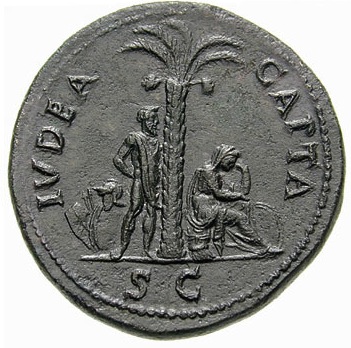
Iudaea capta reverse of Vespasian sestertius
CNG coins. · CC BY-SA 2.5 · Wikimedia Commons
Chapter 2: The Iconography — the Captive Beneath the Palm Tree
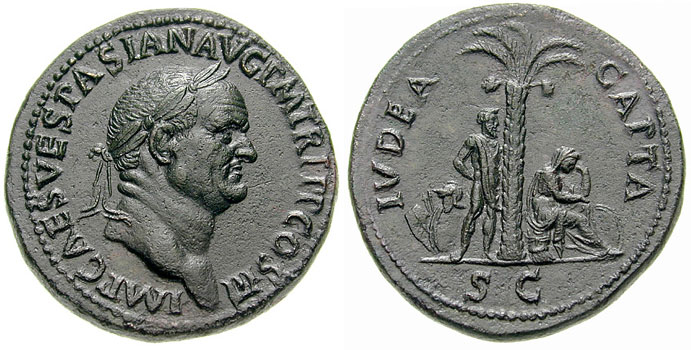
The image that made this series famous is remarkably economical in its means and powerfully symbolic in its impact. The reverse depicts the conquered province in the guise of a stricken human figure. The reverse of the coins may show a woman seated on the right in an attitude of mourning at the foot of a palm tree, accompanied either by a bearded captive man standing on the left, his hands bound behind his back, or by the standing figure of the victorious emperor, or by the goddess Victoria, with a trophy of arms, shields and helmets on the left. [Wikipedia, « Judaea Capta coinage »]
Each element of this composition carries a coded value. The date palm was, in the Greco-Roman imagination, the emblematic tree of Judaea and the region: it immediately signals the territory concerned, without the need for a map or an explanatory inscription. The seated woman, veiled, her head resting on her hand, takes up an ancient iconographic type of provincial personification and mourning; she embodies Judaea herself, reduced to powerlessness. The bearded male captive, his hands bound, reinforces this message by giving it a more directly military dimension: he evokes the mass of prisoners and slaves produced by the war. By contrast, the figures of the triumphant emperor or of winged Victory, standing near the trophy of arms, express the active and glorious face of the conquest.
On the epigraphic level, the formula IVDAEA CAPTA — sometimes in variants such as IVDAEA or IVDAEA DEVICTA — sums it all up. At the bottom of some coins appear the initials SC, which stand for Senatus consulto, "by decree of the Senate." [Wikipedia, « Judaea Capta coinage »] This mention, traditional on bronze coinage, recalls the institutional fiction according to which the issuance of copper currency fell under the authority of the Roman Senate. On gold and silver pieces, by contrast, it is the portrait of the emperor, accompanied by his titulature, that occupies the obverse and embodies the issuing authority.
Versions (1)
- v1 · current · Jun 19, 2026
Chapter 3: Variants, Metals, and Workshops
The "Iudaea Capta" series is not a single piece but a genuine typological ensemble, issued across several metals and according to numerous iconographic schemes. Many variants of this coinage exist. [Wikipedia, "Judaea Capta coinage"] The strikes span the entire Roman monetary system: gold coins (aurei), silver coins (denarii) and, above all, large bronzes—sesterces, dupondii and asses—which offered the broadest surface for compositions and reached the widest public. The bronze sesterces, by their imposing format, remain the most spectacular and most sought-after pieces of the series.
The issue extended well beyond the reign of Vespasian alone. Inaugurated under the latter, the series was continued by his two sons and successors, Titus and then Domitian, prolonging the celebration of the Flavian victory for roughly a quarter of a century, until the end of the first century [Encyclopaedia Judaica]. This longevity attests to the importance the dynasty attached to this theme as a foundation of its legitimacy: the conquest of Judaea was not a fleeting event but a dynastic argument sustained from reign to reign.
From the standpoint of the mints, the bulk of the production came from the mint of Rome, the heart of the system. However, issues connected to the same theme were also struck in the eastern region, notably at Caesarea Maritima in Judaea and at Antioch, sometimes with legends in Greek adapted to the local public. This diffusion, at once central and provincial, gave the message a reach across the entire Empire, from the Roman Forum to the Levantine margins where the war had just been waged.
Versions (1)
- v1 · current · Jun 19, 2026

Sestertius - Vespasiano - Iudaea Capta-RIC 0424
CNG · CC BY-SA 3.0 · Wikimedia Commons
Chapter 4: The Ideological Function — Coinage as Propaganda
Beyond their fiduciary value, the "Iudaea Capta" coins constitute an instrument of political communication of formidable effectiveness. In a world where images circulated little, the coin was one of the few truly universal visual media: every commercial transaction, every wage paid to a soldier, became an occasion for the silent diffusion of the imperial message. To strike the Judaean victory on coinage was to render it omnipresent, ordinary, and incontestable [Encyclopaedia Judaica].
The message served several ends simultaneously. First, it glorified the new dynasty: by associating their name and effigy with the triumph over Judaea, Vespasian, Titus, and Domitian presented themselves as the restorers of Roman order and grandeur after the turmoil of the civil war. It then affirmed the omnipotence of Rome in the face of a people who had revolted, transforming an operation of provincial repression into a major victory worthy of the greatest conquests. The visual rhetoric — the province reduced to a weeping woman and a chained captive — illustrated without ambiguity the fate reserved for all insubordination.
It is appropriate, however, to qualify the modern notion of "propaganda," anachronistic if understood in the contemporary sense of an organized manipulation of the masses. Roman coinage belonged more to a self-representation of power, a ritual and religious affirmation of imperial legitimacy and the favor of the gods, than to a targeted campaign. Nevertheless, the practical effect — the lasting imprinting of the collective imagination by the image of a vanquished Judaea — was indeed real, and it is precisely this symbolic charge that would, centuries later, make the series an object of memorial reappropriation.
Versions (1)
- v1 · current · Jun 19, 2026
Chapter 5: A Jewish Reading and the Memorial Posterity
For the Jewish world, the "Iudaea Capta" series occupies a singular and painful place: it is the image the victor forged of the defeat, the Roman mirror of a catastrophe—the destruction of the Temple—which has structured Jewish memory and liturgy ever since. Where the Jewish tradition developed, in rabbinic literature and the commemoration of the 9th of Av, the narrative of mourning and exile, Roman coinage offers the material and adverse counterpart: the same catastrophe seen, celebrated, and fixed by the one who inflicted it. It is at this point that transmitted Memory and the material archive answer one another, confirming each other while radically opposing each other in point of view.
This ambivalence explains the later fortune of the motif. In the twentieth century, the founding of the State of Israel in 1948 gave rise to a deliberate reversal of the ancient imagery. Israeli medals and stamps took up and inverted the figure of the captive: to the woman bowed beneath the palm tree answered an uplifted figure, celebrating the national rebirth under formulas such as "Israel Liberated" [Encyclopaedia Judaica]. This dialogue of image to image across nearly two millennia constitutes one of the most striking examples of the memorial reappropriation of a heritage object: the instrument of Roman triumph became the overturned symbol of a recovered continuity.
Historical caution here requires distinguishing the registers. The existence and iconography of the ancient coins belong to the established archive; the meaning that successive generations attributed to them—mourning, resistance, rebirth—belongs to Memory and interpretation. It is in the tension between these two orders that the object unfolds all its richness for the historian of the Jewish world and its diasporas.
Versions (1)
- v1 · current · Jun 19, 2026
Conclusion
The "Iudaea Capta" series is far more than a set of ancient coins: it is a document, a monument, and a palimpsest. A document, because it attests, in metal struck by power itself, to the event of 70 and the central place it held in the legitimation of the Flavian dynasty. A monument, because its iconography — the mourning captive beneath the palm tree, the trophy of arms, the lapidary legend — fixed for centuries a canonical representation of victory and submission. A palimpsest, finally, because that same motif could be turned around, millennia later, to serve a narrative of liberation.
For the historian of the Jewish world, these coins embody an essential truth: the memory of a catastrophe is transmitted not only through the texts of the vanquished, but also, in negative, through the triumphal images of the victors. To read the "Iudaea Capta" series is to learn to look upon a defeat through the eyes of the one who inflicted it — and to measure, in the gap between that image and Jewish memory, all the distance that separates the archive from what men make of it.
Versions (1)
- v1 · current · Jun 19, 2026
Features
- Provenance
- Empire romain
Bibliography
- Mireille Hadas-Lebel, Rome, la Judée et les Juifs (2009)
- Seth Schwartz, Imperialism and Jewish Society, 200 B.C.E. to 640 C.E. (2001)